Academic Year 2018-19
By: Shilpa Mishra
Discrimination Between Transformer Inrush
Current and Internal Fault using Combined
DFT-ANN Approach
IIT JODHPUR
Introduction to Transformer Protection
 Modern power transformer : most vital element of EPS.
 Protection is critical : key issue is the false tripping of relay
due to such operating conditions for which tripping is not
required at all.
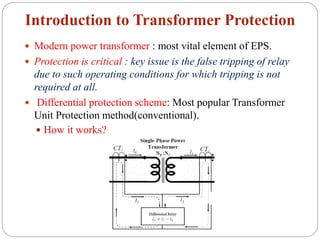
 Differential protection scheme: Most popular Transformer
Unit Protection method(conventional).
 How it works?
Cont.....
Under 3 cases-
1. Internal fault: Differential current in O.C.
initiation of trip signalC.B. isolates
Transformer. (NO issue except sensitivity)
2. External faults: Differential relay must not send
trip signal for this. (Issue arises during heavy
external fault leading false trip due to CTs
mismatch/ saturation)
3. Abnormal operating conditions: Differential
relay must not send trip signal for this. Ex.
Magnetising inrush current, over excitation,
online tap changing.
Magnetising Inrush Current?
 A high magnitude and of high frequency
transient current in primary of CT during start-
up of transformer causing a significant amount
of differential current in operating coil of relay
leading false trip.
 Inrush current is assumed to be rich in 2nd
harmonic compared to other harmonics;
exceeding 10-15% of fundament frequency
component present.
Note: internal fault is supposed to be rich in 3rd
and 5th (odd) harmonic components.
Motivation
 Difficulties: Differential Protection Scheme
 CTs Mismatch and saturation during heavy
external faults.
 Over-excitation of transformer
 Magnetizing inrush current during initial
energization.
 False tripping/ mal-operation of
transformer
How to overcome False Tripping ?
A. Percentage Biased Differential Scheme:
Applicable for initial 2 difficulties mentioned
above.
B. To Compensate for Inrush Induced Differential
Current:
i. Desensitize the relay during starting or add
time delay.
ii. Harmonic Restraint Relay: Designed to restrain
operation as long as the 2nd harmonic current
component exceeds 15% of the fundamental.
(characteristic of inrush current: presumed)
 To get reliable operation by HRR based differential
scheme several computer based digital signal
processing and pattern recognition techniques are
being used for inrush harmonic detection and
isolation; like-
 DFT and STFT
 FFT
 CWT and DWT
 Hilbert Transform
 ANN
 Fuzzy etc
 Fourier analysis based transform gives high
frequency resolution but zero time resolution
hence suitable for stationary signal.
 Solution is STFT: uses fixed size of time window
for all the frequencies, which restricts the
flexibility (High frequency resolution needs short
time window and vice-versa).
 Wavelet transform: a powerful tool for achieving
both time and frequency resolution with
adjustable and movable window : Multi-
Resolution Analysis (MRA) provided by WT.
Proposed Protection Algorithm
• SHR= I2/I1; Using Fourier
approach
• If the SHR> set value,
Output of ANN=0, No tripping
(Inrush current condition)
• If the SHR< set value,
Output of ANN=1,Tripping is
issued (internal fault condition)
 Here technique used to discriminate a magnetizing inrush
current from an internal-fault current is based on
combined DFT and ANN application.
 A full-cycle DFT is firstly applied as a preprocessing
module to extract distinctive features namely the
magnitudes of the fundamental and second harmonic
frequency components I1 and I2 respectively from
transient differential phase currents for each of the
phases a, b, and c.
 These features are then used to calculate the Second
Harmonic Ratio;
SHR= I2/I1
 Secondly, the three SHRs are fed to an ANN which is
already trained for classifying that transient phenomenon
into either magnetizing inrush or internal-fault current.
 The task of the ANN unit is to develop a block signal
Calculation of Second Harmonic Ratio using DFT
 Let the current waveform is sampled at N samples per
period of the fundamental(50Hz) denoted by ik . Here
N=20 is taken so fs = 1000Hz
 The real and imaginary parts of the nth harmonic current In
(an and bn) can be thus calculated as,
• The result are being updated iteratively each time a new sample
is available,
Here current sampling starts at rth
sample
NEURAL NETWORK TRAINING
 Here a 3-layer feed-forward ANN is considered for
this study
 The input layer has 3 neurons. The output layer has
one neuron which gives a binary output of 0 or 1.
 The number of neurons in hidden layers is problem-
based. (based on trade-off between the speed and
accuracy).
Cont...
 The process of determining the weights by
adapting its value iteratively to reduce the error Ep
is called training process.
 The Mean Squared Error (MSE) is used as a
performance criterion in this work.
 To train the proposed ANN a total of 1500
simulations of inrush and internal-fault currents
have been generated on-line as training and testing
patterns by MATLab simulation over a wide range
of inception angles α (0o-180o).
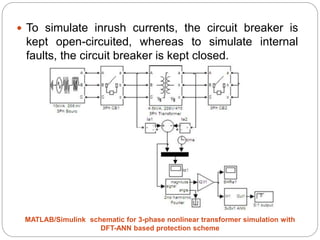
 To simulate inrush currents, the circuit breaker is
kept open-circuited, whereas to simulate internal
faults, the circuit breaker is kept closed.
MATLAB/Simulink schematic for 3-phase nonlinear transformer simulation with
DFT-ANN based protection scheme
 The ANN can be trained using Back propagation
(BP), Newton’s method, Steepest Descent (SD)
or LM algorithm with log-sigmoid transfer
functions in hidden and output layers.
 the LM algorithm is widely accepted as the most
efficient training algorithm in the sense of
realization accuracy among all.
 In this study, ANN has been trained using the LM
learning algorithm.
Results and Discussion
Training: 10 cycles of simulated inrush current, at α=0o and its
Harmonic spectrum
Training: 10 cycles of simulated inrush current, at α=90o and its
Harmonic spectrum
Training : 10 cycles of simulated 3-phase fault current, at α=0o and its
Harmonic spectrum
Training: 10 cycles of simulated 3-phase fault current, at α=90o and its
Harmonic spectrum
 These signals are used to extract SHR of the three
phases (SHRa, SHRb and SHRc) over a 10-cycle transient
current at 0o, 30o, 60o, 90o, 120o, 150o and 180o inception
angles as offline training data inputs.
(Phase
a)
Inrush current Internal Fault current
Phase c
Phase b
• From several tests it was found that an ANN of 3
neurons in the hidden layer is a good choice. It leads to an
MSE<1e-6 in 11 epochs.
• The ANN is trained off-line. Once the desired
performance is achieved, the weights of the ANN are
frozen.
MSE training convergence of the proposed (3-
3-1) ANN
Training performance: NN output
for actual and target patterns of
phase a
(Phase
a)
Inrush current Internal Fault current
• Testing performance of the ANN : 800 input-output
testing patterns representing inrush and internal-fault
transients at inception angles (15o, 45o, 75o, 105o, 135o
and 165o) are examined.
• The testing stage simulations illustrate the efficiency of the
proposed ANN. It can be seen that almost 100% of the 800 tested
inrush and fault patterns have been successfully classified.
(Phase
c)
(Phase b)(Phase
a)
Conclusion
 An ANN has been developed based on the SHR has for
inrush and internal-fault current discrimination.
 The ANN has been trained using LM algorithm to generate
a “no trip” (0) or “trip” (1) output signal according to the
values of the SHR that are extracted from the transient
differential current detected by the differential relay.
 The SHR has been calculated by DFT based harmonic
analysis.
 Performance of the given ANN-based discriminator is
reliable and very encouraging.
 Simulation results show that the proposed ANN is able to
classify current transients that have not been exposed to
during the training phase.
REFERENCES
[1] L. G. Perez, J. Fleching, J. L. Meador, and Z. Obradovic, “Training an artificial
neural network to
discriminate between magnetizing inrush and internal faults,” IEEE Trans. Power
Delivery, vol. 9,
no. 1, pp. 434-441, 1994.
[2] P. Bastard, M. Meunier, and H. Regal, “Neural-network-based algorithm for
power transformer
differential relays,” IEE Proc. Generation, Transmission and Distribution, vol. 142,
no. 4, pp.
386-392, 1995.
[3] P. L. Mao and R. J. Aggarwal, “A novel approach to the classification of the
transient phenomena
in power transformers using combined wavelet transform and neural network,” IEEE
Trans.
Power Delivery, vol. 16, no. 4, pp. 654-660, 2001.
[4] J. Piher, B. Grcar, and D. Dolinar, “Improved operation of power transformer
protection using
artificial neural network,” IEEE Trans. Power Delivery, vol. 12, no. 3, pp. 1128-1136,
1997.
[5] Z. Moravej, D. N. Vishwakarma, and S. P. Singh, “ANN-based protection scheme
for power

Transformer protection from inrush currents: Discrimination of internal fault current from inrush currents using DFT ANN approach

  • 1.
    Academic Year 2018-19 By:Shilpa Mishra Discrimination Between Transformer Inrush Current and Internal Fault using Combined DFT-ANN Approach IIT JODHPUR
  • 2.
    Introduction to TransformerProtection  Modern power transformer : most vital element of EPS.  Protection is critical : key issue is the false tripping of relay due to such operating conditions for which tripping is not required at all.  Differential protection scheme: Most popular Transformer Unit Protection method(conventional).  How it works?
  • 3.
    Cont..... Under 3 cases- 1.Internal fault: Differential current in O.C. initiation of trip signalC.B. isolates Transformer. (NO issue except sensitivity) 2. External faults: Differential relay must not send trip signal for this. (Issue arises during heavy external fault leading false trip due to CTs mismatch/ saturation) 3. Abnormal operating conditions: Differential relay must not send trip signal for this. Ex. Magnetising inrush current, over excitation, online tap changing.
  • 4.
    Magnetising Inrush Current? A high magnitude and of high frequency transient current in primary of CT during start- up of transformer causing a significant amount of differential current in operating coil of relay leading false trip.  Inrush current is assumed to be rich in 2nd harmonic compared to other harmonics; exceeding 10-15% of fundament frequency component present. Note: internal fault is supposed to be rich in 3rd and 5th (odd) harmonic components.
  • 5.
    Motivation  Difficulties: DifferentialProtection Scheme  CTs Mismatch and saturation during heavy external faults.  Over-excitation of transformer  Magnetizing inrush current during initial energization.  False tripping/ mal-operation of transformer
  • 6.
    How to overcomeFalse Tripping ? A. Percentage Biased Differential Scheme: Applicable for initial 2 difficulties mentioned above. B. To Compensate for Inrush Induced Differential Current: i. Desensitize the relay during starting or add time delay. ii. Harmonic Restraint Relay: Designed to restrain operation as long as the 2nd harmonic current component exceeds 15% of the fundamental. (characteristic of inrush current: presumed)
  • 7.
     To getreliable operation by HRR based differential scheme several computer based digital signal processing and pattern recognition techniques are being used for inrush harmonic detection and isolation; like-  DFT and STFT  FFT  CWT and DWT  Hilbert Transform  ANN  Fuzzy etc
  • 8.
     Fourier analysisbased transform gives high frequency resolution but zero time resolution hence suitable for stationary signal.  Solution is STFT: uses fixed size of time window for all the frequencies, which restricts the flexibility (High frequency resolution needs short time window and vice-versa).  Wavelet transform: a powerful tool for achieving both time and frequency resolution with adjustable and movable window : Multi- Resolution Analysis (MRA) provided by WT.
  • 9.
    Proposed Protection Algorithm •SHR= I2/I1; Using Fourier approach • If the SHR> set value, Output of ANN=0, No tripping (Inrush current condition) • If the SHR< set value, Output of ANN=1,Tripping is issued (internal fault condition)
  • 10.
     Here techniqueused to discriminate a magnetizing inrush current from an internal-fault current is based on combined DFT and ANN application.  A full-cycle DFT is firstly applied as a preprocessing module to extract distinctive features namely the magnitudes of the fundamental and second harmonic frequency components I1 and I2 respectively from transient differential phase currents for each of the phases a, b, and c.  These features are then used to calculate the Second Harmonic Ratio; SHR= I2/I1  Secondly, the three SHRs are fed to an ANN which is already trained for classifying that transient phenomenon into either magnetizing inrush or internal-fault current.  The task of the ANN unit is to develop a block signal
  • 11.
    Calculation of SecondHarmonic Ratio using DFT  Let the current waveform is sampled at N samples per period of the fundamental(50Hz) denoted by ik . Here N=20 is taken so fs = 1000Hz  The real and imaginary parts of the nth harmonic current In (an and bn) can be thus calculated as, • The result are being updated iteratively each time a new sample is available, Here current sampling starts at rth sample
  • 12.
    NEURAL NETWORK TRAINING Here a 3-layer feed-forward ANN is considered for this study  The input layer has 3 neurons. The output layer has one neuron which gives a binary output of 0 or 1.  The number of neurons in hidden layers is problem- based. (based on trade-off between the speed and accuracy).
  • 13.
    Cont...  The processof determining the weights by adapting its value iteratively to reduce the error Ep is called training process.  The Mean Squared Error (MSE) is used as a performance criterion in this work.  To train the proposed ANN a total of 1500 simulations of inrush and internal-fault currents have been generated on-line as training and testing patterns by MATLab simulation over a wide range of inception angles α (0o-180o).
  • 14.
     To simulateinrush currents, the circuit breaker is kept open-circuited, whereas to simulate internal faults, the circuit breaker is kept closed. MATLAB/Simulink schematic for 3-phase nonlinear transformer simulation with DFT-ANN based protection scheme
  • 15.
     The ANNcan be trained using Back propagation (BP), Newton’s method, Steepest Descent (SD) or LM algorithm with log-sigmoid transfer functions in hidden and output layers.  the LM algorithm is widely accepted as the most efficient training algorithm in the sense of realization accuracy among all.  In this study, ANN has been trained using the LM learning algorithm.
  • 16.
    Results and Discussion Training:10 cycles of simulated inrush current, at α=0o and its Harmonic spectrum
  • 17.
    Training: 10 cyclesof simulated inrush current, at α=90o and its Harmonic spectrum
  • 18.
    Training : 10cycles of simulated 3-phase fault current, at α=0o and its Harmonic spectrum
  • 19.
    Training: 10 cyclesof simulated 3-phase fault current, at α=90o and its Harmonic spectrum
  • 20.
     These signalsare used to extract SHR of the three phases (SHRa, SHRb and SHRc) over a 10-cycle transient current at 0o, 30o, 60o, 90o, 120o, 150o and 180o inception angles as offline training data inputs. (Phase a) Inrush current Internal Fault current
  • 21.
  • 22.
    • From severaltests it was found that an ANN of 3 neurons in the hidden layer is a good choice. It leads to an MSE<1e-6 in 11 epochs. • The ANN is trained off-line. Once the desired performance is achieved, the weights of the ANN are frozen. MSE training convergence of the proposed (3- 3-1) ANN Training performance: NN output for actual and target patterns of phase a
  • 23.
    (Phase a) Inrush current InternalFault current • Testing performance of the ANN : 800 input-output testing patterns representing inrush and internal-fault transients at inception angles (15o, 45o, 75o, 105o, 135o and 165o) are examined.
  • 24.
    • The testingstage simulations illustrate the efficiency of the proposed ANN. It can be seen that almost 100% of the 800 tested inrush and fault patterns have been successfully classified. (Phase c) (Phase b)(Phase a)
  • 25.
    Conclusion  An ANNhas been developed based on the SHR has for inrush and internal-fault current discrimination.  The ANN has been trained using LM algorithm to generate a “no trip” (0) or “trip” (1) output signal according to the values of the SHR that are extracted from the transient differential current detected by the differential relay.  The SHR has been calculated by DFT based harmonic analysis.  Performance of the given ANN-based discriminator is reliable and very encouraging.  Simulation results show that the proposed ANN is able to classify current transients that have not been exposed to during the training phase.
  • 26.
    REFERENCES [1] L. G.Perez, J. Fleching, J. L. Meador, and Z. Obradovic, “Training an artificial neural network to discriminate between magnetizing inrush and internal faults,” IEEE Trans. Power Delivery, vol. 9, no. 1, pp. 434-441, 1994. [2] P. Bastard, M. Meunier, and H. Regal, “Neural-network-based algorithm for power transformer differential relays,” IEE Proc. Generation, Transmission and Distribution, vol. 142, no. 4, pp. 386-392, 1995. [3] P. L. Mao and R. J. Aggarwal, “A novel approach to the classification of the transient phenomena in power transformers using combined wavelet transform and neural network,” IEEE Trans. Power Delivery, vol. 16, no. 4, pp. 654-660, 2001. [4] J. Piher, B. Grcar, and D. Dolinar, “Improved operation of power transformer protection using artificial neural network,” IEEE Trans. Power Delivery, vol. 12, no. 3, pp. 1128-1136, 1997. [5] Z. Moravej, D. N. Vishwakarma, and S. P. Singh, “ANN-based protection scheme for power