Analyzing Stream ConditionAnalyzing Stream Condition
Using EMAP Algae DataUsing EMAP Algae Data
By Nick Paretti
ARIZONA PHYCOLOGY
ECOL 475
U.S. Environmental Protection AgencyU.S. Environmental Protection Agency
Environmental Monitoring and AssessmentEnvironmental Monitoring and Assessment
Program (EMAP)Program (EMAP)
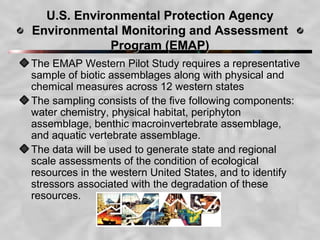
The EMAP Western Pilot Study requires a representative
sample of biotic assemblages along with physical and
chemical measures across 12 western states
The sampling consists of the five following components:
water chemistry, physical habitat, periphyton
assemblage, benthic macroinvertebrate assemblage,
and aquatic vertebrate assemblage.
The data will be used to generate state and regional
scale assessments of the condition of ecological
resources in the western United States, and to identify
stressors associated with the degradation of these
resources.
Questions to AnswerQuestions to Answer
EPA
What proportion of stream and river miles in the western U.S.
are in acceptable (or poor) biological condition?
What is the relative importance of potential stressors (habitat
modification, sedimentation, nutrients, temperature, grazing,
timber harvest, etc.) in streams and rivers across the West?
This project
Use a random subset of data (n=168)
Statistical analyses Oneway ANOVA and simple regression
Determine if algae can be used as an indicator of stream
condition
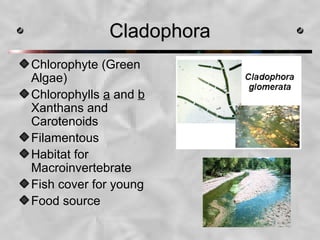
CladophoraCladophora
Chlorophyte (Green
Algae)
Chlorophylls a and b
Xanthans and
Carotenoids
Filamentous
Habitat for
Macroinvertebrate
Fish cover for young
Food source
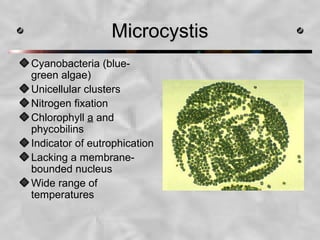
MicrocystisMicrocystis
Cyanobacteria (blue-
green algae)
Unicellular clusters
Nitrogen fixation
Chlorophyll a and
phycobilins
Indicator of eutrophication
Lacking a membrane-
bounded nucleus
Wide range of
temperatures
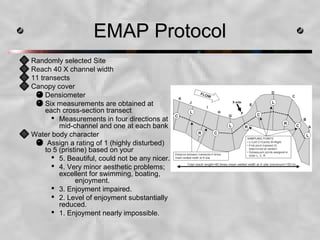
EMAP ProtocolEMAP Protocol
Randomly selected Site
Reach 40 X channel width
11 transects
Canopy cover
Densiometer
Six measurements are obtained at
each cross-section transect
 Measurements in four directions at
mid-channel and one at each bank
Water body character
Assign a rating of 1 (highly disturbed)
to 5 (pristine) based on your
 5. Beautiful, could not be any nicer.
 4. Very minor aesthetic problems;
excellent for swimming, boating,
enjoyment.
 3. Enjoyment impaired.
 2. Level of enjoyment substantially
reduced.
 1. Enjoyment nearly impossible.
Canopy CoverCanopy Cover
Riparian canopy cover
Stream temperatures
Shading / Light penetration
Inputs of coarse and fine particulate
organic material
Organic inputs are food for stream
organisms
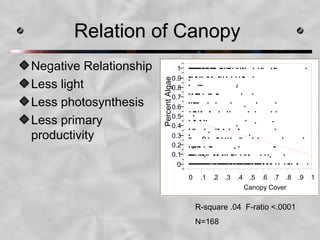
Relation of CanopyRelation of Canopy
Negative Relationship
Less light
Less photosynthesis
Less primary
productivity
0
0.1
0.2
0.3
0.4
0.5
0.6
0.7
0.8
0.9
1
PercentAlgae
0 .1 .2 .3 .4 .5 .6 .7 .8 .9 1
Canopy Cover
R-square .04 F-ratio <.0001
N=168
Dominant Land UseDominant Land Use
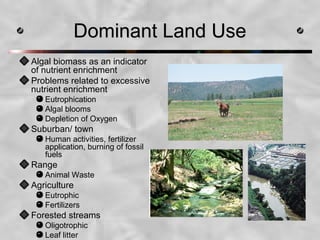
Algal biomass as an indicator
of nutrient enrichment
Problems related to excessive
nutrient enrichment
Eutrophication
Algal blooms
Depletion of Oxygen
Suburban/ town
Human activities, fertilizer
application, burning of fossil
fuels
Range
Animal Waste
Agriculture
Eutrophic
Fertilizers
Forested streams
Oligotrophic
Leaf litter
PercentAlgae
-0.1
0
0.1
0.2
0.3
0.4
0.5
0.6
0.7
0.8
0.9
1
1.1
Agriculture Forest Range Suburban/Town
Dominant Land use
PercentAlgae
-0.1
0
0.1
0.2
0.3
0.4
0.5
0.6
0.7
0.8
0.9
1
1.1
PercentAlgae
-0.1
0
0.1
0.2
0.3
0.4
0.5
0.6
0.7
0.8
0.9
1
1.1
Agriculture Forest Range Suburban/Town
Dominant Land use
Dominant Land UseDominant Land Use
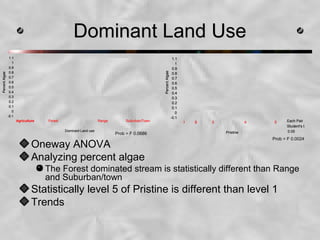
Oneway ANOVA
Analyzing percent algae
The Forest dominated stream is statistically different than Range
and Suburban/town
Statistically level 5 of Pristine is different than level 1
Trends
PercentAlgae
-0.1
0
0.1
0.2
0.3
0.4
0.5
0.6
0.7
0.8
0.9
1
1.1
1 2 3 4 5
Pristine
Each Pair
Student's t
0.05
PercentAlgae
-0.1
0
0.1
0.2
0.3
0.4
0.5
0.6
0.7
0.8
0.9
1
1.1
PercentAlgae
-0.1
0
0.1
0.2
0.3
0.4
0.5
0.6
0.7
0.8
0.9
1
1.1
1 2 3 4 5
Pristine
Each Pair
Student's t
0.05
Prob > F 0.0024
Prob > F 0.0686
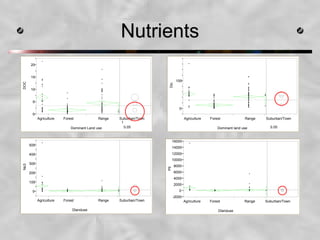
NutrientsNutrients
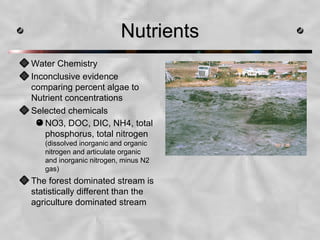
Water Chemistry
Inconclusive evidence
comparing percent algae to
Nutrient concentrations
Selected chemicals
NO3, DOC, DIC, NH4, total
phosphorus, total nitrogen
(dissolved inorganic and organic
nitrogen and articulate organic
and inorganic nitrogen, minus N2
gas)
The forest dominated stream is
statistically different than the
agriculture dominated stream
NutrientsNutrients
DOC
0
5
10
15
20
Agriculture Forest Range Suburban/Town
Dominant Land use
t
0.05
Dic
0
100
Agriculture Forest Range Suburban/Town
Dominant land use 0.05
Ptl
-2000
0
2000
4000
6000
8000
10000
12000
14000
16000
Agriculture Forest Range Suburban/Town
Dlanduse
No3
0
100
200
300
400
500
Agriculture Forest Range Suburban/Town
Dlanduse
Stream OrderStream Order
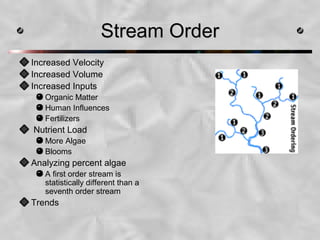
Increased Velocity
Increased Volume
Increased Inputs
Organic Matter
Human Influences
Fertilizers
Nutrient Load
More Algae
Blooms
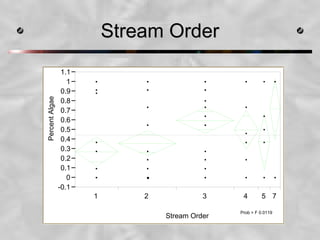
Analyzing percent algae
A first order stream is
statistically different than a
seventh order stream
Trends
Stream OrderStream Order
PercentAlgae
-0.1
0
0.1
0.2
0.3
0.4
0.5
0.6
0.7
0.8
0.9
1
1.1
1 2 3 4 5 7
Stream Order
Prob > F 0.0119
ConclusionsConclusions
Algae as a biological indicator
Identify algae
Identify stressors associated with the
degradation of stream habitat
Canopy Cover
Dominant Land use
Aesthetic appeal
Nutrients
Stream Order
Interpret the data and apply it to
vertebrate communities and
restoration
Produce unbiased estimates of the
ecological condition of surface waters
across a large geographic area (or
areas) of the West

Emap (1)

  • 1.
    Analyzing Stream ConditionAnalyzingStream Condition Using EMAP Algae DataUsing EMAP Algae Data By Nick Paretti ARIZONA PHYCOLOGY ECOL 475
  • 2.
    U.S. Environmental ProtectionAgencyU.S. Environmental Protection Agency Environmental Monitoring and AssessmentEnvironmental Monitoring and Assessment Program (EMAP)Program (EMAP) The EMAP Western Pilot Study requires a representative sample of biotic assemblages along with physical and chemical measures across 12 western states The sampling consists of the five following components: water chemistry, physical habitat, periphyton assemblage, benthic macroinvertebrate assemblage, and aquatic vertebrate assemblage. The data will be used to generate state and regional scale assessments of the condition of ecological resources in the western United States, and to identify stressors associated with the degradation of these resources.
  • 3.
    Questions to AnswerQuestionsto Answer EPA What proportion of stream and river miles in the western U.S. are in acceptable (or poor) biological condition? What is the relative importance of potential stressors (habitat modification, sedimentation, nutrients, temperature, grazing, timber harvest, etc.) in streams and rivers across the West? This project Use a random subset of data (n=168) Statistical analyses Oneway ANOVA and simple regression Determine if algae can be used as an indicator of stream condition
  • 4.
    CladophoraCladophora Chlorophyte (Green Algae) Chlorophylls aand b Xanthans and Carotenoids Filamentous Habitat for Macroinvertebrate Fish cover for young Food source
  • 5.
    MicrocystisMicrocystis Cyanobacteria (blue- green algae) Unicellularclusters Nitrogen fixation Chlorophyll a and phycobilins Indicator of eutrophication Lacking a membrane- bounded nucleus Wide range of temperatures
  • 6.
    EMAP ProtocolEMAP Protocol Randomlyselected Site Reach 40 X channel width 11 transects Canopy cover Densiometer Six measurements are obtained at each cross-section transect  Measurements in four directions at mid-channel and one at each bank Water body character Assign a rating of 1 (highly disturbed) to 5 (pristine) based on your  5. Beautiful, could not be any nicer.  4. Very minor aesthetic problems; excellent for swimming, boating, enjoyment.  3. Enjoyment impaired.  2. Level of enjoyment substantially reduced.  1. Enjoyment nearly impossible.
  • 7.
    Canopy CoverCanopy Cover Ripariancanopy cover Stream temperatures Shading / Light penetration Inputs of coarse and fine particulate organic material Organic inputs are food for stream organisms
  • 8.
    Relation of CanopyRelationof Canopy Negative Relationship Less light Less photosynthesis Less primary productivity 0 0.1 0.2 0.3 0.4 0.5 0.6 0.7 0.8 0.9 1 PercentAlgae 0 .1 .2 .3 .4 .5 .6 .7 .8 .9 1 Canopy Cover R-square .04 F-ratio <.0001 N=168
  • 9.
    Dominant Land UseDominantLand Use Algal biomass as an indicator of nutrient enrichment Problems related to excessive nutrient enrichment Eutrophication Algal blooms Depletion of Oxygen Suburban/ town Human activities, fertilizer application, burning of fossil fuels Range Animal Waste Agriculture Eutrophic Fertilizers Forested streams Oligotrophic Leaf litter
  • 10.
    PercentAlgae -0.1 0 0.1 0.2 0.3 0.4 0.5 0.6 0.7 0.8 0.9 1 1.1 Agriculture Forest RangeSuburban/Town Dominant Land use PercentAlgae -0.1 0 0.1 0.2 0.3 0.4 0.5 0.6 0.7 0.8 0.9 1 1.1 PercentAlgae -0.1 0 0.1 0.2 0.3 0.4 0.5 0.6 0.7 0.8 0.9 1 1.1 Agriculture Forest Range Suburban/Town Dominant Land use Dominant Land UseDominant Land Use Oneway ANOVA Analyzing percent algae The Forest dominated stream is statistically different than Range and Suburban/town Statistically level 5 of Pristine is different than level 1 Trends PercentAlgae -0.1 0 0.1 0.2 0.3 0.4 0.5 0.6 0.7 0.8 0.9 1 1.1 1 2 3 4 5 Pristine Each Pair Student's t 0.05 PercentAlgae -0.1 0 0.1 0.2 0.3 0.4 0.5 0.6 0.7 0.8 0.9 1 1.1 PercentAlgae -0.1 0 0.1 0.2 0.3 0.4 0.5 0.6 0.7 0.8 0.9 1 1.1 1 2 3 4 5 Pristine Each Pair Student's t 0.05 Prob > F 0.0024 Prob > F 0.0686
  • 11.
    NutrientsNutrients Water Chemistry Inconclusive evidence comparingpercent algae to Nutrient concentrations Selected chemicals NO3, DOC, DIC, NH4, total phosphorus, total nitrogen (dissolved inorganic and organic nitrogen and articulate organic and inorganic nitrogen, minus N2 gas) The forest dominated stream is statistically different than the agriculture dominated stream
  • 12.
    NutrientsNutrients DOC 0 5 10 15 20 Agriculture Forest RangeSuburban/Town Dominant Land use t 0.05 Dic 0 100 Agriculture Forest Range Suburban/Town Dominant land use 0.05 Ptl -2000 0 2000 4000 6000 8000 10000 12000 14000 16000 Agriculture Forest Range Suburban/Town Dlanduse No3 0 100 200 300 400 500 Agriculture Forest Range Suburban/Town Dlanduse
  • 13.
    Stream OrderStream Order IncreasedVelocity Increased Volume Increased Inputs Organic Matter Human Influences Fertilizers Nutrient Load More Algae Blooms Analyzing percent algae A first order stream is statistically different than a seventh order stream Trends
  • 14.
  • 15.
    ConclusionsConclusions Algae as abiological indicator Identify algae Identify stressors associated with the degradation of stream habitat Canopy Cover Dominant Land use Aesthetic appeal Nutrients Stream Order Interpret the data and apply it to vertebrate communities and restoration Produce unbiased estimates of the ecological condition of surface waters across a large geographic area (or areas) of the West