UNIVERSITÀDEGLI STUDI DI TORINO
THE USE OF INDEXES OF RIPARIAN VEGETATION STATUS
AND RIVER ECOLOGICAL FUNCTIONALITY TO SUPPORT
THE DORA BALTEA RIVER MANAGEMENT IN AOSTA
VALLEY (ITALY)
RELATORE: Prof.ssa Consolata Siniscalco
CO-RELATORE: Dott. Andrea Mammoliti Mochet (ARPA Valle d’Aosta)
CO-RELATORE: Dott. Giovanni Leonelli
Candidato: Mattia Ogliengo
Anno Accademico 2010 - 2011
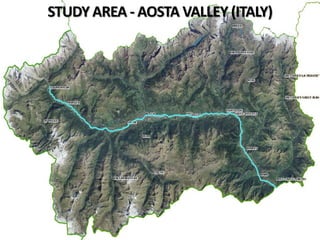
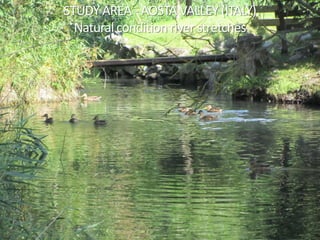
STUDY AREA - AOSTA VALLEY (ITALY)
Natural condition river stretches
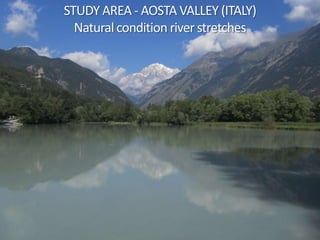
STUDY AREA - AOSTA VALLEY (ITALY)
Natural condition river stretches
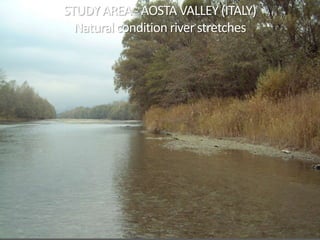
STUDY AREA - AOSTA VALLEY (ITALY)
Natural condition river stretches
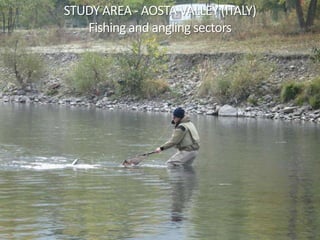
STUDY AREA - AOSTA VALLEY (ITALY)
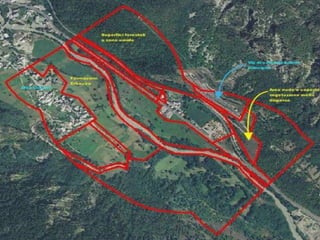
Fishing and angling sectors
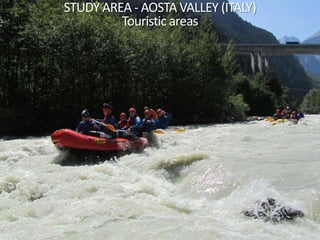
STUDY AREA - AOSTA VALLEY (ITALY)
Touristic areas
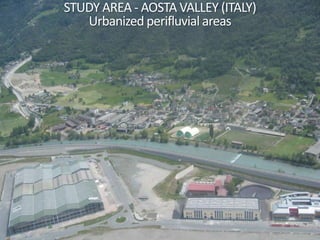
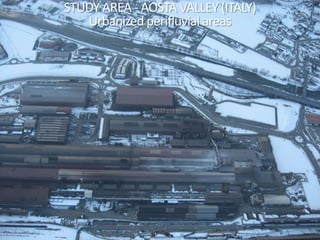
STUDY AREA - AOSTA VALLEY (ITALY)
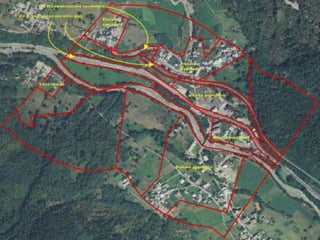
Urbanized perifluvial areas
STUDY AREA - AOSTA VALLEY (ITALY)
Urbanized perifluvial areas
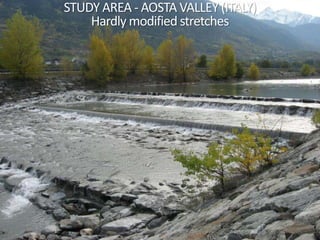
STUDY AREA - AOSTA VALLEY (ITALY)
Hardly modified stretches
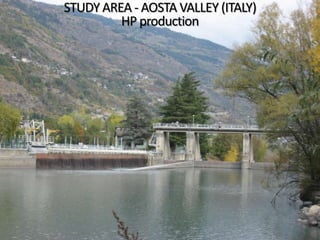
STUDY AREA - AOSTA VALLEY (ITALY)
HP production
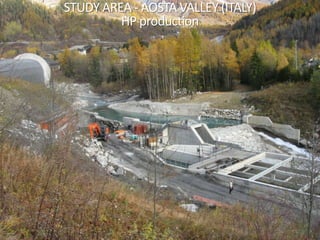
STUDY AREA - AOSTA VALLEY (ITALY)
HP production
Objectives of the thesis
1. Selection of methods able to assess the
natural capital represented by the Dora
Baltea river by aero photogrammetric
approach.
2. Determine which method fits better to IFF
index being less time and resources
consuming.
3. Define a new index (TH, TeleHybrid) based
on aero photogrammetric images and GIS
software.
Materials and methods
Indexes have been selected following the method
used by Abati and Leonelli (SHARE project, 2011)
in the “review of the most used and recent
methods at regional and local spatial scales”
• The index can be used in an Alpine context?
• Quantity of input data needed?
• Is it enforceable by an aerophotogrammetric
approach?
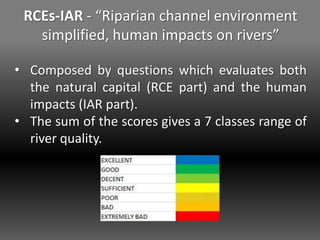
RCEs-IAR - “Riparian channel environment
simplified, human impacts on rivers”
• Composed by questions which evaluates both
the natural capital (RCE part) and the human
impacts (IAR part).
• The sum of the scores gives a 7 classes range of
river quality.
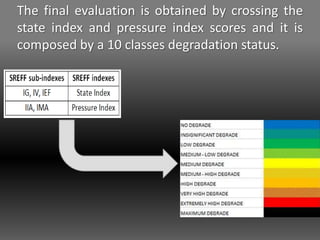
SREFF - “Method for the screening of the
ecosystem resources of the rivers”
• It is based on 5 sub indexes calculated in the
geo-informatic system concerning:
• the geo-morphology (Ig),
• the vegetation (Iv),
• the land cover (Ief) and the impacts (Iia)
on the perifluvial buffer,
• the modifications of the river bed (Ima).
The final evaluation is obtained by crossing the
state index and pressure index scores and it is
composed by a 10 classes degradation status.
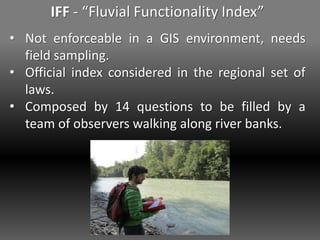
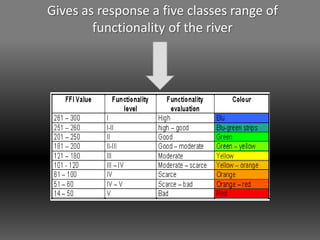
IFF - “Fluvial Functionality Index”
• Not enforceable in a GIS environment, needs
field sampling.
• Official index considered in the regional set of
laws.
• Composed by 14 questions to be filled by a
team of observers walking along river banks.
Gives as response a five classes range of
functionality of the river
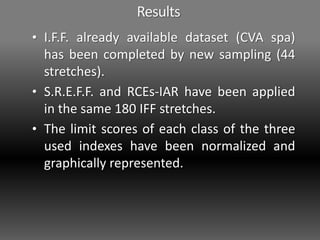
Results
• I.F.F. already available dataset (CVA spa)
has been completed by new sampling (44
stretches).
• S.R.E.F.F. and RCEs-IAR have been applied
in the same 180 IFF stretches.
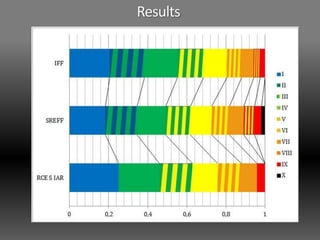
• The limit scores of each class of the three
used indexes have been normalized and
graphically represented.
Results
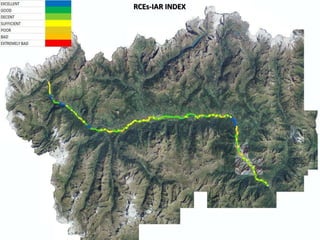
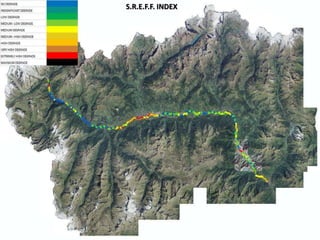
RCEs-IAR INDEX
S.R.E.F.F. INDEX
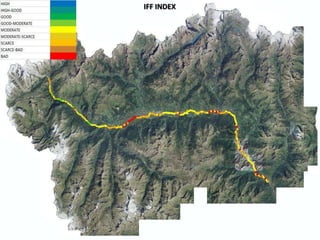
IFF INDEX
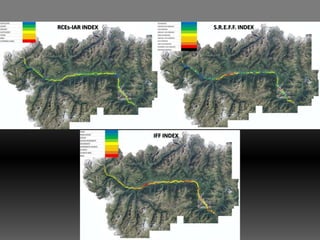
RCEs-IAR INDEX S.R.E.F.F. INDEX
IFF INDEX
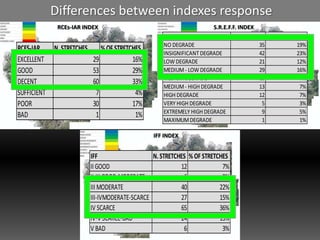
Differences between indexes response
RCEs-IAR INDEX S.R.E.F.F. INDEX
IFF INDEX
IFF N.STRETCHES % OF STRETCHES
II GOOD 12 7%
II-III GOOD-MODERATE 6 3%
III MODERATE 40 22%
III-IVMODERATE-SCARCE 27 15%
IV SCARCE 65 36%
IV-V SCARCE-BAD 24 13%
V BAD 6 3%
RCES-IAR N.STRETCHES %OFSTRETCHES
EXCELLENT 29 16%
GOOD 53 29%
DECENT 60 33%
SUFFICIENT 7 4%
POOR 30 17%
BAD 1 1%
SREFF N. STRETCHES % OF STRETCHES
NO DEGRADE 35 19%
INSIGNIFICANT DEGRADE 42 23%
LOW DEGRADE 21 12%
MEDIUM- LOW DEGRADE 29 16%
MEDIUMDEGRADE 13 7%
MEDIUM- HIGH DEGRADE 13 7%
HIGH DEGRADE 12 7%
VERY HIGH DEGRADE 5 3%
EXTREMELY HIGH DEGRADE 9 5%
MAXIMUMDEGRADE 1 1%
The TeleHybrid (TH) index creation
• A selection of sub-indexes of SREFF and
RCEs-IAR has been performed, followed by
an iterative process of fine tuning of the
associated weights.
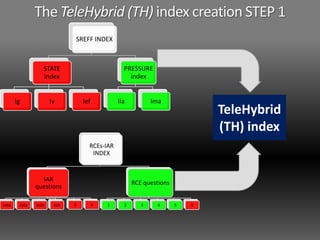
SREFF INDEX
STATE
index
Ig Iv Ief
PRESSURE
index
Iia Ima
RCEs-IAR
INDEX
IAR
questions
1abc 2abc 3abc 4ab 5 6
RCE questions
1 2 3 4 5 6
TeleHybrid
(TH) index
The TeleHybrid (TH) index creation STEP 1
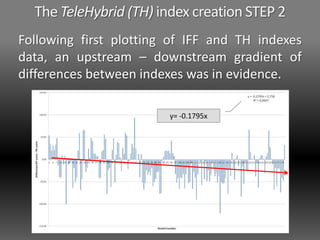
The TeleHybrid (TH) index creation STEP 2
Following first plotting of IFF and TH indexes
data, an upstream – downstream gradient of
differences between indexes was in evidence.
y= -0.1795x
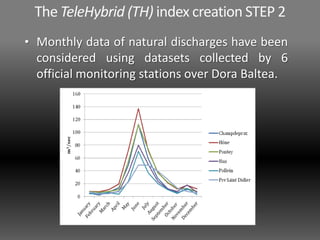
• Monthly data of natural discharges have been
considered using datasets collected by 6
official monitoring stations over Dora Baltea.
The TeleHybrid (TH) index creation STEP 2
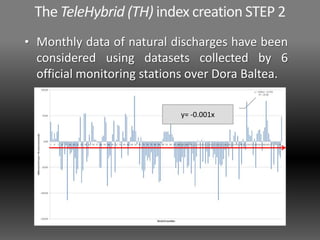
y= -0.001x
• Monthly data of natural discharges have been
considered using datasets collected by 6
official monitoring stations over Dora Baltea.
The TeleHybrid (TH) index creation STEP 2
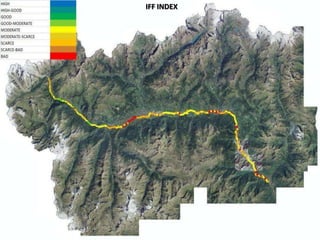
ResultsTH INDEXIFF INDEX
ResultsTH INDEX
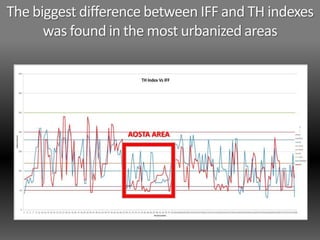
The biggest difference between IFF and TH indexes
was found in the most urbanized areas
AOSTA AREA
Results
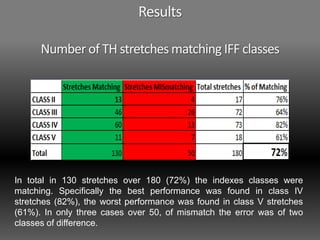
Number of TH stretches matching IFF classes
In total in 130 stretches over 180 (72%) the indexes classes were
matching. Specifically the best performance was found in class IV
stretches (82%), the worst performance was found in class V stretches
(61%). In only three cases over 50, of mismatch the error was of two
classes of difference.
Discussion
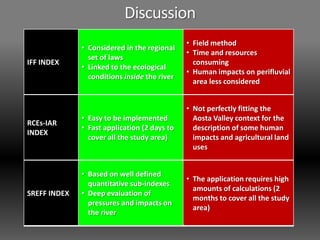
IFF INDEX
• Considered in the regional
set of laws
• Linked to the ecological
conditions inside the river
• Field method
• Time and resources
consuming
• Human impacts on perifluvial
area less considered
RCEs-IAR
INDEX
• Easy to be implemented
• Fast application (2 days to
cover all the study area)
• Not perfectly fitting the
Aosta Valley context for the
description of some human
impacts and agricultural land
uses
SREFF INDEX
• Based on well defined
quantitative sub-indexes
• Deep evaluation of
pressures and impacts on
the river
• The application requires high
amounts of calculations (2
months to cover all the study
area)
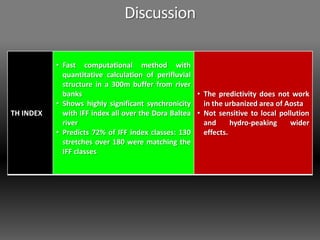
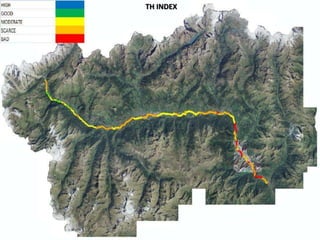
TH INDEX
• Fast computational method with
quantitative calculation of perifluvial
structure in a 300m buffer from river
banks
• Shows highly significant synchronicity
with IFF index all over the Dora Baltea
river
• Predicts 72% of IFF index classes: 130
stretches over 180 were matching the
IFF classes
• The predictivity does not work
in the urbanized area of Aosta
• Not sensitive to local pollution
and hydro-peaking wider
effects.
Discussion
Conclusions
This work has shown that by means of a aero-
photogrammetric approach it is possible to assess
72% of the stretches values obtained from a field
based index such as IFF, meaning that these
indexes respond in a similar way to changes in the
river ecosystem quality.
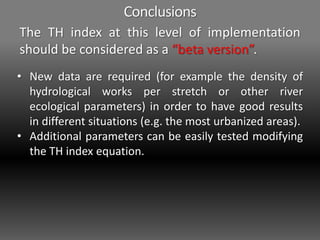
• New data are required (for example the density of
hydrological works per stretch or other river
ecological parameters) in order to have good results
in different situations (e.g. the most urbanized areas).
• Additional parameters can be easily tested modifying
the TH index equation.
Conclusions
The TH index at this level of implementation
should be considered as a “beta version”.
Conclusions
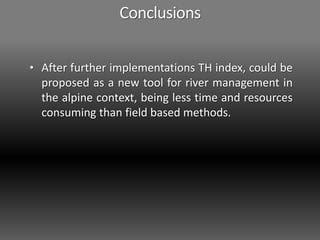
• After further implementations TH index, could be
proposed as a new tool for river management in
the alpine context, being less time and resources
consuming than field based methods.
THANK YOU FOR YOUR ATTENTION

The use of indexes of riparian vegetation status and river ecological functionality to support the Dora Baltea river management in Aosta Valley (Italy)

  • 1.
    UNIVERSITÀDEGLI STUDI DITORINO THE USE OF INDEXES OF RIPARIAN VEGETATION STATUS AND RIVER ECOLOGICAL FUNCTIONALITY TO SUPPORT THE DORA BALTEA RIVER MANAGEMENT IN AOSTA VALLEY (ITALY) RELATORE: Prof.ssa Consolata Siniscalco CO-RELATORE: Dott. Andrea Mammoliti Mochet (ARPA Valle d’Aosta) CO-RELATORE: Dott. Giovanni Leonelli Candidato: Mattia Ogliengo Anno Accademico 2010 - 2011
  • 2.
    STUDY AREA -AOSTA VALLEY (ITALY)
  • 3.
    STUDY AREA -AOSTA VALLEY (ITALY) Natural condition river stretches
  • 4.
    STUDY AREA -AOSTA VALLEY (ITALY) Natural condition river stretches
  • 5.
    STUDY AREA -AOSTA VALLEY (ITALY) Natural condition river stretches
  • 6.
    STUDY AREA -AOSTA VALLEY (ITALY) Fishing and angling sectors
  • 7.
    STUDY AREA -AOSTA VALLEY (ITALY) Touristic areas
  • 8.
    STUDY AREA -AOSTA VALLEY (ITALY) Urbanized perifluvial areas
  • 9.
    STUDY AREA -AOSTA VALLEY (ITALY) Urbanized perifluvial areas
  • 10.
    STUDY AREA -AOSTA VALLEY (ITALY) Hardly modified stretches
  • 11.
    STUDY AREA -AOSTA VALLEY (ITALY) HP production
  • 12.
    STUDY AREA -AOSTA VALLEY (ITALY) HP production
  • 13.
    Objectives of thethesis 1. Selection of methods able to assess the natural capital represented by the Dora Baltea river by aero photogrammetric approach. 2. Determine which method fits better to IFF index being less time and resources consuming. 3. Define a new index (TH, TeleHybrid) based on aero photogrammetric images and GIS software.
  • 14.
    Materials and methods Indexeshave been selected following the method used by Abati and Leonelli (SHARE project, 2011) in the “review of the most used and recent methods at regional and local spatial scales” • The index can be used in an Alpine context? • Quantity of input data needed? • Is it enforceable by an aerophotogrammetric approach?
  • 15.
    RCEs-IAR - “Riparianchannel environment simplified, human impacts on rivers” • Composed by questions which evaluates both the natural capital (RCE part) and the human impacts (IAR part). • The sum of the scores gives a 7 classes range of river quality.
  • 16.
    SREFF - “Methodfor the screening of the ecosystem resources of the rivers” • It is based on 5 sub indexes calculated in the geo-informatic system concerning: • the geo-morphology (Ig), • the vegetation (Iv), • the land cover (Ief) and the impacts (Iia) on the perifluvial buffer, • the modifications of the river bed (Ima).
  • 19.
    The final evaluationis obtained by crossing the state index and pressure index scores and it is composed by a 10 classes degradation status.
  • 20.
    IFF - “FluvialFunctionality Index” • Not enforceable in a GIS environment, needs field sampling. • Official index considered in the regional set of laws. • Composed by 14 questions to be filled by a team of observers walking along river banks.
  • 21.
    Gives as responsea five classes range of functionality of the river
  • 22.
    Results • I.F.F. alreadyavailable dataset (CVA spa) has been completed by new sampling (44 stretches). • S.R.E.F.F. and RCEs-IAR have been applied in the same 180 IFF stretches. • The limit scores of each class of the three used indexes have been normalized and graphically represented.
  • 23.
  • 24.
  • 25.
  • 26.
  • 27.
  • 28.
    Differences between indexesresponse RCEs-IAR INDEX S.R.E.F.F. INDEX IFF INDEX IFF N.STRETCHES % OF STRETCHES II GOOD 12 7% II-III GOOD-MODERATE 6 3% III MODERATE 40 22% III-IVMODERATE-SCARCE 27 15% IV SCARCE 65 36% IV-V SCARCE-BAD 24 13% V BAD 6 3% RCES-IAR N.STRETCHES %OFSTRETCHES EXCELLENT 29 16% GOOD 53 29% DECENT 60 33% SUFFICIENT 7 4% POOR 30 17% BAD 1 1% SREFF N. STRETCHES % OF STRETCHES NO DEGRADE 35 19% INSIGNIFICANT DEGRADE 42 23% LOW DEGRADE 21 12% MEDIUM- LOW DEGRADE 29 16% MEDIUMDEGRADE 13 7% MEDIUM- HIGH DEGRADE 13 7% HIGH DEGRADE 12 7% VERY HIGH DEGRADE 5 3% EXTREMELY HIGH DEGRADE 9 5% MAXIMUMDEGRADE 1 1%
  • 29.
    The TeleHybrid (TH)index creation • A selection of sub-indexes of SREFF and RCEs-IAR has been performed, followed by an iterative process of fine tuning of the associated weights.
  • 30.
    SREFF INDEX STATE index Ig IvIef PRESSURE index Iia Ima RCEs-IAR INDEX IAR questions 1abc 2abc 3abc 4ab 5 6 RCE questions 1 2 3 4 5 6 TeleHybrid (TH) index The TeleHybrid (TH) index creation STEP 1
  • 31.
    The TeleHybrid (TH)index creation STEP 2 Following first plotting of IFF and TH indexes data, an upstream – downstream gradient of differences between indexes was in evidence. y= -0.1795x
  • 32.
    • Monthly dataof natural discharges have been considered using datasets collected by 6 official monitoring stations over Dora Baltea. The TeleHybrid (TH) index creation STEP 2
  • 33.
    y= -0.001x • Monthlydata of natural discharges have been considered using datasets collected by 6 official monitoring stations over Dora Baltea. The TeleHybrid (TH) index creation STEP 2
  • 34.
  • 35.
  • 36.
    The biggest differencebetween IFF and TH indexes was found in the most urbanized areas AOSTA AREA
  • 37.
    Results Number of THstretches matching IFF classes In total in 130 stretches over 180 (72%) the indexes classes were matching. Specifically the best performance was found in class IV stretches (82%), the worst performance was found in class V stretches (61%). In only three cases over 50, of mismatch the error was of two classes of difference.
  • 38.
    Discussion IFF INDEX • Consideredin the regional set of laws • Linked to the ecological conditions inside the river • Field method • Time and resources consuming • Human impacts on perifluvial area less considered RCEs-IAR INDEX • Easy to be implemented • Fast application (2 days to cover all the study area) • Not perfectly fitting the Aosta Valley context for the description of some human impacts and agricultural land uses SREFF INDEX • Based on well defined quantitative sub-indexes • Deep evaluation of pressures and impacts on the river • The application requires high amounts of calculations (2 months to cover all the study area)
  • 39.
    TH INDEX • Fastcomputational method with quantitative calculation of perifluvial structure in a 300m buffer from river banks • Shows highly significant synchronicity with IFF index all over the Dora Baltea river • Predicts 72% of IFF index classes: 130 stretches over 180 were matching the IFF classes • The predictivity does not work in the urbanized area of Aosta • Not sensitive to local pollution and hydro-peaking wider effects. Discussion
  • 40.
    Conclusions This work hasshown that by means of a aero- photogrammetric approach it is possible to assess 72% of the stretches values obtained from a field based index such as IFF, meaning that these indexes respond in a similar way to changes in the river ecosystem quality.
  • 41.
    • New dataare required (for example the density of hydrological works per stretch or other river ecological parameters) in order to have good results in different situations (e.g. the most urbanized areas). • Additional parameters can be easily tested modifying the TH index equation. Conclusions The TH index at this level of implementation should be considered as a “beta version”.
  • 42.
    Conclusions • After furtherimplementations TH index, could be proposed as a new tool for river management in the alpine context, being less time and resources consuming than field based methods.
  • 43.
    THANK YOU FORYOUR ATTENTION