Health-related Web search habits A recent Belgian study
Presentation of the survey
Objectives Assess how Belgian people use Internet for Health-related information and pharma products purchase. On-line interview from the IPSOS Access Panel. 1000 respondents, representative for the national population aged 18-65 years. Methodology
Sample’s profile 18-34 Higher Upper FR Urban Non urban YES NO 35-54 55+ Male Female FL
Results
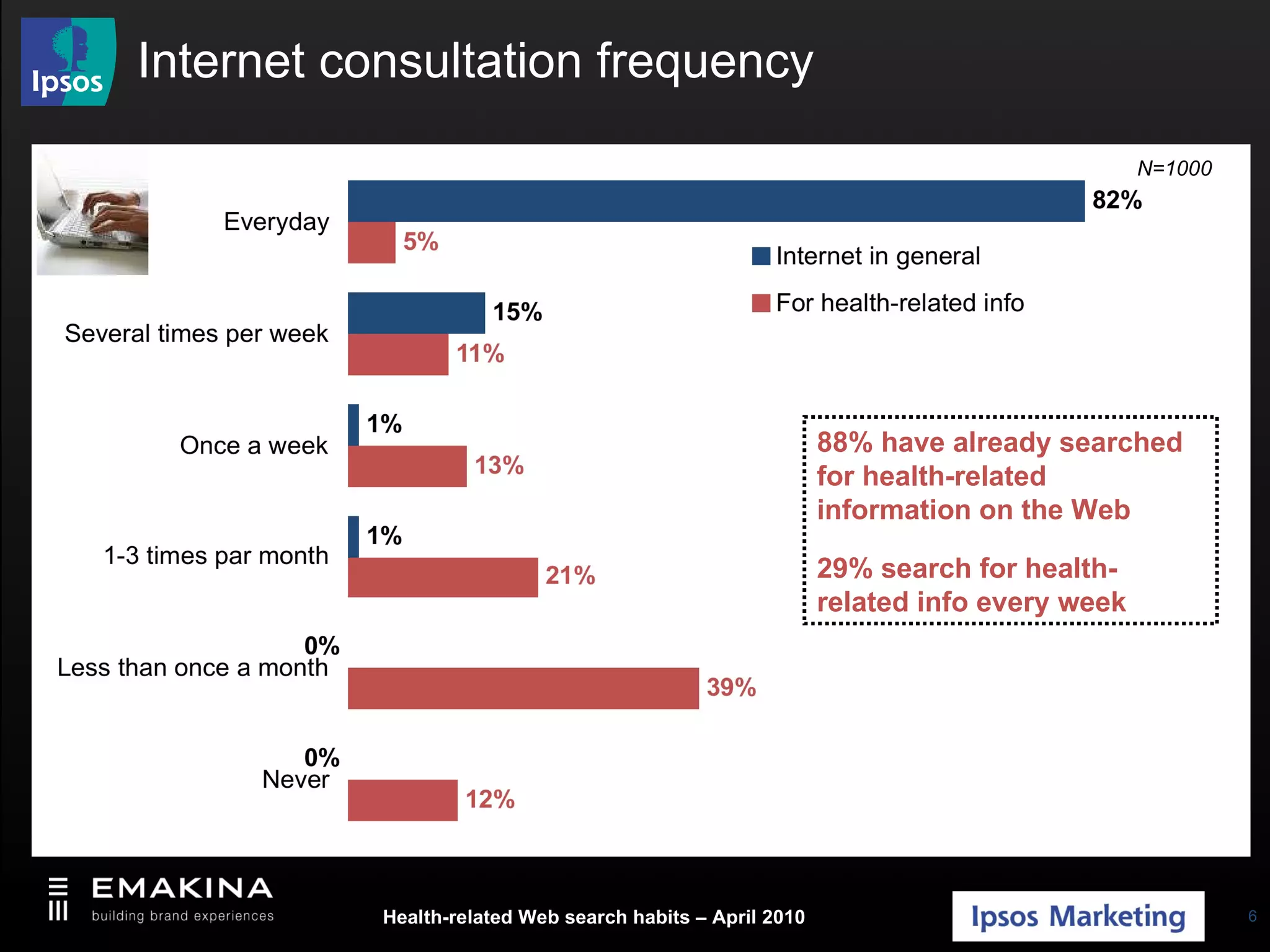
Internet consultation frequency 88% have already searched for health-related information on the Web 29% search for health-related info every week N=1000
Motivation to consult the Web for health-related info    First    Top 3 49% are primarily searching info about symptoms / problems they personally suffer from N=884
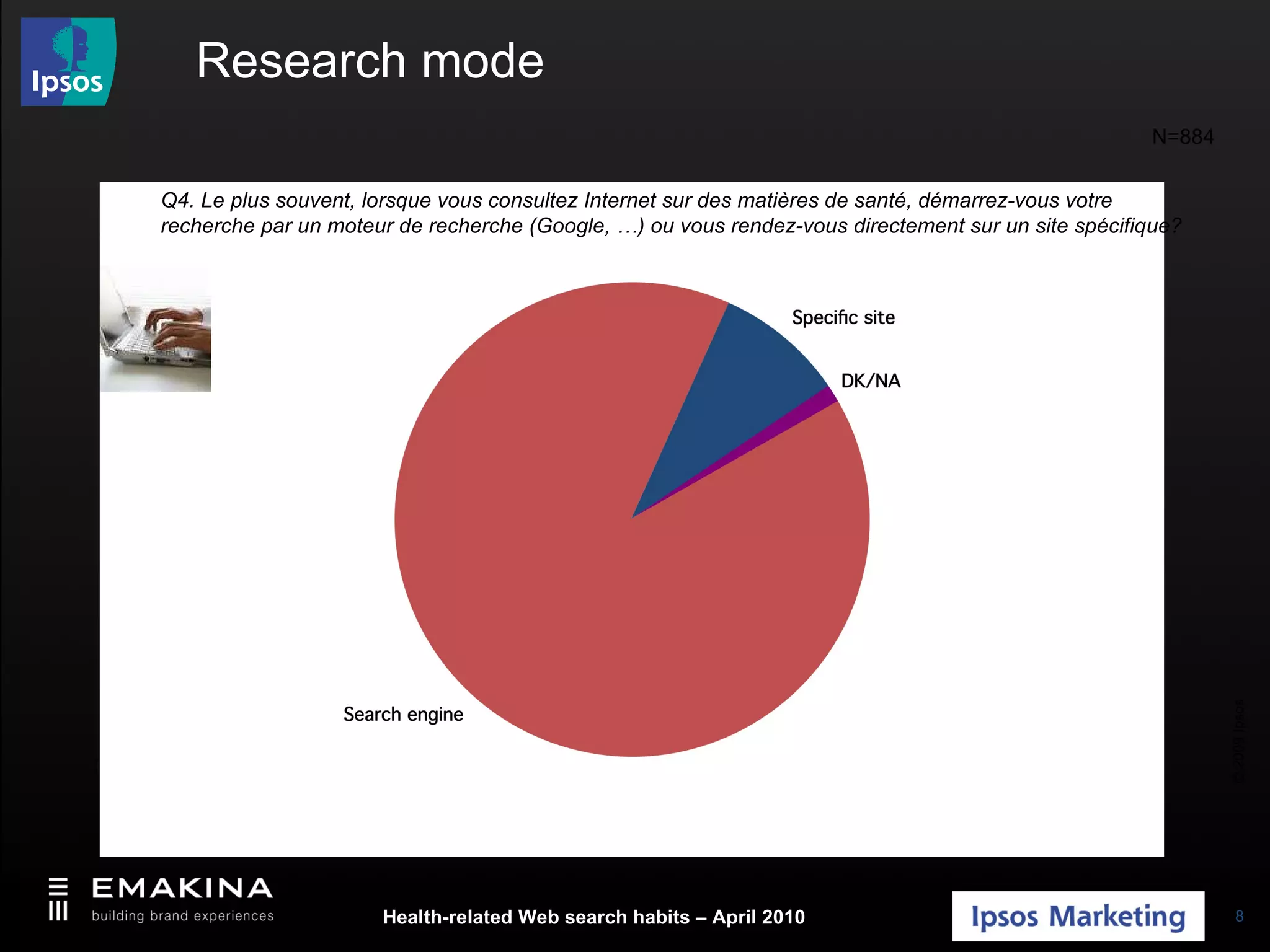
Research mode N=884 Q4. Le plus souvent, lorsque vous consultez Internet sur des matières de santé, démarrez-vous votre recherche par un moteur de recherche (Google, …) ou vous rendez-vous directement sur un site spécifique?
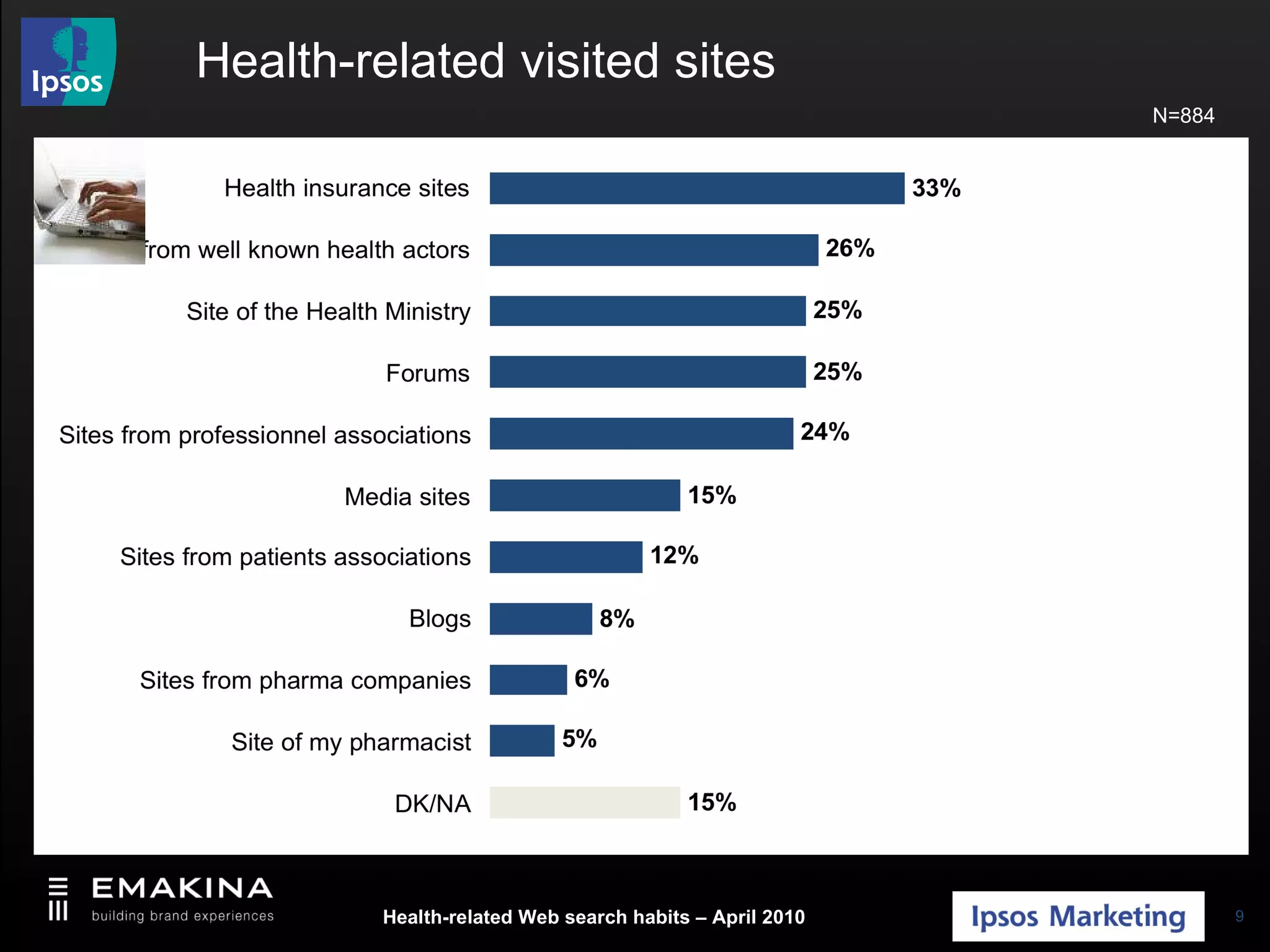
Health-related visited sites N=884
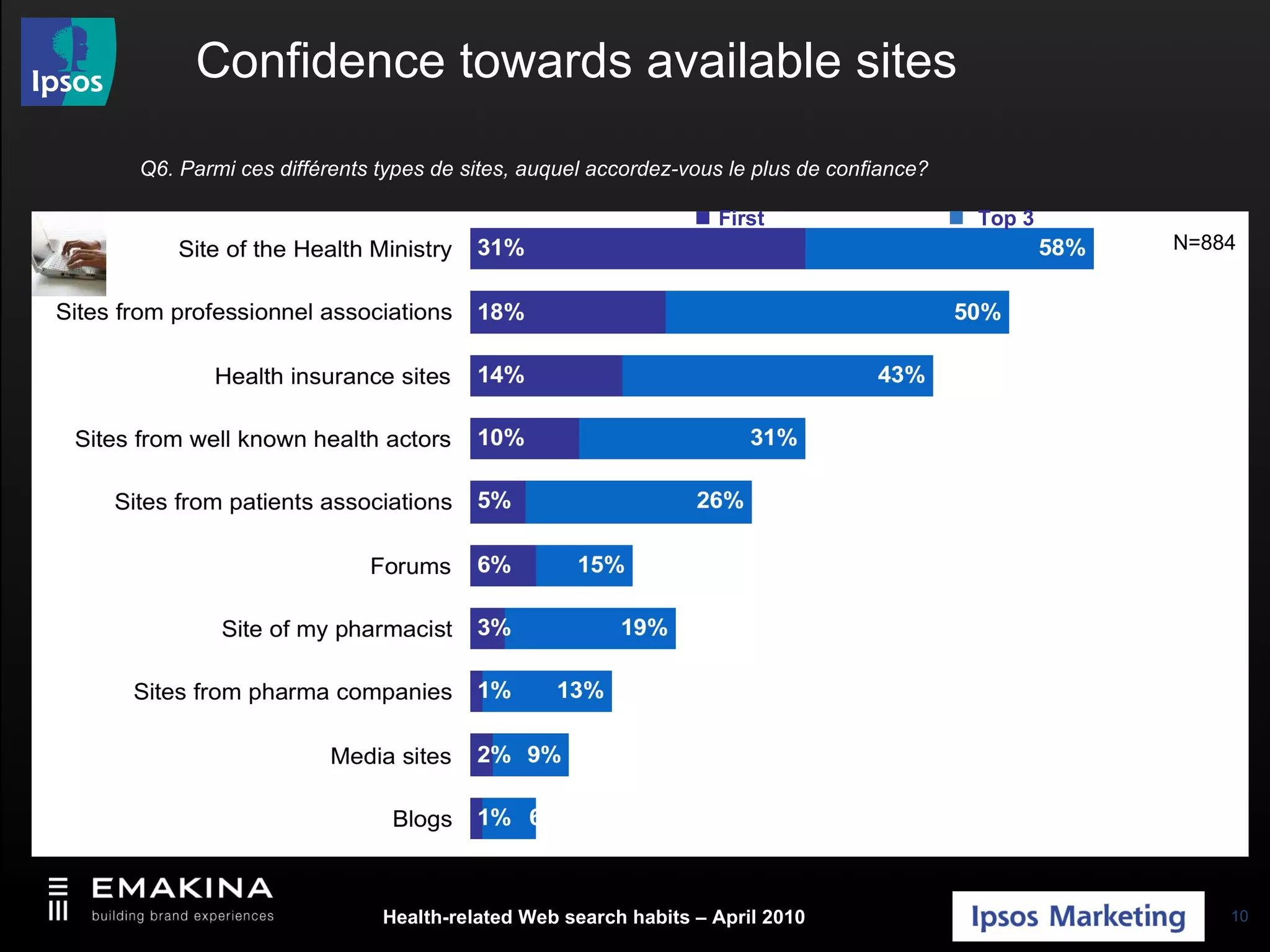
Confidence towards available sites N=884    First    Top 3 Q6. Parmi ces différents types de sites, auquel accordez-vous le plus de confiance?
Confidence criteria N=884 Q7. Lorsque vous recherchez de l’information sur la santé ou des médicaments sur Internet, sur quels critères vous basez-vous pour évaluer la qualité, le sérieux et la crédibilité de ce que vous trouvez?
On-line medicines purchase N = 1000 Q8. Avez-vous déjà acheté des médicaments par Internet? OTC or RX ?
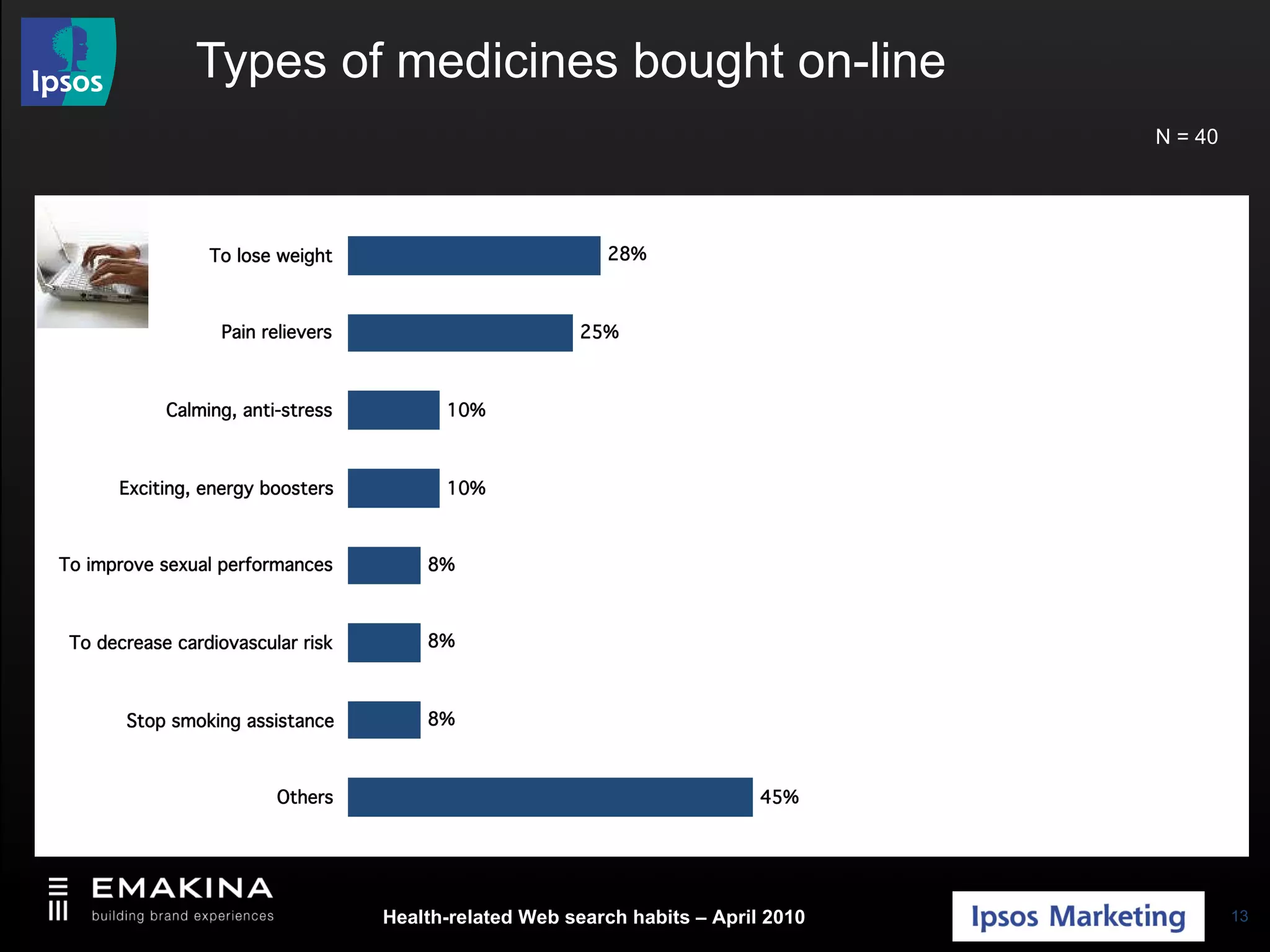
Types of medicines bought on-line N = 40
Reasons for buying medicines on-line N = 40
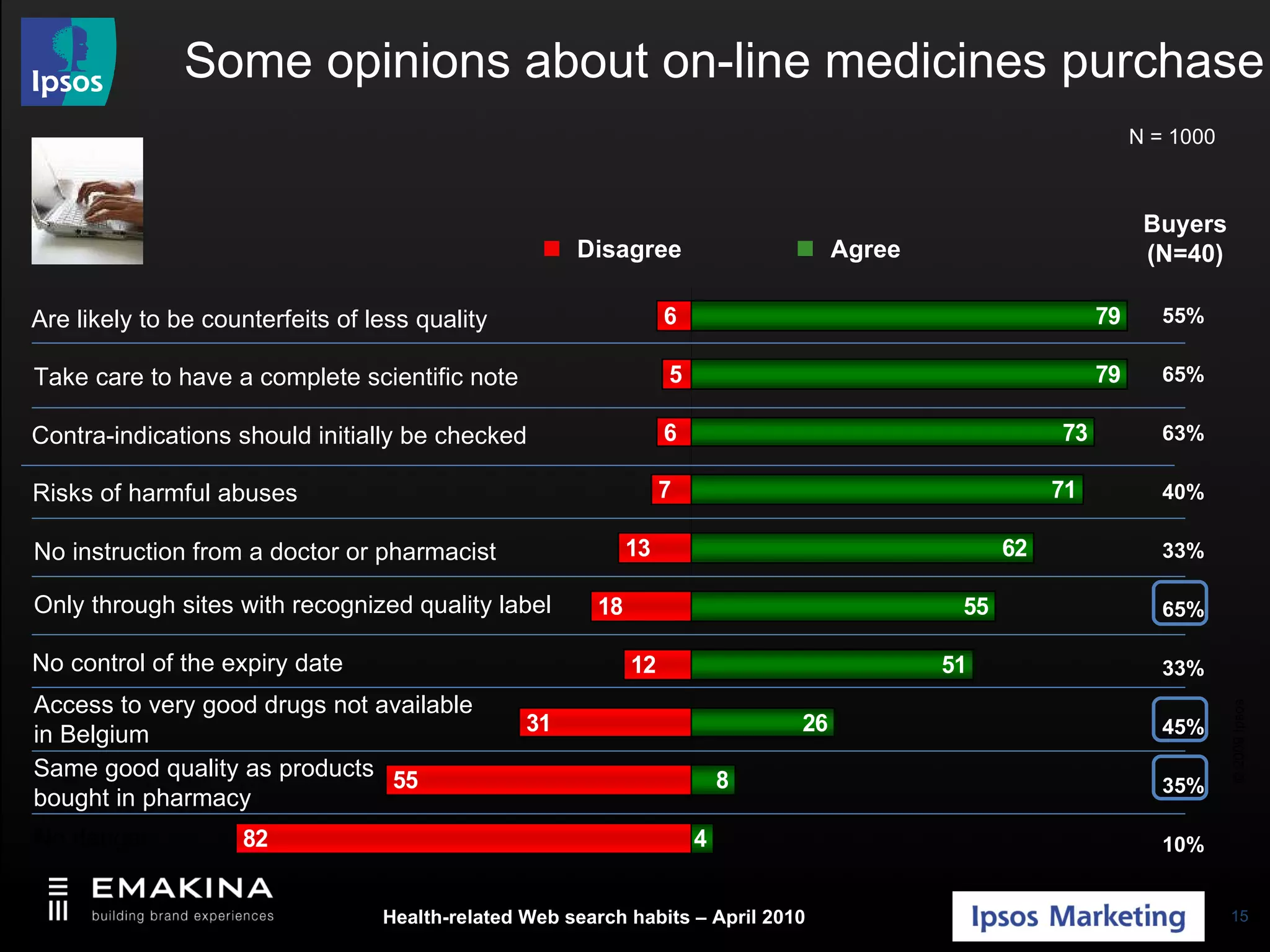
Some opinions about on-line medicines purchase 55% 65% 63% 40% 33% 65% 33% 45% 35% 10% N = 1000 No danger Same good quality as products bought in pharmacy No instruction from a doctor or pharmacist Contra-indications should initially be checked Are likely to be counterfeits of less quality Risks of harmful abuses Only through sites with recognized quality label Take care to have a complete scientific note No control of the expiry date Access to very good drugs not available in Belgium     Disagree    Agree Buyers (N=40)
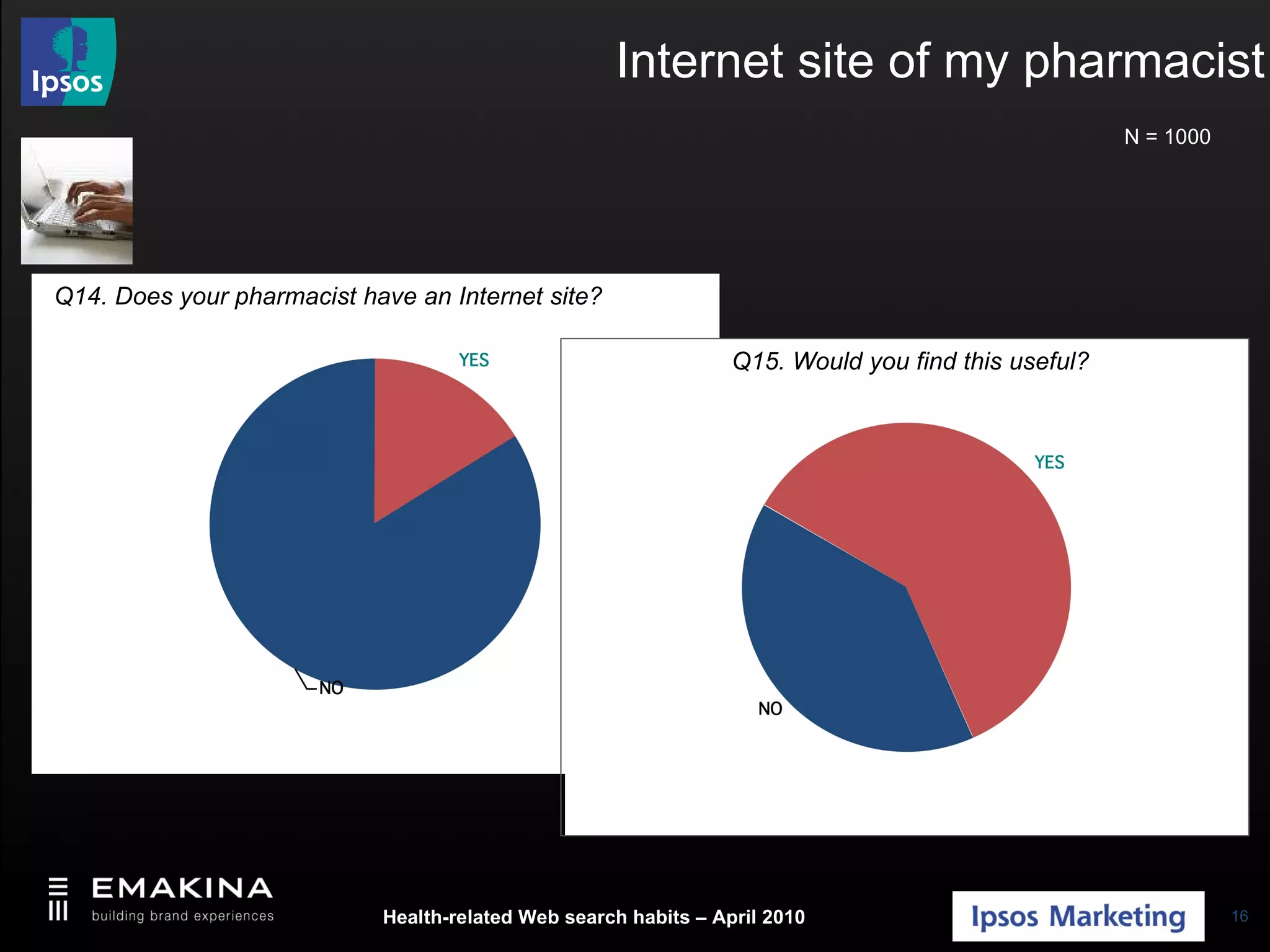
Internet site of my pharmacist N = 1000 Q14. Does your pharmacist have an Internet site? Q15. Would you find this useful?
Motivations towards a pharmacist site N = 598 who would find this useful
Complementary results from a Microsoft research in the U.S. * http://research.microsoft.com/en-us/um/people/ryenw/papers/WhiteTOIS2009.pdf Ryen White and Eric Horvitz November 2008
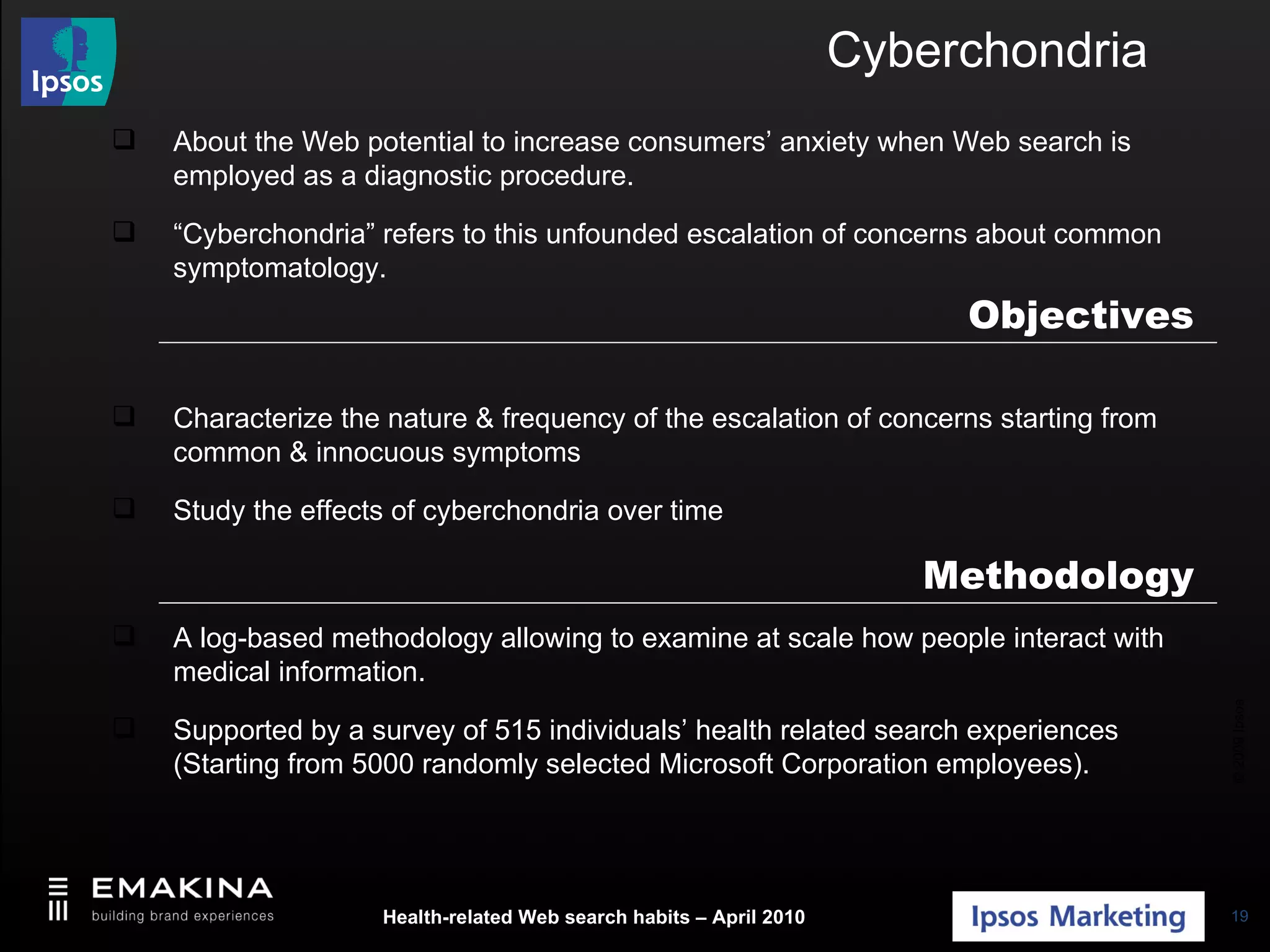
Cyberchondria About the Web potential to increase consumers’ anxiety when Web search is employed as a diagnostic procedure. “ Cyberchondria” refers to this unfounded escalation of concerns about common symptomatology. Characterize the nature & frequency of the escalation of concerns starting from common & innocuous symptoms Study the effects of cyberchondria over time A log-based methodology allowing to examine at scale how people interact with medical information. Supported by a survey of 515 individuals’ health related search experiences (Starting from 5000 randomly selected Microsoft Corporation employees). Methodology Objectives
Some results OBSERVATION 2% of all queries were health related 78% of all queries related to a medical symptom occur within 2 weeks of the initial query for that symptom   searches for symptoms may occur in a bursty manner HEALTH RELATED SEARCH HABITS (experience of 515 people who had performed at least 1 search for health-related info)   Average of 10 health-related Web searches per month, 2 of them being for professionally undiagnosed medical conditions 58% are primarily searching health-related info for themselves, 40% for relative, friend or work colleague 86% of searches are for info on symptoms 49% for info on serious medical conditions 42% for a medical diagnosis 38% for others’ experience of similar conditions
Some results HEALTH-RELATED ANXIETY How often do your Web searches for symptoms / basic medical conditions lead to your review of content on serious illnesses? PERSISTENCE & INTERRUPTION Your queries for that serious Illness persist then over weeks, months or years This escalation has interrupted your online activity This escalation has interrupted your other activities
Some results SEARCHES FOR DIAGNOSES If your queries contain medical symptoms, how often do you consider the ranking of Web search results as indicating the likelihood of the illnesses, with more likely diseases appearing higher up on the result page(s)? In 73% of the cases, the appointment reassured them that their worries were not justified 25% have used Web search as a medical expert system where one inputs symptoms  and expects to review possible diseases ranked by likelihood 24% believe they’ve been in the situation where Web content “put them over the  threshold” for scheduling an appointment with a health professional, when they would  likely have not sought professional attention if they had not reviewed Web content
Some results SOURCES OF ANXIETY & CONTRIBUTION OF CONTENT FEATURES What was your anxiety related to? What was it about the content of those pages that contributed to your anxiety?
Conclusions Escalation of medical concerns is potentially related to the amount and distribution of medical content viewed by users, the presence of escalatory terminology in pages visited, and a user’s predisposition to escalate or seek more reasonable explanations for ailments Persistence of concerns following an escalation and the effect that such ongoing concerns could have on interrupting users’ activities over a prolonged period of time Search engine architects have a responsibility to ensure that searchers do not experience unnecessary concern generated by the definition of relevance and the ranking algorithms their engines use They must focus on serving medical search results that are reliable, complete and timely, as well as topically relevant

Emakina Academy / Ipsos

  • 1.
    Health-related Web searchhabits A recent Belgian study
  • 2.
  • 3.
    Objectives Assess howBelgian people use Internet for Health-related information and pharma products purchase. On-line interview from the IPSOS Access Panel. 1000 respondents, representative for the national population aged 18-65 years. Methodology
  • 4.
    Sample’s profile 18-34Higher Upper FR Urban Non urban YES NO 35-54 55+ Male Female FL
  • 5.
  • 6.
    Internet consultation frequency88% have already searched for health-related information on the Web 29% search for health-related info every week N=1000
  • 7.
    Motivation to consultthe Web for health-related info  First  Top 3 49% are primarily searching info about symptoms / problems they personally suffer from N=884
  • 8.
    Research mode N=884Q4. Le plus souvent, lorsque vous consultez Internet sur des matières de santé, démarrez-vous votre recherche par un moteur de recherche (Google, …) ou vous rendez-vous directement sur un site spécifique?
  • 9.
  • 10.
    Confidence towards availablesites N=884  First  Top 3 Q6. Parmi ces différents types de sites, auquel accordez-vous le plus de confiance?
  • 11.
    Confidence criteria N=884Q7. Lorsque vous recherchez de l’information sur la santé ou des médicaments sur Internet, sur quels critères vous basez-vous pour évaluer la qualité, le sérieux et la crédibilité de ce que vous trouvez?
  • 12.
    On-line medicines purchaseN = 1000 Q8. Avez-vous déjà acheté des médicaments par Internet? OTC or RX ?
  • 13.
    Types of medicinesbought on-line N = 40
  • 14.
    Reasons for buyingmedicines on-line N = 40
  • 15.
    Some opinions abouton-line medicines purchase 55% 65% 63% 40% 33% 65% 33% 45% 35% 10% N = 1000 No danger Same good quality as products bought in pharmacy No instruction from a doctor or pharmacist Contra-indications should initially be checked Are likely to be counterfeits of less quality Risks of harmful abuses Only through sites with recognized quality label Take care to have a complete scientific note No control of the expiry date Access to very good drugs not available in Belgium  Disagree  Agree Buyers (N=40)
  • 16.
    Internet site ofmy pharmacist N = 1000 Q14. Does your pharmacist have an Internet site? Q15. Would you find this useful?
  • 17.
    Motivations towards apharmacist site N = 598 who would find this useful
  • 18.
    Complementary results froma Microsoft research in the U.S. * http://research.microsoft.com/en-us/um/people/ryenw/papers/WhiteTOIS2009.pdf Ryen White and Eric Horvitz November 2008
  • 19.
    Cyberchondria About theWeb potential to increase consumers’ anxiety when Web search is employed as a diagnostic procedure. “ Cyberchondria” refers to this unfounded escalation of concerns about common symptomatology. Characterize the nature & frequency of the escalation of concerns starting from common & innocuous symptoms Study the effects of cyberchondria over time A log-based methodology allowing to examine at scale how people interact with medical information. Supported by a survey of 515 individuals’ health related search experiences (Starting from 5000 randomly selected Microsoft Corporation employees). Methodology Objectives
  • 20.
    Some results OBSERVATION2% of all queries were health related 78% of all queries related to a medical symptom occur within 2 weeks of the initial query for that symptom  searches for symptoms may occur in a bursty manner HEALTH RELATED SEARCH HABITS (experience of 515 people who had performed at least 1 search for health-related info) Average of 10 health-related Web searches per month, 2 of them being for professionally undiagnosed medical conditions 58% are primarily searching health-related info for themselves, 40% for relative, friend or work colleague 86% of searches are for info on symptoms 49% for info on serious medical conditions 42% for a medical diagnosis 38% for others’ experience of similar conditions
  • 21.
    Some results HEALTH-RELATEDANXIETY How often do your Web searches for symptoms / basic medical conditions lead to your review of content on serious illnesses? PERSISTENCE & INTERRUPTION Your queries for that serious Illness persist then over weeks, months or years This escalation has interrupted your online activity This escalation has interrupted your other activities
  • 22.
    Some results SEARCHESFOR DIAGNOSES If your queries contain medical symptoms, how often do you consider the ranking of Web search results as indicating the likelihood of the illnesses, with more likely diseases appearing higher up on the result page(s)? In 73% of the cases, the appointment reassured them that their worries were not justified 25% have used Web search as a medical expert system where one inputs symptoms and expects to review possible diseases ranked by likelihood 24% believe they’ve been in the situation where Web content “put them over the threshold” for scheduling an appointment with a health professional, when they would likely have not sought professional attention if they had not reviewed Web content
  • 23.
    Some results SOURCESOF ANXIETY & CONTRIBUTION OF CONTENT FEATURES What was your anxiety related to? What was it about the content of those pages that contributed to your anxiety?
  • 24.
    Conclusions Escalation ofmedical concerns is potentially related to the amount and distribution of medical content viewed by users, the presence of escalatory terminology in pages visited, and a user’s predisposition to escalate or seek more reasonable explanations for ailments Persistence of concerns following an escalation and the effect that such ongoing concerns could have on interrupting users’ activities over a prolonged period of time Search engine architects have a responsibility to ensure that searchers do not experience unnecessary concern generated by the definition of relevance and the ranking algorithms their engines use They must focus on serving medical search results that are reliable, complete and timely, as well as topically relevant