This event is live as of XYZ
Going Mobile:
Using mobile to enhance care and efficiency
Dickie Sweeney
Senior Manager, athenahealth
2
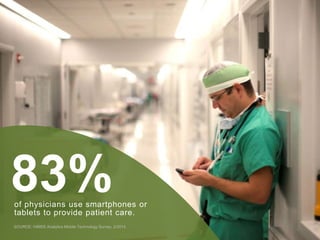
of physicians use smartphones or
tablets to provide patient care.
83%
SOURCE: HIMSS Analytics Mobile Technology Survey, 2/2014
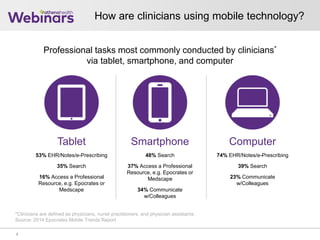
How are clinicians using mobile technology?
Professional tasks most commonly conducted by clinicians*
via tablet, smartphone, and computer
*Clinicians are defined as physicians, nurse practitioners, and physician assistants.
Source: 2014 Epocrates Mobile Trends Report
3
Tablet
53% EHR/Notes/e-Prescribing
35% Search
16% Access a Professional
Resource, e.g. Epocrates or
Medscape
Smartphone
48% Search
37% Access a Professional
Resource, e.g. Epocrates or
Medscape
34% Communicate
w/Colleagues
Computer
74% EHR/Notes/e-Prescribing
39% Search
23% Communicate
w/Colleagues
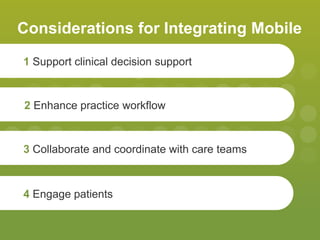
Considerations for Integrating Mobile
1 Support clinical decision support
2 Enhance practice workflow
3 Collaborate and coordinate with care teams
4 Engage patients
Support clinical
decision support
Support clinical decisions
6
Clinicals use clinical reference apps to:
• Check drug recommendations for prescribing
and safety information
• Check for potential drug-drug interactions
• Diagnose and treat conditions
• Understand current practice guidelines
Who approved that app?
7
The U.S. Food and Drug Administration (FDA)
released much-debated guidelines in 2013 to
help mobile app developers determine whether
their product would require oversight.
Source: PBS Newshour. Available at: http://www.pbs.org/newshour/rundown/fda-regulation-unable-keep-pace-new-mobile-health-
apps/
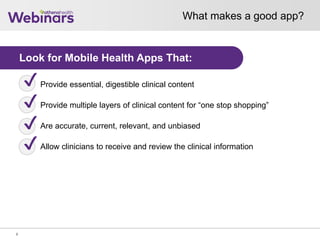
What makes a good app?
8
Provide essential, digestible clinical content
Provide multiple layers of clinical content for “one stop shopping”
Are accurate, current, relevant, and unbiased
Allow clinicians to receive and review the clinical information
Look for Mobile Health Apps That:
✔
✔
✔
✔
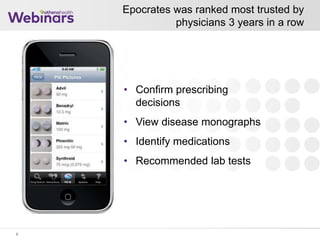
Epocrates was ranked most trusted by
physicians 3 years in a row
9
• Confirm prescribing
decisions
• View disease monographs
• Identify medications
• Recommended lab tests
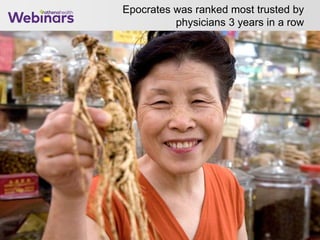
Epocrates was ranked most trusted by
physicians 3 years in a row
10
Enhance practice
workflow
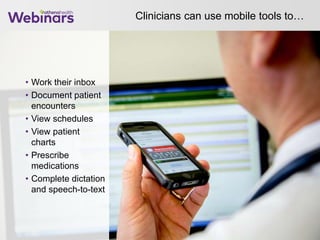
Clinicians can use mobile tools to…
• Work their inbox
• Document patient
encounters
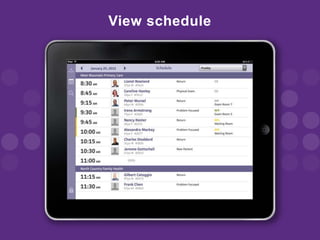
• View schedules
• View patient
charts
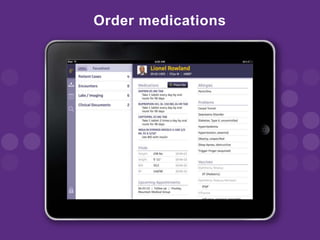
• Prescribe
medications
• Complete dictation
and speech-to-text
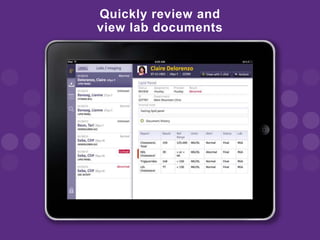
Quickly review and
view lab documents
View schedule
Order medications
Collaborate and
coordinate with
care teams
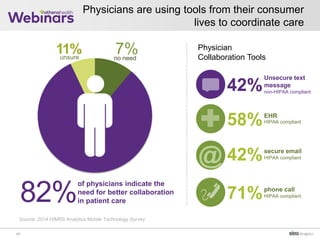
Physicians are using tools from their consumer
lives to coordinate care
17
82%
of physicians indicate the
need for better collaboration
in patient care
7%no need
11%unsure
42%
Unsecure text
message
non-HIPAA compliant
58%EHR
HIPAA compliant
42%secure email
HIPAA compliant
71%phone call
HIPAA compliant
Physician
Collaboration Tools
@
Source: 2014 HIMSS Analytics Mobile Technology Survey
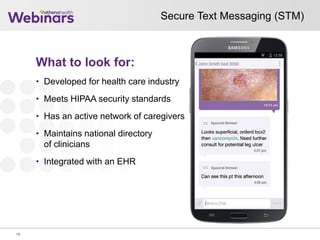
Secure Text Messaging (STM)
18
What to look for:
• Developed for health care industry
• Meets HIPAA security standards
• Has an active network of caregivers
• Maintains national directory
of clinicians
• Integrated with an EHR
Engage patients
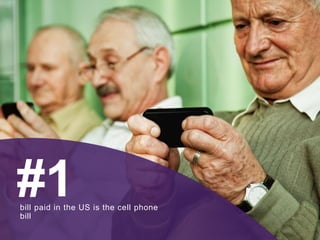
bill paid in the US is the cell phone
bill
#1
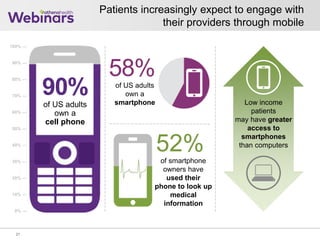
Patients increasingly expect to engage with
their providers through mobile
Low income
patients
may have greater
access to
smartphones
than computers
21
90%
of US adults
own a
cell phone
100% —
90% —
80% —
70% —
60% —
50% —
40% —
30% —
20% —
10% —
0% —
of US adults
own a
smartphone
58%
of smartphone
owners have
used their
phone to look up
medical
information
52%
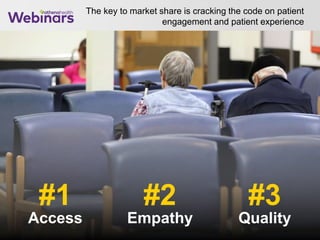
The key to market share is cracking the code on patient
engagement and patient experience
22
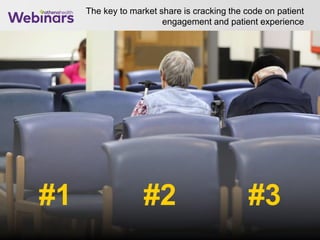
#2#1 #3
The key to market share is cracking the code on patient
engagement and patient experience
23
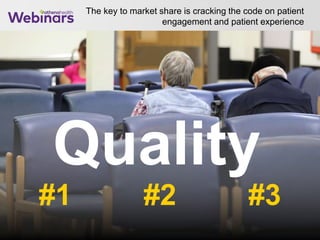
#2#1 #3
Quality
The key to market share is cracking the code on patient
engagement and patient experience
24
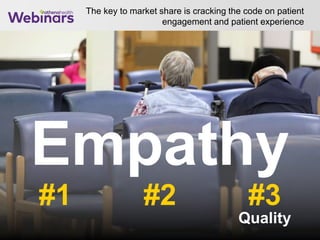
#2#1 #3
Empathy
Quality
The key to market share is cracking the code on patient
engagement and patient experience
25
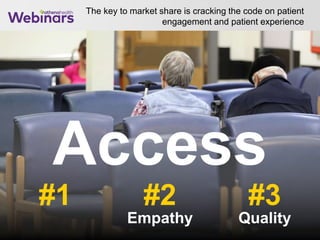
#2#1 #3
Access
QualityEmpathy
The key to market share is cracking the code on patient
engagement and patient experience
26
#2#1 #3
QualityEmpathyAccess
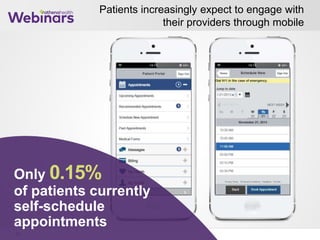
Patients increasingly expect to engage with
their providers through mobile
27
Only 0.15%
of patients currently
self-schedule
appointments
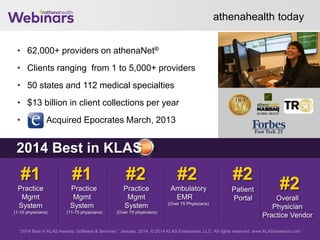
athenahealth today
• 62,000+ providers on athenaNet®
• Clients ranging from 1 to 5,000+ providers
• 50 states and 112 medical specialties
• $13 billion in client collections per year
• Acquired Epocrates March, 2013
28
“2014 Best in KLAS Awards: Software & Services,” January, 2014. © 2014 KLAS Enterprises, LLC. All rights reserved. www.KLASresearch.com
#1
Practice
Mgmt
System
(1-10 physicians)
#1
Practice
Mgmt
System
(11-75 physicians)
#2
Practice
Mgmt
System
(Over 75 physicians)
#2
Ambulatory
EMR
(Over 75 Physicians)
#2
Patient
Portal
#2
Overall
Physician
Practice Vendor
2014 Best in KLAS
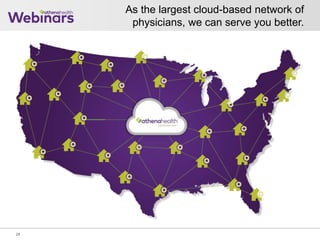
As the largest cloud-based network of
physicians, we can serve you better.
29
30

Going Mobile: Using mobile to enhance care and efficiency

  • 1.
    This event islive as of XYZ Going Mobile: Using mobile to enhance care and efficiency Dickie Sweeney Senior Manager, athenahealth
  • 2.
    2 of physicians usesmartphones or tablets to provide patient care. 83% SOURCE: HIMSS Analytics Mobile Technology Survey, 2/2014
  • 3.
    How are cliniciansusing mobile technology? Professional tasks most commonly conducted by clinicians* via tablet, smartphone, and computer *Clinicians are defined as physicians, nurse practitioners, and physician assistants. Source: 2014 Epocrates Mobile Trends Report 3 Tablet 53% EHR/Notes/e-Prescribing 35% Search 16% Access a Professional Resource, e.g. Epocrates or Medscape Smartphone 48% Search 37% Access a Professional Resource, e.g. Epocrates or Medscape 34% Communicate w/Colleagues Computer 74% EHR/Notes/e-Prescribing 39% Search 23% Communicate w/Colleagues
  • 4.
    Considerations for IntegratingMobile 1 Support clinical decision support 2 Enhance practice workflow 3 Collaborate and coordinate with care teams 4 Engage patients
  • 5.
  • 6.
    Support clinical decisions 6 Clinicalsuse clinical reference apps to: • Check drug recommendations for prescribing and safety information • Check for potential drug-drug interactions • Diagnose and treat conditions • Understand current practice guidelines
  • 7.
    Who approved thatapp? 7 The U.S. Food and Drug Administration (FDA) released much-debated guidelines in 2013 to help mobile app developers determine whether their product would require oversight. Source: PBS Newshour. Available at: http://www.pbs.org/newshour/rundown/fda-regulation-unable-keep-pace-new-mobile-health- apps/
  • 8.
    What makes agood app? 8 Provide essential, digestible clinical content Provide multiple layers of clinical content for “one stop shopping” Are accurate, current, relevant, and unbiased Allow clinicians to receive and review the clinical information Look for Mobile Health Apps That: ✔ ✔ ✔ ✔
  • 9.
    Epocrates was rankedmost trusted by physicians 3 years in a row 9 • Confirm prescribing decisions • View disease monographs • Identify medications • Recommended lab tests
  • 10.
    Epocrates was rankedmost trusted by physicians 3 years in a row 10
  • 11.
  • 12.
    Clinicians can usemobile tools to… • Work their inbox • Document patient encounters • View schedules • View patient charts • Prescribe medications • Complete dictation and speech-to-text
  • 13.
  • 14.
  • 15.
  • 16.
  • 17.
    Physicians are usingtools from their consumer lives to coordinate care 17 82% of physicians indicate the need for better collaboration in patient care 7%no need 11%unsure 42% Unsecure text message non-HIPAA compliant 58%EHR HIPAA compliant 42%secure email HIPAA compliant 71%phone call HIPAA compliant Physician Collaboration Tools @ Source: 2014 HIMSS Analytics Mobile Technology Survey
  • 18.
    Secure Text Messaging(STM) 18 What to look for: • Developed for health care industry • Meets HIPAA security standards • Has an active network of caregivers • Maintains national directory of clinicians • Integrated with an EHR
  • 19.
  • 20.
    bill paid inthe US is the cell phone bill #1
  • 21.
    Patients increasingly expectto engage with their providers through mobile Low income patients may have greater access to smartphones than computers 21 90% of US adults own a cell phone 100% — 90% — 80% — 70% — 60% — 50% — 40% — 30% — 20% — 10% — 0% — of US adults own a smartphone 58% of smartphone owners have used their phone to look up medical information 52%
  • 22.
    The key tomarket share is cracking the code on patient engagement and patient experience 22 #2#1 #3
  • 23.
    The key tomarket share is cracking the code on patient engagement and patient experience 23 #2#1 #3 Quality
  • 24.
    The key tomarket share is cracking the code on patient engagement and patient experience 24 #2#1 #3 Empathy Quality
  • 25.
    The key tomarket share is cracking the code on patient engagement and patient experience 25 #2#1 #3 Access QualityEmpathy
  • 26.
    The key tomarket share is cracking the code on patient engagement and patient experience 26 #2#1 #3 QualityEmpathyAccess
  • 27.
    Patients increasingly expectto engage with their providers through mobile 27 Only 0.15% of patients currently self-schedule appointments
  • 28.
    athenahealth today • 62,000+providers on athenaNet® • Clients ranging from 1 to 5,000+ providers • 50 states and 112 medical specialties • $13 billion in client collections per year • Acquired Epocrates March, 2013 28 “2014 Best in KLAS Awards: Software & Services,” January, 2014. © 2014 KLAS Enterprises, LLC. All rights reserved. www.KLASresearch.com #1 Practice Mgmt System (1-10 physicians) #1 Practice Mgmt System (11-75 physicians) #2 Practice Mgmt System (Over 75 physicians) #2 Ambulatory EMR (Over 75 Physicians) #2 Patient Portal #2 Overall Physician Practice Vendor 2014 Best in KLAS
  • 29.
    As the largestcloud-based network of physicians, we can serve you better. 29
  • 30.

Editor's Notes

  • #2 Welcome and introduction
  • #3 Mobile devices are becoming as ubiquitous in the health care setting as they are in the rest of our lives. The 2014 HIMSS Analytics Mobile Technology Survey reported that 83 percent of physicians use mobile technology to provide patient care.1 Clinicians—including physicians, nurse practitioners, nurses, and physician assistants—use mobile technology to update patient records, search for clinical information, and connect to colleagues. Patients use mobile technology to track health indicators, communicate with their providers, and search for health information.
  • #4 Here are the most common use cases for mobile technology versus computer. Phones are used largely for search and text. While tablets and computers are more likely to be used for clinical documentation and prescribing.
  • #5 When considering mobile for your practice or health system, it may be used for …
  • #8 The agency does not scrutinize all health apps, just ones used as accessories for a regulated medical device or those that “transform a mobile platform into a regulated medical device.” As of July 2014, the FDA had reviewed about 100 health apps, while hundreds of apps continue to appear on the Apple iTune store and Google Play store each month, potentially avoiding federal regulation.
  • #9 Good clinical apps are actively curated. The most trusted apps set editorial standards to ensure content is accurate, current, unbiased, relevant, essential and readily consumable during the moments of care. Using a mobile device to input data and update patient charts allows the clinician to focus more on the patient, and less on the computer. In fact, studies have shown patients respond favorably to their physician using a tablet during office visits.6 However, make sure clinical apps that capture patient data are seamlessly connected to the EHR, eliminating the extra step of updating patient charts from a desktop station.
  • #11 Recently, Epocrates has added alternative medicine look-ups for interaction checks, etc. She’s holding ginseng.
  • #13 The power of mobile technology is bringing the right work to the right person in the right place. Mobile devices, especially those connected to a clinician’s EHR, can help clinicians use time more productively in and out of the office. Much of the work that clogs clinicians’ inboxes can be handled appropriately, conveniently, and efficiently out of the office.
  • #18 42%!! And that’s self-reported so one could image that number is much higher in reality. Health care executives should understand what kinds of mobile and remote devices are operating in their organizations and whether these devices are putting private health information at risk. Efforts to protect health information must go beyond telling employees what they can and cannot do. A more effective approach is to use privacy and security platforms that are integrated into the workflow, rather than creating barriers or hindering adoption.
  • #19 When considering STM for your organization, it is important to look for solutions that have been developed specifically for the health care industry. This ensures that using STM is a time-saver for clinicians, and can be layered into the clinical workflow. This also helps with adoption, since clinicians want to minimize the extra taps and passwords required to send and receive secure messages. In addition, STM solutions should offer a clinician directory that contains contact and other profile information for verified providers across the U.S. Caregivers should be able to quickly and easily manage their own identity as well as find their colleagues. STM directories need to provide clinicians with certainty that they are sending a message to the right person. STM solutions should also be integrated with the organization’s EHR. This ensures important information isn’t lost or buried but is captured in complete clinical records that are in compliance with guidelines for storing, sharing and accessing patient data. Like good clinical apps, it also ensures that clinicians can use a single workflow to securely send and receive messages to coordinate care, without the extra step of entering information on a desktop EHR.
  • #21 We already talked about the fact that health care workers are on their phones… no surprise that your patients are too.
  • #22 Patients increasingly expect to engage with their providers through their mobile devices. Pew Internet reported that 90 percent of U.S. adults own a cell phone and 58 percent of U.S. adults own a smartphone. Thirty-one percent of cell phone owners and 52 percent of smartphone owners have used their phone to look up health or medical information. Young people, Latinos, and African Americans are significantly more likely than other groups to have mobile Internet access.
  • #23 The Advisory Board Company did a recent survey of few hundred patients to find out what was most important to them when selecting a health care provider. Many of you would think that it’s “Quality” [CLICK]. It turns out, it’s not quality. Well then, maybe it’s the undivided attention and care the provider gives in the exam room. The feeling that their doctor is really listening to their concerns. Whelp, “Empathy” wasn’t the leading driver either [CLICK]. What do patients really care about? [CLICK] “Access”. The ability to get in touch with their provider in a way that is convenient for them. The ability to schedule easily. And ask clinical questions. Get prescription refills more easily, etc.
  • #24 The Advisory Board Company did a recent survey of few hundred patients to find out what was most important to them when selecting a health care provider. Many of you would think that it’s “Quality” [CLICK]. It turns out, it’s not quality. Well then, maybe it’s the undivided attention and care the provider gives in the exam room. The feeling that their doctor is really listening to their concerns. Whelp, “Empathy” wasn’t the leading driver either [CLICK]. What do patients really care about? [CLICK] “Access”. The ability to get in touch with their provider in a way that is convenient for them. The ability to schedule easily. And ask clinical questions. Get prescription refills more easily, etc.
  • #25 The Advisory Board Company did a recent survey of few hundred patients to find out what was most important to them when selecting a health care provider. Many of you would think that it’s “Quality” [CLICK]. It turns out, it’s not quality. Well then, maybe it’s the undivided attention and care the provider gives in the exam room. The feeling that their doctor is really listening to their concerns. Whelp, “Empathy” wasn’t the leading driver either [CLICK]. What do patients really care about? [CLICK] “Access”. The ability to get in touch with their provider in a way that is convenient for them. The ability to schedule easily. And ask clinical questions. Get prescription refills more easily, etc.
  • #26 The Advisory Board Company did a recent survey of few hundred patients to find out what was most important to them when selecting a health care provider. Many of you would think that it’s “Quality” [CLICK]. It turns out, it’s not quality. Well then, maybe it’s the undivided attention and care the provider gives in the exam room. The feeling that their doctor is really listening to their concerns. Whelp, “Empathy” wasn’t the leading driver either [CLICK]. What do patients really care about? [CLICK] “Access”. The ability to get in touch with their provider in a way that is convenient for them. The ability to schedule easily. And ask clinical questions. Get prescription refills more easily, etc.
  • #27 The Advisory Board Company did a recent survey of few hundred patients to find out what was most important to them when selecting a health care provider. Many of you would think that it’s “Quality” [CLICK]. It turns out, it’s not quality. Well then, maybe it’s the undivided attention and care the provider gives in the exam room. The feeling that their doctor is really listening to their concerns. Whelp, “Empathy” wasn’t the leading driver either [CLICK]. What do patients really care about? [CLICK] “Access”. The ability to get in touch with their provider in a way that is convenient for them. The ability to schedule easily. And ask clinical questions. Get prescription refills more easily, etc.
  • #28 They expect to be able to schedule appointments, view lab results, pay bills, and message their care team.