Consumer health trends Paul Grant Head of Strategy Implementation www.creationhealthcare.com
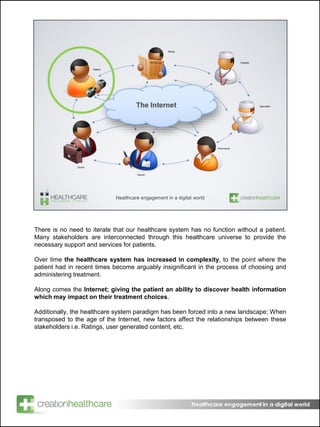
Insurer The Internet Patient Doctor Specialist Media Hospital Pharmacist
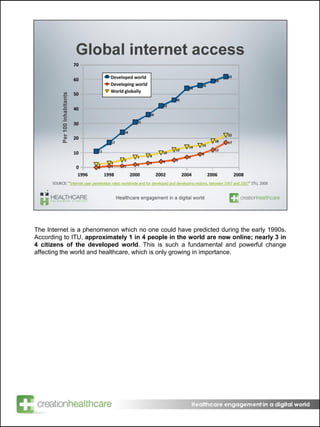
Global internet access Per 100 inhabitants SOURCE: “ Internet user penetration rates worldwide and for developed and developing regions, between 1997 and 2007 ” ITU, 2008
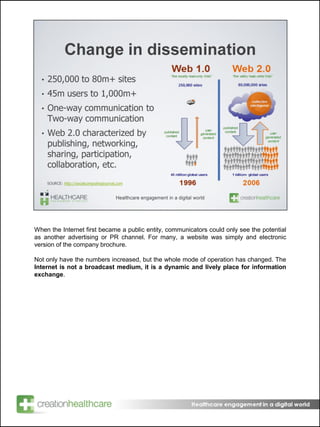
Change in dissemination 250,000 to 80m+ sites 45m users to 1,000m+ One-way communication to Two-way communication Web 2.0 characterized by publishing, networking, sharing, participation, collaboration, etc. SOURCE:  http://socialcomputingjournal.com
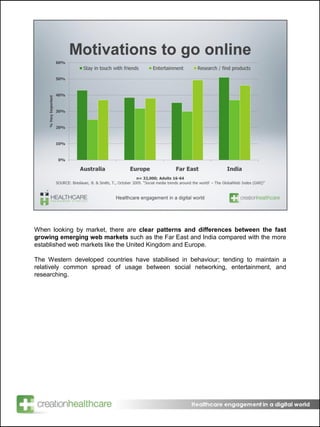
Motivations to go online n= 32,000; Adults 16-64 SOURCE: Breslauer, B. & Smith, T., October 2009. “Social media trends around the world! – The GlobalWeb Index (GWI)”
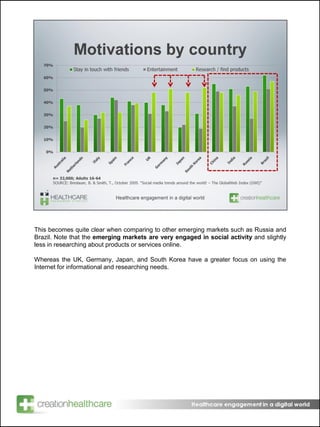
Motivations by country n= 32,000; Adults 16-64 SOURCE: Breslauer, B. & Smith, T., October 2009. “Social media trends around the world! – The GlobalWeb Index (GWI)”
The internet for health SOURCE: “ The State of eHealth: Trends of Today’s eHealth Consumer ” Manhattan Research, 2008 36% increase 33% increase 27% increase 23% increase 18-34 years 35-44 45-54 55+ 2004   2008
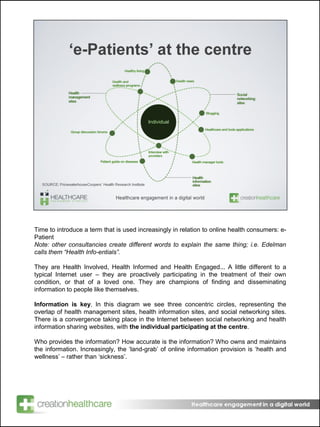
‘ e-Patients’ at the centre SOURCE: PricewaterhouseCoopers’ Health Research Institute
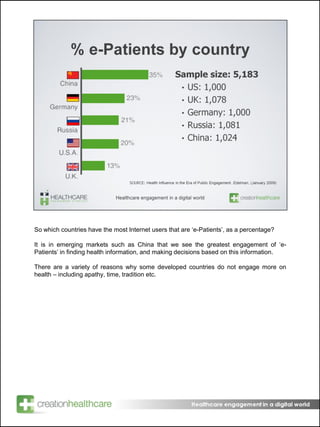
% e-Patients by country  Sample size: 5,183 US: 1,000 UK: 1,078 Germany: 1,000 Russia: 1,081 China: 1,024 SOURCE:  Health Influence in the Era of Public Engagement.  Edelman , (January 2009)
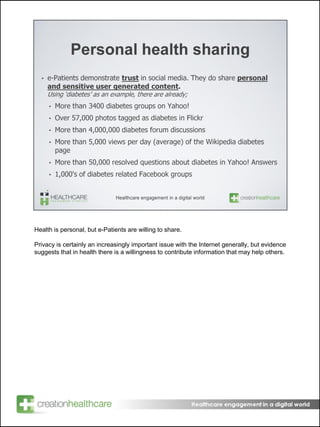
Personal health sharing e-Patients demonstrate  trust   in social media. They do share  personal and sensitive user generated content .  Using ‘diabetes’ as an example, there are already; More than  3400  diabetes  groups  on Yahoo! Over  57,000 photos  tagged as diabetes in Flickr More than  4,000,000  diabetes forum  discussions   More than  5,000  views per day (average) of the  Wikipedia  diabetes page More than  50,000  resolved  questions  about diabetes in Yahoo! Answers 1,000's  of diabetes related  Facebook groups
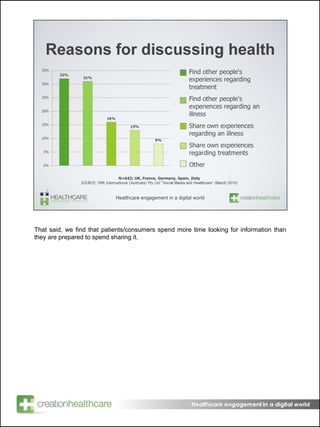
Reasons for discussing health Find other people's experiences regarding treatment  Find other people's experiences regarding an illness  Share own experiences regarding an illness Share own experiences regarding treatments  Other N=642; UK, France, Germany, Spain, Italy  SOURCE: IMR International (Australia) Pty Ltd “ Social Media and Healthcare” (March 2010)
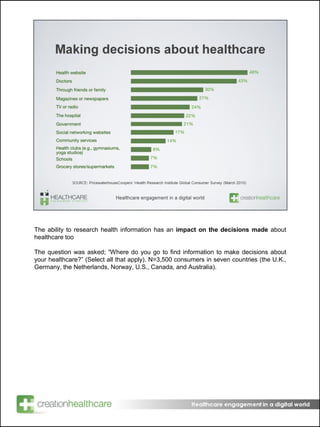
Making decisions about healthcare SOURCE:  PricewaterhouseCoopers’ Health Research Institute Global Consumer Survey (March 2010)
Informing consumer health e-Patients want to understand the options and be involved in decisions about their treatment and healthcare; 1 in 3  consumers  compared doctors  before choosing one 1 in 3  checked to  see if their insurance will cover treatment   1 in 5  looked or  asked for information about a health insurance plan 1 in 5   compared health insurance plans  before choosing one. 1 in 7   compared hospitals . 1 in 3  consumers said they  compared prescription treatment  options. SOURCE: “ 2009 Survey of Health Care Consumers: Key Findings, Strategic Implications ” Deloitte Center for Health Solutions, 2009
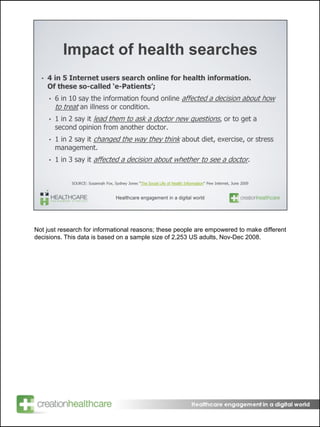
Impact of health searches 4 in 5 Internet users search online for health information.  Of these so-called ‘e-Patients’; 6 in 10  say the information found online  affected a decision about how to treat  an illness or condition. 1 in 2  say it  lead them to ask a doctor new questions , or to get a second opinion from another doctor. 1 in 2  say it  changed the way they think  about diet, exercise, or stress management.  1 in 3  say it  affected a decision about whether to see a doctor .  SOURCE: Susannah Fox, Sydney Jones “ The Social Life of Health Information ” Pew Internet, June 2009
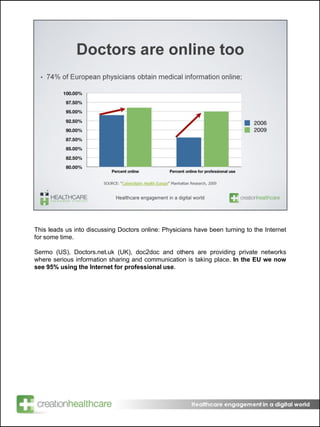
Doctors are online too 74%  of European physicians obtain medical information online; SOURCE: “ Cybercitizen Health Europe ” Manhattan Research, 2009
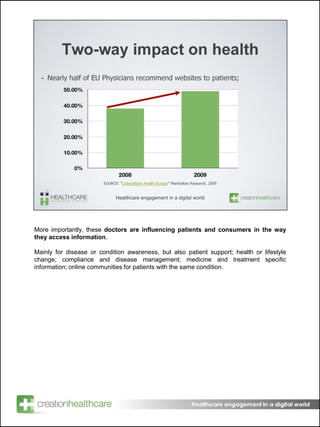
Two-way impact on health Nearly half of EU Physicians recommend websites to patients; SOURCE: “ Cybercitizen Health Europe ” Manhattan Research, 2009
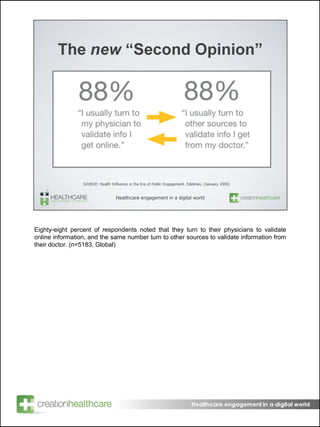
The  new  “Second Opinion” SOURCE: Health Influence in the Era of Public Engagement. Edelman, (January 2009)
www.engagementstrategy.com The e-journal for business leaders and communicators in healthcare

Consumer health trends

  • 1.
    Consumer health trendsPaul Grant Head of Strategy Implementation www.creationhealthcare.com
  • 2.
    Insurer The InternetPatient Doctor Specialist Media Hospital Pharmacist
  • 3.
    Global internet accessPer 100 inhabitants SOURCE: “ Internet user penetration rates worldwide and for developed and developing regions, between 1997 and 2007 ” ITU, 2008
  • 4.
    Change in dissemination250,000 to 80m+ sites 45m users to 1,000m+ One-way communication to Two-way communication Web 2.0 characterized by publishing, networking, sharing, participation, collaboration, etc. SOURCE: http://socialcomputingjournal.com
  • 5.
    Motivations to goonline n= 32,000; Adults 16-64 SOURCE: Breslauer, B. & Smith, T., October 2009. “Social media trends around the world! – The GlobalWeb Index (GWI)”
  • 6.
    Motivations by countryn= 32,000; Adults 16-64 SOURCE: Breslauer, B. & Smith, T., October 2009. “Social media trends around the world! – The GlobalWeb Index (GWI)”
  • 7.
    The internet forhealth SOURCE: “ The State of eHealth: Trends of Today’s eHealth Consumer ” Manhattan Research, 2008 36% increase 33% increase 27% increase 23% increase 18-34 years 35-44 45-54 55+ 2004 2008
  • 8.
    ‘ e-Patients’ atthe centre SOURCE: PricewaterhouseCoopers’ Health Research Institute
  • 9.
    % e-Patients bycountry Sample size: 5,183 US: 1,000 UK: 1,078 Germany: 1,000 Russia: 1,081 China: 1,024 SOURCE: Health Influence in the Era of Public Engagement. Edelman , (January 2009)
  • 10.
    Personal health sharinge-Patients demonstrate trust in social media. They do share personal and sensitive user generated content . Using ‘diabetes’ as an example, there are already; More than 3400 diabetes groups on Yahoo! Over 57,000 photos tagged as diabetes in Flickr More than 4,000,000 diabetes forum discussions More than 5,000 views per day (average) of the Wikipedia diabetes page More than 50,000 resolved questions about diabetes in Yahoo! Answers 1,000's of diabetes related Facebook groups
  • 11.
    Reasons for discussinghealth Find other people's experiences regarding treatment Find other people's experiences regarding an illness Share own experiences regarding an illness Share own experiences regarding treatments Other N=642; UK, France, Germany, Spain, Italy SOURCE: IMR International (Australia) Pty Ltd “ Social Media and Healthcare” (March 2010)
  • 12.
    Making decisions abouthealthcare SOURCE: PricewaterhouseCoopers’ Health Research Institute Global Consumer Survey (March 2010)
  • 13.
    Informing consumer healthe-Patients want to understand the options and be involved in decisions about their treatment and healthcare; 1 in 3 consumers compared doctors before choosing one 1 in 3 checked to see if their insurance will cover treatment 1 in 5 looked or asked for information about a health insurance plan 1 in 5 compared health insurance plans before choosing one. 1 in 7 compared hospitals . 1 in 3 consumers said they compared prescription treatment options. SOURCE: “ 2009 Survey of Health Care Consumers: Key Findings, Strategic Implications ” Deloitte Center for Health Solutions, 2009
  • 14.
    Impact of healthsearches 4 in 5 Internet users search online for health information. Of these so-called ‘e-Patients’; 6 in 10 say the information found online affected a decision about how to treat an illness or condition. 1 in 2 say it lead them to ask a doctor new questions , or to get a second opinion from another doctor. 1 in 2 say it changed the way they think about diet, exercise, or stress management. 1 in 3 say it affected a decision about whether to see a doctor . SOURCE: Susannah Fox, Sydney Jones “ The Social Life of Health Information ” Pew Internet, June 2009
  • 15.
    Doctors are onlinetoo 74% of European physicians obtain medical information online; SOURCE: “ Cybercitizen Health Europe ” Manhattan Research, 2009
  • 16.
    Two-way impact onhealth Nearly half of EU Physicians recommend websites to patients; SOURCE: “ Cybercitizen Health Europe ” Manhattan Research, 2009
  • 17.
    The new “Second Opinion” SOURCE: Health Influence in the Era of Public Engagement. Edelman, (January 2009)
  • 18.
    www.engagementstrategy.com The e-journalfor business leaders and communicators in healthcare

Editor's Notes

  • #2 Creation Healthcare is an international consultancy helping healthcare and pharmaceutical companies to understand and implement engagement strategies. In this presentation today we will be taking a look at some of the emerging trends for consumers using the Internet , and the impact that this is having on the healthcare landscape. This will only be a snapshot, based on a compilation of various existing studies that have relevance to this organization. We are not predicting the future, but merely bringing a perspective on what is happening right now, at this moment in time.
  • #3 There is no need to iterate that our healthcare system has no function without a patient. Many stakeholders are interconnected through this healthcare universe to provide the necessary support and services for patients. Over time the healthcare system has increased in complexity , to the point where the patient had in recent times become arguably insignificant in the process of choosing and administering treatment. Along comes the Internet; giving the patient an ability to discover health information which may impact on their treatment choices . Additionally, the healthcare system paradigm has been forced into a new landscape; When transposed to the age of the Internet, new factors affect the relationships between these stakeholders i.e. Ratings, user generated content, etc.
  • #4 The Internet is a phenomenon which no one could have predicted during the early 1990s. According to ITU, approximately 1 in 4 people in the world are now online; nearly 3 in 4 citizens of the developed world . This is such a fundamental and powerful change affecting the world and healthcare, which is only growing in importance.
  • #5 When the Internet first became a public entity, communicators could only see the potential as another advertising or PR channel. For many, a website was simply and electronic version of the company brochure. Not only have the numbers increased, but the whole mode of operation has changed. The Internet is not a broadcast medium, it is a dynamic and lively place for information exchange .
  • #6 When looking by market, there are clear patterns and differences between the fast growing emerging web markets such as the Far East and India compared with the more established web markets like the United Kingdom and Europe. The Western developed countries have stabilised in behaviour; tending to maintain a relatively common spread of usage between social networking, entertainment, and researching.
  • #7 This becomes quite clear when comparing to other emerging markets such as Russia and Brazil. Note that the emerging markets are very engaged in social activity and slightly less in researching about products or services online. Whereas the UK, Germany, Japan, and South Korea have a greater focus on using the Internet for informational and researching needs.
  • #8 In just four years from 2004 to 2008, we have seen approximately 30% increase in usage of the Internet in relation to health . These figures are based on a survey of 8,714 people in the USA, Q3 2008. Nonetheless, this is indicative of the developed world generally. Since the inception of the Internet, the US has been a useful indicator for global trends – usually one to two years ahead of the rest of the world. This gap has been reducing in the past ten years. Considering a more international example, in a global study of 5183 people across US, UK, Germany, Russia, and China : 63 percent of people said they are becoming more actively engaged in health issues ; 60 percent are becoming more actively engaged with health products and services; and 40 percent are becoming more actively engaged with companies and organizations involved in health . (Edelman 2009).
  • #9 Time to introduce a term that is used increasingly in relation to online health consumers: e-Patient Note: other consultancies create different words to explain the same thing; i.e. Edelman calls them “Health Info-entials”. They are Health Involved, Health Informed and Health Engaged... A little different to a typical Internet user – they are proactively participating in the treatment of their own condition, or that of a loved one. They are champions of finding and disseminating information to people like themselves. Information is key . In this diagram we see three concentric circles, representing the overlap of health management sites, health information sites, and social networking sites. There is a convergence taking place in the Internet between social networking and health information sharing websites, with the individual participating at the centre . Who provides the information? How accurate is the information? Who owns and maintains the information. Increasingly, the ‘land-grab’ of online information provision is ‘health and wellness’ – rather than ‘sickness’.
  • #10 So which countries have the most Internet users that are ‘e-Patients’, as a percentage? It is in emerging markets such as China that we see the greatest engagement of ‘e-Patients’ in finding health information, and making decisions based on this information. There are a variety of reasons why some developed countries do not engage more on health – including apathy, time, tradition etc.
  • #11 Health is personal, but e-Patients are willing to share. Privacy is certainly an increasingly important issue with the Internet generally, but evidence suggests that in health there is a willingness to contribute information that may help others.
  • #12 That said, we find that patients/consumers spend more time looking for information than they are prepared to spend sharing it.
  • #13 The ability to research health information has an impact on the decisions made about healthcare too The question was asked; “Where do you go to find information to make decisions about your healthcare?” (Select all that apply). N=3,500 consumers in seven countries (the U.K., Germany, the Netherlands, Norway, U.S., Canada, and Australia).
  • #14 Other studies show similar evidence that e-Patients are researching prior to undertaking a health related decision. This data is based on a survey of 4,001 people, conducted October 2008.
  • #15 Not just research for informational reasons; these people are empowered to make different decisions. This data is based on a sample size of 2,253 US adults, Nov-Dec 2008.
  • #16 This leads us into discussing Doctors online: Physicians have been turning to the Internet for some time. Sermo (US), Doctors.net.uk (UK), doc2doc and others are providing private networks where serious information sharing and communication is taking place. In the EU we now see 95% using the Internet for professional use .
  • #17 More importantly, these doctors are influencing patients and consumers in the way they access information . Mainly for disease or condition awareness, but also patient support; health or lifestyle change; compliance and disease management; medicine and treatment specific information; online communities for patients with the same condition.
  • #18 Eighty-eight percent of respondents noted that they turn to their physicians to validate online information, and the same number turn to other sources to validate information from their doctor. (n=5183, Global)
  • #19 New technology brings controversy – change. Evidence shows that the impact of the Internet is more than a simple trend, it is a paradigm shift unlike anything the health care industry has seen before. It is at times subtle, yet is slowly and consistently impacting every aspect of health services provision. The key to it all is information, and the potential for two-way engagement with individuals. For those wanting to capitalize on the opportunities – need an informed and strategic approach. What is the role of this organization in providing information? What kinds of information will you provide? What level of two-way engagement will be appropriate? What perception does/will the consumer have of the organizational ‘brand’? How can the organization tap into new insights and measurement afforded by patient communities?