Health In CMC Luke Harrison, Marley Gordon,  Anthony Glynn , Samuel Harmer and Simon Hill
Points to be discussed Online health concerns Advantages & Disadvantages Sources of health information Professional opinions The future of these opinions and the community
Online health concerns There are a few concerns with Online health care as the user who is seeking medical advice uses the internet to gather information on what to do next or to treat themselves depending on there situation. For example there are way too many different resources that can be accessed to find out the relevant information, these include search engines, NHS sites etc. This means that there can be a number of different versions to the remedy of these problems.
Online health concerns cont.. Also there are more and more people are turning to online health care because of the current state of the NHS with queuing times and service and if people don’t get the correct supervision that they require then this could have serve repercussions for there health. Another concern is that some of the information can be edited, take Wikipedia for example, a user can search this to find a remedy however this data can edit by anyone who has an account and this may cause problems the information posted by people might not be correct.
Professional opinions  It is possible to get professional opinions via internet from sources such as the NHS direct which provides advice on health and medical problems. In America alone it is estimated that 52 million people have used the internet to find information about diseases and medical treatment. (Moores. 2004) 55% of internet users surveyed had accessed health information. (fox et al. 2000) However only 9% of this figure had exchanged emails with their physician.
Professional opinions cont… Most “health seekers” focused on getting information about an immediate medical problem (fox et al. 2000) Majority got information in conjunction with a doctor’s visit  Users appreciate the convenience of being able to seek information at any hour
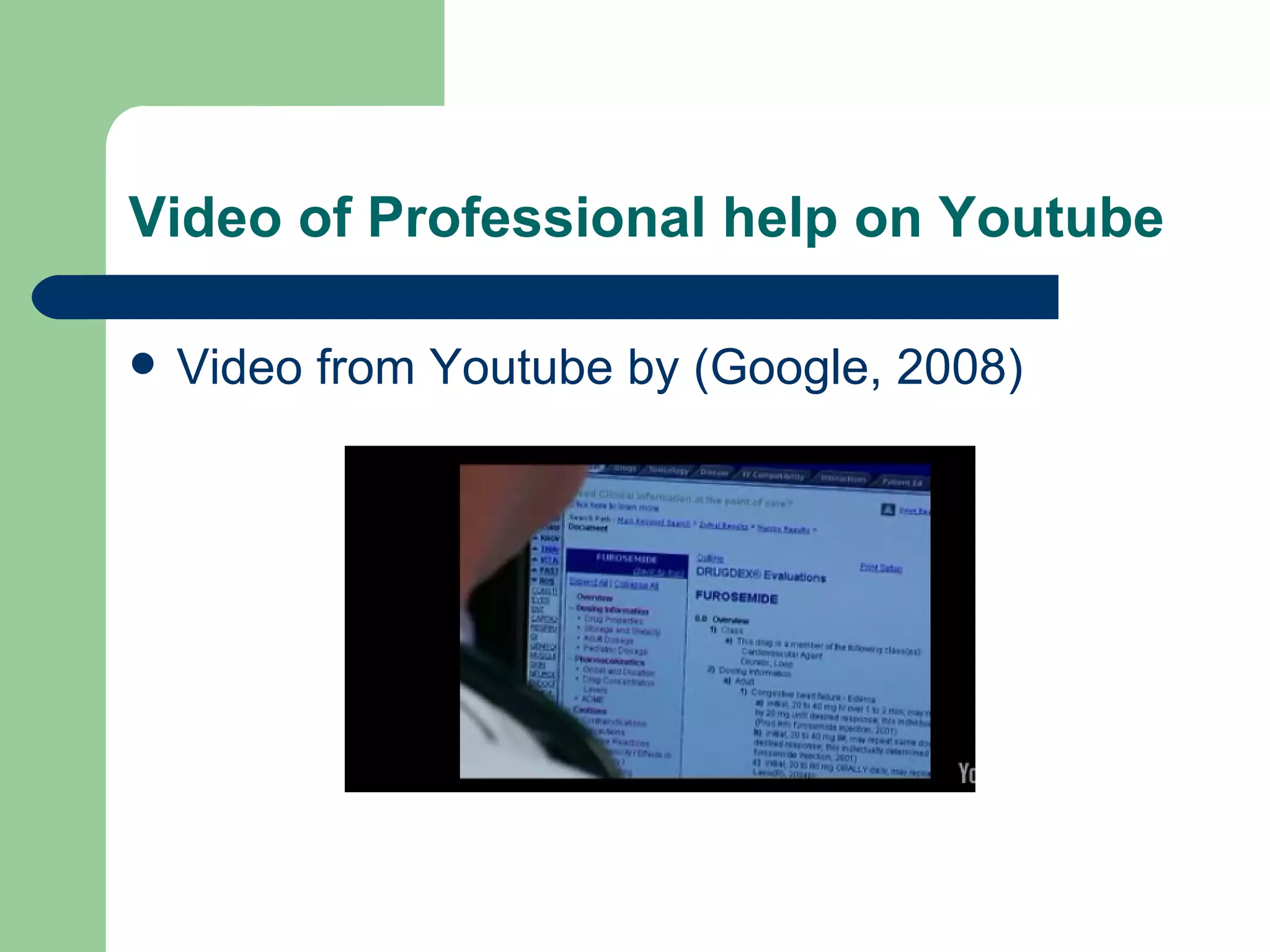
Video of Professional help on Youtube Video from Youtube by (Google, 2008)
Information Sources Seeking advice over the web is popular this means that more qualified personal need to be available there is more and more demand for this. For example in America the site  ‘America’s Doctor’  ( www.Amerciasdoctor.com ) states that it has over 142 physicians. (American Doctor. 2008) WebMD  (www.webmd.com) provides online group discussions with medical experts on various medial topics. (WebMD. 2008) Cyberdocs  ( www.cyberdocs.com ) this is an online service that started in 1996 this offers consultations from board certified physicians that can cost from $50 - $100 a session. It is reported that by 1999 the service gets 3000 hits a day or about 10,000 a month. (Cyberdocs. 2008)
Information Sources Cont.. http://ehealth-connection.org/  - this is an African based site that allows user to interact with other suffers  African E-health  – “The focus is on how increasing access to the Internet and related technologies can be used to improve health care delivery in developing countries” (Fofana. 2008)
Other sites/journals http://www.cancer.org/docroot/home/index.asp http://www.diabetes.org/ http://www.cdc.gov/ http://www.nih.gov/ http://content.nejm.org/ http://www.intelihealth.com/IH/ihtIH/WSIHW000/408/408.html
Advantages of professional opinions Lots of information readily available Convenient and also available 24 hour No face to face with doctors Anonymity is an attraction Get information without leaving your home
Disadvantages of professional opinions Security concerns  – Other than people’s financial data, a persons health is very sensitive information, and if consumers are giving this data over the internet then security becomes an issue. This may put people off using the internet to interact with doctors over their health which in turn means that they might not get treated. (Medical News Today. 2008) Quality of information  – Due to the diversity of the information that can be found on the internet, there is most likely to be a great deal of poor quality information available. This quality of information can turn users off some customers and physicians from using the embracing the internet. ( Schimelpfening , 2006 ) Lack of Resources for Web Development  – Information systems departments in most health care organization are not web-orientated as these departments they under funded.
The Future of Professional opinions Customers who seek health information may end up taking matters into their own hands by the following: Consumer Health information services  – as consumers seek information from the thousands of web pages dedicated to health care, the number of these sites will increase. New web-orientated health start-ups will encourage individuals to put up their own content, rating services and trusted brands will help customers sort though all the information that can be found. Online support groups for patients and caregivers  – Online support for patients with a given diseases and the people who care for them will continue to develop rapidly. Patients will feel more in control and for many diseases have better outcomes.
Summary (1) Mass information = mostly infective information Support is out there for suffers via groups Communities have been set up to help similar suffers Doctors are available for e-commerce interaction
Summary (2) Don’t believe every remedy you see on the internet Videos from Youtube and other sites can be quite helpful Google is your friend Its costs nothing to search for help before seeing a doctor
References (1 - 6) Americas Doctor. 2008.  Web stats  [online]  www.Amerciasdoctor.com  (Accessed 03 February 2009) WebMD. 2008.  Web Stats  [online]  www.webmd.com  (Accessed 03 February 2009) Cyberdocs. 2008.  Web Stats  www.cyberdocs.com  (Accessed 03 February 2009) Medscape General Medicine, 1999.  Healthcare via the internet  [online]  www.Medscape.com  [Accessed Date 3rd February 2009] Fox et al. 2000.  The online health care revolution  [online]  http://www.pewinternet.org/Reports/2000/The-Online-Health-Care-Revolution.aspx  (Accessed 03 February 2009) Schimelpfening , 2006. [online]  Healthcare & The Internet  http://depression.about.com/od/preparingforappointment/a/internethealth.htm  (Accessed 04 February 2008)
References (7 - 11) The Opte Project. 2007. [Online]  http://ehealth-connection.org/  (Accessed 04 February 2009) Fofana. A. 2008.  Boosting health care via the internet  [Online]  http://allafrica.com/stories/200807230029.html  (Accessed 04 February 2009) Moores. J. 2004.  Health Care on the Internet  [Online]  http://www.medhunters.com/articles/healthcareOnTheInternet.html  (Accessed 05 February 2009) Google 2007.  Consumers and Physicians Online for Health  [Video]  http://www.youtube.com/watch?v=PuNhxPCu2aY  (Accessed 06 Febuary 2009) Medical News Today. 2008.  Resolution Of Privacy, Security Concerns Might Prompt Adoption Of Health Care Information Technology  [Online]  http://www.medicalnewstoday.com/articles/133326.php  (Accessed 06 Febuary 2009)

Ass3 Form

  • 1.
    Health In CMCLuke Harrison, Marley Gordon, Anthony Glynn , Samuel Harmer and Simon Hill
  • 2.
    Points to bediscussed Online health concerns Advantages & Disadvantages Sources of health information Professional opinions The future of these opinions and the community
  • 3.
    Online health concernsThere are a few concerns with Online health care as the user who is seeking medical advice uses the internet to gather information on what to do next or to treat themselves depending on there situation. For example there are way too many different resources that can be accessed to find out the relevant information, these include search engines, NHS sites etc. This means that there can be a number of different versions to the remedy of these problems.
  • 4.
    Online health concernscont.. Also there are more and more people are turning to online health care because of the current state of the NHS with queuing times and service and if people don’t get the correct supervision that they require then this could have serve repercussions for there health. Another concern is that some of the information can be edited, take Wikipedia for example, a user can search this to find a remedy however this data can edit by anyone who has an account and this may cause problems the information posted by people might not be correct.
  • 5.
    Professional opinions It is possible to get professional opinions via internet from sources such as the NHS direct which provides advice on health and medical problems. In America alone it is estimated that 52 million people have used the internet to find information about diseases and medical treatment. (Moores. 2004) 55% of internet users surveyed had accessed health information. (fox et al. 2000) However only 9% of this figure had exchanged emails with their physician.
  • 6.
    Professional opinions cont…Most “health seekers” focused on getting information about an immediate medical problem (fox et al. 2000) Majority got information in conjunction with a doctor’s visit Users appreciate the convenience of being able to seek information at any hour
  • 7.
    Video of Professionalhelp on Youtube Video from Youtube by (Google, 2008)
  • 8.
    Information Sources Seekingadvice over the web is popular this means that more qualified personal need to be available there is more and more demand for this. For example in America the site ‘America’s Doctor’ ( www.Amerciasdoctor.com ) states that it has over 142 physicians. (American Doctor. 2008) WebMD (www.webmd.com) provides online group discussions with medical experts on various medial topics. (WebMD. 2008) Cyberdocs ( www.cyberdocs.com ) this is an online service that started in 1996 this offers consultations from board certified physicians that can cost from $50 - $100 a session. It is reported that by 1999 the service gets 3000 hits a day or about 10,000 a month. (Cyberdocs. 2008)
  • 9.
    Information Sources Cont..http://ehealth-connection.org/ - this is an African based site that allows user to interact with other suffers African E-health – “The focus is on how increasing access to the Internet and related technologies can be used to improve health care delivery in developing countries” (Fofana. 2008)
  • 10.
    Other sites/journals http://www.cancer.org/docroot/home/index.asphttp://www.diabetes.org/ http://www.cdc.gov/ http://www.nih.gov/ http://content.nejm.org/ http://www.intelihealth.com/IH/ihtIH/WSIHW000/408/408.html
  • 11.
    Advantages of professionalopinions Lots of information readily available Convenient and also available 24 hour No face to face with doctors Anonymity is an attraction Get information without leaving your home
  • 12.
    Disadvantages of professionalopinions Security concerns – Other than people’s financial data, a persons health is very sensitive information, and if consumers are giving this data over the internet then security becomes an issue. This may put people off using the internet to interact with doctors over their health which in turn means that they might not get treated. (Medical News Today. 2008) Quality of information – Due to the diversity of the information that can be found on the internet, there is most likely to be a great deal of poor quality information available. This quality of information can turn users off some customers and physicians from using the embracing the internet. ( Schimelpfening , 2006 ) Lack of Resources for Web Development – Information systems departments in most health care organization are not web-orientated as these departments they under funded.
  • 13.
    The Future ofProfessional opinions Customers who seek health information may end up taking matters into their own hands by the following: Consumer Health information services – as consumers seek information from the thousands of web pages dedicated to health care, the number of these sites will increase. New web-orientated health start-ups will encourage individuals to put up their own content, rating services and trusted brands will help customers sort though all the information that can be found. Online support groups for patients and caregivers – Online support for patients with a given diseases and the people who care for them will continue to develop rapidly. Patients will feel more in control and for many diseases have better outcomes.
  • 14.
    Summary (1) Massinformation = mostly infective information Support is out there for suffers via groups Communities have been set up to help similar suffers Doctors are available for e-commerce interaction
  • 15.
    Summary (2) Don’tbelieve every remedy you see on the internet Videos from Youtube and other sites can be quite helpful Google is your friend Its costs nothing to search for help before seeing a doctor
  • 16.
    References (1 -6) Americas Doctor. 2008. Web stats [online] www.Amerciasdoctor.com (Accessed 03 February 2009) WebMD. 2008. Web Stats [online] www.webmd.com (Accessed 03 February 2009) Cyberdocs. 2008. Web Stats www.cyberdocs.com (Accessed 03 February 2009) Medscape General Medicine, 1999. Healthcare via the internet [online] www.Medscape.com [Accessed Date 3rd February 2009] Fox et al. 2000. The online health care revolution [online] http://www.pewinternet.org/Reports/2000/The-Online-Health-Care-Revolution.aspx (Accessed 03 February 2009) Schimelpfening , 2006. [online] Healthcare & The Internet http://depression.about.com/od/preparingforappointment/a/internethealth.htm (Accessed 04 February 2008)
  • 17.
    References (7 -11) The Opte Project. 2007. [Online] http://ehealth-connection.org/ (Accessed 04 February 2009) Fofana. A. 2008. Boosting health care via the internet [Online] http://allafrica.com/stories/200807230029.html (Accessed 04 February 2009) Moores. J. 2004. Health Care on the Internet [Online] http://www.medhunters.com/articles/healthcareOnTheInternet.html (Accessed 05 February 2009) Google 2007. Consumers and Physicians Online for Health [Video] http://www.youtube.com/watch?v=PuNhxPCu2aY (Accessed 06 Febuary 2009) Medical News Today. 2008. Resolution Of Privacy, Security Concerns Might Prompt Adoption Of Health Care Information Technology [Online] http://www.medicalnewstoday.com/articles/133326.php (Accessed 06 Febuary 2009)