

EMAIL
ETIQUETTE
AGENDA
WHAT IS ETIQUETTE?
۞The meaning of ‘ETIQUETTE’ is the customary code of polite behavior in society or
among members of a particular profession or group.
۞Etiquette governing communication on the internet
۞Rules for how to communicate appropriately and respectfully online.
WHY DOES IT MATTER?
۞Good email communication skills..
۞Are part of succeeding in college and on the job
۞Help you make a good impression
۞Make it more likely that you will get the response you want.
BASIC RULES OF EMAIL
Be sure to include these following:
۞Proper subject line
۞Greeting
۞Introduction (if necessary)
۞Request
۞Thank you or closing remarks
۞Signature
PROPER SUBJECT LINE
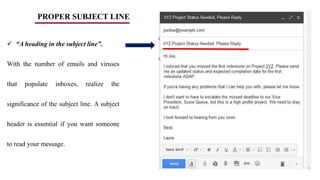
 “A heading in the subject line”.
With the number of emails and viruses
that populate inboxes, realize the
significance of the subject line. A subject
header is essential if you want someone
to read your message.
PROPER SUBJECT LINE
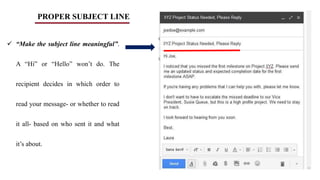
 “Make the subject line meaningful”.
A “Hi” or “Hello” won’t do. The
recipient decides in which order to
read your message- or whether to read
it all- based on who sent it and what
it’s about.
PROPER SUBJECT LINE
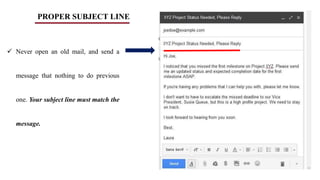
 Never open an old mail, and send a
message that nothing to do previous
one. Your subject line must match the
message.
PROPER SUBJECT LINE
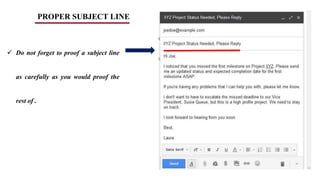
 Do not forget to proof a subject line
as carefully as you would proof the
rest of .
GREETINGS
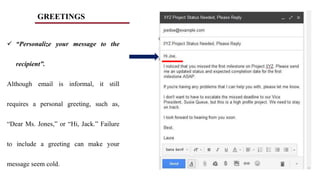
 “Personalize your message to the
recipient”.
Although email is informal, it still
requires a personal greeting, such as,
“Dear Ms. Jones,” or “Hi, Jack.” Failure
to include a greeting can make your
message seem cold.
INTRODUCTION AND SUBJECT MATTER
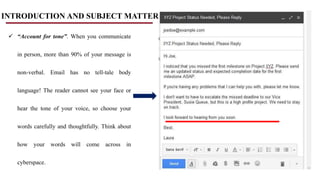
 “Account for tone”. When you communicate
in person, more than 90% of your message is
non-verbal. Email has no tell-tale body
language! The reader cannot see your face or
hear the tone of your voice, so choose your
words carefully and thoughtfully. Think about
how your words will come across in
cyberspace.
SIGNATURE
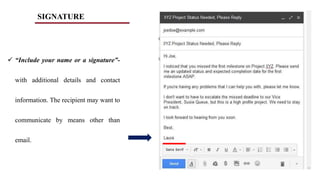
 “Include your name or a signature”-
with additional details and contact
information. The recipient may want to
communicate by means other than
email.
SIGNATURE
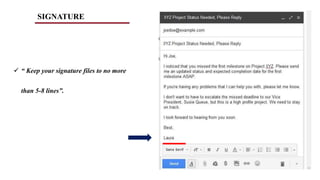
 “ Keep your signature files to no more
than 5-8 lines”.
SIGNATURE
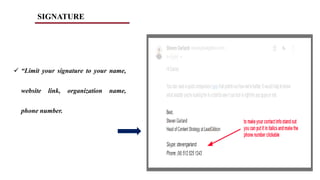
 “Limit your signature to your name,
website link, organization name,
phone number.
BASIC RULES OF FORWARDING AN EMAIL
 When forwarding an email you should include a personal comment to the person you are forwarding to.
 When forwarding a long email thread, a common courtesy is to summarize what’s being discussed below so the
recipient knows exactly what you want from them. It is considered a bad practice to forward a multiple-chain thread
with a note that just says, “see below.”
 Do not forward corporate emails to anybody besides other than any other organization’s employees or relevant
stakeholders.
BASIC RULES OF FORWARDING AN EMAIL
 Do not forward anything without editing out all the forwarding signs, other email addresses, headers and commentary
from all the other forwarders, unless it is an important information for the recipient.
 If you would like your forwarded email to start a new email chain (rather than being a part of your current thread),
simply include your own commentary in the subject line.
 Some emails are not intended to be forwarded. If a contact is sending you private or sensitive information, use high
caution before forwarding it along. If someone asks you to refrain from forwarding emails they have that right
BASIC RULES OF EMAIL RESPONSE TIME
 You should do your best to respond to all your work-related emails as quickly as possible.
 Reply to your emails-even if the email wasn’t intended for you, especially if the sender is expecting a
reply.
Due to busy schedules, it is not always possible to respond to emails right away. You should try to think of
email response times properly.
OTHER-BASIC RULES OF EMAIL
 Assume everything you write is a public document
 Avoid talking about other people in an email message.
 Use proper grammar and sentence structure. Spell check your message
 If your message includes a request, always close with a thank you to the recipient for considering it.
 Do not expect or demand an immediate response
 Reread your message before sending it, and rephrase if necessary.
OTHER-BASIC RULES OF EMAIL
 If you receive a confusing or unclear email message…
 Give the writer the benefit of doubt
 Ask politely for clarification
 Suggest discussing the matter in person
“ They may forget what you said, but
they will never forget how you mad
themfeel”
-Carl W. Buechner
THANK YOU

Email etiquette

  • 1.
  • 2.
  • 3.
    WHAT IS ETIQUETTE? ۞Themeaning of ‘ETIQUETTE’ is the customary code of polite behavior in society or among members of a particular profession or group. ۞Etiquette governing communication on the internet ۞Rules for how to communicate appropriately and respectfully online.
  • 4.
    WHY DOES ITMATTER? ۞Good email communication skills.. ۞Are part of succeeding in college and on the job ۞Help you make a good impression ۞Make it more likely that you will get the response you want.
  • 5.
    BASIC RULES OFEMAIL Be sure to include these following: ۞Proper subject line ۞Greeting ۞Introduction (if necessary) ۞Request ۞Thank you or closing remarks ۞Signature
  • 6.
    PROPER SUBJECT LINE “A heading in the subject line”. With the number of emails and viruses that populate inboxes, realize the significance of the subject line. A subject header is essential if you want someone to read your message.
  • 7.
    PROPER SUBJECT LINE “Make the subject line meaningful”. A “Hi” or “Hello” won’t do. The recipient decides in which order to read your message- or whether to read it all- based on who sent it and what it’s about.
  • 8.
    PROPER SUBJECT LINE Never open an old mail, and send a message that nothing to do previous one. Your subject line must match the message.
  • 9.
    PROPER SUBJECT LINE Do not forget to proof a subject line as carefully as you would proof the rest of .
  • 10.
    GREETINGS  “Personalize yourmessage to the recipient”. Although email is informal, it still requires a personal greeting, such as, “Dear Ms. Jones,” or “Hi, Jack.” Failure to include a greeting can make your message seem cold.
  • 11.
    INTRODUCTION AND SUBJECTMATTER  “Account for tone”. When you communicate in person, more than 90% of your message is non-verbal. Email has no tell-tale body language! The reader cannot see your face or hear the tone of your voice, so choose your words carefully and thoughtfully. Think about how your words will come across in cyberspace.
  • 12.
    SIGNATURE  “Include yourname or a signature”- with additional details and contact information. The recipient may want to communicate by means other than email.
  • 13.
    SIGNATURE  “ Keepyour signature files to no more than 5-8 lines”.
  • 14.
    SIGNATURE  “Limit yoursignature to your name, website link, organization name, phone number.
  • 15.
    BASIC RULES OFFORWARDING AN EMAIL  When forwarding an email you should include a personal comment to the person you are forwarding to.  When forwarding a long email thread, a common courtesy is to summarize what’s being discussed below so the recipient knows exactly what you want from them. It is considered a bad practice to forward a multiple-chain thread with a note that just says, “see below.”  Do not forward corporate emails to anybody besides other than any other organization’s employees or relevant stakeholders.
  • 16.
    BASIC RULES OFFORWARDING AN EMAIL  Do not forward anything without editing out all the forwarding signs, other email addresses, headers and commentary from all the other forwarders, unless it is an important information for the recipient.  If you would like your forwarded email to start a new email chain (rather than being a part of your current thread), simply include your own commentary in the subject line.  Some emails are not intended to be forwarded. If a contact is sending you private or sensitive information, use high caution before forwarding it along. If someone asks you to refrain from forwarding emails they have that right
  • 17.
    BASIC RULES OFEMAIL RESPONSE TIME  You should do your best to respond to all your work-related emails as quickly as possible.  Reply to your emails-even if the email wasn’t intended for you, especially if the sender is expecting a reply. Due to busy schedules, it is not always possible to respond to emails right away. You should try to think of email response times properly.
  • 18.
    OTHER-BASIC RULES OFEMAIL  Assume everything you write is a public document  Avoid talking about other people in an email message.  Use proper grammar and sentence structure. Spell check your message  If your message includes a request, always close with a thank you to the recipient for considering it.  Do not expect or demand an immediate response  Reread your message before sending it, and rephrase if necessary.
  • 19.
    OTHER-BASIC RULES OFEMAIL  If you receive a confusing or unclear email message…  Give the writer the benefit of doubt  Ask politely for clarification  Suggest discussing the matter in person
  • 20.
    “ They mayforget what you said, but they will never forget how you mad themfeel” -Carl W. Buechner
  • 22.