HEMCHAND YADAW
UNIVERSITY,
DURG
ENZYME LINKED
IMMUNOSORBENT ESSAY
(ELISA)
PRESENTED BY:
DHAMESHWAR SAHU
M.Sc. 1STsemester
INTRODUCTION
ELISA is a qualitative or quantitative immunological
procedures in which the Ag-Ab reaction is monitored by
enzyme measurements.
The term ELISA was first used by Engvall & Perlma in
1971.
The ELISA test was the first screening test commonly
employed for HIV. It has a high sensitivity.
Principle
Its principle is similar to RIA but depends on an enzyme
rather than a radioactive label.
An enzyme conjugated with an antibody reacts with a
colorless substrate to generate a colored reaction
product. Such a substrate is called a chromogenic
substrate.
A number of enzymes have been employed for ELISA
including alkaline phosphatase, horseradish peroxidase
and β-galactosidase.
Equipment's
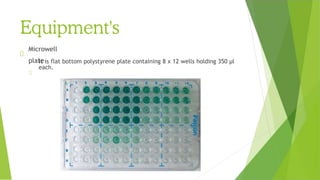
Microwell
plate
It is flat bottom polystyrene plate containing 8 x 12 wells holding 350 µl
each.
Equipment's
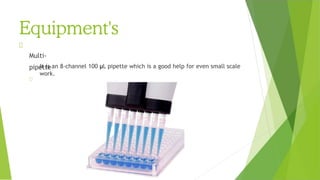
Multi-
pipette
It is an 8-channel 100 μL pipette which is a good help for even small scale
work.
Equipment's
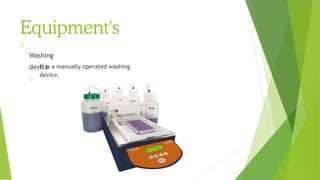
Washing
device
It is a manually operated washing
device.
Equipment's
Microplate
washer
These are very efficient with very low carry over contamination.
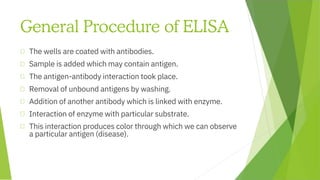
General Procedure of ELISA
The wells are coated with antibodies.
Sample is added which may contain antigen.
Removal of unbound antigens by washing.
Addition of another antibody which is linked with enzyme.
Interaction of enzyme with particular substrate.
This interaction produces color through which we can observe
a particular antigen (disease).
The antigen-antibody interaction took place.
Types of ELISA
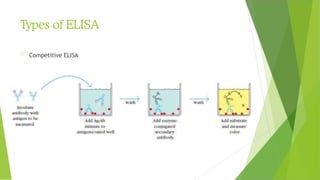
Competitive ELISA
There are three types of ELISA :-
. Indirect ELISA
Sandwich
ELISA
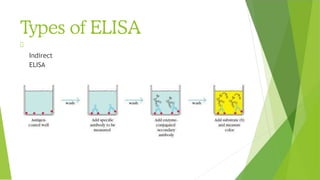
Types of ELISA
Indirect
ELISA
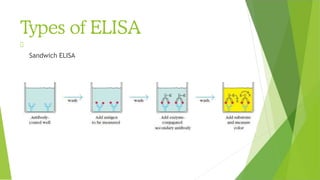
Types of ELISA
Sandwich ELISA
Types of ELISA
Competitive ELISA
Advantages of ELISA
Equipment's are inexpensive and widely
available. ELISA can be used to detect variety of
infections.
Reagents are relatively cheap and have a long shelf life.
No radiation hazards occur during labelling or disposal of
waste.
ELISA is highly specific and
sensitive.
Easy to perform and quick procedures.
Disadvantages of ELISA
Measurement of enzyme can be more complex.
Kits are commercially available, but not cheap.
Very specific to a particular antigen. Won’t recognize any
other antigen.
False positives/negatives possible, especially with
mutated/ altered antigen.
Enzyme activity may be affected by plasma constituents.
Thank You

Elisa _20231014_131716_0000.pptx

  • 1.
    HEMCHAND YADAW UNIVERSITY, DURG ENZYME LINKED IMMUNOSORBENTESSAY (ELISA) PRESENTED BY: DHAMESHWAR SAHU M.Sc. 1STsemester
  • 2.
    INTRODUCTION ELISA is aqualitative or quantitative immunological procedures in which the Ag-Ab reaction is monitored by enzyme measurements. The term ELISA was first used by Engvall & Perlma in 1971. The ELISA test was the first screening test commonly employed for HIV. It has a high sensitivity.
  • 3.
    Principle Its principle issimilar to RIA but depends on an enzyme rather than a radioactive label. An enzyme conjugated with an antibody reacts with a colorless substrate to generate a colored reaction product. Such a substrate is called a chromogenic substrate. A number of enzymes have been employed for ELISA including alkaline phosphatase, horseradish peroxidase and β-galactosidase.
  • 4.
    Equipment's Microwell plate It is flatbottom polystyrene plate containing 8 x 12 wells holding 350 µl each.
  • 5.
    Equipment's Multi- pipette It is an8-channel 100 μL pipette which is a good help for even small scale work.
  • 6.
    Equipment's Washing device It is amanually operated washing device.
  • 7.
    Equipment's Microplate washer These are veryefficient with very low carry over contamination.
  • 8.
    General Procedure ofELISA The wells are coated with antibodies. Sample is added which may contain antigen. Removal of unbound antigens by washing. Addition of another antibody which is linked with enzyme. Interaction of enzyme with particular substrate. This interaction produces color through which we can observe a particular antigen (disease). The antigen-antibody interaction took place.
  • 9.
    Types of ELISA CompetitiveELISA There are three types of ELISA :- . Indirect ELISA Sandwich ELISA
  • 10.
  • 11.
  • 12.
  • 13.
    Advantages of ELISA Equipment'sare inexpensive and widely available. ELISA can be used to detect variety of infections. Reagents are relatively cheap and have a long shelf life. No radiation hazards occur during labelling or disposal of waste. ELISA is highly specific and sensitive. Easy to perform and quick procedures.
  • 14.
    Disadvantages of ELISA Measurementof enzyme can be more complex. Kits are commercially available, but not cheap. Very specific to a particular antigen. Won’t recognize any other antigen. False positives/negatives possible, especially with mutated/ altered antigen. Enzyme activity may be affected by plasma constituents.
  • 15.