Before the Model:
How Machine Learning
Products Start
Elena Grewal / November 11, 2016 / @elenatej
Machine Learning Products @ Airbnb
● Two sided marketplace: Each guest and host are unique.
● ML at its core is around personalization and we use it in all
aspects of our product.
● Teams which have ML products: host growth, guest growth,
search, pricing, customer support, many more.
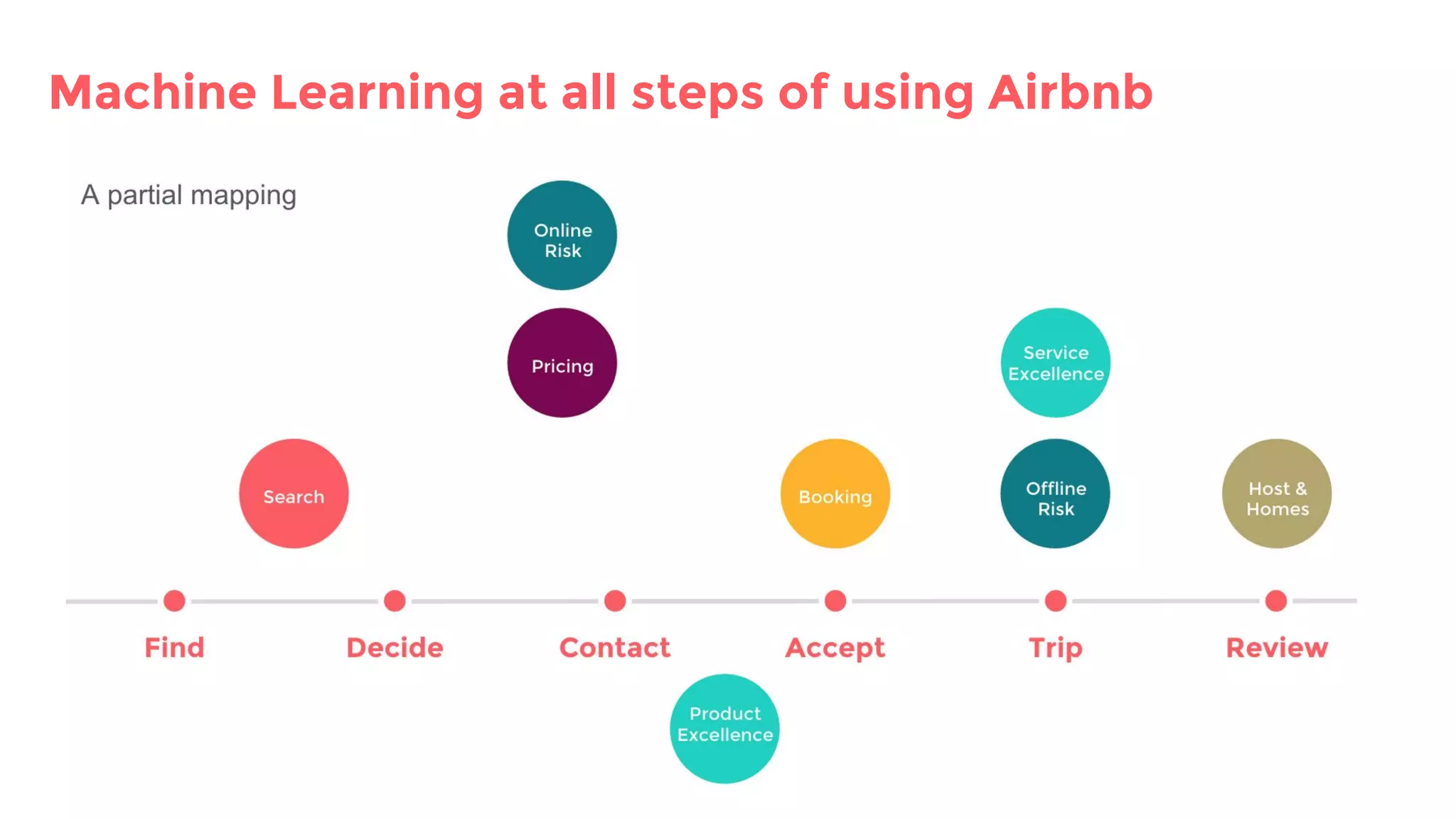
Machine Learning at all steps of using Airbnb
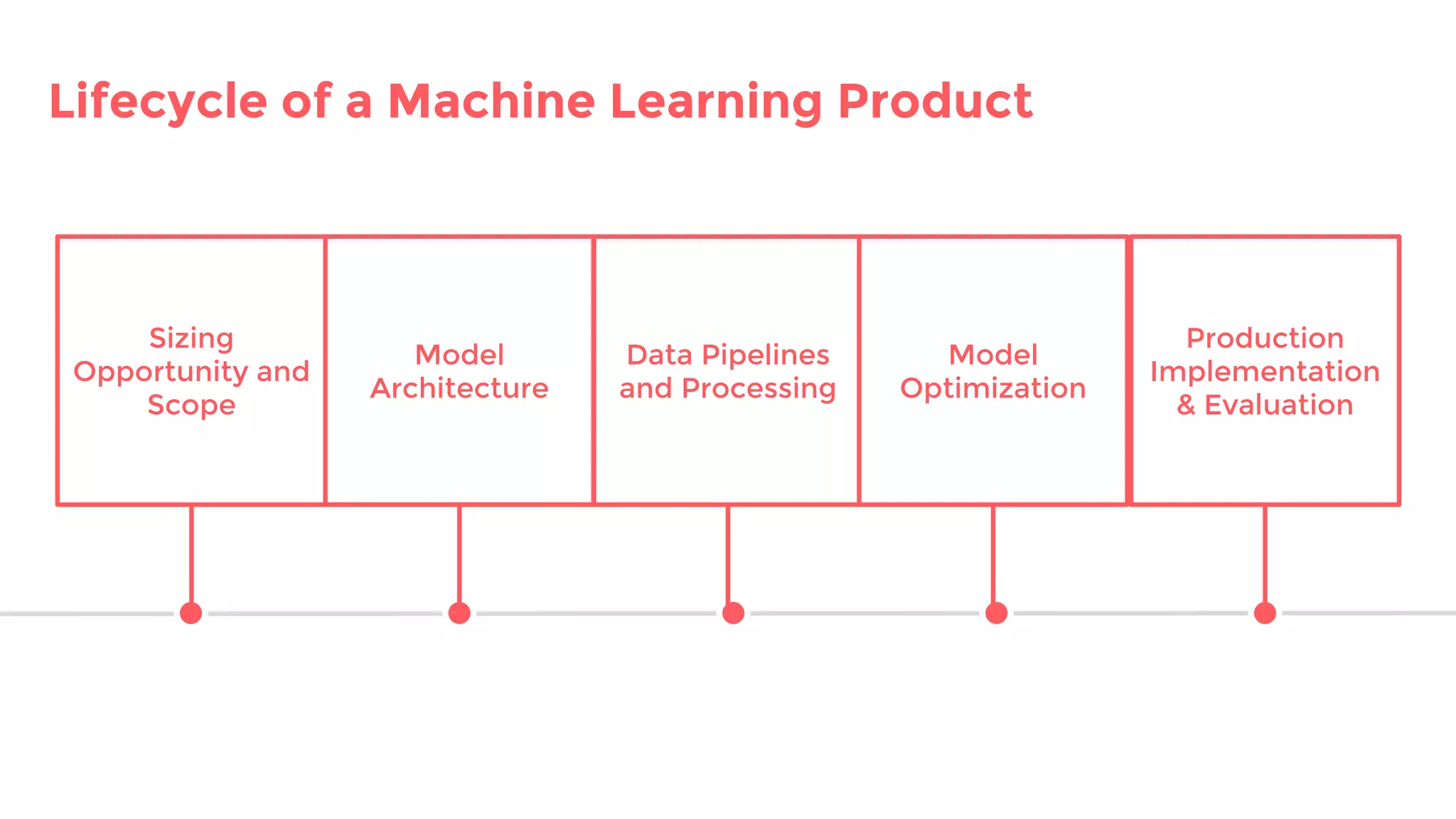
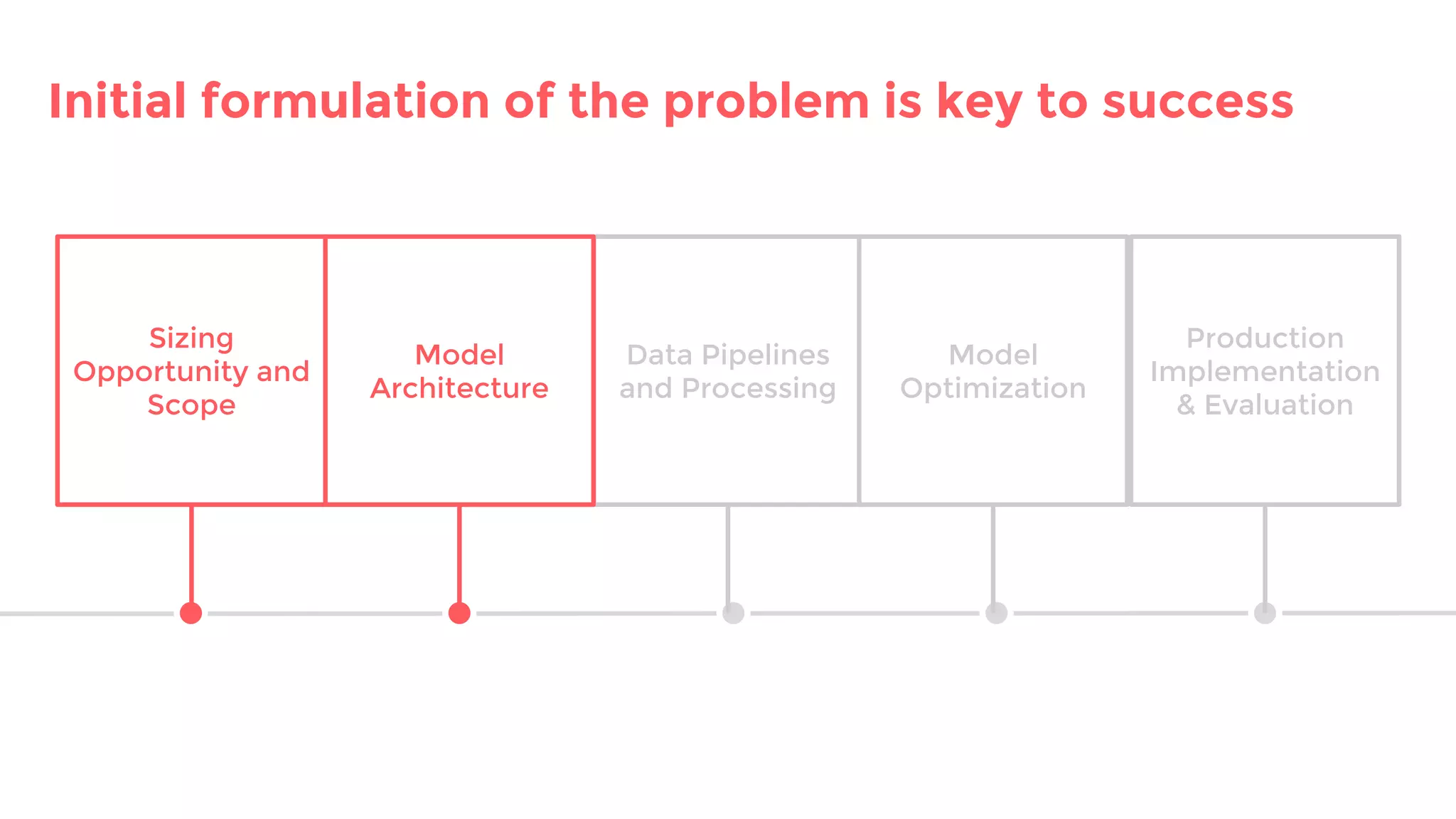
Lifecycle of a Machine Learning Product
Sizing
Opportunity and
Scope
Model
Architecture
Data Pipelines
and Processing
Model
Optimization
Production
Implementation
& Evaluation
Initial formulation of the problem is key to success
Sizing
Opportunity and
Scope
Data Pipelines
and Processing
Model
Optimization
Production
Implementation
& Evaluation
Model
Architecture
You need to have the
right target metric(s)
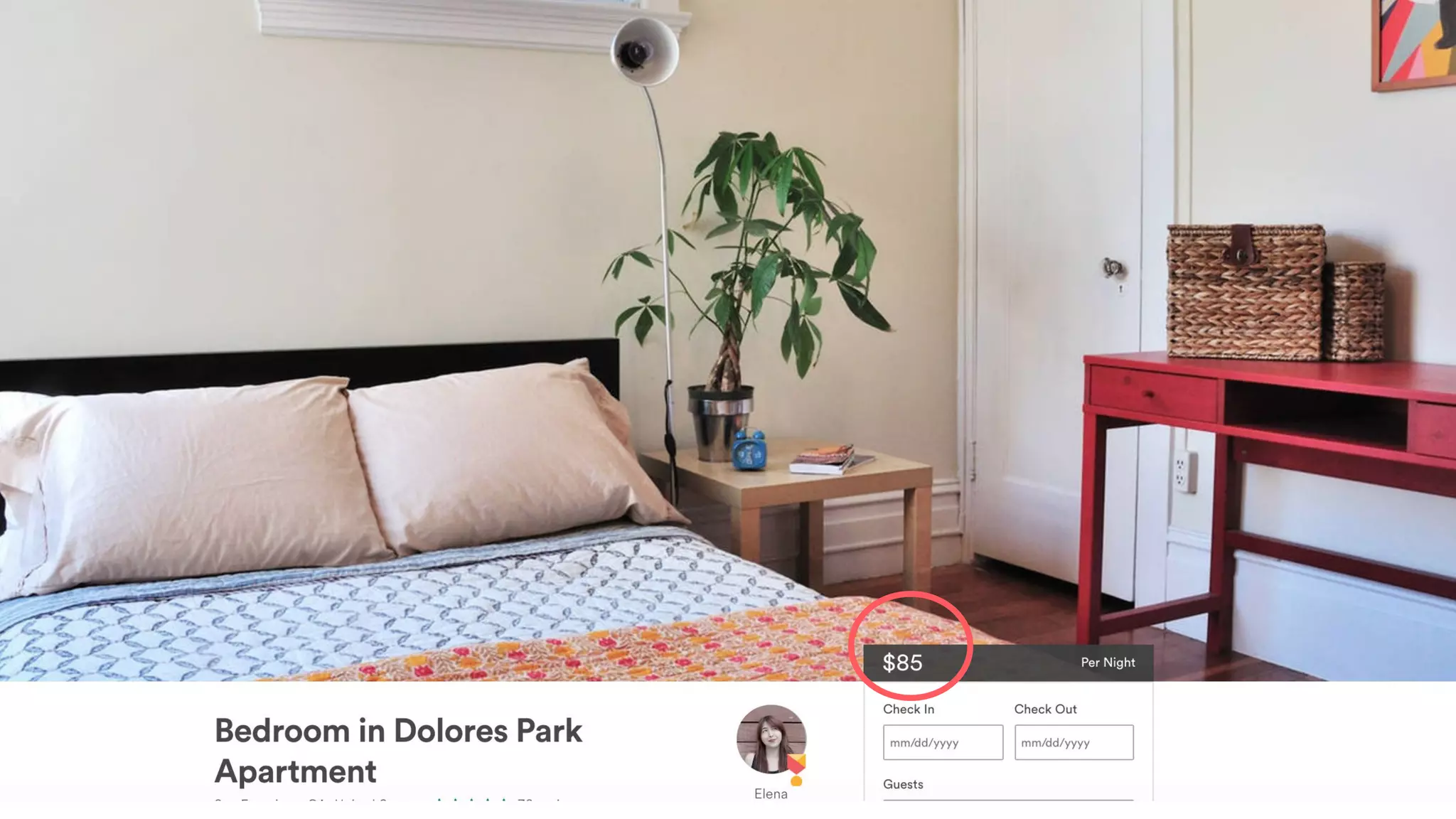
Pricing
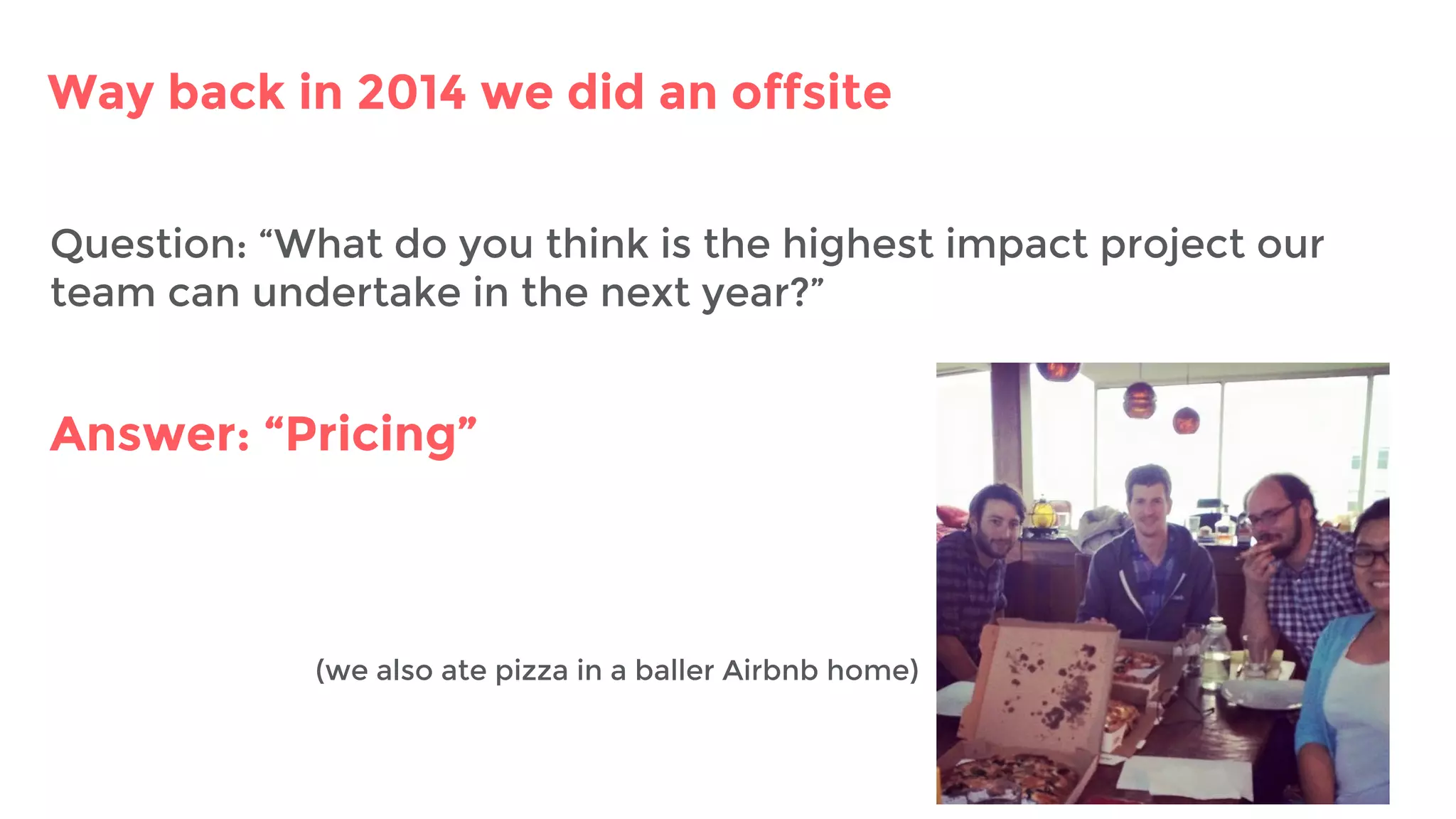
Way back in 2014 we did an offsite
Question: “What do you think is the highest impact project our
team can undertake in the next year?”
Answer: “Pricing”
(we also ate pizza in a baller Airbnb home)
Step 1: Make the Case for Working on Pricing
- Highlight all the ways that prices matter
- The impact of price on booking + rebooking
- Price filter usage
- Variations by market
50 slide deck presented to executives
Buy time! A project like this takes ~6 months to see any results
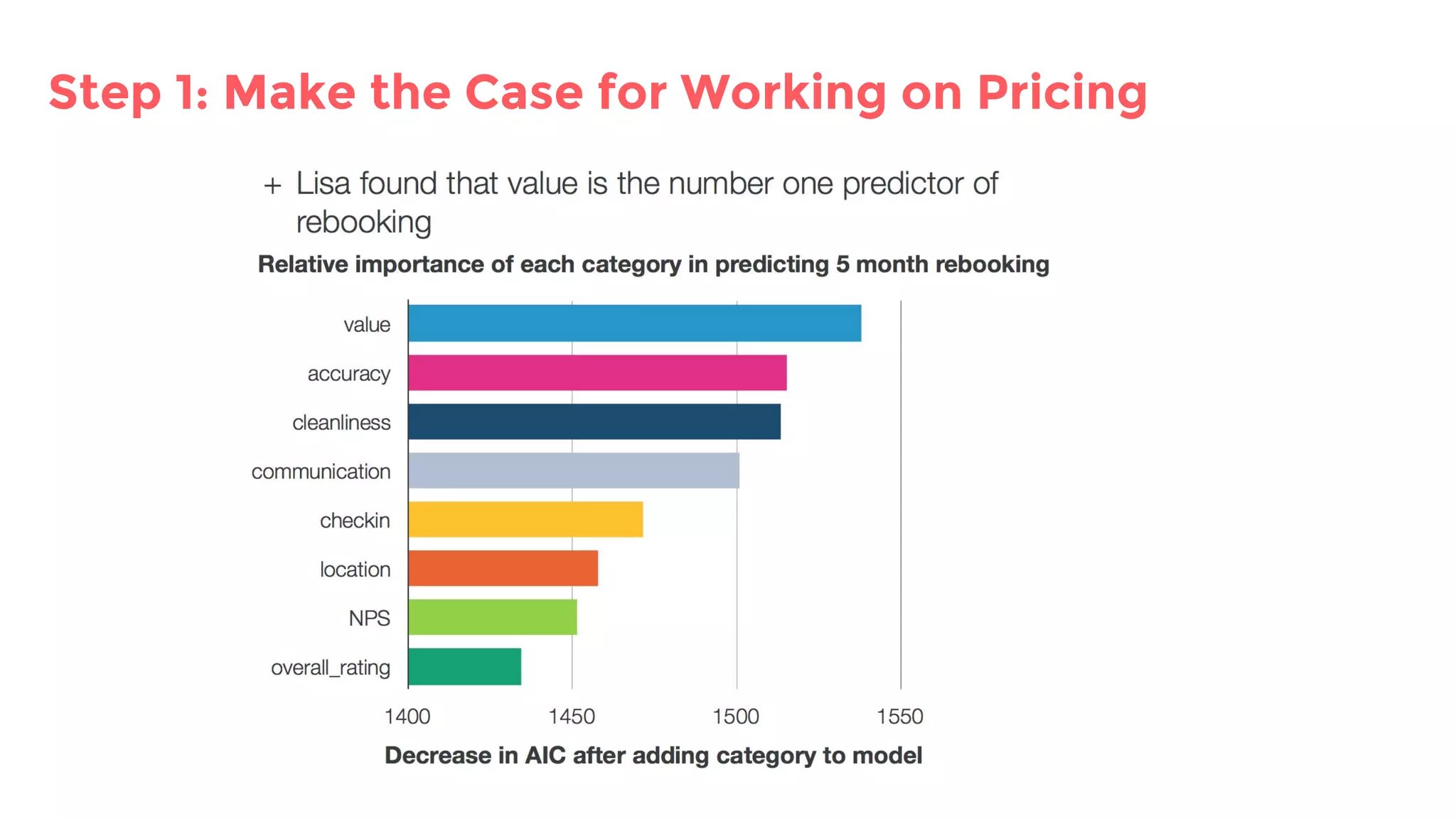
Step 1: Make the Case for Working on Pricing
Step 2: Model Architecture - Before
Current model predicted price using nearby Airbnb homes
- Location, Listing characteristics, Recency
This mimicked host behavior
Step 2: Model Architecture - After
New metric: Bookings
Price suggestion based on probability of booked on given day
- Much more flexible
- Prices for each date
- Interesting UX opportunities
Added model layer for adoption of prices. Team of 15 on it now!
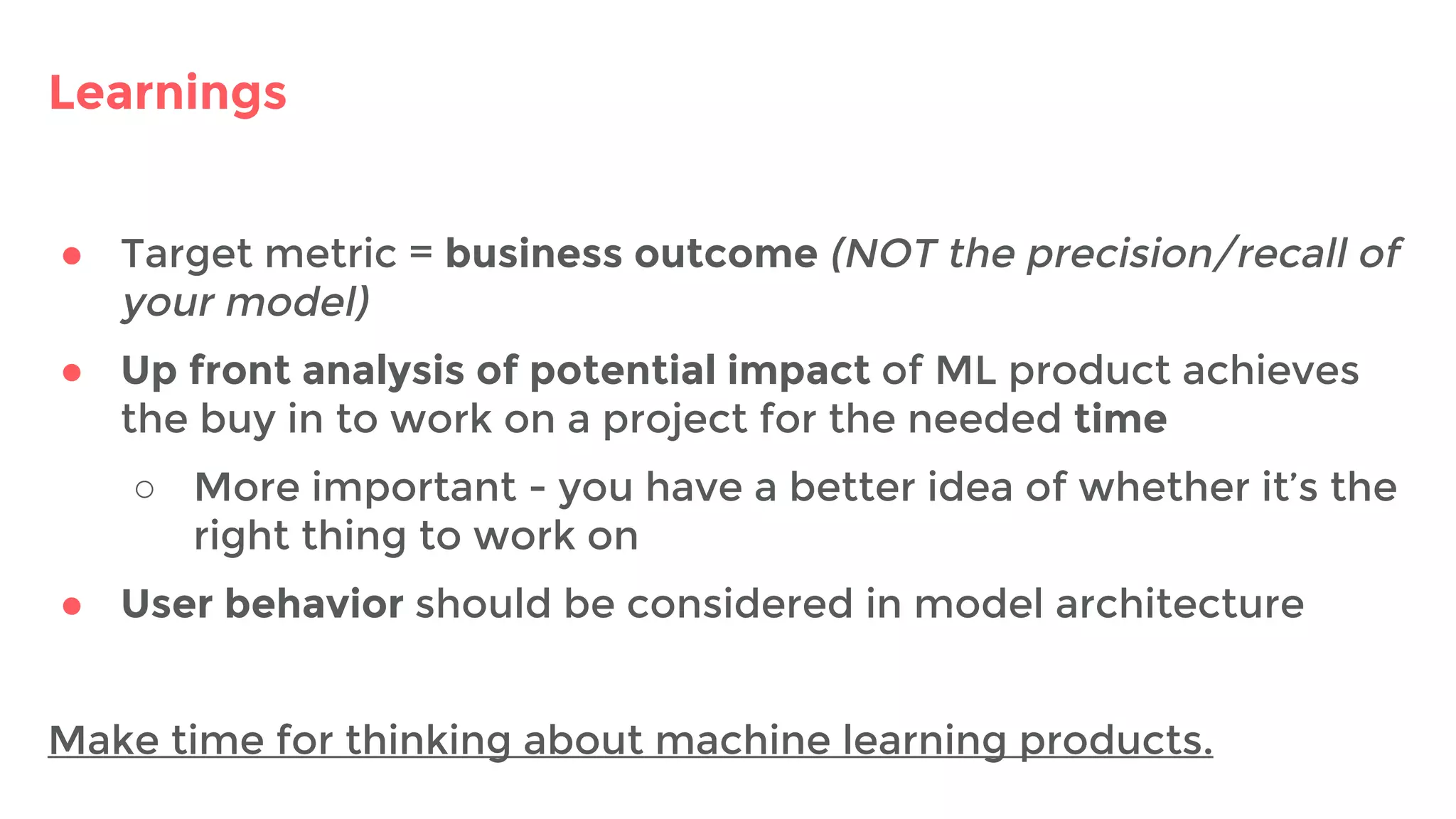
Learnings
● Target metric = business outcome (NOT the precision/recall of
your model)
● Up front analysis of potential impact of ML product achieves
the buy in to work on a project for the needed time
○ More important - you have a better idea of whether it’s the
right thing to work on
● User behavior should be considered in model architecture
Make time for thinking about machine learning products.
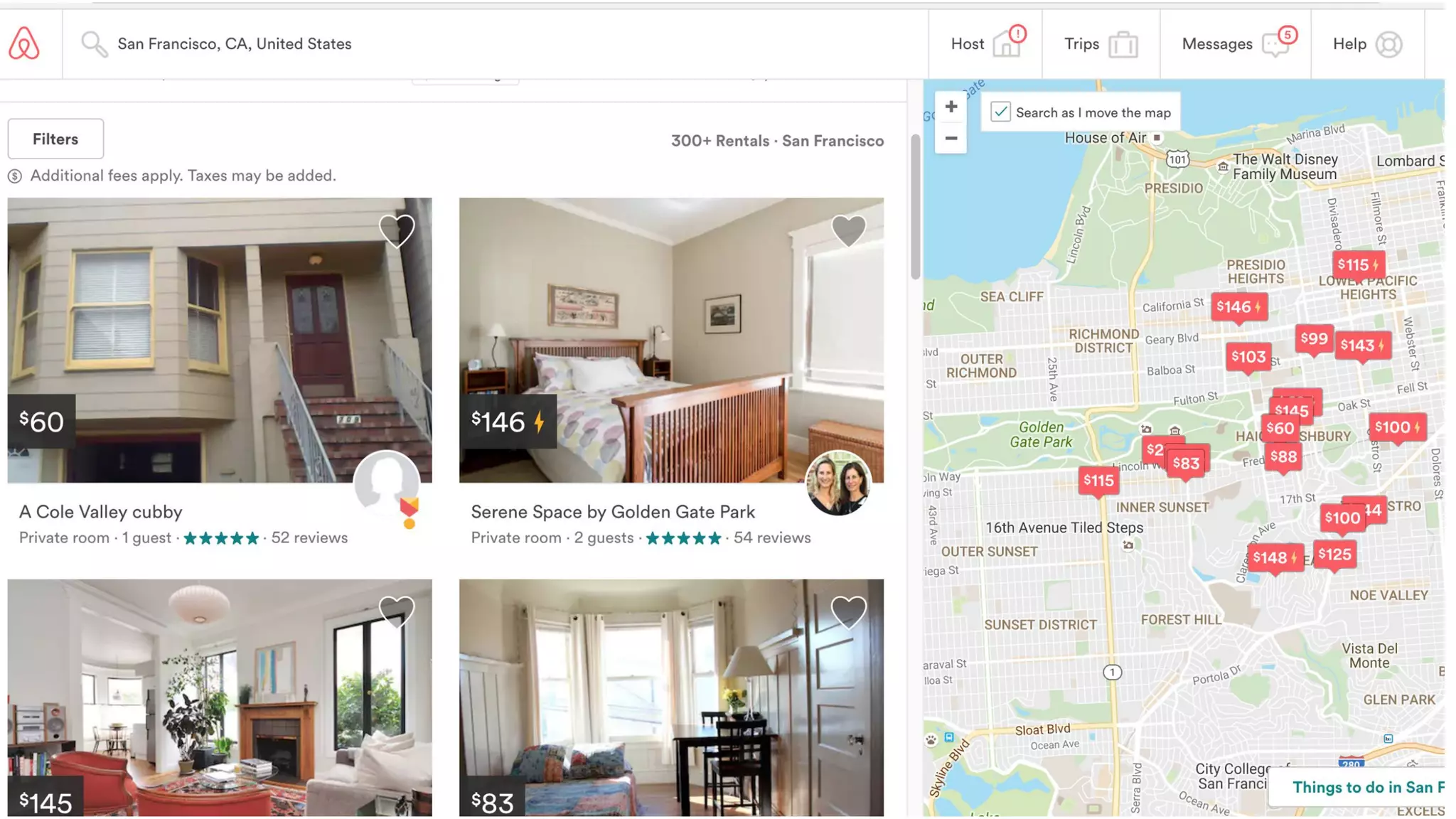
Search
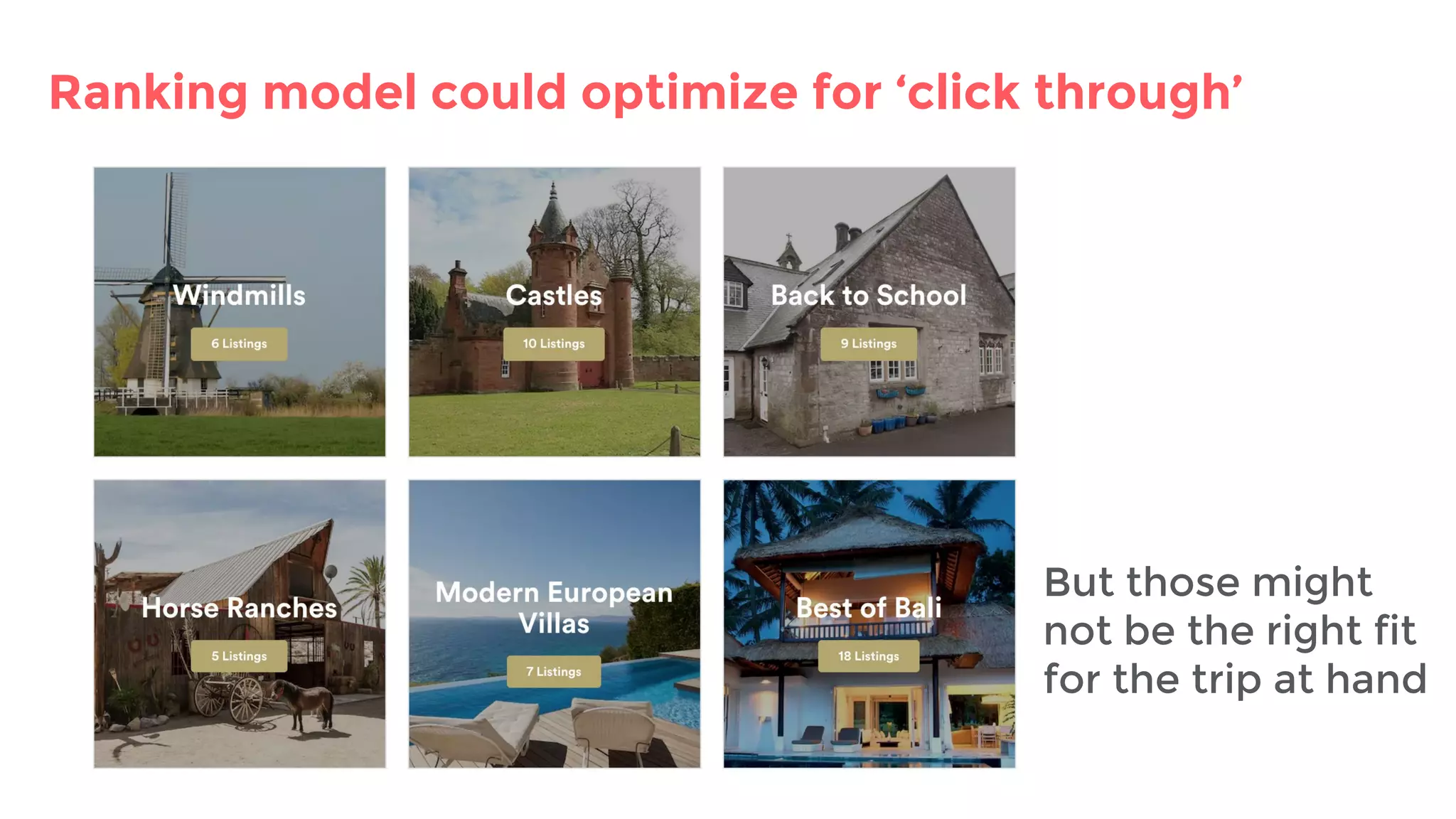
Ranking model could optimize for ‘click through’
But those might
not be the right fit
for the trip at hand
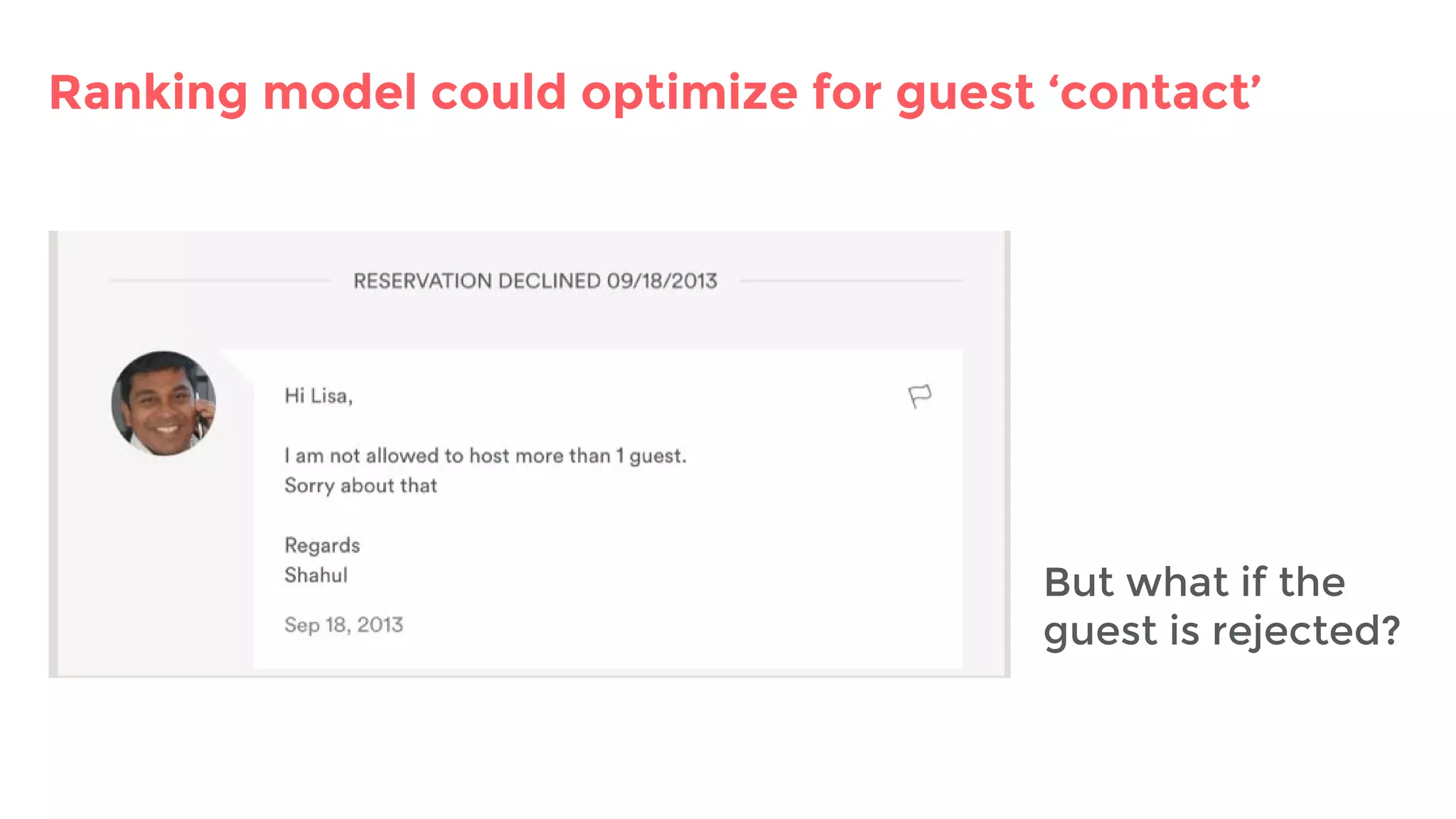
Ranking model could optimize for guest ‘contact’
But what if the
guest is rejected?
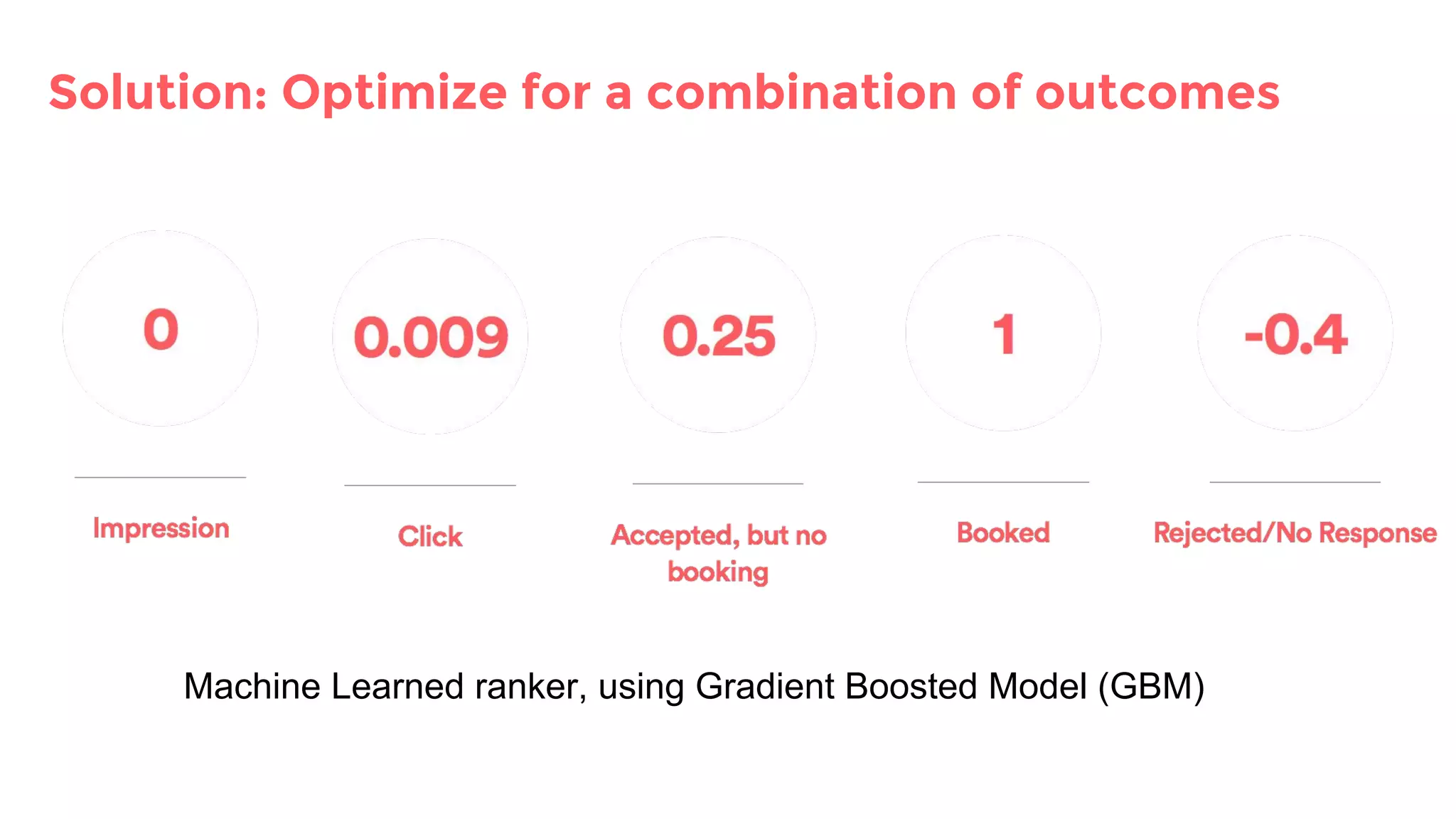
Solution: Optimize for a combination of outcomes
Machine Learned ranker, using Gradient Boosted Model (GBM)
Learnings
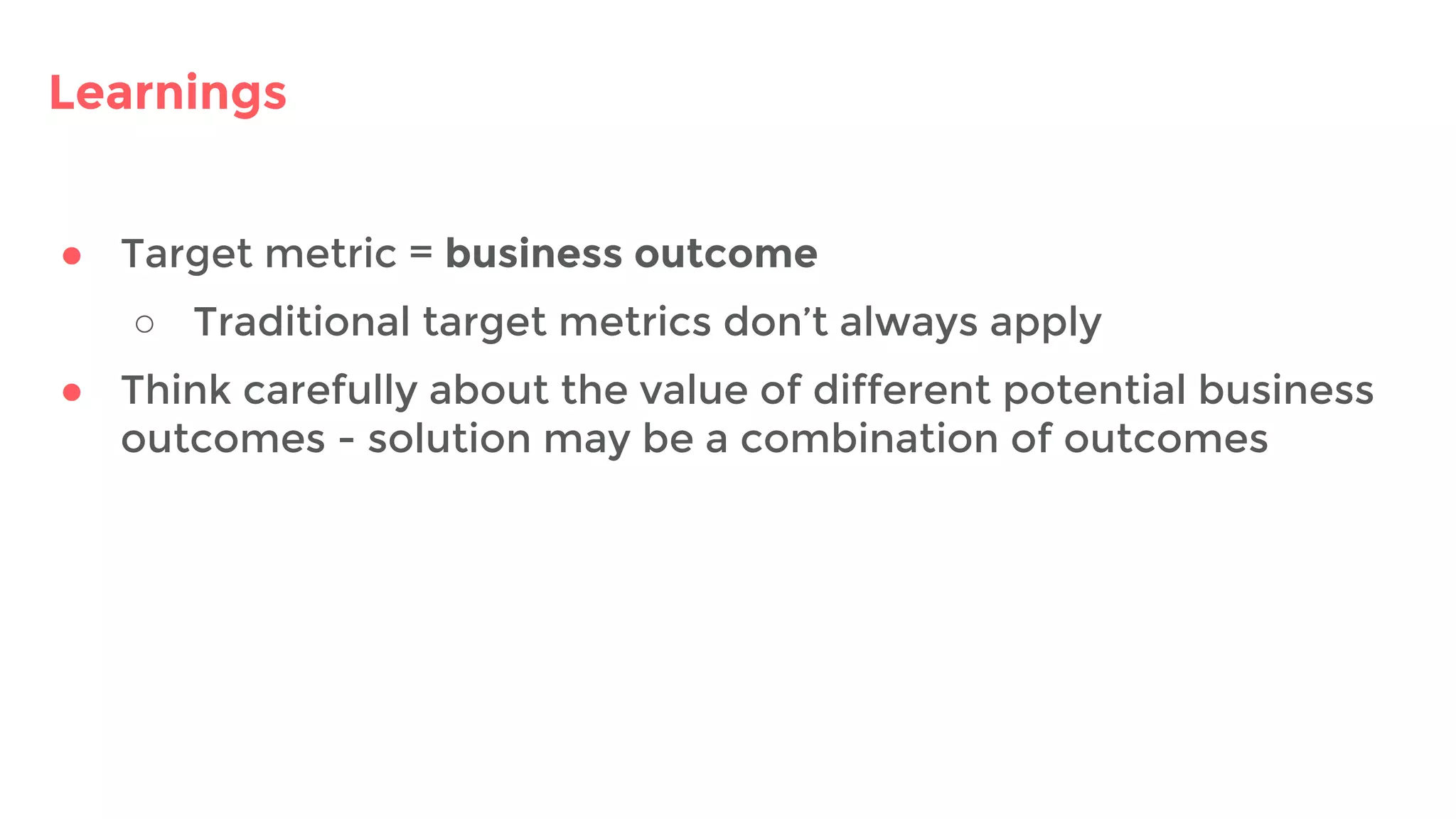
● Target metric = business outcome
○ Traditional target metrics don’t always apply
● Think carefully about the value of different potential business
outcomes - solution may be a combination of outcomes
Business Travel
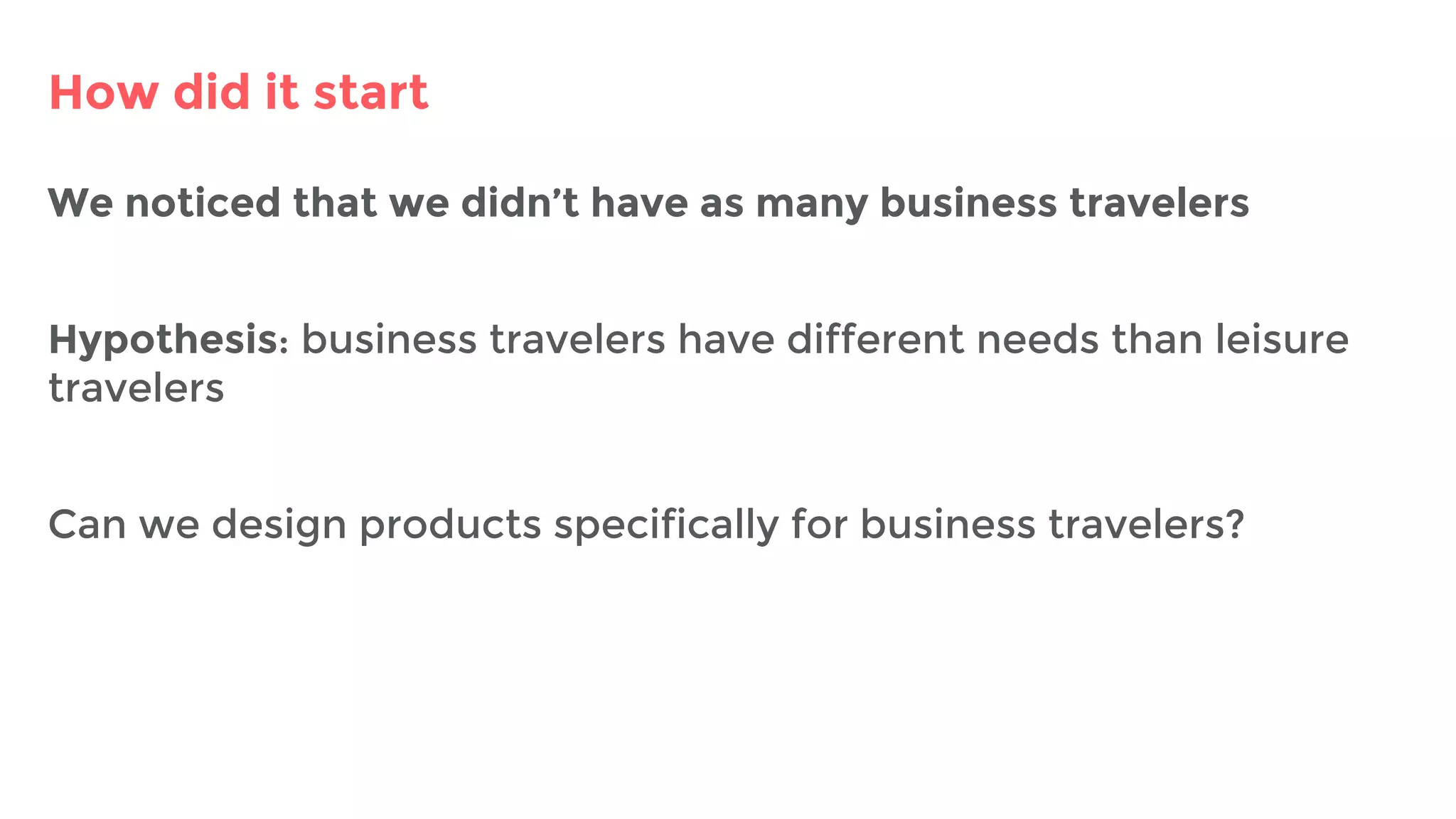
How did it start
We noticed that we didn’t have as many business travelers
Hypothesis: business travelers have different needs than leisure
travelers
Can we design products specifically for business travelers?
Step 1: Size the Opportunity
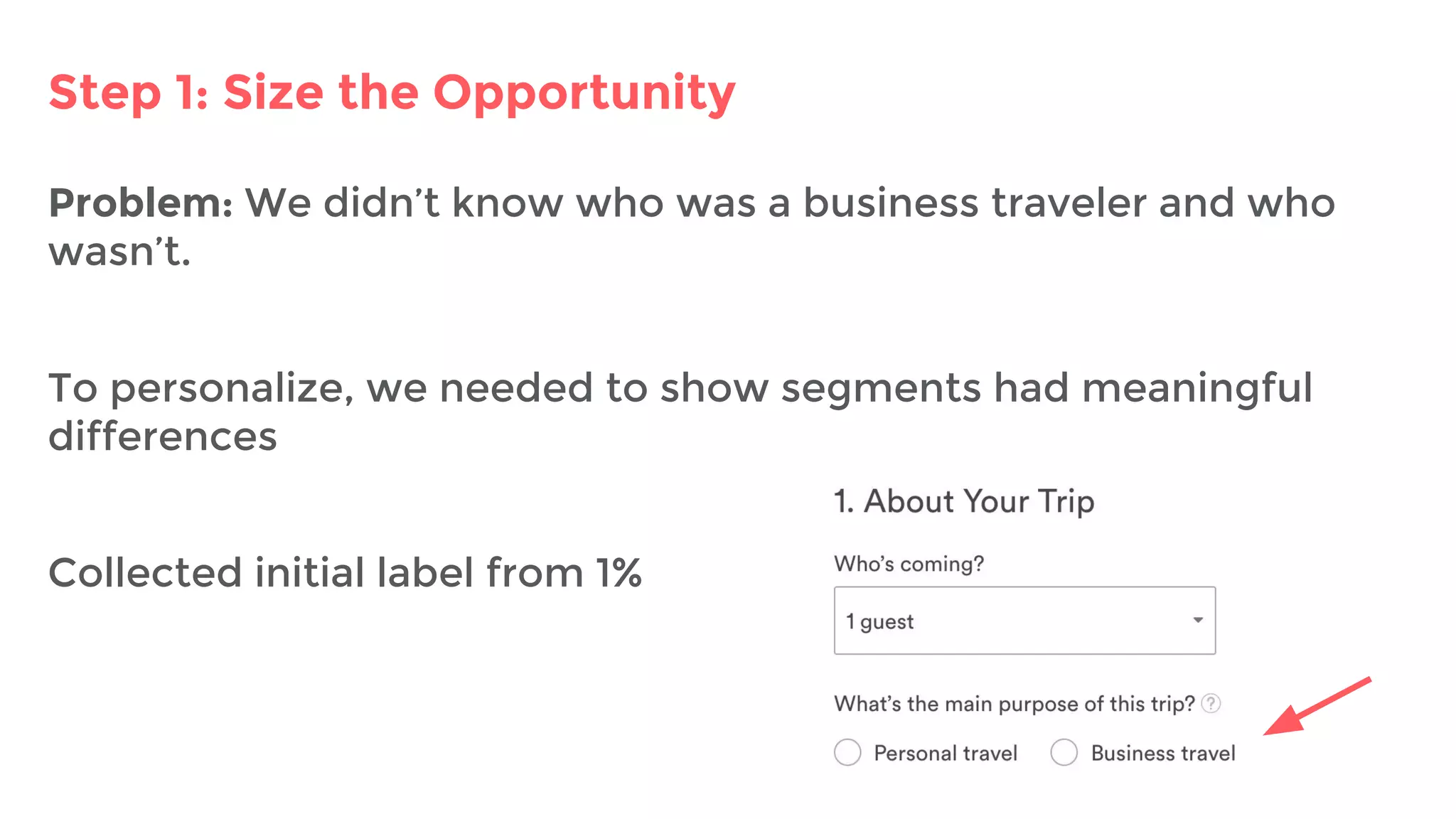
Problem: We didn’t know who was a business traveler and who
wasn’t.
To personalize, we needed to show segments had meaningful
differences
Collected initial label from 1%
Step 2: Model architecture
In this case, our goal was to target business travelers with
customized content to increase business travel penetration
Simple model, where we predicted if you were a business traveler
or not.
Learnings
● Start with hypothesis
● Collect labeled data
● Build a simple product to start - see how it works
Machine Learning Infrastructure
Prior state of the world
- Teams develop multiple ML infrastructure with different
versions of features
- ML in production requires engineering expertise
- While many teams are using ML the process is painful
Meta before the model
Step 1: Sizing the opportunity & scope
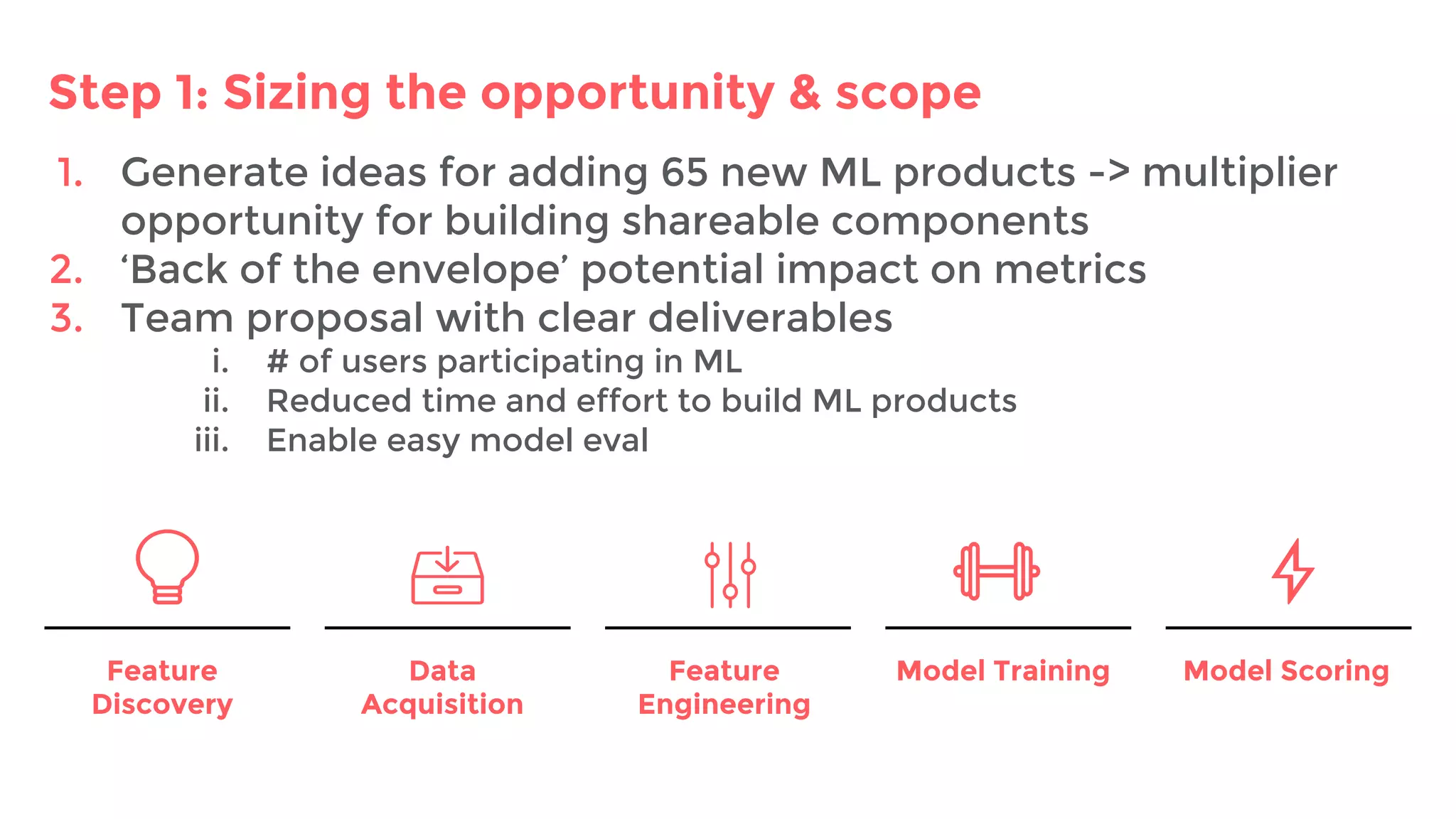
1. Generate ideas for adding 65 new ML products -> multiplier
opportunity for building shareable components
2. ‘Back of the envelope’ potential impact on metrics
3. Team proposal with clear deliverables
i. # of users participating in ML
ii. Reduced time and effort to build ML products
iii. Enable easy model eval
Feature
Discovery
Data
Acquisition
Feature
Engineering
Model Training Model Scoring
Step 2: In progress!
We have added support for Tensorflow and are now supporting a
couple models in production with new infra
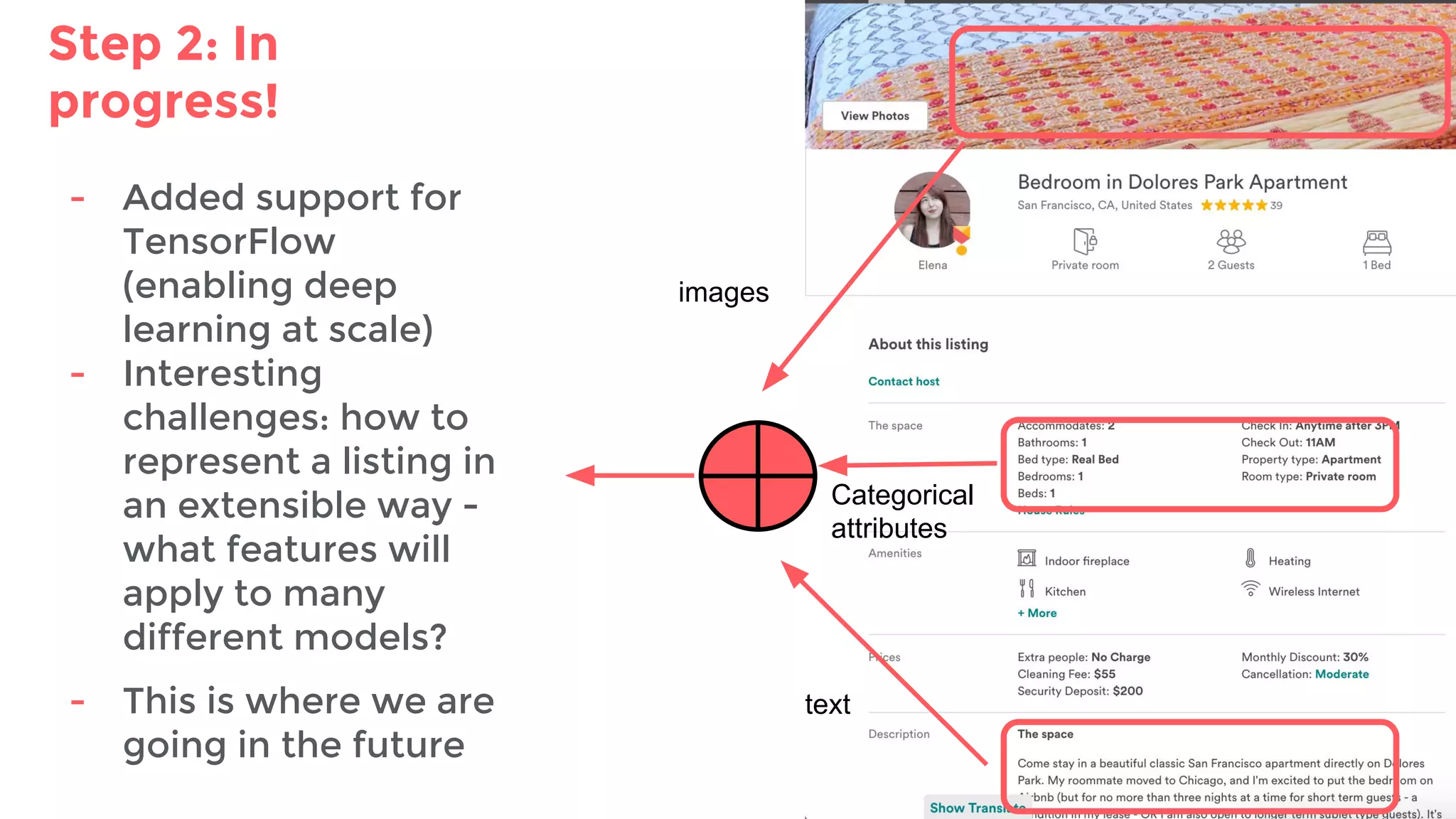
Interesting challenges: how to represent a listing in an extensible
way - what features will apply to many different models?
This is where we are going in the future.
Step 2: In
progress!
- Added support for
TensorFlow
(enabling deep
learning at scale)
- Interesting
challenges: how to
represent a listing in
an extensible way -
what features will
apply to many
different models?
- This is where we are
going in the future
images
text
Categorical
attributes
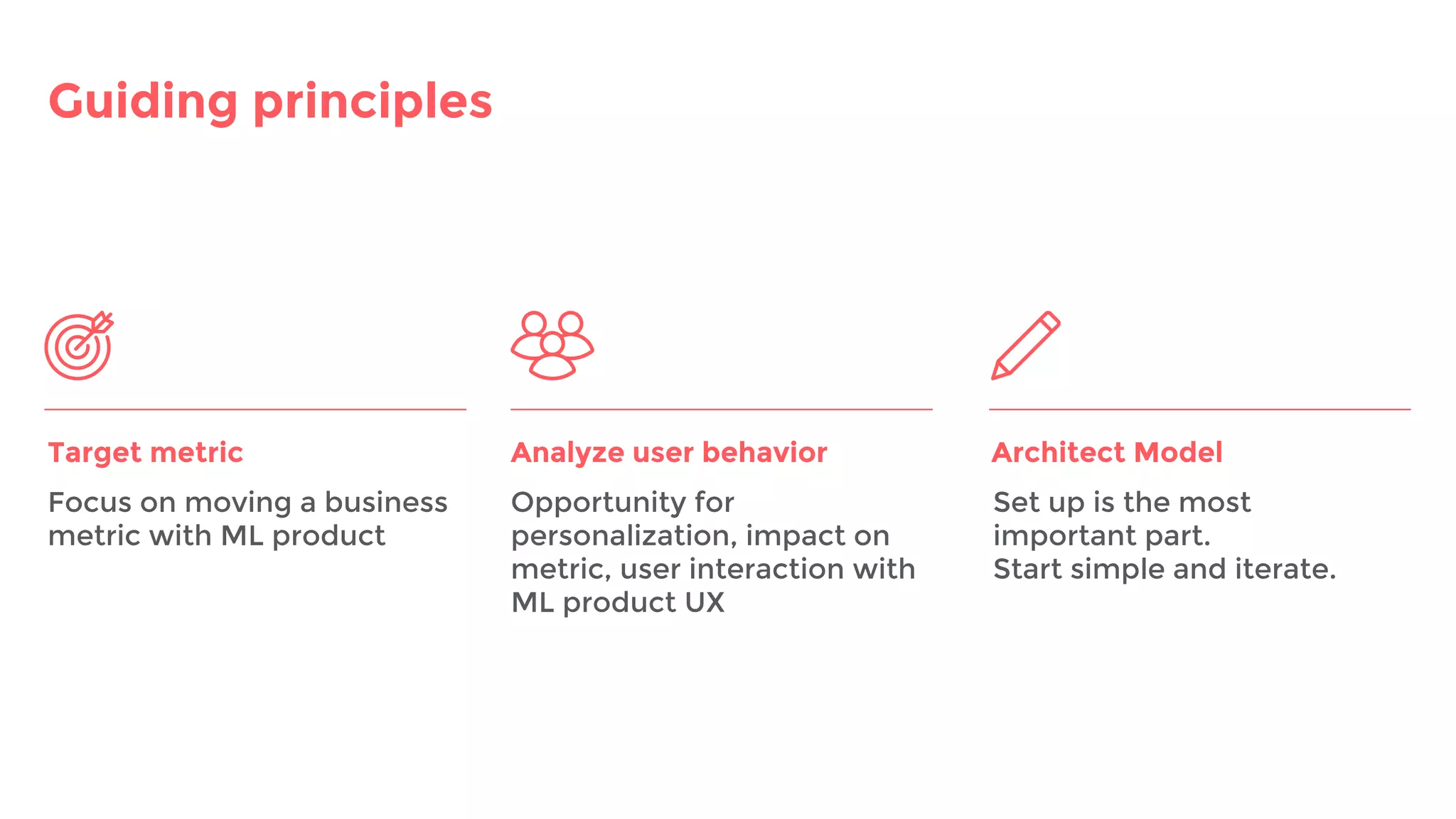
Guiding principles
Target metric Analyze user behavior Architect Model
Opportunity for
personalization, impact on
metric, user interaction with
ML product UX
Set up is the most
important part.
Start simple and iterate.
Focus on moving a business
metric with ML product
Appendix
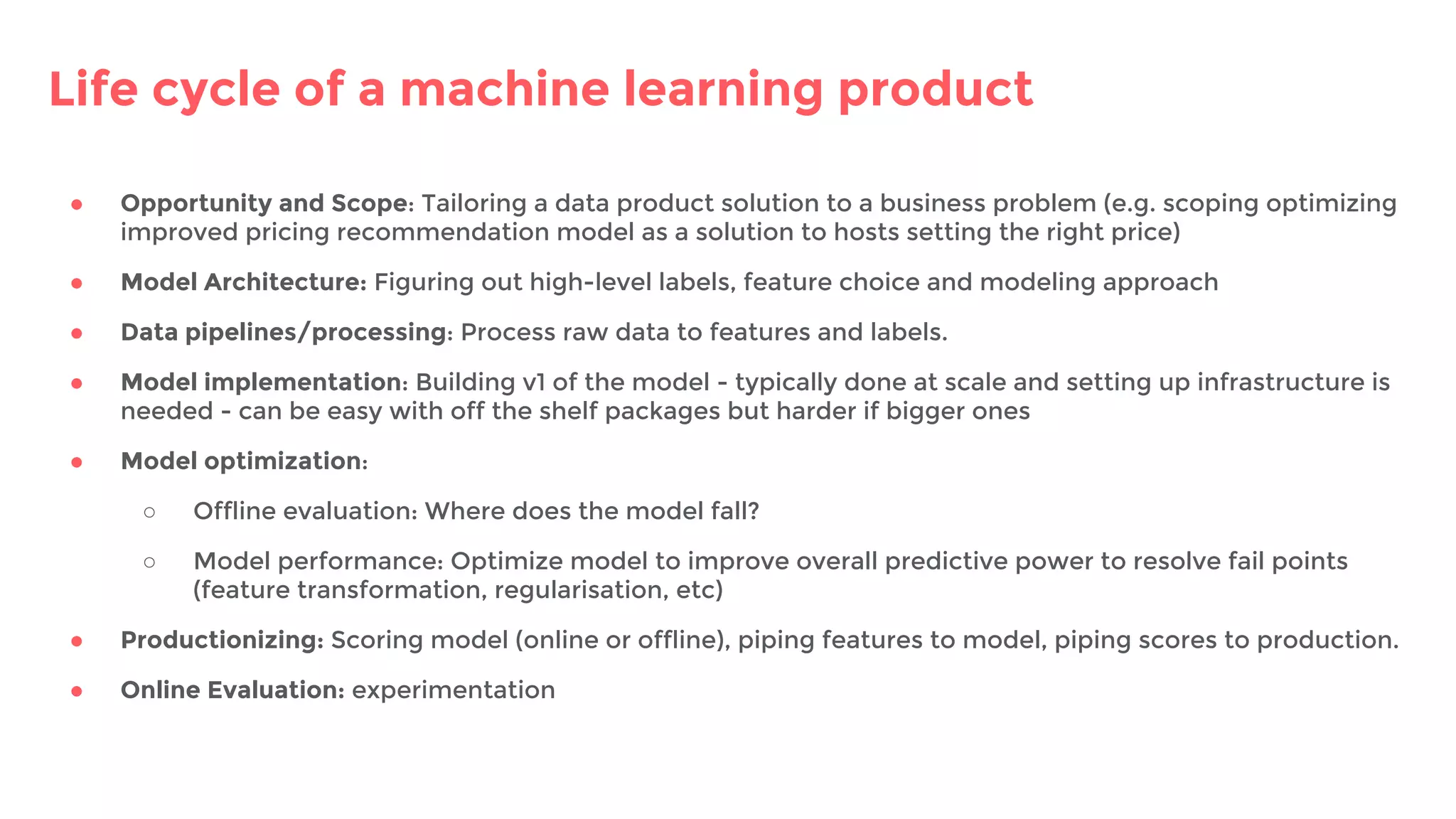
Life cycle of a machine learning product
● Opportunity and Scope: Tailoring a data product solution to a business problem (e.g. scoping optimizing
improved pricing recommendation model as a solution to hosts setting the right price)
● Model Architecture: Figuring out high-level labels, feature choice and modeling approach
● Data pipelines/processing: Process raw data to features and labels.
● Model implementation: Building v1 of the model - typically done at scale and setting up infrastructure is
needed - can be easy with off the shelf packages but harder if bigger ones
● Model optimization:
○ Offline evaluation: Where does the model fall?
○ Model performance: Optimize model to improve overall predictive power to resolve fail points
(feature transformation, regularisation, etc)
● Productionizing: Scoring model (online or offline), piping features to model, piping scores to production.
● Online Evaluation: experimentation
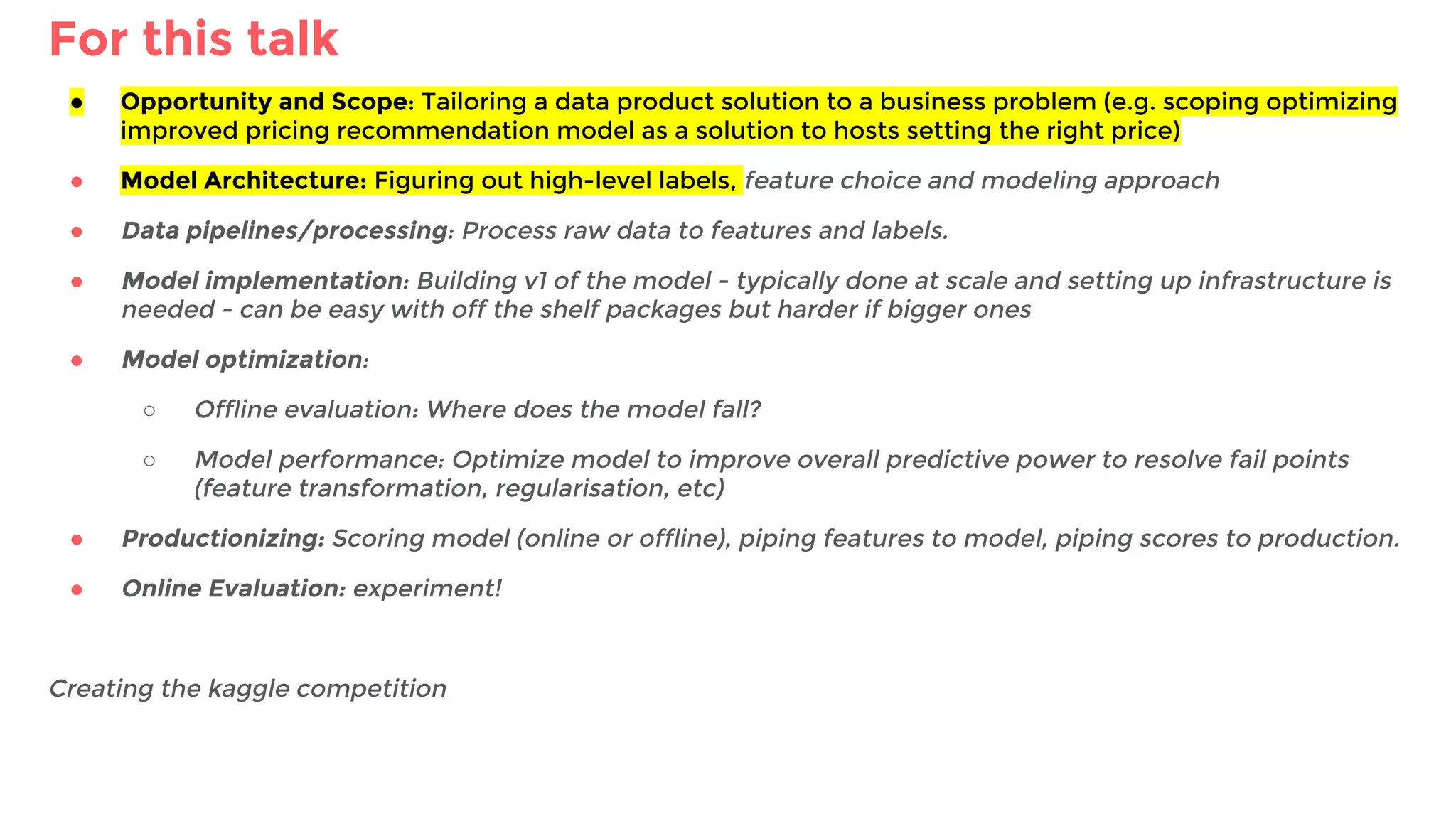
For this talk
● Opportunity and Scope: Tailoring a data product solution to a business problem (e.g. scoping optimizing
improved pricing recommendation model as a solution to hosts setting the right price)
● Model Architecture: Figuring out high-level labels, feature choice and modeling approach
● Data pipelines/processing: Process raw data to features and labels.
● Model implementation: Building v1 of the model - typically done at scale and setting up infrastructure is
needed - can be easy with off the shelf packages but harder if bigger ones
● Model optimization:
○ Offline evaluation: Where does the model fall?
○ Model performance: Optimize model to improve overall predictive power to resolve fail points
(feature transformation, regularisation, etc)
● Productionizing: Scoring model (online or offline), piping features to model, piping scores to production.
● Online Evaluation: experiment!
Creating the kaggle competition
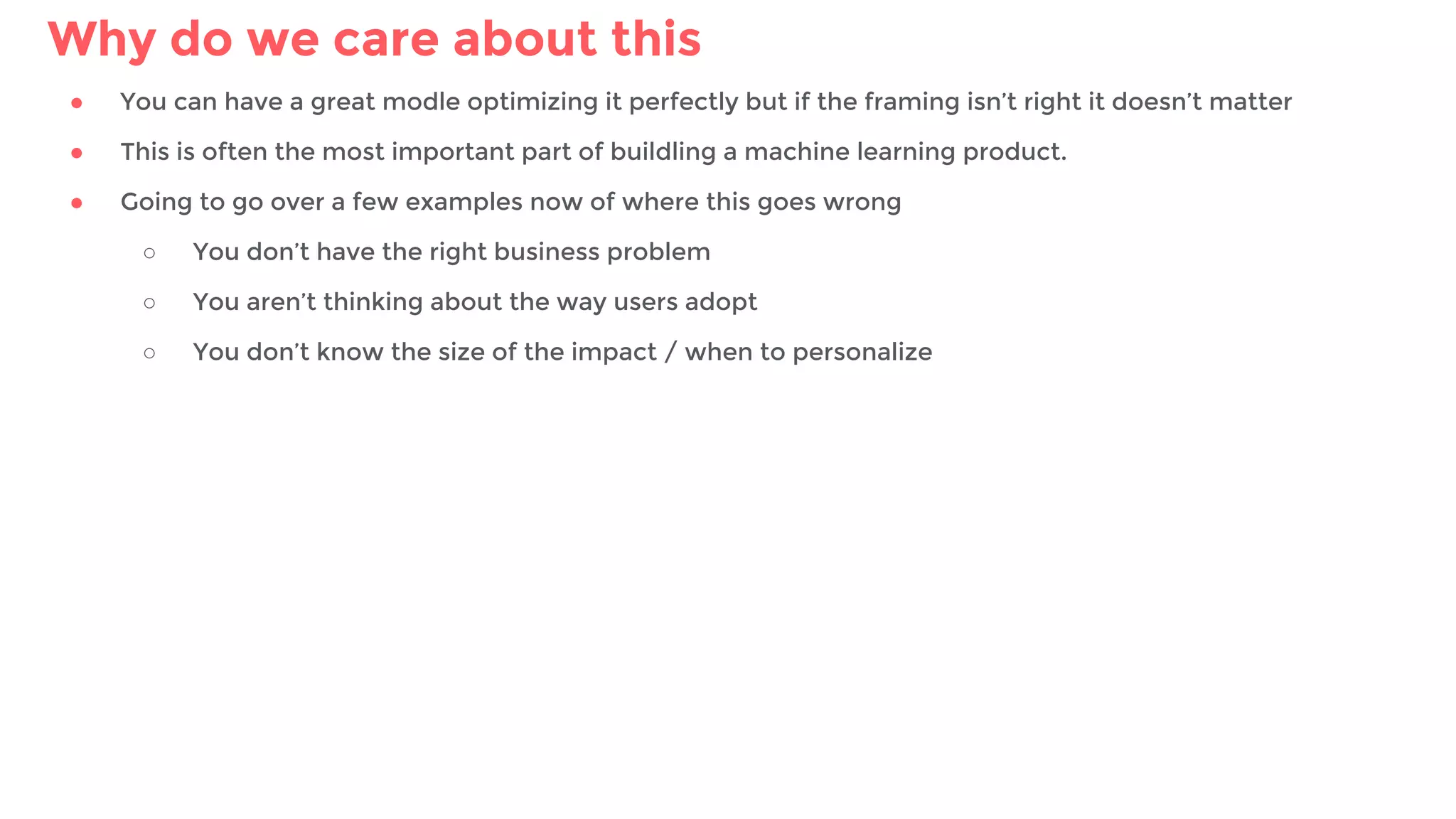
Why do we care about this
● You can have a great modle optimizing it perfectly but if the framing isn’t right it doesn’t matter
● This is often the most important part of buildling a machine learning product.
● Going to go over a few examples now of where this goes wrong
○ You don’t have the right business problem
○ You aren’t thinking about the way users adopt
○ You don’t know the size of the impact / when to personalize
Ways a ML product can begin
● Structured: You have a metric you’d like to improve - you think of a machine learning product that could
help
● Unstructured: You’re playing around with new data, you have some ideas - brainstorm etc
A company that builds successful ML products will create incentives and space for innovation in both
instances
Importance of a metric
● For any machine learning challenge you need to have a metric that you are optimizing against.
Otherwise you will be unable to evaluate the value of a machine learning product to your business and
to your users.
● OKR structure
● Bookings over time - we have a goal of 100 how do we get it there?
Get a lesson out of every case study
E.g. Worth training off explainability
Pricing
● When we first started there was a model that used the most important characteristics about a listing, like
the number of rooms and beds, the neighboring properties, and certain amenities, like a parking space or
even a pool. And then essential looked at nearby listings with close similarities to suggest a price
● Simulated what users were doing on their own and automated, and you could throw more features and do
better clustering
● Didn’t take into account demand, not flexible. and most importantly wasn’t formulated in a way that
would optimize against the right metric
Add the work up front to prove we should invest
6 months - 12 peopel on it now. All from a data science offsite
Indirectly it was whether they accepted or not. Standard recommender is did they take my suggestions.
15 people working on it - huge lever - ux - designers testing those changes.
summarziation/highlights
It was against the metric of traffice. Things to do in san francisco. SEO. this is what this is for.
Search
Slides from Lisa
Biz Travel - Personalization
1) figure out if there is a personalization opportunity. 2) get labeled data. Biz travle. Our hypothesis is that biz travelers are looking for
something different than leisure. Is there actually an opportunity there? FIrst you need some labels. Take 1% of traffic and prompt users
to tell us if you are traveling for business or leisure. Then you have labeled data. Now we have user attributes and we can see if there is a
difference and can we predict if someone is traveling for business or leisure. Trip attributes were also super important. Entire home.
Weekdays. Biz travelers usually look at the city level at pseicific address and you’re not starting big and zooming in. Search attributes.
Price. Wifi. Then you can build a model and deploy. Show the right business travel promotion. A banner on the booking page to sign up
for business travel for the people who are likely for it. A promotion of 100% would cannibalize the promotion space. P5 banners. That
gives virality effect where they can sign up> Yahoo is sign up company. Google is its a long tail of small business similar with facebook.
Airbnb core product is better for small medium businesses. Next time someone else signs up with the same company its legit and has
more than one person. Then we can send an email to those people to ask your travel managers - directly billed to company, find the right
listing. Data science is being used to find the long tail that we wouldn’t have found direct sales. Shared itinerary with other people - growth
experiment so other people sign up.
Machine learning infrastructure
Creating generalized infrastructure so we can do it all
● Making the case for machine learning infrastructure. Machine learning infrastructure. Holistic
representation of a listing. Where we are going in the future.
Case studies
● Early motivation is looking at our main metric. Search was a very hand tuned in the past. Pricing. Its not
easy! Accuracy is what I can improve but that metric moving is harder. You can improve the
performance intrinsically but then you deploy and it looks like the improvement doesn’t lead to the
improvement you think of. For example smart pricing you don’t like the suggestion. You’re lowballing.
Take into account people’s behavior and how users respond to an improvement.
● The simpler model is often a lot more effective. Better to build something quickly see how it performs
and then see if it can be revisit. Can reference the post on coming from academia.
● Ticket routing and user issues - had hard set rules that were very rigid - is you are in this bucket we
implemented a probabilistic model that figures automatically what we can do. Go from manual rules to
a learned model. Rules failing and then moving to ‘softer’ approaches that are probabilistic. One
pattern. We look at signals when the user comes in - surface these links vs those links. Like biz travel.
We were ignoring a strong signal that was the text of a ticket. Improve accuracy and also increase
volume and optimize precision and recall. Could address CX staffing accordingly. Route more to directly
and its ok if they can’t solve it and it takes time to send it back to Airbnb. Impossible to do in previous
world. High level talking point - these models give us more flexibility to adapt to the changing dymanics
of our business. Set of rules are much harder to tweak. Models give a lot more flexibility.
● Using machine learning to not just build model for predictive performance but to inform analysis. Chao
yang on host quality. 30% are worse. Build model on 70%. Learn a model to predict ratings in other
bucket. Lead model. PX model. Customizing how users interact with our website using signals available.
● Making the case for machine learning infrastructure. Machine learning infrastructure. Holistic
representation of a listing. Where we are going in the future.
Slide Title Here
Optional subtitle goes here
● Cereal Entrepreneur: Creative. Embraces
constraints. Solution-oriented. Tenacious.
● Be a Host: Collaborative. Anticipates the needs of
others. Prepared. Authentic. Listens.
● Embrace the Adventure: Flexible. Risk tolerant.
Always learning. Curious. Open-minded.
● Simplify: Distills a problem to its essence. Makes
and communicates clear decisions.
● Champion the Mission: Passionate. Committed.
Optimistic.
● Every Frame Matters: Thinks holistically. Rigorous
about quality. Appreciates the details and
prioritizes the right ones.
Slide Title Here
Optional subtitle goes here
Slide Title Here
Optional subtitle goes here
Lorem ipsum dolor sit amet,
consectetur adipiscing elit. Sed
risus arcu, lacinia a aliquet in,
vulputate ac turpis.
Donec elit elit, consectetur at
hendrerit a, porta ac elit.
Vivamus efficitur lacus nec ex
porttitor lacinia at et nulla.
Your text overlay goes here
Your text overlay
goes here
Your text overlay
goes here
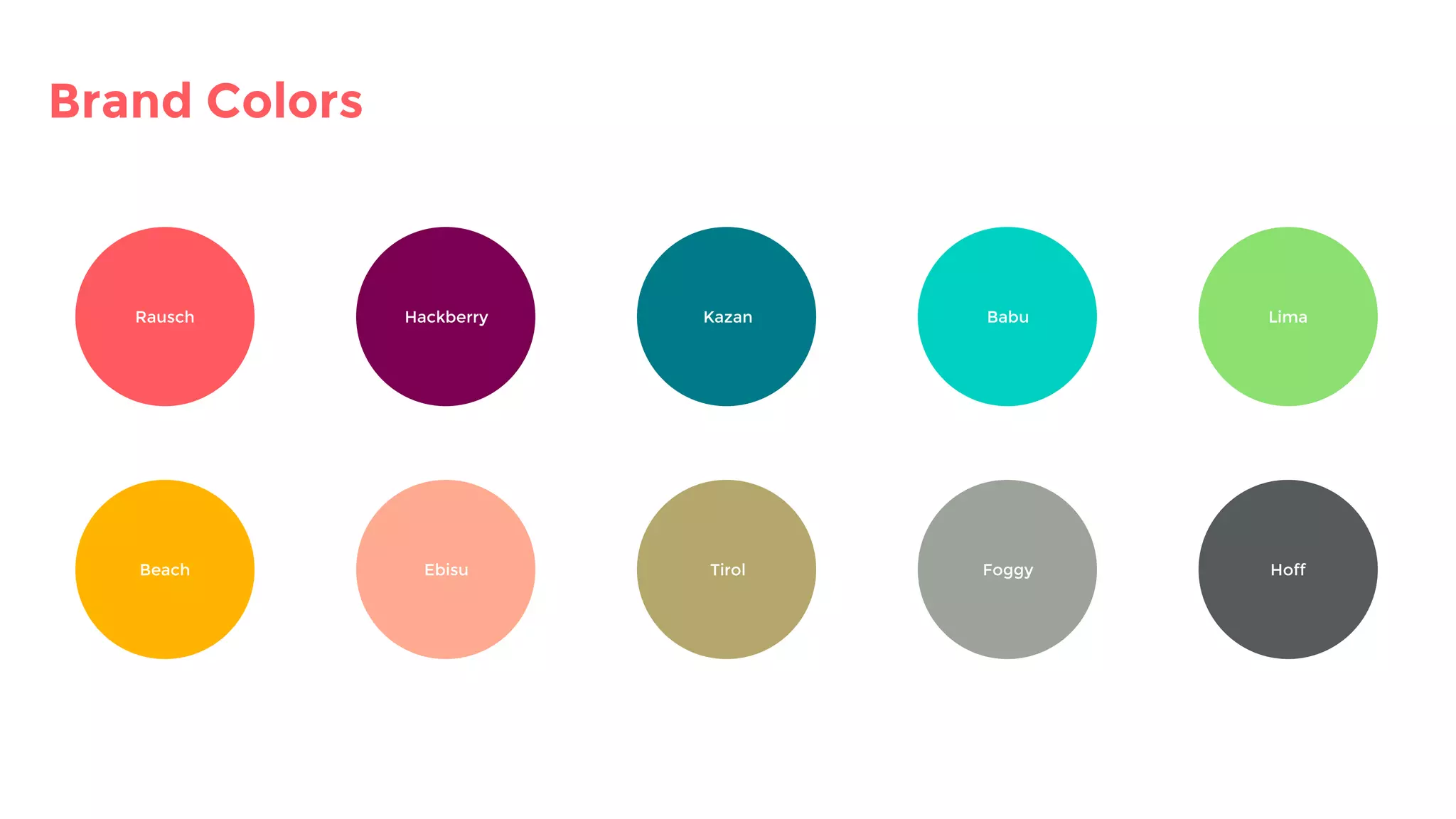
Rausch Hackberry Kazan Babu Lima
Beach Ebisu Tirol Foggy Hoff
Brand Colors
Product Icons
Iconic Lists
Four Items
Iconic List
List Item 1 List Item 2 List Item 3
Lorem ipsum dolor
sit amet,
consectetur
adipiscing elit
Sed risus arcu,
lacinia a aliquet in,
vulputate turpis
Donec elit elit,
consectetur at
hendrerit a,
porta ac elit
Vivamus efficitur
lacus nec ex
porttitor lacinia at et
nulla
List Item 4
Five Items
Iconic List
List Item 1 List Item 2 List Item 3
Lorem ipsum
dolor sit amet,
consectetur
adipiscing elit
Sed risus arcu,
lacinia a aliquet
in, vulputate
turpis
Donec elit elit,
consectetur at
hendrerit a,
porta ac elit
Vivamus
efficitur
lacus nec ex
porttitor lacinia
at et nulla
List Item 4 List Item 5
Lorem ipsum
dolor sit amet,
consectetur
adipiscing elit
Timelines
Three Items
Timeline
Time 1 Time 2 Time 3
Lorem ipsum dolor sit amet,
consectetur adipiscing elit
Sed risus arcu, lacinia a
aliquet in, vulputate turpis
Donec elit elit, consectetur
at hendrerit a, porta ac elit
Four Items
Timeline
Time 1 Time 2 Time 3
Lorem ipsum dolor
sit amet, consectetur
adipiscing elit
Sed risus arcu, lacinia
a aliquet in,
vulputate turpis
Donec elit elit,
consectetur at
hendrerit a, porta ac
elit
Vivamus efficitur
lacus nec ex porttitor
lacinia at et nulla
Time 4
Five Items
Timeline
Time 1 Time 2 Time 3
Lorem ipsum
dolor sit amet,
consectetur
adipiscing elit
Sed risus arcu,
lacinia a aliquet
in, vulputate
turpis
Donec elit elit,
consectetur at
hendrerit a,
porta ac elit
Vivamus
efficitur
lacus nec ex
porttitor lacinia
at et nulla
Time 4 Time 5
Lorem ipsum
dolor sit amet,
consectetur
adipiscing elit
Four Items with Box Callout
Timeline
This is a box
callout. Text is
fully editable
and you can
move it around
to different
dots.
Time 1 Time 2 Time 3 Time 4
Six Items with Box Callout
Timeline
Time 1 Time 2 Time 3 Time 4 Time 5
This is a box
callout. Text is
fully editable
and you can
move it around
to different
dots.
Time 6
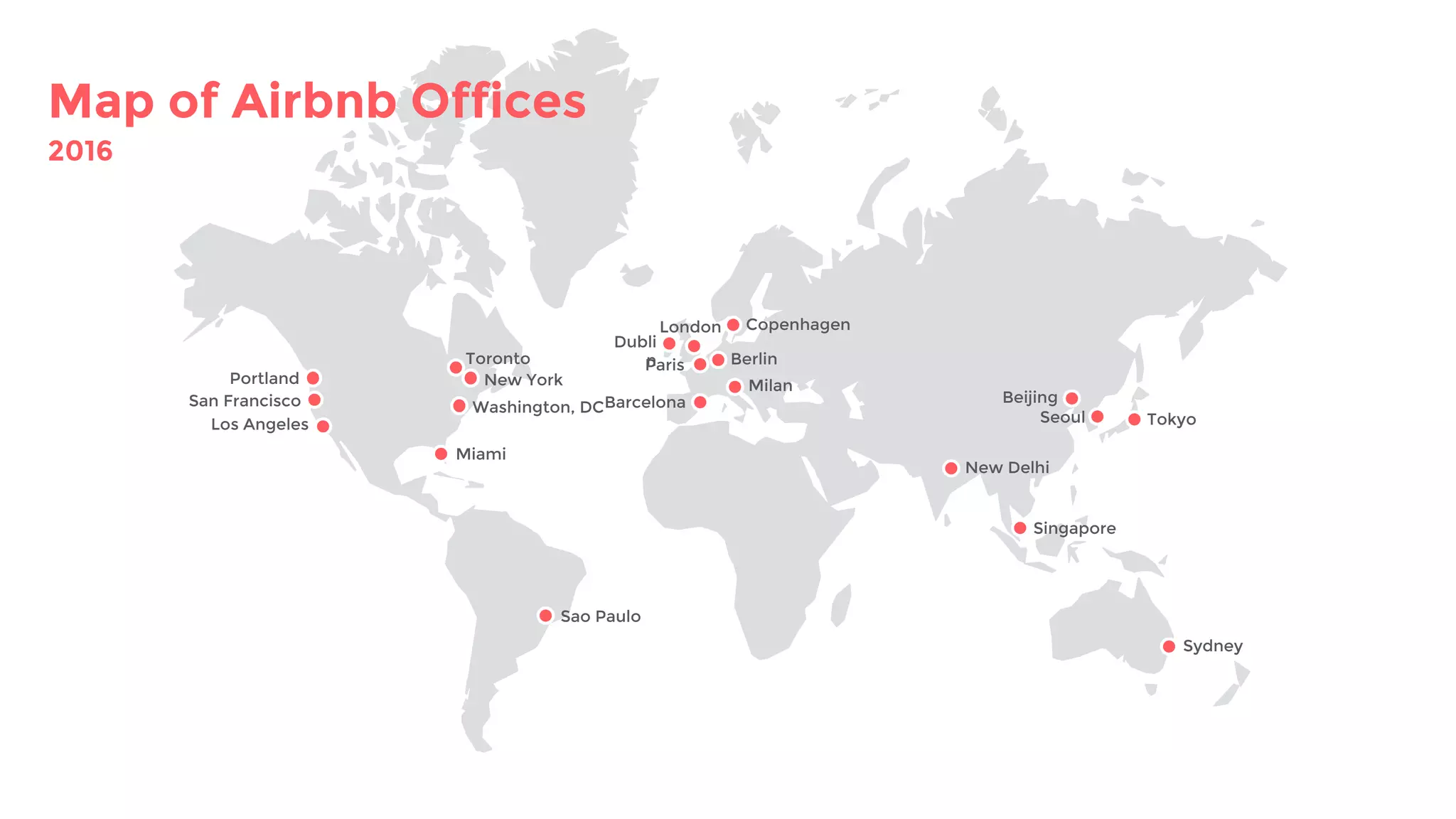
Map of Airbnb Offices
Portland
San Francisco
Los Angeles
Toronto
New York
Miami
Sao Paulo
Dubli
n
London
Paris
Barcelona
Berlin
Milan
Copenhagen
New Delhi
Seoul
Beijing
Tokyo
Sydney
Singapore
Washington, DC
Map of Airbnb Offices
2016
Charts
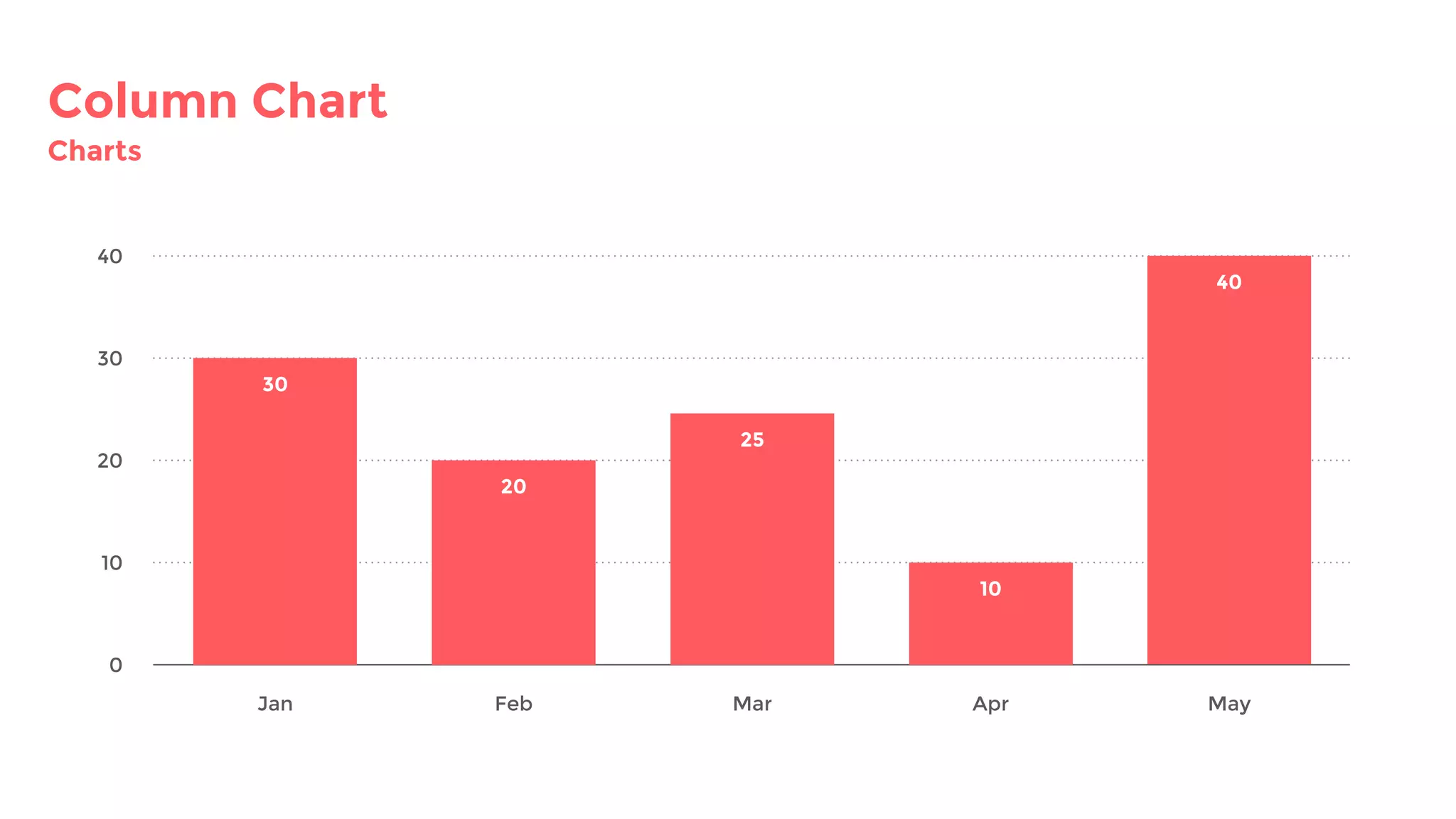
Column Chart
Charts
Jan Feb Mar Apr
30
May
10
20
30
40
0
20
25
10
40
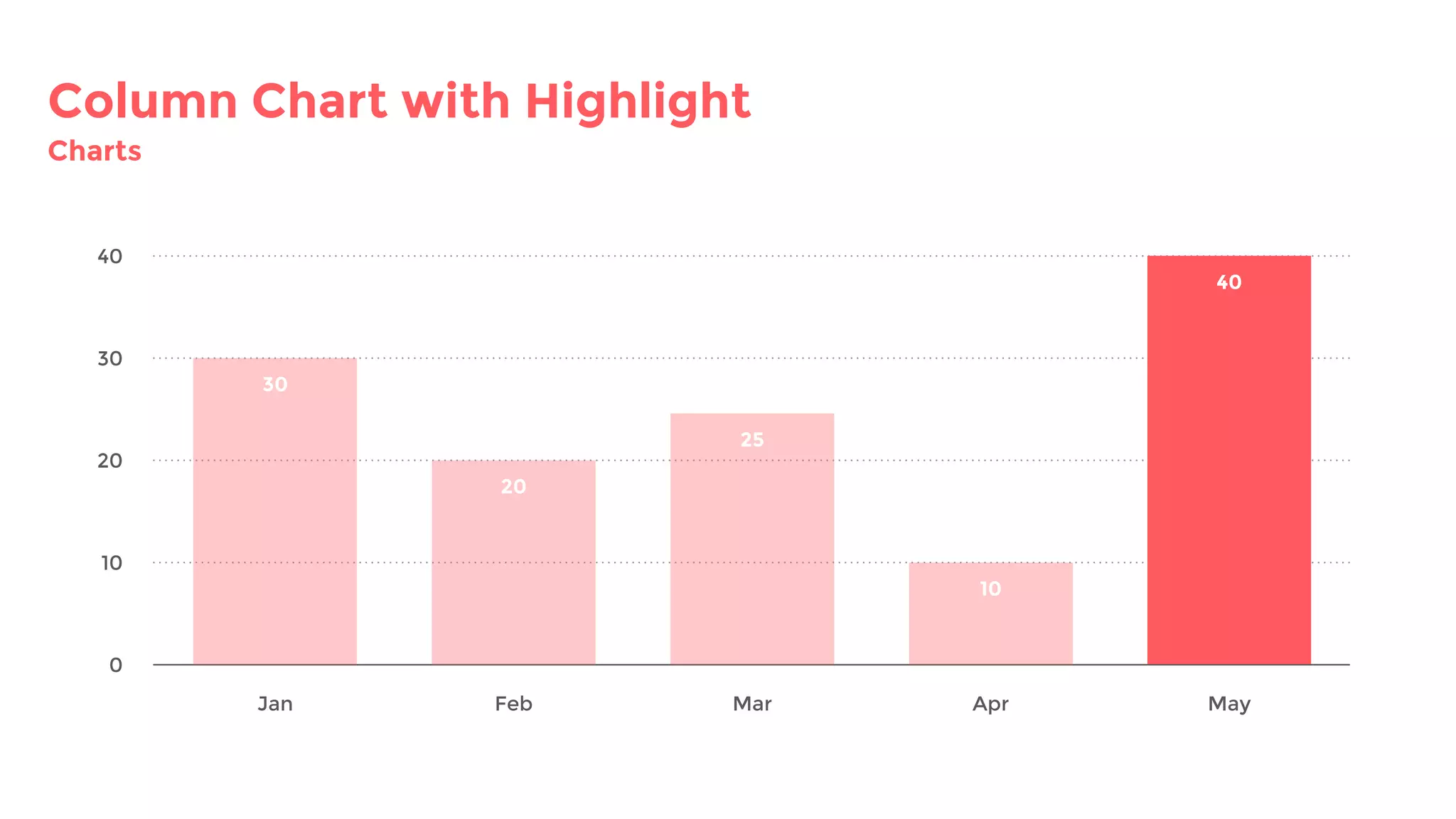
Column Chart with Highlight
Charts
Jan Feb Mar Apr
30
May
10
20
30
40
0
20
25
10
40
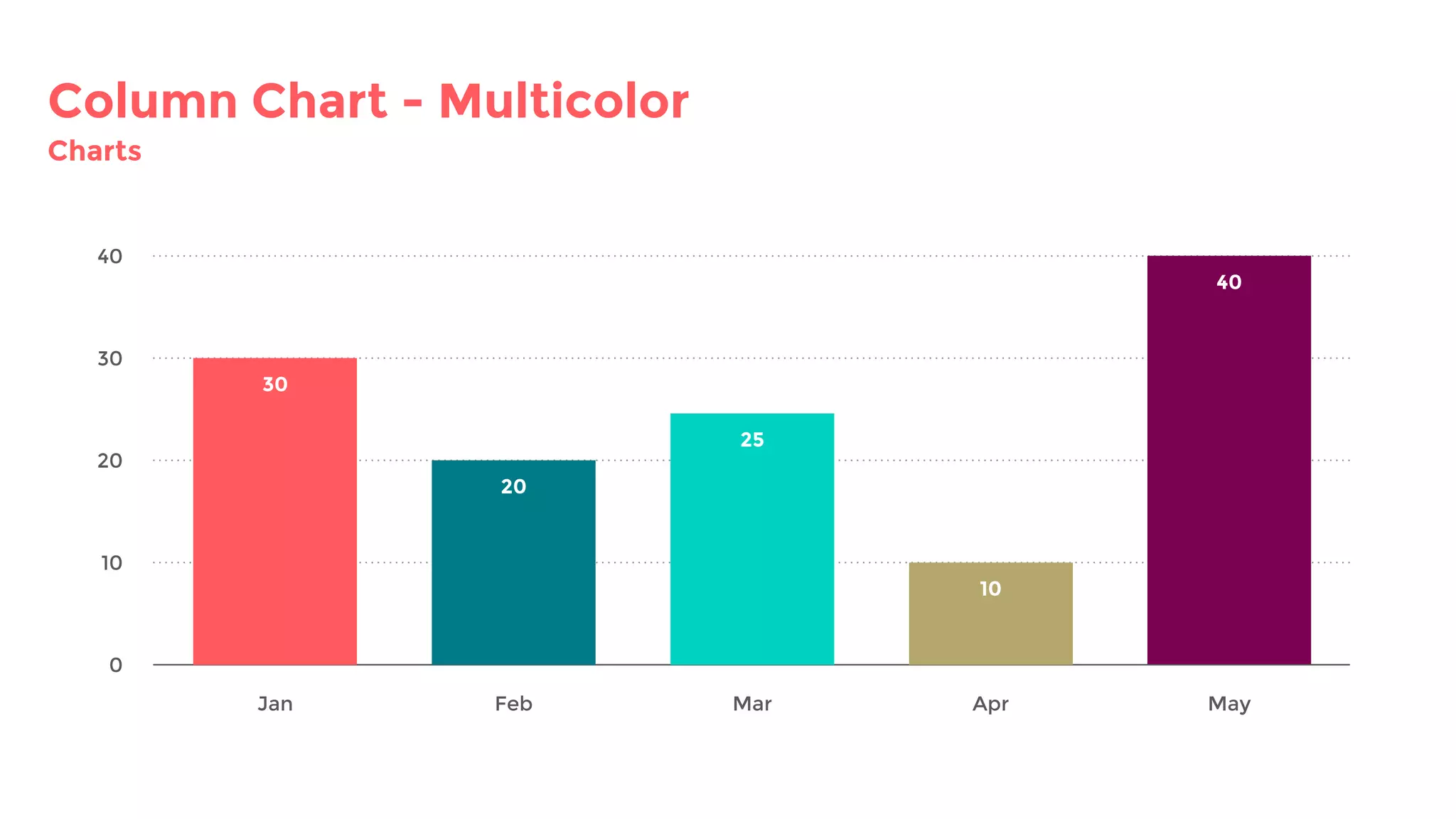
Column Chart - Multicolor
Charts
Jan Feb Mar Apr
30
May
10
20
30
40
0
20
25
10
40
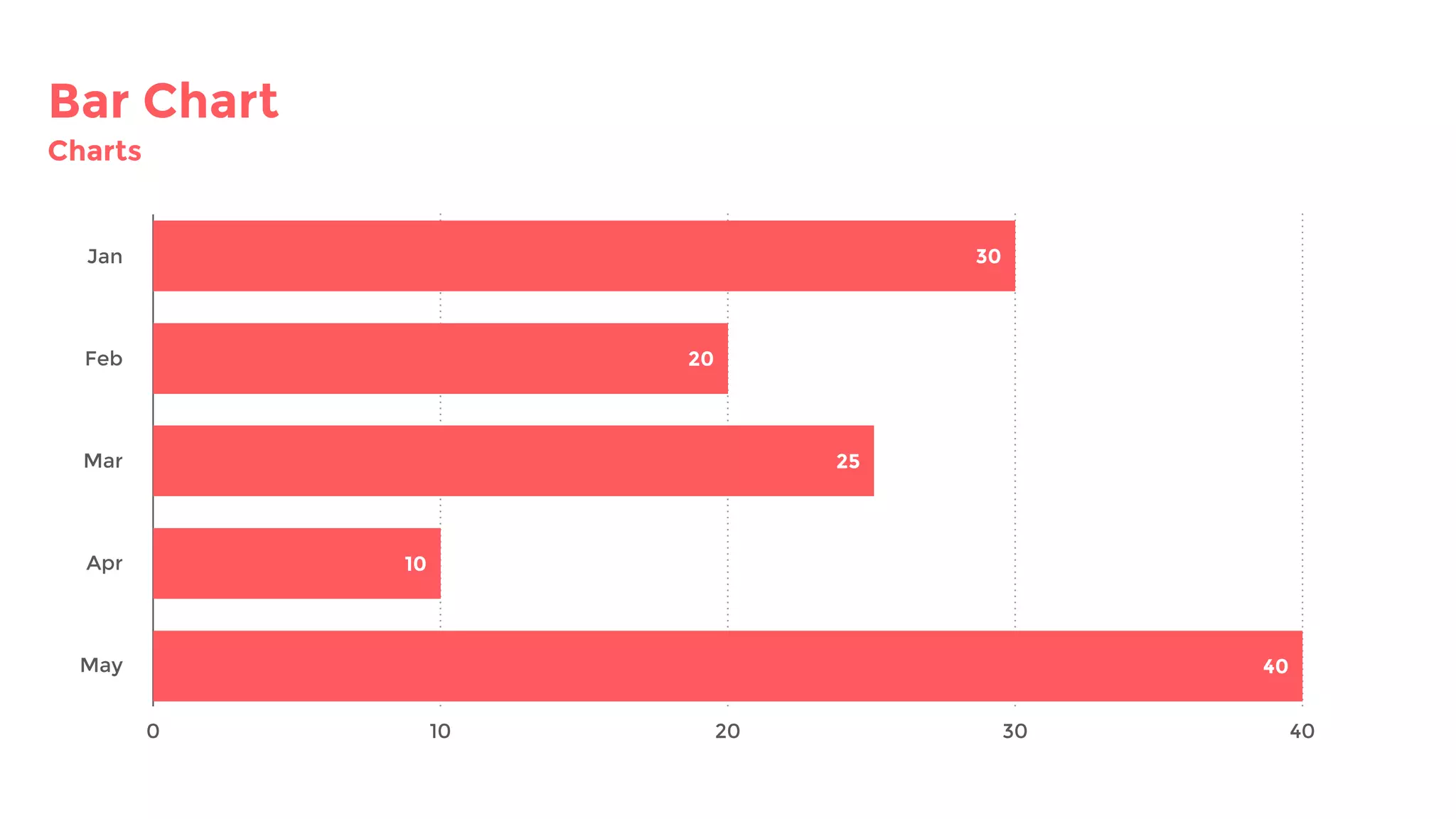
Bar Chart
Charts
10 20 30 40
Apr
Mar
Feb
Jan
May
0
30
20
25
10
40
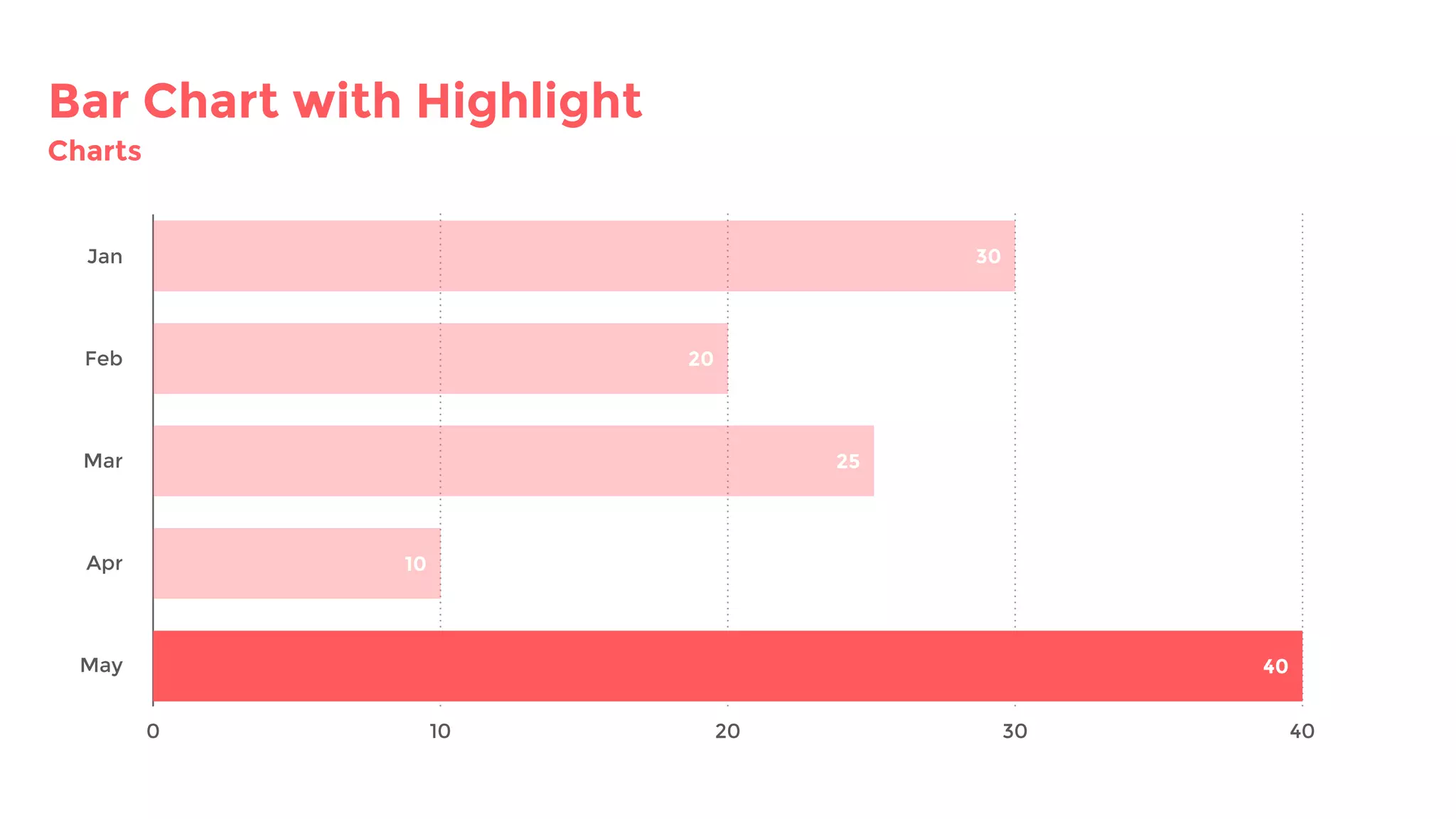
Bar Chart with Highlight
Charts
10 20 30 40
Apr
Mar
Feb
Jan
May
0
30
20
25
10
40
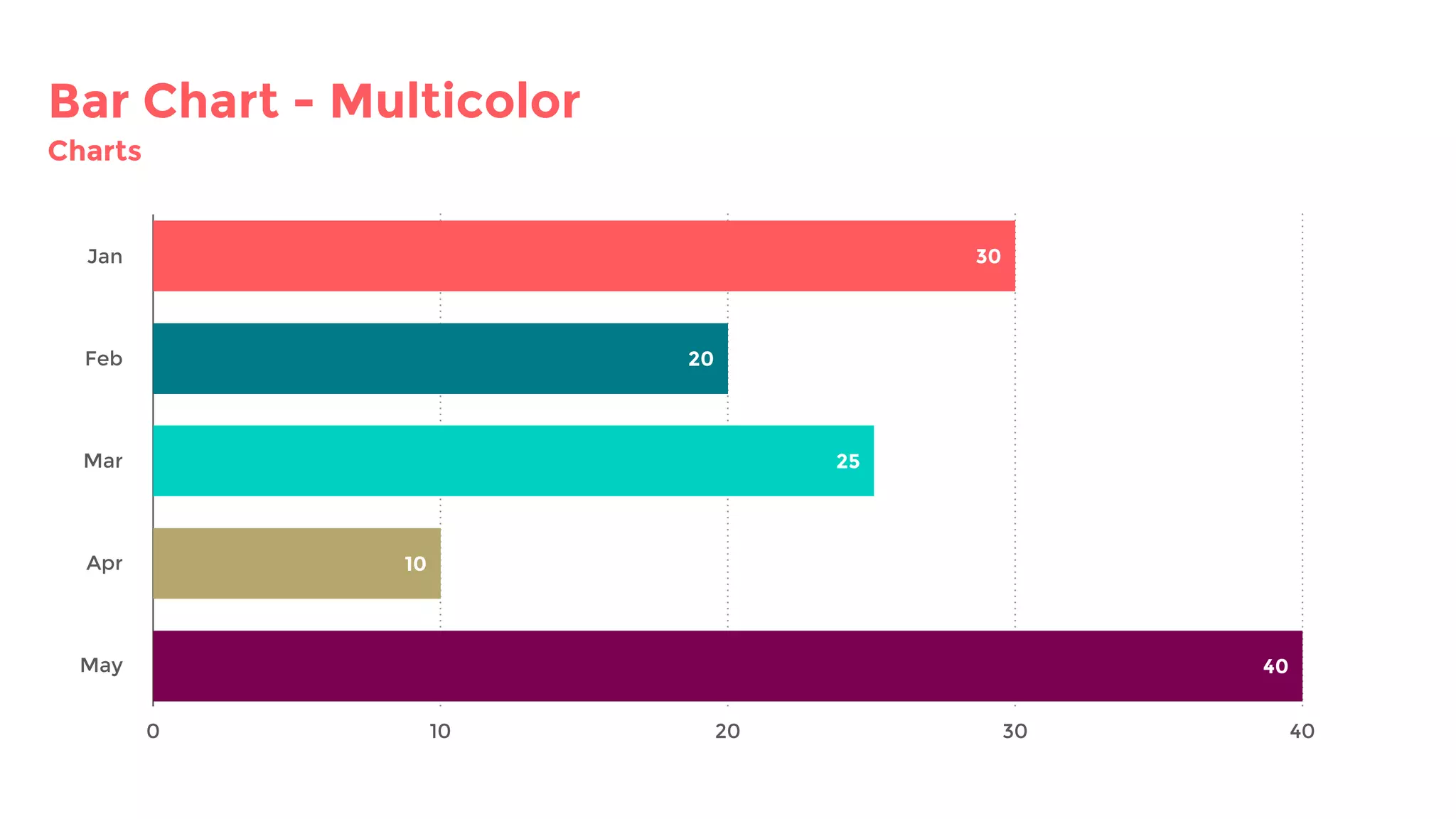
Bar Chart - Multicolor
Charts
10 20 30 40
Apr
Mar
Feb
Jan
May
0
30
20
25
10
40
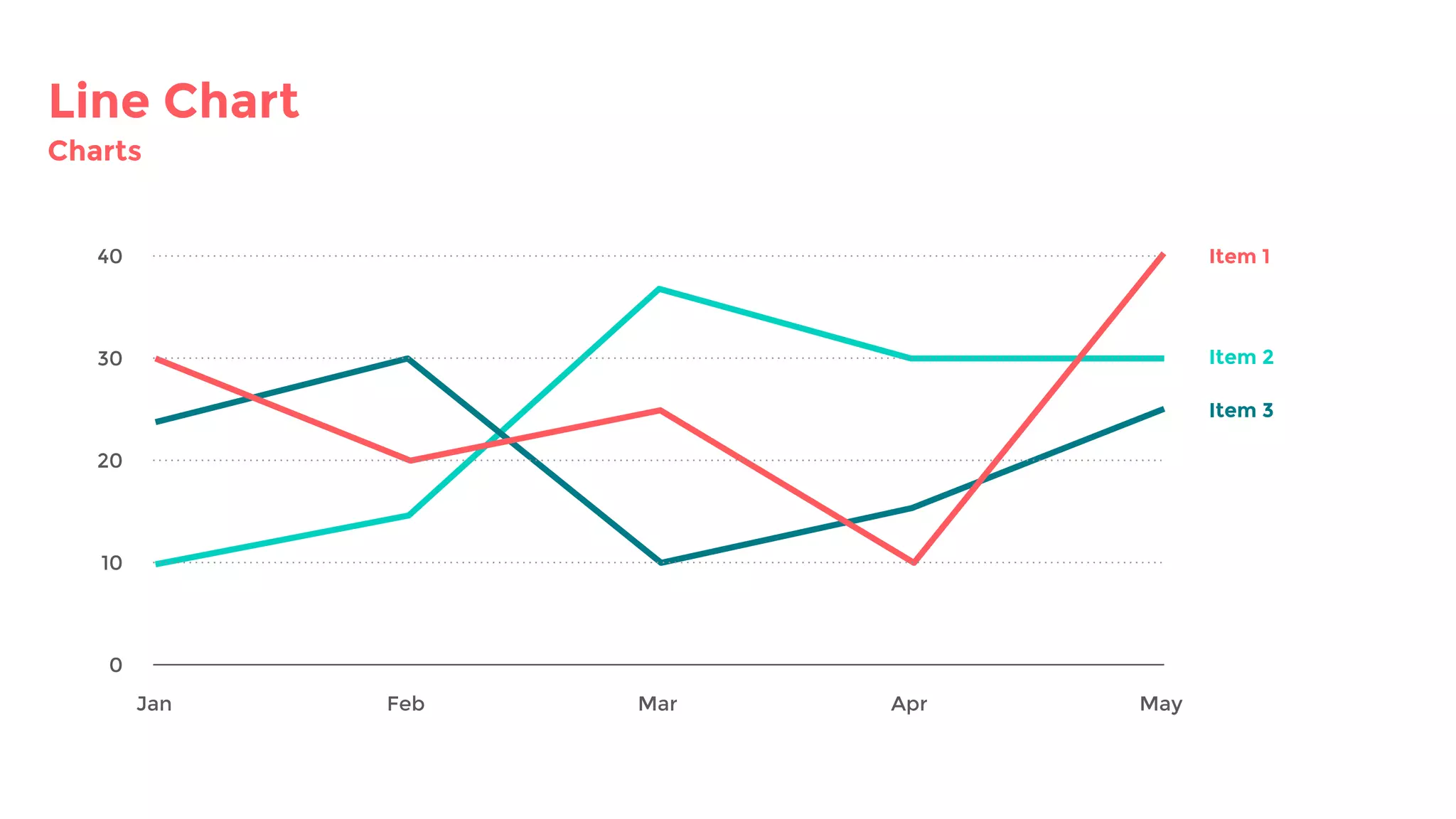
Line Chart
Charts
Jan Feb Mar Apr May
10
20
30
40
0
Item 1
Item 2
Item 3
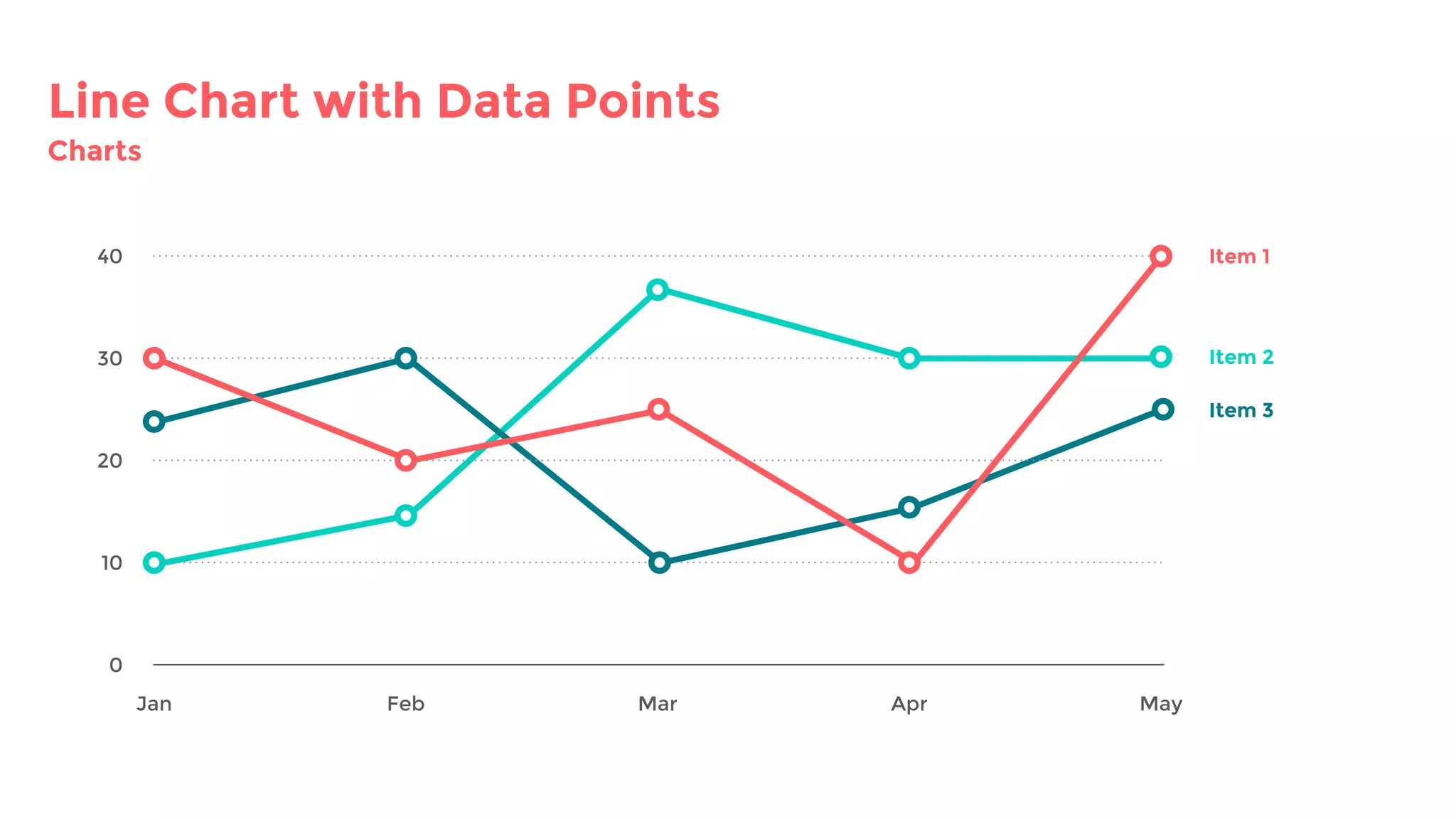
Line Chart with Data Points
Charts
Jan Feb Mar Apr May
10
20
30
40
0
Item 1
Item 2
Item 3

Elena Grewal, Data Science Manager, Airbnb at MLconf SF 2016

  • 1.
    Before the Model: HowMachine Learning Products Start Elena Grewal / November 11, 2016 / @elenatej
  • 2.
    Machine Learning Products@ Airbnb ● Two sided marketplace: Each guest and host are unique. ● ML at its core is around personalization and we use it in all aspects of our product. ● Teams which have ML products: host growth, guest growth, search, pricing, customer support, many more.
  • 3.
    Machine Learning atall steps of using Airbnb
  • 4.
    Lifecycle of aMachine Learning Product Sizing Opportunity and Scope Model Architecture Data Pipelines and Processing Model Optimization Production Implementation & Evaluation
  • 5.
    Initial formulation ofthe problem is key to success Sizing Opportunity and Scope Data Pipelines and Processing Model Optimization Production Implementation & Evaluation Model Architecture
  • 6.
    You need tohave the right target metric(s)
  • 7.
  • 9.
    Way back in2014 we did an offsite Question: “What do you think is the highest impact project our team can undertake in the next year?” Answer: “Pricing” (we also ate pizza in a baller Airbnb home)
  • 10.
    Step 1: Makethe Case for Working on Pricing - Highlight all the ways that prices matter - The impact of price on booking + rebooking - Price filter usage - Variations by market 50 slide deck presented to executives Buy time! A project like this takes ~6 months to see any results
  • 11.
    Step 1: Makethe Case for Working on Pricing
  • 12.
    Step 2: ModelArchitecture - Before Current model predicted price using nearby Airbnb homes - Location, Listing characteristics, Recency This mimicked host behavior
  • 13.
    Step 2: ModelArchitecture - After New metric: Bookings Price suggestion based on probability of booked on given day - Much more flexible - Prices for each date - Interesting UX opportunities Added model layer for adoption of prices. Team of 15 on it now!
  • 14.
    Learnings ● Target metric= business outcome (NOT the precision/recall of your model) ● Up front analysis of potential impact of ML product achieves the buy in to work on a project for the needed time ○ More important - you have a better idea of whether it’s the right thing to work on ● User behavior should be considered in model architecture Make time for thinking about machine learning products.
  • 15.
  • 17.
    Ranking model couldoptimize for ‘click through’ But those might not be the right fit for the trip at hand
  • 18.
    Ranking model couldoptimize for guest ‘contact’ But what if the guest is rejected?
  • 19.
    Solution: Optimize fora combination of outcomes Machine Learned ranker, using Gradient Boosted Model (GBM)
  • 20.
    Learnings ● Target metric= business outcome ○ Traditional target metrics don’t always apply ● Think carefully about the value of different potential business outcomes - solution may be a combination of outcomes
  • 21.
  • 22.
    How did itstart We noticed that we didn’t have as many business travelers Hypothesis: business travelers have different needs than leisure travelers Can we design products specifically for business travelers?
  • 24.
    Step 1: Sizethe Opportunity Problem: We didn’t know who was a business traveler and who wasn’t. To personalize, we needed to show segments had meaningful differences Collected initial label from 1%
  • 25.
    Step 2: Modelarchitecture In this case, our goal was to target business travelers with customized content to increase business travel penetration Simple model, where we predicted if you were a business traveler or not.
  • 26.
    Learnings ● Start withhypothesis ● Collect labeled data ● Build a simple product to start - see how it works
  • 27.
  • 28.
    Prior state ofthe world - Teams develop multiple ML infrastructure with different versions of features - ML in production requires engineering expertise - While many teams are using ML the process is painful Meta before the model
  • 29.
    Step 1: Sizingthe opportunity & scope 1. Generate ideas for adding 65 new ML products -> multiplier opportunity for building shareable components 2. ‘Back of the envelope’ potential impact on metrics 3. Team proposal with clear deliverables i. # of users participating in ML ii. Reduced time and effort to build ML products iii. Enable easy model eval Feature Discovery Data Acquisition Feature Engineering Model Training Model Scoring
  • 30.
    Step 2: Inprogress! We have added support for Tensorflow and are now supporting a couple models in production with new infra Interesting challenges: how to represent a listing in an extensible way - what features will apply to many different models? This is where we are going in the future.
  • 31.
    Step 2: In progress! -Added support for TensorFlow (enabling deep learning at scale) - Interesting challenges: how to represent a listing in an extensible way - what features will apply to many different models? - This is where we are going in the future images text Categorical attributes
  • 32.
    Guiding principles Target metricAnalyze user behavior Architect Model Opportunity for personalization, impact on metric, user interaction with ML product UX Set up is the most important part. Start simple and iterate. Focus on moving a business metric with ML product
  • 34.
  • 35.
    Life cycle ofa machine learning product ● Opportunity and Scope: Tailoring a data product solution to a business problem (e.g. scoping optimizing improved pricing recommendation model as a solution to hosts setting the right price) ● Model Architecture: Figuring out high-level labels, feature choice and modeling approach ● Data pipelines/processing: Process raw data to features and labels. ● Model implementation: Building v1 of the model - typically done at scale and setting up infrastructure is needed - can be easy with off the shelf packages but harder if bigger ones ● Model optimization: ○ Offline evaluation: Where does the model fall? ○ Model performance: Optimize model to improve overall predictive power to resolve fail points (feature transformation, regularisation, etc) ● Productionizing: Scoring model (online or offline), piping features to model, piping scores to production. ● Online Evaluation: experimentation
  • 36.
    For this talk ●Opportunity and Scope: Tailoring a data product solution to a business problem (e.g. scoping optimizing improved pricing recommendation model as a solution to hosts setting the right price) ● Model Architecture: Figuring out high-level labels, feature choice and modeling approach ● Data pipelines/processing: Process raw data to features and labels. ● Model implementation: Building v1 of the model - typically done at scale and setting up infrastructure is needed - can be easy with off the shelf packages but harder if bigger ones ● Model optimization: ○ Offline evaluation: Where does the model fall? ○ Model performance: Optimize model to improve overall predictive power to resolve fail points (feature transformation, regularisation, etc) ● Productionizing: Scoring model (online or offline), piping features to model, piping scores to production. ● Online Evaluation: experiment! Creating the kaggle competition
  • 37.
    Why do wecare about this ● You can have a great modle optimizing it perfectly but if the framing isn’t right it doesn’t matter ● This is often the most important part of buildling a machine learning product. ● Going to go over a few examples now of where this goes wrong ○ You don’t have the right business problem ○ You aren’t thinking about the way users adopt ○ You don’t know the size of the impact / when to personalize
  • 38.
    Ways a MLproduct can begin ● Structured: You have a metric you’d like to improve - you think of a machine learning product that could help ● Unstructured: You’re playing around with new data, you have some ideas - brainstorm etc A company that builds successful ML products will create incentives and space for innovation in both instances
  • 39.
    Importance of ametric ● For any machine learning challenge you need to have a metric that you are optimizing against. Otherwise you will be unable to evaluate the value of a machine learning product to your business and to your users. ● OKR structure ● Bookings over time - we have a goal of 100 how do we get it there? Get a lesson out of every case study E.g. Worth training off explainability
  • 40.
    Pricing ● When wefirst started there was a model that used the most important characteristics about a listing, like the number of rooms and beds, the neighboring properties, and certain amenities, like a parking space or even a pool. And then essential looked at nearby listings with close similarities to suggest a price ● Simulated what users were doing on their own and automated, and you could throw more features and do better clustering ● Didn’t take into account demand, not flexible. and most importantly wasn’t formulated in a way that would optimize against the right metric Add the work up front to prove we should invest 6 months - 12 peopel on it now. All from a data science offsite Indirectly it was whether they accepted or not. Standard recommender is did they take my suggestions. 15 people working on it - huge lever - ux - designers testing those changes. summarziation/highlights It was against the metric of traffice. Things to do in san francisco. SEO. this is what this is for.
  • 41.
  • 42.
    Biz Travel -Personalization 1) figure out if there is a personalization opportunity. 2) get labeled data. Biz travle. Our hypothesis is that biz travelers are looking for something different than leisure. Is there actually an opportunity there? FIrst you need some labels. Take 1% of traffic and prompt users to tell us if you are traveling for business or leisure. Then you have labeled data. Now we have user attributes and we can see if there is a difference and can we predict if someone is traveling for business or leisure. Trip attributes were also super important. Entire home. Weekdays. Biz travelers usually look at the city level at pseicific address and you’re not starting big and zooming in. Search attributes. Price. Wifi. Then you can build a model and deploy. Show the right business travel promotion. A banner on the booking page to sign up for business travel for the people who are likely for it. A promotion of 100% would cannibalize the promotion space. P5 banners. That gives virality effect where they can sign up> Yahoo is sign up company. Google is its a long tail of small business similar with facebook. Airbnb core product is better for small medium businesses. Next time someone else signs up with the same company its legit and has more than one person. Then we can send an email to those people to ask your travel managers - directly billed to company, find the right listing. Data science is being used to find the long tail that we wouldn’t have found direct sales. Shared itinerary with other people - growth experiment so other people sign up.
  • 43.
    Machine learning infrastructure Creatinggeneralized infrastructure so we can do it all ● Making the case for machine learning infrastructure. Machine learning infrastructure. Holistic representation of a listing. Where we are going in the future.
  • 44.
    Case studies ● Earlymotivation is looking at our main metric. Search was a very hand tuned in the past. Pricing. Its not easy! Accuracy is what I can improve but that metric moving is harder. You can improve the performance intrinsically but then you deploy and it looks like the improvement doesn’t lead to the improvement you think of. For example smart pricing you don’t like the suggestion. You’re lowballing. Take into account people’s behavior and how users respond to an improvement. ● The simpler model is often a lot more effective. Better to build something quickly see how it performs and then see if it can be revisit. Can reference the post on coming from academia. ● Ticket routing and user issues - had hard set rules that were very rigid - is you are in this bucket we implemented a probabilistic model that figures automatically what we can do. Go from manual rules to a learned model. Rules failing and then moving to ‘softer’ approaches that are probabilistic. One pattern. We look at signals when the user comes in - surface these links vs those links. Like biz travel. We were ignoring a strong signal that was the text of a ticket. Improve accuracy and also increase volume and optimize precision and recall. Could address CX staffing accordingly. Route more to directly and its ok if they can’t solve it and it takes time to send it back to Airbnb. Impossible to do in previous world. High level talking point - these models give us more flexibility to adapt to the changing dymanics of our business. Set of rules are much harder to tweak. Models give a lot more flexibility. ● Using machine learning to not just build model for predictive performance but to inform analysis. Chao yang on host quality. 30% are worse. Build model on 70%. Learn a model to predict ratings in other bucket. Lead model. PX model. Customizing how users interact with our website using signals available. ● Making the case for machine learning infrastructure. Machine learning infrastructure. Holistic representation of a listing. Where we are going in the future.
  • 45.
    Slide Title Here Optionalsubtitle goes here ● Cereal Entrepreneur: Creative. Embraces constraints. Solution-oriented. Tenacious. ● Be a Host: Collaborative. Anticipates the needs of others. Prepared. Authentic. Listens. ● Embrace the Adventure: Flexible. Risk tolerant. Always learning. Curious. Open-minded. ● Simplify: Distills a problem to its essence. Makes and communicates clear decisions. ● Champion the Mission: Passionate. Committed. Optimistic. ● Every Frame Matters: Thinks holistically. Rigorous about quality. Appreciates the details and prioritizes the right ones.
  • 46.
    Slide Title Here Optionalsubtitle goes here
  • 47.
    Slide Title Here Optionalsubtitle goes here Lorem ipsum dolor sit amet, consectetur adipiscing elit. Sed risus arcu, lacinia a aliquet in, vulputate ac turpis. Donec elit elit, consectetur at hendrerit a, porta ac elit. Vivamus efficitur lacus nec ex porttitor lacinia at et nulla.
  • 49.
  • 51.
    Your text overlay goeshere Your text overlay goes here
  • 53.
    Rausch Hackberry KazanBabu Lima Beach Ebisu Tirol Foggy Hoff Brand Colors
  • 59.
  • 61.
  • 62.
    Four Items Iconic List ListItem 1 List Item 2 List Item 3 Lorem ipsum dolor sit amet, consectetur adipiscing elit Sed risus arcu, lacinia a aliquet in, vulputate turpis Donec elit elit, consectetur at hendrerit a, porta ac elit Vivamus efficitur lacus nec ex porttitor lacinia at et nulla List Item 4
  • 63.
    Five Items Iconic List ListItem 1 List Item 2 List Item 3 Lorem ipsum dolor sit amet, consectetur adipiscing elit Sed risus arcu, lacinia a aliquet in, vulputate turpis Donec elit elit, consectetur at hendrerit a, porta ac elit Vivamus efficitur lacus nec ex porttitor lacinia at et nulla List Item 4 List Item 5 Lorem ipsum dolor sit amet, consectetur adipiscing elit
  • 64.
  • 65.
    Three Items Timeline Time 1Time 2 Time 3 Lorem ipsum dolor sit amet, consectetur adipiscing elit Sed risus arcu, lacinia a aliquet in, vulputate turpis Donec elit elit, consectetur at hendrerit a, porta ac elit
  • 66.
    Four Items Timeline Time 1Time 2 Time 3 Lorem ipsum dolor sit amet, consectetur adipiscing elit Sed risus arcu, lacinia a aliquet in, vulputate turpis Donec elit elit, consectetur at hendrerit a, porta ac elit Vivamus efficitur lacus nec ex porttitor lacinia at et nulla Time 4
  • 67.
    Five Items Timeline Time 1Time 2 Time 3 Lorem ipsum dolor sit amet, consectetur adipiscing elit Sed risus arcu, lacinia a aliquet in, vulputate turpis Donec elit elit, consectetur at hendrerit a, porta ac elit Vivamus efficitur lacus nec ex porttitor lacinia at et nulla Time 4 Time 5 Lorem ipsum dolor sit amet, consectetur adipiscing elit
  • 68.
    Four Items withBox Callout Timeline This is a box callout. Text is fully editable and you can move it around to different dots. Time 1 Time 2 Time 3 Time 4
  • 69.
    Six Items withBox Callout Timeline Time 1 Time 2 Time 3 Time 4 Time 5 This is a box callout. Text is fully editable and you can move it around to different dots. Time 6
  • 70.
  • 71.
    Portland San Francisco Los Angeles Toronto NewYork Miami Sao Paulo Dubli n London Paris Barcelona Berlin Milan Copenhagen New Delhi Seoul Beijing Tokyo Sydney Singapore Washington, DC Map of Airbnb Offices 2016
  • 72.
  • 73.
    Column Chart Charts Jan FebMar Apr 30 May 10 20 30 40 0 20 25 10 40
  • 74.
    Column Chart withHighlight Charts Jan Feb Mar Apr 30 May 10 20 30 40 0 20 25 10 40
  • 75.
    Column Chart -Multicolor Charts Jan Feb Mar Apr 30 May 10 20 30 40 0 20 25 10 40
  • 76.
    Bar Chart Charts 10 2030 40 Apr Mar Feb Jan May 0 30 20 25 10 40
  • 77.
    Bar Chart withHighlight Charts 10 20 30 40 Apr Mar Feb Jan May 0 30 20 25 10 40
  • 78.
    Bar Chart -Multicolor Charts 10 20 30 40 Apr Mar Feb Jan May 0 30 20 25 10 40
  • 79.
    Line Chart Charts Jan FebMar Apr May 10 20 30 40 0 Item 1 Item 2 Item 3
  • 80.
    Line Chart withData Points Charts Jan Feb Mar Apr May 10 20 30 40 0 Item 1 Item 2 Item 3