NATURE AND PROCESS OF
Can you imagine yourself in a
world without communication?
Life today is impossible without
communication, and we should
concentrate to make communication more
efficient and more natural.
According to Weber (2008) as cited
by Dapat, et.al. (2016), 70% of the
person’s waking time is spent
communicating in different manners
like talking, listening, reading, and
writing.
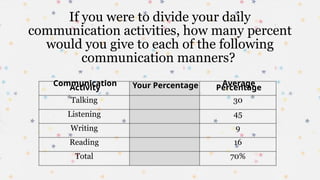
If you were to divide your daily
communication activities, how many percent
would you give to each of the following
communication manners?
Communication
Activity Your Percentage Average
Percentage
Talking 30
Listening 45
Writing 9
Reading 16
Total 70%
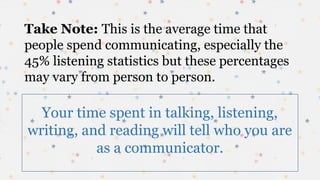
Take Note: This is the average time that
people spend communicating, especially the
45% listening statistics but these percentages
may vary from person to person.
Your time spent in talking, listening,
writing, and reading will tell who you are
as a communicator.
Definition of Communication
According to Mc Cornack (2014) as cited by
Sipacio and Balgos (2016), communication is
a process of sharing and conveying messages
or information from one person to another
within and across channel, context, media,
and cultures.
Where do we find/ see communication?
When do we experience communication?
There is a wide variety of contexts and situations in which
communication can be manifested.
 face to face interaction
 a phone conversation
 a group discussion
 a meeting or interview
 a letter correspondence
 a class recitation
Nature of Communication
1. Communication is a process.
2. Communication occurs between two or more people
(the speaker and the receiver).
3. Communication can be expressed through written or
spoken words, actions (nonverbal), or both spoken words
and nonverbal actions at the same time.
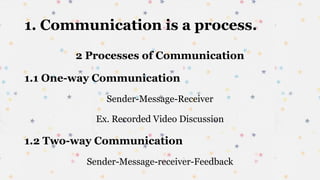
1. Communication is a process.
2 Processes of Communication
1.1 One-way Communication
Sender-Message-Receiver
Ex. Recorded Video Discussion
1.2 Two-way Communication
Sender-Message-receiver-Feedback
2. Communication occurs between two or
more people (the speaker and the receiver).
Is this absolute?
Is this applicable all the time?
NO. – Interpersonal Communication
Usually, communication occurs between
two or more people.
We are social beings, meaning, most of
the time, we want to express our feelings
and experiences with someone else.
3. Communication can be expressed
through written or spoken words,
actions (nonverbal), or both spoken
words and nonverbal actions at the
same time.
2 KINDS OF COMMUNICATION
BASED ON COMMUNICATION
CHANNELS
3.1 VERBAL COMMUNICATION
3.2 NONVERBAL COMMUNICATION
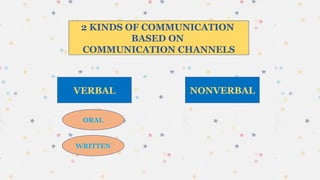
2 KINDS OF COMMUNICATION
BASED ON
COMMUNICATION CHANNELS
VERBAL NONVERBAL
ORAL
WRITTEN
NONVERBAL
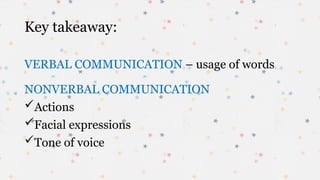
Key takeaway:
VERBAL COMMUNICATION – usage of words
NONVERBAL COMMUNICATION
Actions
Facial expressions
Tone of voice
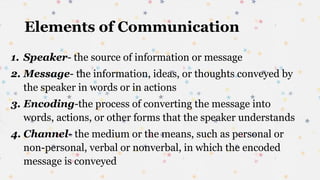
Elements of Communication
1. Speaker- the source of information or message
2. Message- the information, ideas, or thoughts conveyed by
the speaker in words or in actions
3. Encoding-the process of converting the message into
words, actions, or other forms that the speaker understands
4. Channel- the medium or the means, such as personal or
non-personal, verbal or nonverbal, in which the encoded
message is conveyed
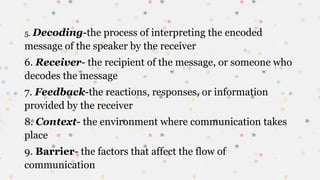
5. Decoding-the process of interpreting the encoded
message of the speaker by the receiver
6. Receiver- the recipient of the message, or someone who
decodes the message
7. Feedback-the reactions, responses, or information
provided by the receiver
8. Context- the environment where communication takes
place
9. Barrier- the factors that affect the flow of
communication
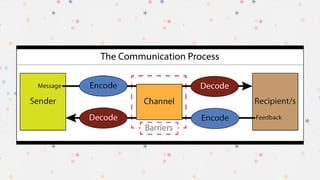
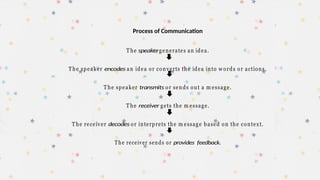
Process of Communication
T he speakergenerates an idea.
T he speaker encodes an idea or converts the idea into w ords or actions.
T he speaker transmits or sends out a m essage.
T he receiver gets the m essage.
T he receiver decodes or interprets the m essage based on the context.
The receiver sends or provides feedback.

ELEMENTS AND PROCESS OF COMMUNICATION.pptx

  • 1.
  • 2.
    Can you imagineyourself in a world without communication?
  • 3.
    Life today isimpossible without communication, and we should concentrate to make communication more efficient and more natural.
  • 4.
    According to Weber(2008) as cited by Dapat, et.al. (2016), 70% of the person’s waking time is spent communicating in different manners like talking, listening, reading, and writing.
  • 5.
    If you wereto divide your daily communication activities, how many percent would you give to each of the following communication manners? Communication Activity Your Percentage Average Percentage Talking 30 Listening 45 Writing 9 Reading 16 Total 70%
  • 6.
    Take Note: Thisis the average time that people spend communicating, especially the 45% listening statistics but these percentages may vary from person to person. Your time spent in talking, listening, writing, and reading will tell who you are as a communicator.
  • 7.
    Definition of Communication Accordingto Mc Cornack (2014) as cited by Sipacio and Balgos (2016), communication is a process of sharing and conveying messages or information from one person to another within and across channel, context, media, and cultures.
  • 8.
    Where do wefind/ see communication? When do we experience communication? There is a wide variety of contexts and situations in which communication can be manifested.  face to face interaction  a phone conversation  a group discussion  a meeting or interview  a letter correspondence  a class recitation
  • 9.
    Nature of Communication 1.Communication is a process. 2. Communication occurs between two or more people (the speaker and the receiver). 3. Communication can be expressed through written or spoken words, actions (nonverbal), or both spoken words and nonverbal actions at the same time.
  • 10.
    1. Communication isa process. 2 Processes of Communication 1.1 One-way Communication Sender-Message-Receiver Ex. Recorded Video Discussion 1.2 Two-way Communication Sender-Message-receiver-Feedback
  • 11.
    2. Communication occursbetween two or more people (the speaker and the receiver). Is this absolute? Is this applicable all the time? NO. – Interpersonal Communication
  • 12.
    Usually, communication occursbetween two or more people. We are social beings, meaning, most of the time, we want to express our feelings and experiences with someone else.
  • 13.
    3. Communication canbe expressed through written or spoken words, actions (nonverbal), or both spoken words and nonverbal actions at the same time.
  • 14.
    2 KINDS OFCOMMUNICATION BASED ON COMMUNICATION CHANNELS 3.1 VERBAL COMMUNICATION 3.2 NONVERBAL COMMUNICATION
  • 15.
    2 KINDS OFCOMMUNICATION BASED ON COMMUNICATION CHANNELS VERBAL NONVERBAL ORAL WRITTEN
  • 16.
  • 17.
    Key takeaway: VERBAL COMMUNICATION– usage of words NONVERBAL COMMUNICATION Actions Facial expressions Tone of voice
  • 18.
    Elements of Communication 1.Speaker- the source of information or message 2. Message- the information, ideas, or thoughts conveyed by the speaker in words or in actions 3. Encoding-the process of converting the message into words, actions, or other forms that the speaker understands 4. Channel- the medium or the means, such as personal or non-personal, verbal or nonverbal, in which the encoded message is conveyed
  • 19.
    5. Decoding-the processof interpreting the encoded message of the speaker by the receiver 6. Receiver- the recipient of the message, or someone who decodes the message 7. Feedback-the reactions, responses, or information provided by the receiver 8. Context- the environment where communication takes place 9. Barrier- the factors that affect the flow of communication
  • 21.
    Process of Communication The speakergenerates an idea. T he speaker encodes an idea or converts the idea into w ords or actions. T he speaker transmits or sends out a m essage. T he receiver gets the m essage. T he receiver decodes or interprets the m essage based on the context. The receiver sends or provides feedback.