ELEMENTS OF ARTS
LET US RECALL!
What are the three Major
Traditions of Philippine
Arts?
TELL ME!
What are the
elements of arts?
PROCESSING QUESTION:
What do you think is the
importance of the
elements of arts?
In the field of arts, knowing the
elements and principles of arts is
important, not just to the artist but
also to the viewer, to have a deeper
understanding of an artwork.
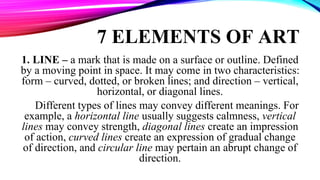
7 ELEMENTS OF ART
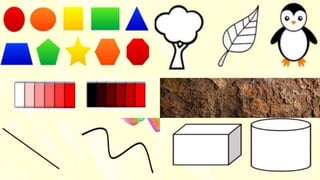
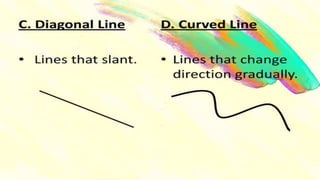
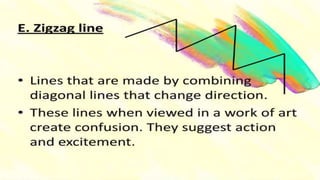
1. LINE – a mark that is made on a surface or outline. Defined
by a moving point in space. It may come in two characteristics:
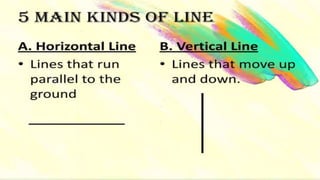
form – curved, dotted, or broken lines; and direction – vertical,
horizontal, or diagonal lines.
Different types of lines may convey different meanings. For
example, a horizontal line usually suggests calmness, vertical
lines may convey strength, diagonal lines create an impression
of action, curved lines create an expression of gradual change
of direction, and circular line may pertain an abrupt change of
direction.
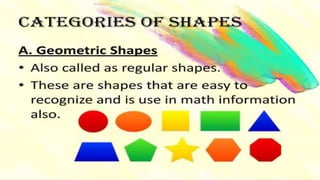
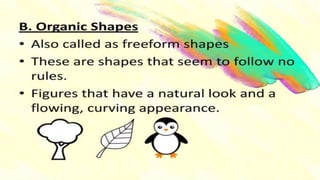
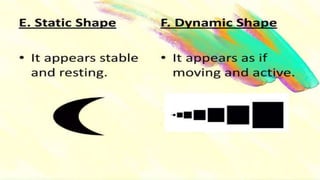
2. SHAPE
•is an area that is enclosed by a line or lines. Shapes
are two dimensional figures with height and width.
There are different kinds of shapes and these are
geometric shapes (triangle, squares, rectangle,
etc.), organic shapes (shapes found in nature, e.g.
shape of a leaf or cloud), abstract shapes
(asymmetrical and free flowing shapes).
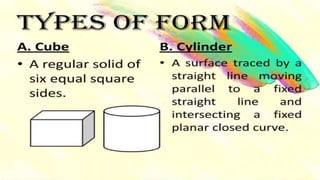
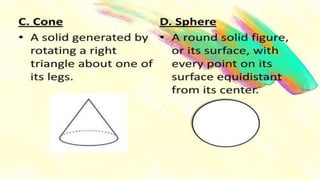
3. FORM
•is a three-dimensional figures. Its
dimensions are height, width, and
volume. Unlike shapes, it has
more depth.
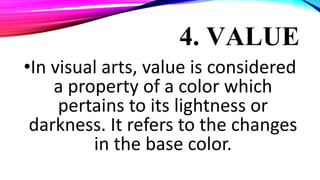
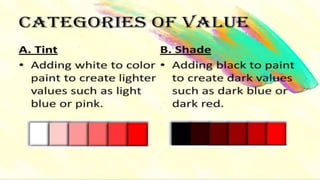
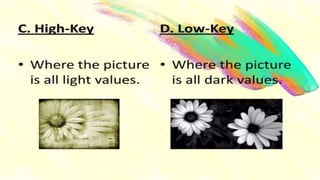
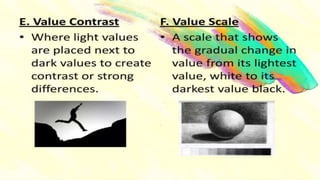
4. VALUE
•In visual arts, value is considered
a property of a color which
pertains to its lightness or
darkness. It refers to the changes
in the base color.
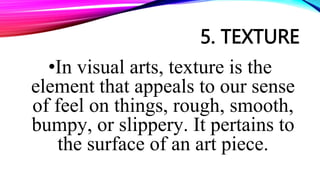
5. TEXTURE
•In visual arts, texture is the
element that appeals to our sense
of feel on things, rough, smooth,
bumpy, or slippery. It pertains to
the surface of an art piece.
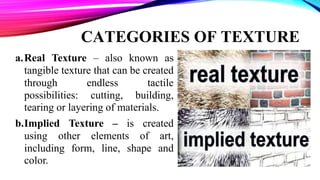
CATEGORIES OF TEXTURE
a.Real Texture – also known as
tangible texture that can be created
through endless tactile
possibilities: cutting, building,
tearing or layering of materials.
b.Implied Texture – is created
using other elements of art,
including form, line, shape and
color.
6. COLOR
•In visual arts, color is associated with the
natural phenomenon in our environment.
Scientifically, when a light passes through a
prism, it will produce different hues of
different wavelengths. These colors may
pertain to lightness, darkness, coolness, or
warmth.
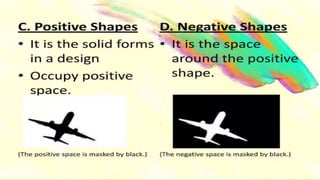
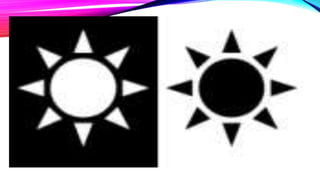
7. SPACE
•pertains to emptiness which may either
be positive space or negative space.
Positive space refers to a part which is
enclosed in a shape, while negative
space refers to the opposite part which
the shape is enclosing.
CPAR DAY 2 LESSON.pptx

CPAR DAY 2 LESSON.pptx

  • 1.
  • 2.
    LET US RECALL! Whatare the three Major Traditions of Philippine Arts?
  • 3.
    TELL ME! What arethe elements of arts?
  • 5.
    PROCESSING QUESTION: What doyou think is the importance of the elements of arts?
  • 6.
    In the fieldof arts, knowing the elements and principles of arts is important, not just to the artist but also to the viewer, to have a deeper understanding of an artwork.
  • 7.
    7 ELEMENTS OFART 1. LINE – a mark that is made on a surface or outline. Defined by a moving point in space. It may come in two characteristics: form – curved, dotted, or broken lines; and direction – vertical, horizontal, or diagonal lines. Different types of lines may convey different meanings. For example, a horizontal line usually suggests calmness, vertical lines may convey strength, diagonal lines create an impression of action, curved lines create an expression of gradual change of direction, and circular line may pertain an abrupt change of direction.
  • 11.
    2. SHAPE •is anarea that is enclosed by a line or lines. Shapes are two dimensional figures with height and width. There are different kinds of shapes and these are geometric shapes (triangle, squares, rectangle, etc.), organic shapes (shapes found in nature, e.g. shape of a leaf or cloud), abstract shapes (asymmetrical and free flowing shapes).
  • 16.
    3. FORM •is athree-dimensional figures. Its dimensions are height, width, and volume. Unlike shapes, it has more depth.
  • 19.
    4. VALUE •In visualarts, value is considered a property of a color which pertains to its lightness or darkness. It refers to the changes in the base color.
  • 23.
    5. TEXTURE •In visualarts, texture is the element that appeals to our sense of feel on things, rough, smooth, bumpy, or slippery. It pertains to the surface of an art piece.
  • 24.
    CATEGORIES OF TEXTURE a.RealTexture – also known as tangible texture that can be created through endless tactile possibilities: cutting, building, tearing or layering of materials. b.Implied Texture – is created using other elements of art, including form, line, shape and color.
  • 25.
    6. COLOR •In visualarts, color is associated with the natural phenomenon in our environment. Scientifically, when a light passes through a prism, it will produce different hues of different wavelengths. These colors may pertain to lightness, darkness, coolness, or warmth.
  • 27.
    7. SPACE •pertains toemptiness which may either be positive space or negative space. Positive space refers to a part which is enclosed in a shape, while negative space refers to the opposite part which the shape is enclosing.