Batch 2021 -2023 sem 2
Presentation Season 2
Code- 22400 Paper no.107 The Twentieth Century
Literature : From World War II to the End of
Century
Department of English ,MK Bhavnagar university
VACHCHHALATA JOSHI
VACHCHHALATAJOSHI.14@GMAIL.COM
ROLL NO.20
TOPIC –AN ELEGY IN MEMORY OF YEATS
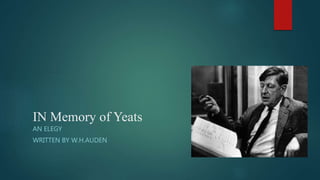
IN Memory of Yeats
AN ELEGY
WRITTEN BY W.H.AUDEN
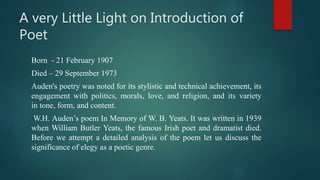
A very Little Light on Introduction of
Poet
Born - 21 February 1907
Died – 29 September 1973
Auden's poetry was noted for its stylistic and technical achievement, its
engagement with politics, morals, love, and religion, and its variety
in tone, form, and content.
W.H. Auden’s poem In Memory of W. B. Yeats. It was written in 1939
when William Butler Yeats, the famous Irish poet and dramatist died.
Before we attempt a detailed analysis of the poem let us discuss the
significance of elegy as a poetic genre.
“
”
“Elegies are poems dedicated to the dead.”
WHAT IS AN ELEGY?
Elegy, meditative lyric poem lamenting the death of a public personage
or of a friend or loved one by extension, any reflective lyric on the broader
theme of human mortality.
An Elegy
Traditionally an elegy includes three stages of
loss: the first is an expression of grief; the
second is full of praise for the deceased person;
the third contains consolation and solace.
Auden’s poem draws on that traditional form
but, makes it clear that while memory deals with
the past, it takes place in the present.
There is a long history of
elegiac poetry, that is, poems
written on the occasion of
someone’s death. Poems about
death are generally concerned
not just with the loss, but also
with remains after a person
dies.
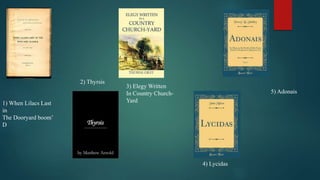
Several Elegies and Poets
 1) Thomas gray – Elegy Written in Country Churchyard
 2) Walt Whiteman – When Lilacs last in the Dooryard and Bloom’d
 3) John Milton – Lycidas
 4) P.B.Shelley – Adonais
 5)Mathew Arnold – Thyrsis
1) When Lilacs Last
in
The Dooryard boom’
D
2) Thyrsis
3) Elegy Written
In Country Church-
Yard
4) Lycidas
5) Adonais
1) Elegy Written in Country church- Yard
An Elegy Written in a Country Church Yard, meditative poem written in iambic
pentameter quatrains by Thomas Gray, published in 1751. A meditation on unused
human potential, the conditions of country life, and mortality, An Elegy Written in a
Country Church Yard is one of the best-known elegies in the language.
The main themes in "Elegy Written in a Country Churchyard" are the universality of
death, social class and value, and poetry and posterity. The universality of death:
Gray's poem depicts death as a leveling force that brings all people, whether rich or
poor, to the same final fate.
In conclusion, the poet, through the speaker, ends the elegy by saying that death is an
inevitable event in this world. Also, he says that man's efforts and his struggles to
succeed in life comes to an end in death. Thus, death conquers man regardless of his
successes and/or failures in his endeavors during his life.
2) When Lilacs Last in the Dooryard
Bloom’D
“When Lilacs Last in the Dooryard Bloom'd” mourns for Lincoln in a way that is all
the more profound for seeing the president's death as only a smaller, albeit highly
symbolic, tragedy in the midst of a world of confusion and sadness.
Whitman's title, 'When Lilacs Last in the Dooryard Bloom'd', refers to the moment
he learned that President Abraham Lincoln had died, in April 1865. At the time,
Whitman was visiting his mother and brother at his mother's home in New York; he
stepped out the door and observed that the lilacs were blooming.
When lilacs last in the dooryard bloom'd, And the great star early droop'd in the
western sky in the night, I mourn'd, and yet shall mourn with ever-returning spring.
3)Lycidas
Lycidas is a pastoral elegy, which we talked about briefly in "In a Nutshell." These
poems have a tradition in which the poet gives the dead person whom they're
mourning a name from the works of Virgil, Theocritus, or other similar poets.
The poem mourns the loss of a virtuous and promising young man about to
embark upon a career as a clergyman. Adopting the conventions of the classical
pastoral elegy (Lycidas was a shepherd in Virgil's Eclogues), Milton muses on fame,
the meaning of existence, and heavenly judgment.
Milton's elegy 'Lycidas' is also known as monody which is in the form of a pastoral
elegy written in 1637 to lament the accidental death, by drowning of Milton's
friend Edward King who was a promising young man of great intelligence. The
elegy takes its name from the subject matter, not its form.
4) Adonais
Adonais is the plural of the Hebrew word Adon, which means “lord” or “master.” It
was first used as God's title before it was used as God's name. The plural and
capitalized Adonais is used because, according to beliefs, God is the lord of all
humanity and thus is the “lord of all lords.”
Percy Shelley's ''Adonais'' is a poem written to commemorate the death of John
Keats. The poem is a pastoral elegy, a poem of mourning that relies on nature
imagery to honor the dead.
Adonis in classical mythology was killed by a boar; Adonais (a variant of Adonis
coined by Shelley) was killed by reviewers. It was in the tradition of elegy to use
proper names taken from classical literature. Shelley's coinage may have been
intended to forestall the misapprehension that the poem was about Adonis.
5) Thyrsis
Arnold's theme in “Thyrsis” is not simply the loss of Arthur Hugh Clough. Rather, the
poem is a lament for many kinds of loss: the lost paradise of Oxford, the loss of
Arnold's youth, his and Clough's lost innocence, and the loss of meaning and direction
in the society and culture of his day.
The poem is a pastoral elegy lamenting Clough as Thyrsis, recalling his 'golden
prime' in the days when he and Arnold wandered through the Oxfordshire
countryside, their youthful rivalry as poets, and Clough's departure for a more
troubled world.
The poem is a pastoral elegy lamenting Clough as Thyrsis, recalling his 'golden
prime' in the days when he and Arnold wandered through the Oxfordshire
countryside, their youthful rivalry as poets, and Clough's departure for a more
troubled world.
The Elegiac Act Auden’s poem
In Memory of Yeats
 The Poem is Structured in Three Sections and Commentary on the nature of poet’s
art and roles during time of life calamity. As well as life time Struggles he has
gone through.
 Why does Auden describe yeats as if he is just disappeared rather than died?
 Auden says that Yeats "disappeared in the dead of winter" because it was during
the wintertime that Yeats died. Yeats died on a cold, dark day, and his death
made that day even colder and darker.
Citation
 https://www.lkouniv.ac.in/site/writereaddata/siteContent/20200430170836
2582Onkar-nath-Upadhyay-In-the-Memory-of-W-B-Yeats-Moocs.pdf
 https://www.jstor.org/stable/373268
 https://www.jstor.org/stable/2929408
 https://www.goodreads.com/book/show/1703965.Adonais
Thank you!!!

Elegy.pptx

  • 1.
    Batch 2021 -2023sem 2 Presentation Season 2 Code- 22400 Paper no.107 The Twentieth Century Literature : From World War II to the End of Century Department of English ,MK Bhavnagar university VACHCHHALATA JOSHI VACHCHHALATAJOSHI.14@GMAIL.COM ROLL NO.20 TOPIC –AN ELEGY IN MEMORY OF YEATS
  • 2.
    IN Memory ofYeats AN ELEGY WRITTEN BY W.H.AUDEN
  • 3.
    A very LittleLight on Introduction of Poet Born - 21 February 1907 Died – 29 September 1973 Auden's poetry was noted for its stylistic and technical achievement, its engagement with politics, morals, love, and religion, and its variety in tone, form, and content. W.H. Auden’s poem In Memory of W. B. Yeats. It was written in 1939 when William Butler Yeats, the famous Irish poet and dramatist died. Before we attempt a detailed analysis of the poem let us discuss the significance of elegy as a poetic genre.
  • 4.
    “ ” “Elegies are poemsdedicated to the dead.” WHAT IS AN ELEGY? Elegy, meditative lyric poem lamenting the death of a public personage or of a friend or loved one by extension, any reflective lyric on the broader theme of human mortality.
  • 5.
    An Elegy Traditionally anelegy includes three stages of loss: the first is an expression of grief; the second is full of praise for the deceased person; the third contains consolation and solace. Auden’s poem draws on that traditional form but, makes it clear that while memory deals with the past, it takes place in the present. There is a long history of elegiac poetry, that is, poems written on the occasion of someone’s death. Poems about death are generally concerned not just with the loss, but also with remains after a person dies.
  • 6.
    Several Elegies andPoets  1) Thomas gray – Elegy Written in Country Churchyard  2) Walt Whiteman – When Lilacs last in the Dooryard and Bloom’d  3) John Milton – Lycidas  4) P.B.Shelley – Adonais  5)Mathew Arnold – Thyrsis
  • 7.
    1) When LilacsLast in The Dooryard boom’ D 2) Thyrsis 3) Elegy Written In Country Church- Yard 4) Lycidas 5) Adonais
  • 8.
    1) Elegy Writtenin Country church- Yard An Elegy Written in a Country Church Yard, meditative poem written in iambic pentameter quatrains by Thomas Gray, published in 1751. A meditation on unused human potential, the conditions of country life, and mortality, An Elegy Written in a Country Church Yard is one of the best-known elegies in the language. The main themes in "Elegy Written in a Country Churchyard" are the universality of death, social class and value, and poetry and posterity. The universality of death: Gray's poem depicts death as a leveling force that brings all people, whether rich or poor, to the same final fate. In conclusion, the poet, through the speaker, ends the elegy by saying that death is an inevitable event in this world. Also, he says that man's efforts and his struggles to succeed in life comes to an end in death. Thus, death conquers man regardless of his successes and/or failures in his endeavors during his life.
  • 9.
    2) When LilacsLast in the Dooryard Bloom’D “When Lilacs Last in the Dooryard Bloom'd” mourns for Lincoln in a way that is all the more profound for seeing the president's death as only a smaller, albeit highly symbolic, tragedy in the midst of a world of confusion and sadness. Whitman's title, 'When Lilacs Last in the Dooryard Bloom'd', refers to the moment he learned that President Abraham Lincoln had died, in April 1865. At the time, Whitman was visiting his mother and brother at his mother's home in New York; he stepped out the door and observed that the lilacs were blooming. When lilacs last in the dooryard bloom'd, And the great star early droop'd in the western sky in the night, I mourn'd, and yet shall mourn with ever-returning spring.
  • 10.
    3)Lycidas Lycidas is apastoral elegy, which we talked about briefly in "In a Nutshell." These poems have a tradition in which the poet gives the dead person whom they're mourning a name from the works of Virgil, Theocritus, or other similar poets. The poem mourns the loss of a virtuous and promising young man about to embark upon a career as a clergyman. Adopting the conventions of the classical pastoral elegy (Lycidas was a shepherd in Virgil's Eclogues), Milton muses on fame, the meaning of existence, and heavenly judgment. Milton's elegy 'Lycidas' is also known as monody which is in the form of a pastoral elegy written in 1637 to lament the accidental death, by drowning of Milton's friend Edward King who was a promising young man of great intelligence. The elegy takes its name from the subject matter, not its form.
  • 11.
    4) Adonais Adonais isthe plural of the Hebrew word Adon, which means “lord” or “master.” It was first used as God's title before it was used as God's name. The plural and capitalized Adonais is used because, according to beliefs, God is the lord of all humanity and thus is the “lord of all lords.” Percy Shelley's ''Adonais'' is a poem written to commemorate the death of John Keats. The poem is a pastoral elegy, a poem of mourning that relies on nature imagery to honor the dead. Adonis in classical mythology was killed by a boar; Adonais (a variant of Adonis coined by Shelley) was killed by reviewers. It was in the tradition of elegy to use proper names taken from classical literature. Shelley's coinage may have been intended to forestall the misapprehension that the poem was about Adonis.
  • 12.
    5) Thyrsis Arnold's themein “Thyrsis” is not simply the loss of Arthur Hugh Clough. Rather, the poem is a lament for many kinds of loss: the lost paradise of Oxford, the loss of Arnold's youth, his and Clough's lost innocence, and the loss of meaning and direction in the society and culture of his day. The poem is a pastoral elegy lamenting Clough as Thyrsis, recalling his 'golden prime' in the days when he and Arnold wandered through the Oxfordshire countryside, their youthful rivalry as poets, and Clough's departure for a more troubled world. The poem is a pastoral elegy lamenting Clough as Thyrsis, recalling his 'golden prime' in the days when he and Arnold wandered through the Oxfordshire countryside, their youthful rivalry as poets, and Clough's departure for a more troubled world.
  • 13.
    The Elegiac ActAuden’s poem In Memory of Yeats  The Poem is Structured in Three Sections and Commentary on the nature of poet’s art and roles during time of life calamity. As well as life time Struggles he has gone through.  Why does Auden describe yeats as if he is just disappeared rather than died?  Auden says that Yeats "disappeared in the dead of winter" because it was during the wintertime that Yeats died. Yeats died on a cold, dark day, and his death made that day even colder and darker.
  • 14.