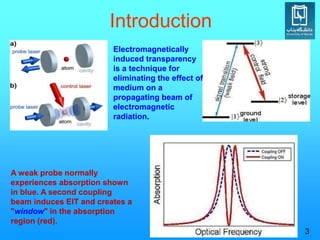
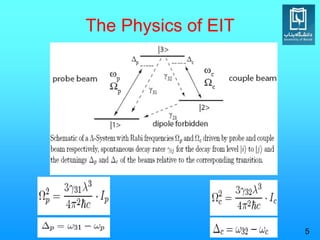
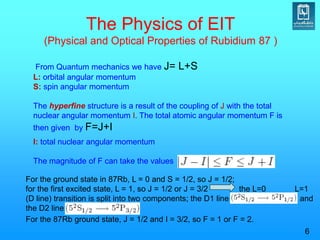
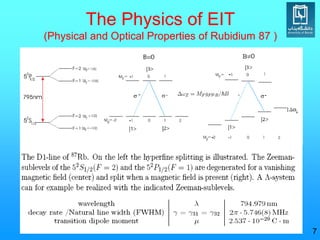
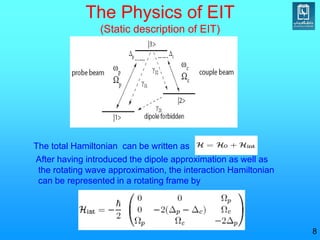
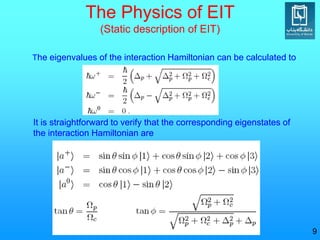
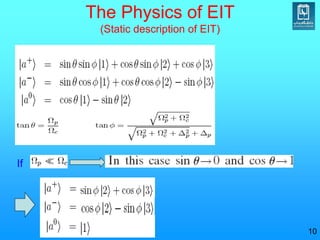
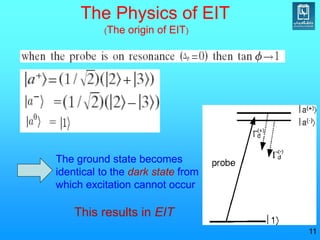
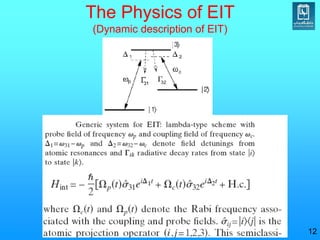
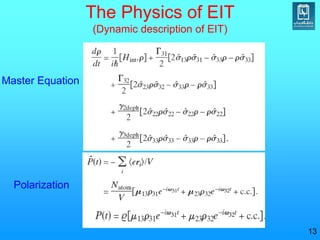
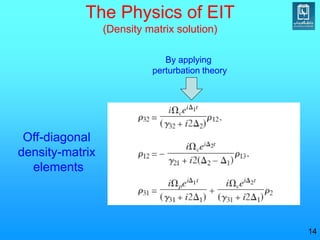
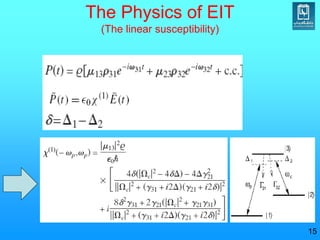
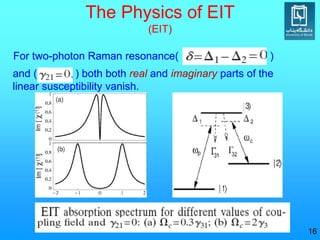
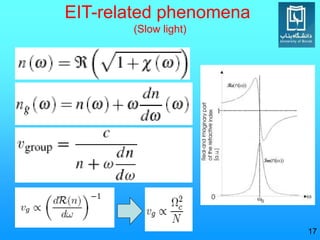
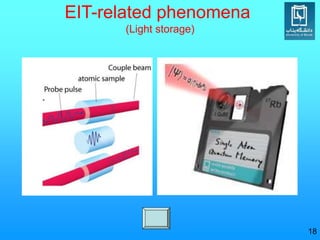
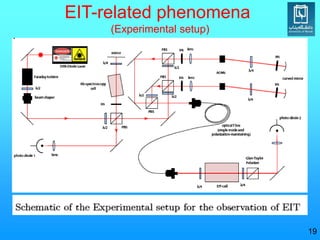
Electromagnetically induced transparency (EIT) is a quantum interference effect that can eliminate absorption of light in a medium. The effect was first observed in 1991 by Steve Harris. EIT occurs when a weak probe beam experiences reduced absorption due to destructive interference from a coupling beam. This creates a "window" of transparency. The physics of EIT involves coherent population trapping in a three-level atomic system using a probe and coupling laser. When the two-photon resonance condition is met, both the real and imaginary parts of the linear susceptibility vanish, resulting in EIT. EIT enables phenomena like slow light and light storage by significantly reducing the group velocity of light pulses.