FEASIBILITY OF SPECTRUM
ENHANCEMENT
MENTOR: DR GURENDRA
BHARADWAJ
BY: MOHIT KARNAWAT
INTRODUCTION
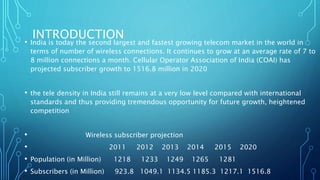
• India is today the second largest and fastest growing telecom market in the world in
terms of number of wireless connections. It continues to grow at an average rate of 7 to
8 million connections a month. Cellular Operator Association of India (COAI) has
projected subscriber growth to 1516.8 million in 2020
• the tele density in India still remains at a very low level compared with international
standards and thus providing tremendous opportunity for future growth, heightened
competition
• Wireless subscriber projection
• 2011 2012 2013 2014 2015 2020
• Population (in Million) 1218 1233 1249 1265 1281
• Subscribers (in Million) 923.8 1049.1 1134.5 1185.3 1217.1 1516.8
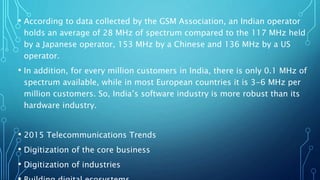
• According to data collected by the GSM Association, an Indian operator
holds an average of 28 MHz of spectrum compared to the 117 MHz held
by a Japanese operator, 153 MHz by a Chinese and 136 MHz by a US
operator.
• In addition, for every million customers in India, there is only 0.1 MHz of
spectrum available, while in most European countries it is 3-6 MHz per
million customers. So, India’s software industry is more robust than its
hardware industry.
• 2015 Telecommunications Trends
• Digitization of the core business
• Digitization of industries
SPECTRUM
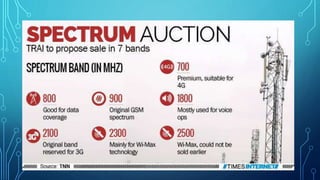
• When we talk about spectrum, we’re talking about the channels and
frequencies used to transmit signals to your phone, your tablet, your TV or
any wireless device.
• The 3G based services are fast becoming the minimum norm of data
services across the country, making it increasingly important to be available
in every circle.
• Today's So-Called 4G: LTE (Long Term Evolutions) and WiMAX.
The problem is that none of the current networks actually fulfil the
International T T Telecommunication Union's requirements for being
called 4G.
METHODOLOGY
• understanding regulation of spectrum community
• positioning in market
• current economic and financial condition
• upcoming trends on the basis of ongoing R&D
REGULATION OF RADIO SPECTRUM
• Licensed Spectrum for Exclusive Usage – Protected through the regulator,
transferable/ flexible usage rights
• Licensed Spectrum for Shared Usage – Restricted to a specific technology
• Unlicensed Spectrum – Available to all radio technologies working with
specified standards, no right for protection from interference
• Open Spectrum – Anyone can access any range of the spectrum, minimum set
of rules defined by standards
BUYING NEW SPECTRUM
• One has to understand that buying new spectrum is like heavily
investing and constructing a multiple lane highway allocated only for
modern automobiles.
• Re-farming, on the other hand means reorganising the existing system
and regulations on highways and
• enabling coexistence of modern and older automobiles too.
• Who ends up scooping up the most amount of spectrum depends on
two factors—the willingness of the sellers to sell (either by choice, or
under pressure from their lenders), and on being able to overcome “the
band and the total cap rules” (an operator is not allowed to have more
than 50% of the total spectrum assigned in a band, and more than 25%
of the total spectrum assigned to all operators).
DIFFICULTIES IN BUSINESS
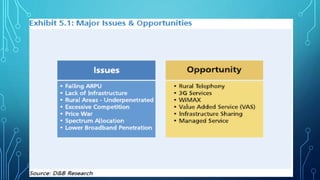
• Most companies complains that the problem is, to a large extent, that of India’s
bureaucracy. For there’s always a certain tension in governance of any sort. Of course
we’d always like whatever decision is made to be the “correct” one, the one that produces
the best results. However, working in the other direction is the necessity of decisions
actually being taken promptly. That’s where the tension comes from: correct decision
or quick decision?
• the law as it is, as it is written, but if the politicians don’t like the result they try to go
back in time to get the result they do want, not the one the law said at the time.
• then they need to recast their entire business plan in the country. And of course that
business plan is dependent upon what all of the competition is doing (and as they point
out, India is a very competitive mobile telecoms market) and that competition hasn’t
been standing still for 10 months.
• raising data tariffs is absolutely inevitable, especially at a time when (average revenue per
MYSTERY OF UNSOLD SPECTRUM
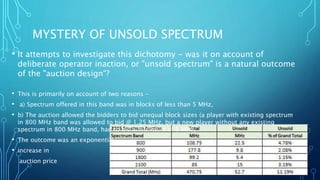
• It attempts to investigate this dichotomy - was it on account of
deliberate operator inaction, or "unsold spectrum" is a natural outcome
of the "auction design“?
• This is primarily on account of two reasons –
• a) Spectrum offered in this band was in blocks of less than 5 MHz,
• b) The auction allowed the bidders to bid unequal block sizes (a player with existing spectrum
in 800 MHz band was allowed to bid @ 1.25 MHz, but a new player without any existing
spectrum in 800 MHz band, had to bid a minimum of 5 MHz,
• The outcome was an exponential
• increase in
auction price
• quantum of spectrum that was left unsold is highly fragmented and not
suitable for deploying next generation technologies if acquired by the
operators in a standalone manner
• Scaling up in the short term would be difficult due to myriad regulatory
and market barriers
• For instance, cable operators are not currently allowed to offer voice, data,
and video together.
• And price points currently do not support a sustainable business case for
operators.
POLICIES ON SPECTRUM UTILIZATION
• Light Licensing - no interference is caused among the involved systems
• Spectrum fragmentation - white spaces among the fragmented
spectrum these are also called “garbage bands” of spectrum
• Spectrum Harmonisation - seamless services over wide areas including
roaming
• Spectrum Liberalisation - removal of technology restrictions to enable
new access technologies to be deployed within the same band
COMMERCIAL SUCCESS
• re-farming of technological instruments promises to; increase
reliability, enhance coverage, reduce space, decrease power
usage, and lower operating costs in many cases. For this
companies need to:
• realistic about their deployment time lines.
• availability of devices at attractive prices.
• ensure backward compatibility with 3G and 2G needs to
support roaming
REVIEW OF LITERATURE
• I read about 50 research papers regarding recent advancements in
the enhancements of spectrum. By keeping Perspectives on future
technology trends to assist national and regional preparations. re-
farming of technological instruments promises to; increase reliability,
enhance coverage, reduce space, decrease power usage, and lower
operating costs in many cases. For this the government must ensure
that there is an efficient usage of the spectrum for the benefit of
society and economy. So, that it become a level-playing field for all
players.
CONCLUSIONS
• India is unique in its excessive fragmentation of spectrum
holdings, and hence requires more innovative approaches in
spectrum management. it can be seen that enhanced spectrum
sharing results in greater efficiency of spectrum usage, which is
essential. the government must ensure that there is an efficient
usage of the spectrum for the benefit of society and economy.
So, that it become a level-playing field for all players.

spectrum by mohit

  • 1.
    FEASIBILITY OF SPECTRUM ENHANCEMENT MENTOR:DR GURENDRA BHARADWAJ BY: MOHIT KARNAWAT
  • 2.
    INTRODUCTION • India istoday the second largest and fastest growing telecom market in the world in terms of number of wireless connections. It continues to grow at an average rate of 7 to 8 million connections a month. Cellular Operator Association of India (COAI) has projected subscriber growth to 1516.8 million in 2020 • the tele density in India still remains at a very low level compared with international standards and thus providing tremendous opportunity for future growth, heightened competition • Wireless subscriber projection • 2011 2012 2013 2014 2015 2020 • Population (in Million) 1218 1233 1249 1265 1281 • Subscribers (in Million) 923.8 1049.1 1134.5 1185.3 1217.1 1516.8
  • 3.
    • According todata collected by the GSM Association, an Indian operator holds an average of 28 MHz of spectrum compared to the 117 MHz held by a Japanese operator, 153 MHz by a Chinese and 136 MHz by a US operator. • In addition, for every million customers in India, there is only 0.1 MHz of spectrum available, while in most European countries it is 3-6 MHz per million customers. So, India’s software industry is more robust than its hardware industry. • 2015 Telecommunications Trends • Digitization of the core business • Digitization of industries
  • 4.
    SPECTRUM • When wetalk about spectrum, we’re talking about the channels and frequencies used to transmit signals to your phone, your tablet, your TV or any wireless device. • The 3G based services are fast becoming the minimum norm of data services across the country, making it increasingly important to be available in every circle. • Today's So-Called 4G: LTE (Long Term Evolutions) and WiMAX. The problem is that none of the current networks actually fulfil the International T T Telecommunication Union's requirements for being called 4G.
  • 5.
    METHODOLOGY • understanding regulationof spectrum community • positioning in market • current economic and financial condition • upcoming trends on the basis of ongoing R&D
  • 7.
    REGULATION OF RADIOSPECTRUM • Licensed Spectrum for Exclusive Usage – Protected through the regulator, transferable/ flexible usage rights • Licensed Spectrum for Shared Usage – Restricted to a specific technology • Unlicensed Spectrum – Available to all radio technologies working with specified standards, no right for protection from interference • Open Spectrum – Anyone can access any range of the spectrum, minimum set of rules defined by standards
  • 8.
    BUYING NEW SPECTRUM •One has to understand that buying new spectrum is like heavily investing and constructing a multiple lane highway allocated only for modern automobiles. • Re-farming, on the other hand means reorganising the existing system and regulations on highways and • enabling coexistence of modern and older automobiles too. • Who ends up scooping up the most amount of spectrum depends on two factors—the willingness of the sellers to sell (either by choice, or under pressure from their lenders), and on being able to overcome “the band and the total cap rules” (an operator is not allowed to have more than 50% of the total spectrum assigned in a band, and more than 25% of the total spectrum assigned to all operators).
  • 9.
    DIFFICULTIES IN BUSINESS •Most companies complains that the problem is, to a large extent, that of India’s bureaucracy. For there’s always a certain tension in governance of any sort. Of course we’d always like whatever decision is made to be the “correct” one, the one that produces the best results. However, working in the other direction is the necessity of decisions actually being taken promptly. That’s where the tension comes from: correct decision or quick decision? • the law as it is, as it is written, but if the politicians don’t like the result they try to go back in time to get the result they do want, not the one the law said at the time. • then they need to recast their entire business plan in the country. And of course that business plan is dependent upon what all of the competition is doing (and as they point out, India is a very competitive mobile telecoms market) and that competition hasn’t been standing still for 10 months. • raising data tariffs is absolutely inevitable, especially at a time when (average revenue per
  • 11.
    MYSTERY OF UNSOLDSPECTRUM • It attempts to investigate this dichotomy - was it on account of deliberate operator inaction, or "unsold spectrum" is a natural outcome of the "auction design“? • This is primarily on account of two reasons – • a) Spectrum offered in this band was in blocks of less than 5 MHz, • b) The auction allowed the bidders to bid unequal block sizes (a player with existing spectrum in 800 MHz band was allowed to bid @ 1.25 MHz, but a new player without any existing spectrum in 800 MHz band, had to bid a minimum of 5 MHz, • The outcome was an exponential • increase in auction price
  • 12.
    • quantum ofspectrum that was left unsold is highly fragmented and not suitable for deploying next generation technologies if acquired by the operators in a standalone manner • Scaling up in the short term would be difficult due to myriad regulatory and market barriers • For instance, cable operators are not currently allowed to offer voice, data, and video together. • And price points currently do not support a sustainable business case for operators.
  • 13.
    POLICIES ON SPECTRUMUTILIZATION • Light Licensing - no interference is caused among the involved systems • Spectrum fragmentation - white spaces among the fragmented spectrum these are also called “garbage bands” of spectrum • Spectrum Harmonisation - seamless services over wide areas including roaming • Spectrum Liberalisation - removal of technology restrictions to enable new access technologies to be deployed within the same band
  • 14.
    COMMERCIAL SUCCESS • re-farmingof technological instruments promises to; increase reliability, enhance coverage, reduce space, decrease power usage, and lower operating costs in many cases. For this companies need to: • realistic about their deployment time lines. • availability of devices at attractive prices. • ensure backward compatibility with 3G and 2G needs to support roaming
  • 15.
    REVIEW OF LITERATURE •I read about 50 research papers regarding recent advancements in the enhancements of spectrum. By keeping Perspectives on future technology trends to assist national and regional preparations. re- farming of technological instruments promises to; increase reliability, enhance coverage, reduce space, decrease power usage, and lower operating costs in many cases. For this the government must ensure that there is an efficient usage of the spectrum for the benefit of society and economy. So, that it become a level-playing field for all players.
  • 16.
    CONCLUSIONS • India isunique in its excessive fragmentation of spectrum holdings, and hence requires more innovative approaches in spectrum management. it can be seen that enhanced spectrum sharing results in greater efficiency of spectrum usage, which is essential. the government must ensure that there is an efficient usage of the spectrum for the benefit of society and economy. So, that it become a level-playing field for all players.