Key Government Initiatives: Strategic Proposal Bridging the Digital Divide Prepared by Najmuddin Jabalpurwala
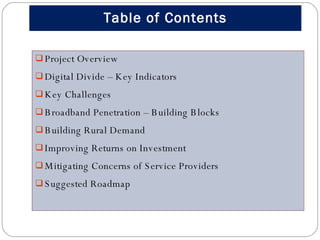
Table of Contents Project Overview Digital Divide – Key Indicators Key Challenges Broadband Penetration – Building Blocks Building Rural Demand Improving Returns on Investment Mitigating Concerns of Service Providers Suggested Roadmap
Project Overview
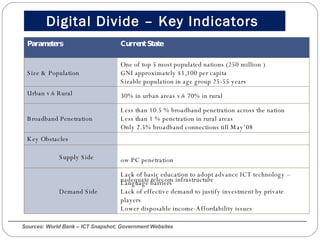
Digital Divide – Key Indicators  Sources: World Bank – ICT Snapshot; Government Websites Parameters Current State Size & Population One of top 5 most populated nations (250 million ) GNI approximately $1,100 per capita Sizable population in age group 25-55 years Urban v/s Rural 30% in urban areas v/s 70% in rural Broadband Penetration Less than 10.5 % broadband penetration across the nation Less than 1 % penetration in rural areas Only 2.5% broadband connections till May’08 Key Obstacles Supply Side Low PC penetration Inadequate telecom infrastructure Demand Side Lack of basic education to adopt advance ICT technology – Language barriers Lack of effective demand to justify investment by private players Lower disposable income-Affordability issues
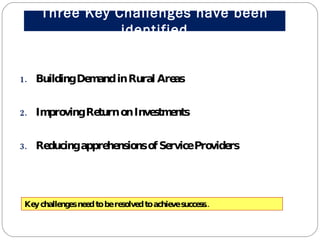
Three Key Challenges have been identified Building Demand in Rural Areas Improving Return on Investments Reducing apprehensions of Service Providers Key challenges need to be resolved to achieve success..
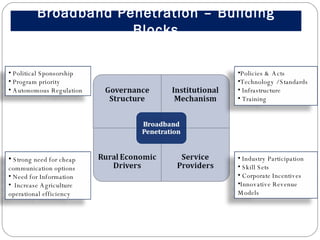
Broadband Penetration – Building Blocks Policies & Acts Technology / Standards Infrastructure  Training Industry Participation Skill Sets Corporate Incentives Innovative Revenue Models Political Sponsorship Program priority Autonomous Regulation Strong need for cheap communication options Need for Information Increase Agriculture operational efficiency
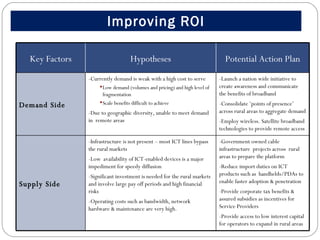
Improving ROI Key Factors Hypotheses Potential Action Plan Demand Side -Currently demand is weak with a high cost to serve Low demand (volumes and pricing) and high level of fragmentation Scale benefits difficult to achieve  -Due to geographic diversity, unable to meet demand in  remote areas -Launch a nation wide initiative to create awareness and communicate the benefits of broadband -Consolidate ‘points of presence’ across rural areas to aggregate demand  -Employ wireless. Satellite broadband technologies to provide remote access Supply Side -Infrastructure is not present – most ICT lines bypass the rural markets -Low  availability of ICT-enabled devices is a major impediment for speedy diffusion -Significant investment is needed for the rural markets and involve large pay off periods and high financial risks -Operating costs such as bandwidth, network hardware & maintenance are very high.  -Government owned cable infrastructure  projects across  rural areas to prepare the platform -Reduce import duties on ICT products such as  handhelds/PDAs to enable faster adoption & penetration -Provide corporate tax benefits & assured subsidies as incentives for Service Providers -Provide access to low interest capital for operators to expand in rural areas
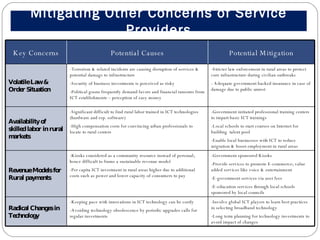
Mitigating Other Concerns of Service Providers Key Concerns Potential Causes Potential Mitigation Volatile Law & Order Situation -Terrorism & related incidents are causing disruption of services & potential damage to infrastructure -Security of business investments is perceived as risky -Political goons frequently demand favors and financial ransoms from ICT establishments – perception of easy money -Stricter law enforcement in rural areas to protect core infrastructure during civilian outbreaks - Adequate government backed insurance in case of damage due to public unrest Availability of skilled labor in rural markets -Significant difficult to find rural labor trained in ICT technologies (hardware and esp. software) -High compensation costs for convincing urban professionals to locate to rural centers -Government initiated professional training centers to impart basic ICT trainings -Local schools to start courses on Internet for building  talent pool -Enable local businesses with ICT to reduce migration & boost employment in rural areas Revenue Models for Rural payments -Kiosks considered as a community resource instead of personal; hence difficult to frame a sustainable revenue model -Per capita ICT investment in rural areas higher due to additional costs such as power and lower capacity of consumers to pay -Government sponsored Kiosks -Provide services to promote E-commerce; value added services like voice & entertainment  -E-government services via user fees -E-education services through local schools sponsored by local councils Radical Changes in Technology -Keeping pace with innovations in ICT technology can be costly -Avoiding technology obsolescence by periodic upgrades calls for regular investments -Involve global ICT players to learn best practices in selecting broadband technology -Long term planning for technology investments to avoid impact of changes
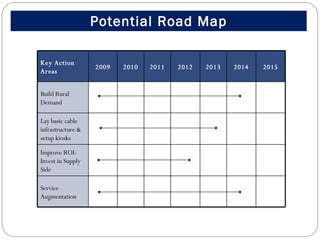
Potential Road Map Key Action Areas 2009 2010 2011 2012 2013 2014 2015 Build Rural Demand Lay basic cable infrastructure & setup kiosks Improve ROI- Invest in Supply Side Service Augmentation

Case Proposal

  • 1.
    Key Government Initiatives:Strategic Proposal Bridging the Digital Divide Prepared by Najmuddin Jabalpurwala
  • 2.
    Table of ContentsProject Overview Digital Divide – Key Indicators Key Challenges Broadband Penetration – Building Blocks Building Rural Demand Improving Returns on Investment Mitigating Concerns of Service Providers Suggested Roadmap
  • 3.
  • 4.
    Digital Divide –Key Indicators Sources: World Bank – ICT Snapshot; Government Websites Parameters Current State Size & Population One of top 5 most populated nations (250 million ) GNI approximately $1,100 per capita Sizable population in age group 25-55 years Urban v/s Rural 30% in urban areas v/s 70% in rural Broadband Penetration Less than 10.5 % broadband penetration across the nation Less than 1 % penetration in rural areas Only 2.5% broadband connections till May’08 Key Obstacles Supply Side Low PC penetration Inadequate telecom infrastructure Demand Side Lack of basic education to adopt advance ICT technology – Language barriers Lack of effective demand to justify investment by private players Lower disposable income-Affordability issues
  • 5.
    Three Key Challengeshave been identified Building Demand in Rural Areas Improving Return on Investments Reducing apprehensions of Service Providers Key challenges need to be resolved to achieve success..
  • 6.
    Broadband Penetration –Building Blocks Policies & Acts Technology / Standards Infrastructure Training Industry Participation Skill Sets Corporate Incentives Innovative Revenue Models Political Sponsorship Program priority Autonomous Regulation Strong need for cheap communication options Need for Information Increase Agriculture operational efficiency
  • 7.
    Improving ROI KeyFactors Hypotheses Potential Action Plan Demand Side -Currently demand is weak with a high cost to serve Low demand (volumes and pricing) and high level of fragmentation Scale benefits difficult to achieve -Due to geographic diversity, unable to meet demand in remote areas -Launch a nation wide initiative to create awareness and communicate the benefits of broadband -Consolidate ‘points of presence’ across rural areas to aggregate demand -Employ wireless. Satellite broadband technologies to provide remote access Supply Side -Infrastructure is not present – most ICT lines bypass the rural markets -Low availability of ICT-enabled devices is a major impediment for speedy diffusion -Significant investment is needed for the rural markets and involve large pay off periods and high financial risks -Operating costs such as bandwidth, network hardware & maintenance are very high. -Government owned cable infrastructure projects across rural areas to prepare the platform -Reduce import duties on ICT products such as handhelds/PDAs to enable faster adoption & penetration -Provide corporate tax benefits & assured subsidies as incentives for Service Providers -Provide access to low interest capital for operators to expand in rural areas
  • 8.
    Mitigating Other Concernsof Service Providers Key Concerns Potential Causes Potential Mitigation Volatile Law & Order Situation -Terrorism & related incidents are causing disruption of services & potential damage to infrastructure -Security of business investments is perceived as risky -Political goons frequently demand favors and financial ransoms from ICT establishments – perception of easy money -Stricter law enforcement in rural areas to protect core infrastructure during civilian outbreaks - Adequate government backed insurance in case of damage due to public unrest Availability of skilled labor in rural markets -Significant difficult to find rural labor trained in ICT technologies (hardware and esp. software) -High compensation costs for convincing urban professionals to locate to rural centers -Government initiated professional training centers to impart basic ICT trainings -Local schools to start courses on Internet for building talent pool -Enable local businesses with ICT to reduce migration & boost employment in rural areas Revenue Models for Rural payments -Kiosks considered as a community resource instead of personal; hence difficult to frame a sustainable revenue model -Per capita ICT investment in rural areas higher due to additional costs such as power and lower capacity of consumers to pay -Government sponsored Kiosks -Provide services to promote E-commerce; value added services like voice & entertainment -E-government services via user fees -E-education services through local schools sponsored by local councils Radical Changes in Technology -Keeping pace with innovations in ICT technology can be costly -Avoiding technology obsolescence by periodic upgrades calls for regular investments -Involve global ICT players to learn best practices in selecting broadband technology -Long term planning for technology investments to avoid impact of changes
  • 9.
    Potential Road MapKey Action Areas 2009 2010 2011 2012 2013 2014 2015 Build Rural Demand Lay basic cable infrastructure & setup kiosks Improve ROI- Invest in Supply Side Service Augmentation