B R O O K H AV E N N AT I O N A L L A B O R ATO RY


              Accelerating Innovation


            Electrocatalysts forPlan FY Cells
                      Laboratory Fuel 2010-2019   June	
  2,	
  2010	


                      June 2012
Technology Description

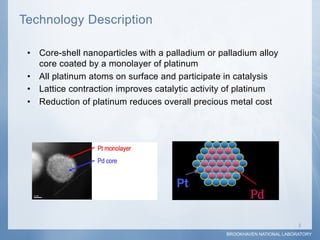
 •  Core-shell nanoparticles with a palladium or palladium alloy
    core coated by a monolayer of platinum
 •  All platinum atoms on surface and participate in catalysis
 •  Lattice contraction improves catalytic activity of platinum
 •  Reduction of platinum reduces overall precious metal cost


                                                                            2	
  
                                                   BROOKHAVEN NATIONAL LABORATORY
Technology Opportunity

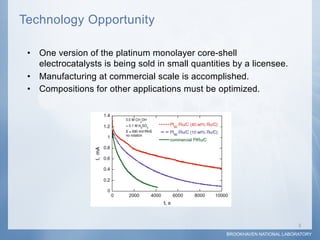
 •  One version of the platinum monolayer core-shell
    electrocatalysts is being sold in small quantities by a licensee.
 •  Manufacturing at commercial scale is accomplished.
 •  Compositions for other applications must be optimized.


                                                                             3	
  
                                                    BROOKHAVEN NATIONAL LABORATORY
Technology Leadership

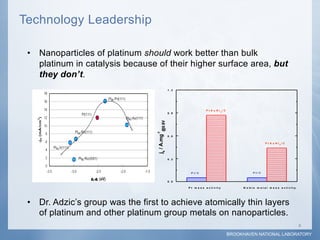
 •  Nanoparticles of platinum should work better than bulk
    platinum in catalysis because of their higher surface area, but
    they don’t.
                                               1.2


                                                                  P t A u N i5/ C
                                               0.9


                                       @0.9V
                                  -1
                                  jk / A.mg
                                               0.6

                                                                                                         P t A u N i5/ C


                                               0.3


                                                      P t/ C                                   P t/ C


                                               0.0

                                                     Pt   m a s s a cti vit y            N o ble   m e t a l m a s s a cti vit y


 •  Dr. Adzic’s group was the first to achieve atomically thin layers
    of platinum and other platinum group metals on nanoparticles.
                                                                                                                                   4	
  
                                                                                    BROOKHAVEN NATIONAL LABORATORY
History: BES-EERE-Industry—Platinum
Monolayer Electrocatalysts
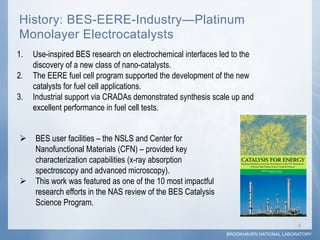
1.  Use-inspired BES research on electrochemical interfaces led to the
    discovery of a new class of nano-catalysts.
2.  The EERE fuel cell program supported the development of the new
    catalysts for fuel cell applications.
3.  Industrial support via CRADAs demonstrated synthesis scale up and
    excellent performance in fuel cell tests.


Ø  BES user facilities – the NSLS and Center for
    Nanofunctional Materials (CFN) – provided key
    characterization capabilities (x-ray absorption
    spectroscopy and advanced microscopy).
Ø  This work was featured as one of the 10 most impactful
    research efforts in the NAS review of the BES Catalysis
    Science Program.

                                                                                       5	
  
                                                              BROOKHAVEN NATIONAL LABORATORY
BES-supported research 1992-present
Fundamental studies of electrocatalysis:
Oxygen reduction reaction (ORR) – mechanism, structure/activity
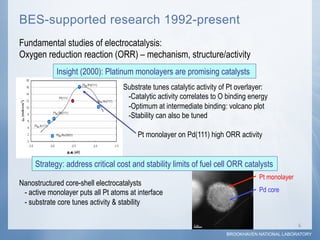
            Insight (2000): Platinum monolayers are promising catalysts
                                    Substrate tunes catalytic activity of Pt overlayer:
                                     -Catalytic activity correlates to O binding energy
                                     -Optimum at intermediate binding: volcano plot
                                     -Stability can also be tuned

                                         Pt monolayer on Pd(111) high ORR activity


     Strategy: address critical cost and stability limits of fuel cell ORR catalysts
                                                                                    Pt monolayer
Nanostructured core-shell electrocatalysts
 - active monolayer puts all Pt atoms at interface                                  Pd core
 - substrate core tunes activity & stability

                                                                                                   6	
  
                                                                        BROOKHAVEN NATIONAL LABORATORY
EERE-supported research 2003-present
                                                                      Pt
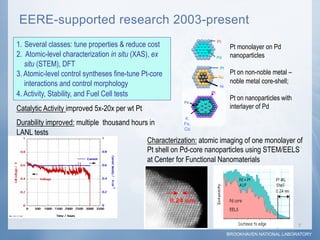
1.  Several classes: tune properties & reduce cost                            Pt monolayer on Pd
2. Atomic-level characterization in situ (XAS), ex                    Pd      nanoparticles
    situ (STEM), DFT                                                    Pt
3. Atomic-level control syntheses fine-tune Pt-core                           Pt on non-noble metal –
                                                                      Au
    interactions and control morphology                                       noble metal core-shell;
                                                                        Ni

4. Activity, Stability, and Fuel Cell tests                      Pt
                                                                              Pt on nanoparticles with
                                                        Pd

Catalytic Activity improved 5x-20x per wt Pt                                  interlayer of Pd
                                                              Smooth
                                                        Ir,   Pd rods
Durability improved: multiple thousand hours in          Fe,
                                                         Co
LANL tests
                                            Characterization: atomic imaging of one monolayer of
                                            Pt shell on Pd-core nanoparticles using STEM/EELS
                                            at Center for Functional Nanomaterials


                                                                                                         7	
  
                                                                             BROOKHAVEN NATIONAL LABORATORY
CRADAs with industry 2005-present
                                                                 Scale-up, fuel cell testing: Toyota, GM, UTC Fuel Cells, Battelle
1.  Demonstrate efficient, reproducible synthesis of
    gram quantities of PtML                                                                                                  Synthesis: e.g., Demonstrate scale-up to 50
2. Fuel cell tests, performance, stability, potential                                                                        gram batches of high-activity nanostructured
    cycling                                                                                                                  core-shell electrocatalysts (with Toyota).

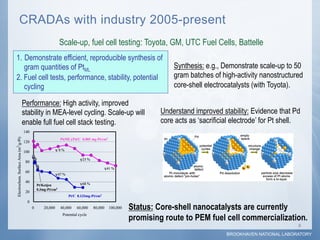
                                      Performance: High activity, improved
                                      stability in MEA-level cycling. Scale-up will                                      Understand improved stability: Evidence that Pd
                                      enable full fuel cell stack testing.                                               core acts as ‘sacrificial electrode’ for Pt shell.
                                                                                                                                          Smooth
                                                                                                                                          Pd rods
                                      140
Electrochem. Surface Area (m /g-Pt)


                                                                  Pt(ML)/Pd/C 0.085 mg-Pt/cm2
                                      120
2


                                                             Δ
                                                             Δ
                                                             Δ   8%
                                      100
                                                                              Δ
                                                                              Δ
                                                                              Δ   23 %
                                       80
                                                                                                  Δ   41 %
                                       60                    Δ   47 %

                                       40                                     Δ
                                                                              Δ
                                                                              Δ   68 %
                                                Pt/Ketjen
                                                0.3mg-Pt/cm2
                                       20
                                                                        Pt/C 0.133mg-Pt/cm2
                                        0
                                            0       20,000        40,000    60,000       80,000       100,000   Status: Core-shell nanocatalysts are currently
                                                                   Potential cycle
                                                                                                                promising route to PEM fuel cell commercialization.
                                                                                                                                                                             8	
  
                                                                                                                                                    BROOKHAVEN NATIONAL LABORATORY
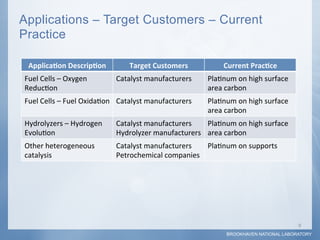
Applications – Target Customers – Current
Practice

 Applica'on	
  Descrip'on	
                 Target	
  Customers	
                Current	
  Prac'ce	
  
Fuel	
  Cells	
  –	
  Oxygen	
         Catalyst	
  manufacturers	
         Pla<num	
  on	
  high	
  surface	
  
Reduc<on	
                                                                 area	
  carbon	
  
Fuel	
  Cells	
  –	
  Fuel	
  Oxida<on	
   Catalyst	
  manufacturers	
     Pla<num	
  on	
  high	
  surface	
  
                                                                           area	
  carbon	
  
Hydrolyzers	
  –	
  Hydrogen	
         Catalyst	
  manufacturers	
     Pla<num	
  on	
  high	
  surface	
  
Evolu<on	
                             Hydrolyzer	
  manufacturers	
   area	
  carbon	
  
Other	
  heterogeneous	
               Catalyst	
  manufacturers	
    Pla<num	
  on	
  supports	
  
catalysis	
                            Petrochemical	
  companies	


                                                                                                                  9	
  
                                                                                   BROOKHAVEN NATIONAL LABORATORY
Contact Information

 •  Dr. Radoslav Adzic, +1(631)344-4522, adzic@bnl.gov
    Senior Chemist, Chemistry Department
    Brookhaven National Laboratory
    Bldg. 555 – P.O. Box 5000
    Upton, NY 11973


 •  Dr. Kimberley Elcess, +1(631)344-4151, elcess@bnl.gov
    Principal Licensing Specialist
    Office of Technology Commercialization and Partnerships
    Brookhaven National Laboratory
    Bldg. 490C – P.O. Box 5000
    Upton, NY 11973


                                                                            10	
  
                                                    BROOKHAVEN NATIONAL LABORATORY

Electrocatalysts for fuel cells

  • 1.
    B R OO K H AV E N N AT I O N A L L A B O R ATO RY Accelerating Innovation Electrocatalysts forPlan FY Cells Laboratory Fuel 2010-2019 June  2,  2010   June 2012
  • 2.
    Technology Description • Core-shell nanoparticles with a palladium or palladium alloy core coated by a monolayer of platinum •  All platinum atoms on surface and participate in catalysis •  Lattice contraction improves catalytic activity of platinum •  Reduction of platinum reduces overall precious metal cost 2   BROOKHAVEN NATIONAL LABORATORY
  • 3.
    Technology Opportunity • One version of the platinum monolayer core-shell electrocatalysts is being sold in small quantities by a licensee. •  Manufacturing at commercial scale is accomplished. •  Compositions for other applications must be optimized. 3   BROOKHAVEN NATIONAL LABORATORY
  • 4.
    Technology Leadership • Nanoparticles of platinum should work better than bulk platinum in catalysis because of their higher surface area, but they don’t. 1.2 P t A u N i5/ C 0.9 @0.9V -1 jk / A.mg 0.6 P t A u N i5/ C 0.3 P t/ C P t/ C 0.0 Pt m a s s a cti vit y N o ble m e t a l m a s s a cti vit y •  Dr. Adzic’s group was the first to achieve atomically thin layers of platinum and other platinum group metals on nanoparticles. 4   BROOKHAVEN NATIONAL LABORATORY
  • 5.
    History: BES-EERE-Industry—Platinum Monolayer Electrocatalysts 1. Use-inspired BES research on electrochemical interfaces led to the discovery of a new class of nano-catalysts. 2.  The EERE fuel cell program supported the development of the new catalysts for fuel cell applications. 3.  Industrial support via CRADAs demonstrated synthesis scale up and excellent performance in fuel cell tests. Ø  BES user facilities – the NSLS and Center for Nanofunctional Materials (CFN) – provided key characterization capabilities (x-ray absorption spectroscopy and advanced microscopy). Ø  This work was featured as one of the 10 most impactful research efforts in the NAS review of the BES Catalysis Science Program. 5   BROOKHAVEN NATIONAL LABORATORY
  • 6.
    BES-supported research 1992-present Fundamentalstudies of electrocatalysis: Oxygen reduction reaction (ORR) – mechanism, structure/activity Insight (2000): Platinum monolayers are promising catalysts Substrate tunes catalytic activity of Pt overlayer: -Catalytic activity correlates to O binding energy -Optimum at intermediate binding: volcano plot -Stability can also be tuned Pt monolayer on Pd(111) high ORR activity Strategy: address critical cost and stability limits of fuel cell ORR catalysts Pt monolayer Nanostructured core-shell electrocatalysts - active monolayer puts all Pt atoms at interface Pd core - substrate core tunes activity & stability 6   BROOKHAVEN NATIONAL LABORATORY
  • 7.
    EERE-supported research 2003-present Pt 1.  Several classes: tune properties & reduce cost Pt monolayer on Pd 2. Atomic-level characterization in situ (XAS), ex Pd nanoparticles situ (STEM), DFT Pt 3. Atomic-level control syntheses fine-tune Pt-core Pt on non-noble metal – Au interactions and control morphology noble metal core-shell; Ni 4. Activity, Stability, and Fuel Cell tests Pt Pt on nanoparticles with Pd Catalytic Activity improved 5x-20x per wt Pt interlayer of Pd Smooth Ir, Pd rods Durability improved: multiple thousand hours in Fe, Co LANL tests Characterization: atomic imaging of one monolayer of Pt shell on Pd-core nanoparticles using STEM/EELS at Center for Functional Nanomaterials 7   BROOKHAVEN NATIONAL LABORATORY
  • 8.
    CRADAs with industry2005-present Scale-up, fuel cell testing: Toyota, GM, UTC Fuel Cells, Battelle 1.  Demonstrate efficient, reproducible synthesis of gram quantities of PtML Synthesis: e.g., Demonstrate scale-up to 50 2. Fuel cell tests, performance, stability, potential gram batches of high-activity nanostructured cycling core-shell electrocatalysts (with Toyota). Performance: High activity, improved stability in MEA-level cycling. Scale-up will Understand improved stability: Evidence that Pd enable full fuel cell stack testing. core acts as ‘sacrificial electrode’ for Pt shell. Smooth Pd rods 140 Electrochem. Surface Area (m /g-Pt) Pt(ML)/Pd/C 0.085 mg-Pt/cm2 120 2 Δ Δ Δ 8% 100 Δ Δ Δ 23 % 80 Δ 41 % 60 Δ 47 % 40 Δ Δ Δ 68 % Pt/Ketjen 0.3mg-Pt/cm2 20 Pt/C 0.133mg-Pt/cm2 0 0 20,000 40,000 60,000 80,000 100,000 Status: Core-shell nanocatalysts are currently Potential cycle promising route to PEM fuel cell commercialization. 8   BROOKHAVEN NATIONAL LABORATORY
  • 9.
    Applications – TargetCustomers – Current Practice Applica'on  Descrip'on   Target  Customers   Current  Prac'ce   Fuel  Cells  –  Oxygen   Catalyst  manufacturers   Pla<num  on  high  surface   Reduc<on   area  carbon   Fuel  Cells  –  Fuel  Oxida<on   Catalyst  manufacturers   Pla<num  on  high  surface   area  carbon   Hydrolyzers  –  Hydrogen   Catalyst  manufacturers   Pla<num  on  high  surface   Evolu<on   Hydrolyzer  manufacturers   area  carbon   Other  heterogeneous   Catalyst  manufacturers   Pla<num  on  supports   catalysis   Petrochemical  companies   9   BROOKHAVEN NATIONAL LABORATORY
  • 10.
    Contact Information • Dr. Radoslav Adzic, +1(631)344-4522, adzic@bnl.gov Senior Chemist, Chemistry Department Brookhaven National Laboratory Bldg. 555 – P.O. Box 5000 Upton, NY 11973 •  Dr. Kimberley Elcess, +1(631)344-4151, elcess@bnl.gov Principal Licensing Specialist Office of Technology Commercialization and Partnerships Brookhaven National Laboratory Bldg. 490C – P.O. Box 5000 Upton, NY 11973 10   BROOKHAVEN NATIONAL LABORATORY