District heating in Finland
2023
Contents
The statistical presentation is divided into three parts. The first part presents statistical
graphs. The next section provides statistical analysis. The third part presents future
scenarios.
Contents
Statistics in graphs
Analysis
Future scenarios
6.11.2024
2
Statistical year 2023
The year 2023 was the year of the electrification of district heating.
• Overall, non-combustion-based production increased by about 40% from 2022.
• Non-combustion-based production, especially the production of heat pumps and electric boilers,
is likely to grow strongly in the next few years.
Fuel supply started to recover from the exceptional years of 2022, when the war in
Ukraine began and imports of Russian fuels were stopped.
• The availability of natural gas improved in 2023, which reduced the use of oil and coal in district
heat production. Forest fuelwood was also used to replace coal and peat.
• However, fuel prices remained high.
The year 2023 was, on average, slightly warmer than the normal year (1991-2020
average). However, monthly temperatures differed from the average year.
• The January, February and summer months were warmer than normal, but March and the rest of
the year were colder than normal.
6.11.2024
3
Statistics in graphs
Statistics 2023
5
~16 500 km
district heating networks
6.11.2024
~10,1
cent/kWh
The average price including
taxes
~3,0 million
people
lives in houses with district
heating
~3 mrd. EUR
the value of heat sold including
taxes
~ 45 %
market share*
District heating networks in
Finland
~33 TWh
energy sold annually
*market share of heating in residential and apartment
buildings
Market share of space heating in 2022 (Statistics Finland)
6 6.11.2024
• Includes residential, commercial and
public buildings
Electricity: includes the electricity
consumption of heat distribution
equipment and electric sauna stoves
Wood: includes the wood used by
sauna stoves
district heat
45%
electricity
17%
heat pump, electricity
consumption
(estimate)
7%
heat pump
13%
wood
12%
fuel oil 5%
other 1%
District heat consumption and connected heat
load of the customers
7 6.11.2024
0
5
10
15
20
25
30
35
0
5
10
15
20
25
30
35
40
1976 1980 1984 1988 1992 1996 2000 2004 2008 2012 2016 2020
GW
TWh/a
Measured consumption (TWh/a) Connected heat load (GW)
Temperature corrected heat consumption
8
• District heat consumption 33,2
TWh (year 2023)
• Temperature corrected heat
consumption 33,8 TWh
• Temperature corrected heat
consumption decreased 0,3 %
from 2022
Temperature correction takes into
account annual temperature
differences.
6.11.2024
0
5
10
15
20
25
30
35
40
1970 1974 1978 1982 1986 1990 1994 1998 2002 2006 2010 2014 2018 2022
TWh
Measured consumption (TWh) Temperature corrected consumption (TWh)
Number of customers and the length of networks
9 6.11.2024
10 000
11 000
12 000
13 000
14 000
15 000
16 000
17 000
18 000
100 000
110 000
120 000
130 000
140 000
150 000
160 000
170 000
180 000
2010 2011 2012 2013 2014 2015 2016 2017 2018 2019 2020 2021 2022 2023
km
pc
Number of customers Total length of networks
Specific heat consumption in district heated buildings
10
• Specific heat consumption
indicates how much energy has
been used to heat premises
and domestic water per
building volume or surface
area.
• Specific heat consumption has
been standardised to
correspond to the comparison
period 1991-2020
6.11.2024
0
50
100
150
200
250
300
0
10
20
30
40
50
60
70
80
90
1970 1974 1978 1982 1986 1990 1994 1998 2002 2006 2010 2014 2018 2022
kWh/m2,a
kWh/m3,a
District heat supply and the share of cogeneration
11 6.11.2024
76 %
76 %75 %75 %76 %73 %75 %74 %75 %71 %
71 %
72 %69 %73 %72 %73 %67 %68 %67 %67 %
60 %56 %
54 %
0
5
10
15
20
25
30
35
40
2000 2002 2004 2006 2008 2010 2012 2014 2016 2018 2020 2022
TWh
Cogenerated heat Separate heat
Heat recovery,
heat pumps,
electric boilers
19,2%
Natural gas 7,1%
Coal 11,5%
Oil 2,7%
Peat 10,1%
Waste 11,9%
Wood + other bio
56,3%
Fuel-based
production 80,8 %
Share of fuel-based production
District heat supply and the fuels used for DH and
cogeneration
12
Total district heat supply 36,7 TWh
District heat production by fuels 29,7 TWh
Net production of electricity in CHP
production
5,9 TWh
Fuel energy consumed 43,2 TWh
Heat recovery and heat produced
by heat pumps
7,0 TWh
6.11.2024
Energy sources for district heat supply in 2023
by fuel category
13
• Waste category includes municipal waste, recovered fuels,
demolition wood, impregnated wood, plastic waste and
hazardous waste.
• Bio share of waste is 54 % and fossil share 46 %.
• Other biofuels: other biofuels and mixed fuels
• Others: steam, hydrogen
6.11.2024
• Carbon neutral*: 70 %
o Renewables + Heat recovery + electricity usage of electric
boilers
o Share of imported fossil fuels in district heat supply 17 %
*Carbon neutral energy sources include those energy sources
whose carbon dioxide impact is not reported in heat
production. The climate impact of bioenergy is included in
the land use sector and emissions from electricity used in
district heat production in electricity production.
Forest fuelwood
29,6 %
Industrial
wood
residues
11,1 %
Other biofuels
5,4 %
Waste
9,1 %
Heat recovery
17,1 %
Electric Boilers
2,0 %
Peat
8,4 %
Natural gas
6,3 %
Coal
8,0 %
Oil
2,7 %
Others
0,2 %
Heat supply
36,7 TWh
Energy sources for district
heat supply in 2023 by
fuels
6.11.2024
14
Forest
fuelwood
30%
Industrial
wood
residues
11%
Other
biofuels
5%
Waste
9%
Heat recovery
17%
Electric Boilers
2%
Peat
8%
Natural gas
6%
Coal
8%
Oil
3%
Chips from roundwood
22%
Forest residue chips
8%
Bark
4%
Saw dust
4%
Other
3%
Recovered wood
2%
Wood pellets
3%
Municipal waste
6%
Other waste
3%
Heat recovery
12%
Heat pumps
6%
Milled peat
7%
Sod peat
1%
Other fuels
0%
Heat supply
36,7 TWh
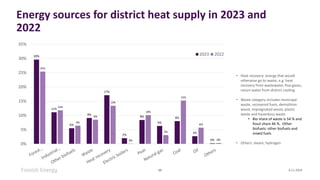
Energy sources for district heat supply in 2023 and
2022
6.11.2024
15
30%
11%
6%
9%
17%
2%
8%
6%
8%
3%
0%
25%
12%
6%
9%
13%
0%
10%
3%
15%
6%
0%
0%
5%
10%
15%
20%
25%
30%
35%
2023 2022
• Heat recovery: energy that would
otherwise go to waste, e.g. heat
recovery from wastewater, flue gases,
return water from district cooling.
• Waste category includes municipal
waste, recovered fuels, demolition
wood, impregnated wood, plastic
waste and hazardous waste.
• Bio share of waste is 54 % and
fossil share 46 %. Other
biofuels: other biofuels and
mixed fuels
• Others: steam, hydrogen
Heat generated by electric boilers
• Electric boilers reduce the use
of fuels when electricity price
is low.
• Alongside electric boilers,
there is usually a heat storage.
6.11.2024
16
16
58
746
0
100
200
300
400
500
600
700
800
2021 2022 2023
GWh
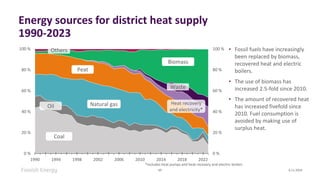
Energy sources for district heat supply
1990-2023
17
• Fossil fuels have increasingly
been replaced by biomass,
recovered heat and electric
boilers.
• The use of biomass has
increased 2.5-fold since 2010.
• The amount of recovered heat
has increased fivefold since
2010. Fuel consumption is
avoided by making use of
surplus heat.
*includes heat pumps and heat recovery and electric boilers
6.11.2024
0 %
20 %
40 %
60 %
80 %
100 %
0 %
20 %
40 %
60 %
80 %
100 %
1990 1994 1998 2002 2006 2010 2014 2018 2022
Natural gas
Peat
Biomass
Others
Coal
Heat recovery
and electricity*
Waste
Oil
Energy sources for district heat supply
1976-2023
18 6.11.2024
*includes heat pumps and heat recovery and electric boilers
0 %
20 %
40 %
60 %
80 %
100 %
0 %
20 %
40 %
60 %
80 %
100 %
1976 1980 1984 1988 1992 1996 2000 2004 2008 2012 2016 2020
Natural gas
Peat
Oil
Biomass
Others
Coal
Heat recovery
and electricity*
Waste
Energy sources for district heat by region in 2023
19 6.11.2024
• The share of district heat
energy sources in
combined heat and power
plants has been estimated
using general coefficients
that have not been
adjusted to the county-
specific level.
Uusimaa
Varsinais-Suomi
Satakunta
Kanta-Häme
Pirkanmaa
Päijät-Häme
Kymenlaakso
Etelä-Karjala
Etelä-Savo
Pohjois-Savo
Pohjois-Karjala
Keski-Suomi
Etelä-Pohjanmaa
Pohjanmaa
Keski-Pohjanmaa
Pohjois-Pohjanmaa
Kainuu
Lappi
Ahvenanmaa
0 % 20 % 40 % 60 % 80 % 100 %
Bio Waste Heat recovery Electric Boilers Peat Natural gas Coal Oil Others
Energy sources for DH by region in 2005 and in 2023
20
Year 2005 Year 2023
6.11.2024
Renewable fuels in the production of district
heat and cogeneration
6.11.2024
21
0
5 000
10 000
15 000
20 000
25 000
30 000
1985 1990 1995 2000 2005 2010 2015 2020
GWh
District heat +
cogeneration
Heat recovery and electric boilers
22
The electric boilers produced 750 GWh of
heat in 2023.
6 249 GWh of district heat was produced by
heat recovery
• Heat recovery by heat exchangers 4 230 GWh
• The most significant heat sources: flue gases,
industrial processes and geothermal energy
• Heat produced by the heat pumps 2 020 GWh
• The most significant heat sources: sewage,
district cooling return water and data centers
6.11.2024
0
1 000
2 000
3 000
4 000
5 000
6 000
7 000
8 000
2006 2008 2010 2012 2014 2016 2018 2020 2022
GWh
Heat produced using
heat pumps, heat recovery and
electric boilers
Total emissions from district heating
• CO2-emissions from district
heat production in 2023 were
3,1 Million tons and decreased
by 22 % from the previous year
6.11.2024
23
0
5
10
15
20
25
30
35
40
45
2011 2012 2013 2014 2015 2016 2017 2018 2019 2020 2021 2022 2023
0,0
1,0
2,0
3,0
4,0
5,0
6,0
7,0
8,0
TWh
Mill. t CO2
CO2-emissions, Mill. t CO2 District heat production, TWh
CO2 -emissions from the district heat supply
24
• Specific emissions from district heat
production in 2022 were 85 gCO2/kWh,
which
• Decreased by 26 % from the
previous year
• Decreased by 58 % since 2010
• Fuels used in combined heat and power
production were allocated according to
the benefit allocation method
Sources :
Statistics Finland (2000…2022)
Finnish Energy (1976…1999, 2023) 6.11.2024
0
50
100
150
200
250
300
350
1976 1980 1984 1988 1992 1996 2000 2004 2008 2012 2016 2020
g CO2 /kWh
Price of district heat (incl. VAT)
Average, minimum and maximum values
25
• The price includes all taxes, demand
and energy charges as well as other
possible annual charges. Connection
fees are excluded.
• Weighted average price: 100,69
€/M
• Arithmetical average price: 96,26
€/M
6.11.2024
0
20
40
60
80
100
120
140
1983 1987 1991 1995 1999 2003 2007 2011 2015 2019 2023
€/MWh
The share of district heating companies according
to the average heat sales price in 2023 (incl. VAT)
26
• The price includes all taxes, demand
and energy charges as well as other
possible annual charges. Connection
fees are excluded.
The graph represents only enterprises that
responded to the sales section of the
statistics.
6.11.2024
0%
5%
10%
15%
20%
€/MWh
Price of district heat in new buildings (€/MWh)
Fixed price + energy fee, incl. taxes
• The price includes all taxes,
demand and energy charges as
well as other possible annual
charges. Connection fees are
excluded.
27 6.11.2024
Source: Finnish Energy, District heating prices 07/2023
0
10
20
30
40
50
60
70
80
90
100
110
120
2012 2013 2014 2015 2016 2017 2018 2019 2020 2021 2022 2023
€/MWh
Detached house (600 m³) Terraced house/Block, small (5000 m³) Block, large (20000 m³)
Development of the real price of district heat
Corrected with cost-of-living index
28
Source: Finnish Energy, District heating prices 07/2023
6.11.2024
0
20
40
60
80
100
120
140
160
01/10 01/11 01/12 01/12 01/14 01/15 01/16 01/17 01/18 01/19 01/20 01/21 01/22 01/23
Real price of district heat Real price of district heat (excl. taxes)
2010 = 100
€/MWh
District heat consumption in 2023
29 6.11.2024
Housing
53,6 %
Industry
9,4 %
Others
36,9 %
Total 33,2 TWh
Distribution of customers according to
connected heat load
30
• Number of customers: 160 000
• 130 000 customers in
residential buildings
• 3,0 million inhabitants
6.11.2024
0%
10%
20%
30%
40%
50%
… - 20 kW
(Detached house)
21 - 290 kW
(Block / Office building,
small)
291 - …
(Block / Office building,
large)
connected heat
load, kW
%-share, 1990 %-share, 1995 %-share, 2000 %-share, 2005
%-share, 2010 %-share, 2015 %-share, 2023
Production capacity and connected heat load of
the customers
6.11.2024
31
0
5
10
15
20
25
1970 1974 1978 1982 1986 1990 1994 1998 2002 2006 2010 2014 2018 2022
GW
Production capacity Connected heat load
Analysis
Estimated monthly district heat demand
6.11.2024
33
Year 2023 was 0,3 warmer than the
normal period of 1991-2020.
However, monthly temperatures
differed from the average year.
• The January, February and summer
months were warmer than normal,
but March and the rest of the year
were colder than normal.
The cold winter months exemplify the
need for a wide palette of fuels to
ensure the security of supply of
heating.
0
1 000
2 000
3 000
4 000
5 000
6 000
Jan Feb Mar Apr May Jun Jul Aug Sep Oct Nov Dec
GWh
2020 2021 2022 2023
Theoretical consumption 2023 if it had been
a "normal" month in terms of outdoor
temperatures
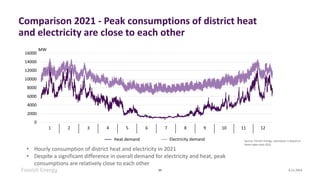
Comparison 2021 - Peak consumptions of district heat
and electricity are close to each other
6.11.2024
34
0
2000
4000
6000
8000
10000
12000
14000
16000
MW
Kaukolämmön kysyntä Sähkön kysyntä Source: Finnish Energy, estimation is based on
Helen open data 2021
1 2 3 4 5 6 7 8 9 10 11 12
• Hourly consumption of district heat and electricity in 2021
• Despite a significant difference in overall demand for electricity and heat, peak
consumptions are relatively close to each other
Heat demand Electricity demand
Electricity vs heat demand in winter in 2021
• Demand of district heating (DH) at the time of the
peak consumption is about the same magnitude as
the demand for electricity. On annual basis the
demand of electricity is higher than DH (ca. 85 TWh
vs. 35 TWh)
• Combined Heat and Power (CHP) plants produce a
significant amount of electricity (2 500 MW) while
producing heat.
• District heating reduces electricity demand peaks,
in addition to electricity production
6.11.2024
35
Impact of electric boilers on fuel use –
The electric boiler significantly reduced the fuel usage of the Seinäjoki district
heating network
524 549
2022 2023
DH production, GWh
157
69
2022 2023
Electricity production, GWh
830
571
2022 2023
Fuels, GWh
-31 %
Although the need for district heating in the network grew slightly in Seinäjoki, 30% less fuels were used
in the production of electricity and heat. The electric boiler produced about 20% of the heat demand of
the network. In Seinäjoki, the commissioning of an electric boiler together with the falling market prices
of electricity also decreased electricity production significantly.
6.11.2024
36
Future scenarios
Use of fossil fuels and peat is declining rapidly
6.11.2024
38
0
2000
4000
6000
8000
10000
12000
14000
2021 2023 2024 2025 2026 2027 2028 2029 2030
GWh
Coal Gas Oil Peat
Source: Member survey in spring 2024
The share of biomass and waste in district heating will
decrease slightly towards the end of the decade
6.11.2024
39
0
2000
4000
6000
8000
10000
12000
14000
16000
18000
20000
2021 2023 2024 2025 2026 2027 2028 2029 2030
GWh
Biomass Municipality waste Recycled fuels
Source: Member survey in spring 2024
Electrifying district heat production replaces fossil fuels and
peat and reduces the need for energy use of biomass
6.11.2024
40
0
2000
4000
6000
8000
10000
12000
14000
16000
18000
2021 2023 2024 2025 2026 2027 2028 2029 2030
GWh
Electric boilers Waste heat and heat pumps
Source: Member survey in spring 2024
Energy sources for district heat supply 1990-2030
41
*includes heat pumps and heat recovery
6.11.2024
Source for 2024-2030: Member survey in spring 2024
0%
20%
40%
60%
80%
100%
0%
20%
40%
60%
80%
100%
1990 1994 1998 2002 2006 2010 2014 2018 2022 2026 2030
Coal
Oil
Natural gas
Peat
Others
Biomass
Waste
Heat recovery *
Electric boilers

District_heating_statistical_graphs_2023

  • 1.
    District heating inFinland 2023
  • 2.
    Contents The statistical presentationis divided into three parts. The first part presents statistical graphs. The next section provides statistical analysis. The third part presents future scenarios. Contents Statistics in graphs Analysis Future scenarios 6.11.2024 2
  • 3.
    Statistical year 2023 Theyear 2023 was the year of the electrification of district heating. • Overall, non-combustion-based production increased by about 40% from 2022. • Non-combustion-based production, especially the production of heat pumps and electric boilers, is likely to grow strongly in the next few years. Fuel supply started to recover from the exceptional years of 2022, when the war in Ukraine began and imports of Russian fuels were stopped. • The availability of natural gas improved in 2023, which reduced the use of oil and coal in district heat production. Forest fuelwood was also used to replace coal and peat. • However, fuel prices remained high. The year 2023 was, on average, slightly warmer than the normal year (1991-2020 average). However, monthly temperatures differed from the average year. • The January, February and summer months were warmer than normal, but March and the rest of the year were colder than normal. 6.11.2024 3
  • 4.
  • 5.
    Statistics 2023 5 ~16 500km district heating networks 6.11.2024 ~10,1 cent/kWh The average price including taxes ~3,0 million people lives in houses with district heating ~3 mrd. EUR the value of heat sold including taxes ~ 45 % market share* District heating networks in Finland ~33 TWh energy sold annually *market share of heating in residential and apartment buildings
  • 6.
    Market share ofspace heating in 2022 (Statistics Finland) 6 6.11.2024 • Includes residential, commercial and public buildings Electricity: includes the electricity consumption of heat distribution equipment and electric sauna stoves Wood: includes the wood used by sauna stoves district heat 45% electricity 17% heat pump, electricity consumption (estimate) 7% heat pump 13% wood 12% fuel oil 5% other 1%
  • 7.
    District heat consumptionand connected heat load of the customers 7 6.11.2024 0 5 10 15 20 25 30 35 0 5 10 15 20 25 30 35 40 1976 1980 1984 1988 1992 1996 2000 2004 2008 2012 2016 2020 GW TWh/a Measured consumption (TWh/a) Connected heat load (GW)
  • 8.
    Temperature corrected heatconsumption 8 • District heat consumption 33,2 TWh (year 2023) • Temperature corrected heat consumption 33,8 TWh • Temperature corrected heat consumption decreased 0,3 % from 2022 Temperature correction takes into account annual temperature differences. 6.11.2024 0 5 10 15 20 25 30 35 40 1970 1974 1978 1982 1986 1990 1994 1998 2002 2006 2010 2014 2018 2022 TWh Measured consumption (TWh) Temperature corrected consumption (TWh)
  • 9.
    Number of customersand the length of networks 9 6.11.2024 10 000 11 000 12 000 13 000 14 000 15 000 16 000 17 000 18 000 100 000 110 000 120 000 130 000 140 000 150 000 160 000 170 000 180 000 2010 2011 2012 2013 2014 2015 2016 2017 2018 2019 2020 2021 2022 2023 km pc Number of customers Total length of networks
  • 10.
    Specific heat consumptionin district heated buildings 10 • Specific heat consumption indicates how much energy has been used to heat premises and domestic water per building volume or surface area. • Specific heat consumption has been standardised to correspond to the comparison period 1991-2020 6.11.2024 0 50 100 150 200 250 300 0 10 20 30 40 50 60 70 80 90 1970 1974 1978 1982 1986 1990 1994 1998 2002 2006 2010 2014 2018 2022 kWh/m2,a kWh/m3,a
  • 11.
    District heat supplyand the share of cogeneration 11 6.11.2024 76 % 76 %75 %75 %76 %73 %75 %74 %75 %71 % 71 % 72 %69 %73 %72 %73 %67 %68 %67 %67 % 60 %56 % 54 % 0 5 10 15 20 25 30 35 40 2000 2002 2004 2006 2008 2010 2012 2014 2016 2018 2020 2022 TWh Cogenerated heat Separate heat
  • 12.
    Heat recovery, heat pumps, electricboilers 19,2% Natural gas 7,1% Coal 11,5% Oil 2,7% Peat 10,1% Waste 11,9% Wood + other bio 56,3% Fuel-based production 80,8 % Share of fuel-based production District heat supply and the fuels used for DH and cogeneration 12 Total district heat supply 36,7 TWh District heat production by fuels 29,7 TWh Net production of electricity in CHP production 5,9 TWh Fuel energy consumed 43,2 TWh Heat recovery and heat produced by heat pumps 7,0 TWh 6.11.2024
  • 13.
    Energy sources fordistrict heat supply in 2023 by fuel category 13 • Waste category includes municipal waste, recovered fuels, demolition wood, impregnated wood, plastic waste and hazardous waste. • Bio share of waste is 54 % and fossil share 46 %. • Other biofuels: other biofuels and mixed fuels • Others: steam, hydrogen 6.11.2024 • Carbon neutral*: 70 % o Renewables + Heat recovery + electricity usage of electric boilers o Share of imported fossil fuels in district heat supply 17 % *Carbon neutral energy sources include those energy sources whose carbon dioxide impact is not reported in heat production. The climate impact of bioenergy is included in the land use sector and emissions from electricity used in district heat production in electricity production. Forest fuelwood 29,6 % Industrial wood residues 11,1 % Other biofuels 5,4 % Waste 9,1 % Heat recovery 17,1 % Electric Boilers 2,0 % Peat 8,4 % Natural gas 6,3 % Coal 8,0 % Oil 2,7 % Others 0,2 % Heat supply 36,7 TWh
  • 14.
    Energy sources fordistrict heat supply in 2023 by fuels 6.11.2024 14 Forest fuelwood 30% Industrial wood residues 11% Other biofuels 5% Waste 9% Heat recovery 17% Electric Boilers 2% Peat 8% Natural gas 6% Coal 8% Oil 3% Chips from roundwood 22% Forest residue chips 8% Bark 4% Saw dust 4% Other 3% Recovered wood 2% Wood pellets 3% Municipal waste 6% Other waste 3% Heat recovery 12% Heat pumps 6% Milled peat 7% Sod peat 1% Other fuels 0% Heat supply 36,7 TWh
  • 15.
    Energy sources fordistrict heat supply in 2023 and 2022 6.11.2024 15 30% 11% 6% 9% 17% 2% 8% 6% 8% 3% 0% 25% 12% 6% 9% 13% 0% 10% 3% 15% 6% 0% 0% 5% 10% 15% 20% 25% 30% 35% 2023 2022 • Heat recovery: energy that would otherwise go to waste, e.g. heat recovery from wastewater, flue gases, return water from district cooling. • Waste category includes municipal waste, recovered fuels, demolition wood, impregnated wood, plastic waste and hazardous waste. • Bio share of waste is 54 % and fossil share 46 %. Other biofuels: other biofuels and mixed fuels • Others: steam, hydrogen
  • 16.
    Heat generated byelectric boilers • Electric boilers reduce the use of fuels when electricity price is low. • Alongside electric boilers, there is usually a heat storage. 6.11.2024 16 16 58 746 0 100 200 300 400 500 600 700 800 2021 2022 2023 GWh
  • 17.
    Energy sources fordistrict heat supply 1990-2023 17 • Fossil fuels have increasingly been replaced by biomass, recovered heat and electric boilers. • The use of biomass has increased 2.5-fold since 2010. • The amount of recovered heat has increased fivefold since 2010. Fuel consumption is avoided by making use of surplus heat. *includes heat pumps and heat recovery and electric boilers 6.11.2024 0 % 20 % 40 % 60 % 80 % 100 % 0 % 20 % 40 % 60 % 80 % 100 % 1990 1994 1998 2002 2006 2010 2014 2018 2022 Natural gas Peat Biomass Others Coal Heat recovery and electricity* Waste Oil
  • 18.
    Energy sources fordistrict heat supply 1976-2023 18 6.11.2024 *includes heat pumps and heat recovery and electric boilers 0 % 20 % 40 % 60 % 80 % 100 % 0 % 20 % 40 % 60 % 80 % 100 % 1976 1980 1984 1988 1992 1996 2000 2004 2008 2012 2016 2020 Natural gas Peat Oil Biomass Others Coal Heat recovery and electricity* Waste
  • 19.
    Energy sources fordistrict heat by region in 2023 19 6.11.2024 • The share of district heat energy sources in combined heat and power plants has been estimated using general coefficients that have not been adjusted to the county- specific level. Uusimaa Varsinais-Suomi Satakunta Kanta-Häme Pirkanmaa Päijät-Häme Kymenlaakso Etelä-Karjala Etelä-Savo Pohjois-Savo Pohjois-Karjala Keski-Suomi Etelä-Pohjanmaa Pohjanmaa Keski-Pohjanmaa Pohjois-Pohjanmaa Kainuu Lappi Ahvenanmaa 0 % 20 % 40 % 60 % 80 % 100 % Bio Waste Heat recovery Electric Boilers Peat Natural gas Coal Oil Others
  • 20.
    Energy sources forDH by region in 2005 and in 2023 20 Year 2005 Year 2023 6.11.2024
  • 21.
    Renewable fuels inthe production of district heat and cogeneration 6.11.2024 21 0 5 000 10 000 15 000 20 000 25 000 30 000 1985 1990 1995 2000 2005 2010 2015 2020 GWh District heat + cogeneration
  • 22.
    Heat recovery andelectric boilers 22 The electric boilers produced 750 GWh of heat in 2023. 6 249 GWh of district heat was produced by heat recovery • Heat recovery by heat exchangers 4 230 GWh • The most significant heat sources: flue gases, industrial processes and geothermal energy • Heat produced by the heat pumps 2 020 GWh • The most significant heat sources: sewage, district cooling return water and data centers 6.11.2024 0 1 000 2 000 3 000 4 000 5 000 6 000 7 000 8 000 2006 2008 2010 2012 2014 2016 2018 2020 2022 GWh Heat produced using heat pumps, heat recovery and electric boilers
  • 23.
    Total emissions fromdistrict heating • CO2-emissions from district heat production in 2023 were 3,1 Million tons and decreased by 22 % from the previous year 6.11.2024 23 0 5 10 15 20 25 30 35 40 45 2011 2012 2013 2014 2015 2016 2017 2018 2019 2020 2021 2022 2023 0,0 1,0 2,0 3,0 4,0 5,0 6,0 7,0 8,0 TWh Mill. t CO2 CO2-emissions, Mill. t CO2 District heat production, TWh
  • 24.
    CO2 -emissions fromthe district heat supply 24 • Specific emissions from district heat production in 2022 were 85 gCO2/kWh, which • Decreased by 26 % from the previous year • Decreased by 58 % since 2010 • Fuels used in combined heat and power production were allocated according to the benefit allocation method Sources : Statistics Finland (2000…2022) Finnish Energy (1976…1999, 2023) 6.11.2024 0 50 100 150 200 250 300 350 1976 1980 1984 1988 1992 1996 2000 2004 2008 2012 2016 2020 g CO2 /kWh
  • 25.
    Price of districtheat (incl. VAT) Average, minimum and maximum values 25 • The price includes all taxes, demand and energy charges as well as other possible annual charges. Connection fees are excluded. • Weighted average price: 100,69 €/M • Arithmetical average price: 96,26 €/M 6.11.2024 0 20 40 60 80 100 120 140 1983 1987 1991 1995 1999 2003 2007 2011 2015 2019 2023 €/MWh
  • 26.
    The share ofdistrict heating companies according to the average heat sales price in 2023 (incl. VAT) 26 • The price includes all taxes, demand and energy charges as well as other possible annual charges. Connection fees are excluded. The graph represents only enterprises that responded to the sales section of the statistics. 6.11.2024 0% 5% 10% 15% 20% €/MWh
  • 27.
    Price of districtheat in new buildings (€/MWh) Fixed price + energy fee, incl. taxes • The price includes all taxes, demand and energy charges as well as other possible annual charges. Connection fees are excluded. 27 6.11.2024 Source: Finnish Energy, District heating prices 07/2023 0 10 20 30 40 50 60 70 80 90 100 110 120 2012 2013 2014 2015 2016 2017 2018 2019 2020 2021 2022 2023 €/MWh Detached house (600 m³) Terraced house/Block, small (5000 m³) Block, large (20000 m³)
  • 28.
    Development of thereal price of district heat Corrected with cost-of-living index 28 Source: Finnish Energy, District heating prices 07/2023 6.11.2024 0 20 40 60 80 100 120 140 160 01/10 01/11 01/12 01/12 01/14 01/15 01/16 01/17 01/18 01/19 01/20 01/21 01/22 01/23 Real price of district heat Real price of district heat (excl. taxes) 2010 = 100 €/MWh
  • 29.
    District heat consumptionin 2023 29 6.11.2024 Housing 53,6 % Industry 9,4 % Others 36,9 % Total 33,2 TWh
  • 30.
    Distribution of customersaccording to connected heat load 30 • Number of customers: 160 000 • 130 000 customers in residential buildings • 3,0 million inhabitants 6.11.2024 0% 10% 20% 30% 40% 50% … - 20 kW (Detached house) 21 - 290 kW (Block / Office building, small) 291 - … (Block / Office building, large) connected heat load, kW %-share, 1990 %-share, 1995 %-share, 2000 %-share, 2005 %-share, 2010 %-share, 2015 %-share, 2023
  • 31.
    Production capacity andconnected heat load of the customers 6.11.2024 31 0 5 10 15 20 25 1970 1974 1978 1982 1986 1990 1994 1998 2002 2006 2010 2014 2018 2022 GW Production capacity Connected heat load
  • 32.
  • 33.
    Estimated monthly districtheat demand 6.11.2024 33 Year 2023 was 0,3 warmer than the normal period of 1991-2020. However, monthly temperatures differed from the average year. • The January, February and summer months were warmer than normal, but March and the rest of the year were colder than normal. The cold winter months exemplify the need for a wide palette of fuels to ensure the security of supply of heating. 0 1 000 2 000 3 000 4 000 5 000 6 000 Jan Feb Mar Apr May Jun Jul Aug Sep Oct Nov Dec GWh 2020 2021 2022 2023 Theoretical consumption 2023 if it had been a "normal" month in terms of outdoor temperatures
  • 34.
    Comparison 2021 -Peak consumptions of district heat and electricity are close to each other 6.11.2024 34 0 2000 4000 6000 8000 10000 12000 14000 16000 MW Kaukolämmön kysyntä Sähkön kysyntä Source: Finnish Energy, estimation is based on Helen open data 2021 1 2 3 4 5 6 7 8 9 10 11 12 • Hourly consumption of district heat and electricity in 2021 • Despite a significant difference in overall demand for electricity and heat, peak consumptions are relatively close to each other Heat demand Electricity demand
  • 35.
    Electricity vs heatdemand in winter in 2021 • Demand of district heating (DH) at the time of the peak consumption is about the same magnitude as the demand for electricity. On annual basis the demand of electricity is higher than DH (ca. 85 TWh vs. 35 TWh) • Combined Heat and Power (CHP) plants produce a significant amount of electricity (2 500 MW) while producing heat. • District heating reduces electricity demand peaks, in addition to electricity production 6.11.2024 35
  • 36.
    Impact of electricboilers on fuel use – The electric boiler significantly reduced the fuel usage of the Seinäjoki district heating network 524 549 2022 2023 DH production, GWh 157 69 2022 2023 Electricity production, GWh 830 571 2022 2023 Fuels, GWh -31 % Although the need for district heating in the network grew slightly in Seinäjoki, 30% less fuels were used in the production of electricity and heat. The electric boiler produced about 20% of the heat demand of the network. In Seinäjoki, the commissioning of an electric boiler together with the falling market prices of electricity also decreased electricity production significantly. 6.11.2024 36
  • 37.
  • 38.
    Use of fossilfuels and peat is declining rapidly 6.11.2024 38 0 2000 4000 6000 8000 10000 12000 14000 2021 2023 2024 2025 2026 2027 2028 2029 2030 GWh Coal Gas Oil Peat Source: Member survey in spring 2024
  • 39.
    The share ofbiomass and waste in district heating will decrease slightly towards the end of the decade 6.11.2024 39 0 2000 4000 6000 8000 10000 12000 14000 16000 18000 20000 2021 2023 2024 2025 2026 2027 2028 2029 2030 GWh Biomass Municipality waste Recycled fuels Source: Member survey in spring 2024
  • 40.
    Electrifying district heatproduction replaces fossil fuels and peat and reduces the need for energy use of biomass 6.11.2024 40 0 2000 4000 6000 8000 10000 12000 14000 16000 18000 2021 2023 2024 2025 2026 2027 2028 2029 2030 GWh Electric boilers Waste heat and heat pumps Source: Member survey in spring 2024
  • 41.
    Energy sources fordistrict heat supply 1990-2030 41 *includes heat pumps and heat recovery 6.11.2024 Source for 2024-2030: Member survey in spring 2024 0% 20% 40% 60% 80% 100% 0% 20% 40% 60% 80% 100% 1990 1994 1998 2002 2006 2010 2014 2018 2022 2026 2030 Coal Oil Natural gas Peat Others Biomass Waste Heat recovery * Electric boilers