z
INTRODUCTION
 Impact College of Engineering and Applied Sciences (ICEAS)
was started in the year 2004 and campus having an area of
about acres is one of the finest sites in Bangalore. Today, the
Institute is recognized as one of the center of academic
excellence in the country. Over the years, there has been
significant process at ICEAS in all academic, and a parallel
improvement in facilities and infrastructure, to keep it on per with
the best institutions in the country. This institute is affiliated to
Visveshwaraiah Technological University. It has an intake of 360
students sanctioned by Government of Karnataka and approved
by AICTE; Students from various parts of country have taken
admissions.
z
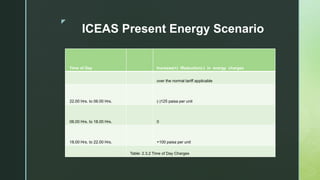
ICEAS Present Energy Scenario
Time of Day Increase(+) /Reduction(-) in energy charges
over the normal tariff applicable
22.00 Hrs. to 06.00 Hrs. (-)125 paisa per unit
06.00 Hrs. to 18.00 Hrs. 0
18.00 Hrs. to 22.00 Hrs. +100 paisa per unit
Table: 2.3.2 Time of Day Charges
z
Benefits of Monitoring Power Quality
 Ensure optimum system performance and
efficiency. Reduce total system loading.
 Improve availability of power
 Minimize losses to the production processes.
Increase plant productivity.
z
LITERATURE SURVEY
 First we took the electricity bill of our college and
we found out that kWh and kVA consumption are
varying. We are paying penalty during most of the
months due to crossing the limit of contract
demand. For this we referred reports on energy
conservation AIT College and from various
electrical related articles and magazines (Electrical
India and Lighting India)
z
Need to Conserve Energy Instead of
Generation
 We use the energy faster than it is produced
i.e., there is a rapid increase in electrical
equipment’s used by consumers than it is
generated.
 The basic necessities like coal, oil, natural
gas the most utilized sources take thousands
of years for information.
 Most of the resources are limited.
z
ENERGY AUDIT
 The purpose of an energy audit (sometimes
called an “energy assessment” or “energy
study”) is to determine where, when, why and
how energy is used in a facility, and to identify
opportunities to improve efficiency.
z
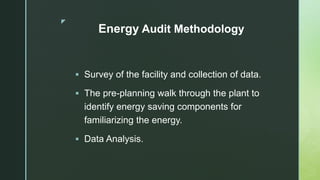
Energy Audit Methodology
 Survey of the facility and collection of data.
 The pre-planning walk through the plant to
identify energy saving components for
familiarizing the energy.
 Data Analysis.
z
Energy Audit Covers
 Operational efficiency of diesel generator
sets.
 electric supply authority.
 Evaluation of different components of the
electrical network
 Study of utility equipment like fans, pumps,
air-conditioning and lightning, etc.
z
FUTURE WORK
 Implementation of all suggestions mentioned in
lighting, air-conditioning, computers etc.
 Installation of energy meters in all blocks taking
readings. Resizing of cables, switch gears.
 Setting of time-table i.e. ,labs which helps in
equal distribution of load
z
Objective of Project Highlighting
 To know and understand the level of power factor and
harmonics present in electric
 Network of Impact College of engineering and take
necessary steps to improve the power quality.
 Perform a literature survey to determine if any work has
to been previously done in this field.
z
POWER QUALITY
 Equipment designer or manufacturer: a
perfect sinusoidal wave, with no
variations in the voltage, and no noise
present on the grounding system
z
POWER QUALITY CAN IMPROVED BY
 Power factor correction. Harmonic filtering.
 Special line notch filtering.
 Transient voltage surge suppression. Proper
earthling systems.
z
SMPS
 A switched mode power supply (SMPS or
Switcher) is an electronic power supply that
incorporates a switching regulator to convert
electrical power efficiently. Like other power
supplies, an SMPS transfers power from a
source
z
OVER ALL SUGGESTION
 Lightening system
 Room Air Conditioners
 computers
z
RESULTS
 Collection of all the bills form the
particular year .
 Collection of Load Data:
 Harmonic Analysis
z
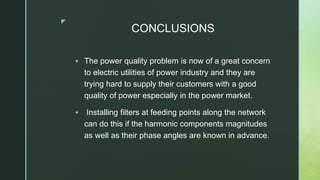
CONCLUSIONS
 The power quality problem is now of a great concern
to electric utilities of power industry and they are
trying hard to supply their customers with a good
quality of power especially in the power market.
 Installing filters at feeding points along the network
can do this if the harmonic components magnitudes
as well as their phase angles are known in advance.

ENERGY AUDIT

  • 1.
    z INTRODUCTION  Impact Collegeof Engineering and Applied Sciences (ICEAS) was started in the year 2004 and campus having an area of about acres is one of the finest sites in Bangalore. Today, the Institute is recognized as one of the center of academic excellence in the country. Over the years, there has been significant process at ICEAS in all academic, and a parallel improvement in facilities and infrastructure, to keep it on per with the best institutions in the country. This institute is affiliated to Visveshwaraiah Technological University. It has an intake of 360 students sanctioned by Government of Karnataka and approved by AICTE; Students from various parts of country have taken admissions.
  • 2.
    z ICEAS Present EnergyScenario Time of Day Increase(+) /Reduction(-) in energy charges over the normal tariff applicable 22.00 Hrs. to 06.00 Hrs. (-)125 paisa per unit 06.00 Hrs. to 18.00 Hrs. 0 18.00 Hrs. to 22.00 Hrs. +100 paisa per unit Table: 2.3.2 Time of Day Charges
  • 3.
    z Benefits of MonitoringPower Quality  Ensure optimum system performance and efficiency. Reduce total system loading.  Improve availability of power  Minimize losses to the production processes. Increase plant productivity.
  • 4.
    z LITERATURE SURVEY  Firstwe took the electricity bill of our college and we found out that kWh and kVA consumption are varying. We are paying penalty during most of the months due to crossing the limit of contract demand. For this we referred reports on energy conservation AIT College and from various electrical related articles and magazines (Electrical India and Lighting India)
  • 5.
    z Need to ConserveEnergy Instead of Generation  We use the energy faster than it is produced i.e., there is a rapid increase in electrical equipment’s used by consumers than it is generated.  The basic necessities like coal, oil, natural gas the most utilized sources take thousands of years for information.  Most of the resources are limited.
  • 6.
    z ENERGY AUDIT  Thepurpose of an energy audit (sometimes called an “energy assessment” or “energy study”) is to determine where, when, why and how energy is used in a facility, and to identify opportunities to improve efficiency.
  • 7.
    z Energy Audit Methodology Survey of the facility and collection of data.  The pre-planning walk through the plant to identify energy saving components for familiarizing the energy.  Data Analysis.
  • 8.
    z Energy Audit Covers Operational efficiency of diesel generator sets.  electric supply authority.  Evaluation of different components of the electrical network  Study of utility equipment like fans, pumps, air-conditioning and lightning, etc.
  • 9.
    z FUTURE WORK  Implementationof all suggestions mentioned in lighting, air-conditioning, computers etc.  Installation of energy meters in all blocks taking readings. Resizing of cables, switch gears.  Setting of time-table i.e. ,labs which helps in equal distribution of load
  • 10.
    z Objective of ProjectHighlighting  To know and understand the level of power factor and harmonics present in electric  Network of Impact College of engineering and take necessary steps to improve the power quality.  Perform a literature survey to determine if any work has to been previously done in this field.
  • 11.
    z POWER QUALITY  Equipmentdesigner or manufacturer: a perfect sinusoidal wave, with no variations in the voltage, and no noise present on the grounding system
  • 12.
    z POWER QUALITY CANIMPROVED BY  Power factor correction. Harmonic filtering.  Special line notch filtering.  Transient voltage surge suppression. Proper earthling systems.
  • 13.
    z SMPS  A switchedmode power supply (SMPS or Switcher) is an electronic power supply that incorporates a switching regulator to convert electrical power efficiently. Like other power supplies, an SMPS transfers power from a source
  • 14.
    z OVER ALL SUGGESTION Lightening system  Room Air Conditioners  computers
  • 15.
    z RESULTS  Collection ofall the bills form the particular year .  Collection of Load Data:  Harmonic Analysis
  • 16.
    z CONCLUSIONS  The powerquality problem is now of a great concern to electric utilities of power industry and they are trying hard to supply their customers with a good quality of power especially in the power market.  Installing filters at feeding points along the network can do this if the harmonic components magnitudes as well as their phase angles are known in advance.