European Lean Educator Conference 2017
(ELEC 2017)
Nijmegen, 7th – 10th November 2017
Measuring Lean
Competencies – An
Approach for
Quantifying the
Learning Outcome
of a Simulation
Game
Agenda
1. Introduction Technology Centre PULS
2. Problems evaluating Competence Transfer of Lean Simulation
Games
3. Measuring the Effectiveness of Simulation Games
4. Lean Simulation Game “From Push to Pull”
5. Concept of Measuring the Learning Outcome of a Lean Simulation
Game
6. Application and Results of the Measuring Concept
7. Conclusion
15.11.2017 Landshut University of Applied Sciences, Germany 2
Agenda
1. Introduction Technology Centre PULS
2. Problems evaluating Competence Transfer of Lean Simulation
Games
3. Measuring the Effectiveness of Simulation Games
4. Lean Simulation Game “From Push to Pull”
5. Concept of Measuring the Learning Outcome of a Lean Simulation
Game
6. Application and Results of the Measuring Concept
7. Conclusion
15.11.2017 Landshut University of Applied Sciences, Germany 3
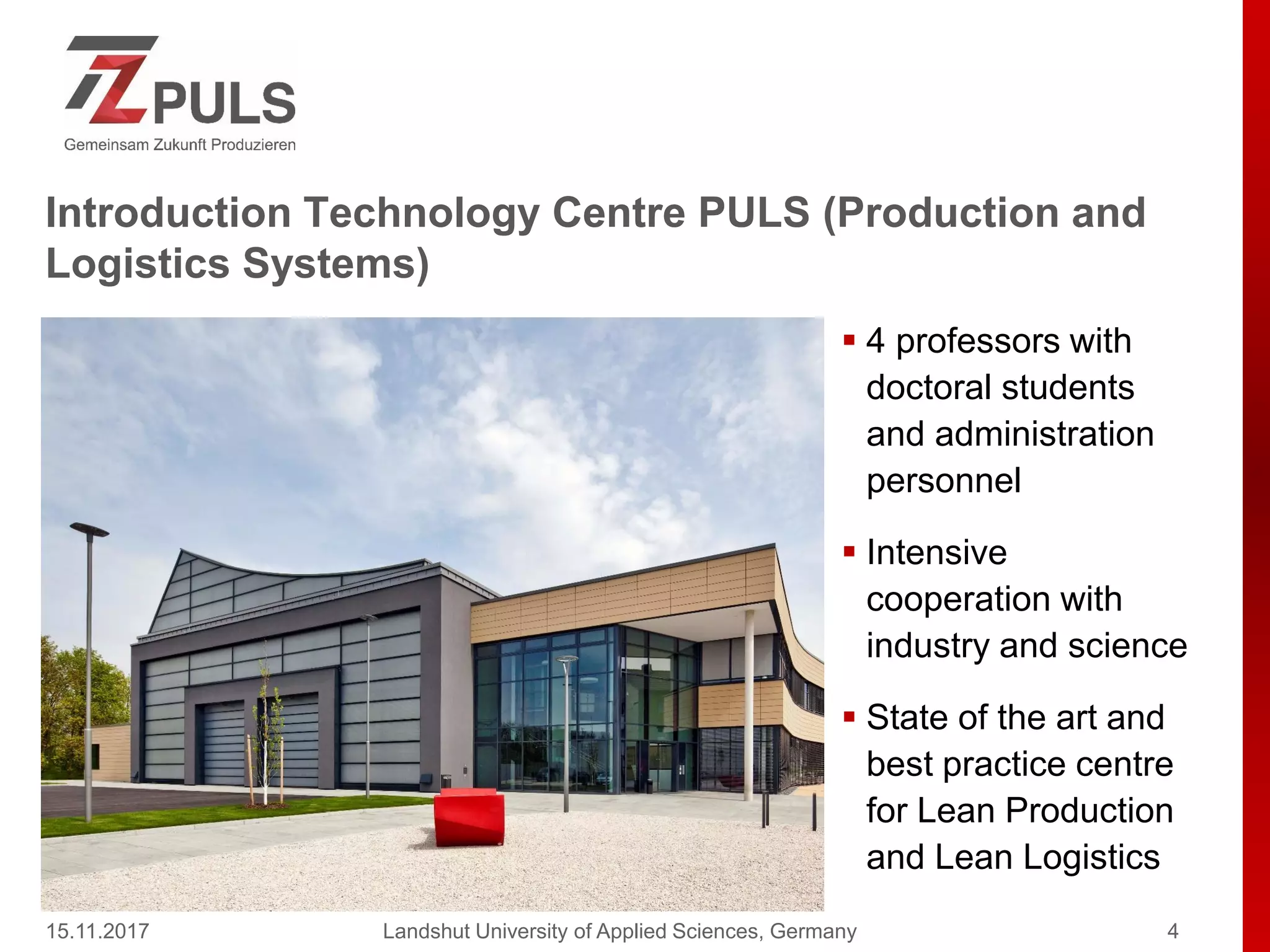
Introduction Technology Centre PULS (Production and
Logistics Systems)
 4 professors with
doctoral students
and administration
personnel
 Intensive
cooperation with
industry and science
 State of the art and
best practice centre
for Lean Production
and Lean Logistics
15.11.2017 Landshut University of Applied Sciences, Germany 4
Agenda
1. Introduction Technology Centre PULS
2. Problems evaluating Competence Transfer of Lean Simulation
Games
3. Measuring the Effectiveness of Simulation Games
4. Lean Simulation Game “From Push to Pull”
5. Concept of Measuring the Learning Outcome of a Lean Simulation
Game
6. Application and Results of the Measuring Concept
7. Conclusion
15.11.2017 Landshut University of Applied Sciences, Germany 5
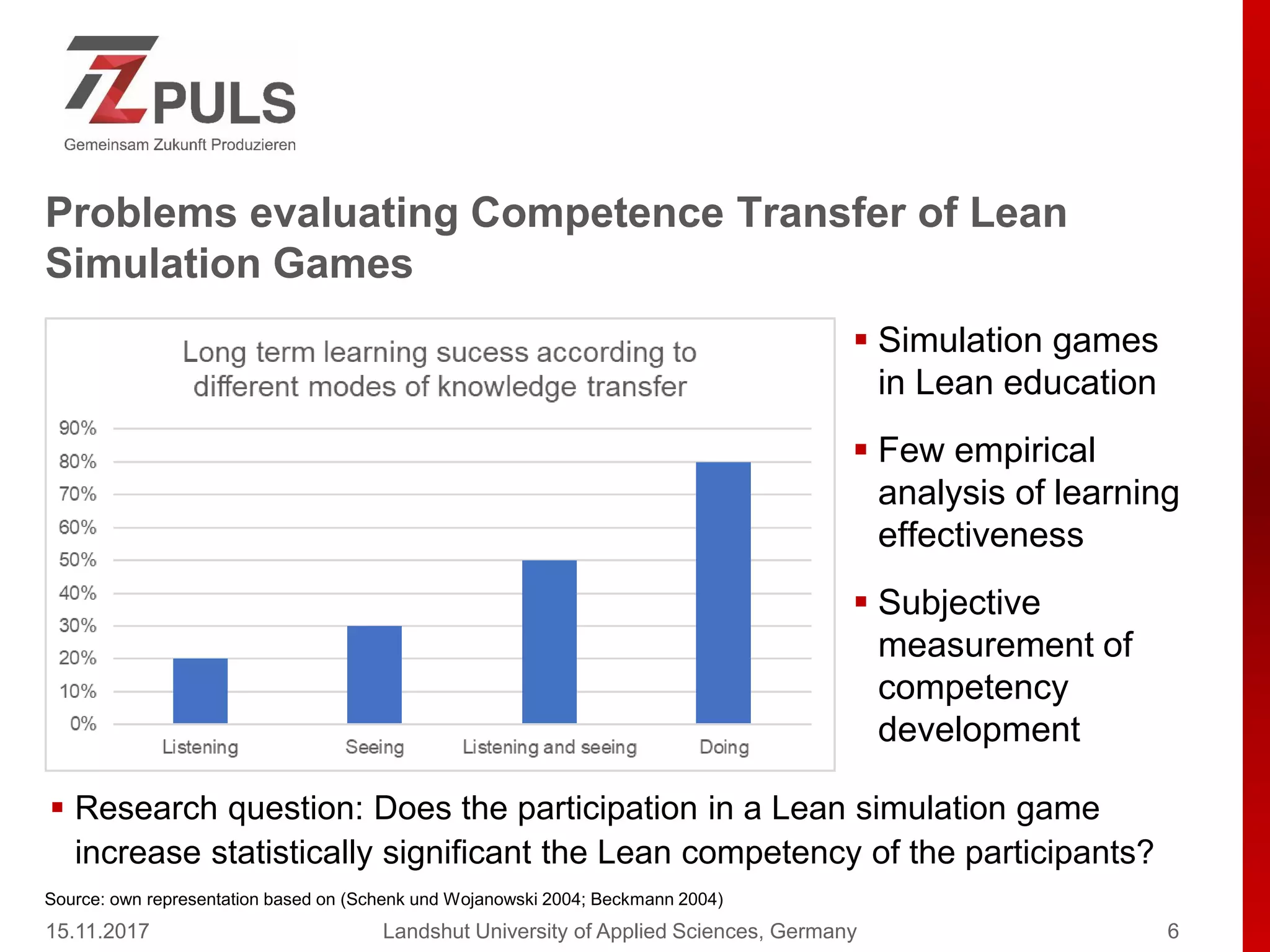
Problems evaluating Competence Transfer of Lean
Simulation Games
 Simulation games
in Lean education
 Few empirical
analysis of learning
effectiveness
 Subjective
measurement of
competency
development
15.11.2017 Landshut University of Applied Sciences, Germany 6
Source: own representation based on (Schenk und Wojanowski 2004; Beckmann 2004)
 Research question: Does the participation in a Lean simulation game
increase statistically significant the Lean competency of the participants?
Agenda
1. Introduction Technology Centre PULS
2. Problems evaluating Competence Transfer of Lean Simulation
Games
3. Measuring the Effectiveness of Simulation Games
4. Lean Simulation Game “From Push to Pull”
5. Concept of Measuring the Learning Outcome of a Lean Simulation
Game
6. Application and Results of the Measuring Concept
7. Conclusion
15.11.2017 Landshut University of Applied Sciences, Germany 7
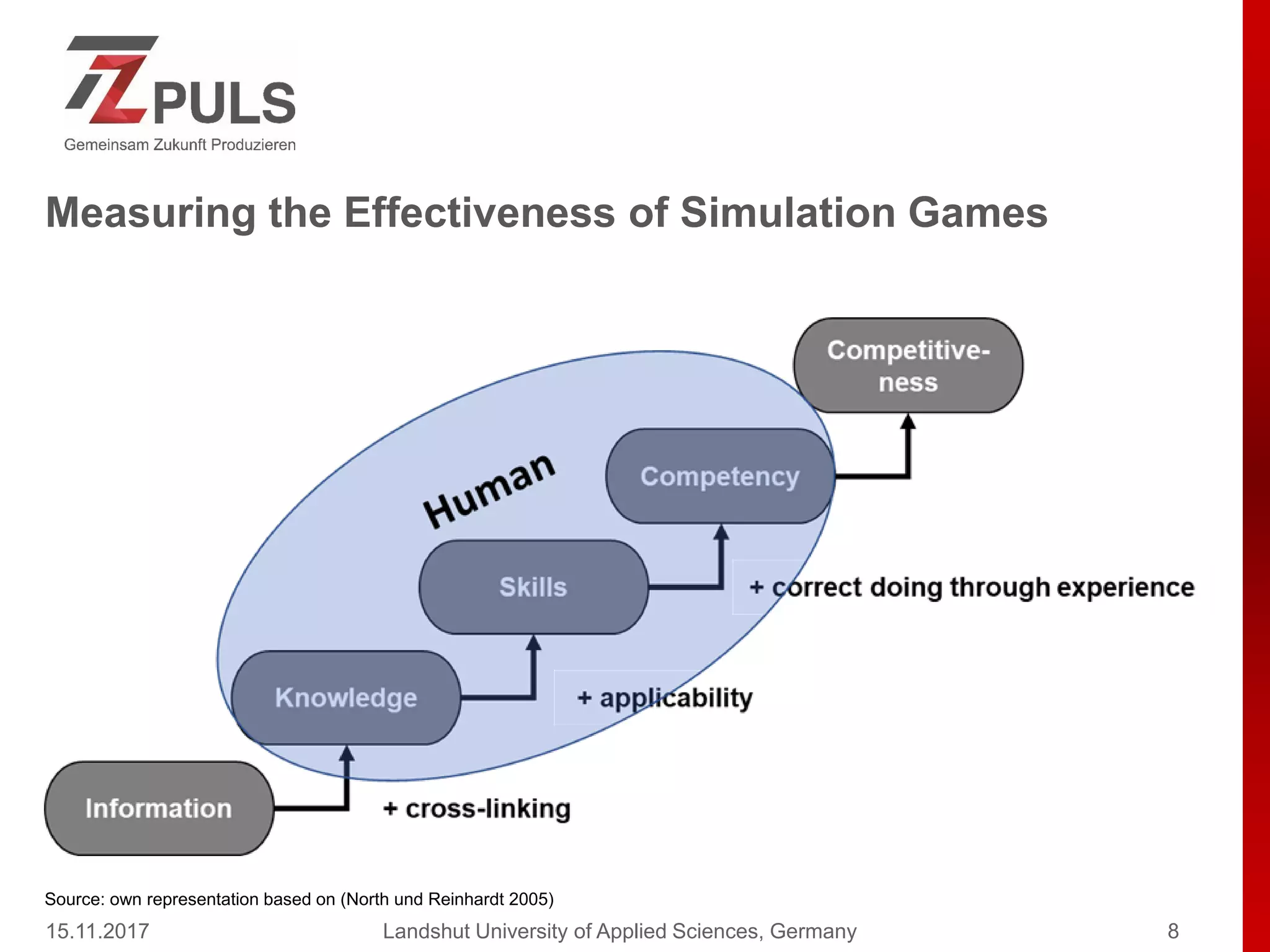
Measuring the Effectiveness of Simulation Games
15.11.2017 Landshut University of Applied Sciences, Germany 8
Source: own representation based on (North und Reinhardt 2005)
Measuring the Effectiveness of Simulation Games
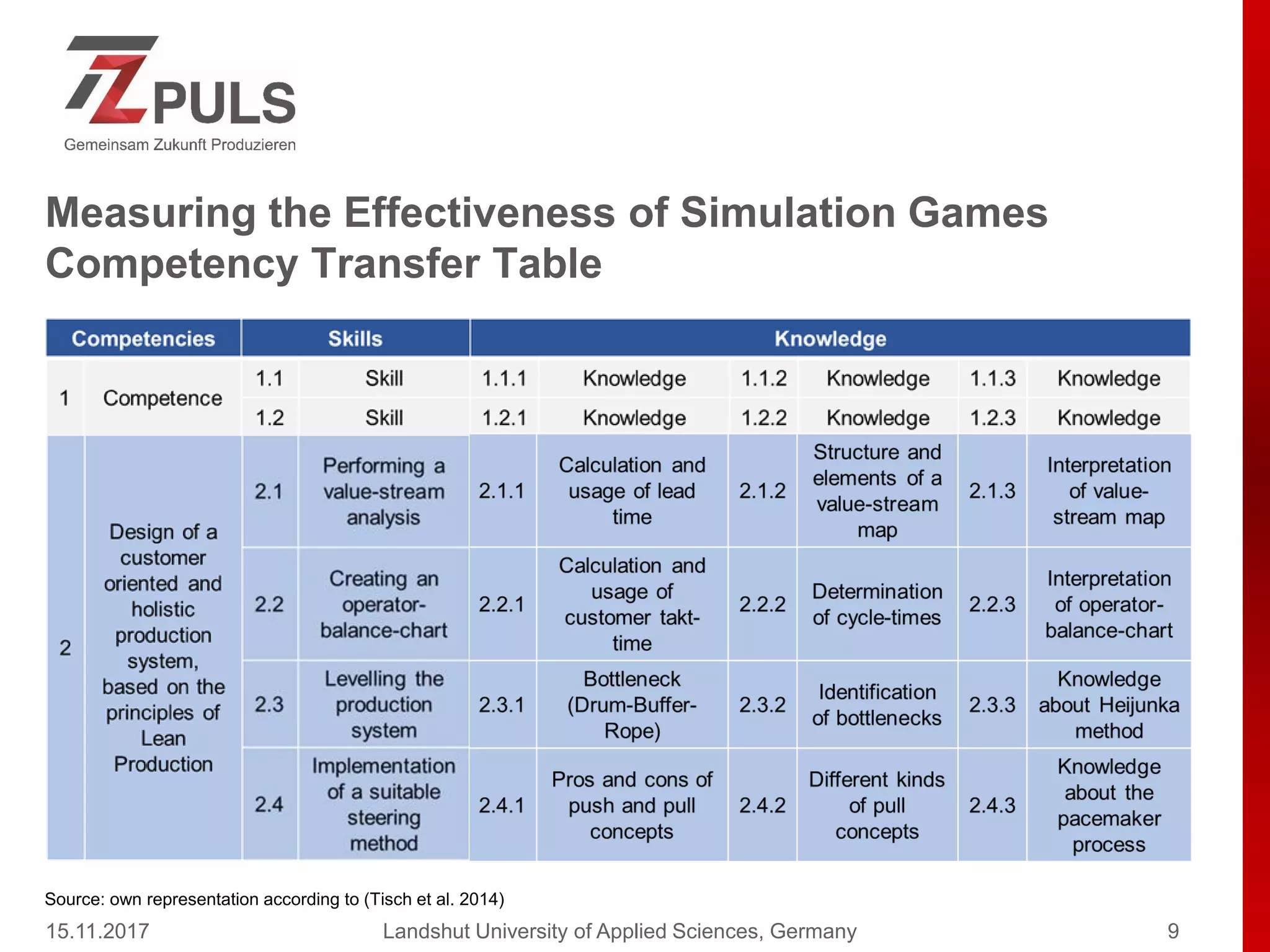
Competency Transfer Table
15.11.2017 Landshut University of Applied Sciences, Germany 9
Source: own representation according to (Tisch et al. 2014)
Measuring the Effectiveness of Simulation Games
Approach
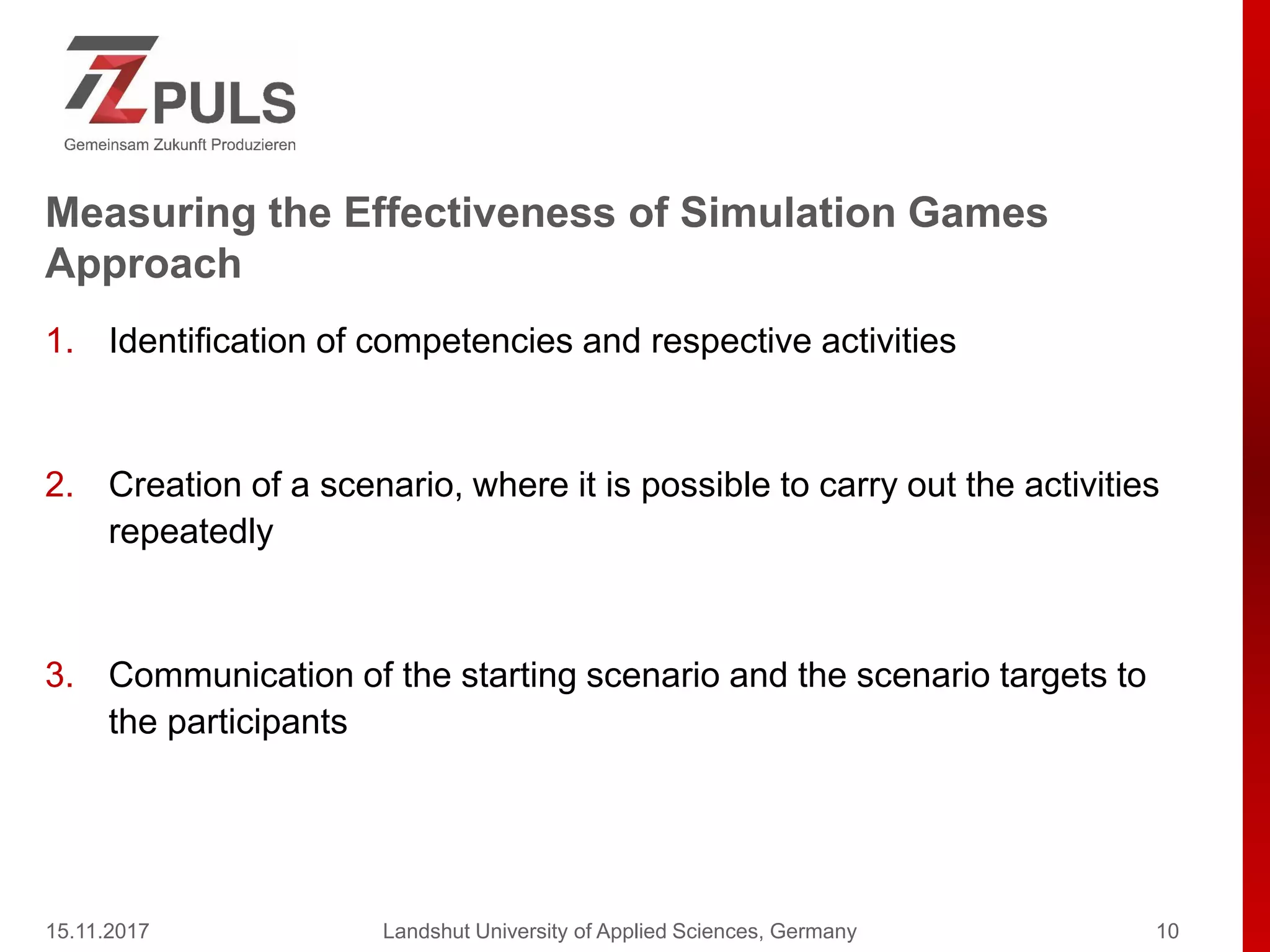
1. Identification of competencies and respective activities
2. Creation of a scenario, where it is possible to carry out the activities
repeatedly
3. Communication of the starting scenario and the scenario targets to
the participants
15.11.2017 Landshut University of Applied Sciences, Germany 10
Agenda
1. Introduction Technology Centre PULS
2. Problems evaluating Competence Transfer of Lean Simulation
Games
3. Measuring the Effectiveness of Simulation Games
4. Lean Simulation Game “From Push to Pull”
5. Concept of Measuring the Learning Outcome of a Lean Simulation
Game
6. Application and Results of the Measuring Concept
7. Conclusion
15.11.2017 Landshut University of Applied Sciences, Germany 11
Lean Simulation Game “From Push to Pull”
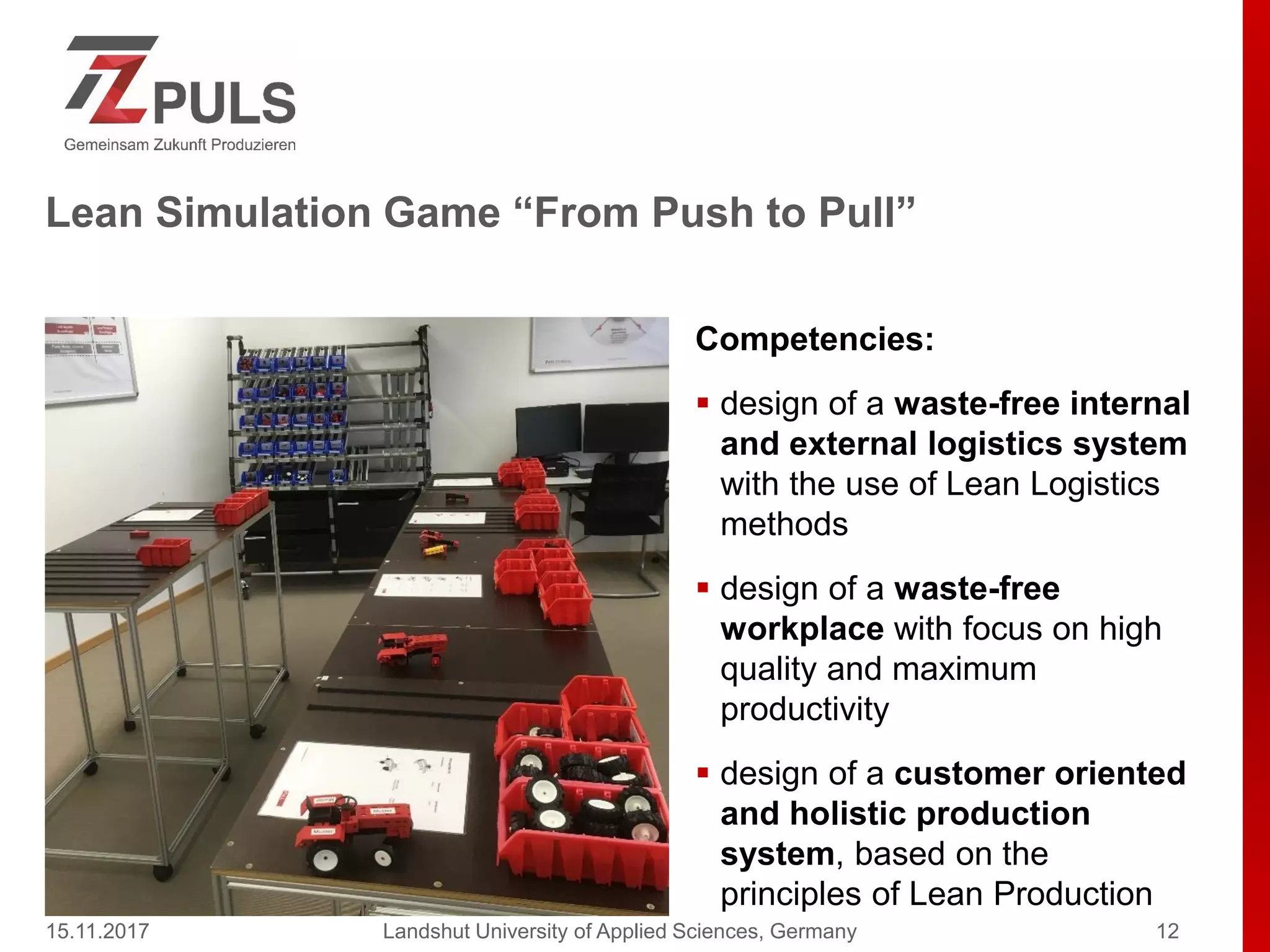
Competencies:
 design of a waste-free internal
and external logistics system
with the use of Lean Logistics
methods
 design of a waste-free
workplace with focus on high
quality and maximum
productivity
 design of a customer oriented
and holistic production
system, based on the
principles of Lean Production
15.11.2017 Landshut University of Applied Sciences, Germany 12
Agenda
1. Introduction Technology Centre PULS
2. Problems evaluating Competence Transfer of Lean Simulation
Games
3. Measuring the Effectiveness of Simulation Games
4. Lean Simulation Game “From Push to Pull”
5. Concept of Measuring the Learning Outcome of a Lean Simulation
Game
6. Application and Results of the Measuring Concept
7. Conclusion
15.11.2017 Landshut University of Applied Sciences, Germany 13
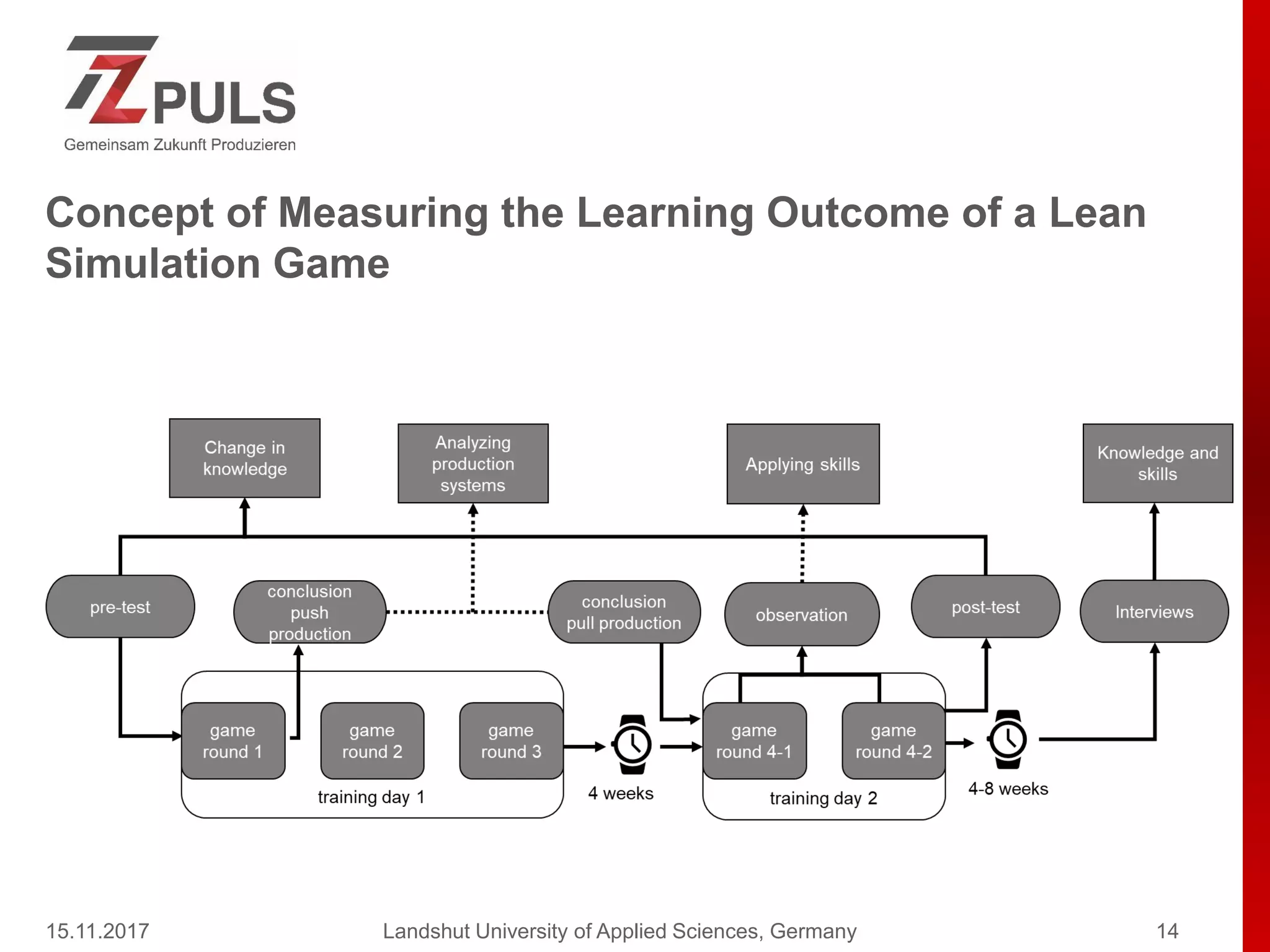
Concept of Measuring the Learning Outcome of a Lean
Simulation Game
15.11.2017 Landshut University of Applied Sciences, Germany 14
Agenda
1. Introduction Technology Centre PULS
2. Problems evaluating Competence Transfer of Lean Simulation
Games
3. Measuring the Effectiveness of Simulation Games
4. Lean Simulation Game “From Push to Pull”
5. Concept of Measuring the Learning Outcome of a Lean Simulation
Game
6. Application and Results of the Measuring Concept
7. Conclusion
15.11.2017 Landshut University of Applied Sciences, Germany 15
Application and Results of the Measuring Concept
Pre- and Post-Test
15.11.2017 Landshut University of Applied Sciences, Germany 16
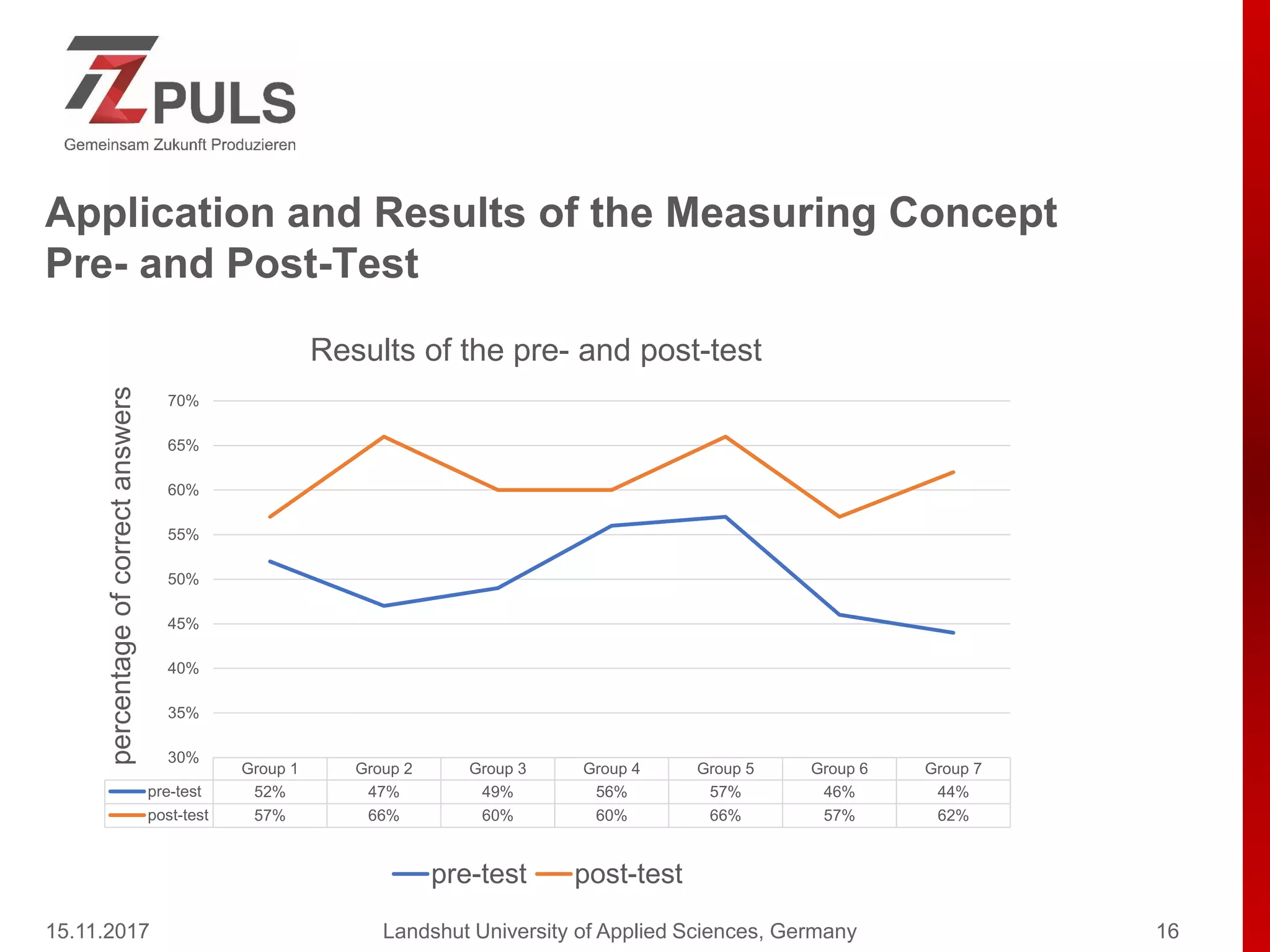
Group 1 Group 2 Group 3 Group 4 Group 5 Group 6 Group 7
pre-test 52% 47% 49% 56% 57% 46% 44%
post-test 57% 66% 60% 60% 66% 57% 62%
30%
35%
40%
45%
50%
55%
60%
65%
70%
percentageofcorrectanswers
Results of the pre- and post-test
pre-test post-test
Application and Results of the Measuring Concept
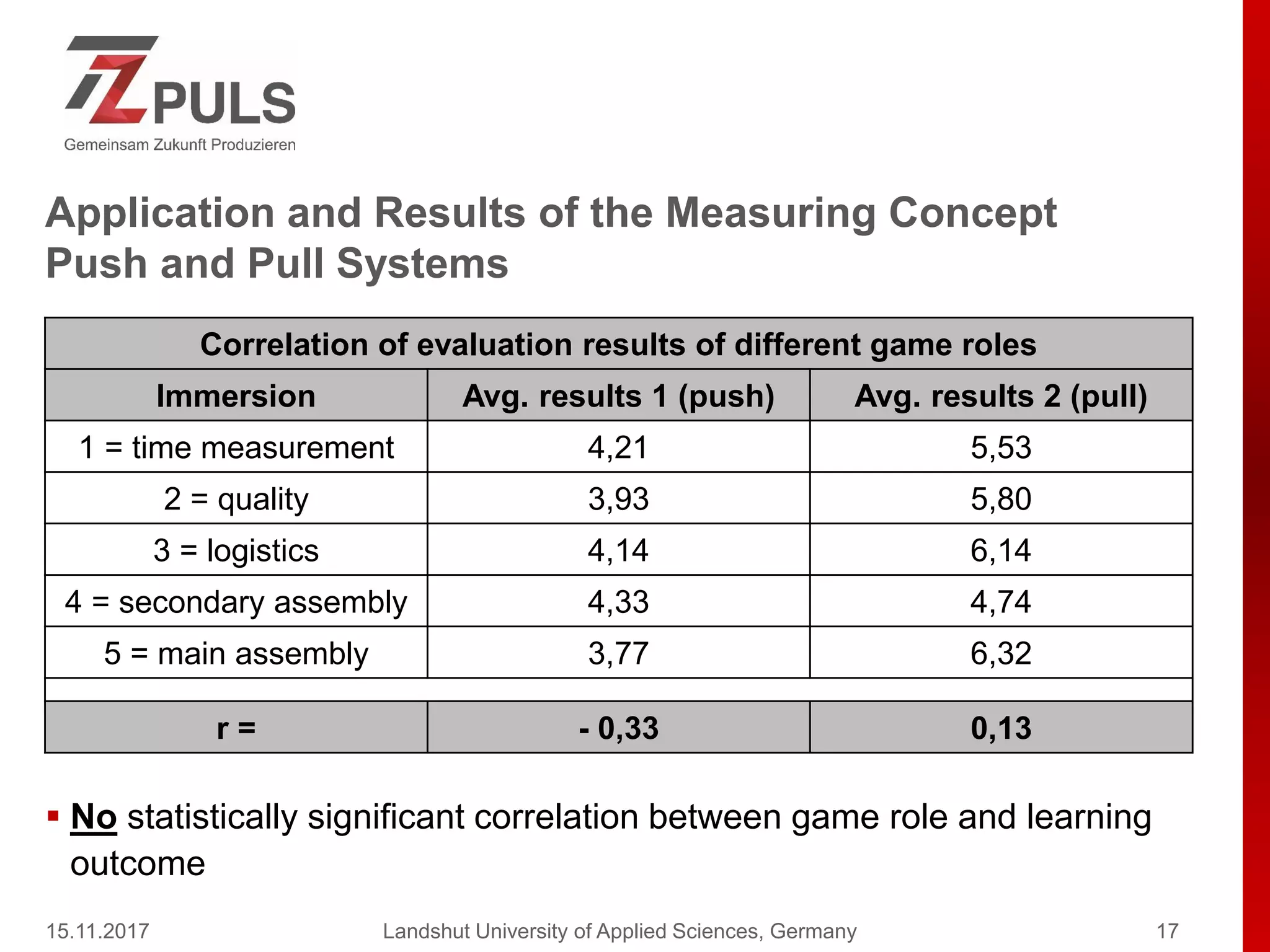
Push and Pull Systems
Correlation of evaluation results of different game roles
Immersion Avg. results 1 (push) Avg. results 2 (pull)
1 = time measurement 4,21 5,53
2 = quality 3,93 5,80
3 = logistics 4,14 6,14
4 = secondary assembly 4,33 4,74
5 = main assembly 3,77 6,32
r = - 0,33 0,13
15.11.2017 Landshut University of Applied Sciences, Germany 17
 No statistically significant correlation between game role and learning
outcome
Application and Results of the Measuring Concept
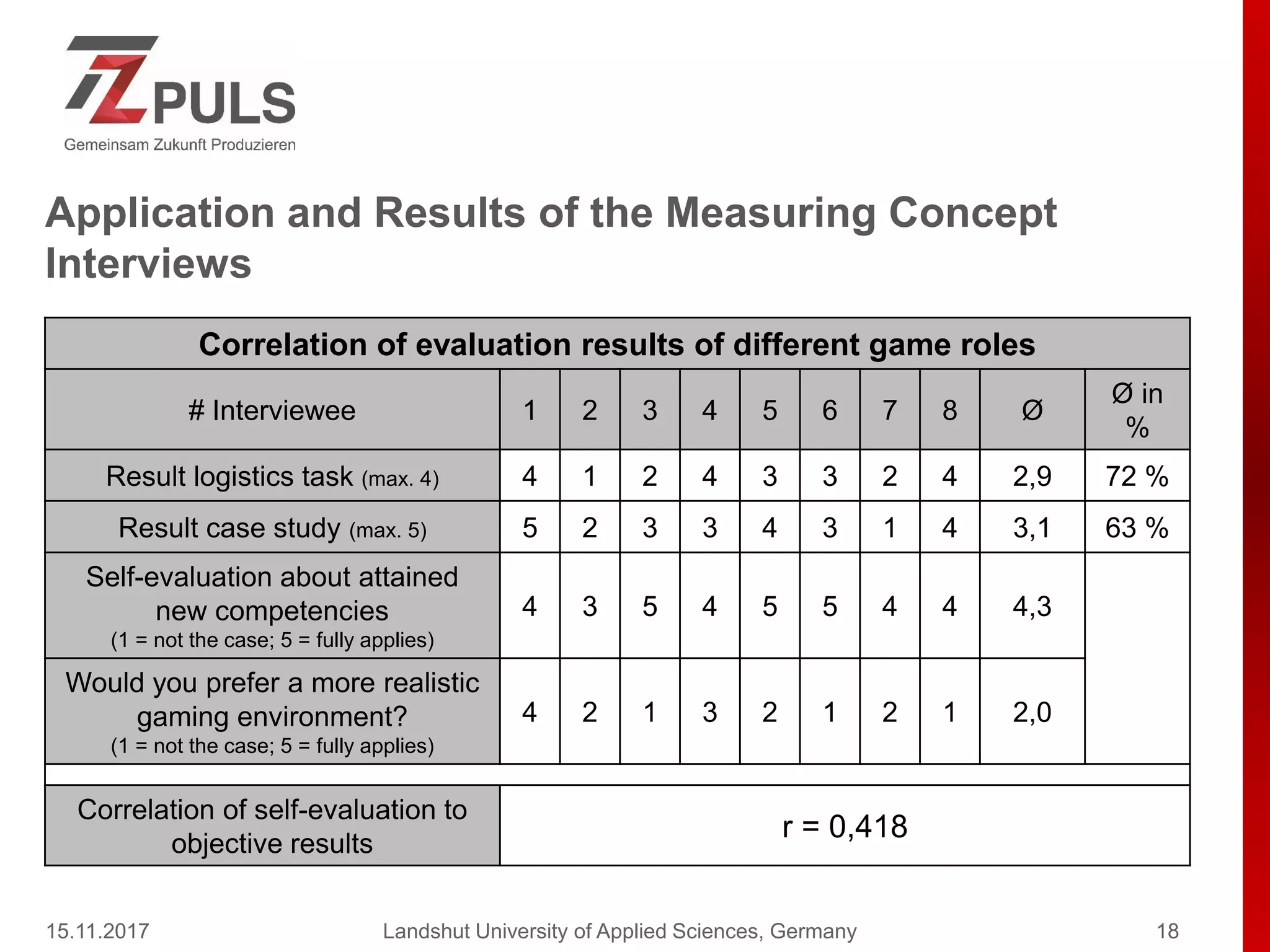
Interviews
15.11.2017 Landshut University of Applied Sciences, Germany 18
Correlation of evaluation results of different game roles
# Interviewee 1 2 3 4 5 6 7 8 Ø
Ø in
%
Result logistics task (max. 4) 4 1 2 4 3 3 2 4 2,9 72 %
Result case study (max. 5) 5 2 3 3 4 3 1 4 3,1 63 %
Self-evaluation about attained
new competencies
(1 = not the case; 5 = fully applies)
4 3 5 4 5 5 4 4 4,3
Would you prefer a more realistic
gaming environment?
(1 = not the case; 5 = fully applies)
4 2 1 3 2 1 2 1 2,0
Correlation of self-evaluation to
objective results
r = 0,418
Agenda
1. Introduction Technology Centre PULS
2. Problems evaluating Competence Transfer of Lean Simulation
Games
3. Measuring the Effectiveness of Simulation Games
4. Lean Simulation Game “From Push to Pull”
5. Concept of Measuring the Learning Outcome of a Lean Simulation
Game
6. Application and Results of the Measuring Concept
7. Conclusion
15.11.2017 Landshut University of Applied Sciences, Germany 19
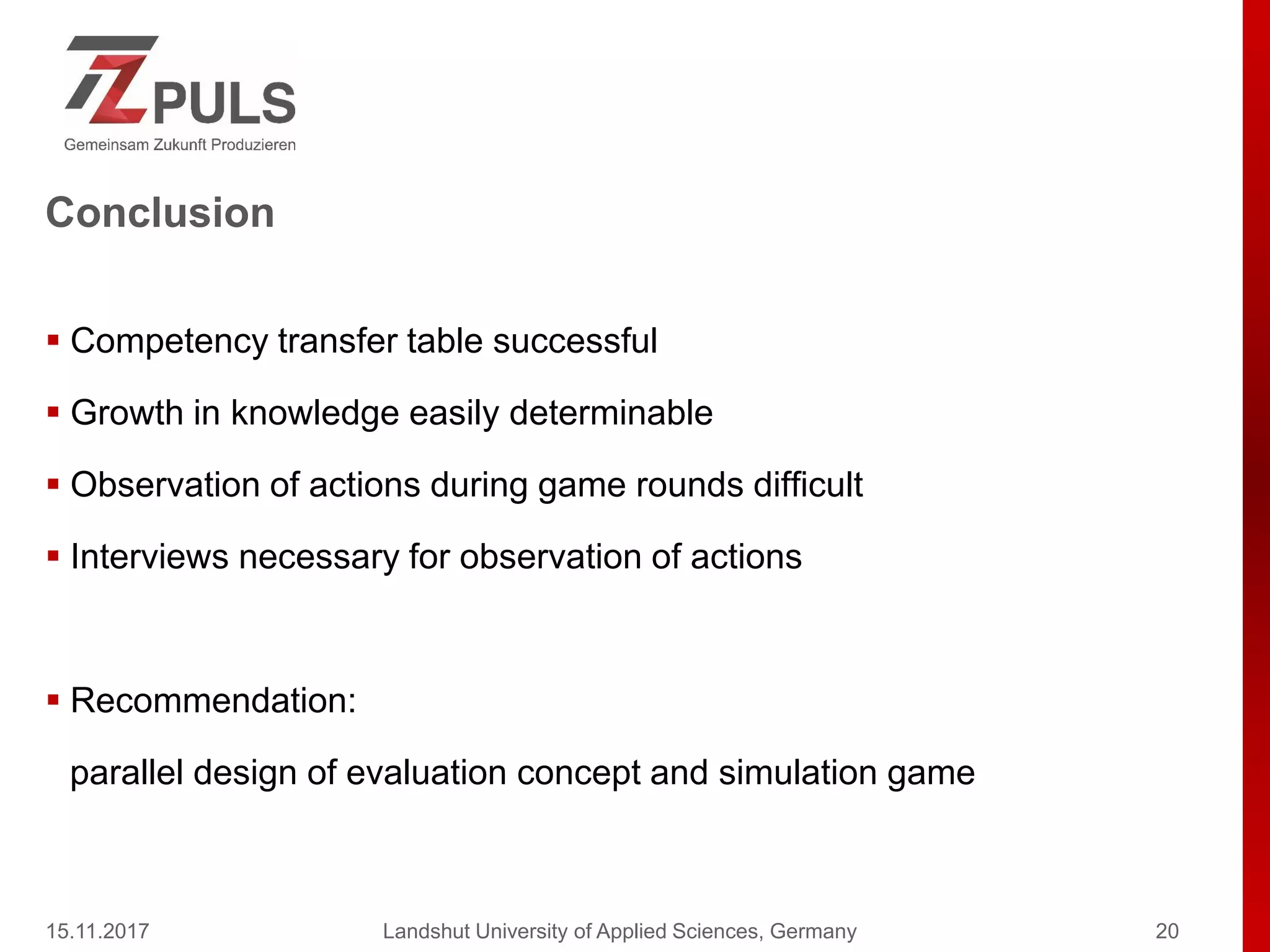
Conclusion
 Competency transfer table successful
 Growth in knowledge easily determinable
 Observation of actions during game rounds difficult
 Interviews necessary for observation of actions
 Recommendation:
parallel design of evaluation concept and simulation game
15.11.2017 Landshut University of Applied Sciences, Germany 20
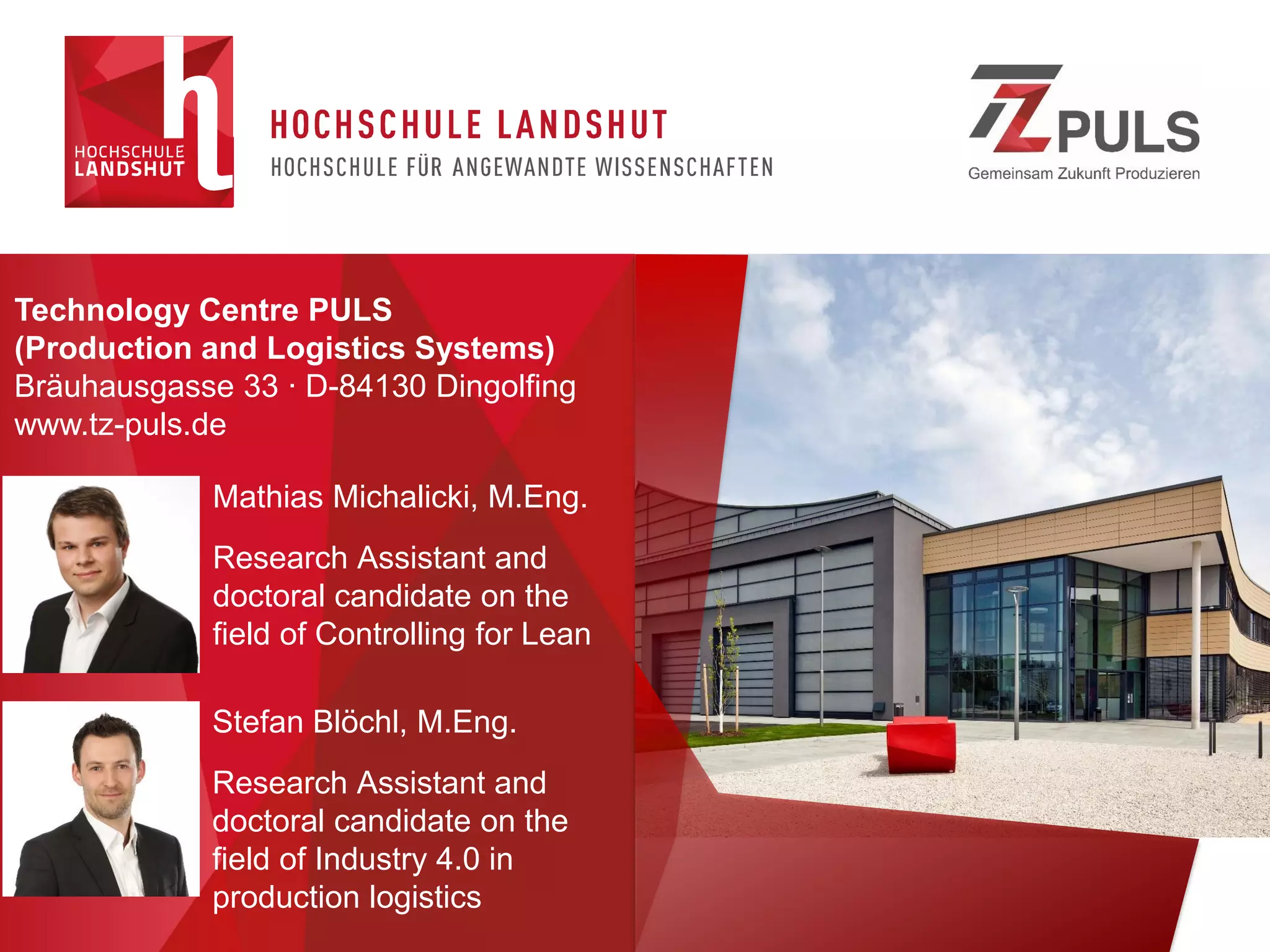
Technology Centre PULS
(Production and Logistics Systems)
Bräuhausgasse 33 ∙ D-84130 Dingolfing
www.tz-puls.de
Stefan Blöchl, M.Eng.
Research Assistant and
doctoral candidate on the
field of Industry 4.0 in
production logistics
Mathias Michalicki, M.Eng.
Research Assistant and
doctoral candidate on the
field of Controlling for Lean

ELEC2017 3.3 s. blöchl - measuring lean competencies – an approach for quantifying the learni

  • 1.
    European Lean EducatorConference 2017 (ELEC 2017) Nijmegen, 7th – 10th November 2017 Measuring Lean Competencies – An Approach for Quantifying the Learning Outcome of a Simulation Game
  • 2.
    Agenda 1. Introduction TechnologyCentre PULS 2. Problems evaluating Competence Transfer of Lean Simulation Games 3. Measuring the Effectiveness of Simulation Games 4. Lean Simulation Game “From Push to Pull” 5. Concept of Measuring the Learning Outcome of a Lean Simulation Game 6. Application and Results of the Measuring Concept 7. Conclusion 15.11.2017 Landshut University of Applied Sciences, Germany 2
  • 3.
    Agenda 1. Introduction TechnologyCentre PULS 2. Problems evaluating Competence Transfer of Lean Simulation Games 3. Measuring the Effectiveness of Simulation Games 4. Lean Simulation Game “From Push to Pull” 5. Concept of Measuring the Learning Outcome of a Lean Simulation Game 6. Application and Results of the Measuring Concept 7. Conclusion 15.11.2017 Landshut University of Applied Sciences, Germany 3
  • 4.
    Introduction Technology CentrePULS (Production and Logistics Systems)  4 professors with doctoral students and administration personnel  Intensive cooperation with industry and science  State of the art and best practice centre for Lean Production and Lean Logistics 15.11.2017 Landshut University of Applied Sciences, Germany 4
  • 5.
    Agenda 1. Introduction TechnologyCentre PULS 2. Problems evaluating Competence Transfer of Lean Simulation Games 3. Measuring the Effectiveness of Simulation Games 4. Lean Simulation Game “From Push to Pull” 5. Concept of Measuring the Learning Outcome of a Lean Simulation Game 6. Application and Results of the Measuring Concept 7. Conclusion 15.11.2017 Landshut University of Applied Sciences, Germany 5
  • 6.
    Problems evaluating CompetenceTransfer of Lean Simulation Games  Simulation games in Lean education  Few empirical analysis of learning effectiveness  Subjective measurement of competency development 15.11.2017 Landshut University of Applied Sciences, Germany 6 Source: own representation based on (Schenk und Wojanowski 2004; Beckmann 2004)  Research question: Does the participation in a Lean simulation game increase statistically significant the Lean competency of the participants?
  • 7.
    Agenda 1. Introduction TechnologyCentre PULS 2. Problems evaluating Competence Transfer of Lean Simulation Games 3. Measuring the Effectiveness of Simulation Games 4. Lean Simulation Game “From Push to Pull” 5. Concept of Measuring the Learning Outcome of a Lean Simulation Game 6. Application and Results of the Measuring Concept 7. Conclusion 15.11.2017 Landshut University of Applied Sciences, Germany 7
  • 8.
    Measuring the Effectivenessof Simulation Games 15.11.2017 Landshut University of Applied Sciences, Germany 8 Source: own representation based on (North und Reinhardt 2005)
  • 9.
    Measuring the Effectivenessof Simulation Games Competency Transfer Table 15.11.2017 Landshut University of Applied Sciences, Germany 9 Source: own representation according to (Tisch et al. 2014)
  • 10.
    Measuring the Effectivenessof Simulation Games Approach 1. Identification of competencies and respective activities 2. Creation of a scenario, where it is possible to carry out the activities repeatedly 3. Communication of the starting scenario and the scenario targets to the participants 15.11.2017 Landshut University of Applied Sciences, Germany 10
  • 11.
    Agenda 1. Introduction TechnologyCentre PULS 2. Problems evaluating Competence Transfer of Lean Simulation Games 3. Measuring the Effectiveness of Simulation Games 4. Lean Simulation Game “From Push to Pull” 5. Concept of Measuring the Learning Outcome of a Lean Simulation Game 6. Application and Results of the Measuring Concept 7. Conclusion 15.11.2017 Landshut University of Applied Sciences, Germany 11
  • 12.
    Lean Simulation Game“From Push to Pull” Competencies:  design of a waste-free internal and external logistics system with the use of Lean Logistics methods  design of a waste-free workplace with focus on high quality and maximum productivity  design of a customer oriented and holistic production system, based on the principles of Lean Production 15.11.2017 Landshut University of Applied Sciences, Germany 12
  • 13.
    Agenda 1. Introduction TechnologyCentre PULS 2. Problems evaluating Competence Transfer of Lean Simulation Games 3. Measuring the Effectiveness of Simulation Games 4. Lean Simulation Game “From Push to Pull” 5. Concept of Measuring the Learning Outcome of a Lean Simulation Game 6. Application and Results of the Measuring Concept 7. Conclusion 15.11.2017 Landshut University of Applied Sciences, Germany 13
  • 14.
    Concept of Measuringthe Learning Outcome of a Lean Simulation Game 15.11.2017 Landshut University of Applied Sciences, Germany 14
  • 15.
    Agenda 1. Introduction TechnologyCentre PULS 2. Problems evaluating Competence Transfer of Lean Simulation Games 3. Measuring the Effectiveness of Simulation Games 4. Lean Simulation Game “From Push to Pull” 5. Concept of Measuring the Learning Outcome of a Lean Simulation Game 6. Application and Results of the Measuring Concept 7. Conclusion 15.11.2017 Landshut University of Applied Sciences, Germany 15
  • 16.
    Application and Resultsof the Measuring Concept Pre- and Post-Test 15.11.2017 Landshut University of Applied Sciences, Germany 16 Group 1 Group 2 Group 3 Group 4 Group 5 Group 6 Group 7 pre-test 52% 47% 49% 56% 57% 46% 44% post-test 57% 66% 60% 60% 66% 57% 62% 30% 35% 40% 45% 50% 55% 60% 65% 70% percentageofcorrectanswers Results of the pre- and post-test pre-test post-test
  • 17.
    Application and Resultsof the Measuring Concept Push and Pull Systems Correlation of evaluation results of different game roles Immersion Avg. results 1 (push) Avg. results 2 (pull) 1 = time measurement 4,21 5,53 2 = quality 3,93 5,80 3 = logistics 4,14 6,14 4 = secondary assembly 4,33 4,74 5 = main assembly 3,77 6,32 r = - 0,33 0,13 15.11.2017 Landshut University of Applied Sciences, Germany 17  No statistically significant correlation between game role and learning outcome
  • 18.
    Application and Resultsof the Measuring Concept Interviews 15.11.2017 Landshut University of Applied Sciences, Germany 18 Correlation of evaluation results of different game roles # Interviewee 1 2 3 4 5 6 7 8 Ø Ø in % Result logistics task (max. 4) 4 1 2 4 3 3 2 4 2,9 72 % Result case study (max. 5) 5 2 3 3 4 3 1 4 3,1 63 % Self-evaluation about attained new competencies (1 = not the case; 5 = fully applies) 4 3 5 4 5 5 4 4 4,3 Would you prefer a more realistic gaming environment? (1 = not the case; 5 = fully applies) 4 2 1 3 2 1 2 1 2,0 Correlation of self-evaluation to objective results r = 0,418
  • 19.
    Agenda 1. Introduction TechnologyCentre PULS 2. Problems evaluating Competence Transfer of Lean Simulation Games 3. Measuring the Effectiveness of Simulation Games 4. Lean Simulation Game “From Push to Pull” 5. Concept of Measuring the Learning Outcome of a Lean Simulation Game 6. Application and Results of the Measuring Concept 7. Conclusion 15.11.2017 Landshut University of Applied Sciences, Germany 19
  • 20.
    Conclusion  Competency transfertable successful  Growth in knowledge easily determinable  Observation of actions during game rounds difficult  Interviews necessary for observation of actions  Recommendation: parallel design of evaluation concept and simulation game 15.11.2017 Landshut University of Applied Sciences, Germany 20
  • 21.
    Technology Centre PULS (Productionand Logistics Systems) Bräuhausgasse 33 ∙ D-84130 Dingolfing www.tz-puls.de Stefan Blöchl, M.Eng. Research Assistant and doctoral candidate on the field of Industry 4.0 in production logistics Mathias Michalicki, M.Eng. Research Assistant and doctoral candidate on the field of Controlling for Lean