EURYDICE 
The contribution of 
Eurydice to 
European 
evidence-based 
policy making in 
Education 
Peter Birch 
18 September 2014 
1
Content 
Date: in 12 pts EURYDICE 
• Eurydice Mission 
• Reports and data 
• ET2020 
• Examples: Key data on Teachers and School 
Leaders in Europe (2013); Financing 
Schools in Europe (2014) 
2
Compulsory schooling? 
Date: in 12 pts EURYDICE 
Really?! 
3
Duration of 
full-time 
compulsory 
schooling in Europe 
1980-2012 
Part-time 
Source: Eurydice 
Key data on Education in Europe - 
2012 
Date: in 12 pts EURYDICE 
4
Date: in 12 pts EURYDICE 
Grade retention? 
What is that!? 
5
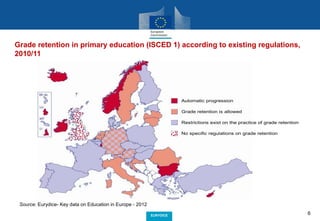
Grade retention in primary education (ISCED 1) according to existing regulations, 
2010/11 
Date: in 12 pts EURYDICE 
Source: Eurydice- Key data on Education in Europe - 2012 
Automatic progression 
Grade retention is allowed 
Restrictions exist on the practice of grade retention 
No specific regulations on grade retention 
6
Date: in 12 pts EURYDICE 
What do you mean 
we can't choose?! 
7
Degree of parental/pupil freedom in choice of school for compulsory education 
in the public sector, 2010/11 
ISCED 2 
ISCED 2 and 3 
STUDENTS are allocated to a specific school by the public 
authorities based on geographical criteria 
STUDENTS are allocated to a school but parents may 
request an alternative 
PARENTS choose a school but the public authorities may 
intervene if it is over-subscribed 
PARENTS choose a school, with no action by the public 
authorities to regulate pupil numbers 
Date: in 12 pts EURYDICE 
Source: Eurydice - Key data on Education in Europe - 2012 
8
So… how is compulsory education 
Date: in 12 pts EURYDICE 
organised in Europe? 
Jose Mujica 
9
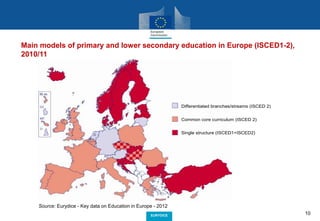
Main models of primary and lower secondary education in Europe (ISCED1-2), 
2010/11 
Source: Eurydice - Key data on Education in Europe - 2012 
Differentiated branches/streams (ISCED 2) 
Common core curriculum (ISCED 2) 
Single structure (ISCED1+ISCED2) 
Date: in 12 pts EURYDICE 
10
Date: in 12 pts EURYDICE 
Eurydice: mission statement 
To provide those responsible for education 
systems and policies in Europe with European-level 
analyses and information which will assist 
them in their decision making. 
11
Date: in 12 pts EURYDICE 
Eurydice 
Network in 2014 
36 COUNTRIES 
40 NATIONAL UNITS 
(under Ministries’ responsibility) 
12
5 Benchmarks for 2020 & programme 2014-2020 
2010 : Europe 2020 strategy 
2000 : Lisbon 
1999 Bologna process 
Evolution of the 
Eurydice Network 
Support to public debate and 
providing information to policy-makers 
1992 Maastricht 
1980 Birth of the Network 
Indicators and 
secondary analysis 
Thematic comparative 
studies 
Comparable national descriptions 
Date: in 12 pts EURYDICE 
Mutual understanding 
Exchange of information Questions and answers 
13
Current context: 
Education and Training 2020 
ET 2020: strategic framework strengthening cooperation 
in Education and Training 
Overarching objectives: high-quality pre-primary, 
primary, secondary, higher and vocational education and 
training keeping in mind that they contribute to 
employment, economic success, and allow people to 
participate fully in society 
Date: in 12 pts EURYDICE 
14
ET 2020 - objectives 
• Making lifelong learning and mobility a reality 
• Improving the quality and efficiency of education and 
Date: in 12 pts EURYDICE 
training 
• Promoting equity, social cohesion and active 
citizenship 
• Enhancing creativity and innovation, including 
entrepreneurship, at all levels of education and training 
15
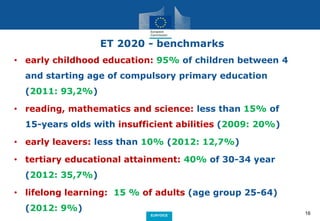
ET 2020 - benchmarks 
• early childhood education: 95% of children between 4 
and starting age of compulsory primary education 
(2011: 93,2%) 
• reading, mathematics and science: less than 15% of 
15-years olds with insufficient abilities (2009: 20%) 
• early leavers: less than 10% (2012: 12,7%) 
• tertiary educational attainment: 40% of 30-34 year 
Date: in 12 pts EURYDICE 
(2012: 35,7%) 
• lifelong learning: 15 % of adults (age group 25-64) 
(2012: 9%) 
16
To be able to provide legitimate policy advice, 
the Commission needs: 
• Detailed knowledge about the institutional set-up in 
Date: in 12 pts EURYDICE 
individual countries 
• Understanding of association between 
reforms/institutional set-up and national performance 
• Monitoring of reforms and performance over time 
17
Date: in 12 pts EURYDICE 
Eurydice national units provide 
normative and qualitative information 
(laws, decrees, regulations and 
recommendations) 
Descriptive, comparable information on 
European education systems and policies 
Comparative analyses on various topics 
Eurydice contribution at 
work 
18
3 types of products 
• Harmonised descriptions of education systems - 
Date: in 12 pts EURYDICE 
Eurypedia 
• Reports 
• Facts and Figures 
19
https://webgate.ec.europa.eu/fpfis/mwikis/eurydice/ 
Date: in 12 pts EURYDICE 
20
… on a wide-range of topics European 
education policy: 
Teaching 
Modernisation of higher education 
Financing schools… 
Date: in 12 pts EURYDICE 
Thematic reports… 
21
Key Data on Education 
Key Data on Education in Europe sets out a very wide 
variety of both qualitative and quantitative indicators on 
different aspects of education systems in 33 European 
countries 
Date: in 12 pts EURYDICE 
22
Facts and Figures 
Structure and main features of 
European education systems 
School and academic calendars 
Structure of European 
education systems 
Teacher and School Heads 
Salaries 
Student fees and support 
systems in Higher Education 
Date: in 12 pts EURYDICE 
23 
23
Key Data on Teachers and School 
Leaders in Europe 
2013 Edition Contents 
• Initial Teacher Education 
• Recruitment, Employers and Contracts 
• CPD and Mobility 
• Working conditions and Pay 
• Autonomy and Responsiblities of 
Teachers 
• School Leaders 
Date: in 12 pts EURYDICE
Date: in 12 pts EURYDICE 
School Leaders 
1/7 
25 
Figure F1: Professional experience and headship training officially required to be a school head, from pre-primary 
to upper secondary education (ISCED 0, 1, 2 and 3), 2011/12 
Primary education 
(ISCED 1) 
Professional teaching experience 
+ Administrative experience 
+ Training for headship 
+ Administrative experience + 
Training for headship 
Teaching qualification only 
Training for headship only 
Source: Eurydice.
Date: in 12 pts EURYDICE 
School Leaders 
2/7 
Figure F2: Minimum number of years of professional teaching experience required to become 
a school head from pre-primary to upper secondary education (ISCED 0, 1, 2 and 3), 2011/12 
ISCED 0-1 ISCED 2-3 Required but no duration stipulated  Not required 
Source: Eurydice. UK (1) = UK-ENG/WLS/NIR 
26
Figure F3: Existence of specific academies and/or training programmes for school leadership 
in pre-primary to upper secondary education (ISCED 0, 1, 2 and 3), 2011/12 
Specific training 
programmes/academies 
No specific training programme 
Source: Eurydice. 
Date: in 12 pts EURYDICE 
School Leaders 
3/7 
27
Figure F4: Principal methods of recruiting school heads 
from pre-primary to upper secondary education (ISCED 0, 1, 2 and 3), 2011/12 
Competitive examination 
Open recruitment 
Candidate list 
Source: Eurydice. 
Date: in 12 pts EURYDICE 
School Leaders 
4/7 
28
Figure F5: Forms of distributed school leadership promoted by the top level education authority from pre-primary 
to upper secondary education (ISCED 0, 1, 2 and 3), 2011/12 
Pre-primary and primary education 
(ISCED 0-1) 
Redistribution of tasks among formal 
leadership teams 
Informal ad-hoc groups 
Schools decide about leadership 
distribution 
No distributed school leadership 
Source: Eurydice. 
Date: in 12 pts EURYDICE 
School Leaders 
5/7 
29
Figure F8: Percentage of female school heads in 
primary and secondary education (ISCED 1, 2 and 3), public and private sectors combined, 2010 
ISCED 1 ISCED 2 ISCED 3 
Source: Eurostat 
Date: in 12 pts EURYDICE 
School Leaders 
6/7 
30
Figure F10: Status of continuing professional development for school heads 
from pre-primary to upper secondary education (ISCED 0, 1, 2 and 3), 2011/12 
Pre-primary and primary education 
(ISCED 0-1) 
Professional duty 
Necessary for promotion 
Optional 
Source: Eurydice. 
Date: in 12 pts EURYDICE 
School Leaders 
7/7 
31
Figure C1: Status of continuing professional development for teachers 
in pre-primary, primary and general (lower and upper) secondary education (ISCED 0, 1, 2 and 3), 2011/12 
Pre-primary education 
ISCED 0 
Professional duty 
Necessary for promotion 
Optional 
Source: Eurydice. 
Date: in 12 pts EURYDICE 
Teachers 
CPD 1/2 
32
Figure C2: Status of the CPD plan at school level for teachers 
in pre-primary, primary and general (lower and upper) secondary education (ISCED 0, 1, 2 and 3), 2011/12 
Pre-primary education 
ISCED 0 
Pre-primary and primary 
education (ISCED 0-1) 
Compulsory 
Not compulsory 
Source: Eurydice. 
Date: in 12 pts EURYDICE 
Teachers 
CPD 2/2 
33
Norway (primary and general secondary education) 
Date: in 12 pts EURYDICE 
Source: Eurydice - Financing schools in Europe - 2014 
34
Austria (primary and general secondary schools) 
Date: in 12 pts EURYDICE 
Source: Eurydice - Financing schools in Europe - 2014 
35
Poland (primary and general secondary schools) 
Date: in 12 pts EURYDICE 
Source: Eurydice - Financing schools in Europe - 2014 36
http://eacea.ec.europa.eu/education/eurydice/index_en.php 
Date: in 12 pts EURYDICE 
37
Most knowledge is learning from the other across the border. 
Amartya Sen - Indian Economist Nobel-prize winner 
Thank you 
Date: in 12 pts EURYDICE 
Website: 
http://eacea.ec.europa.eu/index_en.php 
Functional mailbox: 
eacea-eurydice@ec.europa.eu 
38

Eurydice - Key Data Teachers and School Leaders - Peter Birch

  • 1.
    EURYDICE The contributionof Eurydice to European evidence-based policy making in Education Peter Birch 18 September 2014 1
  • 2.
    Content Date: in12 pts EURYDICE • Eurydice Mission • Reports and data • ET2020 • Examples: Key data on Teachers and School Leaders in Europe (2013); Financing Schools in Europe (2014) 2
  • 3.
    Compulsory schooling? Date:in 12 pts EURYDICE Really?! 3
  • 4.
    Duration of full-time compulsory schooling in Europe 1980-2012 Part-time Source: Eurydice Key data on Education in Europe - 2012 Date: in 12 pts EURYDICE 4
  • 5.
    Date: in 12pts EURYDICE Grade retention? What is that!? 5
  • 6.
    Grade retention inprimary education (ISCED 1) according to existing regulations, 2010/11 Date: in 12 pts EURYDICE Source: Eurydice- Key data on Education in Europe - 2012 Automatic progression Grade retention is allowed Restrictions exist on the practice of grade retention No specific regulations on grade retention 6
  • 7.
    Date: in 12pts EURYDICE What do you mean we can't choose?! 7
  • 8.
    Degree of parental/pupilfreedom in choice of school for compulsory education in the public sector, 2010/11 ISCED 2 ISCED 2 and 3 STUDENTS are allocated to a specific school by the public authorities based on geographical criteria STUDENTS are allocated to a school but parents may request an alternative PARENTS choose a school but the public authorities may intervene if it is over-subscribed PARENTS choose a school, with no action by the public authorities to regulate pupil numbers Date: in 12 pts EURYDICE Source: Eurydice - Key data on Education in Europe - 2012 8
  • 9.
    So… how iscompulsory education Date: in 12 pts EURYDICE organised in Europe? Jose Mujica 9
  • 10.
    Main models ofprimary and lower secondary education in Europe (ISCED1-2), 2010/11 Source: Eurydice - Key data on Education in Europe - 2012 Differentiated branches/streams (ISCED 2) Common core curriculum (ISCED 2) Single structure (ISCED1+ISCED2) Date: in 12 pts EURYDICE 10
  • 11.
    Date: in 12pts EURYDICE Eurydice: mission statement To provide those responsible for education systems and policies in Europe with European-level analyses and information which will assist them in their decision making. 11
  • 12.
    Date: in 12pts EURYDICE Eurydice Network in 2014 36 COUNTRIES 40 NATIONAL UNITS (under Ministries’ responsibility) 12
  • 13.
    5 Benchmarks for2020 & programme 2014-2020 2010 : Europe 2020 strategy 2000 : Lisbon 1999 Bologna process Evolution of the Eurydice Network Support to public debate and providing information to policy-makers 1992 Maastricht 1980 Birth of the Network Indicators and secondary analysis Thematic comparative studies Comparable national descriptions Date: in 12 pts EURYDICE Mutual understanding Exchange of information Questions and answers 13
  • 14.
    Current context: Educationand Training 2020 ET 2020: strategic framework strengthening cooperation in Education and Training Overarching objectives: high-quality pre-primary, primary, secondary, higher and vocational education and training keeping in mind that they contribute to employment, economic success, and allow people to participate fully in society Date: in 12 pts EURYDICE 14
  • 15.
    ET 2020 -objectives • Making lifelong learning and mobility a reality • Improving the quality and efficiency of education and Date: in 12 pts EURYDICE training • Promoting equity, social cohesion and active citizenship • Enhancing creativity and innovation, including entrepreneurship, at all levels of education and training 15
  • 16.
    ET 2020 -benchmarks • early childhood education: 95% of children between 4 and starting age of compulsory primary education (2011: 93,2%) • reading, mathematics and science: less than 15% of 15-years olds with insufficient abilities (2009: 20%) • early leavers: less than 10% (2012: 12,7%) • tertiary educational attainment: 40% of 30-34 year Date: in 12 pts EURYDICE (2012: 35,7%) • lifelong learning: 15 % of adults (age group 25-64) (2012: 9%) 16
  • 17.
    To be ableto provide legitimate policy advice, the Commission needs: • Detailed knowledge about the institutional set-up in Date: in 12 pts EURYDICE individual countries • Understanding of association between reforms/institutional set-up and national performance • Monitoring of reforms and performance over time 17
  • 18.
    Date: in 12pts EURYDICE Eurydice national units provide normative and qualitative information (laws, decrees, regulations and recommendations) Descriptive, comparable information on European education systems and policies Comparative analyses on various topics Eurydice contribution at work 18
  • 19.
    3 types ofproducts • Harmonised descriptions of education systems - Date: in 12 pts EURYDICE Eurypedia • Reports • Facts and Figures 19
  • 20.
  • 21.
    … on awide-range of topics European education policy: Teaching Modernisation of higher education Financing schools… Date: in 12 pts EURYDICE Thematic reports… 21
  • 22.
    Key Data onEducation Key Data on Education in Europe sets out a very wide variety of both qualitative and quantitative indicators on different aspects of education systems in 33 European countries Date: in 12 pts EURYDICE 22
  • 23.
    Facts and Figures Structure and main features of European education systems School and academic calendars Structure of European education systems Teacher and School Heads Salaries Student fees and support systems in Higher Education Date: in 12 pts EURYDICE 23 23
  • 24.
    Key Data onTeachers and School Leaders in Europe 2013 Edition Contents • Initial Teacher Education • Recruitment, Employers and Contracts • CPD and Mobility • Working conditions and Pay • Autonomy and Responsiblities of Teachers • School Leaders Date: in 12 pts EURYDICE
  • 25.
    Date: in 12pts EURYDICE School Leaders 1/7 25 Figure F1: Professional experience and headship training officially required to be a school head, from pre-primary to upper secondary education (ISCED 0, 1, 2 and 3), 2011/12 Primary education (ISCED 1) Professional teaching experience + Administrative experience + Training for headship + Administrative experience + Training for headship Teaching qualification only Training for headship only Source: Eurydice.
  • 26.
    Date: in 12pts EURYDICE School Leaders 2/7 Figure F2: Minimum number of years of professional teaching experience required to become a school head from pre-primary to upper secondary education (ISCED 0, 1, 2 and 3), 2011/12 ISCED 0-1 ISCED 2-3 Required but no duration stipulated  Not required Source: Eurydice. UK (1) = UK-ENG/WLS/NIR 26
  • 27.
    Figure F3: Existenceof specific academies and/or training programmes for school leadership in pre-primary to upper secondary education (ISCED 0, 1, 2 and 3), 2011/12 Specific training programmes/academies No specific training programme Source: Eurydice. Date: in 12 pts EURYDICE School Leaders 3/7 27
  • 28.
    Figure F4: Principalmethods of recruiting school heads from pre-primary to upper secondary education (ISCED 0, 1, 2 and 3), 2011/12 Competitive examination Open recruitment Candidate list Source: Eurydice. Date: in 12 pts EURYDICE School Leaders 4/7 28
  • 29.
    Figure F5: Formsof distributed school leadership promoted by the top level education authority from pre-primary to upper secondary education (ISCED 0, 1, 2 and 3), 2011/12 Pre-primary and primary education (ISCED 0-1) Redistribution of tasks among formal leadership teams Informal ad-hoc groups Schools decide about leadership distribution No distributed school leadership Source: Eurydice. Date: in 12 pts EURYDICE School Leaders 5/7 29
  • 30.
    Figure F8: Percentageof female school heads in primary and secondary education (ISCED 1, 2 and 3), public and private sectors combined, 2010 ISCED 1 ISCED 2 ISCED 3 Source: Eurostat Date: in 12 pts EURYDICE School Leaders 6/7 30
  • 31.
    Figure F10: Statusof continuing professional development for school heads from pre-primary to upper secondary education (ISCED 0, 1, 2 and 3), 2011/12 Pre-primary and primary education (ISCED 0-1) Professional duty Necessary for promotion Optional Source: Eurydice. Date: in 12 pts EURYDICE School Leaders 7/7 31
  • 32.
    Figure C1: Statusof continuing professional development for teachers in pre-primary, primary and general (lower and upper) secondary education (ISCED 0, 1, 2 and 3), 2011/12 Pre-primary education ISCED 0 Professional duty Necessary for promotion Optional Source: Eurydice. Date: in 12 pts EURYDICE Teachers CPD 1/2 32
  • 33.
    Figure C2: Statusof the CPD plan at school level for teachers in pre-primary, primary and general (lower and upper) secondary education (ISCED 0, 1, 2 and 3), 2011/12 Pre-primary education ISCED 0 Pre-primary and primary education (ISCED 0-1) Compulsory Not compulsory Source: Eurydice. Date: in 12 pts EURYDICE Teachers CPD 2/2 33
  • 34.
    Norway (primary andgeneral secondary education) Date: in 12 pts EURYDICE Source: Eurydice - Financing schools in Europe - 2014 34
  • 35.
    Austria (primary andgeneral secondary schools) Date: in 12 pts EURYDICE Source: Eurydice - Financing schools in Europe - 2014 35
  • 36.
    Poland (primary andgeneral secondary schools) Date: in 12 pts EURYDICE Source: Eurydice - Financing schools in Europe - 2014 36
  • 37.
  • 38.
    Most knowledge islearning from the other across the border. Amartya Sen - Indian Economist Nobel-prize winner Thank you Date: in 12 pts EURYDICE Website: http://eacea.ec.europa.eu/index_en.php Functional mailbox: eacea-eurydice@ec.europa.eu 38