E-Learning at the University ( the case of Tallinn University   ) Sirje Klaos, [email_address] Project Digisnordplus seminar, 12.11.2009
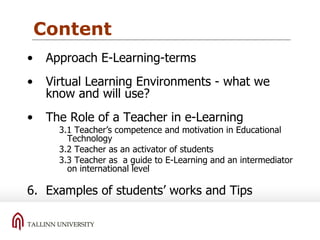
Content Approach E-Learning-terms Virtual Learning Environments - what we know and will use? The Role of a Teacher in e-Learning  3.1 Teacher’s competence and motivation in Educational Technology 3.2 Teacher as an activator of students 3.3 Teacher as  a guide to E-Learning and an intermediator on international level Examples of students’ works and Tips
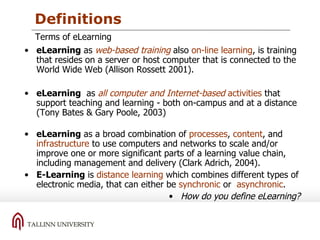
eLearning  as  web-based training  also  on-line learning , is training that resides on a server or host computer that is connected to the World Wide Web (Allison Rossett 2001).  eLearning   as  all computer and Internet-based   activities  that support teaching and learning - both on-campus and at a distance (Tony Bates & Gary Poole, 2003) eLearning  as a broad combination of  processes ,  content , and  infrastructure  to use computers and networks to scale and/or improve one or more significant parts of a learning value chain, including management and delivery (Clark Adrich, 2004).   E-Learning  is  distance learning  which combines  different types of electronic media,  that  can either be  synchronic  or   asynchronic . How do you define eLearning? Terms of eLearning Definition s
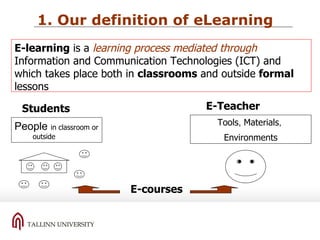
E-Teacher E-courses Students 1. Our definition of eLearning E-learning  is a  learning process mediated through  Information and Communication Technologies (ICT) and which takes place both in  classrooms  and outside  formal  lessons  People   in classroom or  outside Tools ,  Materials ,  Environments
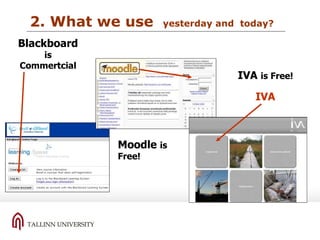
2. What we use  yesterday  and  today? Blackboard  is Commertcial IVA IVA  is Free! Moodle  is Free!
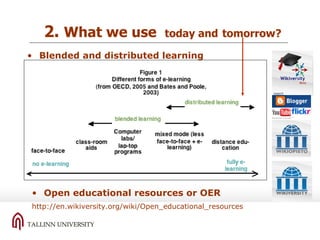
Blended and distributed learning 2.  What we use  today and   tomorrow? Open educational resources or OER http://en.wikiversity.org/wiki/Open_educational_resources
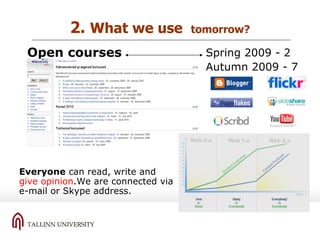
2.  What we use  tomorrow? Open courses Spring 2009 - 2 Autumn 2009 - 7 Everyone  can read, write and  give  opinion .We are  connect ed via e-mail or Skype address.
2. What we mean by e-Learning? Is that modern possibilities and a necessity? Information society offers an opportunity To be flexible To be independent time place location To be baldfaced To be engaged in lifelong learning We know that and must be prepared, because our student are waiting for that!
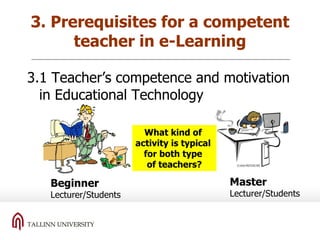
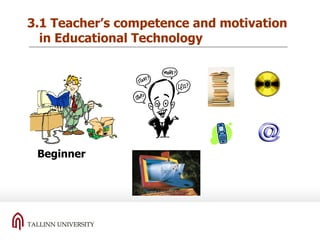
3. Prerequisites for a competent teacher in e-Learning 3.1 Teacher’s competence and motivation in Educational Technology Beginner Lecturer/Students Master Lecturer/Students What kind of  activity is typical  for both type  of teachers?
3.1 Teacher’s competence and motivation in Educational Technology Beginner
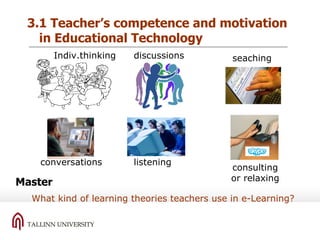
3.1 Teacher’s competence and motivation in Educational Technology Master Indiv.thinking What kind of learning theories teachers use in e-Learning? discussions conversations listening c onsulting or relaxing seaching
3.2 Teacher as an activator of students The lessons must be motivating (including  sounds  and  videos, cross-words  and  pictures ) Teacher should choose  average tempo  which is  appropriate  for beginners as well as masters (students/learners) Teacher must use variety of learning methods ( individual -, pair - and groupwork  etc)
3.3 A Teacher as a guide to E-Learning and  intermediator  on international level The teacher can promote the  discussion  between students and  encourage  their independent work to achieve a common aim (in blogs or forums) The teacher looks for contacts in an international level to enrich e-learning and include foreigen students into e-learning process
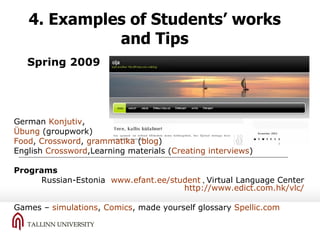
4. Examples of Students’ works and Tips German  Konjutiv ,  Übung  (groupwork) Food ,  Crossword ,  grammatika  ( blog ) English  Crossword ,Learning materials ( Creating interviews ) Programs Russian-Estonia  www.efant.ee/student  ,  Virtual Language Center   http://www.edict.com.hk/vlc/   Games –  simulations ,  Comics , made yourself glossary  Spellic.com Spring  2009
Conclusion: E-Learning can be Free and Open,  but depends neverthless on the Teacher and the methods chosen by him/her, as well as the feedback!  Thank You! [email_address]

e-Learning

  • 1.
    E-Learning at theUniversity ( the case of Tallinn University ) Sirje Klaos, [email_address] Project Digisnordplus seminar, 12.11.2009
  • 2.
    Content Approach E-Learning-termsVirtual Learning Environments - what we know and will use? The Role of a Teacher in e-Learning 3.1 Teacher’s competence and motivation in Educational Technology 3.2 Teacher as an activator of students 3.3 Teacher as a guide to E-Learning and an intermediator on international level Examples of students’ works and Tips
  • 3.
    eLearning as web-based training also on-line learning , is training that resides on a server or host computer that is connected to the World Wide Web (Allison Rossett 2001). eLearning as all computer and Internet-based activities that support teaching and learning - both on-campus and at a distance (Tony Bates & Gary Poole, 2003) eLearning as a broad combination of processes , content , and infrastructure to use computers and networks to scale and/or improve one or more significant parts of a learning value chain, including management and delivery (Clark Adrich, 2004). E-Learning is distance learning which combines different types of electronic media, that can either be synchronic or asynchronic . How do you define eLearning? Terms of eLearning Definition s
  • 4.
    E-Teacher E-courses Students1. Our definition of eLearning E-learning is a learning process mediated through Information and Communication Technologies (ICT) and which takes place both in classrooms and outside formal lessons People in classroom or outside Tools , Materials , Environments
  • 5.
    2. What weuse yesterday and today? Blackboard is Commertcial IVA IVA is Free! Moodle is Free!
  • 6.
    Blended and distributedlearning 2. What we use today and tomorrow? Open educational resources or OER http://en.wikiversity.org/wiki/Open_educational_resources
  • 7.
    2. Whatwe use tomorrow? Open courses Spring 2009 - 2 Autumn 2009 - 7 Everyone can read, write and give opinion .We are connect ed via e-mail or Skype address.
  • 8.
    2. What wemean by e-Learning? Is that modern possibilities and a necessity? Information society offers an opportunity To be flexible To be independent time place location To be baldfaced To be engaged in lifelong learning We know that and must be prepared, because our student are waiting for that!
  • 9.
    3. Prerequisites fora competent teacher in e-Learning 3.1 Teacher’s competence and motivation in Educational Technology Beginner Lecturer/Students Master Lecturer/Students What kind of activity is typical for both type of teachers?
  • 10.
    3.1 Teacher’s competenceand motivation in Educational Technology Beginner
  • 11.
    3.1 Teacher’s competenceand motivation in Educational Technology Master Indiv.thinking What kind of learning theories teachers use in e-Learning? discussions conversations listening c onsulting or relaxing seaching
  • 12.
    3.2 Teacher asan activator of students The lessons must be motivating (including sounds and videos, cross-words and pictures ) Teacher should choose average tempo which is appropriate for beginners as well as masters (students/learners) Teacher must use variety of learning methods ( individual -, pair - and groupwork etc)
  • 13.
    3.3 A Teacheras a guide to E-Learning and intermediator on international level The teacher can promote the discussion between students and encourage their independent work to achieve a common aim (in blogs or forums) The teacher looks for contacts in an international level to enrich e-learning and include foreigen students into e-learning process
  • 14.
    4. Examples ofStudents’ works and Tips German Konjutiv , Übung (groupwork) Food , Crossword , grammatika ( blog ) English Crossword ,Learning materials ( Creating interviews ) Programs Russian-Estonia www.efant.ee/student , Virtual Language Center http://www.edict.com.hk/vlc/ Games – simulations , Comics , made yourself glossary Spellic.com Spring 2009
  • 15.
    Conclusion: E-Learning canbe Free and Open, but depends neverthless on the Teacher and the methods chosen by him/her, as well as the feedback! Thank You! [email_address]

Editor's Notes

  • #5 I n online courses we took teaching via Internet or through ICT tools either as a part-time or a full-time courses. Tools- (computer, video- projector, mobile, internet etc.) Materials - (documents, pictures, audios,videos etc. Environments (WebCT -Blackboard , Moodle, IVA, Optima etc.) Information society is characterized by offering conditions, which make it possible for people in hectic (heitlik) work and life to study. They can choose the time and place of doing their assignments by using ICT tools.
  • #8 Student put their addresse’s in the open learning environment.
  • #12 Socio- constructivist, socio-cultural, cooperative (work together), collaborative learning (synthesis of work done by individuals)