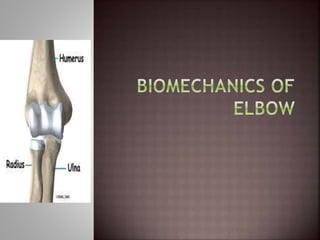
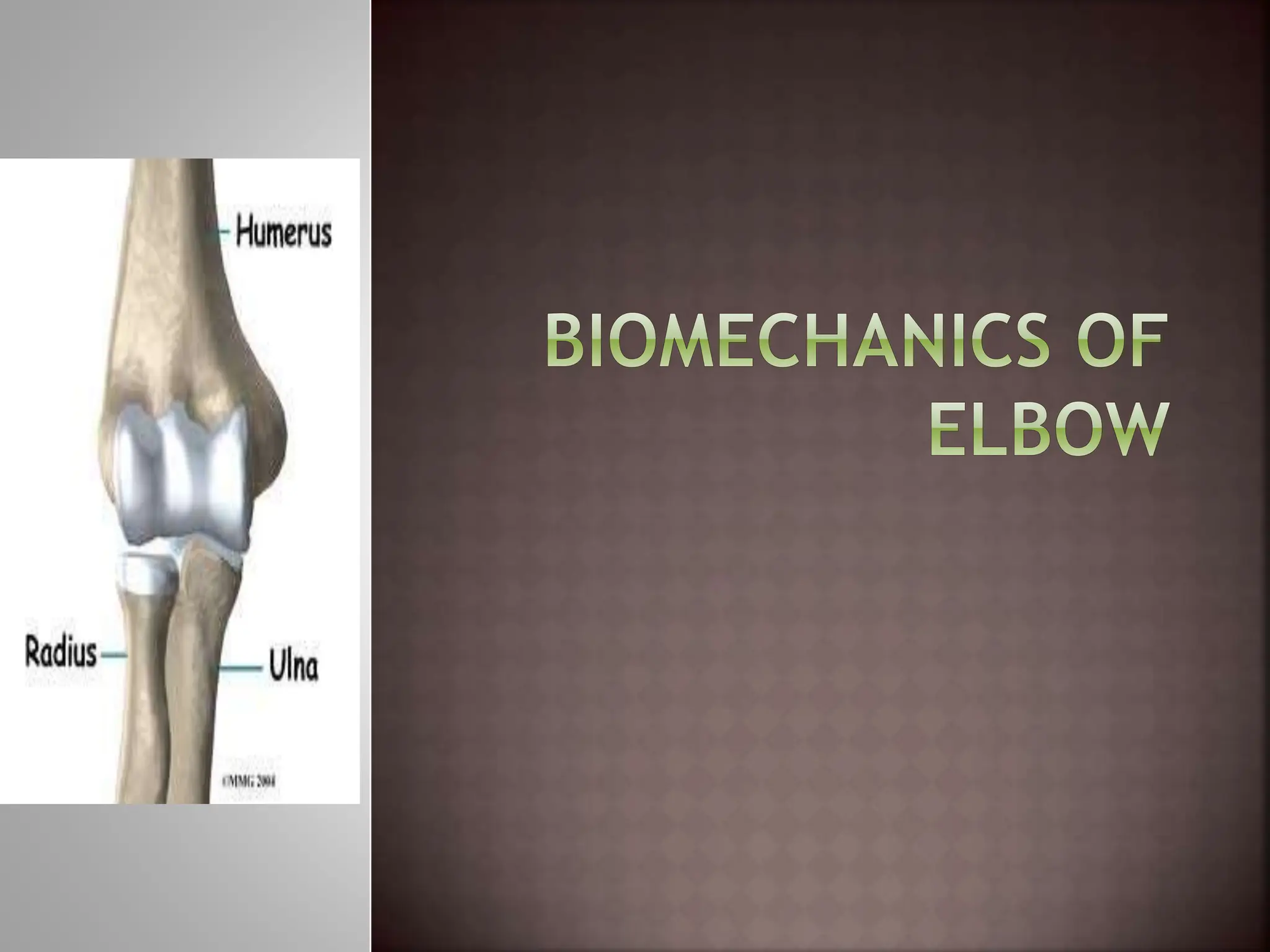
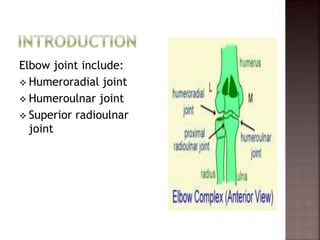
Elbow joint include:
 Humeroradial joint
 Humeroulnar joint
 Superior radioulnar
joint
HUMEROULNAR JOINT
AND
HUMERORADIAL JOINT
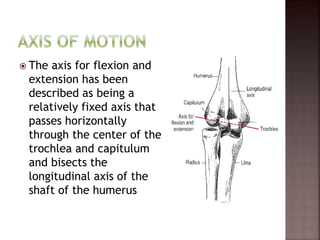
 The axis for flexion and
extension has been
described as being a
relatively fixed axis that
passes horizontally
through the center of the
trochlea and capitulum
and bisects the
longitudinal axis of the
shaft of the humerus
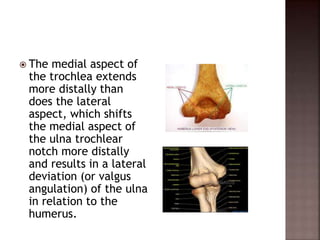
 The medial aspect of
the trochlea extends
more distally than
does the lateral
aspect, which shifts
the medial aspect of
the ulna trochlear
notch more distally
and results in a lateral
deviation (or valgus
angulation) of the ulna
in relation to the
humerus.
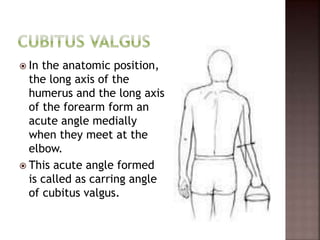
 In the anatomic position,
the long axis of the
humerus and the long axis
of the forearm form an
acute angle medially
when they meet at the
elbow.
 This acute angle formed
is called as carring angle
of cubitus valgus.
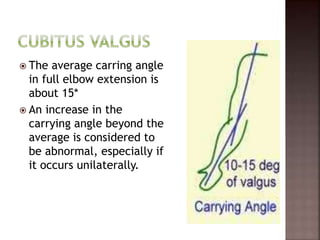
 The average carring angle
in full elbow extension is
about 15*
 An increase in the
carrying angle beyond the
average is considered to
be abnormal, especially if
it occurs unilaterally.
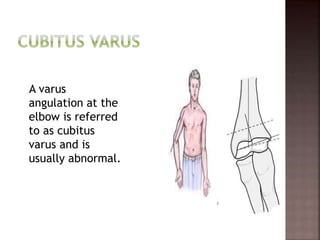
A varus
angulation at the
elbow is referred
to as cubitus
varus and is
usually abnormal.
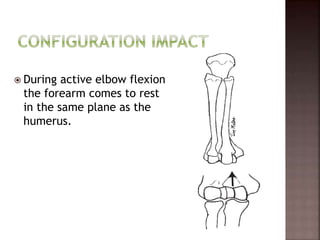
 During active elbow flexion
the forearm comes to rest
in the same plane as the
humerus.
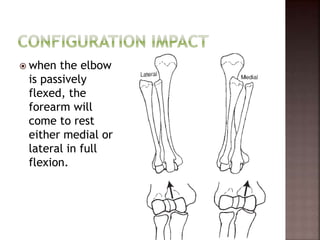
 when the elbow
is passively
flexed, the
forearm will
come to rest
either medial or
lateral in full
flexion.
 ROM of elbow joint depend upon many
factors.
 These factors include:
o the type of motion (active or passive),
o the position of the forearm (relative pronation-
supination),
o and the position of the shoulder.
 The range of active flexion at the elbow is
usually less about 135 to 145, whereas the range
for passive flexion is between 150 and 160.
 When the forearm is either in pronation or
midway between supination and pronation, the
ROM is less than it is when the forearm is
supinated.
 Two joint muscles, such as the biceps brachii and
the triceps, that cross both the shoulder and
elbow joints may limit ROM at the elbow if a full
ROM is attempted at both joints simultaneously.
 Other factors that limit the ROM but help
provide stability for the elbow are:
o the configuration of the joint surfaces,
o the ligaments,
o and joint capsule.
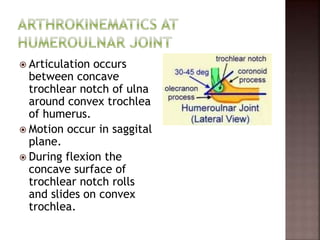
 Articulation occurs
between concave
trochlear notch of ulna
around convex trochlea
of humerus.
 Motion occur in saggital
plane.
 During flexion the
concave surface of
trochlear notch rolls
and slides on convex
trochlea.
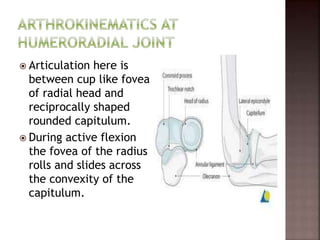
 Articulation here is
between cup like fovea
of radial head and
reciprocally shaped
rounded capitulum.
 During active flexion
the fovea of the radius
rolls and slides across
the convexity of the
capitulum.
MUSCLE ACTION
 Number of joints crossed by the muscle.
 Physiologic cross sectional area.
 Location in relation to joint.
 Position of the elbow and adjacent joints.
 Position of the forearm.
 Magnitude of the applied load.
 Types of muscle action.
 Speed of motion.
 Moment arm (MA).
 Fiber types.
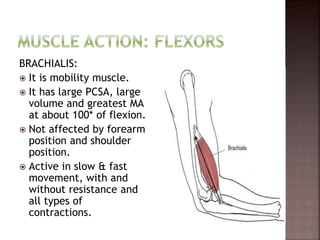
BRACHIALIS:
 It is mobility muscle.
 It has large PCSA, large
volume and greatest MA
at about 100* of flexion.
 Not affected by forearm
position and shoulder
position.
 Active in slow & fast
movement, with and
without resistance and
all types of
contractions.
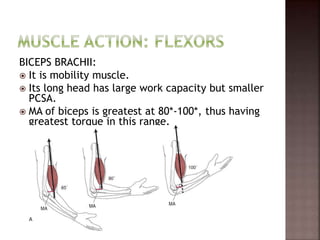
BICEPS BRACHII:
 It is mobility muscle.
 Its long head has large work capacity but smaller
PCSA.
 MA of biceps is greatest at 80*-100*, thus having
greatest torque in this range.
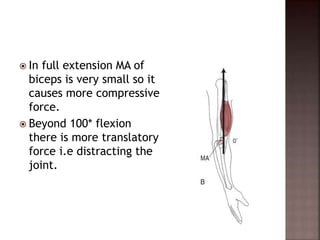
 In full extension MA of
biceps is very small so it
causes more compressive
force.
 Beyond 100* flexion
there is more translatory
force i.e distracting the
joint.
 Activity of biceps is
affected by:
o Position of shoulder.
o Position of forearm.
o Angle at the elbow.
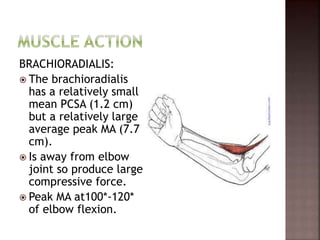
BRACHIORADIALIS:
 The brachioradialis
has a relatively small
mean PCSA (1.2 cm)
but a relatively large
average peak MA (7.7
cm).
 Is away from elbow
joint so produce large
compressive force.
 Peak MA at100*-120*
of elbow flexion.
Brachioradialis is affected by :
 Elbow angle,
 Type of contraction,
 Position of forearm
 Slow or fast contraction
 Resisted or unresisted contraction
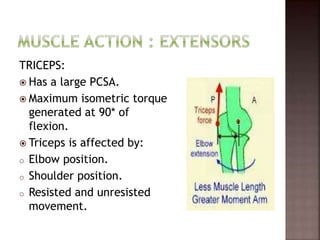
TRICEPS:
 Has a large PCSA.
 Maximum isometric torque
generated at 90* of
flexion.
 Triceps is affected by:
o Elbow position.
o Shoulder position.
o Resisted and unresisted
movement.
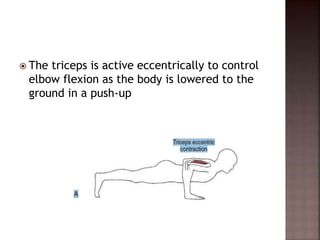
 The triceps is active eccentrically to control
elbow flexion as the body is lowered to the
ground in a push-up
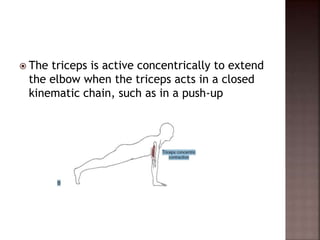
 The triceps is active concentrically to extend
the elbow when the triceps acts in a closed
kinematic chain, such as in a push-up
 Triceps also act as
stabilizer.
 The other extensor of the
elbow, the anconeus,
assists in elbow extension
and apparently also acts
as a stabilizer during
supination and pronation.
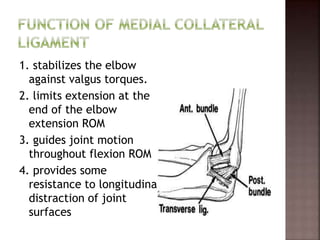
1. stabilizes the elbow
against valgus torques.
2. limits extension at the
end of the elbow
extension ROM
3. guides joint motion
throughout flexion ROM
4. provides some
resistance to longitudinal
distraction of joint
surfaces
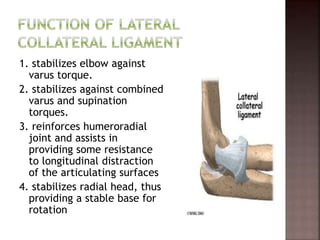
1. stabilizes elbow against
varus torque.
2. stabilizes against combined
varus and supination
torques.
3. reinforces humeroradial
joint and assists in
providing some resistance
to longitudinal distraction
of the articulating surfaces
4. stabilizes radial head, thus
providing a stable base for
rotation
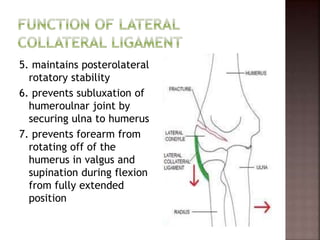
5. maintains posterolateral
rotatory stability
6. prevents subluxation of
humeroulnar joint by
securing ulna to humerus
7. prevents forearm from
rotating off of the
humerus in valgus and
supination during flexion
from fully extended
position
RADIOULNAR
JOINT
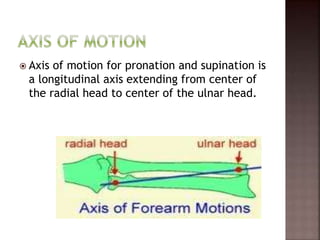
 Axis of motion for pronation and supination is
a longitudinal axis extending from center of
the radial head to center of the ulnar head.
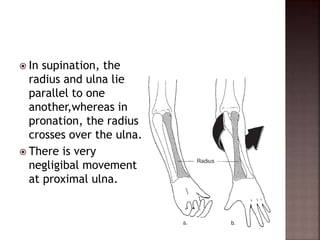
 In supination, the
radius and ulna lie
parallel to one
another,whereas in
pronation, the radius
crosses over the ulna.
 There is very
negligibal movement
at proximal ulna.
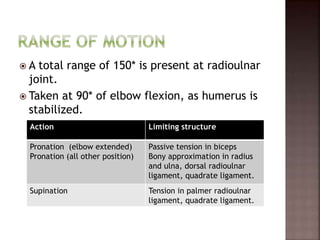
 A total range of 150* is present at radioulnar
joint.
 Taken at 90* of elbow flexion, as humerus is
stabilized.
Action Limiting structure
Pronation (elbow extended)
Pronation (all other position)
Passive tension in biceps
Bony approximation in radius
and ulna, dorsal radioulnar
ligament, quadrate ligament.
Supination Tension in palmer radioulnar
ligament, quadrate ligament.
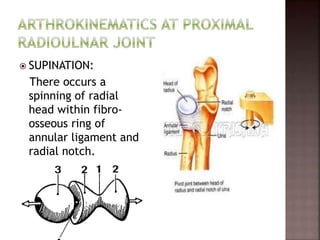
 SUPINATION:
There occurs a
spinning of radial
head within fibro-
osseous ring of
annular ligament and
radial notch.
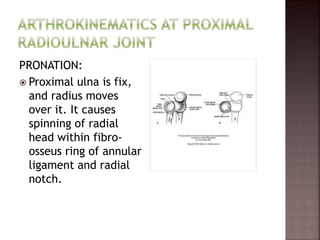
PRONATION:
 Proximal ulna is fix,
and radius moves
over it. It causes
spinning of radial
head within fibro-
osseus ring of annular
ligament and radial
notch.
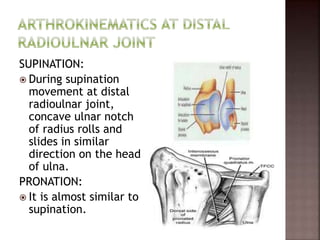
SUPINATION:
 During supination
movement at distal
radioulnar joint,
concave ulnar notch
of radius rolls and
slides in similar
direction on the head
of ulna.
PRONATION:
 It is almost similar to
supination.
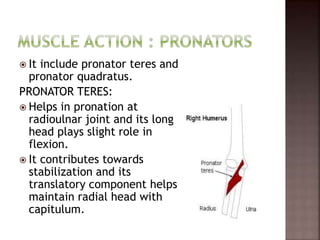
 It include pronator teres and
pronator quadratus.
PRONATOR TERES:
 Helps in pronation at
radioulnar joint and its long
head plays slight role in
flexion.
 It contributes towards
stabilization and its
translatory component helps
maintain radial head with
capitulum.
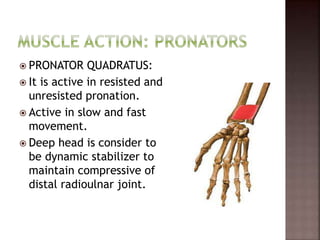
 PRONATOR QUADRATUS:
 It is active in resisted and
unresisted pronation.
 Active in slow and fast
movement.
 Deep head is consider to
be dynamic stabilizer to
maintain compressive of
distal radioulnar joint.
 Supinator torque is greatest with
forearm in pronated position and
pronation torque generation is
greatesr with forearm in supinated
position.
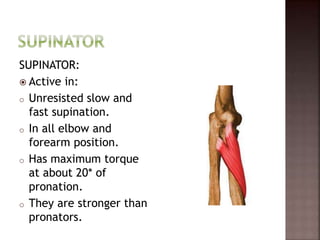
SUPINATOR:
 Active in:
o Unresisted slow and
fast supination.
o In all elbow and
forearm position.
o Has maximum torque
at about 20* of
pronation.
o They are stronger than
pronators.
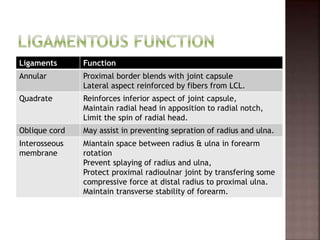
Ligaments Function
Annular Proximal border blends with joint capsule
Lateral aspect reinforced by fibers from LCL.
Quadrate Reinforces inferior aspect of joint capsule,
Maintain radial head in apposition to radial notch,
Limit the spin of radial head.
Oblique cord May assist in preventing sepration of radius and ulna.
Interosseous
membrane
Miantain space between radius & ulna in forearm
rotation
Prevent splaying of radius and ulna,
Protect proximal radioulnar joint by transfering some
compressive force at distal radius to proximal ulna.
Maintain transverse stability of forearm.
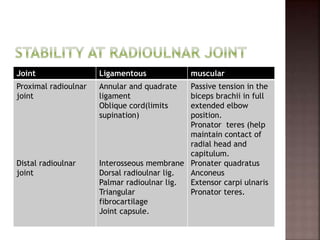
Joint Ligamentous muscular
Proximal radioulnar
joint
Distal radioulnar
joint
Annular and quadrate
ligament
Oblique cord(limits
supination)
Interosseous membrane
Dorsal radioulnar lig.
Palmar radioulnar lig.
Triangular
fibrocartilage
Joint capsule.
Passive tension in the
biceps brachii in full
extended elbow
position.
Pronator teres (help
maintain contact of
radial head and
capitulum.
Pronater quadratus
Anconeus
Extensor carpi ulnaris
Pronator teres.
 Muscles of the elbow complex are used in
almost all activities of daily living such as
dressing, eating, brushing hair, brushing
teeth, carrying, and lifting.
 They are also used in tasks such as splitting
firewood, hammering nails, and playing
tennis.
 Most of the activities of daily living require a
combination of motion at both the elbow and
radioulnar joints.
elbow biomechanics.pptx

elbow biomechanics.pptx

  • 2.
    Elbow joint include: Humeroradial joint  Humeroulnar joint  Superior radioulnar joint
  • 3.
  • 4.
     The axisfor flexion and extension has been described as being a relatively fixed axis that passes horizontally through the center of the trochlea and capitulum and bisects the longitudinal axis of the shaft of the humerus
  • 5.
     The medialaspect of the trochlea extends more distally than does the lateral aspect, which shifts the medial aspect of the ulna trochlear notch more distally and results in a lateral deviation (or valgus angulation) of the ulna in relation to the humerus.
  • 6.
     In theanatomic position, the long axis of the humerus and the long axis of the forearm form an acute angle medially when they meet at the elbow.  This acute angle formed is called as carring angle of cubitus valgus.
  • 7.
     The averagecarring angle in full elbow extension is about 15*  An increase in the carrying angle beyond the average is considered to be abnormal, especially if it occurs unilaterally.
  • 8.
    A varus angulation atthe elbow is referred to as cubitus varus and is usually abnormal.
  • 9.
     During activeelbow flexion the forearm comes to rest in the same plane as the humerus.
  • 10.
     when theelbow is passively flexed, the forearm will come to rest either medial or lateral in full flexion.
  • 11.
     ROM ofelbow joint depend upon many factors.  These factors include: o the type of motion (active or passive), o the position of the forearm (relative pronation- supination), o and the position of the shoulder.
  • 12.
     The rangeof active flexion at the elbow is usually less about 135 to 145, whereas the range for passive flexion is between 150 and 160.  When the forearm is either in pronation or midway between supination and pronation, the ROM is less than it is when the forearm is supinated.  Two joint muscles, such as the biceps brachii and the triceps, that cross both the shoulder and elbow joints may limit ROM at the elbow if a full ROM is attempted at both joints simultaneously.
  • 13.
     Other factorsthat limit the ROM but help provide stability for the elbow are: o the configuration of the joint surfaces, o the ligaments, o and joint capsule.
  • 14.
     Articulation occurs betweenconcave trochlear notch of ulna around convex trochlea of humerus.  Motion occur in saggital plane.  During flexion the concave surface of trochlear notch rolls and slides on convex trochlea.
  • 15.
     Articulation hereis between cup like fovea of radial head and reciprocally shaped rounded capitulum.  During active flexion the fovea of the radius rolls and slides across the convexity of the capitulum.
  • 16.
  • 17.
     Number ofjoints crossed by the muscle.  Physiologic cross sectional area.  Location in relation to joint.  Position of the elbow and adjacent joints.  Position of the forearm.  Magnitude of the applied load.  Types of muscle action.  Speed of motion.  Moment arm (MA).  Fiber types.
  • 18.
    BRACHIALIS:  It ismobility muscle.  It has large PCSA, large volume and greatest MA at about 100* of flexion.  Not affected by forearm position and shoulder position.  Active in slow & fast movement, with and without resistance and all types of contractions.
  • 19.
    BICEPS BRACHII:  Itis mobility muscle.  Its long head has large work capacity but smaller PCSA.  MA of biceps is greatest at 80*-100*, thus having greatest torque in this range.
  • 20.
     In fullextension MA of biceps is very small so it causes more compressive force.  Beyond 100* flexion there is more translatory force i.e distracting the joint.
  • 21.
     Activity ofbiceps is affected by: o Position of shoulder. o Position of forearm. o Angle at the elbow.
  • 22.
    BRACHIORADIALIS:  The brachioradialis hasa relatively small mean PCSA (1.2 cm) but a relatively large average peak MA (7.7 cm).  Is away from elbow joint so produce large compressive force.  Peak MA at100*-120* of elbow flexion.
  • 23.
    Brachioradialis is affectedby :  Elbow angle,  Type of contraction,  Position of forearm  Slow or fast contraction  Resisted or unresisted contraction
  • 24.
    TRICEPS:  Has alarge PCSA.  Maximum isometric torque generated at 90* of flexion.  Triceps is affected by: o Elbow position. o Shoulder position. o Resisted and unresisted movement.
  • 25.
     The tricepsis active eccentrically to control elbow flexion as the body is lowered to the ground in a push-up
  • 26.
     The tricepsis active concentrically to extend the elbow when the triceps acts in a closed kinematic chain, such as in a push-up
  • 27.
     Triceps alsoact as stabilizer.  The other extensor of the elbow, the anconeus, assists in elbow extension and apparently also acts as a stabilizer during supination and pronation.
  • 28.
    1. stabilizes theelbow against valgus torques. 2. limits extension at the end of the elbow extension ROM 3. guides joint motion throughout flexion ROM 4. provides some resistance to longitudinal distraction of joint surfaces
  • 29.
    1. stabilizes elbowagainst varus torque. 2. stabilizes against combined varus and supination torques. 3. reinforces humeroradial joint and assists in providing some resistance to longitudinal distraction of the articulating surfaces 4. stabilizes radial head, thus providing a stable base for rotation
  • 30.
    5. maintains posterolateral rotatorystability 6. prevents subluxation of humeroulnar joint by securing ulna to humerus 7. prevents forearm from rotating off of the humerus in valgus and supination during flexion from fully extended position
  • 31.
  • 32.
     Axis ofmotion for pronation and supination is a longitudinal axis extending from center of the radial head to center of the ulnar head.
  • 33.
     In supination,the radius and ulna lie parallel to one another,whereas in pronation, the radius crosses over the ulna.  There is very negligibal movement at proximal ulna.
  • 34.
     A totalrange of 150* is present at radioulnar joint.  Taken at 90* of elbow flexion, as humerus is stabilized. Action Limiting structure Pronation (elbow extended) Pronation (all other position) Passive tension in biceps Bony approximation in radius and ulna, dorsal radioulnar ligament, quadrate ligament. Supination Tension in palmer radioulnar ligament, quadrate ligament.
  • 35.
     SUPINATION: There occursa spinning of radial head within fibro- osseous ring of annular ligament and radial notch.
  • 36.
    PRONATION:  Proximal ulnais fix, and radius moves over it. It causes spinning of radial head within fibro- osseus ring of annular ligament and radial notch.
  • 37.
    SUPINATION:  During supination movementat distal radioulnar joint, concave ulnar notch of radius rolls and slides in similar direction on the head of ulna. PRONATION:  It is almost similar to supination.
  • 38.
     It includepronator teres and pronator quadratus. PRONATOR TERES:  Helps in pronation at radioulnar joint and its long head plays slight role in flexion.  It contributes towards stabilization and its translatory component helps maintain radial head with capitulum.
  • 39.
     PRONATOR QUADRATUS: It is active in resisted and unresisted pronation.  Active in slow and fast movement.  Deep head is consider to be dynamic stabilizer to maintain compressive of distal radioulnar joint.
  • 40.
     Supinator torqueis greatest with forearm in pronated position and pronation torque generation is greatesr with forearm in supinated position.
  • 41.
    SUPINATOR:  Active in: oUnresisted slow and fast supination. o In all elbow and forearm position. o Has maximum torque at about 20* of pronation. o They are stronger than pronators.
  • 42.
    Ligaments Function Annular Proximalborder blends with joint capsule Lateral aspect reinforced by fibers from LCL. Quadrate Reinforces inferior aspect of joint capsule, Maintain radial head in apposition to radial notch, Limit the spin of radial head. Oblique cord May assist in preventing sepration of radius and ulna. Interosseous membrane Miantain space between radius & ulna in forearm rotation Prevent splaying of radius and ulna, Protect proximal radioulnar joint by transfering some compressive force at distal radius to proximal ulna. Maintain transverse stability of forearm.
  • 43.
    Joint Ligamentous muscular Proximalradioulnar joint Distal radioulnar joint Annular and quadrate ligament Oblique cord(limits supination) Interosseous membrane Dorsal radioulnar lig. Palmar radioulnar lig. Triangular fibrocartilage Joint capsule. Passive tension in the biceps brachii in full extended elbow position. Pronator teres (help maintain contact of radial head and capitulum. Pronater quadratus Anconeus Extensor carpi ulnaris Pronator teres.
  • 44.
     Muscles ofthe elbow complex are used in almost all activities of daily living such as dressing, eating, brushing hair, brushing teeth, carrying, and lifting.  They are also used in tasks such as splitting firewood, hammering nails, and playing tennis.  Most of the activities of daily living require a combination of motion at both the elbow and radioulnar joints.