Reference:
MANAGERIAL
ECONOMICS AND
FINANCIAL
ANALYSIS -
A R ARYASRI
PRICE ELASTICITY OF DEMAND
 The price elasticity of demand is the percentage
change in quantity demanded divided by the
percentage change in price.
Price elasticity of demand =
Percentage change in quantity demanded
Percentage change in price
PRICE ELASTICITY OF DEMAND
/
/
P
Q Q Q P
E
P P P Q
 
  
 Point Definition
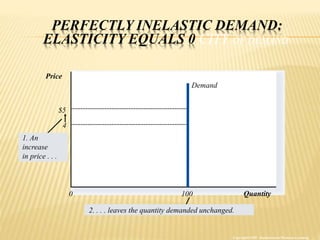
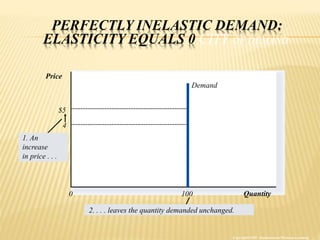
PERFECTLY INELASTIC DEMAND:
ELASTICITY EQUALS 0 CITY OF DEMAND
Copyright©2003 Southwestern/Thomson Learning
$5
4
Quantity
Demand
1000
1. An
increase
in price . . .
2. . . . leaves the quantity demanded unchanged.
Price
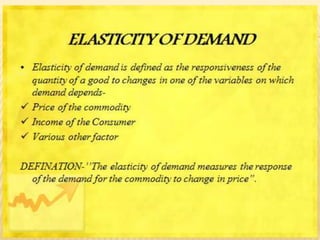
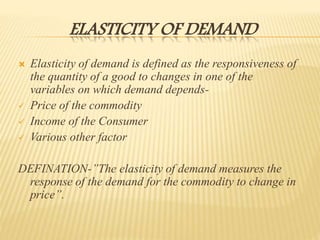
ELASTICITY OF DEMAND
 Elasticity of demand is defined as the responsiveness of
the quantity of a good to changes in one of the
variables on which demand depends-
 Price of the commodity
 Income of the Consumer
 Various other factor
DEFINATION-’’The elasticity of demand measures the
response of the demand for the commodity to change in
price”.
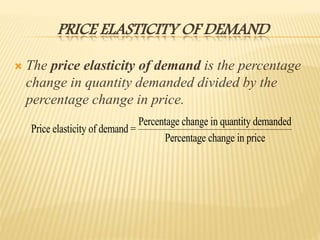
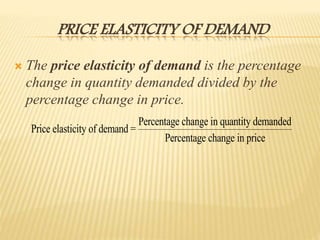
PRICE ELASTICITY OF DEMAND
 The price elasticity of demand is the percentage
change in quantity demanded divided by the
percentage change in price.
Price elasticity of demand =
Percentage change in quantity demanded
Percentage change in price
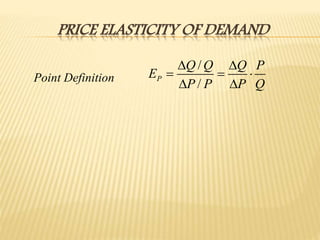
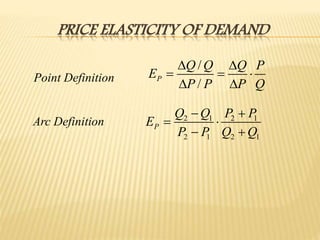
PRICE ELASTICITY OF DEMAND
/
/
P
Q Q Q P
E
P P P Q
 
  
 Point Definition
Arc Definition 2 1 2 1
2 1 2 1
P
Q Q P P
E
P P Q Q
 
 
 
PERFECTLY INELASTIC DEMAND:
ELASTICITY EQUALS 0 CITY OF DEMAND
Copyright©2003 Southwestern/Thomson Learning
$5
4
Quantity
Demand
1000
1. An
increase
in price . . .
2. . . . leaves the quantity demanded unchanged.
Price
ELASTIC DEMAND
 If Demand for a good is very sensitive to
changes in price, the demand is ELASTIC
Or
 If prices changes a little bit, demand will
change a lot!
ELASTIC DEMAND
 If Demand for a good is very sensitive to
changes in price, the demand is ELASTIC
Or
 If prices changes a little bit, demand will
change a lot!
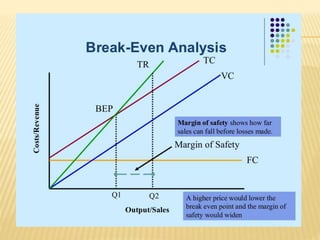
BREAK-EVEN ANALYSIS
 Cost – Volume – Profit [cvp analysis]
 Breakeven point = No profit No loss point
MAKE OR BUY DECISION
 A firm has fixed cost of Rs 10,000; selling
price per unit is Rs 5 and variable cost per
unit is
Rs 3
 Determine the following:
 1. BEP in terms of volume and also sales
value.
 2. Calculate the margin of safety
considering that the actual production is
8,000 units.
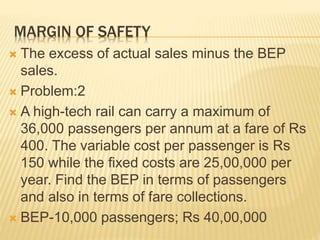
MARGIN OF SAFETY
 The excess of actual sales minus the BEP
sales.
 Problem:2
 A high-tech rail can carry a maximum of
36,000 passengers per annum at a fare of Rs
400. The variable cost per passenger is Rs
150 while the fixed costs are 25,00,000 per
year. Find the BEP in terms of passengers
and also in terms of fare collections.
 BEP-10,000 passengers; Rs 40,00,000
What is Production?
What do you mean by Factors of
Production?
laissez-faire
Abstention by governments from interfering
in
the workings of the free market.
LAW OF DEMAND
 Other things remaining the same, the amount of
quanity demanded rises with every fall in the price
and vice versa.
 As the price of a good rises, quantity demanded of
that good falls.
 As the price of a good falls, quantity demanded of
that good rises.
Ceteris paribus means other things
remaining the same.
LAW OF DEMAND
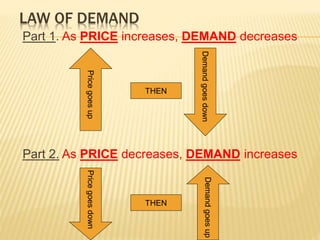
Part 1. As PRICE increases, DEMAND decreases
Part 2. As PRICE decreases, DEMAND increases
Pricegoesup
DemandgoesdownDemandgoesup
Pricegoesdown
THEN
THEN
EXCEPTIONS TO THE LAW OF DEMAND
 1. Giffen paradox:
 The Giffen good or inferior good is an
exception to the law of demand. When the
price of an inferior good falls, the poor will buy
less and vice versa. For example, when the
price of maize falls, the poor are willing to
spend more on superior goods than on maize
if the price of maize increases, he has to
increase the quantity of money spent on it.
Otherwise he will have to face starvation.
Thus a fall in price is followed by reduction in
quantity demanded and vice versa. “Giffen”
first explained this and therefore it is called as
Giffen’s paradox.
GIFFEN & VEBLEN GOODS
 Veblen goods
 ‘Veblen’ has explained the exceptional
demand curve through his doctrine of
conspicuous
 consumption. Rich people buy certain
good because it gives social distinction or
prestige
 for example diamonds are bought by the
richer class for the prestige it possess. It
the
 price of diamonds falls poor also will buy
is hence they will not give prestige.
Therefore,
EXCEPTIONS TO THE LAW OF DEMAND
 Ignorance:
 Sometimes, the quality of the commodity is
Judge by its price. Consumers think that the
 product is superior if the price is high. As
such they buy more at a higher price.
EXCEPTIONS TO THE LAW OF DEMAND
 4. Speculative effect:
 If the price of the commodity is increasing the
consumers will buy more of it because of
 the fear that it increase still further, Thus, an
increase in price may not be accomplished
 by a decrease in demand.
EXCEPTIONS TO THE LAW OF DEMAND
 Fear of shortage:
 During the times of emergency of war People
may expect shortage of a commodity. At
 that time, they may buy more at a higher
price to keep stocks for the future.
EXCEPTIONS TO THE LAW OF DEMAND
 Necessaries:
 In the case of necessaries like rice,
vegetables etc. people buy more even at a
higher price.
FACTORS AFFECTING DEMAND:
 There are factors on which the demand for a commodity
depends. These factors are economic, social as well as
political factors. The effect of all the factors on the
amount demanded for the commodity is called Demand
Function.
 These factors are as follows:
 1. Price of the Commodity:
 The most important factor-affecting amount demanded is
the price of the commodity. The amount of a commodity
demanded at a particular price is more properly called
price
 demand. The relation between price and demand is called
the Law of Demand. It is not only the existing price but
also the expected changes in price, which affect demand.
FACTORS AFFECTING DEMAND:
 2. Income of the Consumer:
 The second most important factor influencing
demand is consumer income. In fact, we can
establish a relation between the consumer
income and the demand at different levels of
income, price and other things remaining the
same. The demand for a normal commodity
goes up when income rises and falls down when
income falls. But in case of Giffen goods the
relationship is the opposite.
FACTORS AFFECTING DEMAND:
 Prices of related goods:
 The demand for a commodity is also affected by the changes in
prices of the related goods also. Related goods can be of two
types:
 (i). Substitutes which can replace each other in use; for
example, tea and coffee are substitutes. The change in price of a
substitute has effect on a commodity’s demand in the same
direction in which price changes. The rise in price of coffee shall
raise the demand for tea;
 (ii). Complementary foods are those which are jointly
demanded, such as pen and ink. In such cases complementary
goods have opposite relationship between price of one
commodity and the amount demanded for the other. If the price of
pens goes up, their demand is less as a result of which the
demand for ink is also less. The price and demand go in opposite
direction. The effect of changes in price of a commodity on
FACTORS AFFECTING DEMAND:
 4. Tastes of the Consumers:
 The amount demanded also depends on
consumer’s taste. Tastes include fashion,
habit,
 customs, etc. A consumer’s taste is also
affected by advertisement. If the taste for a
 commodity goes up, its amount demanded is
more even at the same price. This is called
 increase in demand. The opposite is called
decrease in demand.
FACTORS AFFECTING DEMAND:
 Wealth:
 The amount demanded of commodity is also
affected by the amount of wealth as well as
 its distribution. The wealthier are the people;
higher is the demand for normal
 commodities. If wealth is more equally
distributed, the demand for necessaries and
 comforts is more. On the other hand, if some
people are rich, while the majorities are
 poor, the demand for luxuries is generally
higher.
FACTORS AFFECTING DEMAND:
 Population:
 Increase in population increases
demand for necessaries of life. The
composition of
 population also affects demand.
Composition of population means the
proportion of young
 and old and children as well as the ratio
of men to women. A change in
composition of
FACTORS AFFECTING DEMAND:
Government Policy:
Government policy affects the
demands for
commodities through taxation. Taxing
a
commodity increases its price and the
Demand goes down. Similarly,
financial help
from the government increases the
FACTORS AFFECTING DEMAND:
Expectations regarding the future:
If consumers expect changes in price of
commodity in future, they will change the
demand at present even when the present
price
remains the same. Similarly, if consumers
Expect their incomes to rise in the near
future
they may increase the demand for a
FACTORS AFFECTING DEMAND:
Climate and weather:
The climate of an area and the
weather
prevailing there has a decisive effect
on
consumer’s demand. In cold areas
woolen cloth is demanded. During
hot
FACTORS AFFECTING DEMAND:
 State of business:
 The level of demand for different
commodities also depends upon the
business conditions
 in the country. If the country is passing
through boom conditions, there will be a
marked
 increase in demand.
 On the other hand, the level of demand
goes down during depression.

Elasticity of demand

  • 1.
  • 3.
    PRICE ELASTICITY OFDEMAND  The price elasticity of demand is the percentage change in quantity demanded divided by the percentage change in price. Price elasticity of demand = Percentage change in quantity demanded Percentage change in price
  • 4.
    PRICE ELASTICITY OFDEMAND / / P Q Q Q P E P P P Q       Point Definition
  • 5.
    PERFECTLY INELASTIC DEMAND: ELASTICITYEQUALS 0 CITY OF DEMAND Copyright©2003 Southwestern/Thomson Learning $5 4 Quantity Demand 1000 1. An increase in price . . . 2. . . . leaves the quantity demanded unchanged. Price
  • 6.
    ELASTICITY OF DEMAND Elasticity of demand is defined as the responsiveness of the quantity of a good to changes in one of the variables on which demand depends-  Price of the commodity  Income of the Consumer  Various other factor DEFINATION-’’The elasticity of demand measures the response of the demand for the commodity to change in price”.
  • 7.
    PRICE ELASTICITY OFDEMAND  The price elasticity of demand is the percentage change in quantity demanded divided by the percentage change in price. Price elasticity of demand = Percentage change in quantity demanded Percentage change in price
  • 8.
    PRICE ELASTICITY OFDEMAND / / P Q Q Q P E P P P Q       Point Definition Arc Definition 2 1 2 1 2 1 2 1 P Q Q P P E P P Q Q      
  • 9.
    PERFECTLY INELASTIC DEMAND: ELASTICITYEQUALS 0 CITY OF DEMAND Copyright©2003 Southwestern/Thomson Learning $5 4 Quantity Demand 1000 1. An increase in price . . . 2. . . . leaves the quantity demanded unchanged. Price
  • 10.
    ELASTIC DEMAND  IfDemand for a good is very sensitive to changes in price, the demand is ELASTIC Or  If prices changes a little bit, demand will change a lot!
  • 11.
    ELASTIC DEMAND  IfDemand for a good is very sensitive to changes in price, the demand is ELASTIC Or  If prices changes a little bit, demand will change a lot!
  • 12.
    BREAK-EVEN ANALYSIS  Cost– Volume – Profit [cvp analysis]  Breakeven point = No profit No loss point
  • 13.
    MAKE OR BUYDECISION  A firm has fixed cost of Rs 10,000; selling price per unit is Rs 5 and variable cost per unit is Rs 3  Determine the following:  1. BEP in terms of volume and also sales value.  2. Calculate the margin of safety considering that the actual production is 8,000 units.
  • 14.
    MARGIN OF SAFETY The excess of actual sales minus the BEP sales.  Problem:2  A high-tech rail can carry a maximum of 36,000 passengers per annum at a fare of Rs 400. The variable cost per passenger is Rs 150 while the fixed costs are 25,00,000 per year. Find the BEP in terms of passengers and also in terms of fare collections.  BEP-10,000 passengers; Rs 40,00,000
  • 16.
    What is Production? Whatdo you mean by Factors of Production? laissez-faire Abstention by governments from interfering in the workings of the free market.
  • 17.
    LAW OF DEMAND Other things remaining the same, the amount of quanity demanded rises with every fall in the price and vice versa.  As the price of a good rises, quantity demanded of that good falls.  As the price of a good falls, quantity demanded of that good rises. Ceteris paribus means other things remaining the same.
  • 18.
    LAW OF DEMAND Part1. As PRICE increases, DEMAND decreases Part 2. As PRICE decreases, DEMAND increases Pricegoesup DemandgoesdownDemandgoesup Pricegoesdown THEN THEN
  • 19.
    EXCEPTIONS TO THELAW OF DEMAND  1. Giffen paradox:  The Giffen good or inferior good is an exception to the law of demand. When the price of an inferior good falls, the poor will buy less and vice versa. For example, when the price of maize falls, the poor are willing to spend more on superior goods than on maize if the price of maize increases, he has to increase the quantity of money spent on it. Otherwise he will have to face starvation. Thus a fall in price is followed by reduction in quantity demanded and vice versa. “Giffen” first explained this and therefore it is called as Giffen’s paradox.
  • 20.
    GIFFEN & VEBLENGOODS  Veblen goods  ‘Veblen’ has explained the exceptional demand curve through his doctrine of conspicuous  consumption. Rich people buy certain good because it gives social distinction or prestige  for example diamonds are bought by the richer class for the prestige it possess. It the  price of diamonds falls poor also will buy is hence they will not give prestige. Therefore,
  • 21.
    EXCEPTIONS TO THELAW OF DEMAND  Ignorance:  Sometimes, the quality of the commodity is Judge by its price. Consumers think that the  product is superior if the price is high. As such they buy more at a higher price.
  • 22.
    EXCEPTIONS TO THELAW OF DEMAND  4. Speculative effect:  If the price of the commodity is increasing the consumers will buy more of it because of  the fear that it increase still further, Thus, an increase in price may not be accomplished  by a decrease in demand.
  • 23.
    EXCEPTIONS TO THELAW OF DEMAND  Fear of shortage:  During the times of emergency of war People may expect shortage of a commodity. At  that time, they may buy more at a higher price to keep stocks for the future.
  • 24.
    EXCEPTIONS TO THELAW OF DEMAND  Necessaries:  In the case of necessaries like rice, vegetables etc. people buy more even at a higher price.
  • 25.
    FACTORS AFFECTING DEMAND: There are factors on which the demand for a commodity depends. These factors are economic, social as well as political factors. The effect of all the factors on the amount demanded for the commodity is called Demand Function.  These factors are as follows:  1. Price of the Commodity:  The most important factor-affecting amount demanded is the price of the commodity. The amount of a commodity demanded at a particular price is more properly called price  demand. The relation between price and demand is called the Law of Demand. It is not only the existing price but also the expected changes in price, which affect demand.
  • 26.
    FACTORS AFFECTING DEMAND: 2. Income of the Consumer:  The second most important factor influencing demand is consumer income. In fact, we can establish a relation between the consumer income and the demand at different levels of income, price and other things remaining the same. The demand for a normal commodity goes up when income rises and falls down when income falls. But in case of Giffen goods the relationship is the opposite.
  • 27.
    FACTORS AFFECTING DEMAND: Prices of related goods:  The demand for a commodity is also affected by the changes in prices of the related goods also. Related goods can be of two types:  (i). Substitutes which can replace each other in use; for example, tea and coffee are substitutes. The change in price of a substitute has effect on a commodity’s demand in the same direction in which price changes. The rise in price of coffee shall raise the demand for tea;  (ii). Complementary foods are those which are jointly demanded, such as pen and ink. In such cases complementary goods have opposite relationship between price of one commodity and the amount demanded for the other. If the price of pens goes up, their demand is less as a result of which the demand for ink is also less. The price and demand go in opposite direction. The effect of changes in price of a commodity on
  • 28.
    FACTORS AFFECTING DEMAND: 4. Tastes of the Consumers:  The amount demanded also depends on consumer’s taste. Tastes include fashion, habit,  customs, etc. A consumer’s taste is also affected by advertisement. If the taste for a  commodity goes up, its amount demanded is more even at the same price. This is called  increase in demand. The opposite is called decrease in demand.
  • 29.
    FACTORS AFFECTING DEMAND: Wealth:  The amount demanded of commodity is also affected by the amount of wealth as well as  its distribution. The wealthier are the people; higher is the demand for normal  commodities. If wealth is more equally distributed, the demand for necessaries and  comforts is more. On the other hand, if some people are rich, while the majorities are  poor, the demand for luxuries is generally higher.
  • 30.
    FACTORS AFFECTING DEMAND: Population:  Increase in population increases demand for necessaries of life. The composition of  population also affects demand. Composition of population means the proportion of young  and old and children as well as the ratio of men to women. A change in composition of
  • 31.
    FACTORS AFFECTING DEMAND: GovernmentPolicy: Government policy affects the demands for commodities through taxation. Taxing a commodity increases its price and the Demand goes down. Similarly, financial help from the government increases the
  • 32.
    FACTORS AFFECTING DEMAND: Expectationsregarding the future: If consumers expect changes in price of commodity in future, they will change the demand at present even when the present price remains the same. Similarly, if consumers Expect their incomes to rise in the near future they may increase the demand for a
  • 33.
    FACTORS AFFECTING DEMAND: Climateand weather: The climate of an area and the weather prevailing there has a decisive effect on consumer’s demand. In cold areas woolen cloth is demanded. During hot
  • 34.
    FACTORS AFFECTING DEMAND: State of business:  The level of demand for different commodities also depends upon the business conditions  in the country. If the country is passing through boom conditions, there will be a marked  increase in demand.  On the other hand, the level of demand goes down during depression.

Editor's Notes