Elasticity of Demand
Understanding How Demand
Responds to Economic Changes
Presented by ChatGPT
Introduction to Elasticity
• Elasticity of demand measures how quantity
demanded changes in response to changes in
price or other factors.
• Key types: Price Elasticity, Income Elasticity,
and Cross Elasticity.
Types of Elasticity of Demand
• 1. Price Elasticity of Demand (PED)
• 2. Income Elasticity of Demand (YED)
• 3. Cross Elasticity of Demand (XED)
Price Elasticity of Demand (PED)
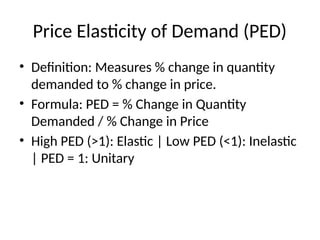
• Definition: Measures % change in quantity
demanded to % change in price.
• Formula: PED = % Change in Quantity
Demanded / % Change in Price
• High PED (>1): Elastic | Low PED (<1): Inelastic
| PED = 1: Unitary
Graphical Representation of PED
• Perfectly Elastic: Horizontal demand curve
• Perfectly Inelastic: Vertical demand curve
• Normal Elastic: Downward sloping curve with
varying slope
Determinants of PED
• 1. Availability of substitutes
• 2. Necessity vs. luxury
• 3. Proportion of income spent
• 4. Time period considered
Income Elasticity of Demand (YED)
• Measures how quantity demanded changes
with income changes.
• YED > 0: Normal goods | YED < 0: Inferior
goods
• Helps in understanding consumer behavior
with rising income.
Cross Elasticity of Demand (XED)
• Measures how demand of one good changes
with the price of another.
• XED > 0: Substitutes | XED < 0: Complements
• Example: Tea and Coffee (substitutes), Pen and
Ink (complements)
Applications of Elasticity
• 1. Business pricing strategies
• 2. Government taxation policy
• 3. Revenue estimation
• 4. Forecasting market reactions
Summary
• Elasticity helps understand consumer
sensitivity to economic changes.
• Useful for pricing, policymaking, and strategic
decisions.
• Includes PED, YED, and XED for different
economic analyses.
Any Questions?
• Feel free to ask for clarifications or examples
on any topic.
Thank You!
• Presentation by ChatGPT.
• We hope you now have a better
understanding of Elasticity of Demand.

demand and their types and Elasticity_of_Demand_Presentation.pptx

  • 1.
    Elasticity of Demand UnderstandingHow Demand Responds to Economic Changes Presented by ChatGPT
  • 2.
    Introduction to Elasticity •Elasticity of demand measures how quantity demanded changes in response to changes in price or other factors. • Key types: Price Elasticity, Income Elasticity, and Cross Elasticity.
  • 3.
    Types of Elasticityof Demand • 1. Price Elasticity of Demand (PED) • 2. Income Elasticity of Demand (YED) • 3. Cross Elasticity of Demand (XED)
  • 4.
    Price Elasticity ofDemand (PED) • Definition: Measures % change in quantity demanded to % change in price. • Formula: PED = % Change in Quantity Demanded / % Change in Price • High PED (>1): Elastic | Low PED (<1): Inelastic | PED = 1: Unitary
  • 5.
    Graphical Representation ofPED • Perfectly Elastic: Horizontal demand curve • Perfectly Inelastic: Vertical demand curve • Normal Elastic: Downward sloping curve with varying slope
  • 6.
    Determinants of PED •1. Availability of substitutes • 2. Necessity vs. luxury • 3. Proportion of income spent • 4. Time period considered
  • 7.
    Income Elasticity ofDemand (YED) • Measures how quantity demanded changes with income changes. • YED > 0: Normal goods | YED < 0: Inferior goods • Helps in understanding consumer behavior with rising income.
  • 8.
    Cross Elasticity ofDemand (XED) • Measures how demand of one good changes with the price of another. • XED > 0: Substitutes | XED < 0: Complements • Example: Tea and Coffee (substitutes), Pen and Ink (complements)
  • 9.
    Applications of Elasticity •1. Business pricing strategies • 2. Government taxation policy • 3. Revenue estimation • 4. Forecasting market reactions
  • 10.
    Summary • Elasticity helpsunderstand consumer sensitivity to economic changes. • Useful for pricing, policymaking, and strategic decisions. • Includes PED, YED, and XED for different economic analyses.

  • 11.
    Any Questions? • Feelfree to ask for clarifications or examples on any topic.
  • 12.
    Thank You! • Presentationby ChatGPT. • We hope you now have a better understanding of Elasticity of Demand.