Unit 6: External Influences on business
activity
6.1 Chapter 24 Government
economic objectives and
policies
 The impact of business activity on
society
All business activity has benefits
and undesirable effects on society.
These reasons are why governments
want to have some control over
business activity:
 Possible benefits:
 Production of useful goods to satisfy customer wants.
 Create employment/increases workers living standards.
 Introduction of new products or processes that reduces costs and widen
product range.
 Taxes help finance public services.
 Business earn foreign currency in exports and this could be spent on imports.
 Possible undesirable effects:
 Business might ruin cheap but beautiful areas.
 Low wages and unsafe working conditions for workers because businesses
want to lower costs.
 Pollution
 Production of dangerous goods.
 Monopolies
 Advertising can mislead customers.
 Governments tend to pass laws that restrict undesirable activities while
supporting desirable activities.
 Governments and the economy
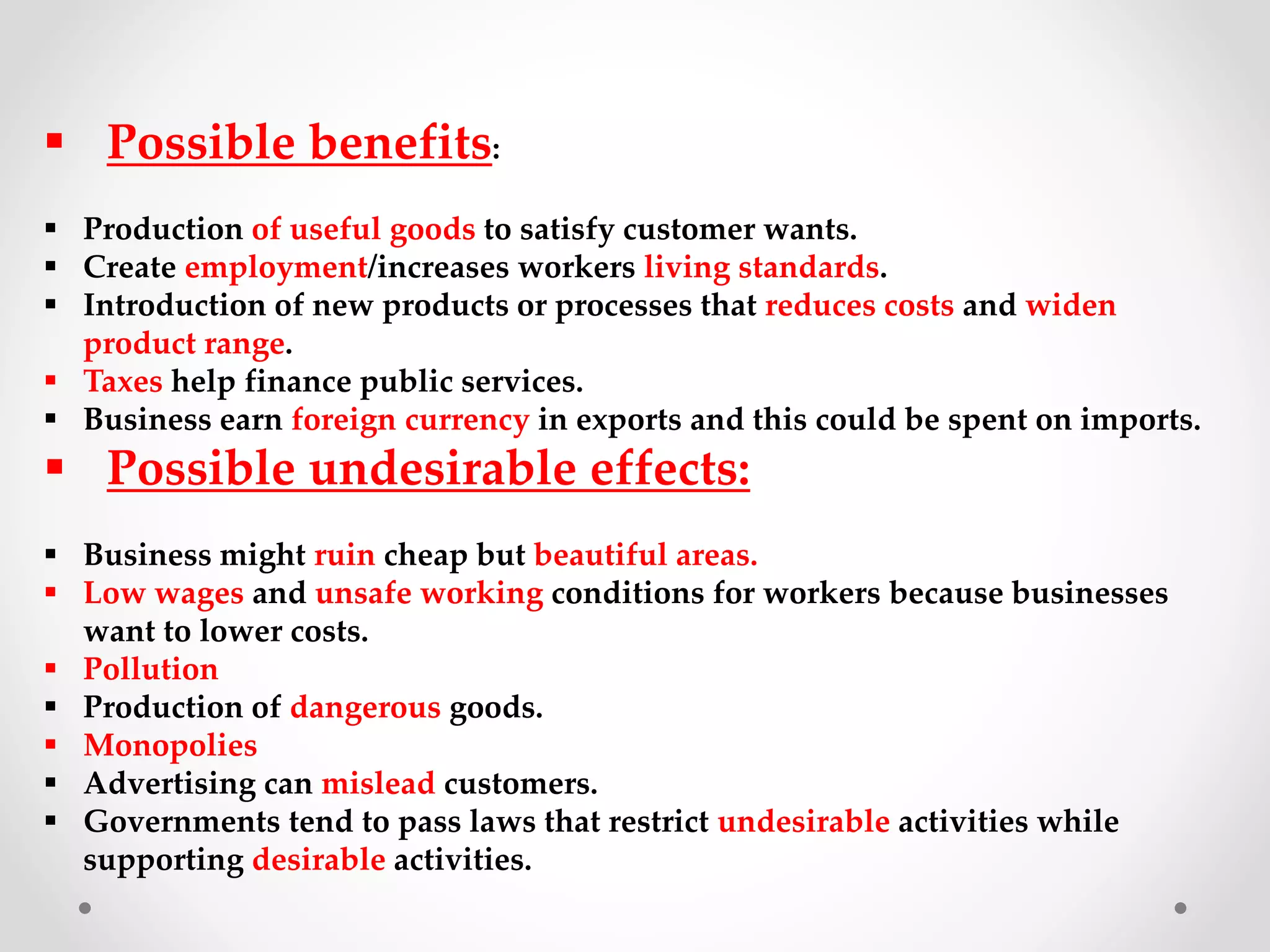
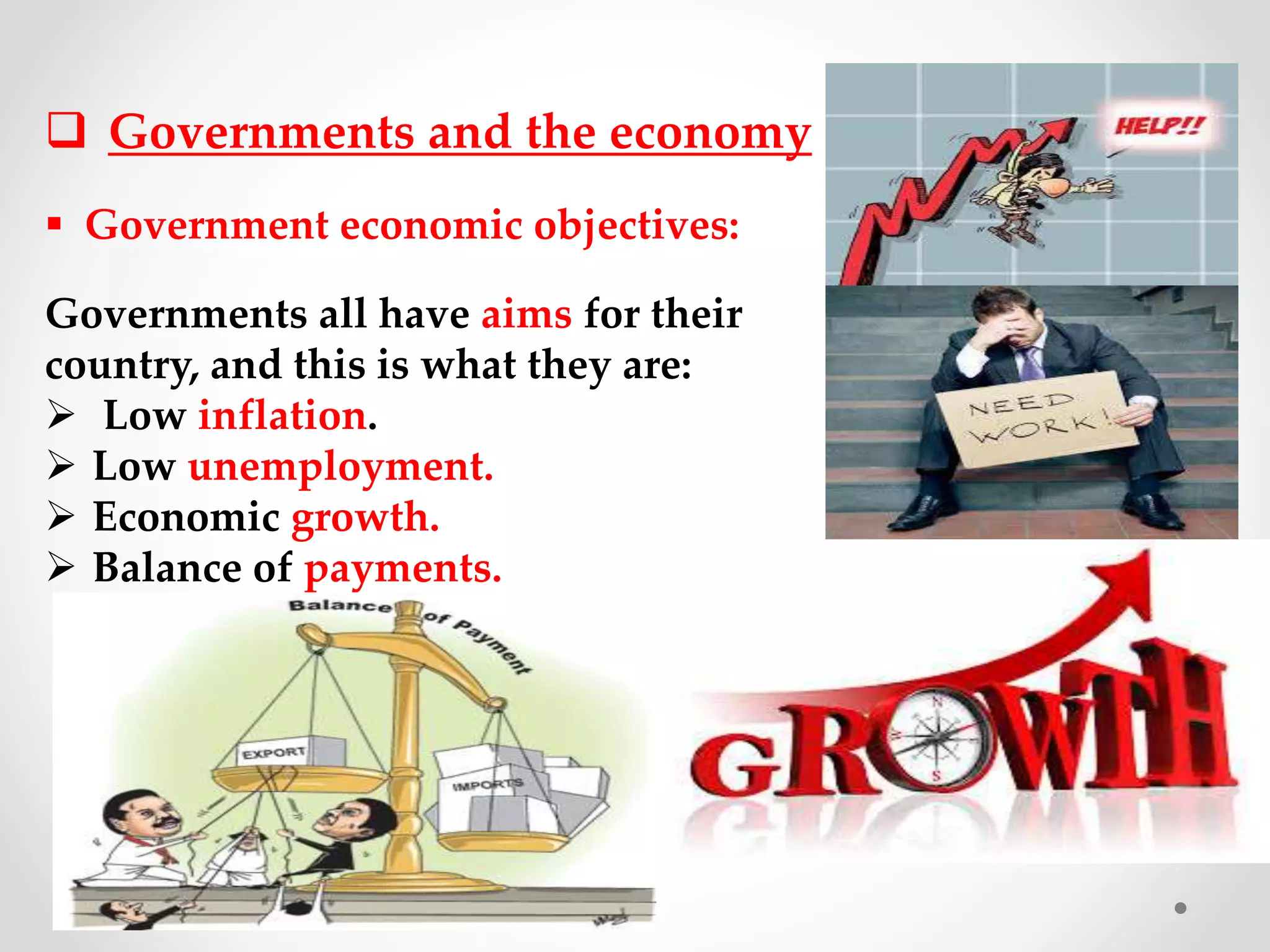
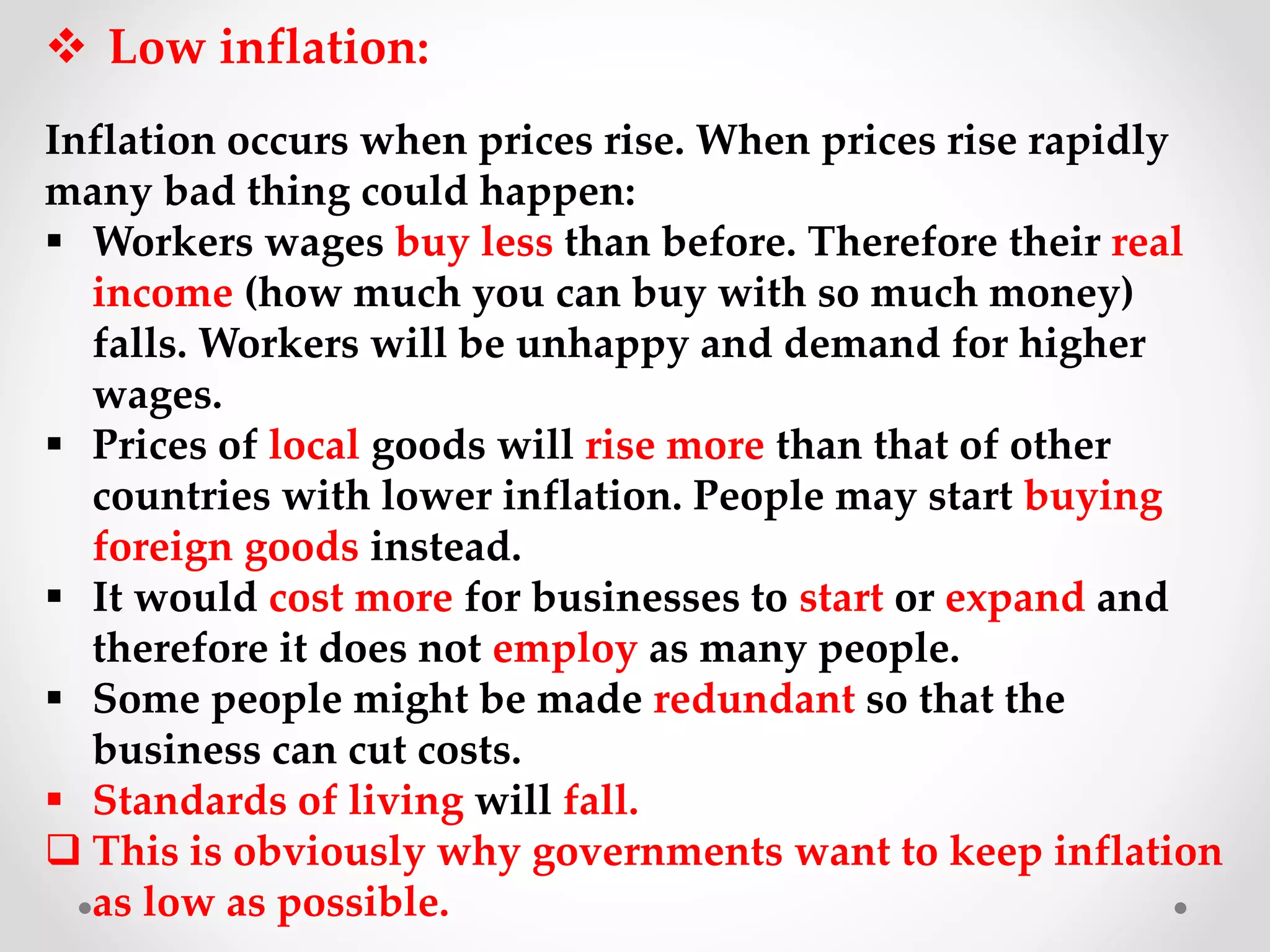
 Government economic objectives:
Governments all have aims for their
country, and this is what they are:
 Low inflation.
 Low unemployment.
 Economic growth.
 Balance of payments.
 Low inflation:
Inflation occurs when prices rise. When prices rise rapidly
many bad thing could happen:
 Workers wages buy less than before. Therefore their real
income (how much you can buy with so much money)
falls. Workers will be unhappy and demand for higher
wages.
 Prices of local goods will rise more than that of other
countries with lower inflation. People may start buying
foreign goods instead.
 It would cost more for businesses to start or expand and
therefore it does not employ as many people.
 Some people might be made redundant so that the
business can cut costs.
 Standards of living will fall.
 This is obviously why governments want to keep inflation
as low as possible.
 Low levels of unemployment:
When people are unemployed, they want to work
but cannot find a job. This causes many problems:
 Unemployed people do not work. Therefore
national output will be lower than it should be.
 The government will have to pay for
unemployment benefits. This is expensive and
money cannot be use for other purposes.
 If the level up unemployment is low, it will
increase national output and improve standards
of living for workers.
 Economic growth
A country is said to grow when its GDP (Gross Domestic
Product) is increasing. This is the total value of goods
produced in one year. The standards of living tends to
increase with economic growth. Problems arise when a
country's GDP fall:
 The country's output is falling, fewer workers are needed
and unemployment occurs.
 Standards of living will fall.
 Businesses will not expand because they have less money
to invest.
 Economic growth is not achieved every year.
There are years where the GDP falls and the
trade cycle explains the pattern of rises and falls
in national GDP.
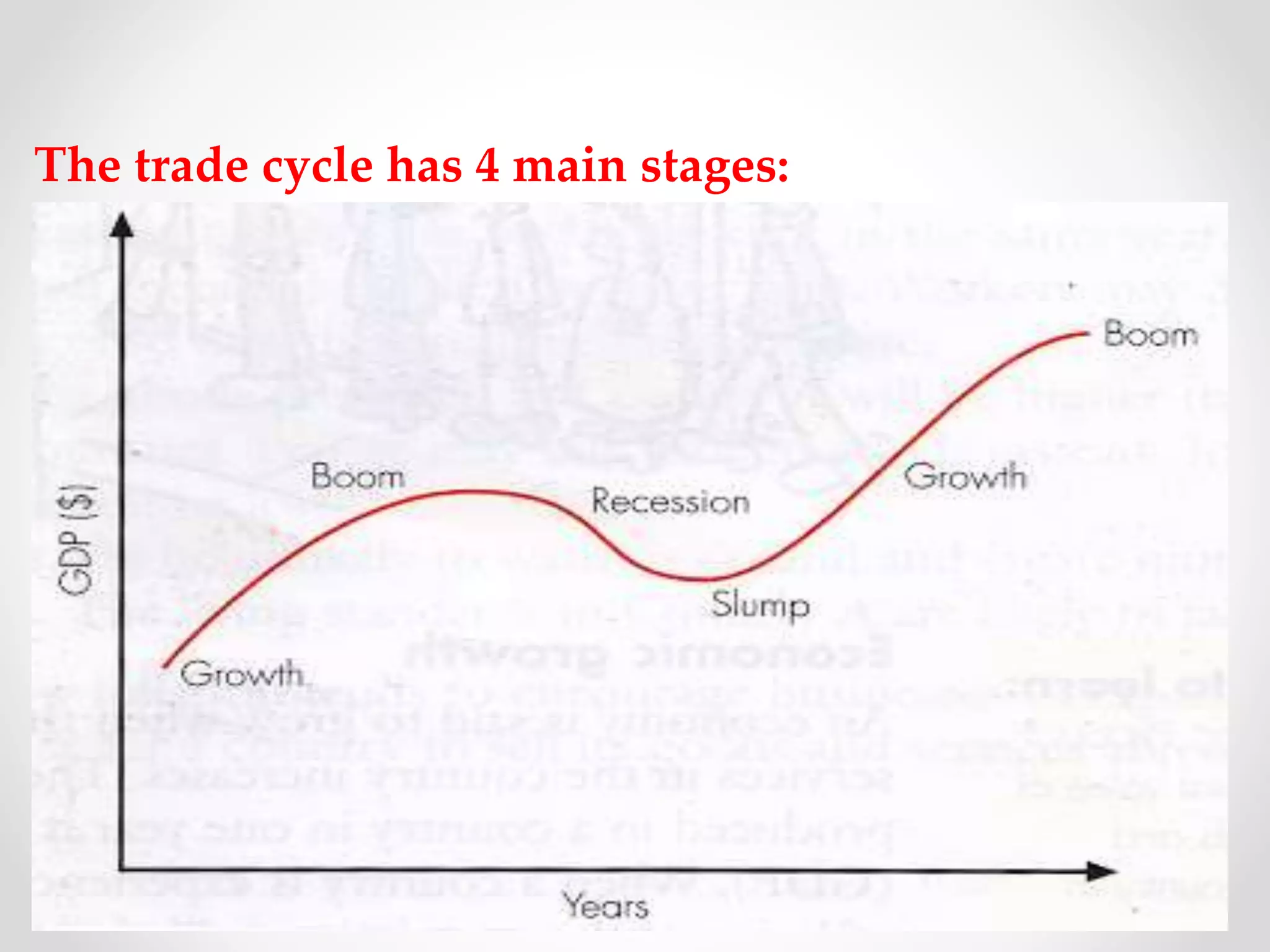
The trade cycle has 4 main stages:
 The trade cycle has 4 main stages:
 Growth: This is when GDP is rising, unemployment is falling, and the
country has higher standards of living. Businesses tend to do well in
this period.
 Boom: Caused by overspending. Prices rise rapidly and there is a
shortage of skilled workers. Business costs will be rising and they are
uncertain about the future.
 Recession: Because overspending caused the boom, people now spend
too little. GDP will fall and businesses will lose demand and profits.
Workers may lose their jobs.
 Slump: A long drawn out recession. Unemployment will peak and
prices will fall. Many firms will go out of business.
 After all of this happens the economy recovers and begins
to grow again. Governments want to avoid a boom so that
it will not lead to a recession and a slump. Currently, the
government of China is spending a lot of money so that
their economy would continue to grow and avoid a boom.
 Balance of payments (BOP)
Exports earn foreign currency, while imports are paid for by
foreign currency (or vice versa). The difference between the
value of exports and imports of a country is called balance of
payments. Governments try to achieve a balance in imports
and exports to avoid a trade deficit, when exports are higher
than imports. Of course, the government will lose money
and their reservoir of foreign currency will fall. This results
in:
 If the country wants to import more, they will have to
borrow foreign currency to buy goods.
 The country's currency will now worth less compared to
others and can buy less goods. This is called exchange rate
depreciation.
 Government economic policies
Governments want to influence the national
economy so that it would achieve their
aforementioned objectives. They have a lot of
power over business activity and can pass laws to
try to achieve their goals. The main ways in which
governments can influence business activity are
called economic policies.
They are:
 Fiscal Policy: taxes and public spending.
 Monetary policy: controlling the amount of
money in the economy through interest rates.
 Supply side policies: aimed at increasing
efficiency.
 Fiscal policy
Government spending could benefit some firms such as:
 Construction firms (road building)
 Defense industries (Afghan war)
 Bus manufacturers (public transport)
Governments raise money from taxes. There are Direct taxes
on income and Indirect taxes on spending.
There are four common taxes:
 Income tax
 Profits tax
 VAT (Value Added Tax)
 Import tariffs
Income tax
Income tax is based on a percentage of your income. Income
tax is usually progressive, meaning that the percentage of tax
you have to pay rises with your income. Effects on business
and individuals if there was a rise of income tax:
 People will have less disposable income.
 Sales fall because people have less money to spend.
 Managers will cut costs for more profit. Workers might be
made redundant.
 Businesses producing luxury goods will lose the most,
while others producing everyday needs will get less
affected.
 Profits tax or corporation tax
This is a percentage of the profit a business makes.
A rise in it would mean:
 Managers will have less retained profit, making it
harder for the business to expand.
 Owners will get less return on capital employed.
Potential owners will be reluctant to start their
own business if the profit margin is too low.
 Indirect taxes
These taxes are a percentage on the price of goods,
making them more expensive. Governments want to
avoid putting them on essential goods such as
foods. A rise it would mean:
 The effect would be almost the same as that of an
increase in income tax. People would buy less but
they would still spend money on essential goods.
 Again, real incomes fall. Costs will rise when
workers demand higher wages.
 Import tariffs and quotas
Governments put tariffs on imports to make local
goods look more competitive and also to reduce
imports. When governments put import tariffs on
imports:
 Sales of local goods become cheaper than
imports, leading to increased sales.
 Businesses who import raw materials will suffer
higher costs.
 Other countries will retaliate by putting tariffs
on the country's exports, making it less
competitive.
 Quotas maybe used to limit the amount of
imports coming in.
 Monetary policy and interest rates
Governments usually have to power to change interest rates
through the central bank. Interest rates affect people who
borrow from the bank. When interest rates rise:
 Businesses who owe to bank will have to pay more,
resulting in less retained profit.
 People are more reluctant to start new businesses or
expand.
 Consumers who took out loans such as mortgages will
now have less disposable income. They will spend less on
other goods.
 Demand will fall for businesses who produces luxury or
expensive goods such as cars because people are less
willing to borrow.
 Higher interest rates will encourage other countries to
deposit money into local banks and earn higher profits.
They will change their money into the local currency,
increasing its demand and causing exchange rate
 Supply side policies
These policies aim to make the countries economy more
efficient so that they can produce more goods and compete
in the international economy. In doing so their GDP will
rise. Here are some policies:
 Privatisation: Its aim is to use profit as an incentive to
increase efficiency.
 Improve training and education: This obviously increases
efficiency. This is crucial to countries with a big computer
software industry.
 Increase competition: Competition causes companies to be
more efficient to survive. Governments need to remove
any monopolies.
 Government controls over business activity
Government also influence major areas of business activity:
 what goods can be produced
 responsibilities to employees and working conditions
 responsibilities to consumers
 responsibilities to the natural environment
 location decisions
Undesirable effects created by business activity make
governments want to control business activity:
 Business might be cheap but ruin beautiful areas.
 Monopolies.
 Advertising can mislead customers.
 Why government control business activity
 Production of certain goods and services:
Governments can pass laws to restrict and ban certain
dangerous goods such as:
 Weapons like guns and explosives.
 Drugs
 Goods that harm the environment
 Consumer protection:
Consumers are easily misled by advertising. It is because
consumers lack the technical knowledge and advertising can
be very persuasive. In the UK, these laws are passed to
protect customers from being exploited by businesses:
 Weights and Measures Act: to stop underweight goods
being sold to customers.
 Trade Descriptions Act: all advertisements must be
truthful.
 Consumer Credit Act: makes it illegal to not give
customers their copy of the credit agreement to check how
much money they really have.
 Sale of Goods Act: Makes it illegal to sell:
 Goods which have serious flaws or problems.
 Products that are not fit for the purpose intended by the
consumer.
 Products that do not function as described on their label or
by the retailer.
 Consumer Protection Act: Make false pricing claims
illegal. Consumers can now sue producers or retailers if
their products cause harm to them.
 Competition policy: Control of monopolies
Monopolies could cause a lot of harm to an economy because there are
nobody to compete against them:
 They exploit consumers with high prices.
 They prevent new firms from starting up.
 Monopolies are not encouraged to be efficient because there are
no competitors.
In some countries, monopolies are banned and must be broken up into
smaller firms. In the UK, monopolies can be investigated by the
Competition Commission. This government body reports two main
types of problems:
 Business decisions that are against consumer interests, such as trying
to eliminate all competitors.
 Proposed mergers or takeovers that will result in a monopoly.
 Protecting employees:
Employees need protection in the following areas:
 Unfair discrimination
 Health and safety at work
 Unfair dismissal
 Wage protection
Protection against unfair discrimination:
Often workers are discriminated in a job because of various
reasons. There are laws that protect the employee from such
reasons to be discriminated against:
 Sex Discrimination Act: people of different genders
must have equal opportunities.
 Race Relations Act: people of all races and religions
mush have equal opportunities.
 Disability Discrimination Act: it must be made
suitable for disabled people to work in businesses.
 Equal Opportunities Policy: That is what everything is
all about. The UK is currently working on an age
discrimination act.
 Health and Safety at work:
Laws protect workers from:
 protect workers from dangerous machinery.
 provide safety equipment and clothing.
 maintain reasonable workplace temperatures.
 provide hygienic conditions and washing facilities.
 do not insist on excessively long shifts and provide
breaks in the work timetable.
Managers not only provide safety for their employees only because laws
say so. Some believe that keeping employees safe and happy improves
their motivation and keeps them in the business. Others do it because it
is present in their moral code. They are then considered making an
ethical decision. However, in many countries, workers are still exploited
by employers.
 Protection against unfair dismissal
Employees need protection from being dismissed unfairly. The following
reasons for the employee to be dismissed is unreasonable:
 for joining a trade union.
 for being pregnant.
 when no warnings were given beforehand.
Workers who thing they have been dismissed unfairly can take their case
to the Industrial Tribunal to be judged and he/she might receive
compensation if the case is in his/her favour.
 Wage Protection
Employers must pay employees the same amount that has
been stated on the contract of employment, which states:
 Hours of work.
 Nature of the job.
 The wage rate to be paid.
 How frequently wages will be paid.
 What deduction will be made from wages, e.g. income
tax.
A minimum wage rate is present in many Western countries
and the USA. There are Advantages and cons of the
minimum wage:
 Advantages:
 Prevents strong employees to exploit unskilled
workers who could not easily find work.
 Encourages employers to train unskilled employees to
increase efficiency.
 Encourages more people to seek work.
 Low-paid workers can now spend more.
 Disadvantages:
 Increases costs, increases prices.
 Owners who cannot afford these wages might make
employees redundant instead.
 Higher paid workers want higher wages to keep on the
same level difference as the lower paid workers. Costs
will rise.
 Location of Industry
How governments want to locate businesses:
 They encourage businesses to move to areas with a high level of
unemployment, or called development areas.
 They discourage firms from locating in overcrowded cites or sites
noted for their natural beauty.
How governments will influence the decisions of firms to locate:
 Businesses will be refused planning permission (permit to build
in a place) if they wish to locate in overcrowded cities or beautiful
areas. Building in these areas might be banned altogether.
 Governments can provide regional assistance, such as grants and
subsidies to encourage firms to locate in undeveloped areas.
 Governments can help businesses too
 Governments can help businesses to:
 to encourage businesses to locate in poorer regions.
 to encourage enterprise by helping small businesses
set up and survive.
 to encourage businesses to export.
 Regional Assistance:
 Governments want development to be spread evenly
over the whole country.
 Grants and subsidies can be used to attract firms to an
area.
 Small firms
Small firms are important for and economy because:
 They provide most of the employment because they
are usually labour intensive.
 Small firms operate in rural areas where
unemployment tends to be high.
 They can grow into very important businesses
employing thousands of workers and producing
output worth millions of dollars.
 Provides more choice for customers. They compete
against bigger companies.
 They are often managed in a very flexible way, and is
quicker to adapt to changing demands.
 Governments help them by:
 Lower rates of profits tax, so they can have more
retained profit.
 Giving grants and cheap loans.
 Providing advice and information centers to small
firms.
 Exporting goods and services
Why governments want businesses to export:
 Exports earn foreign currency, which can be use to buy
imports.
 More exports means more people needed to produce
them, increasing employment and standards of living.
 Successful exporters earn more money and have to pay
more profits tax.
 Governments can support exporters by:
 Encourage banks to lend to exporting businesses at
lower interest rates.
 Offering subsidies or lower taxes to firms. However,
other countries would retaliate and there would be no
overall advantage.
 Trying to keep the local currency as stable as possible
to make it easier for businesses to know how much
they are going to make from exports.
 Organising trade fairs abroad to encourage foreign
businesses to buy the country's exports.
 Offering credit facilities. This means that if a foreign
customers refuses to pay for goods, the company could
be compensated by the government.
 Businesses in the economic and legal
environment
Businesses could not ignore the power of the
government in controlling business activity.
Multinationals are an exception although normally
businesses cannot afford to move to other countries.
Government decisions create the environment in
which businesses will have to operate and adapt to.
The environment created by legal and economic
controls are one of the constraints to managers
when making decisions.
6.2 Chapter 25: Environmental and
ethical issues
 External constraints and constraints on
business activity
Businesses cannot survive by neglecting
the "real world", which includes
influences that forces a business to
make certain decisions or constraints
that limits or controls actions. External
constraints are things that businesses
cannot control, these are:
 Technological change: New products.
 Technological change: New production
processes.
 Increased competition.
 Environmental issues.
 Technological changes
Technological change bring about constant changes in
consumer products and production processes. By using
R&D to develop new products, companies could open up
new markets and make huge amounts of money. Such
companies include Microsoft, Sony and Apple. However,
new products quickly replace old ones just like how
machines are replacing workers in production processes.
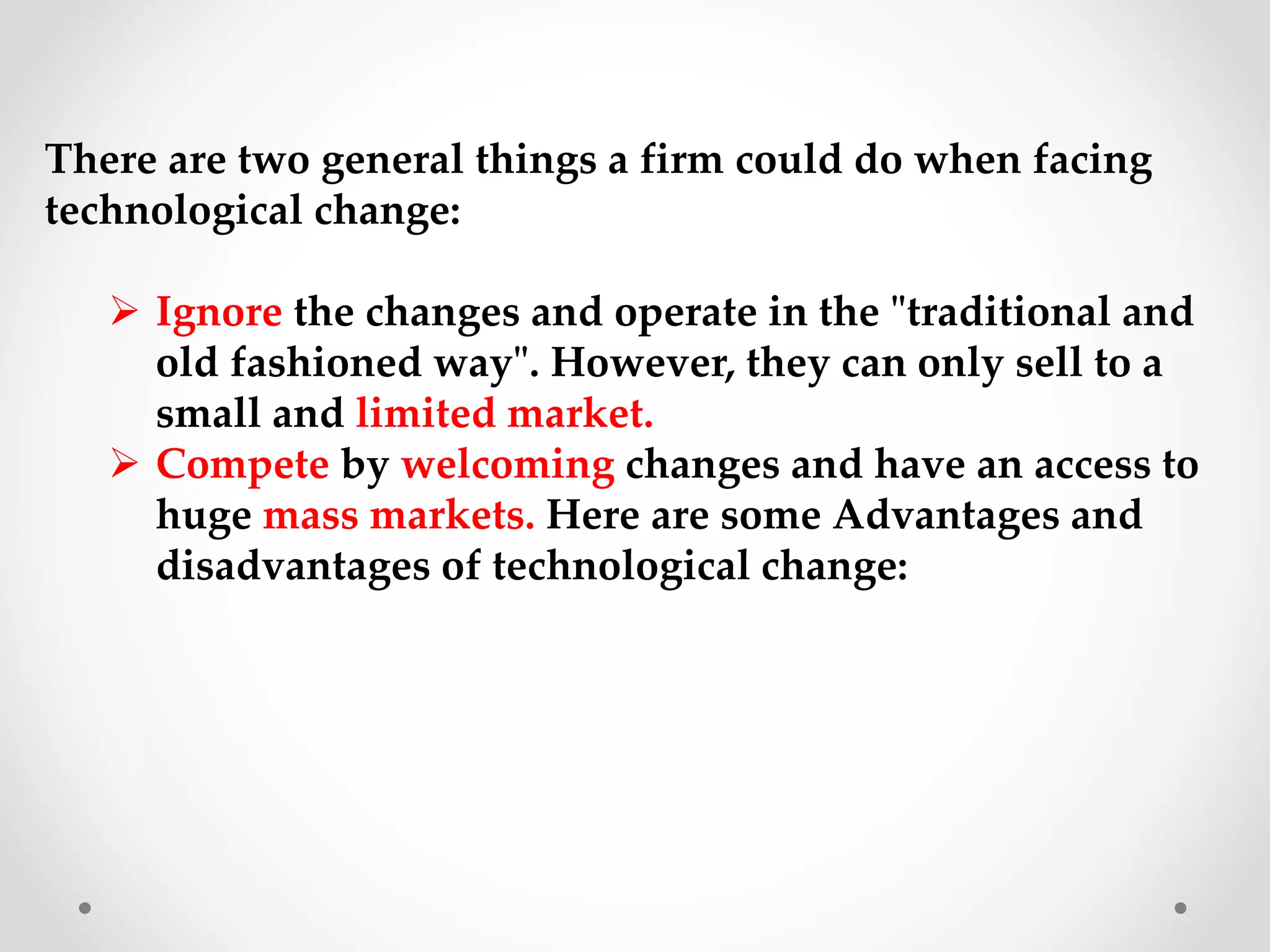
There are two general things a firm could do when facing
technological change:
 Ignore the changes and operate in the "traditional and
old fashioned way". However, they can only sell to a
small and limited market.
 Compete by welcoming changes and have an access to
huge mass markets. Here are some Advantages and
disadvantages of technological change:
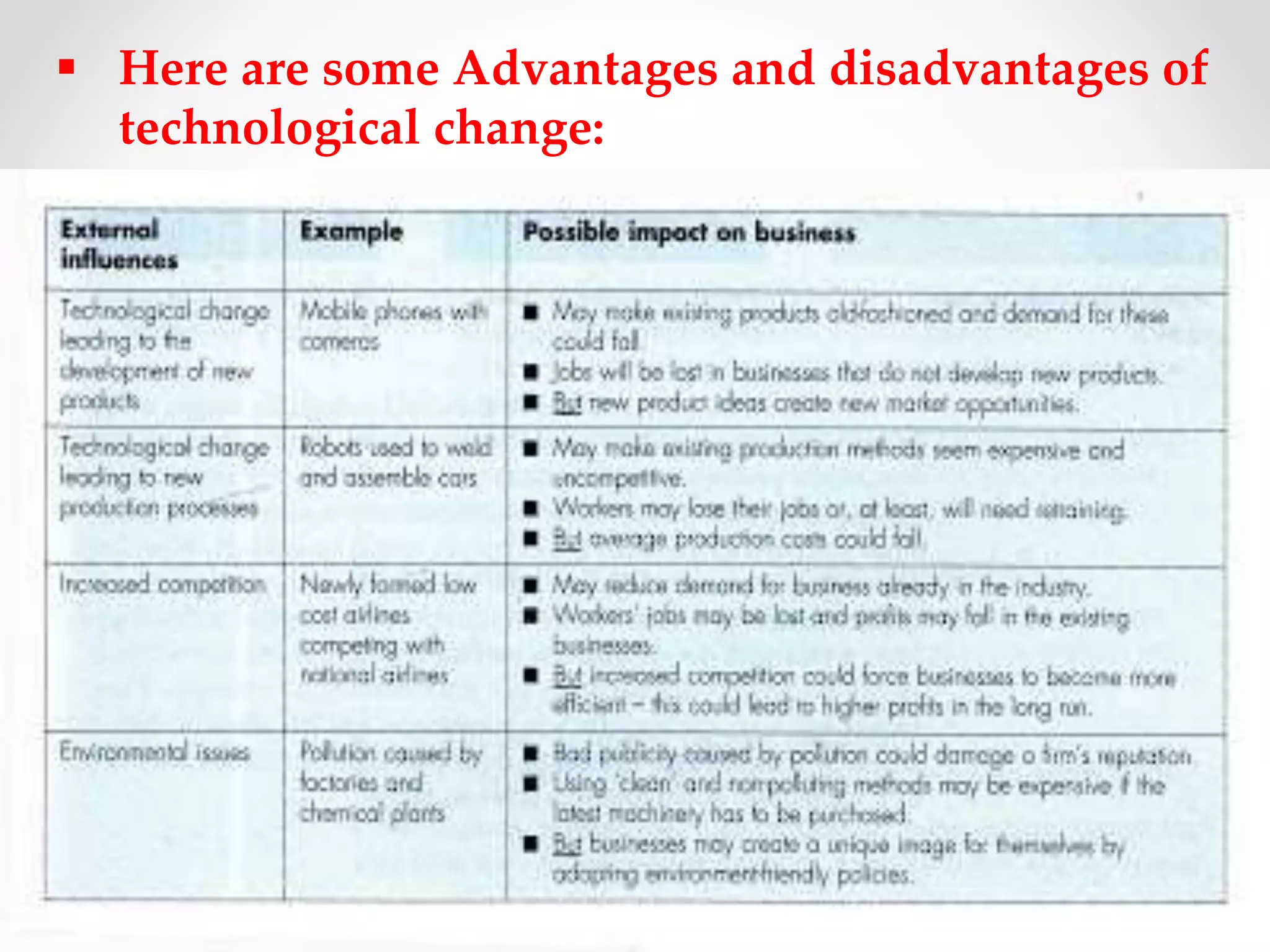
 Here are some Advantages and disadvantages of
technological change:
 Advantages:
 New products encourage customers to buy more.
 If a business comes up with a new product first, they
gain a huge competitive advantage.

"High-tech" production methods make production
more efficient.
 Fewer workers are required.
 New production methods can be adapted very quickly
which gives businesses more flexibility in meeting
consumer wants.
 E-commerce opens up new markets and the Internet is
a medium of advertising.
 Disadvantages:
 R&D is expensive, without guaranteed success.
 Businesses that do not develop new products
will fail, leaving workers unemployed.
 New production methods and machines are
expensive.
 Workers will need retraining which is
expensive. They might be reluctant to learn or
fear that they will not do well. This could lead
to a fall in motivation.
 E-commerce lacks personal customer service.
 Smaller businesses cannot afford these things.
 Introducing technological change successfully
Workers and managers may fear change. Workers might
think:
 Will I be able to operate the new machines?
 Will I lose my job because the machines are more
efficient?
Older workers are especially afraid of loosing out to younger
and better trained workers. Managers also fear change, since
recruiting technology experts will make them look more
inferior in some way.
To make these changes work better, workers need to be
involved in the changes. Workers might be told why the new
machines are necessary and how they will be trained to use
them, as well as letting them suggest ways to make work
more efficient with the machines. It leads to more
opportunities for trained and skilled staff and can lead to
new ideas and products.
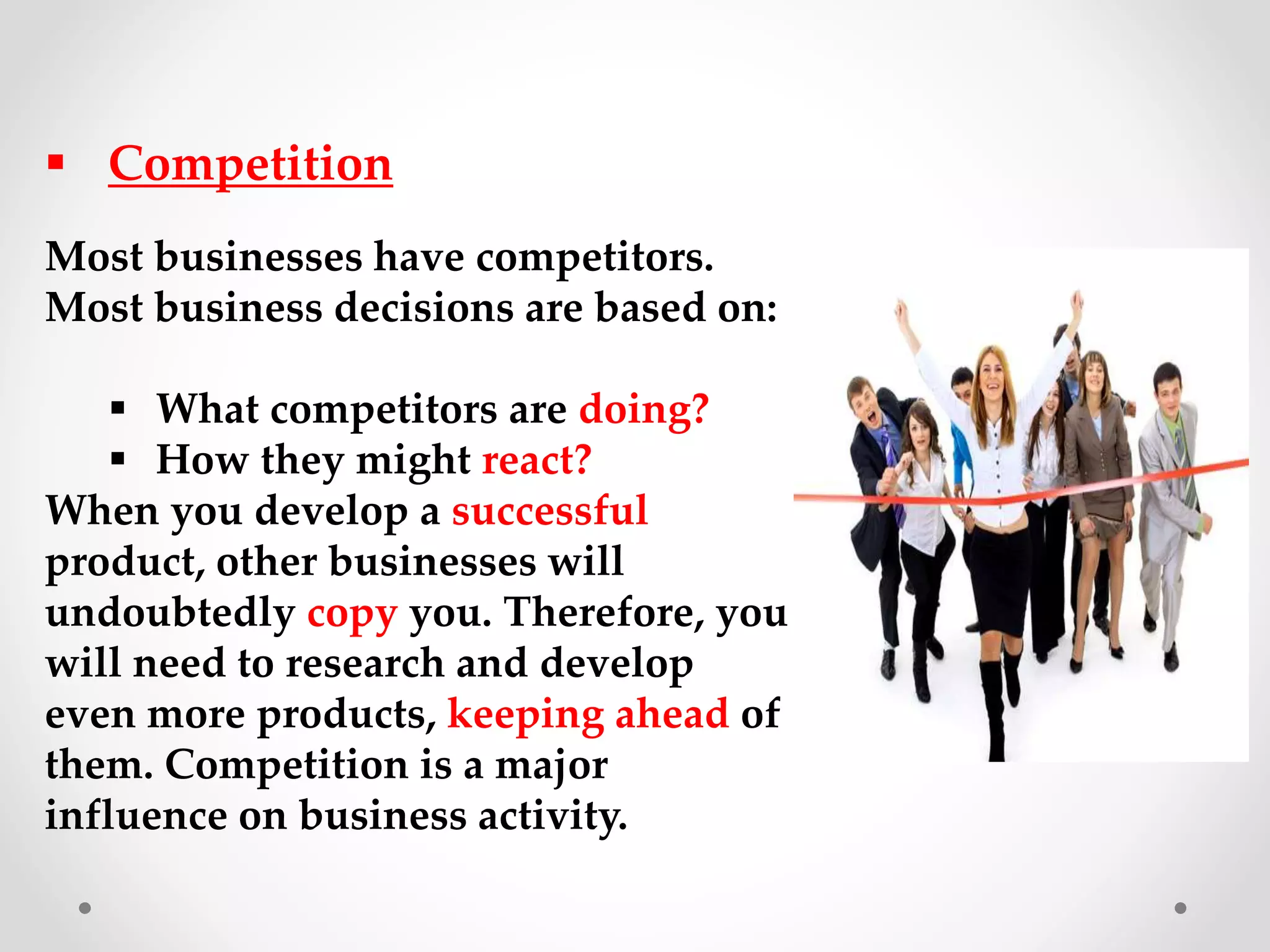
 Competition
Most businesses have competitors.
Most business decisions are based on:
 What competitors are doing?
 How they might react?
When you develop a successful
product, other businesses will
undoubtedly copy you. Therefore, you
will need to research and develop
even more products, keeping ahead of
them. Competition is a major
influence on business activity.
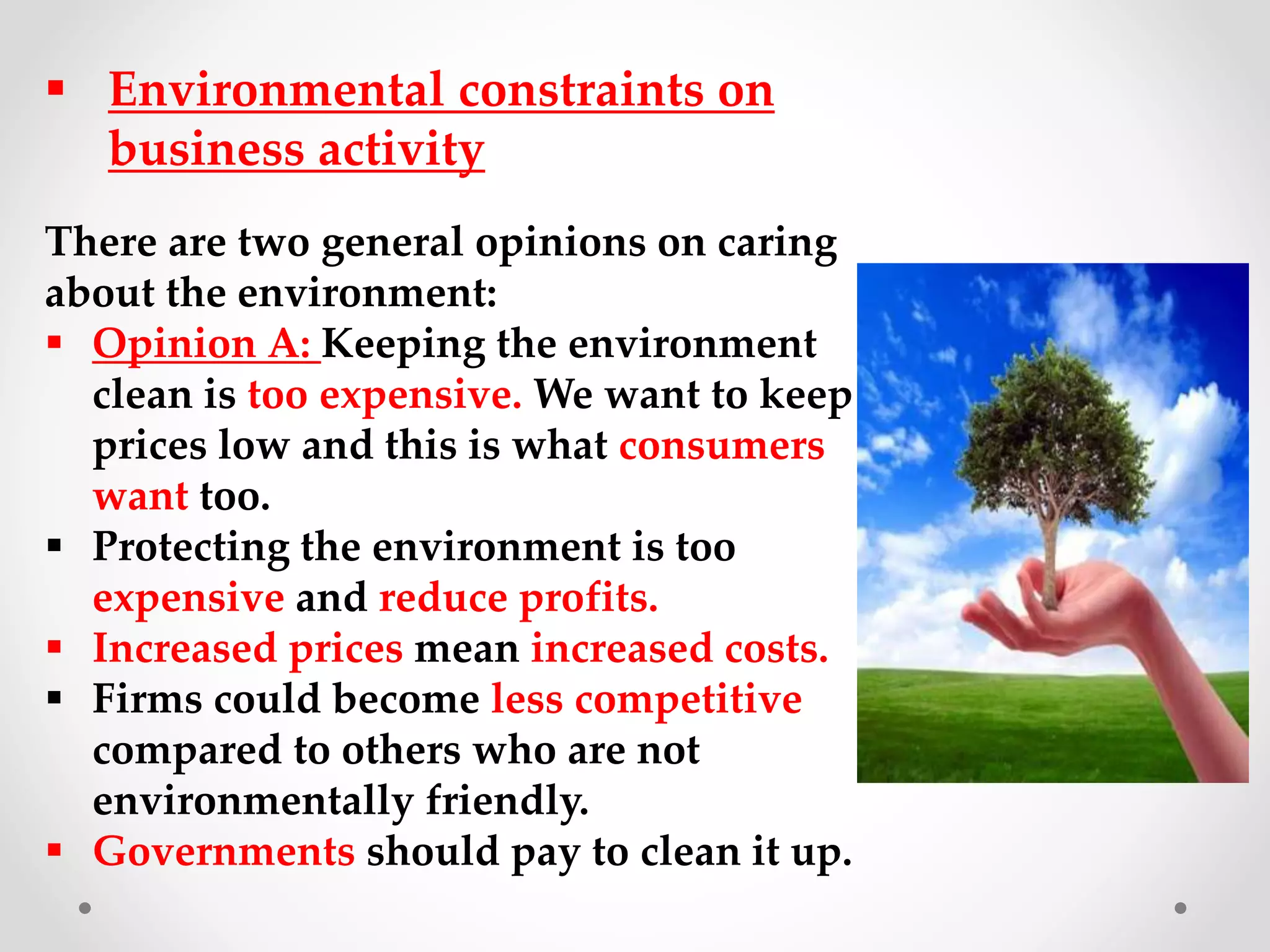
 Environmental constraints on
business activity
There are two general opinions on caring
about the environment:
 Opinion A: Keeping the environment
clean is too expensive. We want to keep
prices low and this is what consumers
want too.
 Protecting the environment is too
expensive and reduce profits.
 Increased prices mean increased costs.
 Firms could become less competitive
compared to others who are not
environmentally friendly.
 Governments should pay to clean it up.
 Opinion B: Consumers are now starting to prefer
businesses with social responsibility. Cleaner and more
efficient machinery benefit the business in the long-run.
 Environmental issues affect us all and businesses have
a social responsibility to deal with them.
 Using up scarce resources leaves less for future
generations and raise prices.
 Consumers are becoming more socially aware. More
now prefer firms that are environmentally friendly
which could become an marketing advantage.
 If a business damages the environment, pressure
groups could protest and damage its image and
reputation.
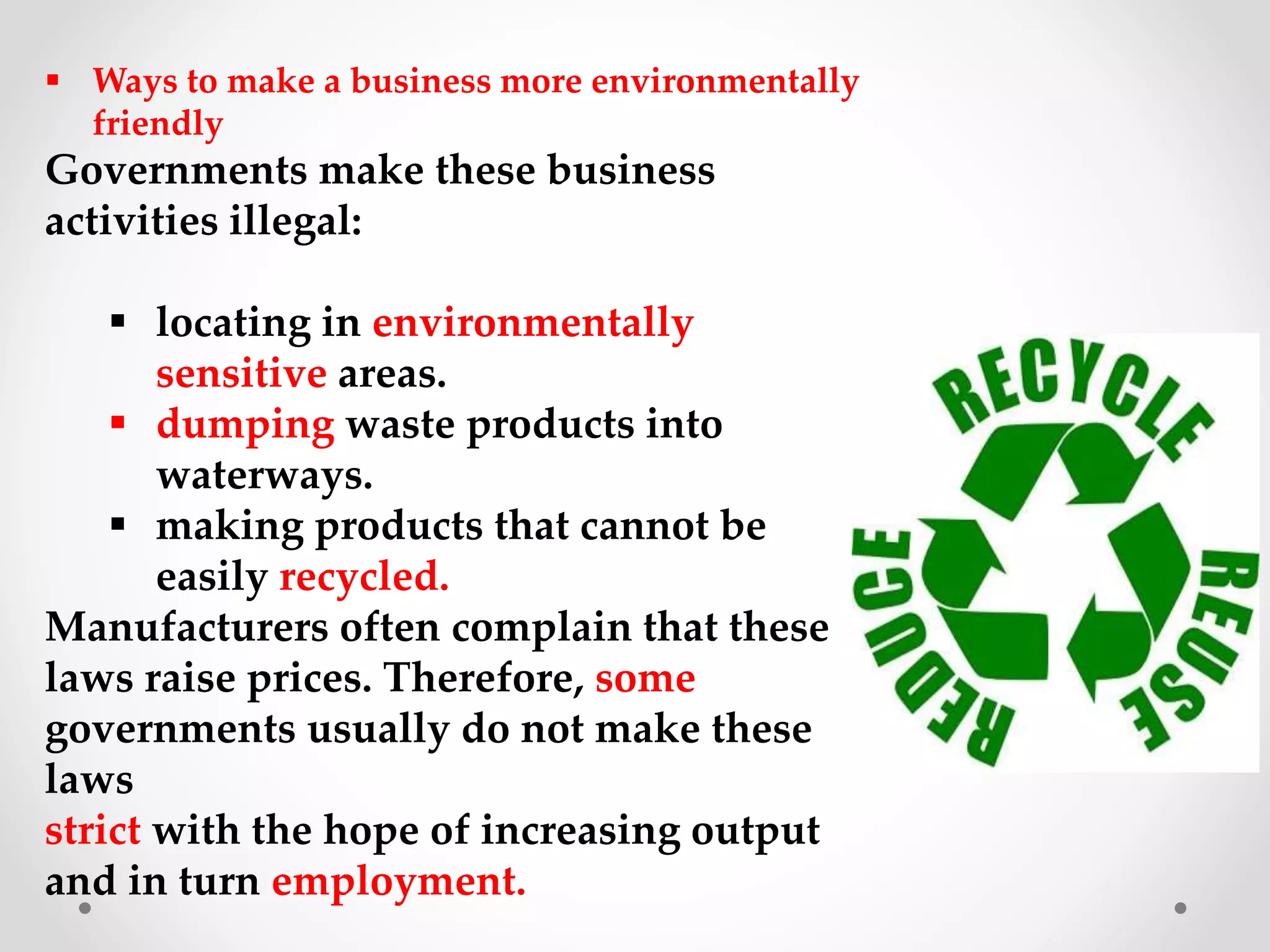
 Ways to make a business more environmentally
friendly
Governments make these business
activities illegal:
 locating in environmentally
sensitive areas.
 dumping waste products into
waterways.
 making products that cannot be
easily recycled.
Manufacturers often complain that these
laws raise prices. Therefore, some
governments usually do not make these
laws
strict with the hope of increasing output
and in turn employment.
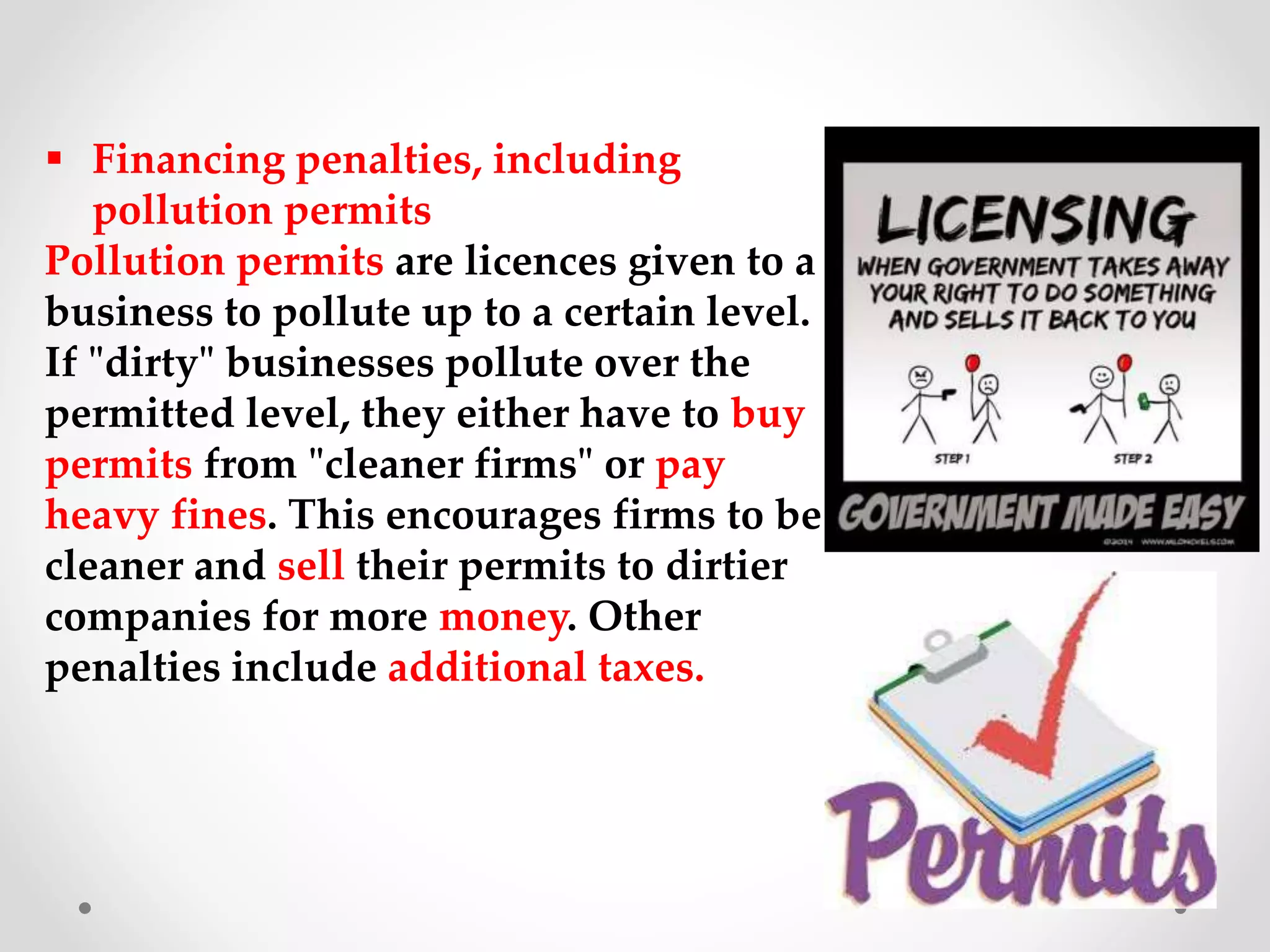
 Financing penalties, including
pollution permits
Pollution permits are licences given to a
business to pollute up to a certain level.
If "dirty" businesses pollute over the
permitted level, they either have to buy
permits from "cleaner firms" or pay
heavy fines. This encourages firms to be
cleaner and sell their permits to dirtier
companies for more money. Other
penalties include additional taxes.
 Consumer action and pressure groups
Consumers are becoming more socially aware,
and many of them will stop buying goods from
companies which pollute the environment,
harming a business' reputation and image. Bad
publicity means lower sales. If they want to
keep their sales revenue up firms would have to
adapt to more environmentally friendly
production processes again.
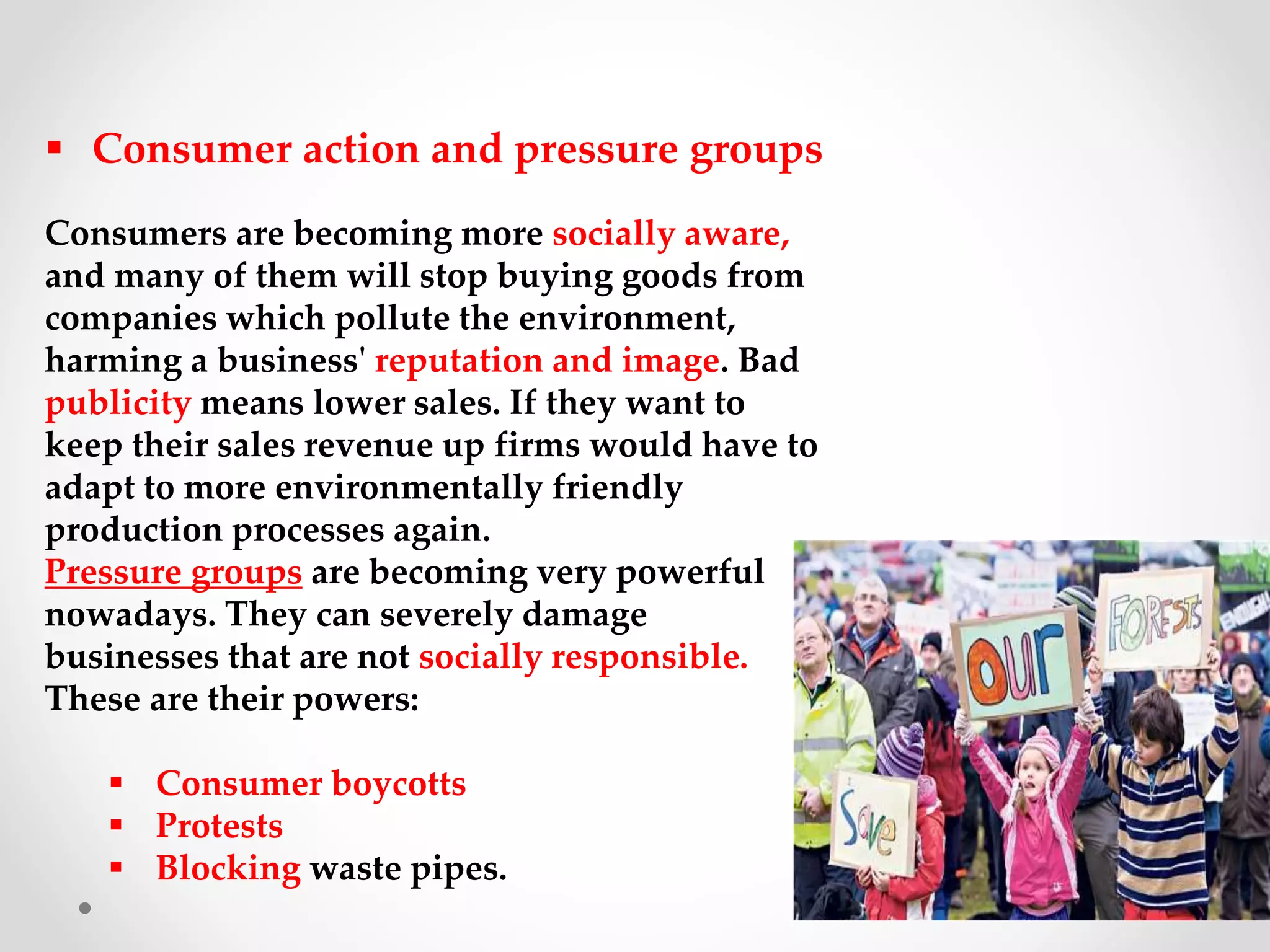
Pressure groups are becoming very powerful
nowadays. They can severely damage
businesses that are not socially responsible.
These are their powers:
 Consumer boycotts
 Protests
 Blocking waste pipes.
 These are times when they are likely to take action:
They have popular public support and has a lot of media coverage.
The group is well organised and financed. These are times when
they are less likely to take action:
 What a company is doing is unpopular but not illegal. (e.g.
testing drugs on rats)
 The cost of making the company cleaner is more than losses that
could be made by losing image and sales.
 The firm supplies other firms and not customers, public support
will be less effective.
 Environmental issues and cost-benefit analysis
Governments are increasingly concerned about the social and
environmental effects of business activity. They have started to use a
new type of analysis on businesses and government proposals which
will not only take into account financial costs but also external costs.
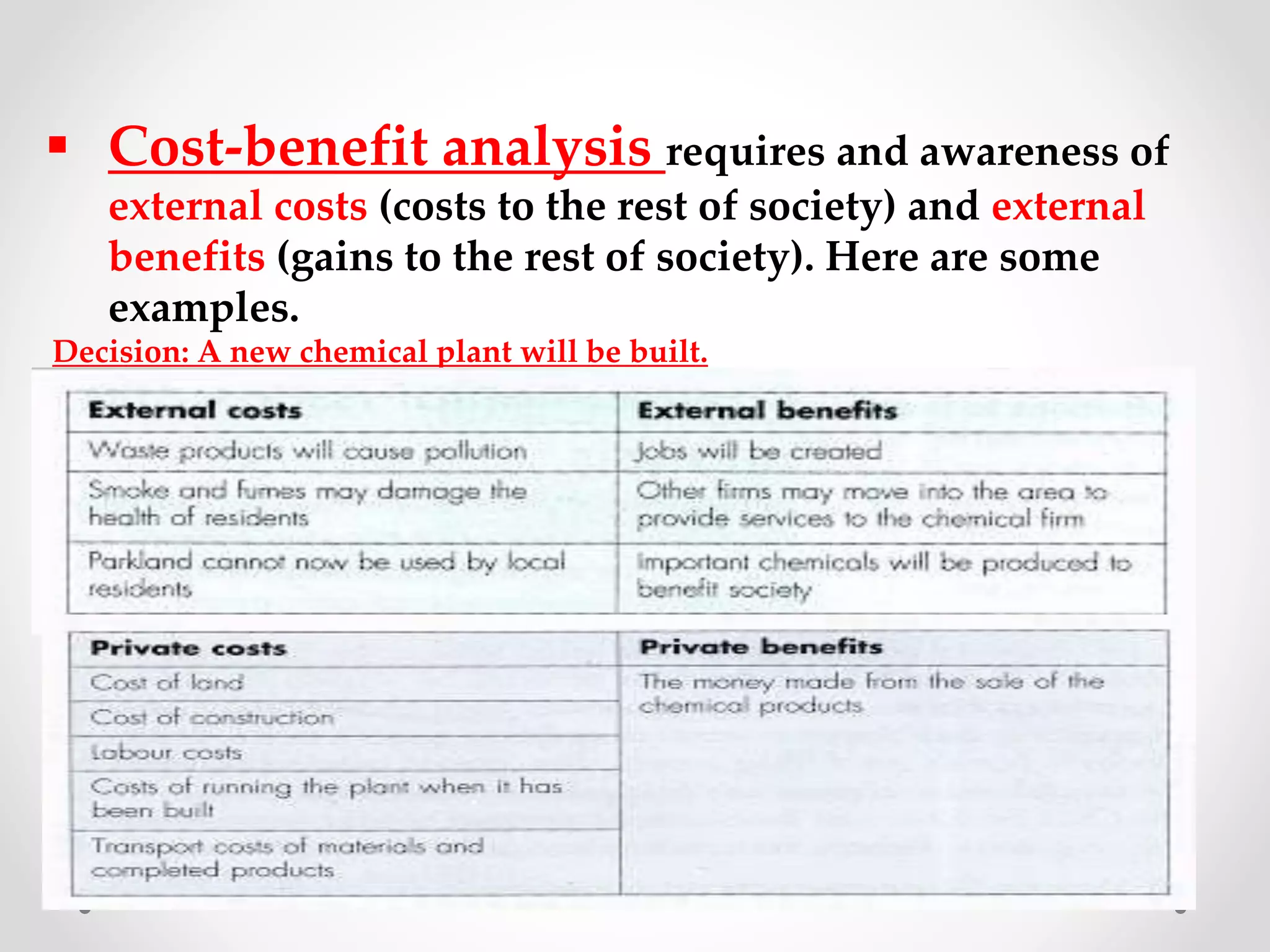
 Cost-benefit analysis requires and awareness of
external costs (costs to the rest of society) and external
benefits (gains to the rest of society). Here are some
examples.
Decision: A new chemical plant will be built.
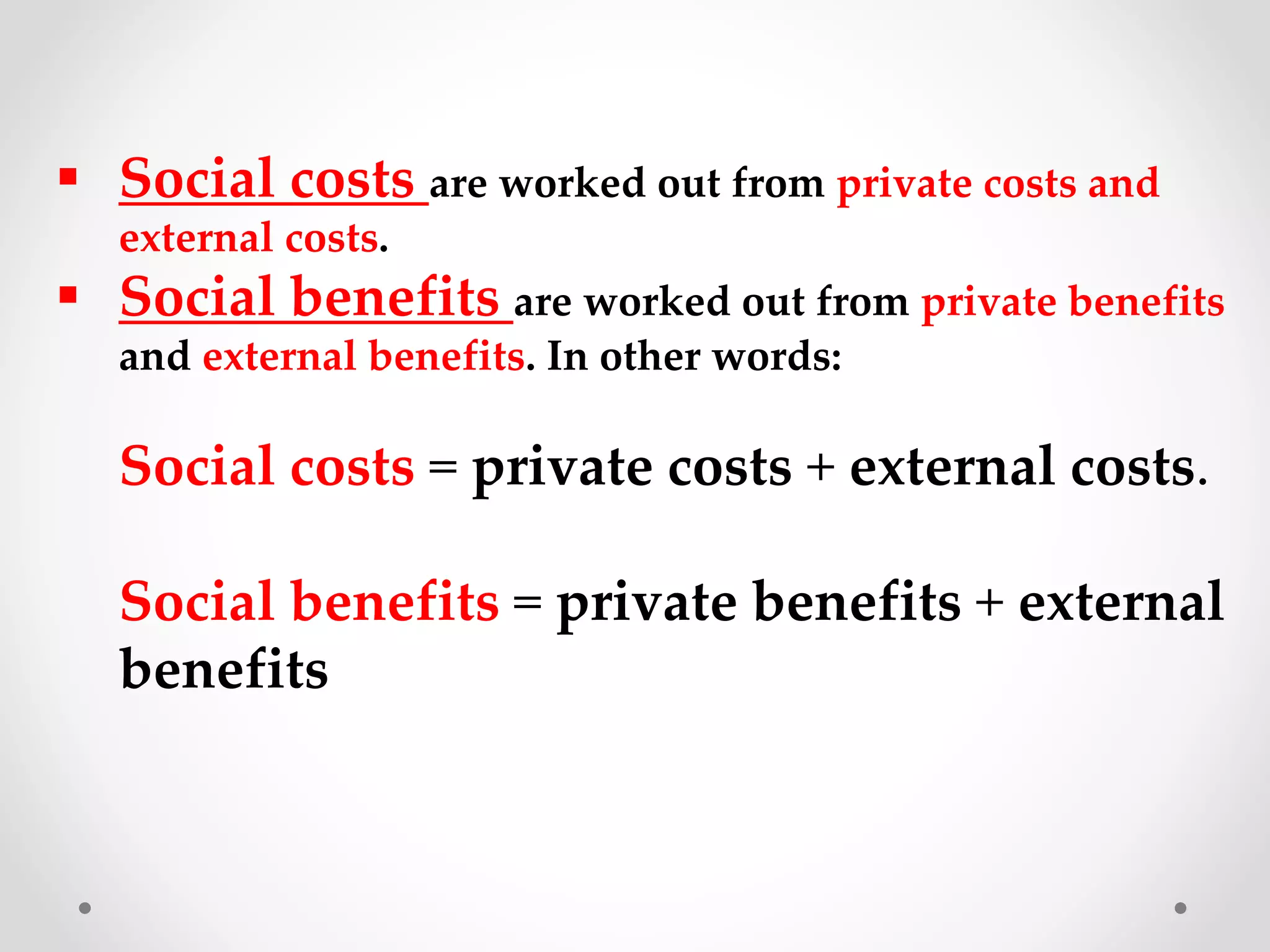
 Social costs are worked out from private costs and
external costs.
 Social benefits are worked out from private benefits
and external benefits. In other words:
Social costs = private costs + external costs.
Social benefits = private benefits + external
benefits
6.3 Chapter 26: Business and the
international economy
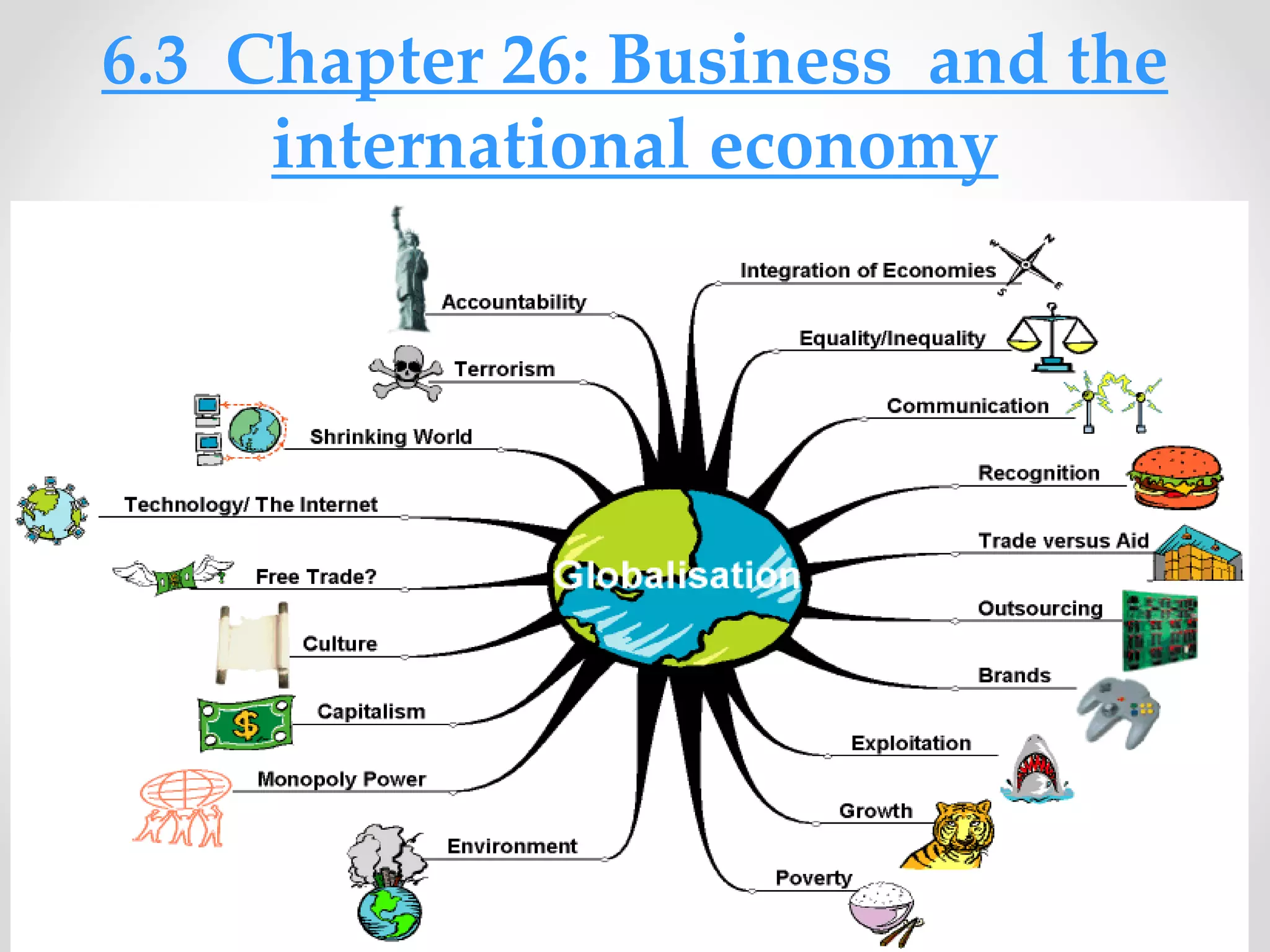
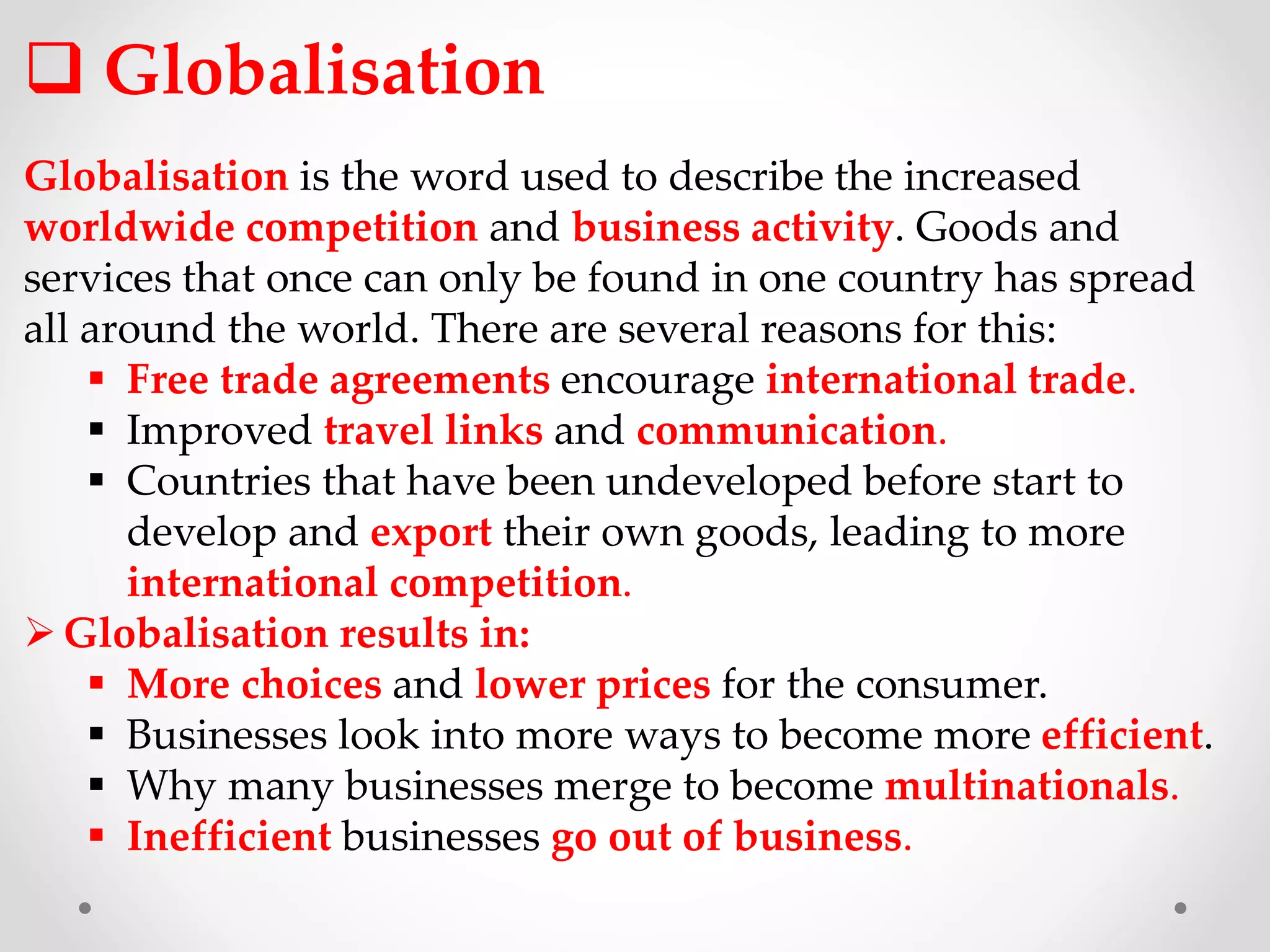
 Globalisation
Globalisation is the word used to describe the increased
worldwide competition and business activity. Goods and
services that once can only be found in one country has spread
all around the world. There are several reasons for this:
 Free trade agreements encourage international trade.
 Improved travel links and communication.
 Countries that have been undeveloped before start to
develop and export their own goods, leading to more
international competition.
Globalisation results in:
 More choices and lower prices for the consumer.
 Businesses look into more ways to become more efficient.
 Why many businesses merge to become multinationals.
 Inefficient businesses go out of business.
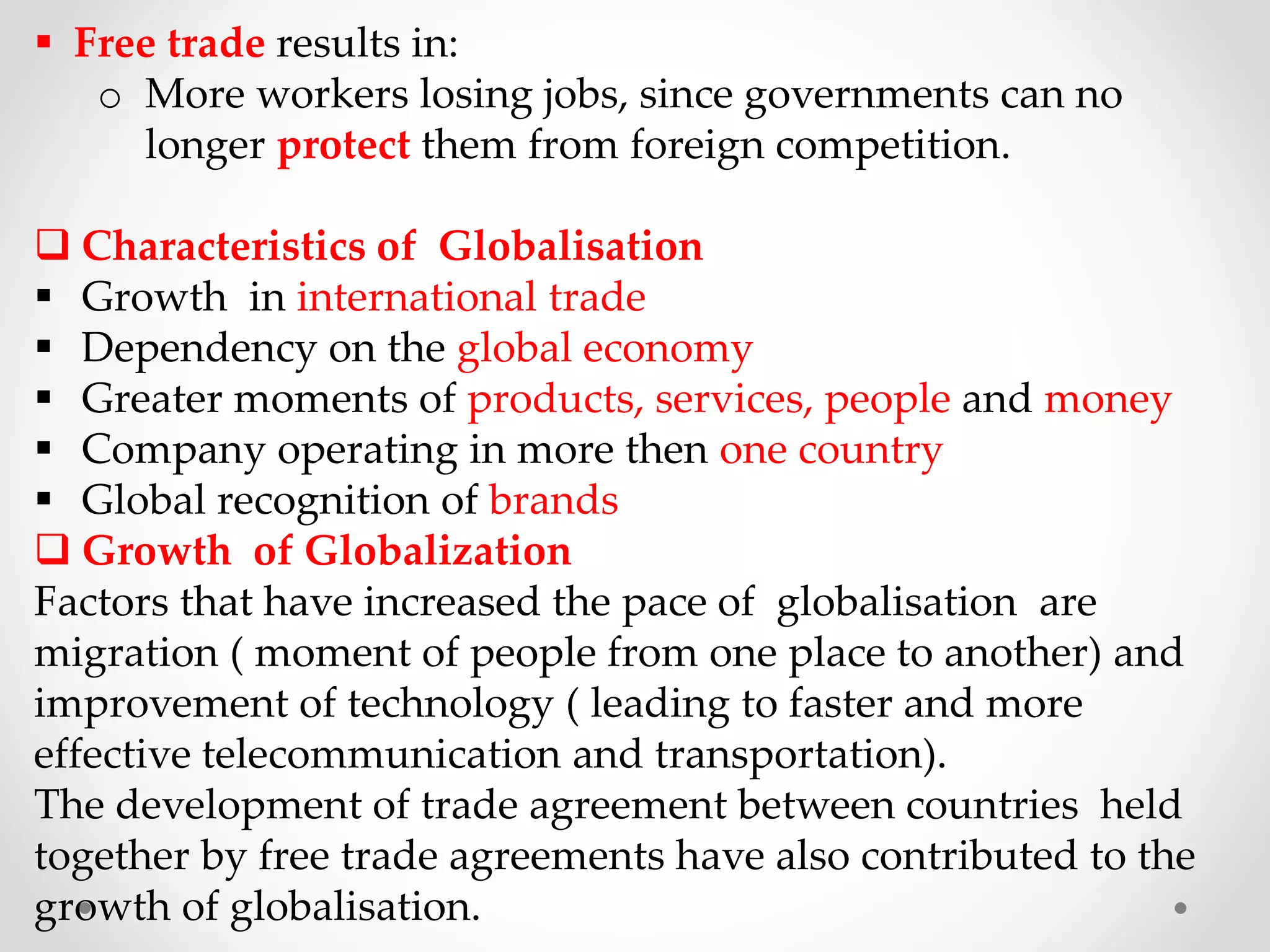
 Free trade results in:
o More workers losing jobs, since governments can no
longer protect them from foreign competition.
 Characteristics of Globalisation
 Growth in international trade
 Dependency on the global economy
 Greater moments of products, services, people and money
 Company operating in more then one country
 Global recognition of brands
 Growth of Globalization
Factors that have increased the pace of globalisation are
migration ( moment of people from one place to another) and
improvement of technology ( leading to faster and more
effective telecommunication and transportation).
The development of trade agreement between countries held
together by free trade agreements have also contributed to the
growth of globalisation.
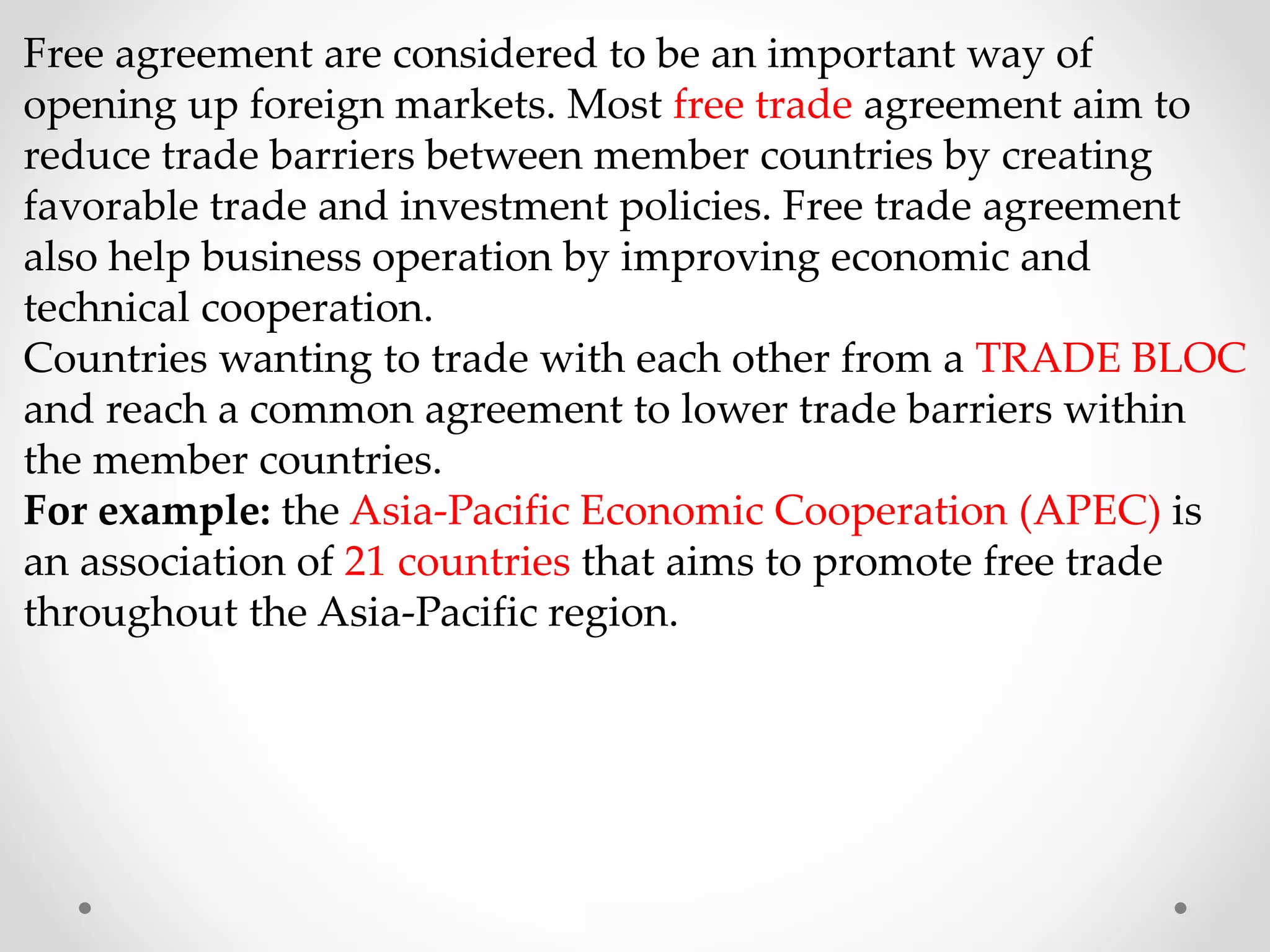
Free agreement are considered to be an important way of
opening up foreign markets. Most free trade agreement aim to
reduce trade barriers between member countries by creating
favorable trade and investment policies. Free trade agreement
also help business operation by improving economic and
technical cooperation.
Countries wanting to trade with each other from a TRADE BLOC
and reach a common agreement to lower trade barriers within
the member countries.
For example: the Asia-Pacific Economic Cooperation (APEC) is
an association of 21 countries that aims to promote free trade
throughout the Asia-Pacific region.
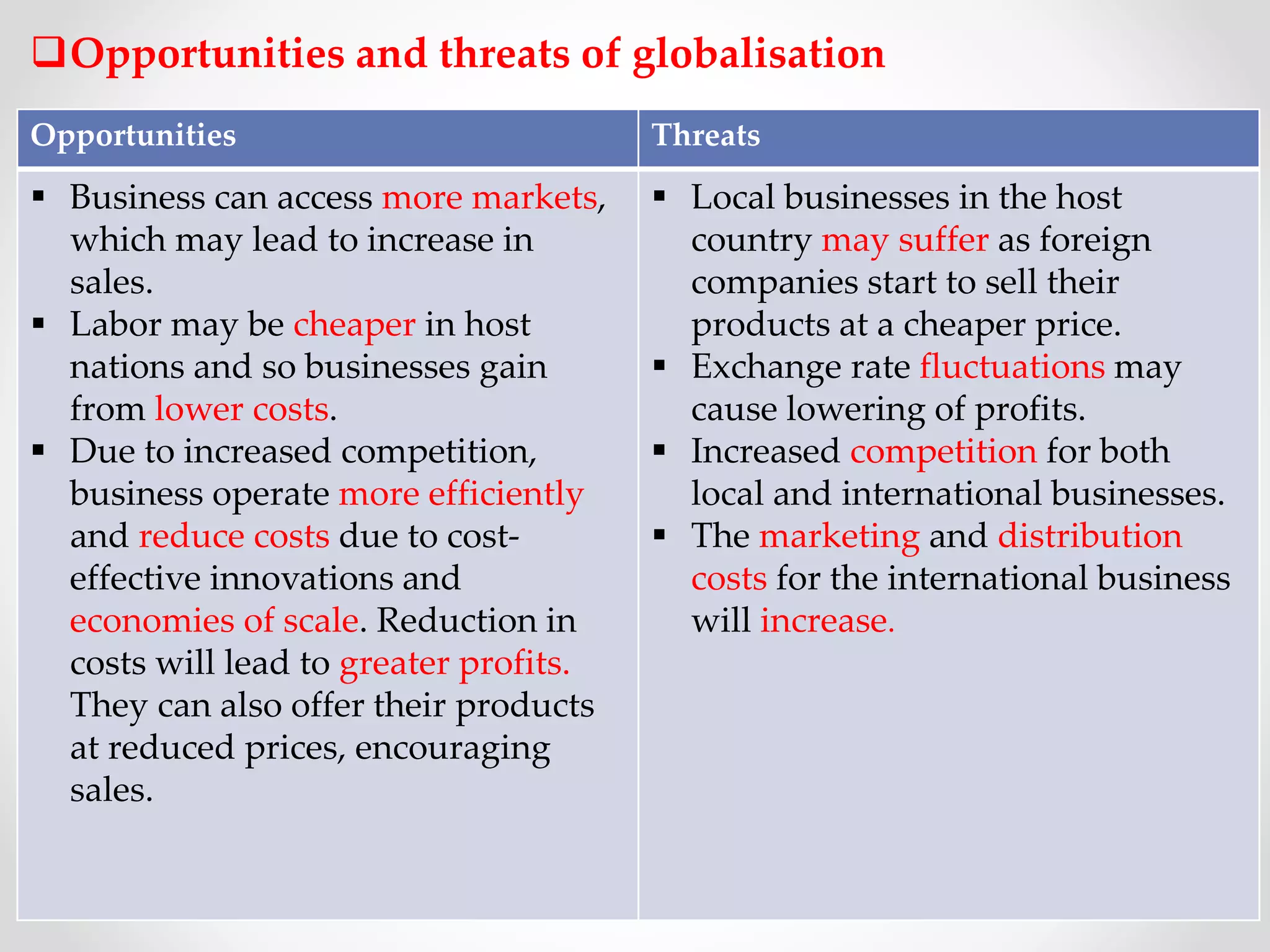
Opportunities and threats of globalisation
Opportunities Threats
 Business can access more markets,
which may lead to increase in
sales.
 Labor may be cheaper in host
nations and so businesses gain
from lower costs.
 Due to increased competition,
business operate more efficiently
and reduce costs due to cost-
effective innovations and
economies of scale. Reduction in
costs will lead to greater profits.
They can also offer their products
at reduced prices, encouraging
sales.
 Local businesses in the host
country may suffer as foreign
companies start to sell their
products at a cheaper price.
 Exchange rate fluctuations may
cause lowering of profits.
 Increased competition for both
local and international businesses.
 The marketing and distribution
costs for the international business
will increase.
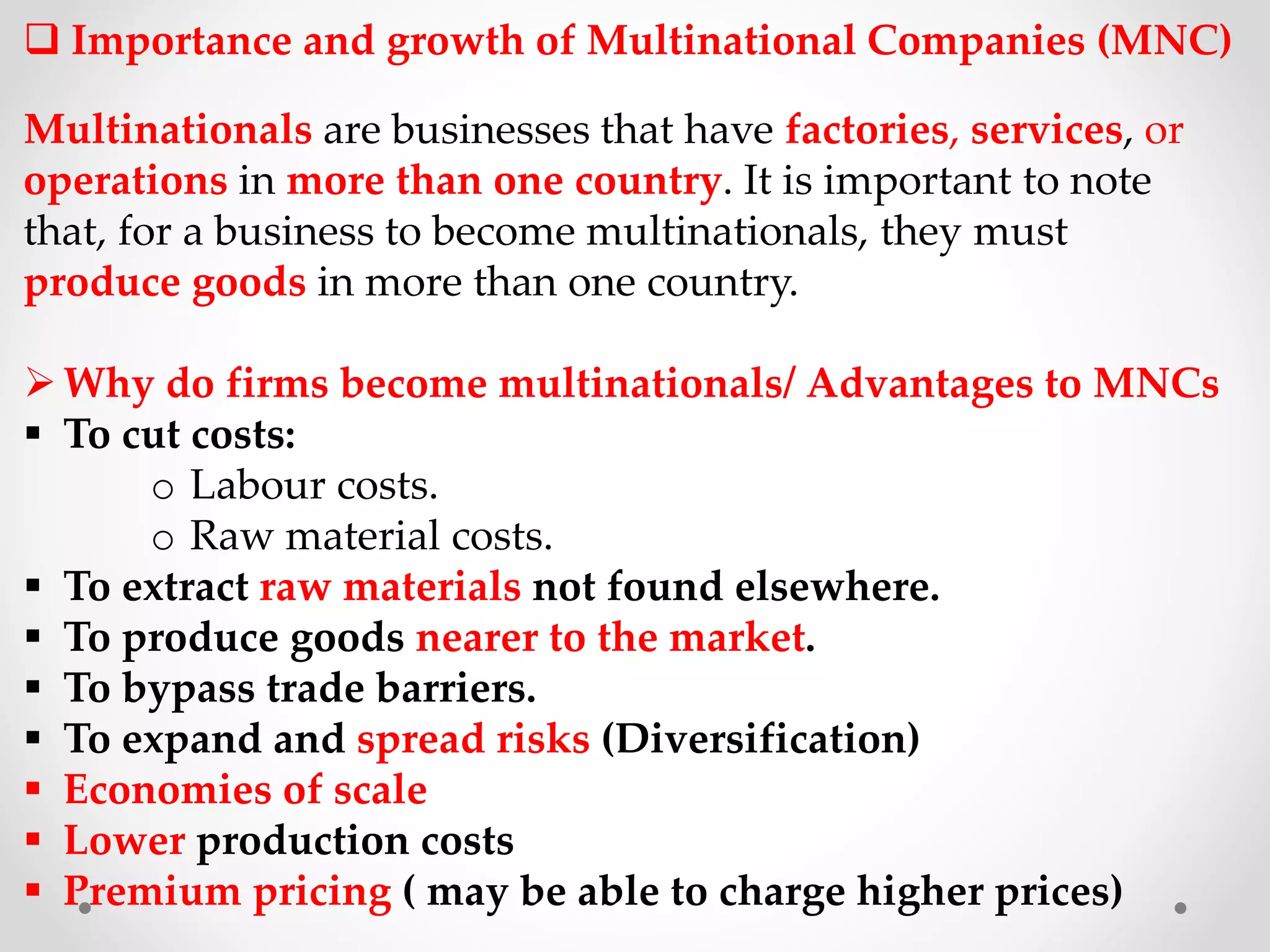
 Importance and growth of Multinational Companies (MNC)
Multinationals are businesses that have factories, services, or
operations in more than one country. It is important to note
that, for a business to become multinationals, they must
produce goods in more than one country.
Why do firms become multinationals/ Advantages to MNCs
 To cut costs:
o Labour costs.
o Raw material costs.
 To extract raw materials not found elsewhere.
 To produce goods nearer to the market.
 To bypass trade barriers.
 To expand and spread risks (Diversification)
 Economies of scale
 Lower production costs
 Premium pricing ( may be able to charge higher prices)
 Possible threats to MNCs in the host country for success
 Shortage of skilled labor
 Lack of information about the local market
 Language barrier
 Cultural differences
 Strict regulations
 Hostile business environment ( competitors might retaliate
through marketing tactics to defend their market position)
 Expensive labor costs
 Local opposition or threats from pressure groups
 Little brand awareness
 Currency fluctuations
 Political instability in the host country
 Advantages of MNCs operating in a country/Benefits to the
host country
 Jobs are created.
 New investment increases national output.
 Imports are reduced since there are more goods in the
country. More exports to improve the balance of payments.
 More taxes are paid to the government.
 Increase in choice and quality of goods and services
 Improves country`s reputation
 Improve infrastructure
 Knowledge-sharing
 Disadvantages/Drawbacks of MNCs operating in a country
 Jobs created are usually unskilled jobs.
 Local firms are forced out of business since they can't
compete with multinationals.
 Profits flow out of the country.
 Multinationals use up scarce resources.
 May influence the government.
 Environmental damage
 Exploitation of labor
 Exploitation of natural resources
 Negative social impact
 Less sense of social responsibility
 Exchange rate (ER)
Exchange rates is the value of one currency compared to another.
Eg. $1= Rmb 6.54
 How are exchange rates determined?
There THREE type so currencies:
 Floating rate: The exchange rate of the currency is allowed
to change freely depending on market forces, i.e supply
and demand of the currency.
 Fixed rate: The exchange rate of the currency is set by the
country's central bank. When the exchange rate rises, it is
called appreciation. When it falls, it is called depreciation.
 Managed exchange rate: The exchange rate is determined
by supply and demand BUT highly managed by the
government through intervention.
 How are businesses affected by changing exchange rates?
Appreciation:
Import prices fall ( Cheaper).
Export prices rise ( Expensive).
Depreciation:
Import prices rise (Expensive).
Export prices fall (Cheaper).
These exchange rate movements can cause serious damage to
businesses, making business endeavors that would have been
profitable make losses because of changes in the currencies. The
EU, for example, wants to limit these bad effects, and hence
established a common currency, the Euro.
Congratulations !!!
You are great students, I wholeheartedly appreciate your effort
to complete whole 2 year syllabus within 1 year. Wishing you a
great success in your up coming IGCSE exam !!!

Unit 6 external influences on business activity ppt

  • 1.
    Unit 6: ExternalInfluences on business activity 6.1 Chapter 24 Government economic objectives and policies  The impact of business activity on society All business activity has benefits and undesirable effects on society. These reasons are why governments want to have some control over business activity:
  • 2.
     Possible benefits: Production of useful goods to satisfy customer wants.  Create employment/increases workers living standards.  Introduction of new products or processes that reduces costs and widen product range.  Taxes help finance public services.  Business earn foreign currency in exports and this could be spent on imports.  Possible undesirable effects:  Business might ruin cheap but beautiful areas.  Low wages and unsafe working conditions for workers because businesses want to lower costs.  Pollution  Production of dangerous goods.  Monopolies  Advertising can mislead customers.  Governments tend to pass laws that restrict undesirable activities while supporting desirable activities.
  • 3.
     Governments andthe economy  Government economic objectives: Governments all have aims for their country, and this is what they are:  Low inflation.  Low unemployment.  Economic growth.  Balance of payments.
  • 4.
     Low inflation: Inflationoccurs when prices rise. When prices rise rapidly many bad thing could happen:  Workers wages buy less than before. Therefore their real income (how much you can buy with so much money) falls. Workers will be unhappy and demand for higher wages.  Prices of local goods will rise more than that of other countries with lower inflation. People may start buying foreign goods instead.  It would cost more for businesses to start or expand and therefore it does not employ as many people.  Some people might be made redundant so that the business can cut costs.  Standards of living will fall.  This is obviously why governments want to keep inflation as low as possible.
  • 5.
     Low levelsof unemployment: When people are unemployed, they want to work but cannot find a job. This causes many problems:  Unemployed people do not work. Therefore national output will be lower than it should be.  The government will have to pay for unemployment benefits. This is expensive and money cannot be use for other purposes.  If the level up unemployment is low, it will increase national output and improve standards of living for workers.
  • 6.
     Economic growth Acountry is said to grow when its GDP (Gross Domestic Product) is increasing. This is the total value of goods produced in one year. The standards of living tends to increase with economic growth. Problems arise when a country's GDP fall:  The country's output is falling, fewer workers are needed and unemployment occurs.  Standards of living will fall.  Businesses will not expand because they have less money to invest.  Economic growth is not achieved every year. There are years where the GDP falls and the trade cycle explains the pattern of rises and falls in national GDP.
  • 7.
    The trade cyclehas 4 main stages:
  • 8.
     The tradecycle has 4 main stages:  Growth: This is when GDP is rising, unemployment is falling, and the country has higher standards of living. Businesses tend to do well in this period.  Boom: Caused by overspending. Prices rise rapidly and there is a shortage of skilled workers. Business costs will be rising and they are uncertain about the future.  Recession: Because overspending caused the boom, people now spend too little. GDP will fall and businesses will lose demand and profits. Workers may lose their jobs.  Slump: A long drawn out recession. Unemployment will peak and prices will fall. Many firms will go out of business.  After all of this happens the economy recovers and begins to grow again. Governments want to avoid a boom so that it will not lead to a recession and a slump. Currently, the government of China is spending a lot of money so that their economy would continue to grow and avoid a boom.
  • 9.
     Balance ofpayments (BOP) Exports earn foreign currency, while imports are paid for by foreign currency (or vice versa). The difference between the value of exports and imports of a country is called balance of payments. Governments try to achieve a balance in imports and exports to avoid a trade deficit, when exports are higher than imports. Of course, the government will lose money and their reservoir of foreign currency will fall. This results in:  If the country wants to import more, they will have to borrow foreign currency to buy goods.  The country's currency will now worth less compared to others and can buy less goods. This is called exchange rate depreciation.
  • 10.
     Government economicpolicies Governments want to influence the national economy so that it would achieve their aforementioned objectives. They have a lot of power over business activity and can pass laws to try to achieve their goals. The main ways in which governments can influence business activity are called economic policies. They are:  Fiscal Policy: taxes and public spending.  Monetary policy: controlling the amount of money in the economy through interest rates.  Supply side policies: aimed at increasing efficiency.
  • 11.
     Fiscal policy Governmentspending could benefit some firms such as:  Construction firms (road building)  Defense industries (Afghan war)  Bus manufacturers (public transport) Governments raise money from taxes. There are Direct taxes on income and Indirect taxes on spending. There are four common taxes:  Income tax  Profits tax  VAT (Value Added Tax)  Import tariffs
  • 12.
    Income tax Income taxis based on a percentage of your income. Income tax is usually progressive, meaning that the percentage of tax you have to pay rises with your income. Effects on business and individuals if there was a rise of income tax:  People will have less disposable income.  Sales fall because people have less money to spend.  Managers will cut costs for more profit. Workers might be made redundant.  Businesses producing luxury goods will lose the most, while others producing everyday needs will get less affected.
  • 13.
     Profits taxor corporation tax This is a percentage of the profit a business makes. A rise in it would mean:  Managers will have less retained profit, making it harder for the business to expand.  Owners will get less return on capital employed. Potential owners will be reluctant to start their own business if the profit margin is too low.
  • 14.
     Indirect taxes Thesetaxes are a percentage on the price of goods, making them more expensive. Governments want to avoid putting them on essential goods such as foods. A rise it would mean:  The effect would be almost the same as that of an increase in income tax. People would buy less but they would still spend money on essential goods.  Again, real incomes fall. Costs will rise when workers demand higher wages.
  • 15.
     Import tariffsand quotas Governments put tariffs on imports to make local goods look more competitive and also to reduce imports. When governments put import tariffs on imports:  Sales of local goods become cheaper than imports, leading to increased sales.  Businesses who import raw materials will suffer higher costs.  Other countries will retaliate by putting tariffs on the country's exports, making it less competitive.  Quotas maybe used to limit the amount of imports coming in.
  • 16.
     Monetary policyand interest rates Governments usually have to power to change interest rates through the central bank. Interest rates affect people who borrow from the bank. When interest rates rise:  Businesses who owe to bank will have to pay more, resulting in less retained profit.  People are more reluctant to start new businesses or expand.  Consumers who took out loans such as mortgages will now have less disposable income. They will spend less on other goods.  Demand will fall for businesses who produces luxury or expensive goods such as cars because people are less willing to borrow.  Higher interest rates will encourage other countries to deposit money into local banks and earn higher profits. They will change their money into the local currency, increasing its demand and causing exchange rate
  • 17.
     Supply sidepolicies These policies aim to make the countries economy more efficient so that they can produce more goods and compete in the international economy. In doing so their GDP will rise. Here are some policies:  Privatisation: Its aim is to use profit as an incentive to increase efficiency.  Improve training and education: This obviously increases efficiency. This is crucial to countries with a big computer software industry.  Increase competition: Competition causes companies to be more efficient to survive. Governments need to remove any monopolies.
  • 18.
     Government controlsover business activity Government also influence major areas of business activity:  what goods can be produced  responsibilities to employees and working conditions  responsibilities to consumers  responsibilities to the natural environment  location decisions Undesirable effects created by business activity make governments want to control business activity:  Business might be cheap but ruin beautiful areas.  Monopolies.  Advertising can mislead customers.
  • 19.
     Why governmentcontrol business activity  Production of certain goods and services: Governments can pass laws to restrict and ban certain dangerous goods such as:  Weapons like guns and explosives.  Drugs  Goods that harm the environment  Consumer protection: Consumers are easily misled by advertising. It is because consumers lack the technical knowledge and advertising can be very persuasive. In the UK, these laws are passed to protect customers from being exploited by businesses:
  • 20.
     Weights andMeasures Act: to stop underweight goods being sold to customers.  Trade Descriptions Act: all advertisements must be truthful.  Consumer Credit Act: makes it illegal to not give customers their copy of the credit agreement to check how much money they really have.  Sale of Goods Act: Makes it illegal to sell:  Goods which have serious flaws or problems.  Products that are not fit for the purpose intended by the consumer.  Products that do not function as described on their label or by the retailer.  Consumer Protection Act: Make false pricing claims illegal. Consumers can now sue producers or retailers if their products cause harm to them.
  • 21.
     Competition policy:Control of monopolies Monopolies could cause a lot of harm to an economy because there are nobody to compete against them:  They exploit consumers with high prices.  They prevent new firms from starting up.  Monopolies are not encouraged to be efficient because there are no competitors. In some countries, monopolies are banned and must be broken up into smaller firms. In the UK, monopolies can be investigated by the Competition Commission. This government body reports two main types of problems:  Business decisions that are against consumer interests, such as trying to eliminate all competitors.  Proposed mergers or takeovers that will result in a monopoly.
  • 22.
     Protecting employees: Employeesneed protection in the following areas:  Unfair discrimination  Health and safety at work  Unfair dismissal  Wage protection Protection against unfair discrimination: Often workers are discriminated in a job because of various reasons. There are laws that protect the employee from such reasons to be discriminated against:  Sex Discrimination Act: people of different genders must have equal opportunities.
  • 23.
     Race RelationsAct: people of all races and religions mush have equal opportunities.  Disability Discrimination Act: it must be made suitable for disabled people to work in businesses.  Equal Opportunities Policy: That is what everything is all about. The UK is currently working on an age discrimination act.  Health and Safety at work: Laws protect workers from:  protect workers from dangerous machinery.  provide safety equipment and clothing.  maintain reasonable workplace temperatures.  provide hygienic conditions and washing facilities.  do not insist on excessively long shifts and provide breaks in the work timetable.
  • 24.
    Managers not onlyprovide safety for their employees only because laws say so. Some believe that keeping employees safe and happy improves their motivation and keeps them in the business. Others do it because it is present in their moral code. They are then considered making an ethical decision. However, in many countries, workers are still exploited by employers.  Protection against unfair dismissal Employees need protection from being dismissed unfairly. The following reasons for the employee to be dismissed is unreasonable:  for joining a trade union.  for being pregnant.  when no warnings were given beforehand. Workers who thing they have been dismissed unfairly can take their case to the Industrial Tribunal to be judged and he/she might receive compensation if the case is in his/her favour.
  • 25.
     Wage Protection Employersmust pay employees the same amount that has been stated on the contract of employment, which states:  Hours of work.  Nature of the job.  The wage rate to be paid.  How frequently wages will be paid.  What deduction will be made from wages, e.g. income tax. A minimum wage rate is present in many Western countries and the USA. There are Advantages and cons of the minimum wage:
  • 26.
     Advantages:  Preventsstrong employees to exploit unskilled workers who could not easily find work.  Encourages employers to train unskilled employees to increase efficiency.  Encourages more people to seek work.  Low-paid workers can now spend more.  Disadvantages:  Increases costs, increases prices.  Owners who cannot afford these wages might make employees redundant instead.  Higher paid workers want higher wages to keep on the same level difference as the lower paid workers. Costs will rise.
  • 27.
     Location ofIndustry How governments want to locate businesses:  They encourage businesses to move to areas with a high level of unemployment, or called development areas.  They discourage firms from locating in overcrowded cites or sites noted for their natural beauty. How governments will influence the decisions of firms to locate:  Businesses will be refused planning permission (permit to build in a place) if they wish to locate in overcrowded cities or beautiful areas. Building in these areas might be banned altogether.  Governments can provide regional assistance, such as grants and subsidies to encourage firms to locate in undeveloped areas.
  • 28.
     Governments canhelp businesses too  Governments can help businesses to:  to encourage businesses to locate in poorer regions.  to encourage enterprise by helping small businesses set up and survive.  to encourage businesses to export.  Regional Assistance:  Governments want development to be spread evenly over the whole country.  Grants and subsidies can be used to attract firms to an area.
  • 29.
     Small firms Smallfirms are important for and economy because:  They provide most of the employment because they are usually labour intensive.  Small firms operate in rural areas where unemployment tends to be high.  They can grow into very important businesses employing thousands of workers and producing output worth millions of dollars.  Provides more choice for customers. They compete against bigger companies.  They are often managed in a very flexible way, and is quicker to adapt to changing demands.
  • 30.
     Governments helpthem by:  Lower rates of profits tax, so they can have more retained profit.  Giving grants and cheap loans.  Providing advice and information centers to small firms.  Exporting goods and services Why governments want businesses to export:  Exports earn foreign currency, which can be use to buy imports.  More exports means more people needed to produce them, increasing employment and standards of living.  Successful exporters earn more money and have to pay more profits tax.
  • 31.
     Governments cansupport exporters by:  Encourage banks to lend to exporting businesses at lower interest rates.  Offering subsidies or lower taxes to firms. However, other countries would retaliate and there would be no overall advantage.  Trying to keep the local currency as stable as possible to make it easier for businesses to know how much they are going to make from exports.  Organising trade fairs abroad to encourage foreign businesses to buy the country's exports.  Offering credit facilities. This means that if a foreign customers refuses to pay for goods, the company could be compensated by the government.
  • 32.
     Businesses inthe economic and legal environment Businesses could not ignore the power of the government in controlling business activity. Multinationals are an exception although normally businesses cannot afford to move to other countries. Government decisions create the environment in which businesses will have to operate and adapt to. The environment created by legal and economic controls are one of the constraints to managers when making decisions.
  • 33.
    6.2 Chapter 25:Environmental and ethical issues  External constraints and constraints on business activity Businesses cannot survive by neglecting the "real world", which includes influences that forces a business to make certain decisions or constraints that limits or controls actions. External constraints are things that businesses cannot control, these are:
  • 34.
     Technological change:New products.  Technological change: New production processes.  Increased competition.  Environmental issues.  Technological changes Technological change bring about constant changes in consumer products and production processes. By using R&D to develop new products, companies could open up new markets and make huge amounts of money. Such companies include Microsoft, Sony and Apple. However, new products quickly replace old ones just like how machines are replacing workers in production processes.
  • 35.
    There are twogeneral things a firm could do when facing technological change:  Ignore the changes and operate in the "traditional and old fashioned way". However, they can only sell to a small and limited market.  Compete by welcoming changes and have an access to huge mass markets. Here are some Advantages and disadvantages of technological change:
  • 36.
     Here aresome Advantages and disadvantages of technological change:
  • 37.
     Advantages:  Newproducts encourage customers to buy more.  If a business comes up with a new product first, they gain a huge competitive advantage.  "High-tech" production methods make production more efficient.  Fewer workers are required.  New production methods can be adapted very quickly which gives businesses more flexibility in meeting consumer wants.  E-commerce opens up new markets and the Internet is a medium of advertising.
  • 38.
     Disadvantages:  R&Dis expensive, without guaranteed success.  Businesses that do not develop new products will fail, leaving workers unemployed.  New production methods and machines are expensive.  Workers will need retraining which is expensive. They might be reluctant to learn or fear that they will not do well. This could lead to a fall in motivation.  E-commerce lacks personal customer service.  Smaller businesses cannot afford these things.
  • 39.
     Introducing technologicalchange successfully Workers and managers may fear change. Workers might think:  Will I be able to operate the new machines?  Will I lose my job because the machines are more efficient? Older workers are especially afraid of loosing out to younger and better trained workers. Managers also fear change, since recruiting technology experts will make them look more inferior in some way. To make these changes work better, workers need to be involved in the changes. Workers might be told why the new machines are necessary and how they will be trained to use them, as well as letting them suggest ways to make work more efficient with the machines. It leads to more opportunities for trained and skilled staff and can lead to new ideas and products.
  • 40.
     Competition Most businesseshave competitors. Most business decisions are based on:  What competitors are doing?  How they might react? When you develop a successful product, other businesses will undoubtedly copy you. Therefore, you will need to research and develop even more products, keeping ahead of them. Competition is a major influence on business activity.
  • 41.
     Environmental constraintson business activity There are two general opinions on caring about the environment:  Opinion A: Keeping the environment clean is too expensive. We want to keep prices low and this is what consumers want too.  Protecting the environment is too expensive and reduce profits.  Increased prices mean increased costs.  Firms could become less competitive compared to others who are not environmentally friendly.  Governments should pay to clean it up.
  • 42.
     Opinion B:Consumers are now starting to prefer businesses with social responsibility. Cleaner and more efficient machinery benefit the business in the long-run.  Environmental issues affect us all and businesses have a social responsibility to deal with them.  Using up scarce resources leaves less for future generations and raise prices.  Consumers are becoming more socially aware. More now prefer firms that are environmentally friendly which could become an marketing advantage.  If a business damages the environment, pressure groups could protest and damage its image and reputation.
  • 43.
     Ways tomake a business more environmentally friendly Governments make these business activities illegal:  locating in environmentally sensitive areas.  dumping waste products into waterways.  making products that cannot be easily recycled. Manufacturers often complain that these laws raise prices. Therefore, some governments usually do not make these laws strict with the hope of increasing output and in turn employment.
  • 44.
     Financing penalties,including pollution permits Pollution permits are licences given to a business to pollute up to a certain level. If "dirty" businesses pollute over the permitted level, they either have to buy permits from "cleaner firms" or pay heavy fines. This encourages firms to be cleaner and sell their permits to dirtier companies for more money. Other penalties include additional taxes.
  • 45.
     Consumer actionand pressure groups Consumers are becoming more socially aware, and many of them will stop buying goods from companies which pollute the environment, harming a business' reputation and image. Bad publicity means lower sales. If they want to keep their sales revenue up firms would have to adapt to more environmentally friendly production processes again. Pressure groups are becoming very powerful nowadays. They can severely damage businesses that are not socially responsible. These are their powers:  Consumer boycotts  Protests  Blocking waste pipes.
  • 46.
     These aretimes when they are likely to take action: They have popular public support and has a lot of media coverage. The group is well organised and financed. These are times when they are less likely to take action:  What a company is doing is unpopular but not illegal. (e.g. testing drugs on rats)  The cost of making the company cleaner is more than losses that could be made by losing image and sales.  The firm supplies other firms and not customers, public support will be less effective.  Environmental issues and cost-benefit analysis Governments are increasingly concerned about the social and environmental effects of business activity. They have started to use a new type of analysis on businesses and government proposals which will not only take into account financial costs but also external costs.
  • 47.
     Cost-benefit analysisrequires and awareness of external costs (costs to the rest of society) and external benefits (gains to the rest of society). Here are some examples. Decision: A new chemical plant will be built.
  • 48.
     Social costsare worked out from private costs and external costs.  Social benefits are worked out from private benefits and external benefits. In other words: Social costs = private costs + external costs. Social benefits = private benefits + external benefits
  • 49.
    6.3 Chapter 26:Business and the international economy
  • 50.
     Globalisation Globalisation isthe word used to describe the increased worldwide competition and business activity. Goods and services that once can only be found in one country has spread all around the world. There are several reasons for this:  Free trade agreements encourage international trade.  Improved travel links and communication.  Countries that have been undeveloped before start to develop and export their own goods, leading to more international competition. Globalisation results in:  More choices and lower prices for the consumer.  Businesses look into more ways to become more efficient.  Why many businesses merge to become multinationals.  Inefficient businesses go out of business.
  • 51.
     Free traderesults in: o More workers losing jobs, since governments can no longer protect them from foreign competition.  Characteristics of Globalisation  Growth in international trade  Dependency on the global economy  Greater moments of products, services, people and money  Company operating in more then one country  Global recognition of brands  Growth of Globalization Factors that have increased the pace of globalisation are migration ( moment of people from one place to another) and improvement of technology ( leading to faster and more effective telecommunication and transportation). The development of trade agreement between countries held together by free trade agreements have also contributed to the growth of globalisation.
  • 52.
    Free agreement areconsidered to be an important way of opening up foreign markets. Most free trade agreement aim to reduce trade barriers between member countries by creating favorable trade and investment policies. Free trade agreement also help business operation by improving economic and technical cooperation. Countries wanting to trade with each other from a TRADE BLOC and reach a common agreement to lower trade barriers within the member countries. For example: the Asia-Pacific Economic Cooperation (APEC) is an association of 21 countries that aims to promote free trade throughout the Asia-Pacific region.
  • 53.
    Opportunities and threatsof globalisation Opportunities Threats  Business can access more markets, which may lead to increase in sales.  Labor may be cheaper in host nations and so businesses gain from lower costs.  Due to increased competition, business operate more efficiently and reduce costs due to cost- effective innovations and economies of scale. Reduction in costs will lead to greater profits. They can also offer their products at reduced prices, encouraging sales.  Local businesses in the host country may suffer as foreign companies start to sell their products at a cheaper price.  Exchange rate fluctuations may cause lowering of profits.  Increased competition for both local and international businesses.  The marketing and distribution costs for the international business will increase.
  • 54.
     Importance andgrowth of Multinational Companies (MNC) Multinationals are businesses that have factories, services, or operations in more than one country. It is important to note that, for a business to become multinationals, they must produce goods in more than one country. Why do firms become multinationals/ Advantages to MNCs  To cut costs: o Labour costs. o Raw material costs.  To extract raw materials not found elsewhere.  To produce goods nearer to the market.  To bypass trade barriers.  To expand and spread risks (Diversification)  Economies of scale  Lower production costs  Premium pricing ( may be able to charge higher prices)
  • 55.
     Possible threatsto MNCs in the host country for success  Shortage of skilled labor  Lack of information about the local market  Language barrier  Cultural differences  Strict regulations  Hostile business environment ( competitors might retaliate through marketing tactics to defend their market position)  Expensive labor costs  Local opposition or threats from pressure groups  Little brand awareness  Currency fluctuations  Political instability in the host country
  • 56.
     Advantages ofMNCs operating in a country/Benefits to the host country  Jobs are created.  New investment increases national output.  Imports are reduced since there are more goods in the country. More exports to improve the balance of payments.  More taxes are paid to the government.  Increase in choice and quality of goods and services  Improves country`s reputation  Improve infrastructure  Knowledge-sharing
  • 57.
     Disadvantages/Drawbacks ofMNCs operating in a country  Jobs created are usually unskilled jobs.  Local firms are forced out of business since they can't compete with multinationals.  Profits flow out of the country.  Multinationals use up scarce resources.  May influence the government.  Environmental damage  Exploitation of labor  Exploitation of natural resources  Negative social impact  Less sense of social responsibility
  • 58.
     Exchange rate(ER) Exchange rates is the value of one currency compared to another. Eg. $1= Rmb 6.54  How are exchange rates determined? There THREE type so currencies:  Floating rate: The exchange rate of the currency is allowed to change freely depending on market forces, i.e supply and demand of the currency.  Fixed rate: The exchange rate of the currency is set by the country's central bank. When the exchange rate rises, it is called appreciation. When it falls, it is called depreciation.  Managed exchange rate: The exchange rate is determined by supply and demand BUT highly managed by the government through intervention.
  • 59.
     How arebusinesses affected by changing exchange rates? Appreciation: Import prices fall ( Cheaper). Export prices rise ( Expensive). Depreciation: Import prices rise (Expensive). Export prices fall (Cheaper). These exchange rate movements can cause serious damage to businesses, making business endeavors that would have been profitable make losses because of changes in the currencies. The EU, for example, wants to limit these bad effects, and hence established a common currency, the Euro. Congratulations !!! You are great students, I wholeheartedly appreciate your effort to complete whole 2 year syllabus within 1 year. Wishing you a great success in your up coming IGCSE exam !!!