Elastic impression materials
irreversible hydrocolloids
alginate
CONTENTS
∞ Introduction
∞ Types
∞ Available as
∞ Application
∞ Composition
∞ Setting reaction
∞ Properties
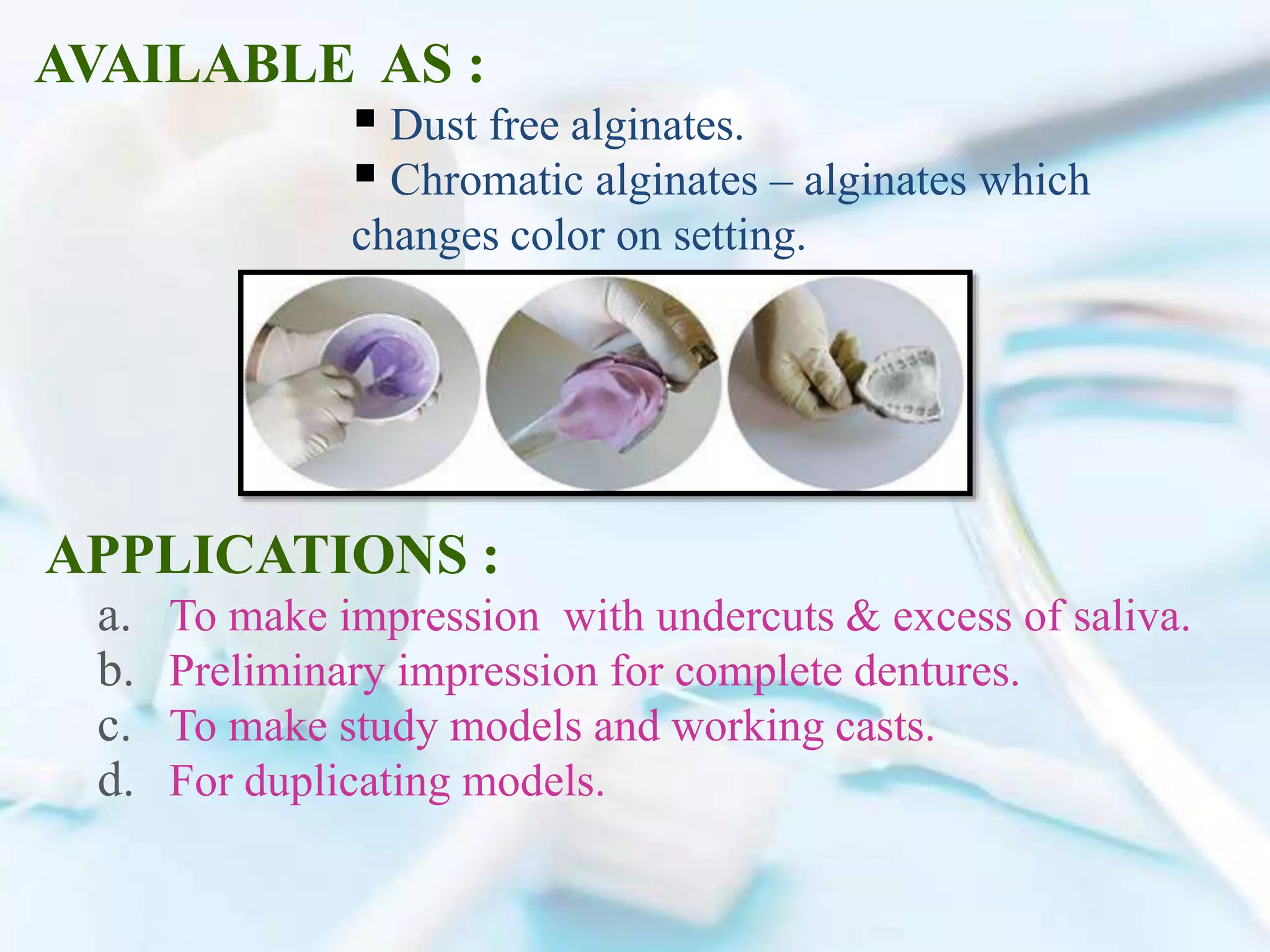
∞ Manipulation
∞ Mixing time
∞ Working time
∞ Gelation time
∞ Impression disinfectant
∞ Advantages & Disadvantages
Introduction :
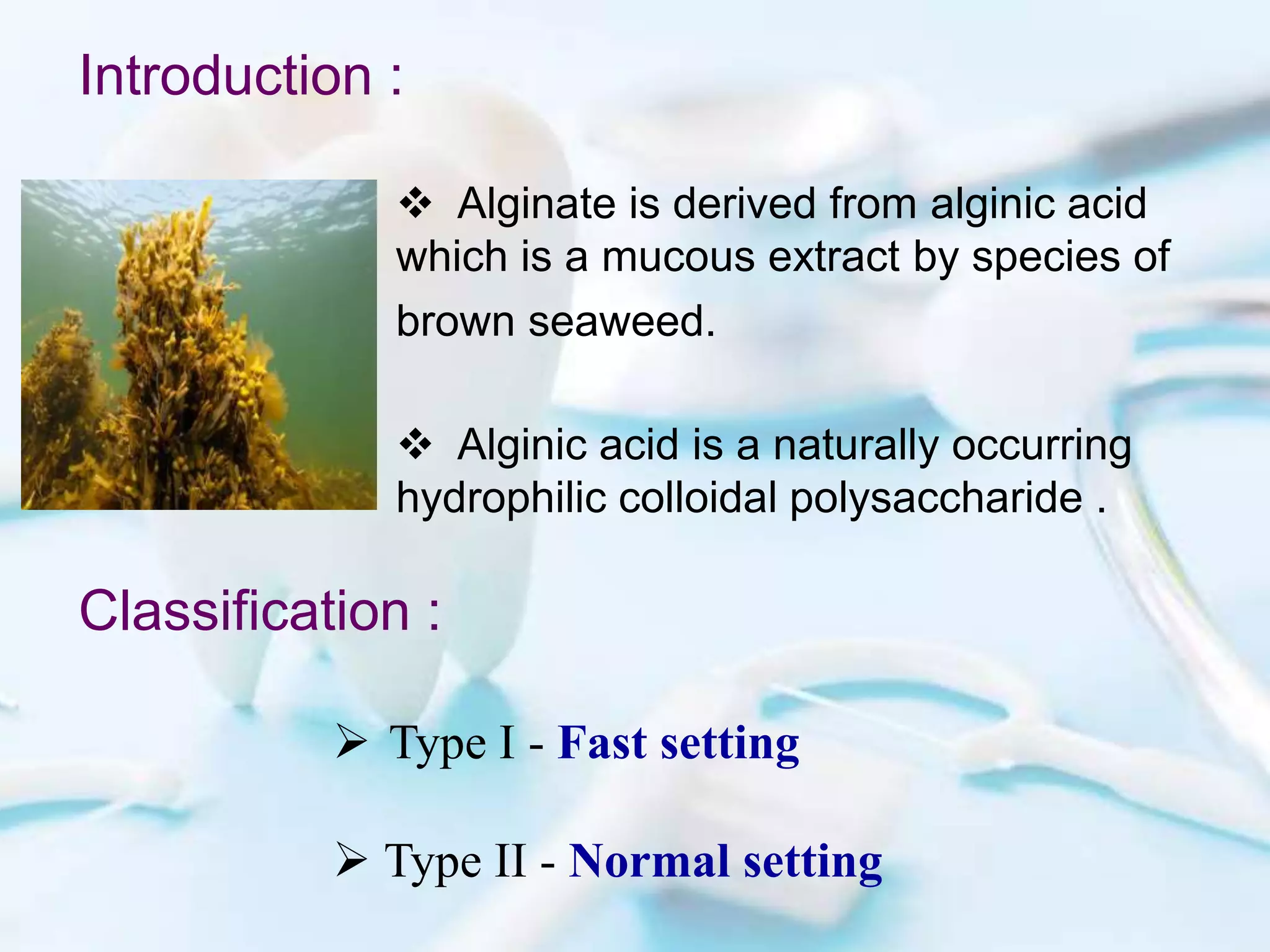
 Alginate is derived from alginic acid
which is a mucous extract by species of
brown seaweed.
 Alginic acid is a naturally occurring
hydrophilic colloidal polysaccharide .
Classification :
 Type I - Fast setting
 Type II - Normal setting
AVAILABLE AS :
 Dust free alginates.
 Chromatic alginates – alginates which
changes color on setting.
APPLICATIONS :
a. To make impression with undercuts & excess of saliva.
b. Preliminary impression for complete dentures.
c. To make study models and working casts.
d. For duplicating models.
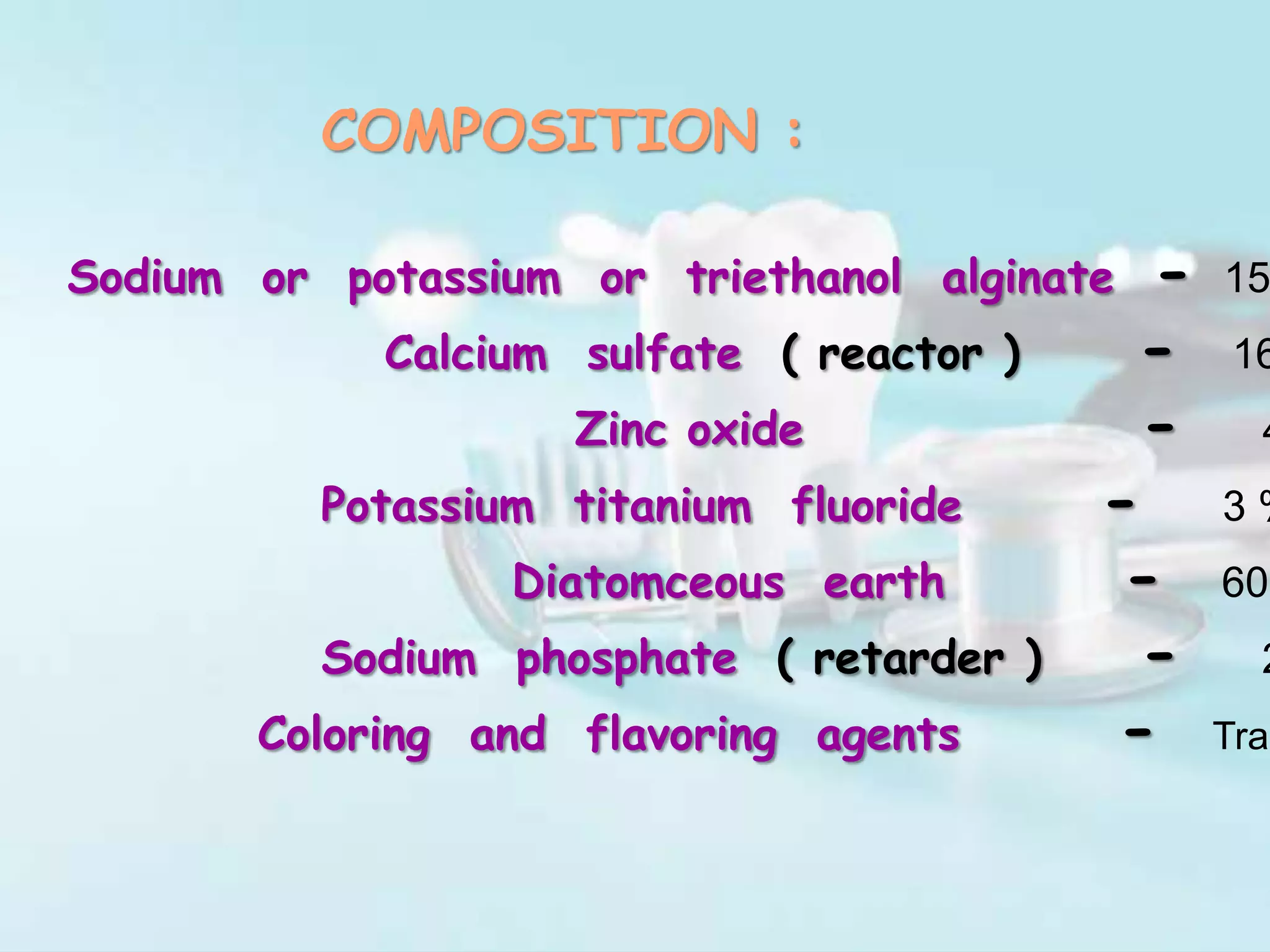
COMPOSITION :
Sodium or potassium or triethanol alginate - 15
Calcium sulfate ( reactor ) - 16
Zinc oxide - 4
Potassium titanium fluoride - 3 %
Diatomceous earth - 60
Sodium phosphate ( retarder ) - 2
Coloring and flavoring agents - Trac
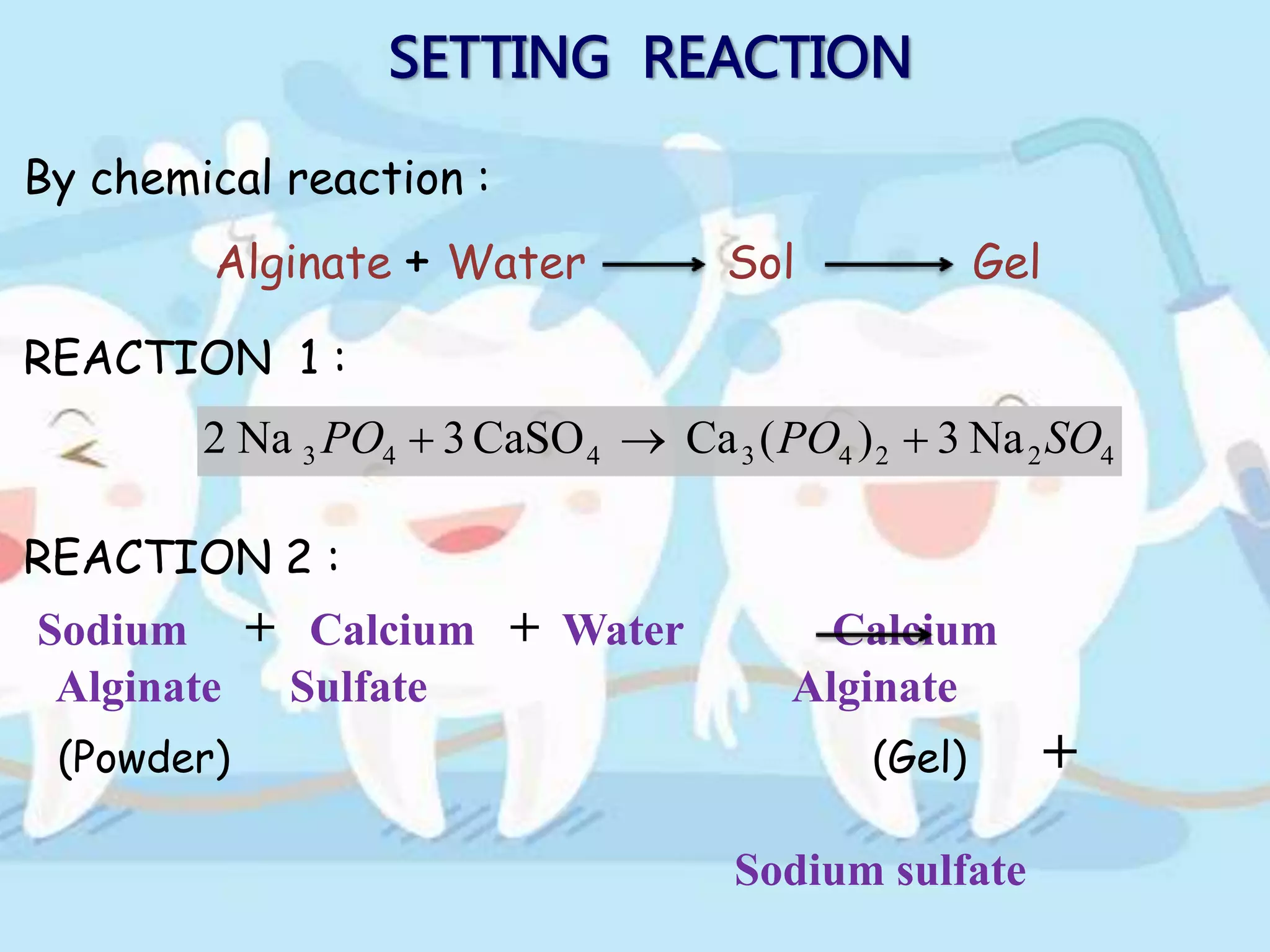
SETTING REACTION
By chemical reaction :
Alginate + Water Sol Gel
REACTION 1 :
REACTION 2 :
Sodium + Calcium + Water Calcium
Alginate Sulfate Alginate
(Powder) (Gel) +
Sodium sulfate
4224344 Na3)(CaCaSO3 SOPOPO 3Na2
Contd….
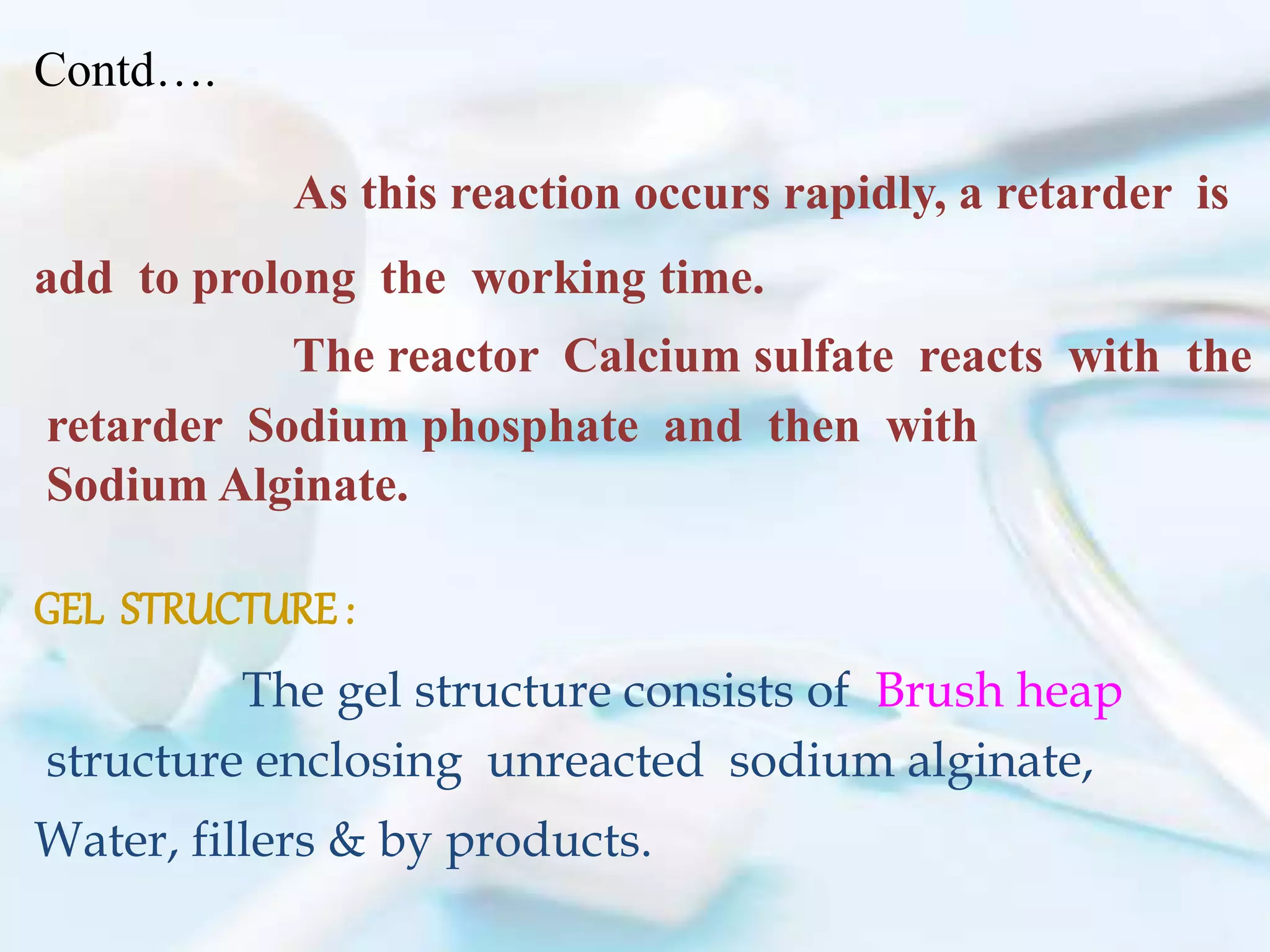
As this reaction occurs rapidly, a retarder is
add to prolong the working time.
The reactor Calcium sulfate reacts with the
retarder Sodium phosphate and then with
Sodium Alginate.
GEL STRUCTURE :
The gel structure consists of Brush heap
structure enclosing unreacted sodium alginate,
Water, fillers & by products.
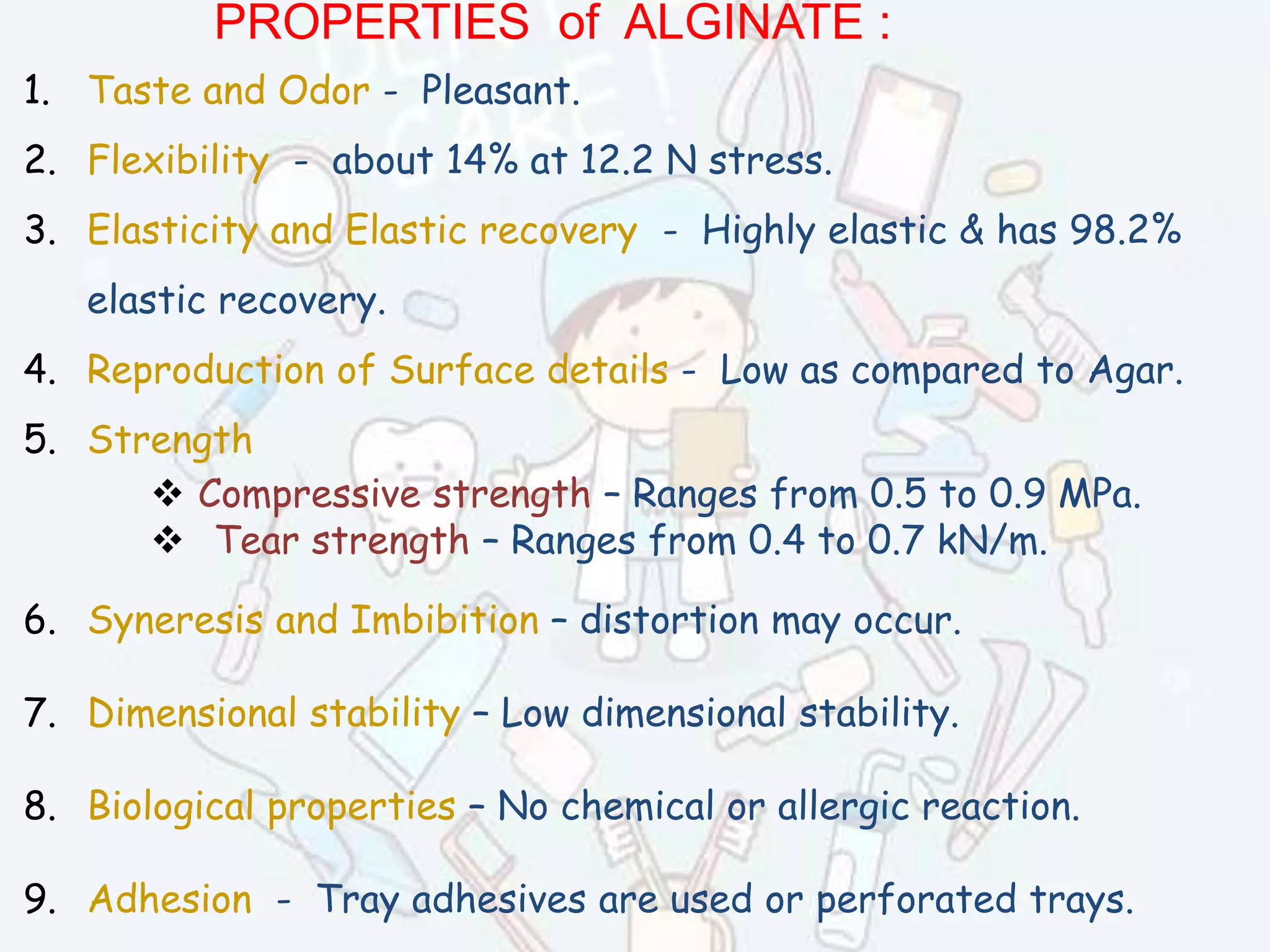
PROPERTIES of ALGINATE :
1. Taste and Odor - Pleasant.
2. Flexibility - about 14% at 12.2 N stress.
3. Elasticity and Elastic recovery - Highly elastic & has 98.2%
elastic recovery.
4. Reproduction of Surface details - Low as compared to Agar.
5. Strength
 Compressive strength – Ranges from 0.5 to 0.9 MPa.
 Tear strength – Ranges from 0.4 to 0.7 kN/m.
6. Syneresis and Imbibition – distortion may occur.
7. Dimensional stability – Low dimensional stability.
8. Biological properties – No chemical or allergic reaction.
9. Adhesion - Tray adhesives are used or perforated trays.
MANIPULATION :
Equipment required :
# Flexible plastic bowl.
# Metal spatula.
≥ W/P ratio – 1 : 2 - Powder is sprinkled into the water.
≥ Stirring motion - to wet the powder with water.
≥ Then a rapid spatulation by Swiping or stropping
against wall is done.
≥ Vigorous 8 motion is also used.
≥ Mechanical device can be used.
Mixing time :
For fast setting Alginate – 45 secs
For normal setting Alginate – 60 secs
Working time :
Type I – 1¼ mins.
Type II – 2 mins.
Gelation time :
Type I – 1.5 to 2 mins.
Type II – 3 to 4.5 mins.
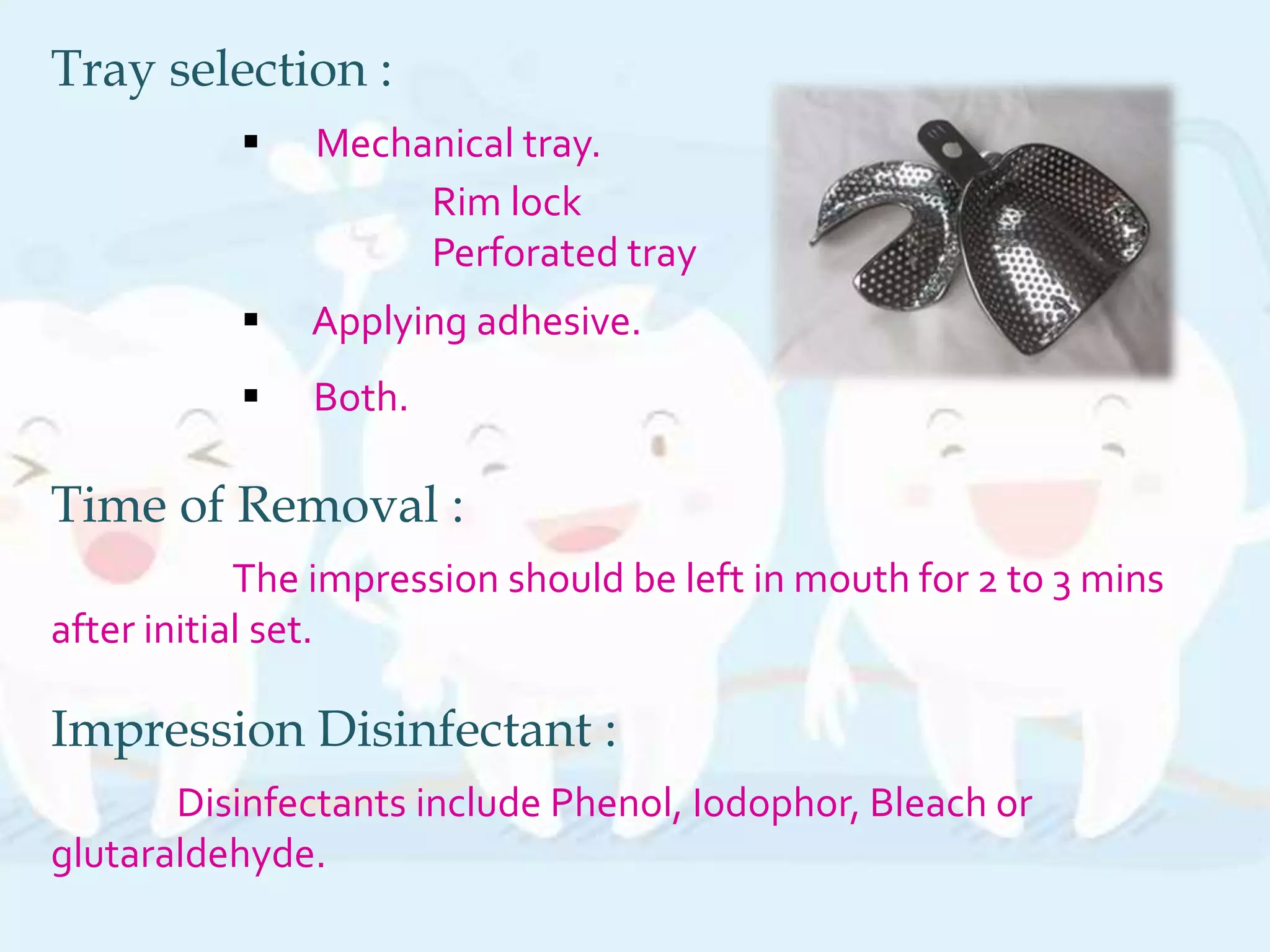
Tray selection :
 Mechanical tray.
Rim lock
Perforated tray
 Applying adhesive.
 Both.
Time of Removal :
The impression should be left in mouth for 2 to 3 mins
after initial set.
Impression Disinfectant :
Disinfectants include Phenol, Iodophor, Bleach or
glutaraldehyde.
Advantages :
∆ Easy to mix & manipulate.
∆ Flexibility of set material.
∆ Comfortable & hygiene.
∆ Good details even in presence of saliva.
∆ Low cost.
Disadvantages :
∆ Cannot be electroplated.
∆ Poor dimensional stability.
∆ Distortion may occur.
∆ Poor tear strength.
∆ Can’t be used for RPD, crowns & FPDs.
“ We just make impressions so
that others will get impressed on
YOU “

Elastic Impression material - Alginate

  • 1.
  • 2.
    CONTENTS ∞ Introduction ∞ Types ∞Available as ∞ Application ∞ Composition ∞ Setting reaction ∞ Properties ∞ Manipulation ∞ Mixing time ∞ Working time ∞ Gelation time ∞ Impression disinfectant ∞ Advantages & Disadvantages
  • 3.
    Introduction :  Alginateis derived from alginic acid which is a mucous extract by species of brown seaweed.  Alginic acid is a naturally occurring hydrophilic colloidal polysaccharide . Classification :  Type I - Fast setting  Type II - Normal setting
  • 4.
    AVAILABLE AS : Dust free alginates.  Chromatic alginates – alginates which changes color on setting. APPLICATIONS : a. To make impression with undercuts & excess of saliva. b. Preliminary impression for complete dentures. c. To make study models and working casts. d. For duplicating models.
  • 5.
    COMPOSITION : Sodium orpotassium or triethanol alginate - 15 Calcium sulfate ( reactor ) - 16 Zinc oxide - 4 Potassium titanium fluoride - 3 % Diatomceous earth - 60 Sodium phosphate ( retarder ) - 2 Coloring and flavoring agents - Trac
  • 6.
    SETTING REACTION By chemicalreaction : Alginate + Water Sol Gel REACTION 1 : REACTION 2 : Sodium + Calcium + Water Calcium Alginate Sulfate Alginate (Powder) (Gel) + Sodium sulfate 4224344 Na3)(CaCaSO3 SOPOPO 3Na2
  • 7.
    Contd…. As this reactionoccurs rapidly, a retarder is add to prolong the working time. The reactor Calcium sulfate reacts with the retarder Sodium phosphate and then with Sodium Alginate. GEL STRUCTURE : The gel structure consists of Brush heap structure enclosing unreacted sodium alginate, Water, fillers & by products.
  • 8.
    PROPERTIES of ALGINATE: 1. Taste and Odor - Pleasant. 2. Flexibility - about 14% at 12.2 N stress. 3. Elasticity and Elastic recovery - Highly elastic & has 98.2% elastic recovery. 4. Reproduction of Surface details - Low as compared to Agar. 5. Strength  Compressive strength – Ranges from 0.5 to 0.9 MPa.  Tear strength – Ranges from 0.4 to 0.7 kN/m. 6. Syneresis and Imbibition – distortion may occur. 7. Dimensional stability – Low dimensional stability. 8. Biological properties – No chemical or allergic reaction. 9. Adhesion - Tray adhesives are used or perforated trays.
  • 9.
    MANIPULATION : Equipment required: # Flexible plastic bowl. # Metal spatula. ≥ W/P ratio – 1 : 2 - Powder is sprinkled into the water. ≥ Stirring motion - to wet the powder with water. ≥ Then a rapid spatulation by Swiping or stropping against wall is done. ≥ Vigorous 8 motion is also used. ≥ Mechanical device can be used.
  • 10.
    Mixing time : Forfast setting Alginate – 45 secs For normal setting Alginate – 60 secs Working time : Type I – 1¼ mins. Type II – 2 mins. Gelation time : Type I – 1.5 to 2 mins. Type II – 3 to 4.5 mins.
  • 11.
    Tray selection : Mechanical tray. Rim lock Perforated tray  Applying adhesive.  Both. Time of Removal : The impression should be left in mouth for 2 to 3 mins after initial set. Impression Disinfectant : Disinfectants include Phenol, Iodophor, Bleach or glutaraldehyde.
  • 12.
    Advantages : ∆ Easyto mix & manipulate. ∆ Flexibility of set material. ∆ Comfortable & hygiene. ∆ Good details even in presence of saliva. ∆ Low cost. Disadvantages : ∆ Cannot be electroplated. ∆ Poor dimensional stability. ∆ Distortion may occur. ∆ Poor tear strength. ∆ Can’t be used for RPD, crowns & FPDs.
  • 13.
    “ We justmake impressions so that others will get impressed on YOU “