Presented by –
Piyali bhattacharya
1st year PGT
Dept . Of Prosthodontics Crown & Bridge
HIDSAR
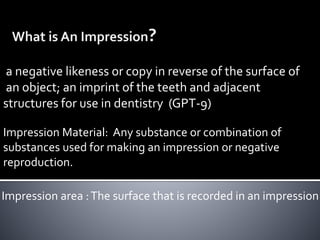
a negative likeness or copy in reverse of the surface of
an object; an imprint of the teeth and adjacent
structures for use in dentistry (GPT-9)
Impression area :The surface that is recorded in an impression
Impression Material: Any substance or combination of
substances used for making an impression or negative
reproduction.
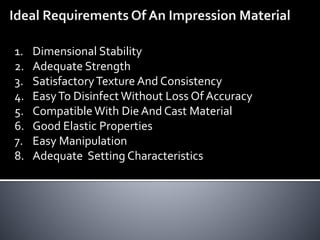
1. Dimensional Stability
2. Adequate Strength
3. SatisfactoryTexture And Consistency
4. EasyTo Disinfect Without Loss Of Accuracy
5. Compatible With Die And Cast Material
6. Good Elastic Properties
7. Easy Manipulation
8. Adequate Setting Characteristics
9.High Reproduction Of Details
10.Should Not Release Any Gas
11.Should Not BeTechnique Sensitive
12.Economical
13.Not Contain AnyToxic And Irritating Component
14.Adequate Shelf Life
15.Pleasant Smell AndTaste
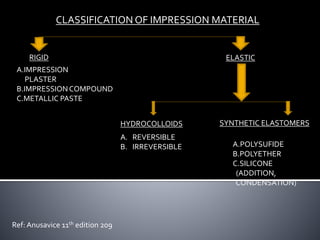
CLASSIFICATION OF IMPRESSION MATERIAL
RIGID ELASTIC
A.IMPRESSION
PLASTER
B.IMPRESSIONCOMPOUND
C.METALLIC PASTE
HYDROCOLLOIDS
A. REVERSIBLE
B. IRREVERSIBLE
SYNTHETIC ELASTOMERS
A.POLYSUFIDE
B.POLYETHER
C.SILICONE
(ADDITION,
CONDENSATION)
Ref: Anusavice 11th edition 209
INTRODUCTION
Reversible hydrocolloid was introduced to the dental
profession in 1925 by Alphons Poller , an
Austrian as impression material .
Agar was first introduced into dentistry for recording
crown impressions in 1937 by Sears .
Sanjay Madhavan et al /J. Pharm. Sci. & Res.Vol. 7(9), 2015, 704-707
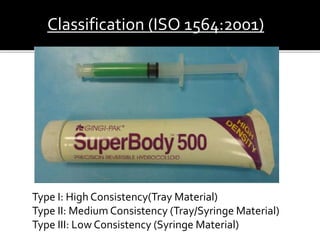
Type I: High Consistency(Tray Material)
Type II: Medium Consistency (Tray/Syringe Material)
Type III: Low Consistency (Syringe Material)
Classification (ISO 1564:2001)
1.Full mouth impression without deep undercuts
2.As a tissue conditioner
3.As duplicating material
4.Earlier it was extensively used for FPD impression
prior to elastomers
Composition & Functions Of Each
Components:
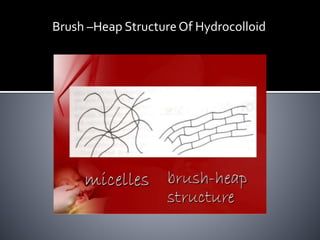
Agar (13%-17%)- Brush-heap structure
Borate(0.2%-0.5%)- Strength
Sulfate(1%-2%)- Gypsum Hardener
Wax(0.5%-1.0%)- Filler
Thixotropic materials(0.3%-0.5%)-Thickener
Water –Reaction medium
Brush –Heap StructureOf Hydrocolloid
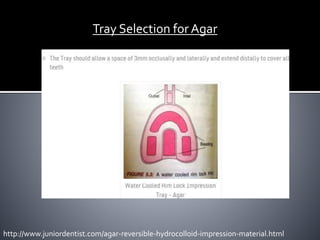
Tray Selection for Agar
http://www.juniordentist.com/agar-reversible-hydrocolloid-impression-material.html
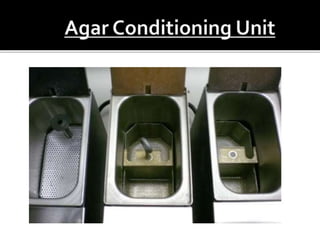
1) Preparation And Conditioning Of The Material
2) TemperingThe Material
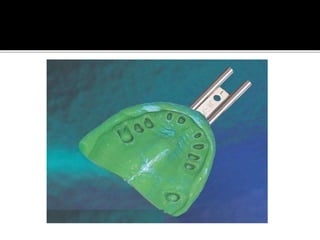
3) MakingThe Agar Impression
Working time: 7-15 minutes
Setting time: 5 minutes
Accuracy:
One of the most accurate impression materials
which has a long history of successful use in
dentistry.
Viscosity ofThe Sol:
The material must be viscous enough even after it
has been liquefied in order to prevent itself from
flowing out of the tray when it’s inverted e.g.;
while making a mandibular impression.
Even when the material is viscous enough to stabilize the
tray it does not offer much resistance to seating Also
patient may “bite through” the impression material..
With a “TripleTrayTechnique ” the oral impression of the
maxillary ,mandibular arches as well as occlusal
relationship can be recorded although it is technique
sensitive procedure.
Distortion during Gelation:
As the material undergoes physical change from
Sol to Gel contraction occurs (usually in the center
of the tray, resulting in larger dies)
As the Sol is a poor conductor of temperature,
rapid cooling of the tray causes stress concentration
near the tray where the gelation first occurs.
Ideally water at 20℃ is most suitable for cooling the
impression tray than ice water.
1.Gelation, Liquefaction And Hysterisis
Gelation at 37 ℃
Liquefaction at 60 ℃ - 70 ℃
2.Syneresis And Imbibition
Whenever immersed into water agar doesn’t imbibe the
original amount of water as it loses by evaporation
3.Flexibility:
Between 4-15% with application of 14.2 Psi pressure
4.Elasticity and elastic recovery
Highly elastic in nature, elastic recovery is about 98.8%
Strength:
Tear strength of agar 0.8-0.9 N/mm
Shelf-life:
One year.
Introduction:
In 1921 in England a chemist , sirWilliam Wilding
received a basic patent for using Algin as a dental
impression material
Was introduced as a substitute for agar when its’ supply
became scarce after WW II.
The material is based on substances extracted from
certain brown seaweed (anhydro –β-δ- mannuronic
acid/ alginic acid).
Properties of Alginate Impression Material:
1. Pleasant taste and smell
2. Highly flexible
3. good elasticity and elastic recovery
4. Fine reproduction of details
5. Compressive strength 0.33-0.70 MPa
6. Tear strength 350-700 gm/cm²
7. Poorly adheres to the tray
Uses:
Used for making preliminary impression to construct
custom tray, make study models , help in treatment
planning.
As alginate is hydrophilic in nature, impression can be
recorded even on moist oral tissues
Potassium Alginate (15%)- Soluble Alginate
(Or Sodium Alginate)
Calcium Sulfate(16%)- Reactor
Zinc Oxide(4%)-Filler Particle
PotassiumTitanium Fluoride(3%)- Accelerator
Diatomaceous earth (60%)- Filler Particles
Sodium Phosphate (2%)- Retarder
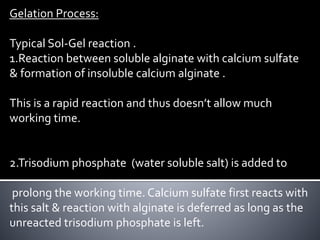
Gelation Process:
Typical Sol-Gel reaction .
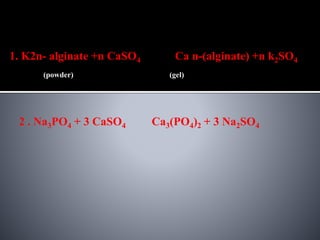
1.Reaction between soluble alginate with calcium sulfate
& formation of insoluble calcium alginate .
This is a rapid reaction and thus doesn’t allow much
working time.
2.Trisodium phosphate (water soluble salt) is added to
prolong the working time. Calcium sulfate first reacts with
this salt & reaction with alginate is deferred as long as the
unreacted trisodium phosphate is left.
1. K2n- alginate +n CaSO4 Ca n-(alginate) +n k2SO4
(powder) (gel)
2 . Na3PO4 + 3 CaSO4 Ca3(PO4)2 + 3 Na2SO4
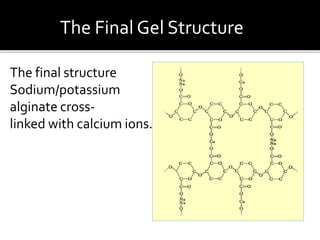
The final structure
Sodium/potassium
alginate cross-
linked with calcium ions.
The Final Gel Structure
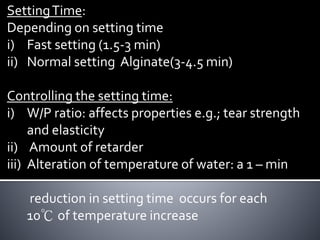
SettingTime:
Depending on setting time
i) Fast setting (1.5-3 min)
ii) Normal setting Alginate(3-4.5 min)
Controlling the setting time:
i) W/P ratio: affects properties e.g.; tear strength
and elasticity
ii) Amount of retarder
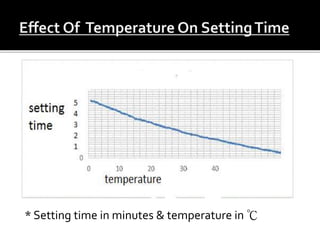
iii) Alteration of temperature of water: a 1 – min
reduction in setting time occurs for each
10℃ of temperature increase
* Setting time in minutes & temperature in ℃
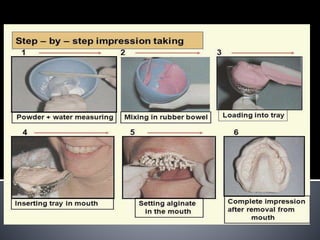
1.Measured powder is sifted into premeasured
water into a clean rubber bowl
2.The powder is incorporated into water by
carefully mixing with a metal spatula in vigorous
figure of 8 motion with intermittent rotations (180◦)
of spatula to press out air bubbles
powder should always be weighed not measured.
Mixing time: 45 sec-1 min
Ideal w/p ratio: 38 ml water/16 gm. powder
A perforated tray is usually used .if plastic or metal rim-lock
tray is used , a thin layer of alginate tray adhesive is applied
and allowed to dry before mixing and loading the tray.
As alginate is weak the tray must fit into the patient’s mouth
to provide sufficient bulk of material.
The thickness of alginate between tray and oral tissue should
be 3 mm.
The compressive strength of alginate doubles the first 4 mins
but after 4 mins it does not increase much
Alginate impression material should be kept in the mouth
for at least 3 min after the gelation has already occurred.
Removal of Impression:
The tear strength of alginate increases if the impression is
removed with a snap
Avoid torqueing or twisting of impression
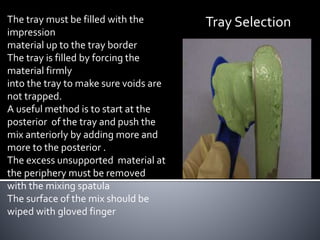
The tray must be filled with the
impression
material up to the tray border
The tray is filled by forcing the
material firmly
into the tray to make sure voids are
not trapped.
A useful method is to start at the
posterior of the tray and push the
mix anteriorly by adding more and
more to the posterior .
The excess unsupported material at
the periphery must be removed
with the mixing spatula
The surface of the mix should be
wiped with gloved finger
Tray Selection
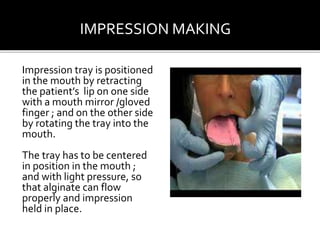
Impression tray is positioned
in the mouth by retracting
the patient’s lip on one side
with a mouth mirror /gloved
finger ; and on the other side
by rotating the tray into the
mouth.
The tray has to be centered
in position in the mouth ;
and with light pressure, so
that alginate can flow
properly and impression
held in place.
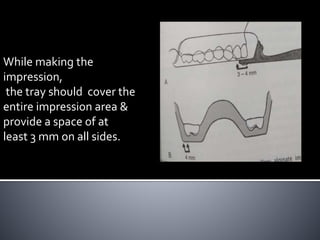
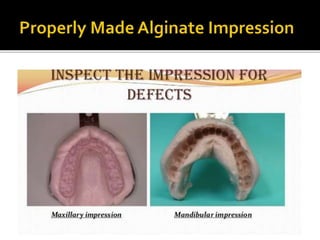
IMPRESSION MAKING
While making the
impression,
the tray should cover the
entire impression area &
provide a space of at
least 3 mm on all sides.
Factors affecting the strength of the gel
1.Adequate w/p ratio: Too much or too less water
weakens the gel
2.Adequet spatulation: over mixing breaks up the
calcium alginate network and reduces the strength.
Accuracy
Alginates are sufficiently accurate for making impression
for removable partial dentures.
However, as compared to elastomeric impression materials,
alginate do not produce finer details
 The tear strength is a measure of
force/thickness ratio needed to initiate or
continue tearing.
 Ranges from- (0.37 to 0.69)N/mm
 Tearing occurs in the thin sections of the
impressions and the probability of tearing
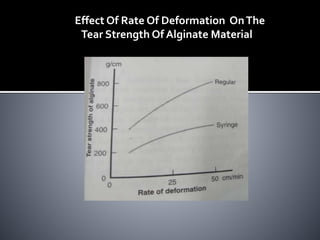
decreases with the increase in rate of removal
Effect Of Rate Of Deformation OnThe
Tear Strength Of Alginate Material
1.Flexibility:About 14% at stress of 1000gm/cm2 .Some of
the hard set materials have lower elasticity(5-8%)lower
w/p ration results in lower flexibility
2.Elasticity & Elastic Recovery:Less elastic when compared to
agar impression material.it Is about 98.2%.thus permanent
deformation is more for alginate, but when set impression is
removed early from mouth , permanent deformation is less
3.Reproduction of tissue detail: Lower when compared to
agar.ADA sp. Requires this material to reproduce a line that is
0.075 mm in width
4.Strength:
Compressive strength: 0.33-0.70MPa
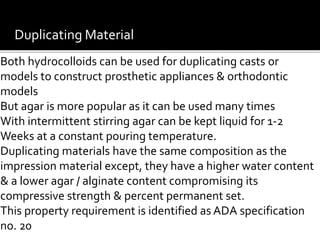
Duplicating Material
Both hydrocolloids can be used for duplicating casts or
models to construct prosthetic appliances & orthodontic
models
But agar is more popular as it can be used many times
With intermittent stirring agar can be kept liquid for 1-2
Weeks at a constant pouring temperature.
Duplicating materials have the same composition as the
impression material except, they have a higher water content
& a lower agar / alginate content compromising its
compressive strength & percent permanent set.
This property requirement is identified as ADA specification
no. 20
Hydrocolloids should be disinfected for a limited time period .
Immersion is more secure than spraying and self-disinfecting
materials are efficacious, but better accompanied by immersion.
Most manufacturers recommend iodophor, gluteraldehyde,
phenol as disinfectants
E . k o t s i omi t i et al., Dimensional changes of disinfected i m p r e s s i o n s, Journal of Oral
Rehabilitation 2008 35; 291–299
Disinfection of hydrocolloids
The addition of 1% chlorhexidine di acetate to
Alginate has decreased its compatibility with
the dental stones when compared with its non-
antimicrobial counterpart. In terms of gypsum
compatibility, the non-antimicrobial Alginate
was compatible with all disinfectant and
gypsum combinations.
King, Norling, and Seal, Compatibility /Antimicrobial Alginates, Journal of prosthodontics.Vol3,
No 4 (December), 1994:pp219-227
The current protocol from the CENTER for DISEASE CONTROL
is to use house hold bleach, (1-10 dilution), Iodophor ,
synthetic phenol as disinfectants . After impression is rinsed
thoroughly under water, disinfectants can be sprayed . then
impression is wrapped in disinfectant soaked paper towel &
placed in a plastic bag for 10 minutes. Finally, impression
Is taken out of bag unwrapped, rinsed, shaken to remove
excess water and poured with stone.
Dimensional stability of Hydrocolloids
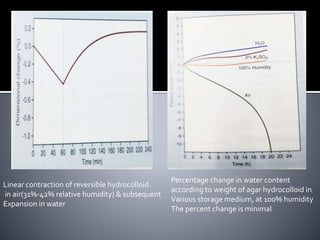
In case of Agar, if the impression is left exposed in the air at
room temperature shrinkage occurs due to syneresis.
If the impression is immersed into water, swelling occurs due to
imbibition
2% Potassium sulfate or 100% relative humidity are suggested
to prevent dimensional change of agar.
Alginate impression materials shrink slightly because of the
thermal differential between mouth temperature
(37˚c) and room temperature(20 ˚c).While agar impression
material shows a temperature shift in opposite direction , from
chilled water to warmer room temperature makes the
impression to expand and become less accurate
Linear contraction of reversible hydrocolloid
in air(31%-42% relative humidity) & subsequent
Expansion in water
Percentage change in water content
according to weight of agar hydrocolloid in
Various storage medium, at 100% humidity
The percent change is minimal
Borax , which is a gypsum retarder is used as a filler in agar
impression material which may cause surface of gypsum
casts prepared from agar to be soft for using as dies.
The gelation process of alginate impression produces
calcium alginate & sodium sulfate which is a gypsum
accelerator at low concentration & a retarder at high
concentration .The amount of sodium sulfate produced
becomes enough to retard the setting of gypsum cast
1. By immersing impression in accelerator such as 2%
potassium sulfate solution prior to pouring impression with
gypsum product
2. By using products that incorporate gypsum hardener or
accelerator e.g.; sulfate in agar & potassium titanium fluoride
in alginate.
The Stone cast/Die should be in contact with the impression
material for at least 30min or preferably 60 min.
Separation of Cast : Separation of cast should be
done within a reasonable period of time . As
desiccation of the hydrocolloid may cause abrasion
of gypsum during removal
Biocompatibility
Silica particles present in alginate may cause silicosis ,pulmonary
hypersensitivity,
The most common side effect of reversible hydrocolloid is
thermal injury due to improper tempering or faulty equipment
during impression making
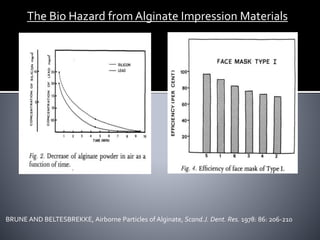
The Bio Hazard from Alginate Impression Materials
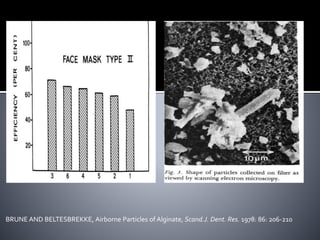
BRUNE AND BELTESBREKKE, Airborne Particles of Alginate, Scand.J. Dent. Res. 1978: 86: 206-210
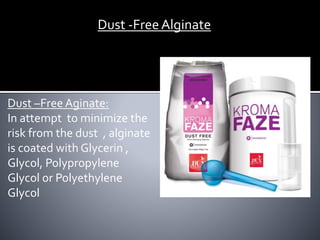
Dust -FreeAlginate
Dust –Free Aginate:
In attempt to minimize the
risk from the dust , alginate
is coated with Glycerin ,
Glycol, Polypropylene
Glycol or Polyethylene
Glycol
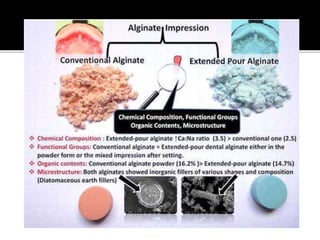
1.Extended-pourAlginate:
enables to delay pouring impression under specified
condition for up to 100 hrs without much dimensional change.
Some extended pour alginate allows to delay pouring up
to 4 weeks
Kaur et. Al., Alginate Impression Material: from then till now..
HealTalk | November-December 2012|volume 05| issue 2
2. HighViscosityAlginates:
By incorporation of hydrophobic material(.01-.1 wt %) or
surfactants (0.05-0.1 wt %) permeation of water is speeded,
Kneading time is shortened , incorporation of polysaccharides
prevent gagging
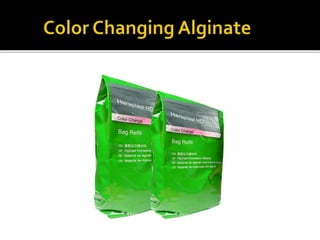
3.Color Changing Alginate: By adding pH indicator.
Although most pH indicator changes color little above pH 8
before the actual gelation time.
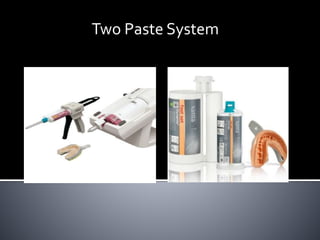
4.Two Paste system:
Base paste contains soluble mix of Alginate , water and fillers .
With paste forming materials e.g.; Gum arabican , carrageenan
Reactor/ catalyst paste contains calcium salt with viscous liq.
like paraffin & a pH stabilizing agent (magnesium hydroxide)
5.Tray Adhesive for Alginate:
A tray adhesive in the form of liquid or spray containing
polyamide or diethylene tetra amine ether , ester gum and rosin
containing isopropyl alcohol.
Two Paste System
Infection Free Alginate: Alginate incorporated with
disinfectant materials such as quaternary ammonium
compounds , bisguanides , chlorhexidine without
compromising its’ properties
Epimax showed highest disinfection action after 10 mins
EFFECT CAUSE
Grainy material •Improper mixing
•Prolonged mixing
•Excessive gelation
•water/powder ratio too low
Tearing •Inadequate bulk
•Moister contamination
•Premature removal from mouth
•Prolonged mixing
External bubbles Undue gelation preventing flow air
incorporated during mixing
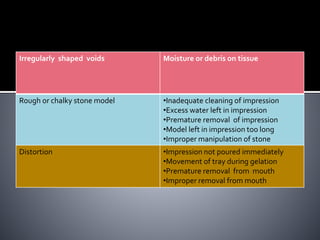
Irregularly shaped voids Moisture or debris on tissue
Rough or chalky stone model •Inadequate cleaning of impression
•Excess water left in impression
•Premature removal of impression
•Model left in impression too long
•Improper manipulation of stone
Distortion •Impression not poured immediately
•Movement of tray during gelation
•Premature removal from mouth
•Improper removal from mouth
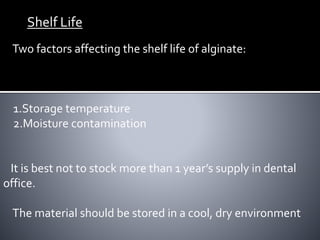
Shelf Life
Two factors affecting the shelf life of alginate:
1.Storage temperature
2.Moisture contamination
It is best not to stock more than 1 year’s supply in dental
office.
The material should be stored in a cool, dry environment
1. Ref: Anusavice 11th edition 209
2. Sanjay Madhavan et al /J. Pharm. Sci. & Res.Vol. 7(9), 2015, 704-707
3. http://www.juniordentist.com/agar-reversible-hydrocolloid-
impressionmaterial.html
4. E . k o t s i omi t i et al., Dimensional changes of disinfected i m p r e s s i o n s,
Journal of Oral Rehabilitation 2008 35; 291–299
5. King, Norling, and Seal, Compatibility /Antimicrobial Alginates, Journal of
prosthodontics.Vol3, No 4 (December), 1994:pp219-227
6. BRUNE AND BELTESBREKKE, Airborne Particles of Alginate, Scand.J. Dent. Res.
1978: 86: 206-210
7. Kaur et. Al., Alginate Impression Material: from then till now..
HealTalk | November-December 2012|volume 05| issue 2

Hydrocolloid impression materials

  • 1.
    Presented by – Piyalibhattacharya 1st year PGT Dept . Of Prosthodontics Crown & Bridge HIDSAR
  • 2.
    a negative likenessor copy in reverse of the surface of an object; an imprint of the teeth and adjacent structures for use in dentistry (GPT-9) Impression area :The surface that is recorded in an impression Impression Material: Any substance or combination of substances used for making an impression or negative reproduction.
  • 3.
    1. Dimensional Stability 2.Adequate Strength 3. SatisfactoryTexture And Consistency 4. EasyTo Disinfect Without Loss Of Accuracy 5. Compatible With Die And Cast Material 6. Good Elastic Properties 7. Easy Manipulation 8. Adequate Setting Characteristics
  • 4.
    9.High Reproduction OfDetails 10.Should Not Release Any Gas 11.Should Not BeTechnique Sensitive 12.Economical 13.Not Contain AnyToxic And Irritating Component 14.Adequate Shelf Life 15.Pleasant Smell AndTaste
  • 5.
    CLASSIFICATION OF IMPRESSIONMATERIAL RIGID ELASTIC A.IMPRESSION PLASTER B.IMPRESSIONCOMPOUND C.METALLIC PASTE HYDROCOLLOIDS A. REVERSIBLE B. IRREVERSIBLE SYNTHETIC ELASTOMERS A.POLYSUFIDE B.POLYETHER C.SILICONE (ADDITION, CONDENSATION) Ref: Anusavice 11th edition 209
  • 6.
  • 8.
    Reversible hydrocolloid wasintroduced to the dental profession in 1925 by Alphons Poller , an Austrian as impression material . Agar was first introduced into dentistry for recording crown impressions in 1937 by Sears . Sanjay Madhavan et al /J. Pharm. Sci. & Res.Vol. 7(9), 2015, 704-707
  • 9.
    Type I: HighConsistency(Tray Material) Type II: Medium Consistency (Tray/Syringe Material) Type III: Low Consistency (Syringe Material) Classification (ISO 1564:2001)
  • 10.
    1.Full mouth impressionwithout deep undercuts 2.As a tissue conditioner 3.As duplicating material 4.Earlier it was extensively used for FPD impression prior to elastomers
  • 11.
    Composition & FunctionsOf Each Components: Agar (13%-17%)- Brush-heap structure Borate(0.2%-0.5%)- Strength Sulfate(1%-2%)- Gypsum Hardener Wax(0.5%-1.0%)- Filler Thixotropic materials(0.3%-0.5%)-Thickener Water –Reaction medium
  • 12.
  • 15.
    Tray Selection forAgar http://www.juniordentist.com/agar-reversible-hydrocolloid-impression-material.html
  • 16.
    1) Preparation AndConditioning Of The Material 2) TemperingThe Material 3) MakingThe Agar Impression
  • 19.
    Working time: 7-15minutes Setting time: 5 minutes
  • 20.
    Accuracy: One of themost accurate impression materials which has a long history of successful use in dentistry. Viscosity ofThe Sol: The material must be viscous enough even after it has been liquefied in order to prevent itself from flowing out of the tray when it’s inverted e.g.; while making a mandibular impression.
  • 21.
    Even when thematerial is viscous enough to stabilize the tray it does not offer much resistance to seating Also patient may “bite through” the impression material.. With a “TripleTrayTechnique ” the oral impression of the maxillary ,mandibular arches as well as occlusal relationship can be recorded although it is technique sensitive procedure.
  • 22.
    Distortion during Gelation: Asthe material undergoes physical change from Sol to Gel contraction occurs (usually in the center of the tray, resulting in larger dies) As the Sol is a poor conductor of temperature, rapid cooling of the tray causes stress concentration near the tray where the gelation first occurs. Ideally water at 20℃ is most suitable for cooling the impression tray than ice water.
  • 23.
    1.Gelation, Liquefaction AndHysterisis Gelation at 37 ℃ Liquefaction at 60 ℃ - 70 ℃ 2.Syneresis And Imbibition Whenever immersed into water agar doesn’t imbibe the original amount of water as it loses by evaporation 3.Flexibility: Between 4-15% with application of 14.2 Psi pressure
  • 24.
    4.Elasticity and elasticrecovery Highly elastic in nature, elastic recovery is about 98.8% Strength: Tear strength of agar 0.8-0.9 N/mm Shelf-life: One year.
  • 25.
    Introduction: In 1921 inEngland a chemist , sirWilliam Wilding received a basic patent for using Algin as a dental impression material Was introduced as a substitute for agar when its’ supply became scarce after WW II. The material is based on substances extracted from certain brown seaweed (anhydro –β-δ- mannuronic acid/ alginic acid).
  • 26.
    Properties of AlginateImpression Material: 1. Pleasant taste and smell 2. Highly flexible 3. good elasticity and elastic recovery 4. Fine reproduction of details 5. Compressive strength 0.33-0.70 MPa 6. Tear strength 350-700 gm/cm² 7. Poorly adheres to the tray
  • 27.
    Uses: Used for makingpreliminary impression to construct custom tray, make study models , help in treatment planning. As alginate is hydrophilic in nature, impression can be recorded even on moist oral tissues
  • 28.
    Potassium Alginate (15%)-Soluble Alginate (Or Sodium Alginate) Calcium Sulfate(16%)- Reactor Zinc Oxide(4%)-Filler Particle PotassiumTitanium Fluoride(3%)- Accelerator Diatomaceous earth (60%)- Filler Particles Sodium Phosphate (2%)- Retarder
  • 29.
    Gelation Process: Typical Sol-Gelreaction . 1.Reaction between soluble alginate with calcium sulfate & formation of insoluble calcium alginate . This is a rapid reaction and thus doesn’t allow much working time. 2.Trisodium phosphate (water soluble salt) is added to prolong the working time. Calcium sulfate first reacts with this salt & reaction with alginate is deferred as long as the unreacted trisodium phosphate is left.
  • 30.
    1. K2n- alginate+n CaSO4 Ca n-(alginate) +n k2SO4 (powder) (gel) 2 . Na3PO4 + 3 CaSO4 Ca3(PO4)2 + 3 Na2SO4
  • 31.
    The final structure Sodium/potassium alginatecross- linked with calcium ions. The Final Gel Structure
  • 32.
    SettingTime: Depending on settingtime i) Fast setting (1.5-3 min) ii) Normal setting Alginate(3-4.5 min) Controlling the setting time: i) W/P ratio: affects properties e.g.; tear strength and elasticity ii) Amount of retarder iii) Alteration of temperature of water: a 1 – min reduction in setting time occurs for each 10℃ of temperature increase
  • 33.
    * Setting timein minutes & temperature in ℃
  • 35.
    1.Measured powder issifted into premeasured water into a clean rubber bowl 2.The powder is incorporated into water by carefully mixing with a metal spatula in vigorous figure of 8 motion with intermittent rotations (180◦) of spatula to press out air bubbles powder should always be weighed not measured. Mixing time: 45 sec-1 min Ideal w/p ratio: 38 ml water/16 gm. powder
  • 36.
    A perforated trayis usually used .if plastic or metal rim-lock tray is used , a thin layer of alginate tray adhesive is applied and allowed to dry before mixing and loading the tray. As alginate is weak the tray must fit into the patient’s mouth to provide sufficient bulk of material. The thickness of alginate between tray and oral tissue should be 3 mm.
  • 37.
    The compressive strengthof alginate doubles the first 4 mins but after 4 mins it does not increase much Alginate impression material should be kept in the mouth for at least 3 min after the gelation has already occurred. Removal of Impression: The tear strength of alginate increases if the impression is removed with a snap Avoid torqueing or twisting of impression
  • 39.
    The tray mustbe filled with the impression material up to the tray border The tray is filled by forcing the material firmly into the tray to make sure voids are not trapped. A useful method is to start at the posterior of the tray and push the mix anteriorly by adding more and more to the posterior . The excess unsupported material at the periphery must be removed with the mixing spatula The surface of the mix should be wiped with gloved finger Tray Selection
  • 40.
    Impression tray ispositioned in the mouth by retracting the patient’s lip on one side with a mouth mirror /gloved finger ; and on the other side by rotating the tray into the mouth. The tray has to be centered in position in the mouth ; and with light pressure, so that alginate can flow properly and impression held in place. IMPRESSION MAKING
  • 42.
    While making the impression, thetray should cover the entire impression area & provide a space of at least 3 mm on all sides.
  • 45.
    Factors affecting thestrength of the gel 1.Adequate w/p ratio: Too much or too less water weakens the gel 2.Adequet spatulation: over mixing breaks up the calcium alginate network and reduces the strength. Accuracy Alginates are sufficiently accurate for making impression for removable partial dentures. However, as compared to elastomeric impression materials, alginate do not produce finer details
  • 46.
     The tearstrength is a measure of force/thickness ratio needed to initiate or continue tearing.  Ranges from- (0.37 to 0.69)N/mm  Tearing occurs in the thin sections of the impressions and the probability of tearing decreases with the increase in rate of removal
  • 47.
    Effect Of RateOf Deformation OnThe Tear Strength Of Alginate Material
  • 48.
    1.Flexibility:About 14% atstress of 1000gm/cm2 .Some of the hard set materials have lower elasticity(5-8%)lower w/p ration results in lower flexibility 2.Elasticity & Elastic Recovery:Less elastic when compared to agar impression material.it Is about 98.2%.thus permanent deformation is more for alginate, but when set impression is removed early from mouth , permanent deformation is less 3.Reproduction of tissue detail: Lower when compared to agar.ADA sp. Requires this material to reproduce a line that is 0.075 mm in width 4.Strength: Compressive strength: 0.33-0.70MPa
  • 53.
    Duplicating Material Both hydrocolloidscan be used for duplicating casts or models to construct prosthetic appliances & orthodontic models But agar is more popular as it can be used many times With intermittent stirring agar can be kept liquid for 1-2 Weeks at a constant pouring temperature. Duplicating materials have the same composition as the impression material except, they have a higher water content & a lower agar / alginate content compromising its compressive strength & percent permanent set. This property requirement is identified as ADA specification no. 20
  • 54.
    Hydrocolloids should bedisinfected for a limited time period . Immersion is more secure than spraying and self-disinfecting materials are efficacious, but better accompanied by immersion. Most manufacturers recommend iodophor, gluteraldehyde, phenol as disinfectants E . k o t s i omi t i et al., Dimensional changes of disinfected i m p r e s s i o n s, Journal of Oral Rehabilitation 2008 35; 291–299 Disinfection of hydrocolloids
  • 55.
    The addition of1% chlorhexidine di acetate to Alginate has decreased its compatibility with the dental stones when compared with its non- antimicrobial counterpart. In terms of gypsum compatibility, the non-antimicrobial Alginate was compatible with all disinfectant and gypsum combinations. King, Norling, and Seal, Compatibility /Antimicrobial Alginates, Journal of prosthodontics.Vol3, No 4 (December), 1994:pp219-227
  • 56.
    The current protocolfrom the CENTER for DISEASE CONTROL is to use house hold bleach, (1-10 dilution), Iodophor , synthetic phenol as disinfectants . After impression is rinsed thoroughly under water, disinfectants can be sprayed . then impression is wrapped in disinfectant soaked paper towel & placed in a plastic bag for 10 minutes. Finally, impression Is taken out of bag unwrapped, rinsed, shaken to remove excess water and poured with stone.
  • 57.
    Dimensional stability ofHydrocolloids In case of Agar, if the impression is left exposed in the air at room temperature shrinkage occurs due to syneresis. If the impression is immersed into water, swelling occurs due to imbibition 2% Potassium sulfate or 100% relative humidity are suggested to prevent dimensional change of agar. Alginate impression materials shrink slightly because of the thermal differential between mouth temperature (37˚c) and room temperature(20 ˚c).While agar impression material shows a temperature shift in opposite direction , from chilled water to warmer room temperature makes the impression to expand and become less accurate
  • 58.
    Linear contraction ofreversible hydrocolloid in air(31%-42% relative humidity) & subsequent Expansion in water Percentage change in water content according to weight of agar hydrocolloid in Various storage medium, at 100% humidity The percent change is minimal
  • 59.
    Borax , whichis a gypsum retarder is used as a filler in agar impression material which may cause surface of gypsum casts prepared from agar to be soft for using as dies. The gelation process of alginate impression produces calcium alginate & sodium sulfate which is a gypsum accelerator at low concentration & a retarder at high concentration .The amount of sodium sulfate produced becomes enough to retard the setting of gypsum cast
  • 60.
    1. By immersingimpression in accelerator such as 2% potassium sulfate solution prior to pouring impression with gypsum product 2. By using products that incorporate gypsum hardener or accelerator e.g.; sulfate in agar & potassium titanium fluoride in alginate. The Stone cast/Die should be in contact with the impression material for at least 30min or preferably 60 min.
  • 61.
    Separation of Cast: Separation of cast should be done within a reasonable period of time . As desiccation of the hydrocolloid may cause abrasion of gypsum during removal
  • 62.
    Biocompatibility Silica particles presentin alginate may cause silicosis ,pulmonary hypersensitivity, The most common side effect of reversible hydrocolloid is thermal injury due to improper tempering or faulty equipment during impression making
  • 63.
    The Bio Hazardfrom Alginate Impression Materials BRUNE AND BELTESBREKKE, Airborne Particles of Alginate, Scand.J. Dent. Res. 1978: 86: 206-210
  • 64.
    BRUNE AND BELTESBREKKE,Airborne Particles of Alginate, Scand.J. Dent. Res. 1978: 86: 206-210
  • 65.
    Dust -FreeAlginate Dust –FreeAginate: In attempt to minimize the risk from the dust , alginate is coated with Glycerin , Glycol, Polypropylene Glycol or Polyethylene Glycol
  • 66.
    1.Extended-pourAlginate: enables to delaypouring impression under specified condition for up to 100 hrs without much dimensional change. Some extended pour alginate allows to delay pouring up to 4 weeks Kaur et. Al., Alginate Impression Material: from then till now.. HealTalk | November-December 2012|volume 05| issue 2
  • 68.
    2. HighViscosityAlginates: By incorporationof hydrophobic material(.01-.1 wt %) or surfactants (0.05-0.1 wt %) permeation of water is speeded, Kneading time is shortened , incorporation of polysaccharides prevent gagging 3.Color Changing Alginate: By adding pH indicator. Although most pH indicator changes color little above pH 8 before the actual gelation time.
  • 69.
    4.Two Paste system: Basepaste contains soluble mix of Alginate , water and fillers . With paste forming materials e.g.; Gum arabican , carrageenan Reactor/ catalyst paste contains calcium salt with viscous liq. like paraffin & a pH stabilizing agent (magnesium hydroxide) 5.Tray Adhesive for Alginate: A tray adhesive in the form of liquid or spray containing polyamide or diethylene tetra amine ether , ester gum and rosin containing isopropyl alcohol.
  • 70.
  • 72.
    Infection Free Alginate:Alginate incorporated with disinfectant materials such as quaternary ammonium compounds , bisguanides , chlorhexidine without compromising its’ properties Epimax showed highest disinfection action after 10 mins
  • 73.
    EFFECT CAUSE Grainy material•Improper mixing •Prolonged mixing •Excessive gelation •water/powder ratio too low Tearing •Inadequate bulk •Moister contamination •Premature removal from mouth •Prolonged mixing External bubbles Undue gelation preventing flow air incorporated during mixing
  • 74.
    Irregularly shaped voidsMoisture or debris on tissue Rough or chalky stone model •Inadequate cleaning of impression •Excess water left in impression •Premature removal of impression •Model left in impression too long •Improper manipulation of stone Distortion •Impression not poured immediately •Movement of tray during gelation •Premature removal from mouth •Improper removal from mouth
  • 75.
    Shelf Life Two factorsaffecting the shelf life of alginate: 1.Storage temperature 2.Moisture contamination It is best not to stock more than 1 year’s supply in dental office. The material should be stored in a cool, dry environment
  • 76.
    1. Ref: Anusavice11th edition 209 2. Sanjay Madhavan et al /J. Pharm. Sci. & Res.Vol. 7(9), 2015, 704-707 3. http://www.juniordentist.com/agar-reversible-hydrocolloid- impressionmaterial.html 4. E . k o t s i omi t i et al., Dimensional changes of disinfected i m p r e s s i o n s, Journal of Oral Rehabilitation 2008 35; 291–299 5. King, Norling, and Seal, Compatibility /Antimicrobial Alginates, Journal of prosthodontics.Vol3, No 4 (December), 1994:pp219-227 6. BRUNE AND BELTESBREKKE, Airborne Particles of Alginate, Scand.J. Dent. Res. 1978: 86: 206-210 7. Kaur et. Al., Alginate Impression Material: from then till now.. HealTalk | November-December 2012|volume 05| issue 2