Recommended
PPT
Suma Y Resta De Nmeros Enteros 1193951099798872 5[1]
PDF
Ecuaciones exponenciales 3º sec. ii bimestre
PDF
PPTX
PDF
DOC
DOCX
Taller funcion cuadratica chircales
PDF
Solucionario ejercicios de productos notables
PPTX
PDF
Lesson 25: Evaluating Definite Integrals (slides)
DOCX
Prueba 1 función inversa dom rec
PPT
L5 infinite limits squeeze theorem
PPTX
Sum and product of the roots of a
PPTX
Lecture 07 graphing linear equations
DOC
T.P.Factorizacion de polinomios
PDF
Solution Manual : Chapter - 01 Functions
DOC
PPTX
8 arc length and area of surfaces x
PPTX
DOC
DOC
Ejercicios resueltos y propuestos de combinacion lineal
PPT
PPT
Calculus - 1 Functions, domain and range
PPTX
Ecuaciones cuadraticas factorizacion
PPTX
PPT
factoring trinomials (1).ppt
DOC
Prueba funcion cuadratica 3º a
DOCX
Trabajo practico de inecuaciones. 2 año de secundaria
PDF
Introducción a los límites con geogebra
PDF
Calculo diferencia Luis y Andreina
More Related Content
PPT
Suma Y Resta De Nmeros Enteros 1193951099798872 5[1]
PDF
Ecuaciones exponenciales 3º sec. ii bimestre
PDF
PPTX
PDF
DOC
DOCX
Taller funcion cuadratica chircales
PDF
Solucionario ejercicios de productos notables
What's hot
PPTX
PDF
Lesson 25: Evaluating Definite Integrals (slides)
DOCX
Prueba 1 función inversa dom rec
PPT
L5 infinite limits squeeze theorem
PPTX
Sum and product of the roots of a
PPTX
Lecture 07 graphing linear equations
DOC
T.P.Factorizacion de polinomios
PDF
Solution Manual : Chapter - 01 Functions
DOC
PPTX
8 arc length and area of surfaces x
PPTX
DOC
DOC
Ejercicios resueltos y propuestos de combinacion lineal
PPT
PPT
Calculus - 1 Functions, domain and range
PPTX
Ecuaciones cuadraticas factorizacion
PPTX
PPT
factoring trinomials (1).ppt
DOC
Prueba funcion cuadratica 3º a
DOCX
Trabajo practico de inecuaciones. 2 año de secundaria
Similar to Ejercicios de limites
PDF
Introducción a los límites con geogebra
PDF
Calculo diferencia Luis y Andreina
DOCX
PPTX
S11.PTFCySTFC.TFC(2023II).pptx
PPTX
S12INTIMPROPIAS(20203_II)UNAC.pptx
PDF
Mm 201 regla_de_lhospital
PDF
Clase del martes 22 de abril:Ejercicios series funcionales
PDF
MAT 101 Solucionario 2P.pdf hdjsown2bdudh2b
PDF
MM 201 limites_trigonometricos
PDF
Μαθηματικά Προσανατολισμού Γ' Λυκείου - Όρια Α'
PDF
PDF
203 bai-tap-gioi-han-www.mathvn.com
DOCX
DOC
PDF
PDF
Valor absoluto widmar aguilar
PDF
Inecuaciones widmar aguilar
DOC
PPTX
Practica calificada 4 Ecuaciones diferenciales
PDF
Problemas resueltos de Matemática Básica MBI ccesa007
Ejercicios de limites 1. ASIGNACIÒN DE EJERCICIOS DE LA UNIDAD II MATEMATICA I.
VALOR: 10%
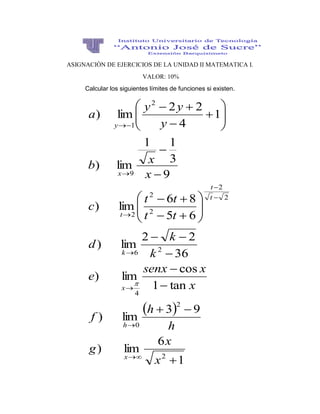
Calcular los siguientes límites de funciones si existen.
1
6
lim)
93
lim)
tan1
cos
lim)
36
22
lim)
65
86
lim)
9
3
11
lim)
1
4
22
lim)
2
2
0
4
26
2
2
2
2
2
9
2
1
x
x
g
h
h
f
x
xsenx
e
k
k
d
tt
tt
c
x
xb
y
yy
a
x
h
x
k
t
t
t
x
y
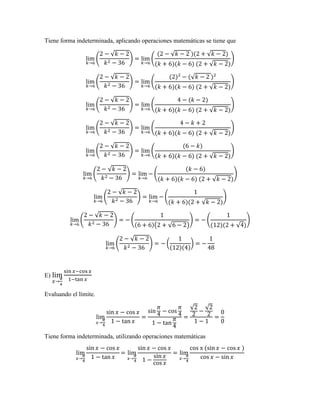
2. Calcular los siguientes límites de funciones si existen:
a) lim
𝑦 → −1
(
𝑦2−2𝑦+2
𝑦−4
+ 1)
Solución:
Reescribiendo el límite y evaluando el límite:
lim
𝑦 → −1
(
𝑦2−2𝑦+2
𝑦−4
+ 1)= lim
𝑥 → −1
(
𝑦2−2𝑦+2
𝑦−4
) + lim
𝑥 → −1
(1)
lim
𝑦 → −1
(
𝑦2
− 2𝑦 + 2
𝑦 − 4
) =
(−1)2
− 2(−1) + 2
(−1) − 4
+ 1
lim
𝑦 → −1
(
𝑦2
− 2𝑦 + 2
𝑦 − 4
) =
1 + 2 + 2
−1 − 4
+ 1
lim
𝑦 → −1
(
𝑦2
− 2𝑦 + 2
𝑦 − 4
) =
5
−5
+ 1
lim
𝑦 → −1
(
𝑦2
− 2𝑦 + 2
𝑦 − 4
) = (−1 + 1) = 0
lim
𝑦 → −1
(
𝑦2
− 2𝑦 + 2
𝑦 − 4
) = 0
b) lim
𝑥→9
1
√ 𝑥
−
1
3
𝑥−9
Reescribiendo el límite
lim
𝑥→9
1
√ 𝑥
−
1
3
𝑥−9
= lim
𝑥→9
3−√ 𝑥
3√ 𝑥
(𝑥−9)
= lim
𝑥→9
3−√ 𝑥
3√ 𝑥 [𝑥−9]
Se procede a evaluar el límite:
lim
𝑥→9
3−√ 𝑥
3√ 𝑥 [𝑥−9]
=
3−√9
3√9 [9−9]
=
3−3
3.3 (0)
=
0
0
Tiene forma indeterminada 0/0, se aplica conjugado y se vuelve a evaluar
lim
𝑥→9
3−√ 𝑥
3√ 𝑥 [𝑥−9]
= lim
𝑥→9
3−√ 𝑥∗(3+√ 𝑥)
3√ 𝑥 [𝑥−9]∗(3+√ 𝑥)
3. lim
𝑥→9
3−√ 𝑥
3√ 𝑥 [𝑥−9]
= lim
𝑥→9
32−√ 𝑥
2
3√ 𝑥 [𝑥−9]∗(3+√ 𝑥)
lim
𝑥→9
3−√ 𝑥
3√ 𝑥 [𝑥−9]
= lim
𝑥→9
9−𝑥
3√ 𝑥 [𝑥−9]∗(3+√ 𝑥)
lim
𝑥→9
3−√ 𝑥
3√ 𝑥 [𝑥−9]
= lim
𝑥→9
−
1
3√ 𝑥 ∗(3+√ 𝑥)
lim
𝑥→9
3−√ 𝑥
3√ 𝑥 [𝑥−9]
= −
1
3√9 ∗(3+√9)
= −
1
3∗3 ∗(3+3)
lim
𝑥→9
3 − √ 𝑥
3√ 𝑥 [𝑥 − 9]
= −
1
9 ∗ 6
= −
1
54
C) lim
𝑡→2
(
𝑡2−6𝑡+8
𝑡2−5𝑡+6
)
𝑡−2
√ 𝑡−√2
Evaluamos el límite
lim
𝑡→2
(
22
− 6 ∗ 2 + 8
22 − 5 ∗ 2 + 6
)
2−2
√2−√2
= (
4 − 12 + 8
4 − 10 + 6
)
0
0
= (
0
0
)
0
0
El límite tiene forma indeterminada por lo que se realizaran operaciones matemáticas
necesarias.
lim
𝑡→2
(
(𝑡 − 4)(𝑡 − 2)
(𝑡 − 3)(𝑡 − 2)
)
(𝑡−2)(√ 𝑡+√2)
(√ 𝑡−√2)(√ 𝑡+√2)
= lim
𝑡→2
(
(𝑡 − 4)
(𝑡 − 3)
)
(𝑡−2)(√ 𝑡+√2)
(√ 𝑡
2
)−(√2
2
)
lim
𝑡→2
(
(𝑡 − 4)
(𝑡 − 3)
)
(𝑡−2)(√ 𝑡+√2)
(𝑡−2)
= lim
𝑡→2
(
(𝑡 − 4)
(𝑡 − 3)
)
(√ 𝑡+√2)
= (
(2 − 4)
(2 − 3)
)
(√2+√2)
lim
𝑡→2
(
(𝑡 − 4)
(𝑡 − 3)
)
(√ 𝑡+√2)
= (
−2
−1
)
(2√2)
= (2)(2√2)
D) lim
𝑘→6
(
2−√𝑘−2
𝑘2−36
)
Evaluamos el límite.
lim
𝑘→6
(
2 − √𝑘 − 2
𝑘2 − 36
) = (
2 − √6 − 2
62 − 36
) = (
2 − 2
36 − 36
) =
0
0
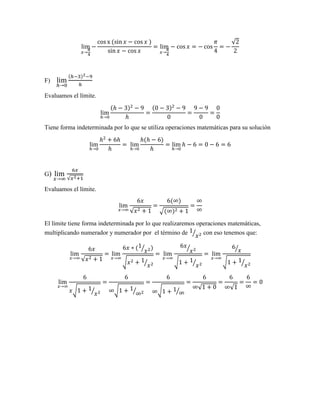
4. Tiene forma indeterminada, aplicando operaciones matemáticas se tiene que
lim
𝑘→6
(
2 − √𝑘 − 2
𝑘2 − 36
) = lim
𝑘→6
(
(2 − √𝑘 − 2 )(2 + √𝑘 − 2)
(𝑘 + 6)(𝑘 − 6) (2 + √𝑘 − 2)
)
lim
𝑘→6
(
2 − √𝑘 − 2
𝑘2 − 36
) = lim
𝑘→6
(
(2)2
− (√𝑘 − 2 )2
(𝑘 + 6)(𝑘 − 6) (2 + √𝑘 − 2)
)
lim
𝑘→6
(
2 − √𝑘 − 2
𝑘2 − 36
) = lim
𝑘→6
(
4 − (𝑘 − 2)
(𝑘 + 6)(𝑘 − 6) (2 + √𝑘 − 2)
)
lim
𝑘→6
(
2 − √𝑘 − 2
𝑘2 − 36
) = lim
𝑘→6
(
4 − 𝑘 + 2
(𝑘 + 6)(𝑘 − 6) (2 + √𝑘 − 2)
)
lim
𝑘→6
(
2 − √𝑘 − 2
𝑘2 − 36
) = lim
𝑘→6
(
(6 − 𝑘)
(𝑘 + 6)(𝑘 − 6) (2 + √𝑘 − 2)
)
lim
𝑘→6
(
2 − √𝑘 − 2
𝑘2 − 36
) = lim
𝑘→6
− (
(𝑘 − 6)
(𝑘 + 6)(𝑘 − 6) (2 + √𝑘 − 2)
)
lim
𝑘→6
(
2 − √𝑘 − 2
𝑘2 − 36
) = lim
𝑘→6
− (
1
(𝑘 + 6)(2 + √𝑘 − 2)
)
lim
𝑘→6
(
2 − √𝑘 − 2
𝑘2 − 36
) = − (
1
(6 + 6)(2 + √6 − 2)
) = − (
1
(12)(2 + √4)
)
lim
𝑘→6
(
2 − √𝑘 − 2
𝑘2 − 36
) = − (
1
(12)(4)
) = −
1
48
E) lim
𝑥→
𝜋
4
sin 𝑥−cos 𝑥
1−tan 𝑥
Evaluando el límite.
lim
𝑥→
𝜋
4
sin 𝑥 − cos 𝑥
1 − tan 𝑥
=
sin
𝜋
4
− cos
𝜋
4
1 − tan
𝜋
4
=
√2
2
−
√2
2
1 − 1
=
0
0
Tiene forma indeterminada, utilizando operaciones matemáticas
lim
𝑥→
𝜋
4
sin 𝑥 − cos 𝑥
1 − tan 𝑥
= lim
𝑥→
𝜋
4
sin 𝑥 − cos 𝑥
1 −
sin 𝑥
cos 𝑥
= lim
𝑥→
𝜋
4
cos x (sin 𝑥 − cos 𝑥 )
cos 𝑥 − sin 𝑥
5. lim
𝑥→
𝜋
4
−
cos x (sin 𝑥 − cos 𝑥 )
sin 𝑥 − cos 𝑥
= lim
𝑥→
𝜋
4
− cos 𝑥 = − cos
𝜋
4
= −
√2
2
F) lim
ℎ→0
(ℎ−3)2−9
ℎ
Evaluamos el límite.
lim
ℎ→0
(ℎ − 3)2
− 9
ℎ
=
(0 − 3)2
− 9
0
=
9 − 9
0
=
0
0
Tiene forma indeterminada por lo que se utiliza operaciones matemáticas para su solución
lim
ℎ→0
ℎ2
+ 6ℎ
ℎ
= lim
ℎ→0
ℎ(ℎ − 6)
ℎ
= lim
ℎ→0
ℎ − 6 = 0 − 6 = 6
G) lim
𝑥→∞
6𝑥
√𝑥2+1
Evaluamos el límite.
lim
𝑥→∞
6𝑥
√𝑥2 + 1
=
6(∞)
√(∞)2 + 1
=
∞
∞
El límite tiene forma indeterminada por lo que realizaremos operaciones matemáticas,
multiplicando numerador y numerador por el término de 1
𝑥2⁄ con eso tenemos que:
lim
𝑥→∞
6𝑥
√𝑥2 + 1
= lim
𝑥→∞
6𝑥 ∗ (1
𝑥2⁄ )
√𝑥2 + 1
𝑥2⁄
= lim
𝑥→∞
6𝑥
𝑥2⁄
√1 + 1
𝑥2⁄
= lim
𝑥→∞
6
𝑥⁄
√1 + 1
𝑥2⁄
lim
𝑥→∞
6
𝑥√1 + 1
𝑥2⁄
=
6
∞√1 + 1
∞2⁄
=
6
∞√1 + 1
∞⁄
=
6
∞√1 + 0
=
6
∞√1
=
6
∞
= 0

![Calcular los siguientes límites de funciones si existen:
a) lim
𝑦 → −1
(
𝑦2−2𝑦+2
𝑦−4
+ 1)
Solución:
Reescribiendo el límite y evaluando el límite:
lim
𝑦 → −1
(
𝑦2−2𝑦+2
𝑦−4
+ 1)= lim
𝑥 → −1
(
𝑦2−2𝑦+2
𝑦−4
) + lim
𝑥 → −1
(1)
lim
𝑦 → −1
(
𝑦2
− 2𝑦 + 2
𝑦 − 4
) =
(−1)2
− 2(−1) + 2
(−1) − 4
+ 1
lim
𝑦 → −1
(
𝑦2
− 2𝑦 + 2
𝑦 − 4
) =
1 + 2 + 2
−1 − 4
+ 1
lim
𝑦 → −1
(
𝑦2
− 2𝑦 + 2
𝑦 − 4
) =
5
−5
+ 1
lim
𝑦 → −1
(
𝑦2
− 2𝑦 + 2
𝑦 − 4
) = (−1 + 1) = 0
lim
𝑦 → −1
(
𝑦2
− 2𝑦 + 2
𝑦 − 4
) = 0
b) lim
𝑥→9
1
√ 𝑥
−
1
3
𝑥−9
Reescribiendo el límite
lim
𝑥→9
1
√ 𝑥
−
1
3
𝑥−9
= lim
𝑥→9
3−√ 𝑥
3√ 𝑥
(𝑥−9)
= lim
𝑥→9
3−√ 𝑥
3√ 𝑥 [𝑥−9]
Se procede a evaluar el límite:
lim
𝑥→9
3−√ 𝑥
3√ 𝑥 [𝑥−9]
=
3−√9
3√9 [9−9]
=
3−3
3.3 (0)
=
0
0
Tiene forma indeterminada 0/0, se aplica conjugado y se vuelve a evaluar
lim
𝑥→9
3−√ 𝑥
3√ 𝑥 [𝑥−9]
= lim
𝑥→9
3−√ 𝑥∗(3+√ 𝑥)
3√ 𝑥 [𝑥−9]∗(3+√ 𝑥)](https://image.slidesharecdn.com/ejerciciosdelimites-140611191641-phpapp02/85/Ejercicios-de-limites-2-320.jpg)
![lim
𝑥→9
3−√ 𝑥
3√ 𝑥 [𝑥−9]
= lim
𝑥→9
32−√ 𝑥
2
3√ 𝑥 [𝑥−9]∗(3+√ 𝑥)
lim
𝑥→9
3−√ 𝑥
3√ 𝑥 [𝑥−9]
= lim
𝑥→9
9−𝑥
3√ 𝑥 [𝑥−9]∗(3+√ 𝑥)
lim
𝑥→9
3−√ 𝑥
3√ 𝑥 [𝑥−9]
= lim
𝑥→9
−
1
3√ 𝑥 ∗(3+√ 𝑥)
lim
𝑥→9
3−√ 𝑥
3√ 𝑥 [𝑥−9]
= −
1
3√9 ∗(3+√9)
= −
1
3∗3 ∗(3+3)
lim
𝑥→9
3 − √ 𝑥
3√ 𝑥 [𝑥 − 9]
= −
1
9 ∗ 6
= −
1
54
C) lim
𝑡→2
(
𝑡2−6𝑡+8
𝑡2−5𝑡+6
)
𝑡−2
√ 𝑡−√2
Evaluamos el límite
lim
𝑡→2
(
22
− 6 ∗ 2 + 8
22 − 5 ∗ 2 + 6
)
2−2
√2−√2
= (
4 − 12 + 8
4 − 10 + 6
)
0
0
= (
0
0
)
0
0
El límite tiene forma indeterminada por lo que se realizaran operaciones matemáticas
necesarias.
lim
𝑡→2
(
(𝑡 − 4)(𝑡 − 2)
(𝑡 − 3)(𝑡 − 2)
)
(𝑡−2)(√ 𝑡+√2)
(√ 𝑡−√2)(√ 𝑡+√2)
= lim
𝑡→2
(
(𝑡 − 4)
(𝑡 − 3)
)
(𝑡−2)(√ 𝑡+√2)
(√ 𝑡
2
)−(√2
2
)
lim
𝑡→2
(
(𝑡 − 4)
(𝑡 − 3)
)
(𝑡−2)(√ 𝑡+√2)
(𝑡−2)
= lim
𝑡→2
(
(𝑡 − 4)
(𝑡 − 3)
)
(√ 𝑡+√2)
= (
(2 − 4)
(2 − 3)
)
(√2+√2)
lim
𝑡→2
(
(𝑡 − 4)
(𝑡 − 3)
)
(√ 𝑡+√2)
= (
−2
−1
)
(2√2)
= (2)(2√2)
D) lim
𝑘→6
(
2−√𝑘−2
𝑘2−36
)
Evaluamos el límite.
lim
𝑘→6
(
2 − √𝑘 − 2
𝑘2 − 36
) = (
2 − √6 − 2
62 − 36
) = (
2 − 2
36 − 36
) =
0
0](https://image.slidesharecdn.com/ejerciciosdelimites-140611191641-phpapp02/85/Ejercicios-de-limites-3-320.jpg)
![Suma Y Resta De Nmeros Enteros 1193951099798872 5[1]](https://cdn.slidesharecdn.com/ss_thumbnails/suma-y-resta-de-nmeros-enteros-1193951099798872-51-090630232736-phpapp02-thumbnail.jpg?width=640&height=640&fit=bounds)


