TM


Global forecasting service
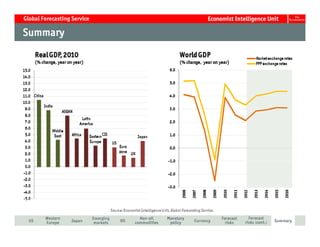
Economic forecast summary - November 2011


                                            www.gfs.eiu.com
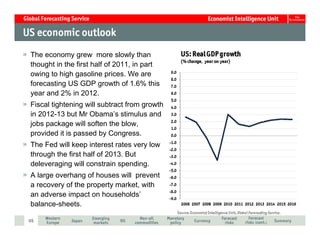
The economy grew more slowly than
thought in the first half of 2011, in part
owing to high gasoline prices. We are
forecasting US GDP growth of 1.6% this
year and 2% in 2012.
Fiscal tightening will subtract from growth
in 2012-13 but Mr Obama’s stimulus and
jobs package will soften the blow,
provided it is passed by Congress.
The Fed will keep interest rates very low
through the first half of 2013. But
deleveraging will constrain spending.
A large overhang of houses will prevent
a recovery of the property market, with
an adverse impact on households’
balance-sheets.
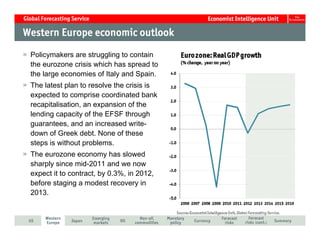
Policymakers are struggling to contain
the eurozone crisis which has spread to
the large economies of Italy and Spain.
The latest plan to resolve the crisis is
expected to comprise coordinated bank
recapitalisation, an expansion of the
lending capacity of the EFSF through
guarantees, and an increased write-
down of Greek debt. None of these
steps is without problems.
The eurozone economy has slowed
sharply since mid-2011 and we now
expect it to contract, by 0.3%, in 2012,
before staging a modest recovery in
2013.
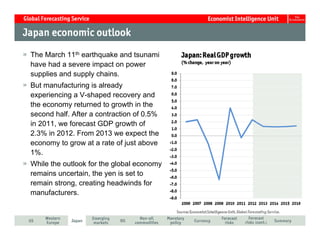
The March 11th earthquake and tsunami
have had a severe impact on power
supplies and supply chains.
But manufacturing is already
experiencing a V-shaped recovery and
the economy returned to growth in the
second half. After a contraction of 0.5%
in 2011, we forecast GDP growth of
2.3% in 2012. From 2013 we expect the
economy to grow at a rate of just above
1%.
While the outlook for the global economy
remains uncertain, the yen is set to
remain strong, creating headwinds for
manufacturers.
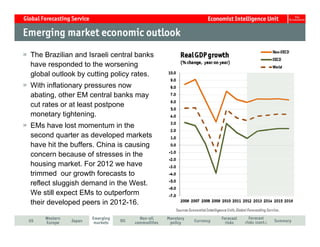
The Brazilian and Israeli central banks
have responded to the worsening
global outlook by cutting policy rates.
With inflationary pressures now
abating, other EM central banks may
cut rates or at least postpone
monetary tightening.
EMs have lost momentum in the
second quarter as developed markets
have hit the buffers. China is causing
concern because of stresses in the
housing market. For 2012 we have
trimmed our growth forecasts to
reflect sluggish demand in the West.
We still expect EMs to outperform
their developed peers in 2012-16.
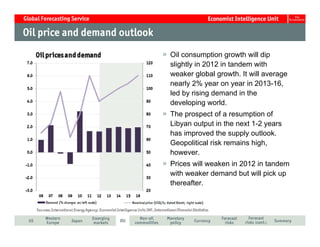
Oil consumption growth will dip
slightly in 2012 in tandem with
weaker global growth. It will average
nearly 2% year on year in 2013-16,
led by rising demand in the
developing world.
The prospect of a resumption of
Libyan output in the next 1-2 years
has improved the supply outlook.
Geopolitical risk remains high,
however.
Prices will weaken in 2012 in tandem
with weaker demand but will pick up
thereafter.
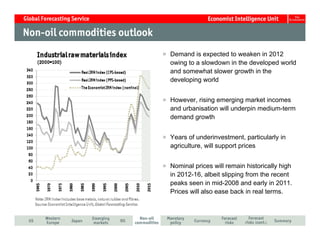
Demand is expected to weaken in 2012
owing to a slowdown in the developed world
and somewhat slower growth in the
developing world


However, rising emerging market incomes
and urbanisation will underpin medium-term
demand growth


Years of underinvestment, particularly in
agriculture, will support prices


Nominal prices will remain historically high
in 2012-16, albeit slipping from the recent
peaks seen in mid-2008 and early in 2011.
Prices will also ease back in real terms.
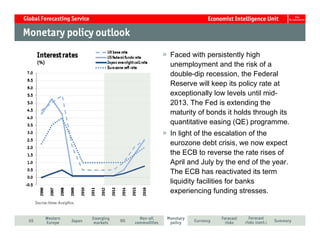
Faced with persistently high
unemployment and the risk of a
double-dip recession, the Federal
Reserve will keep its policy rate at
exceptionally low levels until mid-
2013. The Fed is extending the
maturity of bonds it holds through its
quantitative easing (QE) programme.
In light of the escalation of the
eurozone debt crisis, we now expect
the ECB to reverse the rate rises of
April and July by the end of the year.
The ECB has reactivated its term
liquidity facilities for banks
experiencing funding stresses.
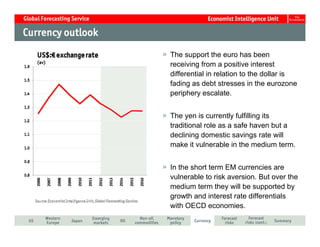
The support the euro has been
receiving from a positive interest
differential in relation to the dollar is
fading as debt stresses in the eurozone
periphery escalate.


The yen is currently fulfilling its
traditional role as a safe haven but a
declining domestic savings rate will
make it vulnerable in the medium term.


In the short term EM currencies are
vulnerable to risk aversion. But over the
medium term they will be supported by
growth and interest rate differentials
with OECD economies.
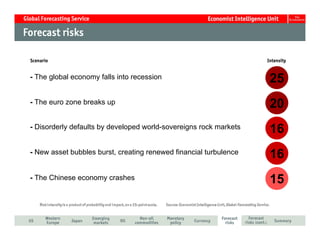
- The global economy falls into recession                          25
- The euro zone breaks up                                          20
- Disorderly defaults by developed world-sovereigns rock markets
                                                                   16
- New asset bubbles burst, creating renewed financial turbulence
                                                                   16
- The Chinese economy crashes                                      15
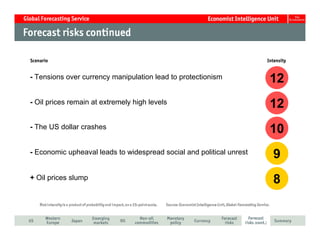
- Tensions over currency manipulation lead to protectionism           12
- Oil prices remain at extremely high levels                          12
- The US dollar crashes
                                                                      10
- Economic upheaval leads to widespread social and political unrest
                                                                      9
+ Oil prices slump                                                    8
The
Global Forecasting Service                                                                                  Economist Intelligence Unit                              Economist


Access analysis on over 200 countries worldwide with the
Economist Intelligence Unit

T  he analysis and content in our reports is derived from our extensive economic, financial, political and business risk analysis of over 203 countries worldwide.
      You may gain access to this information by signing up, free of charge, at www.eiu.com.
  Click on the country name to go straight to the latest analysis of that country:

  Further reports are available from Economist Intelligence Unit and can be downloaded at
  www.eiu.com.


  G8 Countries
  l Canada             l Germany            l Japan                l United Kingdom
  l France             l Italy              l Russia               l United States of America

  BRIC Countries
  l Brazil              l Russia            l India                l China

  CIVETS Countries
  l Colombia            l Vietnam           l Turkey
  l Indonesia           l Egypt             l South Africa

  Or view the list of all the countries.


Should you wish to speak to a sales representative please telephone us:
Americas: +1 212 698 9717
Asia: +852 2585 3888
Europe, Middle East & Africa: +44 (0)20 7576 8181


                                                                                                                                                             www.gfs.eiu.com
The
Global Forecasting Service                                                                                    Economist Intelligence Unit                                Economist


Access analysis and forecasting of major industries with
the Economist Intelligence Unit

I   n addition to the extensive country coverage the Economist Intelligence Unit provides each month industry and commodities information is also available.
       The key industry sectors we cover are listed below with links to more information on each of them.


Automotive
Analysis and five-year forecast for the automotive industry throughout the world providing detail on a country by country basis

Commodities
This service offers analysis for 25 leading commodities. It delivers price forecasts for the next two years with forecasts of factors influencing prices such as production,
consumption and stock levels. Analysis and forecasts are split by the two main commodity types: “Industrial raw materials” and “Food, feedstuffs and beverages”.

Consumer goods
Analysis and five-year forecast for the consumer goods and retail industry throughout the world providing detail on a country by country basis

Energy
Analysis and five-year forecast for the energy industries throughout the world providing detail on a country by country basis

Financial services
Analysis and five-year forecast for the financial services industry throughout the world providing detail on a country by country basis

Healthcare
Analysis and five-year forecast for the healthcare industry throughout the world providing detail on a country by country basis

Technology
Analysis and five-year forecast for the technology industry throughout the world providing detail on a country by country basis


                                                                                                                                                                www.gfs.eiu.com
The
Global Forecasting Service                                    Economist Intelligence Unit    Economist


Media Enquiries for the Economist Intelligence Unit


Europe, Middle East & Africa             Asia
Grayling PR                              The Consultancy
Jennifer Cole                            Tom Engel
Tel: + 44 (0)20 7592 7933                +852 3114 6337 / +852 9577 7106
Sophie Kriefman                          tengel@consultancy-pr.com.hk
Tel: +44 (0)20 7592 7924                 Ian Fok
Ravi Sunnak                              +852 3114 6335 / +852 9348 4484
Tel : +44 (0)207 592 7927                ifok@consultancy-pr.com.hk
Mobile: + 44 (0)7515 974 786             Rhonda Taylor
Email: allgraylingukeiu@grayling.com     +852 3114 6335
                                         rtaylor@consultancy-pr.com.hk
Americas
Grayling New York
                                         Australia and New Zealand
Ivette Almeida                           Cape Public Relations
Tel: +(1) 917-302-9946                   Telephone: (02) 8218 2190
Ivette.almeida@grayling.com              Sara Crowe
Katarina Wenk-Bodenmiller                M: 0437 161916
Tel: +(1) 646-284-9417                   sara@capepublicrelations.com
Katarina.Wenk-Bodenmiller@grayling.com   Luke Roberts
                                         M: 0422 855 930
                                         luke@capepublicrelations.com


                                                                                       www.gfs.eiu.com

October 2011 EIU Global Economic Forecast

  • 1.
    TM Global forecasting service Economicforecast summary - November 2011 www.gfs.eiu.com
  • 2.
    The economy grewmore slowly than thought in the first half of 2011, in part owing to high gasoline prices. We are forecasting US GDP growth of 1.6% this year and 2% in 2012. Fiscal tightening will subtract from growth in 2012-13 but Mr Obama’s stimulus and jobs package will soften the blow, provided it is passed by Congress. The Fed will keep interest rates very low through the first half of 2013. But deleveraging will constrain spending. A large overhang of houses will prevent a recovery of the property market, with an adverse impact on households’ balance-sheets.
  • 3.
    Policymakers are strugglingto contain the eurozone crisis which has spread to the large economies of Italy and Spain. The latest plan to resolve the crisis is expected to comprise coordinated bank recapitalisation, an expansion of the lending capacity of the EFSF through guarantees, and an increased write- down of Greek debt. None of these steps is without problems. The eurozone economy has slowed sharply since mid-2011 and we now expect it to contract, by 0.3%, in 2012, before staging a modest recovery in 2013.
  • 4.
    The March 11thearthquake and tsunami have had a severe impact on power supplies and supply chains. But manufacturing is already experiencing a V-shaped recovery and the economy returned to growth in the second half. After a contraction of 0.5% in 2011, we forecast GDP growth of 2.3% in 2012. From 2013 we expect the economy to grow at a rate of just above 1%. While the outlook for the global economy remains uncertain, the yen is set to remain strong, creating headwinds for manufacturers.
  • 5.
    The Brazilian andIsraeli central banks have responded to the worsening global outlook by cutting policy rates. With inflationary pressures now abating, other EM central banks may cut rates or at least postpone monetary tightening. EMs have lost momentum in the second quarter as developed markets have hit the buffers. China is causing concern because of stresses in the housing market. For 2012 we have trimmed our growth forecasts to reflect sluggish demand in the West. We still expect EMs to outperform their developed peers in 2012-16.
  • 6.
    Oil consumption growthwill dip slightly in 2012 in tandem with weaker global growth. It will average nearly 2% year on year in 2013-16, led by rising demand in the developing world. The prospect of a resumption of Libyan output in the next 1-2 years has improved the supply outlook. Geopolitical risk remains high, however. Prices will weaken in 2012 in tandem with weaker demand but will pick up thereafter.
  • 7.
    Demand is expectedto weaken in 2012 owing to a slowdown in the developed world and somewhat slower growth in the developing world However, rising emerging market incomes and urbanisation will underpin medium-term demand growth Years of underinvestment, particularly in agriculture, will support prices Nominal prices will remain historically high in 2012-16, albeit slipping from the recent peaks seen in mid-2008 and early in 2011. Prices will also ease back in real terms.
  • 8.
    Faced with persistentlyhigh unemployment and the risk of a double-dip recession, the Federal Reserve will keep its policy rate at exceptionally low levels until mid- 2013. The Fed is extending the maturity of bonds it holds through its quantitative easing (QE) programme. In light of the escalation of the eurozone debt crisis, we now expect the ECB to reverse the rate rises of April and July by the end of the year. The ECB has reactivated its term liquidity facilities for banks experiencing funding stresses.
  • 9.
    The support theeuro has been receiving from a positive interest differential in relation to the dollar is fading as debt stresses in the eurozone periphery escalate. The yen is currently fulfilling its traditional role as a safe haven but a declining domestic savings rate will make it vulnerable in the medium term. In the short term EM currencies are vulnerable to risk aversion. But over the medium term they will be supported by growth and interest rate differentials with OECD economies.
  • 10.
    - The globaleconomy falls into recession 25 - The euro zone breaks up 20 - Disorderly defaults by developed world-sovereigns rock markets 16 - New asset bubbles burst, creating renewed financial turbulence 16 - The Chinese economy crashes 15
  • 11.
    - Tensions overcurrency manipulation lead to protectionism 12 - Oil prices remain at extremely high levels 12 - The US dollar crashes 10 - Economic upheaval leads to widespread social and political unrest 9 + Oil prices slump 8
  • 13.
    The Global Forecasting Service Economist Intelligence Unit Economist Access analysis on over 200 countries worldwide with the Economist Intelligence Unit T he analysis and content in our reports is derived from our extensive economic, financial, political and business risk analysis of over 203 countries worldwide. You may gain access to this information by signing up, free of charge, at www.eiu.com. Click on the country name to go straight to the latest analysis of that country: Further reports are available from Economist Intelligence Unit and can be downloaded at www.eiu.com. G8 Countries l Canada l Germany l Japan l United Kingdom l France l Italy l Russia l United States of America BRIC Countries l Brazil l Russia l India l China CIVETS Countries l Colombia l Vietnam l Turkey l Indonesia l Egypt l South Africa Or view the list of all the countries. Should you wish to speak to a sales representative please telephone us: Americas: +1 212 698 9717 Asia: +852 2585 3888 Europe, Middle East & Africa: +44 (0)20 7576 8181 www.gfs.eiu.com
  • 14.
    The Global Forecasting Service Economist Intelligence Unit Economist Access analysis and forecasting of major industries with the Economist Intelligence Unit I n addition to the extensive country coverage the Economist Intelligence Unit provides each month industry and commodities information is also available. The key industry sectors we cover are listed below with links to more information on each of them. Automotive Analysis and five-year forecast for the automotive industry throughout the world providing detail on a country by country basis Commodities This service offers analysis for 25 leading commodities. It delivers price forecasts for the next two years with forecasts of factors influencing prices such as production, consumption and stock levels. Analysis and forecasts are split by the two main commodity types: “Industrial raw materials” and “Food, feedstuffs and beverages”. Consumer goods Analysis and five-year forecast for the consumer goods and retail industry throughout the world providing detail on a country by country basis Energy Analysis and five-year forecast for the energy industries throughout the world providing detail on a country by country basis Financial services Analysis and five-year forecast for the financial services industry throughout the world providing detail on a country by country basis Healthcare Analysis and five-year forecast for the healthcare industry throughout the world providing detail on a country by country basis Technology Analysis and five-year forecast for the technology industry throughout the world providing detail on a country by country basis www.gfs.eiu.com
  • 15.
    The Global Forecasting Service Economist Intelligence Unit Economist Media Enquiries for the Economist Intelligence Unit Europe, Middle East & Africa Asia Grayling PR The Consultancy Jennifer Cole Tom Engel Tel: + 44 (0)20 7592 7933 +852 3114 6337 / +852 9577 7106 Sophie Kriefman tengel@consultancy-pr.com.hk Tel: +44 (0)20 7592 7924 Ian Fok Ravi Sunnak +852 3114 6335 / +852 9348 4484 Tel : +44 (0)207 592 7927 ifok@consultancy-pr.com.hk Mobile: + 44 (0)7515 974 786 Rhonda Taylor Email: allgraylingukeiu@grayling.com +852 3114 6335 rtaylor@consultancy-pr.com.hk Americas Grayling New York Australia and New Zealand Ivette Almeida Cape Public Relations Tel: +(1) 917-302-9946 Telephone: (02) 8218 2190 Ivette.almeida@grayling.com Sara Crowe Katarina Wenk-Bodenmiller M: 0437 161916 Tel: +(1) 646-284-9417 sara@capepublicrelations.com Katarina.Wenk-Bodenmiller@grayling.com Luke Roberts M: 0422 855 930 luke@capepublicrelations.com www.gfs.eiu.com