Global forecasting service
Economic forecast summary - March 2012


                 Master Template              1
                                   www.gfs.eiu.com
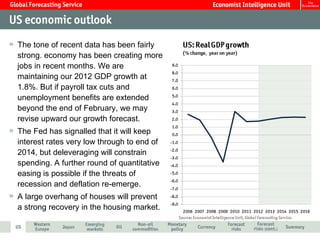
The tone of recent data has been fairly
strong. economy has been creating more
jobs in recent months. We are
maintaining our 2012 GDP growth at
1.8%. But if payroll tax cuts and
unemployment benefits are extended
beyond the end of February, we may
revise upward our growth forecast.
The Fed has signalled that it will keep
interest rates very low through to end of
2014, but deleveraging will constrain
spending. A further round of quantitative
easing is possible if the threats of
recession and deflation re-emerge.
A large overhang of houses will prevent
a strong recovery in the housing market.
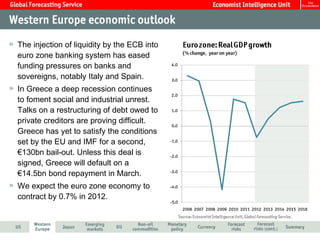
The injection of liquidity by the ECB into
euro zone banking system has eased
funding pressures on banks and
sovereigns, notably Italy and Spain.
In Greece a deep recession continues
to foment social and industrial unrest.
Talks on a restructuring of debt owed to
private creditors are proving difficult.
Greece has yet to satisfy the conditions
set by the EU and IMF for a second,
€130bn bail-out. Unless this deal is
signed, Greece will default on a
€14.5bn bond repayment in March.
We expect the euro zone economy to
contract by 0.7% in 2012.
The March 2011 earthquake and tsunami
had a severe impact on power supplies
and supply chains. Industrial production
is now recovering as infrastructure is
rebuilt. The strong yen is proving a
headwind for exporters.
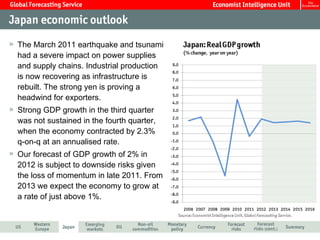
Strong GDP growth in the third quarter
was not sustained in the fourth quarter,
when the economy contracted by 2.3%
q-on-q at an annualised rate.
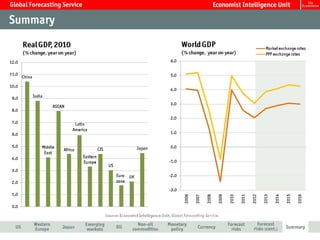
Our forecast of GDP growth of 2% in
2012 is subject to downside risks given
the loss of momentum in late 2011. From
2013 we expect the economy to grow at
a rate of just above 1%.
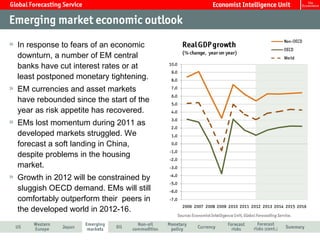
In response to fears of an economic
downturn, a number of EM central
banks have cut interest rates or at
least postponed monetary tightening.
EM currencies and asset markets
have rebounded since the start of the
year as risk appetite has recovered.
EMs lost momentum during 2011 as
developed markets struggled. We
forecast a soft landing in China,
despite problems in the housing
market.
Growth in 2012 will be constrained by
sluggish OECD demand. EMs will still
comfortably outperform their peers in
the developed world in 2012-16.
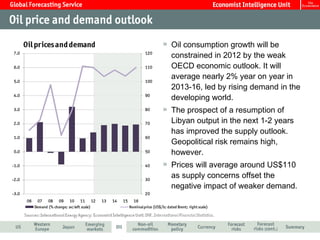
Oil consumption growth will be
constrained in 2012 by the weak
OECD economic outlook. It will
average nearly 2% year on year in
2013-16, led by rising demand in the
developing world.
The prospect of a resumption of
Libyan output in the next 1-2 years
has improved the supply outlook.
Geopolitical risk remains high,
however.
Prices will average around US$110
as supply concerns offset the
negative impact of weaker demand.
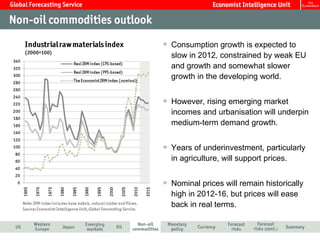
Consumption growth is expected to
slow in 2012, constrained by weak EU
and growth and somewhat slower
growth in the developing world.


However, rising emerging market
incomes and urbanisation will underpin
medium-term demand growth.


Years of underinvestment, particularly
in agriculture, will support prices.


Nominal prices will remain historically
high in 2012-16, but prices will ease
back in real terms.
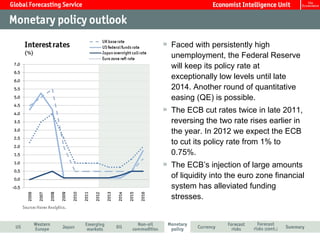
Faced with persistently high
unemployment, the Federal Reserve
will keep its policy rate at
exceptionally low levels until late
2014. Another round of quantitative
easing (QE) is possible.
The ECB cut rates twice in late 2011,
reversing the two rate rises earlier in
the year. In 2012 we expect the ECB
to cut its policy rate from 1% to
0.75%.
The ECB’s injection of large amounts
of liquidity into the euro zone financial
system has alleviated funding
stresses.
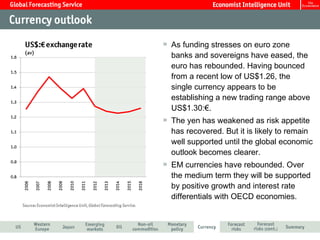
As funding stresses on euro zone
banks and sovereigns have eased, the
euro has rebounded. Having bounced
from a recent low of US$1.26, the
single currency appears to be
establishing a new trading range above
US$1.30:€.
The yen has weakened as risk appetite
has recovered. But it is likely to remain
well supported until the global economic
outlook becomes clearer.
EM currencies have rebounded. Over
the medium term they will be supported
by positive growth and interest rate
differentials with OECD economies.
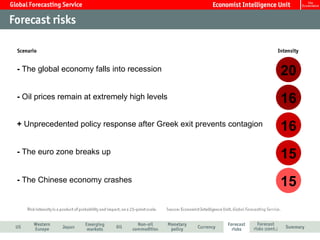
- The global economy falls into recession                             20
- Oil prices remain at extremely high levels                          16
+ Unprecedented policy response after Greek exit prevents contagion
                                                                      16
- The euro zone breaks up
                                                                      15
- The Chinese economy crashes                                         15
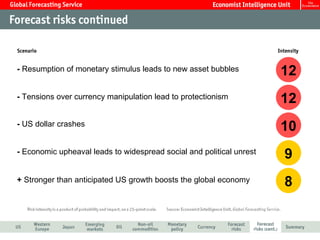
- Resumption of monetary stimulus leads to new asset bubbles          12
- Tensions over currency manipulation lead to protectionism           12
- US dollar crashes
                                                                      10
- Economic upheaval leads to widespread social and political unrest
                                                                      9
+ Stronger than anticipated US growth boosts the global economy       8
Access analysis on over 200 countries worldwide with the Economist Intelligence Unit

 The analysis and content in our reports is d erived from our extensive econom ic, financial, political and business risk analysis of over
 203 countries world wid e.
 You m ay gain access to this inform ation by signing up, free of charge, at www.eiu.com
 C lick on the country nam e to go straight to the latest analysis of that country:
                         able from Econom ist Intelligence Unit and can be d ownl ed at www.eiu.com
 Further reports are avail                                                      oad

 G8 Countries

 * Canada                * Germany                 * Japan                  * United Kingdom
 * France                * Italy                   * Russia                 *
                                                                            United States of America
 BRIC Countries
 * Brazil                * Russia                  * India                   * China


 CIVETS Countries
 * Colombia               * Vietnam                * Turkey
 * Indonesia              * Egypt                  * South Africa

 O r view the list of all the countries.

 Should you wish to speak to a sales representative please telephone us:
 Am ericas: + 1 21 2 698 971 7
 Asia: + 852 2585 3888
 Europe, M id d le East & Africa: + 44 (0)20 7576 81 81

                                                                 Master Template                                                         13
                                                                                                                                www.gfs.eiu.com
Access analysis and forecasting of major industries with the Economist Intelligence Unit

 In ad d ition to the extensive country coverage the Econom ist Intelligence Unit provid es each m onth ind ustry and com m od ities
 inform ation is also available.
 The key ind ustry sectors we cover are l
                                        isted bel with links to m ore inform ation on each of them .
                                                ow

 Automotive
 Analysis and five-year forecast for the autom otive ind ustry throughout the world provid ing d etail on a country by country basis

 Commodities
 This service offers analysis for 25 l ing com m od ities. It d elivers price forecasts for the next two years with forecasts of factors
                                     ead
 influencing prices such as prod uction, consum ption and stock l    evels. Analysis and forecasts are split by the two m ain com m od ity types:
 “Ind ustrial raw m aterials” and “Food , feed stuffs and beverages”.

 Consumer goods
 Analysis and five-year forecast for the consum er good s and retail ind ustry throughout the world provid ing d etail on a country by country
 basis

 Energy
 Anal
    ysis and five-year forecast for the energy ind ustries throughout the world provid ing d etail on a country by country basis

 Financial services
 Analysis and five-year forecast for the financial services ind ustry throughout the world provid ing d etail on a country by country basis

 Healthcare
 Anal
    ysis and five-year forecast for the healthcare ind ustry throughout the world provid ing d etail on a country by country basis

 Technology
 Anal
    ysis and five-year forecast for the technol
                                              ogy ind ustry throughout the world provid ing d etail on a country by country basis


                                                                Master Template                                                             14
                                                                                                                                   www.gfs.eiu.com
Media Enquiries for the Economist Intelligence Unit

 Europe, Middle East & Africa             Asia

 Grayling PR                              The Consultancy
 Jennifer C ole                           Tom Engel
                                          + 852 31 1 4 6337 / + 852 9577 71 06
 Tel: + 44 (0)20 7592 7933
                                          tengel@consultancy-pr.com.hk
 Sophie Kriefm an                         Ian Fok
 Tel: + 44 (0)20 7592 7924                + 852 31 1 4 6335 / + 852 9348 4484
 Ravi Sunnak                              ifok@consultancy-pr.com.hk
 Tel : + 44 (0)207 592 7927               Rhond a Taylor
                                          + 852 31 1 4 6335
 M obile: + 44 (0)751 5 974 786
                                          rtaylor@consultancy-pr.com.hk
 Em ail allgraylingukeiu@grayling.com
       :


 Americas                                 Australia and New Zealand

 Grayling New York                        Cape Public Relations
 Ivette Al eid a
           m                              Telephone: (02) 821 8 21 90
 Tel: + (1 ) 91 7-302-9946                Sara C rowe
 Ivette.almeida@grayling.com              M: 0437 1 61 91 6
                                          sara@capepublicrelations.com
 Katarina Wenk-Bod enm iller              Luke Roberts
 Tel: + (1 ) 646-284-941 7                M: 0422 855 930
 Katarina.Wenk-Bodenmiller@grayling.com   luke@capepublicrelations.com


                                           Master Template                                15
                                                                                 www.gfs.eiu.com

EIU Global Forecast March 2012

  • 1.
    Global forecasting service Economicforecast summary - March 2012 Master Template 1 www.gfs.eiu.com
  • 2.
    The tone ofrecent data has been fairly strong. economy has been creating more jobs in recent months. We are maintaining our 2012 GDP growth at 1.8%. But if payroll tax cuts and unemployment benefits are extended beyond the end of February, we may revise upward our growth forecast. The Fed has signalled that it will keep interest rates very low through to end of 2014, but deleveraging will constrain spending. A further round of quantitative easing is possible if the threats of recession and deflation re-emerge. A large overhang of houses will prevent a strong recovery in the housing market.
  • 3.
    The injection ofliquidity by the ECB into euro zone banking system has eased funding pressures on banks and sovereigns, notably Italy and Spain. In Greece a deep recession continues to foment social and industrial unrest. Talks on a restructuring of debt owed to private creditors are proving difficult. Greece has yet to satisfy the conditions set by the EU and IMF for a second, €130bn bail-out. Unless this deal is signed, Greece will default on a €14.5bn bond repayment in March. We expect the euro zone economy to contract by 0.7% in 2012.
  • 4.
    The March 2011earthquake and tsunami had a severe impact on power supplies and supply chains. Industrial production is now recovering as infrastructure is rebuilt. The strong yen is proving a headwind for exporters. Strong GDP growth in the third quarter was not sustained in the fourth quarter, when the economy contracted by 2.3% q-on-q at an annualised rate. Our forecast of GDP growth of 2% in 2012 is subject to downside risks given the loss of momentum in late 2011. From 2013 we expect the economy to grow at a rate of just above 1%.
  • 5.
    In response tofears of an economic downturn, a number of EM central banks have cut interest rates or at least postponed monetary tightening. EM currencies and asset markets have rebounded since the start of the year as risk appetite has recovered. EMs lost momentum during 2011 as developed markets struggled. We forecast a soft landing in China, despite problems in the housing market. Growth in 2012 will be constrained by sluggish OECD demand. EMs will still comfortably outperform their peers in the developed world in 2012-16.
  • 6.
    Oil consumption growthwill be constrained in 2012 by the weak OECD economic outlook. It will average nearly 2% year on year in 2013-16, led by rising demand in the developing world. The prospect of a resumption of Libyan output in the next 1-2 years has improved the supply outlook. Geopolitical risk remains high, however. Prices will average around US$110 as supply concerns offset the negative impact of weaker demand.
  • 7.
    Consumption growth isexpected to slow in 2012, constrained by weak EU and growth and somewhat slower growth in the developing world. However, rising emerging market incomes and urbanisation will underpin medium-term demand growth. Years of underinvestment, particularly in agriculture, will support prices. Nominal prices will remain historically high in 2012-16, but prices will ease back in real terms.
  • 8.
    Faced with persistentlyhigh unemployment, the Federal Reserve will keep its policy rate at exceptionally low levels until late 2014. Another round of quantitative easing (QE) is possible. The ECB cut rates twice in late 2011, reversing the two rate rises earlier in the year. In 2012 we expect the ECB to cut its policy rate from 1% to 0.75%. The ECB’s injection of large amounts of liquidity into the euro zone financial system has alleviated funding stresses.
  • 9.
    As funding stresseson euro zone banks and sovereigns have eased, the euro has rebounded. Having bounced from a recent low of US$1.26, the single currency appears to be establishing a new trading range above US$1.30:€. The yen has weakened as risk appetite has recovered. But it is likely to remain well supported until the global economic outlook becomes clearer. EM currencies have rebounded. Over the medium term they will be supported by positive growth and interest rate differentials with OECD economies.
  • 10.
    - The globaleconomy falls into recession 20 - Oil prices remain at extremely high levels 16 + Unprecedented policy response after Greek exit prevents contagion 16 - The euro zone breaks up 15 - The Chinese economy crashes 15
  • 11.
    - Resumption ofmonetary stimulus leads to new asset bubbles 12 - Tensions over currency manipulation lead to protectionism 12 - US dollar crashes 10 - Economic upheaval leads to widespread social and political unrest 9 + Stronger than anticipated US growth boosts the global economy 8
  • 13.
    Access analysis onover 200 countries worldwide with the Economist Intelligence Unit The analysis and content in our reports is d erived from our extensive econom ic, financial, political and business risk analysis of over 203 countries world wid e. You m ay gain access to this inform ation by signing up, free of charge, at www.eiu.com C lick on the country nam e to go straight to the latest analysis of that country: able from Econom ist Intelligence Unit and can be d ownl ed at www.eiu.com Further reports are avail oad G8 Countries * Canada * Germany * Japan * United Kingdom * France * Italy * Russia * United States of America BRIC Countries * Brazil * Russia * India * China CIVETS Countries * Colombia * Vietnam * Turkey * Indonesia * Egypt * South Africa O r view the list of all the countries. Should you wish to speak to a sales representative please telephone us: Am ericas: + 1 21 2 698 971 7 Asia: + 852 2585 3888 Europe, M id d le East & Africa: + 44 (0)20 7576 81 81 Master Template 13 www.gfs.eiu.com
  • 14.
    Access analysis andforecasting of major industries with the Economist Intelligence Unit In ad d ition to the extensive country coverage the Econom ist Intelligence Unit provid es each m onth ind ustry and com m od ities inform ation is also available. The key ind ustry sectors we cover are l isted bel with links to m ore inform ation on each of them . ow Automotive Analysis and five-year forecast for the autom otive ind ustry throughout the world provid ing d etail on a country by country basis Commodities This service offers analysis for 25 l ing com m od ities. It d elivers price forecasts for the next two years with forecasts of factors ead influencing prices such as prod uction, consum ption and stock l evels. Analysis and forecasts are split by the two m ain com m od ity types: “Ind ustrial raw m aterials” and “Food , feed stuffs and beverages”. Consumer goods Analysis and five-year forecast for the consum er good s and retail ind ustry throughout the world provid ing d etail on a country by country basis Energy Anal ysis and five-year forecast for the energy ind ustries throughout the world provid ing d etail on a country by country basis Financial services Analysis and five-year forecast for the financial services ind ustry throughout the world provid ing d etail on a country by country basis Healthcare Anal ysis and five-year forecast for the healthcare ind ustry throughout the world provid ing d etail on a country by country basis Technology Anal ysis and five-year forecast for the technol ogy ind ustry throughout the world provid ing d etail on a country by country basis Master Template 14 www.gfs.eiu.com
  • 15.
    Media Enquiries forthe Economist Intelligence Unit Europe, Middle East & Africa Asia Grayling PR The Consultancy Jennifer C ole Tom Engel + 852 31 1 4 6337 / + 852 9577 71 06 Tel: + 44 (0)20 7592 7933 tengel@consultancy-pr.com.hk Sophie Kriefm an Ian Fok Tel: + 44 (0)20 7592 7924 + 852 31 1 4 6335 / + 852 9348 4484 Ravi Sunnak ifok@consultancy-pr.com.hk Tel : + 44 (0)207 592 7927 Rhond a Taylor + 852 31 1 4 6335 M obile: + 44 (0)751 5 974 786 rtaylor@consultancy-pr.com.hk Em ail allgraylingukeiu@grayling.com : Americas Australia and New Zealand Grayling New York Cape Public Relations Ivette Al eid a m Telephone: (02) 821 8 21 90 Tel: + (1 ) 91 7-302-9946 Sara C rowe Ivette.almeida@grayling.com M: 0437 1 61 91 6 sara@capepublicrelations.com Katarina Wenk-Bod enm iller Luke Roberts Tel: + (1 ) 646-284-941 7 M: 0422 855 930 Katarina.Wenk-Bodenmiller@grayling.com luke@capepublicrelations.com Master Template 15 www.gfs.eiu.com

Editor's Notes

  • #3 The euro zone is forecast to underperform the US in 2009 as it suffers from a massive drop in external demand, the impact of the global financial crisis and the unwinding of domestic imbalances. The US recovery will be driven partly by aggressive fiscal stimulus which will make itself felt from the second half of 2009 and some restocking, after the extensive drawdown of inventories in the first half 2009.
  • #4 The euro zone is forecast to underperform the US in 2009, largely reflecting the severe weakness of Germany, which, like Japan, remains highly exposed to the global trade cycle. The US recovery will be driven partly by aggressive fiscal stimulus, which will make itself felt from the second half of 2009.
  • #5 The euro zone is forecast to underperform the US in 2009, largely reflecting the severe weakness of Germany, which, like Japan, remains highly exposed to the global trade cycle. The US recovery will be driven partly by aggressive fiscal stimulus, which will make itself felt from the second half of 2009.
  • #7 Although we are forecasting steady growth in oil demand in 2011-13, ample supply and capacity will prevent significant price gains. While our forecast suggests markedly lower prices in 2009-13 than in 2008, they are still relatively high in both historical and real terms.
  • #9 Policy rates in the largest industrial economies are forecast to remain at ultra-loose levels at least until the end of 2010. Concerns not to inflate fresh bubbles will persuade the Federal Reserve (the US central bank) to start to tighten policy from 2011.