MONTHLY BUSINESS REVIEW
VOLUME: 10 ISSUE: 01
JANUARY-FEBRUARY 2019
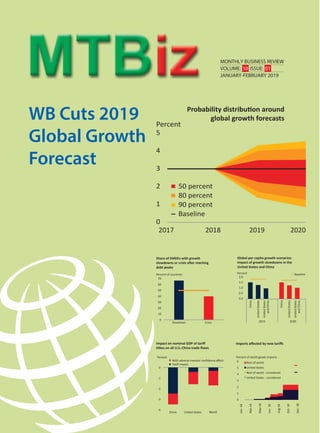
WB Cuts 2019
Global Growth
Forecast
Probability distribution around
global growth forecasts
Percent
5
4
3
2
1
0
50 percent
80 percent
90 percent
Baseline
2017 2018 2019 2020
Imports affected by new tariffs
Percent of world goods imports
Rest of world
United States
Rest of world - considered
United States - considered
6
5
4
3
2
1
0
Jan-18
Mar-18
May-18
Jun-18
Aug-18
Oct-18
Dec-18
Global per capita growth scenarios:
Impact of growth slowdowns in the
United States and China
Percent
2.0
1.5
1.0
0.5
0.0
Baseline
China
UnitedStates
andChina
UnitedStates
2019
China
UnitedStates
andChina
UnitedStates
2020
Impact on nominal GDP of tariff
Hikes on all U.S.-China trade flows
Percent
0
-1
-2
-3
-4
China
With adverse investor confidence effect
Tariff impact
United States World
Share of EMDEs with growth
slowdowns or crisis after reaching
debt peaks
Percent of countries
Slowdown Crisis
70
60
50
40
30
20
10
0
Contents
MONTHLY BUSINESS REVIEW
VOLUME: 10 ISSUE: 01
JANUARY-FEBRUARY 2019
MTBiz
Disclaimer:
MTBiz is printed for non-commercial & selected individual-level
distribution in order to sharing information among stakeholders only.
MTB takes no responsibility for any individual investment decision based
on the information at MTBiz. This review is for information purpose only
and the comments and forecasts are intended to be of general nature and
are current as of the date of publication. Information is obtained from
secondary sources which are assumed to be reliable but their accuracy
cannot be guaranteed. The name of the other companies, products and
services are the properties of their respective owners and are protected by
copyright, trademark and other intellectual property laws.
Developed & Published by
MTB Group R&D
Please send feedback to:
RnD@mutualtrustbank.com
All rights reserved @ 2019
Design & Printing:
Preview
Article of the month 02
National News
The Central Bank 05
Business & Economy 07
MTB News & Events 11
Industry Appointments 16
Dashboard 17
International
Economic Forecast 20
Wells Fargo Monthly Outlook 23
Financial Glossary 24
02 MTBiz
ARTICLE OF THE MONTH
Global growth is moderating as the recovery in trade
and manufacturing activity loses steam. Despite
ongoing negotiations, trade tensions among major
economies remain elevated. These tensions, combined
with concerns about softening global growth prospects,
have weighed on investor sentiment and contributed to
declines in global equity prices. Borrowing costs for
emerging market and developing economies (EMDEs)
have increased, in part as major advanced-economy
central banks continue to withdraw policy
accommodation in varying degrees. A strengthening
U.S. dollar, heightened financial market volatility, and
rising risk premiums have intensified capital outflow
and currency pressures in some large EMDEs, with
some vulnerable countries experiencing substantial
financial stress. Energy prices have fluctuated markedly,
mainly due to supply factors, with sharp falls toward
the end of 2018. Economic activity in the Euro Area has
been somewhat weaker than previously expected,
owing to slowing net exports. EMDE growth edged
down to an estimated 4.2 percent in 2018 as a number
of countries with elevated current account deficits
experienced substantial financial market pressures and
appreciable slowdowns in activity. In low-income
countries (LICs), growth is firming as infrastructure
investment continues and easing drought conditions
support a rebound in agricultural output.
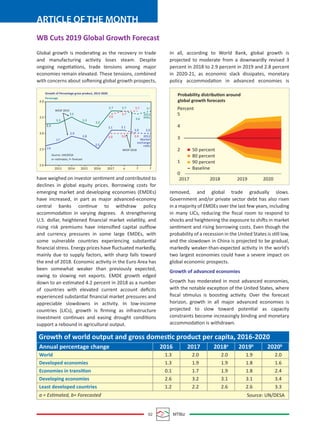
In all, according to World Bank, global growth is
projected to moderate from a downwardly revised 3
percent in 2018 to 2.9 percent in 2019 and 2.8 percent
in 2020-21, as economic slack dissipates, monetary
policy accommodation in advanced economies is
removed, and global trade gradually slows.
Government and/or private sector debt has also risen
in a majority of EMDEs over the last few years, including
in many LICs, reducing the fiscal room to respond to
shocks and heightening the exposure to shifts in market
sentiment and rising borrowing costs. Even though the
probability of a recession in the United States is still low,
and the slowdown in China is projected to be gradual,
markedly weaker-than-expected activity in the world’s
two largest economies could have a severe impact on
global economic prospects.
Growth of advanced economies
Growth has moderated in most advanced economies,
with the notable exception of the United States, where
fiscal stimulus is boosting activity. Over the forecast
horizon, growth in all major advanced economies is
projected to slow toward potential as capacity
constraints become increasingly binding and monetary
accommodation is withdrawn.
WB Cuts 2019 Global Growth Forecast
Percessage
Growth of Percentage gross product, 2012-2020
4.0
3.5
3.0
2.5
2.0
2013 2014 2015 2016 2017 e f f
3.3 3.3
3.3
2.7
2.6
2.9
2.8
3.2
3.6
3.1 3.1
3.0 3.0
3.7
3.6
2012
PPPs
3.7 3.7 3.?
2.5
3.0
WESP 2018
WESP 2019
3.0 3.0 2012
Market
exchange
rates
3.5
3.7
Probability distribution around
global growth forecasts
Percent
5
4
3
2
1
0
50 percent
80 percent
90 percent
Baseline
2017 2018 2019 2020
Growth of world output and gross domestic product per capita, 2016-2020
Annual percentage change 2016 2017 2018a
2019b
2020b
a = Estimated, b= Forecasted
World 1.3 2.0 2.0 1.9 2.0
Developed economies 1.3 1.9 1.9 1.8 1.6
Economies in transition 0.1 1.7 1.9 1.8 2.4
Developing economies 2.6 3.2 3.1 3.1 3.4
Least developed countries 1.2 2.2 2.6 2.6 3.3
Source: UN/DESA
Source: UN/DESA
e= estimates, f= forecast
03 MTBiz
ARTICLE OF THE MONTH
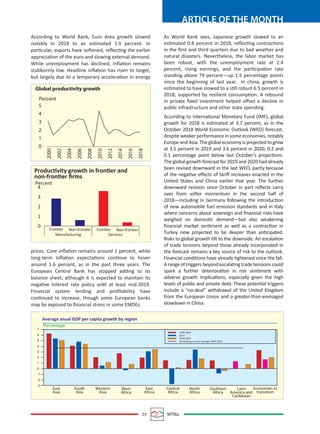
According to World Bank, Euro Area growth slowed
notably in 2018 to an estimated 1.9 percent. In
particular, exports have softened, reflecting the earlier
appreciation of the euro and slowing external demand.
While unemployment has declined, inflation remains
stubbornly low. Headline inflation has risen to target,
but largely due to a temporary acceleration in energy
prices. Core inflation remains around 1 percent, while
long-term Inflation expectations continue to hover
around 1.6 percent, as in the past three years. The
European Central Bank has stopped adding to its
balance sheet, although it is expected to maintain its
negative interest rate policy until at least mid-2019.
Financial system lending and profitability have
continued to increase, though some European banks
may be exposed to financial stress in some EMDEs.
As World Bank sees, Japanese growth slowed to an
estimated 0.8 percent in 2018, reflecting contractions
in the first and third quarters due to bad weather and
natural disasters. Nevertheless, the labor market has
been robust, with the unemployment rate at 2.4
percent, rising earnings, and the participation rate
standing above 79 percent—up 1.5 percentage points
since the beginning of last year. In china, growth is
estimated to have slowed to a still robust 6.5 percent in
2018, supported by resilient consumption. A rebound
in private fixed investment helped offset a decline in
public infrastructure and other state spending.
According to International Monetary Fund (IMF), global
growth for 2018 is estimated at 3.7 percent, as in the
October 2018 World Economic Outlook (WEO) forecast,
despite weaker performance in some economies, notably
Europe and Asia. The global economy is projected to grow
at 3.5 percent in 2019 and 3.6 percent in 2020, 0.2 and
0.1 percentage point below last October’s projections.
The global growth forecast for 2019 and 2020 had already
been revised downward in the last WEO, partly because
of the negative effects of tariff increases enacted in the
United States and China earlier that year. The further
downward revision since October in part reflects carry
over from softer momentum in the second half of
2018—including in Germany following the introduction
of new automobile fuel emission standards and in Italy
where concerns about sovereign and financial risks have
weighed on domestic demand—but also weakening
financial market sentiment as well as a contraction in
Turkey now projected to be deeper than anticipated.
Risks to global growth tilt to the downside. An escalation
of trade tensions beyond those already incorporated in
the forecast remains a key source of risk to the outlook.
Financial conditions have already tightened since the fall.
A range of triggers beyond escalating trade tensions could
spark a further deterioration in risk sentiment with
adverse growth implications, especially given the high
levels of public and private debt. These potential triggers
include a “no-deal” withdrawal of the United Kingdom
from the European Union and a greater-than-envisaged
slowdown in China.
Global productivity growth
Percent
5
4
3
2
1
0
2000
2002
2004
2006
2008
2010
2012
2014
2016
2018
Productivity growth in frontier and
non-frontier firms
Percent
4
3
2
1
0
Frontier Frontier
Manufacturing Services
Non-frontier Non-frontier
Average anual GDP per capita growth by region
Percentage
7
6
5
4
3
2
1
0
-1
-2
-3
1996-2016
2017
2018-2019
Developing country average 1996-2016
East
Asia
South
Asia
Western
Asia
West
Africa
East
Africa
Central
Africa
North
Africa
Southern
Africa
Latin
America and
Caribbean
Economies in
transition
04 MTBiz
ARTICLE OF THE MONTH
According to United Nations (UN), leading indicators
point to some softening in economic momentum in
many countries in 2019. The Organization for Economic
Cooperation and Development (OECD) Composite
Leading Indicator for the 36 members of the OECD plus
6 large non-member countries (Brazil, China, India,
Indonesia, the Russian Federation and South Africa) has
drifted down since the end of 2017. At the global level,
growth is expected to moderate slightly to 3 per cent in
both 2019 and 2020. Slower growth in China and the
United States will be largely offset by continued
recovery in some developing regions and economies in
transition that have been hardest hit by the commodity
price collapse of 2014-15. Among developed
economies, US growth is projected to decelerate
notably as the impulse from fiscal stimulus wanes and
the effects of higher interest rates are increasingly
being felt. While steady growth is projected for the EU,
the risks are tilted to the downside, including a
potential fallout from Brexit.
Emerging market and developing economies
As World Bank narrates, EMDE growth is expected to
stall at 4.2 percent in 2019, markedly below previous
expectations. The forecast reflects the lingering effects
of recent financial market pressure in some large
economies, with a substantially weaker-than-expected
pickup in commodity exporters accompanied by a
deceleration in commodity importers. Growth is
projected to plateau at 4.6 percent toward the end of
the forecast horizon, as the recovery in commodity
exporters levels off. In over 35 percent of EMDEs, per
capita growth will be too low to avoid widening income
gaps with advanced economies. In 2018, global trade
slowed more rapidly than expected, alongside
softening industrial activity. Trade policy uncertainty
remains elevated, dampening global investment and
trade. Borrowing costs have generally tightened in
EMDEs following a broad-based appreciation of the U.S.
dollar, bouts of investor risk aversion, and increased
focus on country-specific vulnerabilities. External
financing conditions are expected to continue
deteriorating in 2019, as monetary policy
accommodation in advanced economies is unwound.
Oil prices were markedly volatile in the second half of
2018, mainly due to supply factors, with sharp falls
toward the end of the year. Most other commodity
prices— particularly metals—also weakened, reflecting
heightened trade tensions.
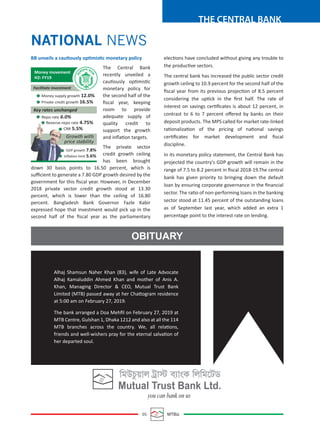
Key Global Risks
As S&P explains, the top two downside risks to S&P’s
global economic forecast remain an escalation and
broadening of the U.S.-China trade war and the
collateral effects of U.S. interest-rate normalization. The
top risk remains the impact on business and consumer
sentiment, spending, and, ultimately, growth from the
(temporarily paused) U.S.-China dispute. As S&P have
argued recently, the direct effects on growth in both
countries from higher tariffs will be less than 1% of GDP.
The second key global risk relates to the potential for
larger-than-expected effects from the normalization of
U.S. interest rates. S&P would underscore that higher
rates themselves don't constitute a risk to the baseline.
The Fed, through various channels - including forward
guidance and the "dot plot" showing the individual
projections of policymakers on the Federal Open
Market Committee (FOMC) - has signaled its intentions
to the market.
Policy Challenges
Advanced-economy monetary policy is expected to be
less stimulative, especially in the United States, where
tightening is proceeding more quickly than elsewhere
partly in response to pro-cyclical fiscal easing.
Advanced economies should use this period of above
potential growth to create the room to respond to
future cyclical shocks. Longer-term prospects remain
subdued and could be further eroded by major shifts in
trade and immigration policies.
Sources:
Global Economic Outlook 2019: Autumn Is Coming, December 11, 2018, S&P Global Ratings
Global Economic Prospects, January 2019, World Bank Group
World Economic Outlook Update, January 2019, International Monetary Fund
World Economic Situation and Prospects 2019, 2019, United Nations
US-China Trade War Effects
Cumulative deviation from baseline GDP, 2010 US$ prices
0.0
(0.5)
(1.0)
(1.5)
(2.0) 2019 2021 202120192020
US
2020
China
Sources: S&P Global Economics, Oxford Economics.
Confidence
Tarrifs
05 MTBiz
THE CENTRAL BANK
elections have concluded without giving any trouble to
the productive sectors.
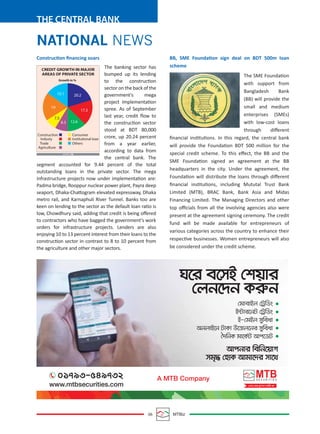
The central bank has increased the public sector credit
growth ceiling to 10.9 percent for the second half of the
fiscal year from its previous projection of 8.5 percent
considering the uptick in the first half. The rate of
interest on savings certificates is about 12 percent, in
contrast to 6 to 7 percent offered by banks on their
deposit products. The MPS called for market rate-linked
rationalization of the pricing of national savings
certificates for market development and fiscal
discipline.
In its monetary policy statement, the Central Bank has
projected the country's GDP growth will remain in the
range of 7.5 to 8.2 percent in fiscal 2018-19.The central
bank has given priority to bringing down the default
loan by ensuring corporate governance in the financial
sector. The ratio of non-performing loans in the banking
sector stood at 11.45 percent of the outstanding loans
as of September last year, which added an extra 1
percentage point to the interest rate on lending.
BB unveils a cautiously optimistic monetary policy
The Central Bank
recently unveiled a
cautiously optimistic
monetary policy for
the second half of the
fiscal year, keeping
room to provide
adequate supply of
quality credit to
support the growth
and inflation targets.
The private sector
credit growth ceiling
has been brought
down 30 basis points to 16.50 percent, which is
sufficient to generate a 7.80 GDP growth desired by the
government for this fiscal year. However, in December
2018 private sector credit growth stood at 13.30
percent, which is lower than the ceiling of 16.80
percent. Bangladesh Bank Governor Fazle Kabir
expressed hope that investment would pick up in the
second half of the fiscal year as the parliamentary
NATIONAL NEWS
OBITUARY
Alhaj Shamsun Naher Khan (83), wife of Late Advocate
Alhaj Kamaluddin Ahmed Khan and mother of Anis A.
Khan, Managing Director & CEO, Mutual Trust Bank
Limited (MTB) passed away at her Chattogram residence
at 5:00 am on February 27, 2019.
The bank arranged a Doa Mehfil on February 27, 2019 at
MTB Centre, Gulshan 1, Dhaka 1212 and also at all the 114
MTB branches across the country. We, all relations,
friends and well-wishers pray for the eternal salvation of
her departed soul.
Money supply growth 12.0%
Private credit growth 16.5%
Repo rate 6.0%
Reverse-repo rate 4.75%
CRR 5.5%
GDP growth 7.8%
Inflation limit 5.6%
Money movement
H2: FY19
Facilitate investment
Key rates unchanged
Growth with
price stability
06 MTBiz
THE CENTRAL BANK
BB, SME Foundation sign deal on BDT 500m loan
scheme
The SME Foundation
with support from
Bangladesh Bank
(BB) will provide the
small and medium
enterprises (SMEs)
with low-cost loans
through different
financial institutions. In this regard, the central bank
will provide the Foundation BDT 500 million for the
special credit scheme. To this effect, the BB and the
SME Foundation signed an agreement at the BB
headquarters in the city. Under the agreement, the
Foundation will distribute the loans through different
financial institutions, including Mututal Trust Bank
Limited (MTB), BRAC Bank, Bank Asia and Midas
Financing Limited. The Managing Directors and other
top officials from all the involving agencies also were
present at the agreement signing ceremony. The credit
fund will be made available for entrepreneurs of
various categories across the country to enhance their
respective businesses. Women entrepreneurs will also
be considered under the credit scheme.
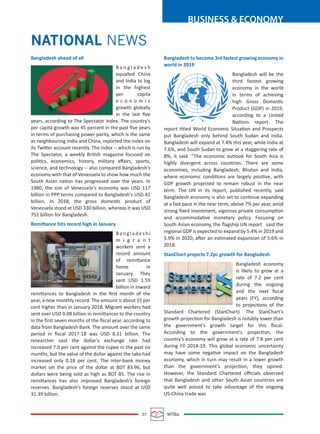
Construction financing soars
The banking sector has
bumped up its lending
to the construction
sector on the back of the
government's mega
project implementation
spree. As of September
last year, credit flow to
the construction sector
stood at BDT 80,000
crore, up 20.24 percent
from a year earlier,
according to data from
the central bank. The
segment accounted for 9.44 percent of the total
outstanding loans in the private sector. The mega
infrastructure projects now under implementation are:
Padma bridge, Rooppur nuclear power plant, Payra deep
seaport, Dhaka-Chattogram elevated expressway, Dhaka
metro rail, and Karnaphuli River Tunnel. Banks too are
keen on lending to the sector as the default loan ratio is
low, Chowdhury said, adding that credit is being offered
to contractors who have bagged the government's work
orders for infrastructure projects. Lenders are also
enjoying 10 to 13 percent interest from their loans to the
construction sector in contrast to 8 to 10 percent from
the agriculture and other major sectors.
NATIONAL NEWS
15.1
19
20.2
17.3
8.3 12.6
7.5
Construction
Industy
Trade
Agriculture
Consumer
Institutional Ioan
Others
CREDIT GROWTH IN MAJOR
AREAS OF PRIVATE SECTOR
Growth in %
SOURCE: BB
07 MTBiz
BUSINESS & ECONOMY
Bangladesh to become 3rd fastest growing economy in
world in 2019
Bangladesh will be the
third fastest growing
economy in the world
in terms of achieving
high Gross Domestic
Product (GDP) in 2019,
according to a United
Nations report. The
report titled World Economic Situation and Prospects
put Bangladesh only behind South Sudan and India.
Bangladesh will expand at 7.4% this year, while India at
7.6%, and South Sudan to grow at a staggering rate of
8%, it said. “The economic outlook for South Asia is
highly divergent across countries. There are some
economies, including Bangladesh, Bhutan and India,
where economic conditions are largely positive, with
GDP growth projected to remain robust in the near
term. The UN in its report, published recently, said
Bangladesh economy is also set to continue expanding
at a fast pace in the near term, above 7% per year, amid
strong fixed investment, vigorous private consumption
and accommodative monetary policy. Focusing on
South Asian economy, the flagship UN report said the
regional GDP is expected to expand by 5.4% in 2019 and
5.9% in 2020, after an estimated expansion of 5.6% in
2018.
StanChart projects 7.2pc growth for Bangladesh
Bangladesh economy
is likely to grow at a
rate of 7.2 per cent
during the ongoing
and the next fiscal
years (FY), according
to projections of the
Standard Chartered (StanChart). The StanChart's
growth projection for Bangladesh is notably lower than
the government's growth target for this fiscal.
According to the government's projection, the
country's economy will grow at a rate of 7.8 per cent
during FY 2018-19. This global economic uncertainty
may have some negative impact on the Bangladesh
economy, which in turn may result in a lower growth
than the government's projection, they opined.
However, the Standard Chartered officials observed
that Bangladesh and other South Asian countries are
quite well poised to take advantage of the ongoing
US-China trade war.
Bangladesh ahead of all
B a n g l a d e s h
equalled China
and India to log
in the highest
per capita
e c o n o m i c
growth globally
in the last five
years, according to The Spectator Index. The country's
per capita growth was 45 percent in the past five years
in terms of purchasing power parity, which is the same
as neighbouring India and China, reported the index on
its Twitter account recently. The index -- which is run by
The Spectator, a weekly British magazine focused on
politics, economics, history, military affairs, sports,
science, and technology -- also compared Bangladesh's
economy with that of Venezuela to show how much the
South Asian nation has progressed over the years. In
1980, the size of Venezuela's economy was USD 117
billion in PPP terms compared to Bangladesh's USD 41
billion. In 2018, the gross domestic product of
Venezuela stood at USD 330 billion, whereas it was USD
751 billion for Bangladesh.
Remittance hits record high in January
B a n g l a d e s h i
m i g r a n t
workers sent a
record amount
of remittance
home in
January. They
sent USD 1.59
billion in inward
remittances to Bangladesh in the first month of the
year, a new monthly record. The amount is about 15 per
cent higher than in January 2018. Migrant workers had
sent over USD 9.08 billion in remittances to the country
in the first seven months of the fiscal year, according to
data from Bangladesh Bank. The amount over the same
period in fiscal 2017-18 was USD 8.31 billion. The
researcher said the dollar’s exchange rate had
increased 7.0 per cent against the rupee in the past six
months, but the value of the dollar against the taka had
increased only 0.18 per cent. The inter-bank money
market set the price of the dollar at BDT 83.96, but
dollars were being sold as high as BDT 85. The rise in
remittances has also improved Bangladesh’s foreign
reserves. Bangladesh’s foreign reserves stood at USD
31.39 billion.
NATIONAL NEWS
08 MTBiz
BUSINESS & ECONOMY
NATIONAL NEWS
BD received USD 28b foreign investments in five years
Bangladesh
received more
than USD 28
billion in
i nve st m e nt
from 45
countries in
the last five
years with China investing the highest amount of USD
8107 million. According to the BIDA's statistics, the top
ten countries in terms of investment size are: China
(USD 8107 million), the UAE (USD 7836 million), Saudi
Arabia (USD 2461 million), Singapore (USD 2261
million), the UK (USD 1962 million), The Netherlands
(USD 1744 million), the USA (USD 1219 million), India
(USD 976 million), Thailand (USD 637 million) and Japan
(USD 384 million). The country's diplomatic missions
are maintaining good relations with different
organisations, multi-national companies alongside
different governments as part of their efforts to
increase foreign investment in Bangladesh and expand
trade further.
Flower business in Jashore booms in February
February, the
s e c o n d
month of the
calendar year,
occupies a
special place
in the hearts
of Bangalis. In
this very month in 1952, people laid down their lives
demanding the right to speak in their mother tongue -
Bangla. Bangladeshis remember the fallen heroes -
some known and many other unknown - on February
21 through various programmes. And flowers are an
integral part of the events. Apart from the International
Mother Language Day, Bangladeshis also celebrate two
other events in February - Pahela Falgun (February 13)
festival and Valentine's Day (February 14), the latter is
usually celebrated by the young. The three events,
coming one after another, push up the demands for
flowers and their prices. The flower growers and
traders of Jashore's Jhikargacha Upazila, one of the
largest flower markets of the country, are optimistic
about a big sale - more than BDT 700 million - this
month, a Bangladesh Flower Society official said.
Bashundhara to invest BDT 447cr to boost cement
production
B a s h u n d h a r a
Industrial Complex,
the cement
manufacturing arm
of Bashundhara
Group, is set to
expand its production capacity with a view to meeting
the fast-growing demand for the construction material
amid mega project-implementation spree. Located in
Madanganj of Narayanganj, the factory's production
capacity at present is 21 lakh tonnes per year. But after
the BDT 447.53 crore expansion project, the annual
production capacity would go up to 30 lakh tonnes. The
new extension unit is expected to go for commercial
operation next year, taking Bashundhara Group's
cement manufacturing capacity to 75.60 lakh tonnes.
Of the BDT 447.53 crore needed for the project, BDT
285 crore has already been raised from the financial
sector, while the remaining amount will come from the
business group's coffer. The demand-supply gap for
cement widened to 1.47 crore tonnes last year and is
expected to hit 1.8 crore tonnes this year. By 2021 the
gap is expected to be 2.17 crore tonnes.
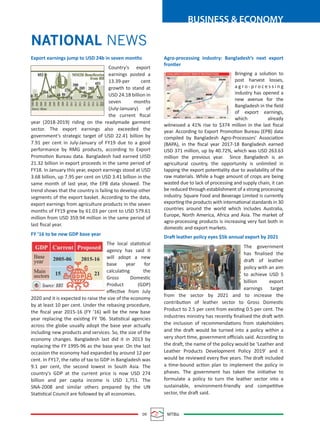
RMG exports soar 36pc
Garment export to
non-traditional markets
grew by 36.21 percent
year-on-year to USD 2.90
billion in the current fiscal
year's first six months
because of a government
stimulus package and
duty-free market access.
The receipt from the
garment shipment in the
same period last fiscal was USD 2.13 billion, according to
data from Export Promotion Bureau and the Bangladesh
Garment Manufacturers and Exporters Association
(BGMEA). Apart from the traditional US, European Union
and Canadian markets, all others are considered
non-traditional or emerging markets for Bangladesh. Of
those, 11 are performing stronger than others. Australia,
Brazil, Chile, China, India, Japan, South Korea, Mexico,
Russia, South Africa and Turkey are the 11 stronger
markets. Last fiscal year, Bangladesh exported garment
items worth USD 30.61 billion, registering an 8.76
percent year-on-year growth whereas in the first six
months the export from this sector grew by 15.65
percent year-on-year to reach USD 17.08 billion.
SOURCE: EPB AND BGMEA
Country Jul-Dec, FY2018 Jul-Dec, FY 2019
Australia 304.25 360.41
Brazil 77.78 89.52
Chile 35.83 55.97
China 166.48 267.26
India 111.33 270.86
Japan 363.31 547.33
Korea 87.03 135.81
Mexico 72.58 101.17
Russia 181.77 220.55
S Africa 34.74 109.17
Turkey 577.62 684.63
Others 577.62 684.63
SHIPMENTTO EMERGING MARKETS
In millions of $
09 MTBiz
BUSINESS & ECONOMY
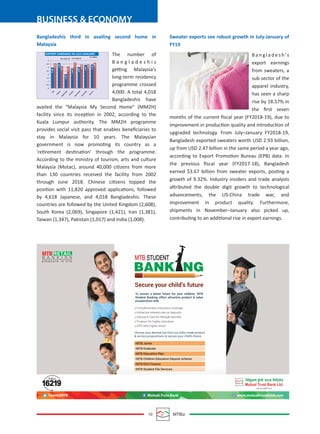
Agro-processing industry: Bangladesh’s next export
frontier
Bringing a solution to
post harvest losses,
a g r o - p r o c e s s i n g
industry has opened a
new avenue for the
Bangladesh in the field
of export earnings,
which already
witnessed a 41% rise to $374 million in the last fiscal
year. According to Export Promotion Bureau (EPB) data
compiled by Bangladesh Agro-Processors’ Association
(BAPA), in the fiscal year 2017-18 Bangladesh earned
USD 371 million, up by 40.72%, which was USD 263.63
million the previous year. Since Bangladesh is an
agricultural country, the opportunity is unlimited in
tapping the export potentiality due to availability of the
raw materials. While a huge amount of crops are being
wasted due to lack of processing and supply chain, it can
be reduced through establishment of a strong processing
industry. Square Food and Beverage Limited is currently
exporting the products with international standards in 30
countries around the world which includes Australia,
Europe, North America, Africa and Asia. The market of
agro-processing products is increasing very fast both in
domestic and export markets.
Draft leather policy eyes $5b annual export by 2021
The government
has finalised the
draft of leather
policy with an aim
to achieve USD 5
billion export
earnings target
from the sector by 2021 and to increase the
contribution of leather sector to Gross Domestic
Product to 2.5 per cent from existing 0.5 per cent. The
industries ministry has recently finalised the draft with
the inclusion of recommendations from stakeholders
and the draft would be turned into a policy within a
very short time, government officials said. According to
the draft, the name of the policy would be ‘Leather and
Leather Products Development Policy 2019’ and it
would be reviewed every five years. The draft included
a time-bound action plan to implement the policy in
phases. The government has taken the initiative to
formulate a policy to turn the leather sector into a
sustainable, environment-friendly and competitive
sector, the draft said.
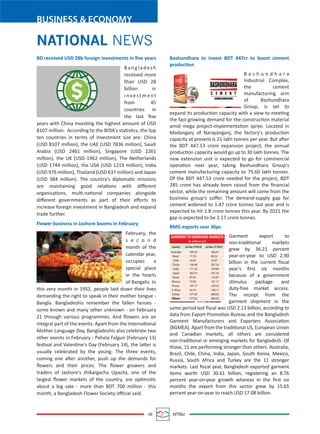
Export earnings jump to USD 24b in seven months
Country’s export
earnings posted a
13.39-per cent
growth to stand at
USD 24.18 billion in
seven months
(July-January) of
the current fiscal
year (2018-2019) riding on the readymade garment
sector. The export earnings also exceeded the
government’s strategic target of USD 22.41 billion by
7.91 per cent in July-January of FY19 due to a good
performance by RMG products, according to Export
Promotion Bureau data. Bangladesh had earned UISD
21.32 billion in export proceeds in the same period of
FY18. In January this year, export earnings stood at USD
3.68 billion, up 7.95 per cent on USD 3.41 billion in the
same month of last year, the EPB data showed. The
trend shows that the country is failing to develop other
segments of the export basket. According to the data,
export earnings from agriculture products in the seven
months of FY19 grew by 61.03 per cent to USD 579.61
million from USD 359.94 million in the same period of
last fiscal year.
FY ’16 to be new GDP base year
The local statistical
agency has said it
will adopt a new
base year for
calculating the
Gross Domestic
Product (GDP)
effective from July
2020 and it is expected to raise the size of the economy
by at least 10 per cent. Under the rebasing procedure,
the fiscal year 2015-16 (FY '16) will be the new base
year replacing the existing FY '06. Statistical agencies
across the globe usually adopt the base year actually
including new products and services. So, the size of the
economy changes. Bangladesh last did it in 2013 by
replacing the FY 1995-96 as the base year. On the last
occasion the economy had expanded by around 12 per
cent. In FY17, the ratio of tax to GDP in Bangladesh was
9.1 per cent, the second lowest in South Asia. The
country's GDP at the current price is now USD 274
billion and per capita income is USD 1,751. The
SNA-2008 and similar others prepared by the UN
Statistical Council are followed by all economies.
NATIONAL NEWS
BUSINESS & ECONOMY
10 MTBiz
Sweater exports see robust growth in July-January of
FY19
B a n g l a d e s h ’s
export earnings
from sweaters, a
sub sector of the
apparel industry,
has seen a sharp
rise by 18.57% in
the first seven
months of the current fiscal year (FY2018-19), due to
improvement in production quality and introduction of
upgraded technology. From July–January FY2018-19,
Bangladesh exported sweaters worth USD 2.93 billion,
up from USD 2.47 billion in the same period a year ago,
according to Export Promotion Bureau (EPB) data. In
the previous fiscal year (FY2017-18), Bangladesh
earned $3.67 billion from sweater exports, posting a
growth of 9.32%. Industry insiders and trade analysts
attributed the double digit growth to technological
advancements, the US-China trade war, and
improvement in product quality. Furthermore,
shipments in November–January also picked up,
contributing to an additional rise in export earnings.
Bangladeshis third in availing second home in
Malaysia
The number of
B a n g l a d e s h i s
getting Malaysia's
long-term residency
programme crossed
4,000. A total 4,018
Bangladeshis have
availed the "Malaysia My Second Home" (MM2H)
facility since its inception in 2002, according to the
Kuala Lumpur authority. The MM2H programme
provides social visit pass that enables beneficiaries to
stay in Malaysia for 10 years. The Malaysian
government is now promoting its country as a
'retirement destination' through the programme.
According to the ministry of tourism, arts and culture
Malaysia (Motac), around 40,000 citizens from more
than 130 countries received the facility from 2002
through June 2018. Chinese citizens topped the
position with 11,820 approved applications, followed
by 4,618 Japanese, and 4,018 Bangladeshis. These
countries are followed by the United Kingdom (2,608),
South Korea (2,069), Singapore (1,421), Iran (1,381),
Taiwan (1,347), Pakistan (1,017) and India (1,008).
EXPORT EARNINGS IN JULY-JANUARY
FY 2017-18
July
August
Septem
ber
October
Novem
ber
Decem
ber
January
4
3.5
3
2.5
2
1.5
1
0.5
0
FY 2018-19
$ in billion
2.98
3.58
3.64
3.21
2.03
3.14
2.84
3.71
3.05
3.42
3.35
3.42
3.41
3.68
MTB NEWS & EVENTS
11 MTBiz
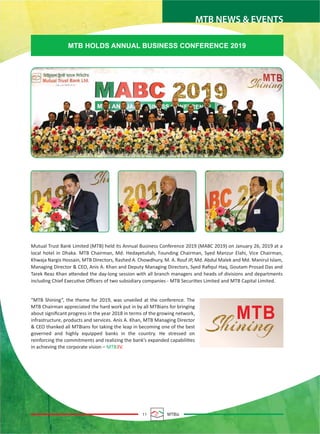
MTB HOLDS ANNUAL BUSINESS CONFERENCE 2019
Mutual Trust Bank Limited (MTB) held its Annual Business Conference 2019 (MABC 2019) on January 26, 2019 at a
local hotel in Dhaka. MTB Chairman, Md. Hedayetullah, Founding Chairman, Syed Manzur Elahi, Vice Chairman,
Khwaja Nargis Hossain, MTB Directors, Rashed A. Chowdhury, M. A. Rouf JP, Md. Abdul Malek and Md. Manirul Islam,
Managing Director & CEO, Anis A. Khan and Deputy Managing Directors, Syed Rafiqul Haq, Goutam Prosad Das and
Tarek Reaz Khan attended the day-long session with all branch managers and heads of divisions and departments
including Chief Executive Officers of two subsidiary companies - MTB Securities Limited and MTB Capital Limited.
“MTB Shining”, the theme for 2019, was unveiled at the conference. The
MTB Chairman appreciated the hard work put in by all MTBians for bringing
about significant progress in the year 2018 in terms of the growing network,
infrastructure, products and services. Anis A. Khan, MTB Managing Director
& CEO thanked all MTBians for taking the leap in becoming one of the best
governed and highly equipped banks in the country. He stressed on
reinforcing the commitments and realizing the bank’s expanded capabilities
in achieving the corporate vision – MTB3V.
12 MTBiz
MTB NEWS & EVENTS
MTB ARRANGES SYNDICATION TERM LOAN FACILITY OF BDT 3,800
MILLION TO SET UP LPG PROJECTS FOR JMI GROUP
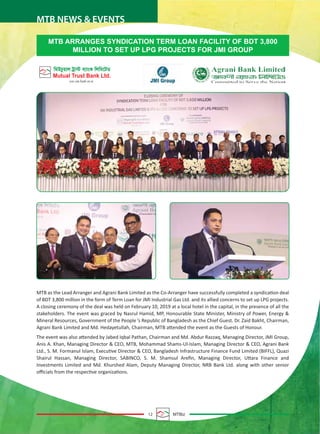
MTB as the Lead Arranger and Agrani Bank Limited as the Co-Arranger have successfully completed a syndication deal
of BDT 3,800 million in the form of Term Loan for JMI Industrial Gas Ltd. and its allied concerns to set up LPG projects.
A closing ceremony of the deal was held on February 10, 2019 at a local hotel in the capital, in the presence of all the
stakeholders. The event was graced by Nasrul Hamid, MP, Honourable State Minister, Ministry of Power, Energy &
Mineral Resources, Government of the People ’s Republic of Bangladesh as the Chief Guest. Dr. Zaid Bakht, Chairman,
Agrani Bank Limited and Md. Hedayetullah, Chairman, MTB attended the event as the Guests of Honour.
The event was also attended by Jabed Iqbal Pathan, Chairman and Md. Abdur Razzaq, Managing Director, JMI Group,
Anis A. Khan, Managing Director & CEO, MTB, Mohammad Shams-Ul-Islam, Managing Director & CEO, Agrani Bank
Ltd., S. M. Formanul Islam, Executive Director & CEO, Bangladesh Infrastructure Finance Fund Limited (BIFFL), Quazi
Shairul Hassan, Managing Director, SABINCO, S. M. Shamsul Arefin, Managing Director, Uttara Finance and
Investments Limited and Md. Khurshed Alam, Deputy Managing Director, NRB Bank Ltd. along with other senior
officials from the respective organizations.
13 MTBiz
MTB NEWS & EVENTS
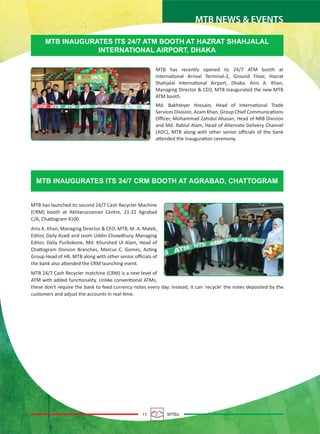
MTB has launched its second 24/7 Cash Recycler Machine
(CRM) booth at Akhtaruzzaman Centre, 21-22 Agrabad
C/A, Chattogram 4100.
Anis A. Khan, Managing Director & CEO, MTB, M. A. Malek,
Editor, Daily Azadi and Jasim Uddin Chowdhury, Managing
Editor, Daily Purbokone, Md. Khurshed Ul Alam, Head of
Chattogram Division Branches, Marcus C. Gomes, Acting
Group Head of HR, MTB along with other senior officials of
the bank also attended the CRM launching event.
MTB 24/7 Cash Recycler matchine (CRM) is a next level of
ATM with added functionality. Unlike conventional ATMs,
these don't require the bank to feed currency notes every day. Instead, it can 'recycle' the notes deposited by the
customers and adjust the accounts in real-time.
MTB INAUGURATES ITS 24/7 ATM BOOTH AT HAZRAT SHAHJALAL
INTERNATIONAL AIRPORT, DHAKA
MTB INAUGURATES ITS 24/7 CRM BOOTH AT AGRABAD, CHATTOGRAM
MTB has recently opened its 24/7 ATM booth at
International Arrival Terminal-2, Ground Floor, Hazrat
Shahjalal International Airport, Dhaka. Anis A. Khan,
Managing Director & CEO, MTB inaugurated the new MTB
ATM booth.
Md. Bakhteyer Hossain, Head of International Trade
Services Division, Azam Khan, Group Chief Communications
Officer, Mohammad Zahidul Ahasan, Head of NRB Division
and Md. Rabiul Alam, Head of Alternate Delivery Channel
(ADC), MTB along with other senior officials of the bank
attended the inauguration ceremony.
14 MTBiz
MTB NEWS & EVENTS
MTB LED SCHOOL BANKING CONFERENCE 2019 AT GAZIPUR
MTB has organized “School Banking Conference 2019” at
Gazipur as the lead bank on January 19, 2019. Dr. Dewan
Muhammad Humayun Kabir, Deputy Commissioner,
Gazipur attended the conference as the Chief Guest, while
Shamsunnahar, PPM, Superintendent of Police, Gazipur
and Mohammad Abul Hashem, Deputy General Manager,
Financial Inclusion Department, Bangladesh Bank graced
the event as special guests. With the objective of building
awareness of the importance of savings and its
contribution to the country’s economy among the
students, the conference has been held.
Gazi Ashraf Hossain Lipu, Former Captain, Bangladesh
National Cricket Team, Tarek Reaz Khan, Deputy Managing
Director, Azam Khan, Group Chief Communications Officer,
MTB along with senior officials from Bangladesh Bank
Head Office and MTB, as well as all scheduled banks
operating in Gazipur, dignitaries and leaders of local
business associations, representatives from different
strata also attended the conference.
S C
H O O
L
15 MTBiz
MTB NEWS & EVENTS
MTB Club organized “2nd
MTB Club Cricket Carnival
2019” at Ashulia, Dhaka 1349 on February 8-9, 2019.
Tarek Reaz Khan, Deputy Managing Director
inaugurated the Cricket Carnival. Teams "Square Sixers"
and "WBD PANGKHAS" became champions and
runner-up respectively. Syed Rafiqul Haq, Deputy
Managing Director & Chief Business Officer, MTB
handed over the trophies among the winning teams.
MTB CLUB ORGANIZES 2ND MTB CLUB FOOTBALL CARNIVAL 2019
16 MTBiz
INDUSTRY APPOINTMENTS
NATIONAL NEWS
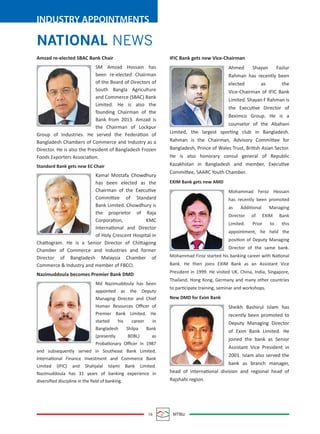
IFIC Bank gets new Vice-Chairman
Ahmed Shayan Fazlur
Rahman has recently been
elected as the
Vice-Chairman of IFIC Bank
Limited. Shayan F Rahman is
the Executive Director of
Beximco Group. He is a
counselor of the Abahani
Limited, the largest sporting club in Bangladesh.
Rahman is the Chairman, Advisory Committee for
Bangladesh, Prince of Wales Trust, British Asian Sector.
He is also honorary consul general of Republic
Kazakhstan in Bangladesh and member, Executive
Committee, SAARC Youth Chamber.
EXIM Bank gets new AMD
Mohammad Feroz Hossain
has recently been promoted
as Additional Managing
Director of EXIM Bank
Limited. Prior to this
appointment, he held the
position of Deputy Managing
Director of the same bank.
Mohammad Firoz started his banking career with National
Bank. He then joins EXIM Bank as an Assistant Vice
President in 1999. He visited UK, China, India, Singapore,
Thailand, Hong Kong, Germany and many other countries
to participate training, seminar and workshops.
New DMD for Exim Bank
Sheikh Bashirul Islam has
recently been promoted to
Deputy Managing Director
of Exim Bank Limited. He
joined the bank as Senior
Assistant Vice President in
2001. Islam also served the
bank as branch manager,
head of international division and regional head of
Rajshahi region.
Amzad re-elected SBAC Bank Chair
SM Amzad Hossain has
been re-elected Chairman
of the Board of Directors of
South Bangla Agriculture
and Commerce (SBAC) Bank
Limited. He is also the
founding Chairman of the
Bank from 2013. Amzad is
the Chairman of Lockpur
Group of Industries. He served the Federation of
Bangladesh Chambers of Commerce and Industry as a
Director. He is also the President of Bangladesh Frozen
Foods Exporters Association.
Standard Bank gets new EC Chair
Kamal Mostafa Chowdhury
has been elected as the
Chairman of the Executive
Committee of Standard
Bank Limited. Chowdhury is
the proprietor of Raja
Corporation, KMC
International and Director
of Holy Crescent Hospital in
Chattogram. He is a Senior Director of Chittagong
Chamber of Commerce and Industries and former
Director of Bangladesh Malaysia Chamber of
Commerce & Industry and member of FBCCI.
Nazimuddoula becomes Premier Bank DMD
Md Nazimuddoula has been
appointed as the Deputy
Managing Director and Chief
Human Resources Officer of
Premier Bank Limited. He
started his career in
Bangladesh Shilpa Bank
(presently BDBL) as
Probationary Officer in 1987
and subsequently served in Southeast Bank Limited,
International Finance Investment and Commerce Bank
Limited (IFIC) and Shahjalal Islami Bank Limited.
Nazimuddoula has 31 years of banking experience in
diversified discipline in the field of banking.
17 MTBiz
DASHBOARD
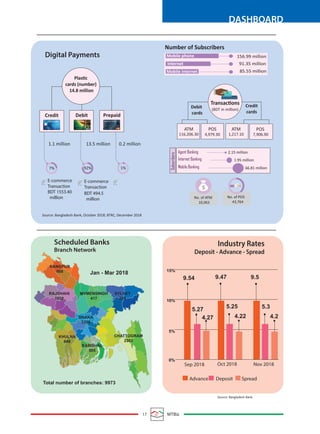
Source: Bangladesh Bank, October 2018; BTRC, December 2018
Digital Payments 156.99 million
91.35 million
85.55 million
Number of Subscribers
Mobile phone
Mobile Internet
Internet
Plastic
cards (number)
14.8 million
Credit Debit Prepaid
1.1 million 13.5 million 0.2 million
E-commerce
Transaction
BDT 1553.40
million
E-commerce
Transaction
BDT 494.5
million
7% 92% 1%
Scheduled Banks
Branch Network
Jan - Mar 2018
RANGPUR
668
RAJSHAHI
1039
MYMENSINGH
417
SYLHET
755
DHAKA
3338
KHULNA
949
BARISHAL
505
CHATTOGRAM
2302
Industry Rates
Deposit - Advance - Spread
Source: Bangladesh Bank
Advance Deposit Spread
Oct 2018Sep 2018
15%
10%
5%
0%
9.54
5.27
5.25
4.27 4.22
9.47
Nov 2018
5.3
4.2
9.5
Total number of branches: 9973
Debit
cards
Credit
cards
No. of ATM
10,063
No. of POS
43,764
POS
4,979.30
ATM
116,206.30
ATM
1,217.10
POS
7,906.90
1.95 million
2.15 million
66.81 millionMobile Banking
Internet Banking
Agent Banking
Subscribers
Transactions
(BDT in million)
18 MTBiz
DASHBOARD
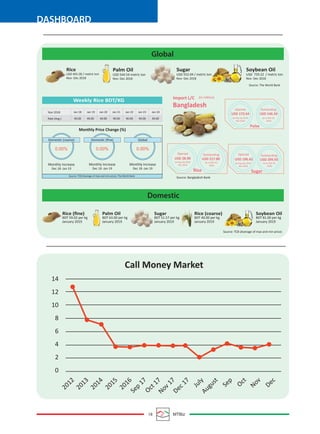
Call Money Market
14
12
10
8
6
4
2
0
2012
2013
2014
2015
2016
Sep
17
Oct 17
Nov 17
Dec 17
July
August
Sep
Oct
Nov
Dec
Domestic (coarse) Domestic (fine) Global
0.00%
Monthly Increase
Dec 18 -Jan 19
0.00%
Monthly Increase
Dec 18 -Jan 19
0.00%
Monthly Increase
Dec 18 -Jan 19
Monthly Price Change (%)
Weekly Rice BDT/KG
Rice
USD 401.00 / metric ton
Nov- Dec 2018
Palm Oil
USD 544.54 metric ton
Nov- Dec 2018
Sugar
USD 552.04 / metric ton
Nov- Dec 2018
Soybean Oil
USD 729.22 / metric ton
Nov- Dec 2018
Source: TCB (Average of max and min price), The World Bank
Source: The World Bank
Source: Bangladesh Bank
(in million)
Rate (Avg.) 40.00 40.00 40.00
Jan 20Jan 18 Jan 19
40.00
Jan 21
40.00
Jan 22
40.00
Jan 23
40.00
Jan 24Year 2018
Global
Domestic
Import L/C
Opened
USD 196.42 USD 299.93
during July 2018
Nov 2018
during July 2018
Nov 2018
(as on Nov 30,
2018)
Outstanding
USD 217.80
(as on Nov 30,
2018)
OutstandingOpened
USD 28.90
during July 2018
Nov 2018
(as on Nov 30,
2018)
Opened Outstanding
USD 173.64 USD 146.34
Bangladesh
SugarRice
Pulse
Rice (fine)
BDT 59.02 per kg
January 2019
Palm Oil
BDT 63.00 per kg
January 2019
Sugar
BDT 51.57 per kg
January 2019
Rice (coarse)
BDT 40.00 per kg
January 2019
Soybean Oil
BDT 81.00 per kg
January 2019
Source: TCB (Average of max and min price)
19 MTBiz
DASHBOARD
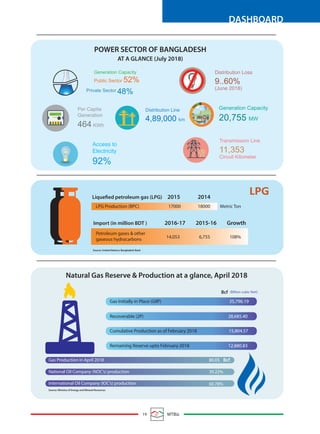
Natural Gas Reserve & Production at a glance, April 2018
Bcf
Gas Initially in Place (GIIP) 35,796.19
Recoverable (2P) 28,685.40
Gas Production in April 2018 80.05
National Oil Company (NOC’s) production 39.22%
International Oil Company (IOC’s) production 60.78%
(Billion cubic feet)
Cumulative Production as of February 2018 15,804.57
Remaining Reserve upto February 2018 12,880.83
Source: Ministry of Energy and Mineral Resources
Generation Capacity
Public Sector 52%
Private Sector
Per Capita
Generation
464 KWh
Distribution Line
4,89,000 km
Distribution Loss
9..60%
(June 2018)
Access to
Electricity
92%
Transmission Line
11,353
Circuit Kilometer
Generation Capacity
20,755 MW
POWER SECTOR OF BANGLADESH
AT A GLANCE (July 2018)
48%
Liquefied petroleum gas (LPG) 2015 2014
Import (in million BDT ) 2016-17 2015-16 Growth
LPG Production (BPC) 17000
14,053 6,755 108%
18000 Metric Ton
Petroleum gases & other
gaseous hydrocarbons
LPG
Bcf
Source: United Nations; Bangladesh Bank
20 MTBiz
ECONOMIC FORECAST
INTERNATIONAL NEWS
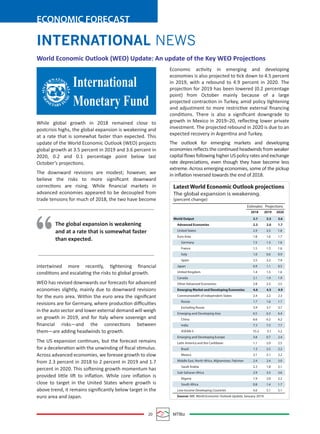
While global growth in 2018 remained close to
postcrisis highs, the global expansion is weakening and
at a rate that is somewhat faster than expected. This
update of the World Economic Outlook (WEO) projects
global growth at 3.5 percent in 2019 and 3.6 percent in
2020, 0.2 and 0.1 percentage point below last
October’s projections.
The downward revisions are modest; however, we
believe the risks to more significant downward
corrections are rising. While financial markets in
advanced economies appeared to be decoupled from
trade tensions for much of 2018, the two have become
intertwined more recently, tightening financial
conditions and escalating the risks to global growth.
WEO has revised downwards our forecasts for advanced
economies slightly, mainly due to downward revisions
for the euro area. Within the euro area the significant
revisions are for Germany, where production difficulties
in the auto sector and lower external demand will weigh
on growth in 2019, and for Italy where sovereign and
financial risks—and the connections between
them—are adding headwinds to growth.
The US expansion continues, but the forecast remains
for a deceleration with the unwinding of fiscal stimulus.
Across advanced economies, we foresee growth to slow
from 2.3 percent in 2018 to 2 percent in 2019 and 1.7
percent in 2020. This softening growth momentum has
provided little lift to inflation. While core inflation is
close to target in the United States where growth is
above trend, it remains significantly below target in the
euro area and Japan.
Economic activity in emerging and developing
economies is also projected to tick down to 4.5 percent
in 2019, with a rebound to 4.9 percent in 2020. The
projection for 2019 has been lowered (0.2 percentage
point) from October mainly because of a large
projected contraction in Turkey, amid policy tightening
and adjustment to more restrictive external financing
conditions. There is also a significant downgrade to
growth in Mexico in 2019–20, reflecting lower private
investment. The projected rebound in 2020 is due to an
expected recovery in Argentina and Turkey.
The outlook for emerging markets and developing
economies reflects the continued headwinds from weaker
capitalflowsfollowinghigherUSpolicyratesandexchange
rate depreciations, even though they have become less
extreme. Across emerging economies, some of the pickup
in inflation reversed towards the end of 2018.
Estimates Projections
World Output 3.7 3.5 3.6
Advanced Economies 2.3 2.0 1.7
United States 2.9 2.5 1.8
Euro Area 1.8 1.6 1.7
Germany 1.5 1.3 1.6
France 1.5 1.5 1.6
Italy 1.0 0.6 0.9
Spain 2.5 2.2 7.9
Japan 0.9 1.1 0.5
United Kingdom 1.4 1.5 1.6
Canada 2.1 1.9 1.9
Other Advanced Economies 2.8 2.5 2.5
Emerging Market and Developing Economies 4.6 4.5 4.9
Commonwealth of independent States 2.4 2.2 2.3
Russia 1.7 1.6 1.7
Excluding Russia 3.9 3.7 3.7
Emerging and Developing Asia 6.5 6.3 6.4
China 6.6 6.2 6.2
India 7.3 7.5 7.7
ASEAN-5 55.2 5.1 5.2
Emerging and Developing Europe 3.8 0.7 2.4
Latin America and the Caribbean 1.1 2.0 2.5
Brazil 1.3 2.5 2.2
Mexico 2.1 2.1 2.2
Middle East, North Africa, Afghanistan, Pakistan 2.4 2.4 3.0
Saudi Arabia 2.3 1.8 2.1
Sub-Saharan Africa 2.9 3.5 3.6
Nigeria 1.9 2.0 2.2
South Africa 0.8 1.4 1.7
Low-Income Developing Countries 4.6 5.1 5.1
Source: IMF, World Economic Outlook Update, January 2019.
Latest World Economic Outlook projections
The global expansion is weakening.
(percent change)
2018 2019 2020
The global expansion is weakening
and at a rate that is somewhat faster
than expected.
International
Monetary Fund
World Economic Outlook (WEO) Update: An update of the Key WEO Projections
21 MTBiz
ECONOMIC FORECAST
Overall, the cyclical forces that propelled broad-based
global growth since the second half of 2017 may be
weakening somewhat faster than we expected in
October. Trade and investment have slowed, industrial
production outside the United States has decelerated,
and purchasing managers’ indices have weakened,
flagging softening momentum. While this does not
mean we are staring at a major downturn—it is
important to take stock of the many rising risks.
An escalation of trade tensions and a worsening of
financial conditions are key sources of risk to the
outlook. Higher trade uncertainty will further dampen
investment and disrupt global supply chains. A more
serious tightening of financial conditions is particularly
costly given the high levels of private and public sector
debt in countries.
China’s growth slowdown could be faster than expected
especially if trade tensions continue, and this can
trigger abrupt sell-offs in financial and commodity
markets as was the case in 2015–16. In Europe the
Brexit cliffhanger continues, and the costly spillovers
between sovereign and financial risk in Italy remain a
threat. In the United States a protracted US federal
government shutdown poses downside risks.
Policy priorities
Given this backdrop policymakers need to act now to
reverse headwinds to growth and prepare for the next
downturn.
The main policy priority is for countries to resolve
cooperatively and quickly their trade disagreements
and the resulting policy uncertainty, rather than raising
harmful barriers further and destabilizing an already
slowing global economy. The call of Group of Twenty
leaders to reform the World Trade Organization in
Buenos Aires must be accomplished. Where fiscal space
is low, fiscal policy needs to adjust in a growth-friendly
manner to ensure public debt is on a sustainable path,
while protecting the most vulnerable.
Monetary policy in advanced economies should continue
to normalize carefully. The major central banks are keenly
aware of the slowing momentum—and we expect they
will calibrate their next steps in line with these
developments. Macro prudential tools should be used
where financial vulnerabilities are building up. Across all
economies, measures to boost potential output growth
and enhance inclusiveness are imperatives.
Lastly, given that policy space for countries is more
limited than in 2008, multilateral cooperation will be
even more important in the event of a sharper decline
in global growth, and it is essential that multilateral
institutions like the IMF have adequate resources to
deal with the rising risks.
MTBSTUDENT
Show your little ones the value of saving with
MTB Junior - an exclusive savings account for
school and college students that lets your
youngsters enjoy the benefits of savings and
secure their future.
• Higher interest rate
• Complimentary insurance coverage
• Discount Card for lifestyle benefits
• Free cheque book
• No account maintenance fee
www.mutualtrustbank.comMutual.Trust.BankTweet2MTB
*ConditionsApply
ECONOMIC FORECAST
23 MTBiz
WELLS FARGO MONTHLY OUTLOOK
INTERNATIONAL NEWS WELLS
SECURITIES
FARGO
Increased Turbulence and Lower Visibility
The partial government shutdown that spanned most of
January and is only tentatively resolved has imparted a
near-term hit to the economy. The direct impact should
largely be limited to federal government output, with
growth made up later in the year. Indirectly, however,
the lack of key data has reduced visibility for the near
term. With that in mind, we have lowered Wells Fargo
GDP estimates for Q4-2018 and Q1-2019 to 2.3% and
1.9%, respectively (previously 2.5% and 2.2%).
In addition to weaker government spending in the first
quarter, the housing sector continues to struggle and
will likely be a larger drag on growth than previously
estimated. At the same time, business investment
remains challenged by ongoing trade uncertainty as
well as a further slowdown in growth abroad.
That keeps the onus of growth on consumer spending.
Although a few major government reports on spending
remain delayed by the shutdown, private sector data
suggest considerable momentum heading into the first
quarter. Moreover, income growth still looks strong
with 304,000 new jobs added in January and wages
continuing to move up.
At its January meeting, the FOMC adopted a notably
more dovish stance, removing references to further rate
hikes and vowing to be patient. Wells Fargo still expects
the FOMC’s next move will be to raise rates, but have
pushed back the timing of the next rate hike to Q3 (from
Q2).Whereas previously Wells Fargo thought the FOMC
would raise rates twice more this year, Wells Fargo now
expect the Q3 hike to be the last of the cycle.
Europe, China at Center of Growth Fears
The United States, the Eurozone and China account for
nearly 0ne half of global GDP on a purchasing power
parity basis, making the growth prospects for these
three players crucial for the global economy as a whole.
All three have shown signs of slowing economic growth
of late, with Europe in particular exhibiting concerning
signs of weakness. This weaker growth outlook has in
turn translated into a slower pace of monetary policy
tightening among the world’s major central banks than
was previously anticipated.
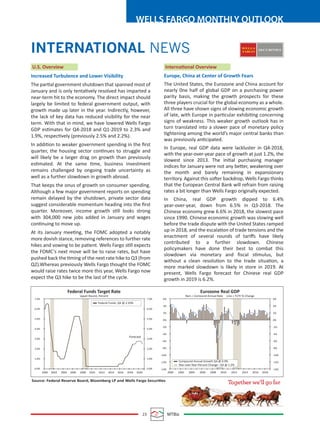
In Europe, real GDP data were lackluster in Q4-2018,
with the year-over-year pace of growth at just 1.2%, the
slowest since 2013. The initial purchasing manager
indices for January were not any better, weakening over
the month and barely remaining in expansionary
territory. Against this softer backdrop, Wells Fargo thinks
that the European Central Bank will refrain from raising
rates a bit longer than Wells Fargo originally expected.
In China, real GDP growth dipped to 6.4%
year-over-year, down from 6.5% in Q3-2018. The
Chinese economy grew 6.6% in 2018, the slowest pace
since 1990. Chinese economic growth was slowing well
before the trade dispute with the United States ramped
up in 2018, and the escalation of trade tensions and the
enactment of several rounds of tariffs have likely
contributed to a further slowdown. Chinese
policymakers have done their best to combat this
slowdown via monetary and fiscal stimulus, but
without a clean resolution to the trade situation, a
more marked slowdown is likely in store in 2019. At
present, Wells Fargo forecast for Chinese real GDP
growth in 2019 is 6.2%.
U.S. Overview International Overview
Source: Federal Reserve Board, Bloomberg LP and Wells Fargo Securities
7.0%
6.0%
5.0%
4.0%
3.0%
2.0%
1.0%
0.0%
6%
4%
2%
0%
-2%
-4%
-6%
-8%
-10%
-12%
-14%
6%
4%
2%
0%
-2%
-4%
-6%
-8%
-10%
-12%
-14%
7.0%
6.0%
5.0%
4.0%
3.0%
2.0%
1.0%
0.0%
Federal Funds Target Rate
Upper Bound, Percent
Eurozone Real GDP
Bars = Comound Annual Rate Line = Yr/Yr % Change
Federal Funds: Q4 @ 2.50%
Forecast
2000 2002 2004 2006 2008 2010 2012 2014 2016 2018 2020 2000 2002 2004 2006 2008 2010 2012 2014 2016 2018
Compound Annual Growth Q4 @ 0.9%
Year-over-Year Percent Change : Q4 @ 1.2%
24 MTBiz
FINANCIAL GLOSSARY
All paper deal: An all paper deal is an acquisition
where a listed company acquires another company
(listed or private) and the shareholders of the target
company only receives shares in the acquiring
company as payment for their shares in the target
company. In some parts of the world, doing an All
Paper Deal instead of a deal that involves cash can be
beneficial from a tax point of view. In the United
States, swapping shares in an All Paper Deal will not
trigger immediate capital gains tax liabilities.
Buy on rumor, sell on the fact: This is a saying that
highlights a commonly seen stock market behavior.
When positive rumors begin to circulate about a
company, this tend to increase the share price, but we
cannot trust this high price to remain for long because
when the actual facts are revealed, the stock market
will often react negatively to them – even if they
aren’t bad. In many cases, it is simply difficult for the
actual facts – such as the launch of a new product – to
live up to the hype preceding the announcement. Of
course, if enough people believe in the axiom of
buying on rumor and selling on fact, it will become a
fulfilling prophecy.
Churning: Churning is the unjustified overtrading by a
stockbroker or fund manager. A broker or manager
that earns a commission whenever a trade is carried
out has an incentive to carry out as many trades as
possible, hence the risk of churning.
Binary Options: Binary options are a type of high risk
financial instrument used to speculate on future
market movement. A binary option is tied to an
underlying asset such as a stock, an index, a currency
pair or a commodity. It is the market movements of
the underlying financial asset that dictates whether a
binary option matures in the money or not. A binary
option has to possible outcomes. You lose your entire
investment or you make a large profit.
Bed and breakfast: In the United Kingdom, “bread
and breakfast” is slang for selling shares one day and
buying them back the following day in order to realize
a gain or a loss. Before the anti-avoidance provisions
of the 1998 Budget came into force, Bed and
Breakfasting was commonly done for tax purposes – a
realized loss could be offset against a gain realized in
the same tax year and vice versa, even for shares that
were sold and then purchased back again the very
next day.
Covered call fund: A covered call fund is a pooled
investment vehicle that combines stock investments
with the sale (issuing) of call options based on stocks
owned by the fund. If the owner of an option decides
to exercise it, the fund owns the stock that it is
obligated to sell. This means that the fund won’t be
forced to purchase stocks on the open market to
honor their obligations. A covered call fund will
typically outperform the underlying stock portfolio in
a bear market.
G O S S A R Y Y
Y
R
R
A
A
S S
O
O
L
L
G
MTB POS

MTBiz Jan-Feb 2019

  • 1.
    MONTHLY BUSINESS REVIEW VOLUME:10 ISSUE: 01 JANUARY-FEBRUARY 2019 WB Cuts 2019 Global Growth Forecast Probability distribution around global growth forecasts Percent 5 4 3 2 1 0 50 percent 80 percent 90 percent Baseline 2017 2018 2019 2020 Imports affected by new tariffs Percent of world goods imports Rest of world United States Rest of world - considered United States - considered 6 5 4 3 2 1 0 Jan-18 Mar-18 May-18 Jun-18 Aug-18 Oct-18 Dec-18 Global per capita growth scenarios: Impact of growth slowdowns in the United States and China Percent 2.0 1.5 1.0 0.5 0.0 Baseline China UnitedStates andChina UnitedStates 2019 China UnitedStates andChina UnitedStates 2020 Impact on nominal GDP of tariff Hikes on all U.S.-China trade flows Percent 0 -1 -2 -3 -4 China With adverse investor confidence effect Tariff impact United States World Share of EMDEs with growth slowdowns or crisis after reaching debt peaks Percent of countries Slowdown Crisis 70 60 50 40 30 20 10 0
  • 3.
    Contents MONTHLY BUSINESS REVIEW VOLUME:10 ISSUE: 01 JANUARY-FEBRUARY 2019 MTBiz Disclaimer: MTBiz is printed for non-commercial & selected individual-level distribution in order to sharing information among stakeholders only. MTB takes no responsibility for any individual investment decision based on the information at MTBiz. This review is for information purpose only and the comments and forecasts are intended to be of general nature and are current as of the date of publication. Information is obtained from secondary sources which are assumed to be reliable but their accuracy cannot be guaranteed. The name of the other companies, products and services are the properties of their respective owners and are protected by copyright, trademark and other intellectual property laws. Developed & Published by MTB Group R&D Please send feedback to: RnD@mutualtrustbank.com All rights reserved @ 2019 Design & Printing: Preview Article of the month 02 National News The Central Bank 05 Business & Economy 07 MTB News & Events 11 Industry Appointments 16 Dashboard 17 International Economic Forecast 20 Wells Fargo Monthly Outlook 23 Financial Glossary 24
  • 4.
    02 MTBiz ARTICLE OFTHE MONTH Global growth is moderating as the recovery in trade and manufacturing activity loses steam. Despite ongoing negotiations, trade tensions among major economies remain elevated. These tensions, combined with concerns about softening global growth prospects, have weighed on investor sentiment and contributed to declines in global equity prices. Borrowing costs for emerging market and developing economies (EMDEs) have increased, in part as major advanced-economy central banks continue to withdraw policy accommodation in varying degrees. A strengthening U.S. dollar, heightened financial market volatility, and rising risk premiums have intensified capital outflow and currency pressures in some large EMDEs, with some vulnerable countries experiencing substantial financial stress. Energy prices have fluctuated markedly, mainly due to supply factors, with sharp falls toward the end of 2018. Economic activity in the Euro Area has been somewhat weaker than previously expected, owing to slowing net exports. EMDE growth edged down to an estimated 4.2 percent in 2018 as a number of countries with elevated current account deficits experienced substantial financial market pressures and appreciable slowdowns in activity. In low-income countries (LICs), growth is firming as infrastructure investment continues and easing drought conditions support a rebound in agricultural output. In all, according to World Bank, global growth is projected to moderate from a downwardly revised 3 percent in 2018 to 2.9 percent in 2019 and 2.8 percent in 2020-21, as economic slack dissipates, monetary policy accommodation in advanced economies is removed, and global trade gradually slows. Government and/or private sector debt has also risen in a majority of EMDEs over the last few years, including in many LICs, reducing the fiscal room to respond to shocks and heightening the exposure to shifts in market sentiment and rising borrowing costs. Even though the probability of a recession in the United States is still low, and the slowdown in China is projected to be gradual, markedly weaker-than-expected activity in the world’s two largest economies could have a severe impact on global economic prospects. Growth of advanced economies Growth has moderated in most advanced economies, with the notable exception of the United States, where fiscal stimulus is boosting activity. Over the forecast horizon, growth in all major advanced economies is projected to slow toward potential as capacity constraints become increasingly binding and monetary accommodation is withdrawn. WB Cuts 2019 Global Growth Forecast Percessage Growth of Percentage gross product, 2012-2020 4.0 3.5 3.0 2.5 2.0 2013 2014 2015 2016 2017 e f f 3.3 3.3 3.3 2.7 2.6 2.9 2.8 3.2 3.6 3.1 3.1 3.0 3.0 3.7 3.6 2012 PPPs 3.7 3.7 3.? 2.5 3.0 WESP 2018 WESP 2019 3.0 3.0 2012 Market exchange rates 3.5 3.7 Probability distribution around global growth forecasts Percent 5 4 3 2 1 0 50 percent 80 percent 90 percent Baseline 2017 2018 2019 2020 Growth of world output and gross domestic product per capita, 2016-2020 Annual percentage change 2016 2017 2018a 2019b 2020b a = Estimated, b= Forecasted World 1.3 2.0 2.0 1.9 2.0 Developed economies 1.3 1.9 1.9 1.8 1.6 Economies in transition 0.1 1.7 1.9 1.8 2.4 Developing economies 2.6 3.2 3.1 3.1 3.4 Least developed countries 1.2 2.2 2.6 2.6 3.3 Source: UN/DESA Source: UN/DESA e= estimates, f= forecast
  • 5.
    03 MTBiz ARTICLE OFTHE MONTH According to World Bank, Euro Area growth slowed notably in 2018 to an estimated 1.9 percent. In particular, exports have softened, reflecting the earlier appreciation of the euro and slowing external demand. While unemployment has declined, inflation remains stubbornly low. Headline inflation has risen to target, but largely due to a temporary acceleration in energy prices. Core inflation remains around 1 percent, while long-term Inflation expectations continue to hover around 1.6 percent, as in the past three years. The European Central Bank has stopped adding to its balance sheet, although it is expected to maintain its negative interest rate policy until at least mid-2019. Financial system lending and profitability have continued to increase, though some European banks may be exposed to financial stress in some EMDEs. As World Bank sees, Japanese growth slowed to an estimated 0.8 percent in 2018, reflecting contractions in the first and third quarters due to bad weather and natural disasters. Nevertheless, the labor market has been robust, with the unemployment rate at 2.4 percent, rising earnings, and the participation rate standing above 79 percent—up 1.5 percentage points since the beginning of last year. In china, growth is estimated to have slowed to a still robust 6.5 percent in 2018, supported by resilient consumption. A rebound in private fixed investment helped offset a decline in public infrastructure and other state spending. According to International Monetary Fund (IMF), global growth for 2018 is estimated at 3.7 percent, as in the October 2018 World Economic Outlook (WEO) forecast, despite weaker performance in some economies, notably Europe and Asia. The global economy is projected to grow at 3.5 percent in 2019 and 3.6 percent in 2020, 0.2 and 0.1 percentage point below last October’s projections. The global growth forecast for 2019 and 2020 had already been revised downward in the last WEO, partly because of the negative effects of tariff increases enacted in the United States and China earlier that year. The further downward revision since October in part reflects carry over from softer momentum in the second half of 2018—including in Germany following the introduction of new automobile fuel emission standards and in Italy where concerns about sovereign and financial risks have weighed on domestic demand—but also weakening financial market sentiment as well as a contraction in Turkey now projected to be deeper than anticipated. Risks to global growth tilt to the downside. An escalation of trade tensions beyond those already incorporated in the forecast remains a key source of risk to the outlook. Financial conditions have already tightened since the fall. A range of triggers beyond escalating trade tensions could spark a further deterioration in risk sentiment with adverse growth implications, especially given the high levels of public and private debt. These potential triggers include a “no-deal” withdrawal of the United Kingdom from the European Union and a greater-than-envisaged slowdown in China. Global productivity growth Percent 5 4 3 2 1 0 2000 2002 2004 2006 2008 2010 2012 2014 2016 2018 Productivity growth in frontier and non-frontier firms Percent 4 3 2 1 0 Frontier Frontier Manufacturing Services Non-frontier Non-frontier Average anual GDP per capita growth by region Percentage 7 6 5 4 3 2 1 0 -1 -2 -3 1996-2016 2017 2018-2019 Developing country average 1996-2016 East Asia South Asia Western Asia West Africa East Africa Central Africa North Africa Southern Africa Latin America and Caribbean Economies in transition
  • 6.
    04 MTBiz ARTICLE OFTHE MONTH According to United Nations (UN), leading indicators point to some softening in economic momentum in many countries in 2019. The Organization for Economic Cooperation and Development (OECD) Composite Leading Indicator for the 36 members of the OECD plus 6 large non-member countries (Brazil, China, India, Indonesia, the Russian Federation and South Africa) has drifted down since the end of 2017. At the global level, growth is expected to moderate slightly to 3 per cent in both 2019 and 2020. Slower growth in China and the United States will be largely offset by continued recovery in some developing regions and economies in transition that have been hardest hit by the commodity price collapse of 2014-15. Among developed economies, US growth is projected to decelerate notably as the impulse from fiscal stimulus wanes and the effects of higher interest rates are increasingly being felt. While steady growth is projected for the EU, the risks are tilted to the downside, including a potential fallout from Brexit. Emerging market and developing economies As World Bank narrates, EMDE growth is expected to stall at 4.2 percent in 2019, markedly below previous expectations. The forecast reflects the lingering effects of recent financial market pressure in some large economies, with a substantially weaker-than-expected pickup in commodity exporters accompanied by a deceleration in commodity importers. Growth is projected to plateau at 4.6 percent toward the end of the forecast horizon, as the recovery in commodity exporters levels off. In over 35 percent of EMDEs, per capita growth will be too low to avoid widening income gaps with advanced economies. In 2018, global trade slowed more rapidly than expected, alongside softening industrial activity. Trade policy uncertainty remains elevated, dampening global investment and trade. Borrowing costs have generally tightened in EMDEs following a broad-based appreciation of the U.S. dollar, bouts of investor risk aversion, and increased focus on country-specific vulnerabilities. External financing conditions are expected to continue deteriorating in 2019, as monetary policy accommodation in advanced economies is unwound. Oil prices were markedly volatile in the second half of 2018, mainly due to supply factors, with sharp falls toward the end of the year. Most other commodity prices— particularly metals—also weakened, reflecting heightened trade tensions. Key Global Risks As S&P explains, the top two downside risks to S&P’s global economic forecast remain an escalation and broadening of the U.S.-China trade war and the collateral effects of U.S. interest-rate normalization. The top risk remains the impact on business and consumer sentiment, spending, and, ultimately, growth from the (temporarily paused) U.S.-China dispute. As S&P have argued recently, the direct effects on growth in both countries from higher tariffs will be less than 1% of GDP. The second key global risk relates to the potential for larger-than-expected effects from the normalization of U.S. interest rates. S&P would underscore that higher rates themselves don't constitute a risk to the baseline. The Fed, through various channels - including forward guidance and the "dot plot" showing the individual projections of policymakers on the Federal Open Market Committee (FOMC) - has signaled its intentions to the market. Policy Challenges Advanced-economy monetary policy is expected to be less stimulative, especially in the United States, where tightening is proceeding more quickly than elsewhere partly in response to pro-cyclical fiscal easing. Advanced economies should use this period of above potential growth to create the room to respond to future cyclical shocks. Longer-term prospects remain subdued and could be further eroded by major shifts in trade and immigration policies. Sources: Global Economic Outlook 2019: Autumn Is Coming, December 11, 2018, S&P Global Ratings Global Economic Prospects, January 2019, World Bank Group World Economic Outlook Update, January 2019, International Monetary Fund World Economic Situation and Prospects 2019, 2019, United Nations US-China Trade War Effects Cumulative deviation from baseline GDP, 2010 US$ prices 0.0 (0.5) (1.0) (1.5) (2.0) 2019 2021 202120192020 US 2020 China Sources: S&P Global Economics, Oxford Economics. Confidence Tarrifs
  • 7.
    05 MTBiz THE CENTRALBANK elections have concluded without giving any trouble to the productive sectors. The central bank has increased the public sector credit growth ceiling to 10.9 percent for the second half of the fiscal year from its previous projection of 8.5 percent considering the uptick in the first half. The rate of interest on savings certificates is about 12 percent, in contrast to 6 to 7 percent offered by banks on their deposit products. The MPS called for market rate-linked rationalization of the pricing of national savings certificates for market development and fiscal discipline. In its monetary policy statement, the Central Bank has projected the country's GDP growth will remain in the range of 7.5 to 8.2 percent in fiscal 2018-19.The central bank has given priority to bringing down the default loan by ensuring corporate governance in the financial sector. The ratio of non-performing loans in the banking sector stood at 11.45 percent of the outstanding loans as of September last year, which added an extra 1 percentage point to the interest rate on lending. BB unveils a cautiously optimistic monetary policy The Central Bank recently unveiled a cautiously optimistic monetary policy for the second half of the fiscal year, keeping room to provide adequate supply of quality credit to support the growth and inflation targets. The private sector credit growth ceiling has been brought down 30 basis points to 16.50 percent, which is sufficient to generate a 7.80 GDP growth desired by the government for this fiscal year. However, in December 2018 private sector credit growth stood at 13.30 percent, which is lower than the ceiling of 16.80 percent. Bangladesh Bank Governor Fazle Kabir expressed hope that investment would pick up in the second half of the fiscal year as the parliamentary NATIONAL NEWS OBITUARY Alhaj Shamsun Naher Khan (83), wife of Late Advocate Alhaj Kamaluddin Ahmed Khan and mother of Anis A. Khan, Managing Director & CEO, Mutual Trust Bank Limited (MTB) passed away at her Chattogram residence at 5:00 am on February 27, 2019. The bank arranged a Doa Mehfil on February 27, 2019 at MTB Centre, Gulshan 1, Dhaka 1212 and also at all the 114 MTB branches across the country. We, all relations, friends and well-wishers pray for the eternal salvation of her departed soul. Money supply growth 12.0% Private credit growth 16.5% Repo rate 6.0% Reverse-repo rate 4.75% CRR 5.5% GDP growth 7.8% Inflation limit 5.6% Money movement H2: FY19 Facilitate investment Key rates unchanged Growth with price stability
  • 8.
    06 MTBiz THE CENTRALBANK BB, SME Foundation sign deal on BDT 500m loan scheme The SME Foundation with support from Bangladesh Bank (BB) will provide the small and medium enterprises (SMEs) with low-cost loans through different financial institutions. In this regard, the central bank will provide the Foundation BDT 500 million for the special credit scheme. To this effect, the BB and the SME Foundation signed an agreement at the BB headquarters in the city. Under the agreement, the Foundation will distribute the loans through different financial institutions, including Mututal Trust Bank Limited (MTB), BRAC Bank, Bank Asia and Midas Financing Limited. The Managing Directors and other top officials from all the involving agencies also were present at the agreement signing ceremony. The credit fund will be made available for entrepreneurs of various categories across the country to enhance their respective businesses. Women entrepreneurs will also be considered under the credit scheme. Construction financing soars The banking sector has bumped up its lending to the construction sector on the back of the government's mega project implementation spree. As of September last year, credit flow to the construction sector stood at BDT 80,000 crore, up 20.24 percent from a year earlier, according to data from the central bank. The segment accounted for 9.44 percent of the total outstanding loans in the private sector. The mega infrastructure projects now under implementation are: Padma bridge, Rooppur nuclear power plant, Payra deep seaport, Dhaka-Chattogram elevated expressway, Dhaka metro rail, and Karnaphuli River Tunnel. Banks too are keen on lending to the sector as the default loan ratio is low, Chowdhury said, adding that credit is being offered to contractors who have bagged the government's work orders for infrastructure projects. Lenders are also enjoying 10 to 13 percent interest from their loans to the construction sector in contrast to 8 to 10 percent from the agriculture and other major sectors. NATIONAL NEWS 15.1 19 20.2 17.3 8.3 12.6 7.5 Construction Industy Trade Agriculture Consumer Institutional Ioan Others CREDIT GROWTH IN MAJOR AREAS OF PRIVATE SECTOR Growth in % SOURCE: BB
  • 9.
    07 MTBiz BUSINESS &ECONOMY Bangladesh to become 3rd fastest growing economy in world in 2019 Bangladesh will be the third fastest growing economy in the world in terms of achieving high Gross Domestic Product (GDP) in 2019, according to a United Nations report. The report titled World Economic Situation and Prospects put Bangladesh only behind South Sudan and India. Bangladesh will expand at 7.4% this year, while India at 7.6%, and South Sudan to grow at a staggering rate of 8%, it said. “The economic outlook for South Asia is highly divergent across countries. There are some economies, including Bangladesh, Bhutan and India, where economic conditions are largely positive, with GDP growth projected to remain robust in the near term. The UN in its report, published recently, said Bangladesh economy is also set to continue expanding at a fast pace in the near term, above 7% per year, amid strong fixed investment, vigorous private consumption and accommodative monetary policy. Focusing on South Asian economy, the flagship UN report said the regional GDP is expected to expand by 5.4% in 2019 and 5.9% in 2020, after an estimated expansion of 5.6% in 2018. StanChart projects 7.2pc growth for Bangladesh Bangladesh economy is likely to grow at a rate of 7.2 per cent during the ongoing and the next fiscal years (FY), according to projections of the Standard Chartered (StanChart). The StanChart's growth projection for Bangladesh is notably lower than the government's growth target for this fiscal. According to the government's projection, the country's economy will grow at a rate of 7.8 per cent during FY 2018-19. This global economic uncertainty may have some negative impact on the Bangladesh economy, which in turn may result in a lower growth than the government's projection, they opined. However, the Standard Chartered officials observed that Bangladesh and other South Asian countries are quite well poised to take advantage of the ongoing US-China trade war. Bangladesh ahead of all B a n g l a d e s h equalled China and India to log in the highest per capita e c o n o m i c growth globally in the last five years, according to The Spectator Index. The country's per capita growth was 45 percent in the past five years in terms of purchasing power parity, which is the same as neighbouring India and China, reported the index on its Twitter account recently. The index -- which is run by The Spectator, a weekly British magazine focused on politics, economics, history, military affairs, sports, science, and technology -- also compared Bangladesh's economy with that of Venezuela to show how much the South Asian nation has progressed over the years. In 1980, the size of Venezuela's economy was USD 117 billion in PPP terms compared to Bangladesh's USD 41 billion. In 2018, the gross domestic product of Venezuela stood at USD 330 billion, whereas it was USD 751 billion for Bangladesh. Remittance hits record high in January B a n g l a d e s h i m i g r a n t workers sent a record amount of remittance home in January. They sent USD 1.59 billion in inward remittances to Bangladesh in the first month of the year, a new monthly record. The amount is about 15 per cent higher than in January 2018. Migrant workers had sent over USD 9.08 billion in remittances to the country in the first seven months of the fiscal year, according to data from Bangladesh Bank. The amount over the same period in fiscal 2017-18 was USD 8.31 billion. The researcher said the dollar’s exchange rate had increased 7.0 per cent against the rupee in the past six months, but the value of the dollar against the taka had increased only 0.18 per cent. The inter-bank money market set the price of the dollar at BDT 83.96, but dollars were being sold as high as BDT 85. The rise in remittances has also improved Bangladesh’s foreign reserves. Bangladesh’s foreign reserves stood at USD 31.39 billion. NATIONAL NEWS
  • 10.
    08 MTBiz BUSINESS &ECONOMY NATIONAL NEWS BD received USD 28b foreign investments in five years Bangladesh received more than USD 28 billion in i nve st m e nt from 45 countries in the last five years with China investing the highest amount of USD 8107 million. According to the BIDA's statistics, the top ten countries in terms of investment size are: China (USD 8107 million), the UAE (USD 7836 million), Saudi Arabia (USD 2461 million), Singapore (USD 2261 million), the UK (USD 1962 million), The Netherlands (USD 1744 million), the USA (USD 1219 million), India (USD 976 million), Thailand (USD 637 million) and Japan (USD 384 million). The country's diplomatic missions are maintaining good relations with different organisations, multi-national companies alongside different governments as part of their efforts to increase foreign investment in Bangladesh and expand trade further. Flower business in Jashore booms in February February, the s e c o n d month of the calendar year, occupies a special place in the hearts of Bangalis. In this very month in 1952, people laid down their lives demanding the right to speak in their mother tongue - Bangla. Bangladeshis remember the fallen heroes - some known and many other unknown - on February 21 through various programmes. And flowers are an integral part of the events. Apart from the International Mother Language Day, Bangladeshis also celebrate two other events in February - Pahela Falgun (February 13) festival and Valentine's Day (February 14), the latter is usually celebrated by the young. The three events, coming one after another, push up the demands for flowers and their prices. The flower growers and traders of Jashore's Jhikargacha Upazila, one of the largest flower markets of the country, are optimistic about a big sale - more than BDT 700 million - this month, a Bangladesh Flower Society official said. Bashundhara to invest BDT 447cr to boost cement production B a s h u n d h a r a Industrial Complex, the cement manufacturing arm of Bashundhara Group, is set to expand its production capacity with a view to meeting the fast-growing demand for the construction material amid mega project-implementation spree. Located in Madanganj of Narayanganj, the factory's production capacity at present is 21 lakh tonnes per year. But after the BDT 447.53 crore expansion project, the annual production capacity would go up to 30 lakh tonnes. The new extension unit is expected to go for commercial operation next year, taking Bashundhara Group's cement manufacturing capacity to 75.60 lakh tonnes. Of the BDT 447.53 crore needed for the project, BDT 285 crore has already been raised from the financial sector, while the remaining amount will come from the business group's coffer. The demand-supply gap for cement widened to 1.47 crore tonnes last year and is expected to hit 1.8 crore tonnes this year. By 2021 the gap is expected to be 2.17 crore tonnes. RMG exports soar 36pc Garment export to non-traditional markets grew by 36.21 percent year-on-year to USD 2.90 billion in the current fiscal year's first six months because of a government stimulus package and duty-free market access. The receipt from the garment shipment in the same period last fiscal was USD 2.13 billion, according to data from Export Promotion Bureau and the Bangladesh Garment Manufacturers and Exporters Association (BGMEA). Apart from the traditional US, European Union and Canadian markets, all others are considered non-traditional or emerging markets for Bangladesh. Of those, 11 are performing stronger than others. Australia, Brazil, Chile, China, India, Japan, South Korea, Mexico, Russia, South Africa and Turkey are the 11 stronger markets. Last fiscal year, Bangladesh exported garment items worth USD 30.61 billion, registering an 8.76 percent year-on-year growth whereas in the first six months the export from this sector grew by 15.65 percent year-on-year to reach USD 17.08 billion. SOURCE: EPB AND BGMEA Country Jul-Dec, FY2018 Jul-Dec, FY 2019 Australia 304.25 360.41 Brazil 77.78 89.52 Chile 35.83 55.97 China 166.48 267.26 India 111.33 270.86 Japan 363.31 547.33 Korea 87.03 135.81 Mexico 72.58 101.17 Russia 181.77 220.55 S Africa 34.74 109.17 Turkey 577.62 684.63 Others 577.62 684.63 SHIPMENTTO EMERGING MARKETS In millions of $
  • 11.
    09 MTBiz BUSINESS &ECONOMY Agro-processing industry: Bangladesh’s next export frontier Bringing a solution to post harvest losses, a g r o - p r o c e s s i n g industry has opened a new avenue for the Bangladesh in the field of export earnings, which already witnessed a 41% rise to $374 million in the last fiscal year. According to Export Promotion Bureau (EPB) data compiled by Bangladesh Agro-Processors’ Association (BAPA), in the fiscal year 2017-18 Bangladesh earned USD 371 million, up by 40.72%, which was USD 263.63 million the previous year. Since Bangladesh is an agricultural country, the opportunity is unlimited in tapping the export potentiality due to availability of the raw materials. While a huge amount of crops are being wasted due to lack of processing and supply chain, it can be reduced through establishment of a strong processing industry. Square Food and Beverage Limited is currently exporting the products with international standards in 30 countries around the world which includes Australia, Europe, North America, Africa and Asia. The market of agro-processing products is increasing very fast both in domestic and export markets. Draft leather policy eyes $5b annual export by 2021 The government has finalised the draft of leather policy with an aim to achieve USD 5 billion export earnings target from the sector by 2021 and to increase the contribution of leather sector to Gross Domestic Product to 2.5 per cent from existing 0.5 per cent. The industries ministry has recently finalised the draft with the inclusion of recommendations from stakeholders and the draft would be turned into a policy within a very short time, government officials said. According to the draft, the name of the policy would be ‘Leather and Leather Products Development Policy 2019’ and it would be reviewed every five years. The draft included a time-bound action plan to implement the policy in phases. The government has taken the initiative to formulate a policy to turn the leather sector into a sustainable, environment-friendly and competitive sector, the draft said. Export earnings jump to USD 24b in seven months Country’s export earnings posted a 13.39-per cent growth to stand at USD 24.18 billion in seven months (July-January) of the current fiscal year (2018-2019) riding on the readymade garment sector. The export earnings also exceeded the government’s strategic target of USD 22.41 billion by 7.91 per cent in July-January of FY19 due to a good performance by RMG products, according to Export Promotion Bureau data. Bangladesh had earned UISD 21.32 billion in export proceeds in the same period of FY18. In January this year, export earnings stood at USD 3.68 billion, up 7.95 per cent on USD 3.41 billion in the same month of last year, the EPB data showed. The trend shows that the country is failing to develop other segments of the export basket. According to the data, export earnings from agriculture products in the seven months of FY19 grew by 61.03 per cent to USD 579.61 million from USD 359.94 million in the same period of last fiscal year. FY ’16 to be new GDP base year The local statistical agency has said it will adopt a new base year for calculating the Gross Domestic Product (GDP) effective from July 2020 and it is expected to raise the size of the economy by at least 10 per cent. Under the rebasing procedure, the fiscal year 2015-16 (FY '16) will be the new base year replacing the existing FY '06. Statistical agencies across the globe usually adopt the base year actually including new products and services. So, the size of the economy changes. Bangladesh last did it in 2013 by replacing the FY 1995-96 as the base year. On the last occasion the economy had expanded by around 12 per cent. In FY17, the ratio of tax to GDP in Bangladesh was 9.1 per cent, the second lowest in South Asia. The country's GDP at the current price is now USD 274 billion and per capita income is USD 1,751. The SNA-2008 and similar others prepared by the UN Statistical Council are followed by all economies. NATIONAL NEWS
  • 12.
    BUSINESS & ECONOMY 10MTBiz Sweater exports see robust growth in July-January of FY19 B a n g l a d e s h ’s export earnings from sweaters, a sub sector of the apparel industry, has seen a sharp rise by 18.57% in the first seven months of the current fiscal year (FY2018-19), due to improvement in production quality and introduction of upgraded technology. From July–January FY2018-19, Bangladesh exported sweaters worth USD 2.93 billion, up from USD 2.47 billion in the same period a year ago, according to Export Promotion Bureau (EPB) data. In the previous fiscal year (FY2017-18), Bangladesh earned $3.67 billion from sweater exports, posting a growth of 9.32%. Industry insiders and trade analysts attributed the double digit growth to technological advancements, the US-China trade war, and improvement in product quality. Furthermore, shipments in November–January also picked up, contributing to an additional rise in export earnings. Bangladeshis third in availing second home in Malaysia The number of B a n g l a d e s h i s getting Malaysia's long-term residency programme crossed 4,000. A total 4,018 Bangladeshis have availed the "Malaysia My Second Home" (MM2H) facility since its inception in 2002, according to the Kuala Lumpur authority. The MM2H programme provides social visit pass that enables beneficiaries to stay in Malaysia for 10 years. The Malaysian government is now promoting its country as a 'retirement destination' through the programme. According to the ministry of tourism, arts and culture Malaysia (Motac), around 40,000 citizens from more than 130 countries received the facility from 2002 through June 2018. Chinese citizens topped the position with 11,820 approved applications, followed by 4,618 Japanese, and 4,018 Bangladeshis. These countries are followed by the United Kingdom (2,608), South Korea (2,069), Singapore (1,421), Iran (1,381), Taiwan (1,347), Pakistan (1,017) and India (1,008). EXPORT EARNINGS IN JULY-JANUARY FY 2017-18 July August Septem ber October Novem ber Decem ber January 4 3.5 3 2.5 2 1.5 1 0.5 0 FY 2018-19 $ in billion 2.98 3.58 3.64 3.21 2.03 3.14 2.84 3.71 3.05 3.42 3.35 3.42 3.41 3.68
  • 13.
    MTB NEWS &EVENTS 11 MTBiz MTB HOLDS ANNUAL BUSINESS CONFERENCE 2019 Mutual Trust Bank Limited (MTB) held its Annual Business Conference 2019 (MABC 2019) on January 26, 2019 at a local hotel in Dhaka. MTB Chairman, Md. Hedayetullah, Founding Chairman, Syed Manzur Elahi, Vice Chairman, Khwaja Nargis Hossain, MTB Directors, Rashed A. Chowdhury, M. A. Rouf JP, Md. Abdul Malek and Md. Manirul Islam, Managing Director & CEO, Anis A. Khan and Deputy Managing Directors, Syed Rafiqul Haq, Goutam Prosad Das and Tarek Reaz Khan attended the day-long session with all branch managers and heads of divisions and departments including Chief Executive Officers of two subsidiary companies - MTB Securities Limited and MTB Capital Limited. “MTB Shining”, the theme for 2019, was unveiled at the conference. The MTB Chairman appreciated the hard work put in by all MTBians for bringing about significant progress in the year 2018 in terms of the growing network, infrastructure, products and services. Anis A. Khan, MTB Managing Director & CEO thanked all MTBians for taking the leap in becoming one of the best governed and highly equipped banks in the country. He stressed on reinforcing the commitments and realizing the bank’s expanded capabilities in achieving the corporate vision – MTB3V.
  • 14.
    12 MTBiz MTB NEWS& EVENTS MTB ARRANGES SYNDICATION TERM LOAN FACILITY OF BDT 3,800 MILLION TO SET UP LPG PROJECTS FOR JMI GROUP MTB as the Lead Arranger and Agrani Bank Limited as the Co-Arranger have successfully completed a syndication deal of BDT 3,800 million in the form of Term Loan for JMI Industrial Gas Ltd. and its allied concerns to set up LPG projects. A closing ceremony of the deal was held on February 10, 2019 at a local hotel in the capital, in the presence of all the stakeholders. The event was graced by Nasrul Hamid, MP, Honourable State Minister, Ministry of Power, Energy & Mineral Resources, Government of the People ’s Republic of Bangladesh as the Chief Guest. Dr. Zaid Bakht, Chairman, Agrani Bank Limited and Md. Hedayetullah, Chairman, MTB attended the event as the Guests of Honour. The event was also attended by Jabed Iqbal Pathan, Chairman and Md. Abdur Razzaq, Managing Director, JMI Group, Anis A. Khan, Managing Director & CEO, MTB, Mohammad Shams-Ul-Islam, Managing Director & CEO, Agrani Bank Ltd., S. M. Formanul Islam, Executive Director & CEO, Bangladesh Infrastructure Finance Fund Limited (BIFFL), Quazi Shairul Hassan, Managing Director, SABINCO, S. M. Shamsul Arefin, Managing Director, Uttara Finance and Investments Limited and Md. Khurshed Alam, Deputy Managing Director, NRB Bank Ltd. along with other senior officials from the respective organizations.
  • 15.
    13 MTBiz MTB NEWS& EVENTS MTB has launched its second 24/7 Cash Recycler Machine (CRM) booth at Akhtaruzzaman Centre, 21-22 Agrabad C/A, Chattogram 4100. Anis A. Khan, Managing Director & CEO, MTB, M. A. Malek, Editor, Daily Azadi and Jasim Uddin Chowdhury, Managing Editor, Daily Purbokone, Md. Khurshed Ul Alam, Head of Chattogram Division Branches, Marcus C. Gomes, Acting Group Head of HR, MTB along with other senior officials of the bank also attended the CRM launching event. MTB 24/7 Cash Recycler matchine (CRM) is a next level of ATM with added functionality. Unlike conventional ATMs, these don't require the bank to feed currency notes every day. Instead, it can 'recycle' the notes deposited by the customers and adjust the accounts in real-time. MTB INAUGURATES ITS 24/7 ATM BOOTH AT HAZRAT SHAHJALAL INTERNATIONAL AIRPORT, DHAKA MTB INAUGURATES ITS 24/7 CRM BOOTH AT AGRABAD, CHATTOGRAM MTB has recently opened its 24/7 ATM booth at International Arrival Terminal-2, Ground Floor, Hazrat Shahjalal International Airport, Dhaka. Anis A. Khan, Managing Director & CEO, MTB inaugurated the new MTB ATM booth. Md. Bakhteyer Hossain, Head of International Trade Services Division, Azam Khan, Group Chief Communications Officer, Mohammad Zahidul Ahasan, Head of NRB Division and Md. Rabiul Alam, Head of Alternate Delivery Channel (ADC), MTB along with other senior officials of the bank attended the inauguration ceremony.
  • 16.
    14 MTBiz MTB NEWS& EVENTS MTB LED SCHOOL BANKING CONFERENCE 2019 AT GAZIPUR MTB has organized “School Banking Conference 2019” at Gazipur as the lead bank on January 19, 2019. Dr. Dewan Muhammad Humayun Kabir, Deputy Commissioner, Gazipur attended the conference as the Chief Guest, while Shamsunnahar, PPM, Superintendent of Police, Gazipur and Mohammad Abul Hashem, Deputy General Manager, Financial Inclusion Department, Bangladesh Bank graced the event as special guests. With the objective of building awareness of the importance of savings and its contribution to the country’s economy among the students, the conference has been held. Gazi Ashraf Hossain Lipu, Former Captain, Bangladesh National Cricket Team, Tarek Reaz Khan, Deputy Managing Director, Azam Khan, Group Chief Communications Officer, MTB along with senior officials from Bangladesh Bank Head Office and MTB, as well as all scheduled banks operating in Gazipur, dignitaries and leaders of local business associations, representatives from different strata also attended the conference. S C H O O L
  • 17.
    15 MTBiz MTB NEWS& EVENTS MTB Club organized “2nd MTB Club Cricket Carnival 2019” at Ashulia, Dhaka 1349 on February 8-9, 2019. Tarek Reaz Khan, Deputy Managing Director inaugurated the Cricket Carnival. Teams "Square Sixers" and "WBD PANGKHAS" became champions and runner-up respectively. Syed Rafiqul Haq, Deputy Managing Director & Chief Business Officer, MTB handed over the trophies among the winning teams. MTB CLUB ORGANIZES 2ND MTB CLUB FOOTBALL CARNIVAL 2019
  • 18.
    16 MTBiz INDUSTRY APPOINTMENTS NATIONALNEWS IFIC Bank gets new Vice-Chairman Ahmed Shayan Fazlur Rahman has recently been elected as the Vice-Chairman of IFIC Bank Limited. Shayan F Rahman is the Executive Director of Beximco Group. He is a counselor of the Abahani Limited, the largest sporting club in Bangladesh. Rahman is the Chairman, Advisory Committee for Bangladesh, Prince of Wales Trust, British Asian Sector. He is also honorary consul general of Republic Kazakhstan in Bangladesh and member, Executive Committee, SAARC Youth Chamber. EXIM Bank gets new AMD Mohammad Feroz Hossain has recently been promoted as Additional Managing Director of EXIM Bank Limited. Prior to this appointment, he held the position of Deputy Managing Director of the same bank. Mohammad Firoz started his banking career with National Bank. He then joins EXIM Bank as an Assistant Vice President in 1999. He visited UK, China, India, Singapore, Thailand, Hong Kong, Germany and many other countries to participate training, seminar and workshops. New DMD for Exim Bank Sheikh Bashirul Islam has recently been promoted to Deputy Managing Director of Exim Bank Limited. He joined the bank as Senior Assistant Vice President in 2001. Islam also served the bank as branch manager, head of international division and regional head of Rajshahi region. Amzad re-elected SBAC Bank Chair SM Amzad Hossain has been re-elected Chairman of the Board of Directors of South Bangla Agriculture and Commerce (SBAC) Bank Limited. He is also the founding Chairman of the Bank from 2013. Amzad is the Chairman of Lockpur Group of Industries. He served the Federation of Bangladesh Chambers of Commerce and Industry as a Director. He is also the President of Bangladesh Frozen Foods Exporters Association. Standard Bank gets new EC Chair Kamal Mostafa Chowdhury has been elected as the Chairman of the Executive Committee of Standard Bank Limited. Chowdhury is the proprietor of Raja Corporation, KMC International and Director of Holy Crescent Hospital in Chattogram. He is a Senior Director of Chittagong Chamber of Commerce and Industries and former Director of Bangladesh Malaysia Chamber of Commerce & Industry and member of FBCCI. Nazimuddoula becomes Premier Bank DMD Md Nazimuddoula has been appointed as the Deputy Managing Director and Chief Human Resources Officer of Premier Bank Limited. He started his career in Bangladesh Shilpa Bank (presently BDBL) as Probationary Officer in 1987 and subsequently served in Southeast Bank Limited, International Finance Investment and Commerce Bank Limited (IFIC) and Shahjalal Islami Bank Limited. Nazimuddoula has 31 years of banking experience in diversified discipline in the field of banking.
  • 19.
    17 MTBiz DASHBOARD Source: BangladeshBank, October 2018; BTRC, December 2018 Digital Payments 156.99 million 91.35 million 85.55 million Number of Subscribers Mobile phone Mobile Internet Internet Plastic cards (number) 14.8 million Credit Debit Prepaid 1.1 million 13.5 million 0.2 million E-commerce Transaction BDT 1553.40 million E-commerce Transaction BDT 494.5 million 7% 92% 1% Scheduled Banks Branch Network Jan - Mar 2018 RANGPUR 668 RAJSHAHI 1039 MYMENSINGH 417 SYLHET 755 DHAKA 3338 KHULNA 949 BARISHAL 505 CHATTOGRAM 2302 Industry Rates Deposit - Advance - Spread Source: Bangladesh Bank Advance Deposit Spread Oct 2018Sep 2018 15% 10% 5% 0% 9.54 5.27 5.25 4.27 4.22 9.47 Nov 2018 5.3 4.2 9.5 Total number of branches: 9973 Debit cards Credit cards No. of ATM 10,063 No. of POS 43,764 POS 4,979.30 ATM 116,206.30 ATM 1,217.10 POS 7,906.90 1.95 million 2.15 million 66.81 millionMobile Banking Internet Banking Agent Banking Subscribers Transactions (BDT in million)
  • 20.
    18 MTBiz DASHBOARD Call MoneyMarket 14 12 10 8 6 4 2 0 2012 2013 2014 2015 2016 Sep 17 Oct 17 Nov 17 Dec 17 July August Sep Oct Nov Dec Domestic (coarse) Domestic (fine) Global 0.00% Monthly Increase Dec 18 -Jan 19 0.00% Monthly Increase Dec 18 -Jan 19 0.00% Monthly Increase Dec 18 -Jan 19 Monthly Price Change (%) Weekly Rice BDT/KG Rice USD 401.00 / metric ton Nov- Dec 2018 Palm Oil USD 544.54 metric ton Nov- Dec 2018 Sugar USD 552.04 / metric ton Nov- Dec 2018 Soybean Oil USD 729.22 / metric ton Nov- Dec 2018 Source: TCB (Average of max and min price), The World Bank Source: The World Bank Source: Bangladesh Bank (in million) Rate (Avg.) 40.00 40.00 40.00 Jan 20Jan 18 Jan 19 40.00 Jan 21 40.00 Jan 22 40.00 Jan 23 40.00 Jan 24Year 2018 Global Domestic Import L/C Opened USD 196.42 USD 299.93 during July 2018 Nov 2018 during July 2018 Nov 2018 (as on Nov 30, 2018) Outstanding USD 217.80 (as on Nov 30, 2018) OutstandingOpened USD 28.90 during July 2018 Nov 2018 (as on Nov 30, 2018) Opened Outstanding USD 173.64 USD 146.34 Bangladesh SugarRice Pulse Rice (fine) BDT 59.02 per kg January 2019 Palm Oil BDT 63.00 per kg January 2019 Sugar BDT 51.57 per kg January 2019 Rice (coarse) BDT 40.00 per kg January 2019 Soybean Oil BDT 81.00 per kg January 2019 Source: TCB (Average of max and min price)
  • 21.
    19 MTBiz DASHBOARD Natural GasReserve & Production at a glance, April 2018 Bcf Gas Initially in Place (GIIP) 35,796.19 Recoverable (2P) 28,685.40 Gas Production in April 2018 80.05 National Oil Company (NOC’s) production 39.22% International Oil Company (IOC’s) production 60.78% (Billion cubic feet) Cumulative Production as of February 2018 15,804.57 Remaining Reserve upto February 2018 12,880.83 Source: Ministry of Energy and Mineral Resources Generation Capacity Public Sector 52% Private Sector Per Capita Generation 464 KWh Distribution Line 4,89,000 km Distribution Loss 9..60% (June 2018) Access to Electricity 92% Transmission Line 11,353 Circuit Kilometer Generation Capacity 20,755 MW POWER SECTOR OF BANGLADESH AT A GLANCE (July 2018) 48% Liquefied petroleum gas (LPG) 2015 2014 Import (in million BDT ) 2016-17 2015-16 Growth LPG Production (BPC) 17000 14,053 6,755 108% 18000 Metric Ton Petroleum gases & other gaseous hydrocarbons LPG Bcf Source: United Nations; Bangladesh Bank
  • 22.
    20 MTBiz ECONOMIC FORECAST INTERNATIONALNEWS While global growth in 2018 remained close to postcrisis highs, the global expansion is weakening and at a rate that is somewhat faster than expected. This update of the World Economic Outlook (WEO) projects global growth at 3.5 percent in 2019 and 3.6 percent in 2020, 0.2 and 0.1 percentage point below last October’s projections. The downward revisions are modest; however, we believe the risks to more significant downward corrections are rising. While financial markets in advanced economies appeared to be decoupled from trade tensions for much of 2018, the two have become intertwined more recently, tightening financial conditions and escalating the risks to global growth. WEO has revised downwards our forecasts for advanced economies slightly, mainly due to downward revisions for the euro area. Within the euro area the significant revisions are for Germany, where production difficulties in the auto sector and lower external demand will weigh on growth in 2019, and for Italy where sovereign and financial risks—and the connections between them—are adding headwinds to growth. The US expansion continues, but the forecast remains for a deceleration with the unwinding of fiscal stimulus. Across advanced economies, we foresee growth to slow from 2.3 percent in 2018 to 2 percent in 2019 and 1.7 percent in 2020. This softening growth momentum has provided little lift to inflation. While core inflation is close to target in the United States where growth is above trend, it remains significantly below target in the euro area and Japan. Economic activity in emerging and developing economies is also projected to tick down to 4.5 percent in 2019, with a rebound to 4.9 percent in 2020. The projection for 2019 has been lowered (0.2 percentage point) from October mainly because of a large projected contraction in Turkey, amid policy tightening and adjustment to more restrictive external financing conditions. There is also a significant downgrade to growth in Mexico in 2019–20, reflecting lower private investment. The projected rebound in 2020 is due to an expected recovery in Argentina and Turkey. The outlook for emerging markets and developing economies reflects the continued headwinds from weaker capitalflowsfollowinghigherUSpolicyratesandexchange rate depreciations, even though they have become less extreme. Across emerging economies, some of the pickup in inflation reversed towards the end of 2018. Estimates Projections World Output 3.7 3.5 3.6 Advanced Economies 2.3 2.0 1.7 United States 2.9 2.5 1.8 Euro Area 1.8 1.6 1.7 Germany 1.5 1.3 1.6 France 1.5 1.5 1.6 Italy 1.0 0.6 0.9 Spain 2.5 2.2 7.9 Japan 0.9 1.1 0.5 United Kingdom 1.4 1.5 1.6 Canada 2.1 1.9 1.9 Other Advanced Economies 2.8 2.5 2.5 Emerging Market and Developing Economies 4.6 4.5 4.9 Commonwealth of independent States 2.4 2.2 2.3 Russia 1.7 1.6 1.7 Excluding Russia 3.9 3.7 3.7 Emerging and Developing Asia 6.5 6.3 6.4 China 6.6 6.2 6.2 India 7.3 7.5 7.7 ASEAN-5 55.2 5.1 5.2 Emerging and Developing Europe 3.8 0.7 2.4 Latin America and the Caribbean 1.1 2.0 2.5 Brazil 1.3 2.5 2.2 Mexico 2.1 2.1 2.2 Middle East, North Africa, Afghanistan, Pakistan 2.4 2.4 3.0 Saudi Arabia 2.3 1.8 2.1 Sub-Saharan Africa 2.9 3.5 3.6 Nigeria 1.9 2.0 2.2 South Africa 0.8 1.4 1.7 Low-Income Developing Countries 4.6 5.1 5.1 Source: IMF, World Economic Outlook Update, January 2019. Latest World Economic Outlook projections The global expansion is weakening. (percent change) 2018 2019 2020 The global expansion is weakening and at a rate that is somewhat faster than expected. International Monetary Fund World Economic Outlook (WEO) Update: An update of the Key WEO Projections
  • 23.
    21 MTBiz ECONOMIC FORECAST Overall,the cyclical forces that propelled broad-based global growth since the second half of 2017 may be weakening somewhat faster than we expected in October. Trade and investment have slowed, industrial production outside the United States has decelerated, and purchasing managers’ indices have weakened, flagging softening momentum. While this does not mean we are staring at a major downturn—it is important to take stock of the many rising risks. An escalation of trade tensions and a worsening of financial conditions are key sources of risk to the outlook. Higher trade uncertainty will further dampen investment and disrupt global supply chains. A more serious tightening of financial conditions is particularly costly given the high levels of private and public sector debt in countries. China’s growth slowdown could be faster than expected especially if trade tensions continue, and this can trigger abrupt sell-offs in financial and commodity markets as was the case in 2015–16. In Europe the Brexit cliffhanger continues, and the costly spillovers between sovereign and financial risk in Italy remain a threat. In the United States a protracted US federal government shutdown poses downside risks. Policy priorities Given this backdrop policymakers need to act now to reverse headwinds to growth and prepare for the next downturn. The main policy priority is for countries to resolve cooperatively and quickly their trade disagreements and the resulting policy uncertainty, rather than raising harmful barriers further and destabilizing an already slowing global economy. The call of Group of Twenty leaders to reform the World Trade Organization in Buenos Aires must be accomplished. Where fiscal space is low, fiscal policy needs to adjust in a growth-friendly manner to ensure public debt is on a sustainable path, while protecting the most vulnerable. Monetary policy in advanced economies should continue to normalize carefully. The major central banks are keenly aware of the slowing momentum—and we expect they will calibrate their next steps in line with these developments. Macro prudential tools should be used where financial vulnerabilities are building up. Across all economies, measures to boost potential output growth and enhance inclusiveness are imperatives. Lastly, given that policy space for countries is more limited than in 2008, multilateral cooperation will be even more important in the event of a sharper decline in global growth, and it is essential that multilateral institutions like the IMF have adequate resources to deal with the rising risks. MTBSTUDENT Show your little ones the value of saving with MTB Junior - an exclusive savings account for school and college students that lets your youngsters enjoy the benefits of savings and secure their future. • Higher interest rate • Complimentary insurance coverage • Discount Card for lifestyle benefits • Free cheque book • No account maintenance fee www.mutualtrustbank.comMutual.Trust.BankTweet2MTB *ConditionsApply
  • 24.
  • 25.
    23 MTBiz WELLS FARGOMONTHLY OUTLOOK INTERNATIONAL NEWS WELLS SECURITIES FARGO Increased Turbulence and Lower Visibility The partial government shutdown that spanned most of January and is only tentatively resolved has imparted a near-term hit to the economy. The direct impact should largely be limited to federal government output, with growth made up later in the year. Indirectly, however, the lack of key data has reduced visibility for the near term. With that in mind, we have lowered Wells Fargo GDP estimates for Q4-2018 and Q1-2019 to 2.3% and 1.9%, respectively (previously 2.5% and 2.2%). In addition to weaker government spending in the first quarter, the housing sector continues to struggle and will likely be a larger drag on growth than previously estimated. At the same time, business investment remains challenged by ongoing trade uncertainty as well as a further slowdown in growth abroad. That keeps the onus of growth on consumer spending. Although a few major government reports on spending remain delayed by the shutdown, private sector data suggest considerable momentum heading into the first quarter. Moreover, income growth still looks strong with 304,000 new jobs added in January and wages continuing to move up. At its January meeting, the FOMC adopted a notably more dovish stance, removing references to further rate hikes and vowing to be patient. Wells Fargo still expects the FOMC’s next move will be to raise rates, but have pushed back the timing of the next rate hike to Q3 (from Q2).Whereas previously Wells Fargo thought the FOMC would raise rates twice more this year, Wells Fargo now expect the Q3 hike to be the last of the cycle. Europe, China at Center of Growth Fears The United States, the Eurozone and China account for nearly 0ne half of global GDP on a purchasing power parity basis, making the growth prospects for these three players crucial for the global economy as a whole. All three have shown signs of slowing economic growth of late, with Europe in particular exhibiting concerning signs of weakness. This weaker growth outlook has in turn translated into a slower pace of monetary policy tightening among the world’s major central banks than was previously anticipated. In Europe, real GDP data were lackluster in Q4-2018, with the year-over-year pace of growth at just 1.2%, the slowest since 2013. The initial purchasing manager indices for January were not any better, weakening over the month and barely remaining in expansionary territory. Against this softer backdrop, Wells Fargo thinks that the European Central Bank will refrain from raising rates a bit longer than Wells Fargo originally expected. In China, real GDP growth dipped to 6.4% year-over-year, down from 6.5% in Q3-2018. The Chinese economy grew 6.6% in 2018, the slowest pace since 1990. Chinese economic growth was slowing well before the trade dispute with the United States ramped up in 2018, and the escalation of trade tensions and the enactment of several rounds of tariffs have likely contributed to a further slowdown. Chinese policymakers have done their best to combat this slowdown via monetary and fiscal stimulus, but without a clean resolution to the trade situation, a more marked slowdown is likely in store in 2019. At present, Wells Fargo forecast for Chinese real GDP growth in 2019 is 6.2%. U.S. Overview International Overview Source: Federal Reserve Board, Bloomberg LP and Wells Fargo Securities 7.0% 6.0% 5.0% 4.0% 3.0% 2.0% 1.0% 0.0% 6% 4% 2% 0% -2% -4% -6% -8% -10% -12% -14% 6% 4% 2% 0% -2% -4% -6% -8% -10% -12% -14% 7.0% 6.0% 5.0% 4.0% 3.0% 2.0% 1.0% 0.0% Federal Funds Target Rate Upper Bound, Percent Eurozone Real GDP Bars = Comound Annual Rate Line = Yr/Yr % Change Federal Funds: Q4 @ 2.50% Forecast 2000 2002 2004 2006 2008 2010 2012 2014 2016 2018 2020 2000 2002 2004 2006 2008 2010 2012 2014 2016 2018 Compound Annual Growth Q4 @ 0.9% Year-over-Year Percent Change : Q4 @ 1.2%
  • 26.
    24 MTBiz FINANCIAL GLOSSARY Allpaper deal: An all paper deal is an acquisition where a listed company acquires another company (listed or private) and the shareholders of the target company only receives shares in the acquiring company as payment for their shares in the target company. In some parts of the world, doing an All Paper Deal instead of a deal that involves cash can be beneficial from a tax point of view. In the United States, swapping shares in an All Paper Deal will not trigger immediate capital gains tax liabilities. Buy on rumor, sell on the fact: This is a saying that highlights a commonly seen stock market behavior. When positive rumors begin to circulate about a company, this tend to increase the share price, but we cannot trust this high price to remain for long because when the actual facts are revealed, the stock market will often react negatively to them – even if they aren’t bad. In many cases, it is simply difficult for the actual facts – such as the launch of a new product – to live up to the hype preceding the announcement. Of course, if enough people believe in the axiom of buying on rumor and selling on fact, it will become a fulfilling prophecy. Churning: Churning is the unjustified overtrading by a stockbroker or fund manager. A broker or manager that earns a commission whenever a trade is carried out has an incentive to carry out as many trades as possible, hence the risk of churning. Binary Options: Binary options are a type of high risk financial instrument used to speculate on future market movement. A binary option is tied to an underlying asset such as a stock, an index, a currency pair or a commodity. It is the market movements of the underlying financial asset that dictates whether a binary option matures in the money or not. A binary option has to possible outcomes. You lose your entire investment or you make a large profit. Bed and breakfast: In the United Kingdom, “bread and breakfast” is slang for selling shares one day and buying them back the following day in order to realize a gain or a loss. Before the anti-avoidance provisions of the 1998 Budget came into force, Bed and Breakfasting was commonly done for tax purposes – a realized loss could be offset against a gain realized in the same tax year and vice versa, even for shares that were sold and then purchased back again the very next day. Covered call fund: A covered call fund is a pooled investment vehicle that combines stock investments with the sale (issuing) of call options based on stocks owned by the fund. If the owner of an option decides to exercise it, the fund owns the stock that it is obligated to sell. This means that the fund won’t be forced to purchase stocks on the open market to honor their obligations. A covered call fund will typically outperform the underlying stock portfolio in a bear market. G O S S A R Y Y Y R R A A S S O O L L G
  • 28.