THE 4 ELEMENTS OF
TIME
Balance your time with a model from antiquity
​
2|
Table of Contents
This SlideTopic will
show you how to
balance your working
day using the four
elements
​1. The Four Elements
​2. What Are Earth
Tasks?
​3. What Are Fire Tasks?
​4. What Are Air Tasks?
​5. What Are Water Tasks?
​7. You, the Great
Time Manager
​6. Balancing Your
Day
3|
1. The Four Elements
​Our lives as human beings are so complex and mysterious
that no one simple solution exists to the question: how
should we manage our time and our lives?
​Managing our lives demands however that we should seek
a state of balance, harmony and equilibrium in all the
different forces that impact on us. Some of these forces are
complementary, some competing, some contradictory.
​One model which helps us to make sense of the need to
balance different demands on our time is the age-old
theory of the Four Elements. This theory suggests that
everything in the world derives from just four elements:
earth, fire, air and water, and it is natural and healthy for
these elements to be in balance. If we consider the
elements as symbols of human characteristics and human
tasks, we can develop a symbolic model of how to balance
our working time.
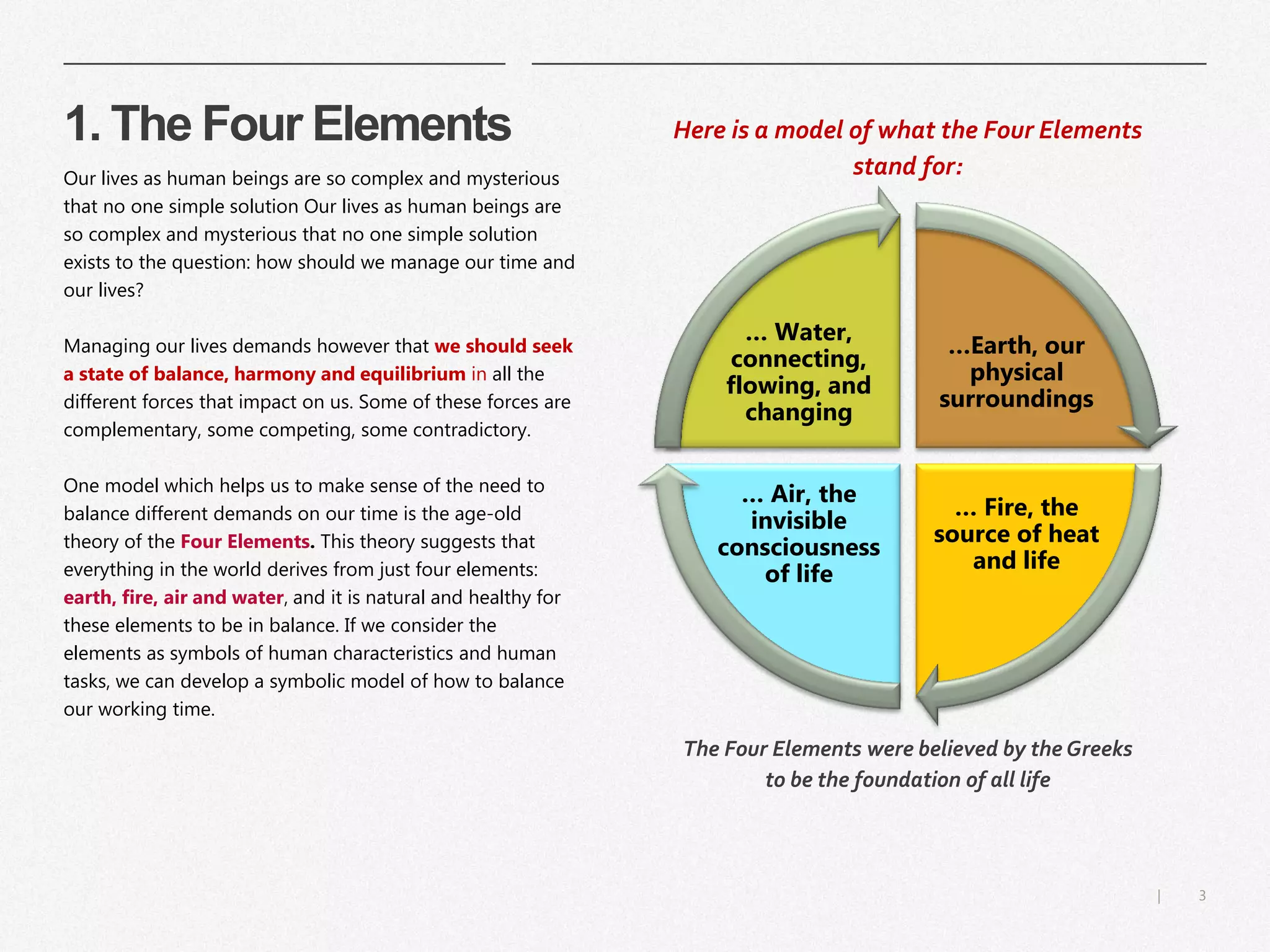
…Earth, our
physical
surroundings
… Fire, the
source of heat
and life
… Air, the
invisible
consciousness
of life
… Water,
connecting,
flowing, and
changing
​The Four Elements were believed by the Greeks
to be the foundation of all life
Here is a model of what the Four Elements
stand for:
4|
Applying the Four
Elements toYour Time
​The ancient Greeks believed that there were four elements
that everything was made up of: earth, water, air, and fire.
This theory was suggested around 450 BC, and it was later
supported and added to by Aristotle. (Aristotle also
suggested that there was a fifth element, aether, which he
applied to the region of the universe above the terrestrial
sphere because he couldn't understand how the stars
would be made out of earthly elements.)
​The Four Elements became the cornerstone of philosophy,
science, and medicine for 2000 years. During this time, they
were used both practically and symbolically to explain
other features of the manifested world, such as people's
personalities, the "humours" that determined our health,
and the four seasons of the year.
​The idea that the Four Elements could still have a relevance
to our lives today, in particular in understanding the
different tasks we manage, was proposed by Margaret
Gullan-Whur in her book, "The Four Elements" in 1987.
​How to apply the Four Elements to the 4 areas of
your life and work
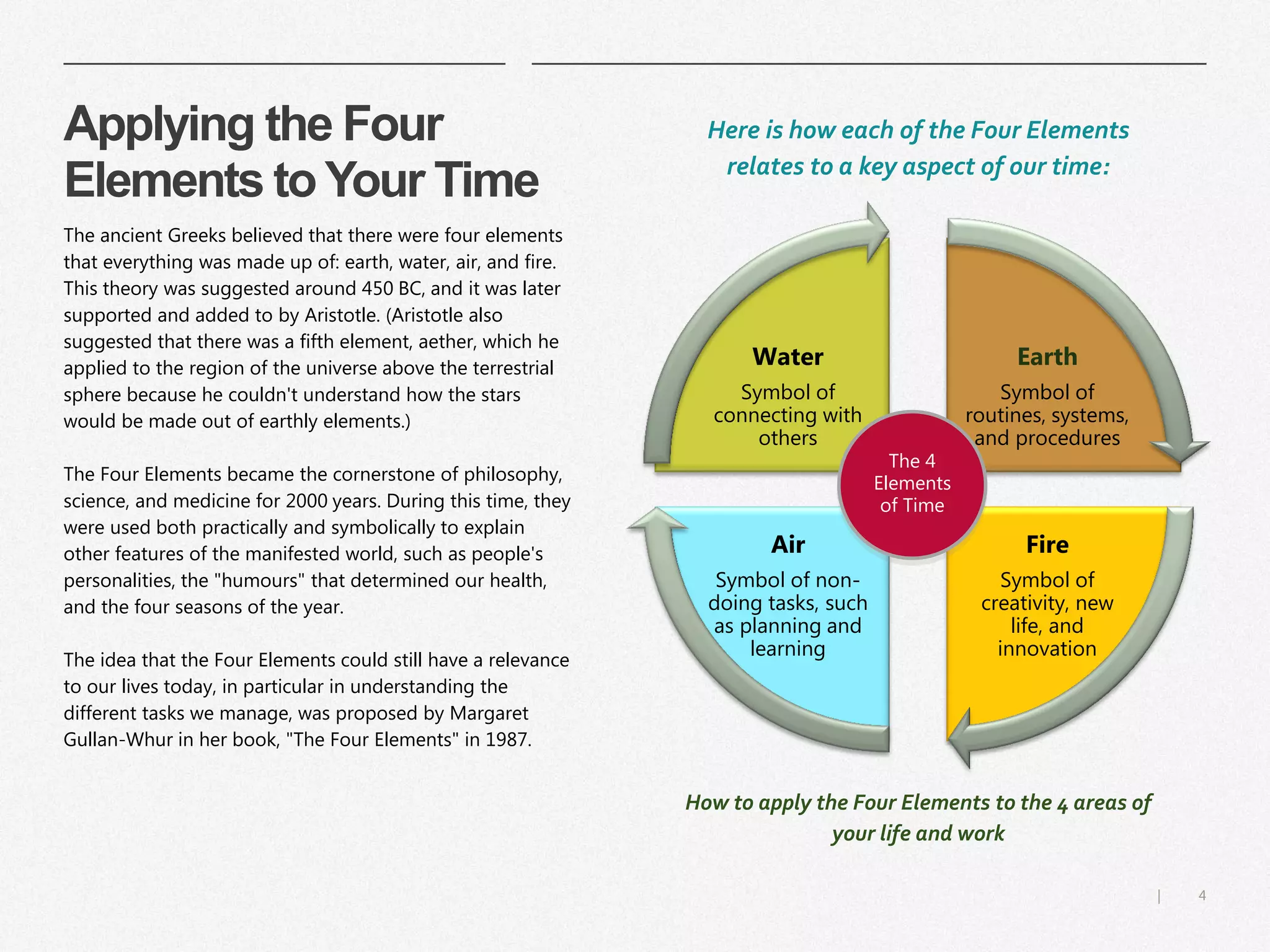
Earth
Symbol of
routines, systems,
and procedures
Fire
Symbol of
creativity, new
life, and
innovation
Air
Symbol of non-
doing tasks, such
as planning and
learning
Water
Symbol of
connecting with
others
The 4
Elements
of Time
Here is how each of the Four Elements
relates to a key aspect of our time:
5|
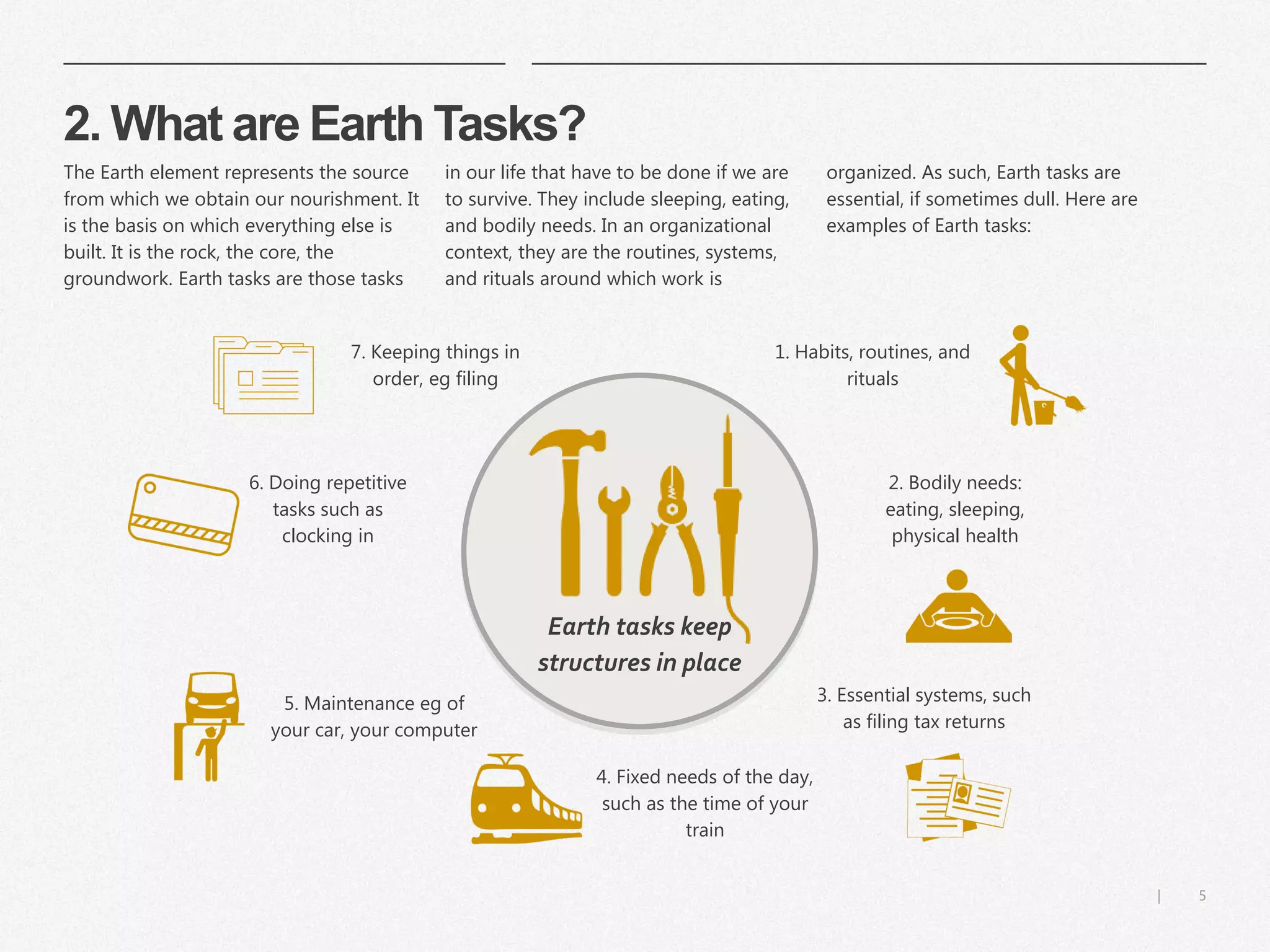
2. What are Earth Tasks?
​1. Habits, routines, and
rituals
​2. Bodily needs:
eating, sleeping,
physical health
​3. Essential systems, such
as filing tax returns
​4. Fixed needs of the day,
such as the time of your
train
​5. Maintenance eg of
your car, your computer
​7. Keeping things in
order, eg filing
​6. Doing repetitive
tasks such as
clocking in
​Earth tasks keep
structures in place
​The Earth element represents the source
from which we obtain our nourishment. It
is the basis on which everything else is
built. It is the rock, the core, the
groundwork. Earth tasks are those tasks
​in our life that have to be done if we are
to survive. They include sleeping, eating,
and bodily needs. In an organizational
context, they are the routines, systems,
and rituals around which work is
​organized. As such, Earth tasks are
essential, if sometimes dull. Here are
examples of Earth tasks:
6|
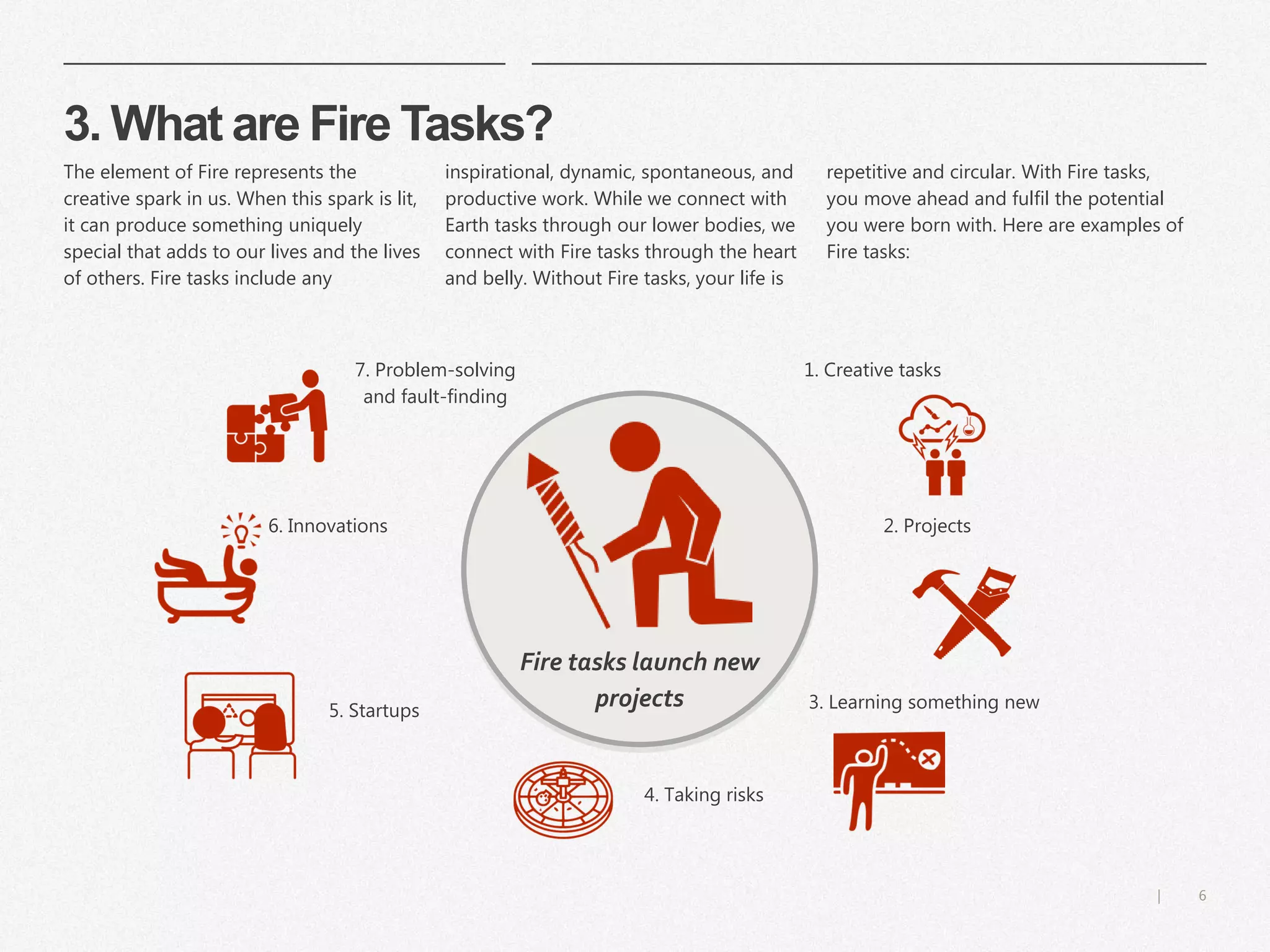
3. What are Fire Tasks?
​1. Creative tasks
​2. Projects
​3. Learning something new
​4. Taking risks
​5. Startups
​7. Problem-solving
and fault-finding
​6. Innovations
​Fire tasks launch new
projects
​The element of Fire represents the
creative spark in us. When this spark is lit,
it can produce something uniquely
special that adds to our lives and the lives
of others. Fire tasks include any
​inspirational, dynamic, spontaneous, and
productive work. While we connect with
Earth tasks through our lower bodies, we
connect with Fire tasks through the heart
and belly. Without Fire tasks, your life is
​repetitive and circular. With Fire tasks,
you move ahead and fulfil the potential
you were born with. Here are examples of
Fire tasks:
7|
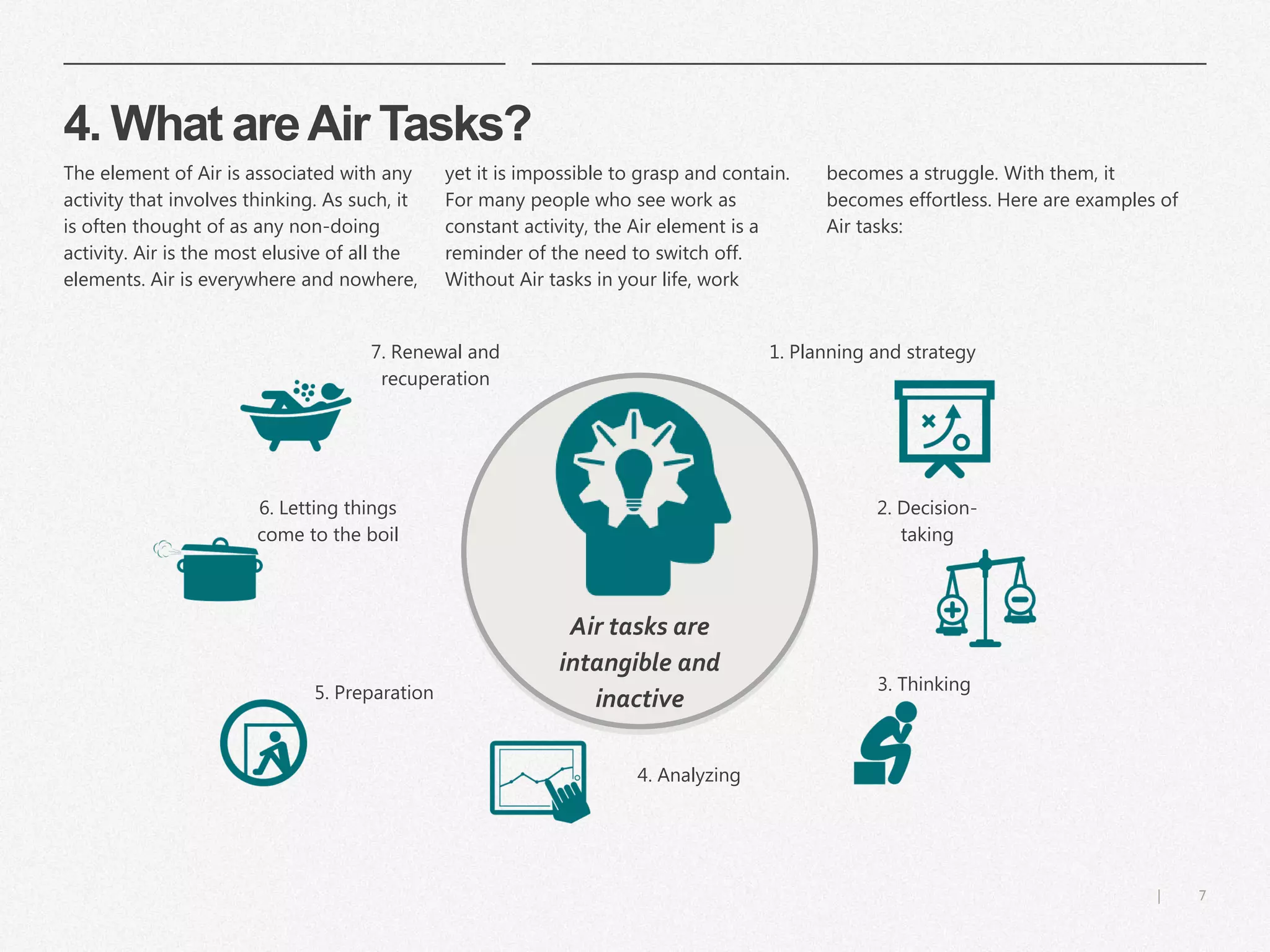
4. What areAir Tasks?
​1. Planning and strategy
​2. Decision-
taking
​3. Thinking
​4. Analyzing
​5. Preparation
​7. Renewal and
recuperation
​6. Letting things
come to the boil
​Air tasks are
intangible and
inactive
​The element of Air is associated with any
activity that involves thinking. As such, it
is often thought of as any non-doing
activity. Air is the most elusive of all the
elements. Air is everywhere and nowhere,
​yet it is impossible to grasp and contain.
For many people who see work as
constant activity, the Air element is a
reminder of the need to switch off.
Without Air tasks in your life, work
​becomes a struggle. With them, it
becomes effortless. Here are examples of
Air tasks:
8|
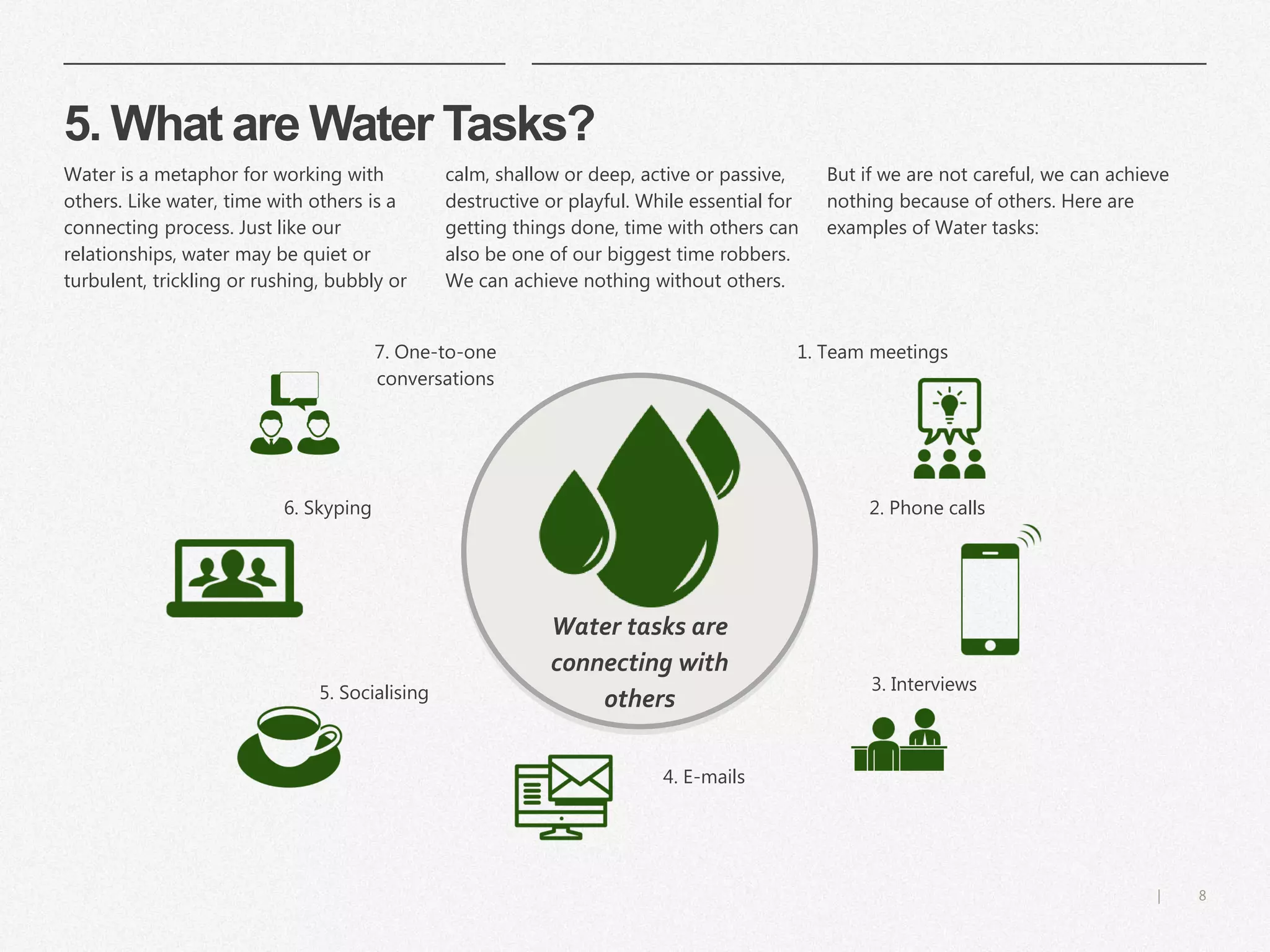
5. What are Water Tasks?
​1. Team meetings
​2. Phone calls
​3. Interviews
​4. E-mails
​5. Socialising
​7. One-to-one
conversations
​6. Skyping
​Water tasks are
connecting with
others
​Water is a metaphor for working with
others. Like water, time with others is a
connecting process. Just like our
relationships, water may be quiet or
turbulent, trickling or rushing, bubbly or
​calm, shallow or deep, active or passive,
destructive or playful. While essential for
getting things done, time with others can
also be one of our biggest time robbers.
We can achieve nothing without others.
​But if we are not careful, we can achieve
nothing because of others. Here are
examples of Water tasks:
9|
6. Balancing Each Day
​Balancing each day's activities is not simply a healthy way
of working; it is also the most productive and enjoyable.
To follow an intense period of brainwork with some time
doing physical work; then to follow that with some time
on a project, followed by time with friends, is to create a
rich and whole texture to the day.
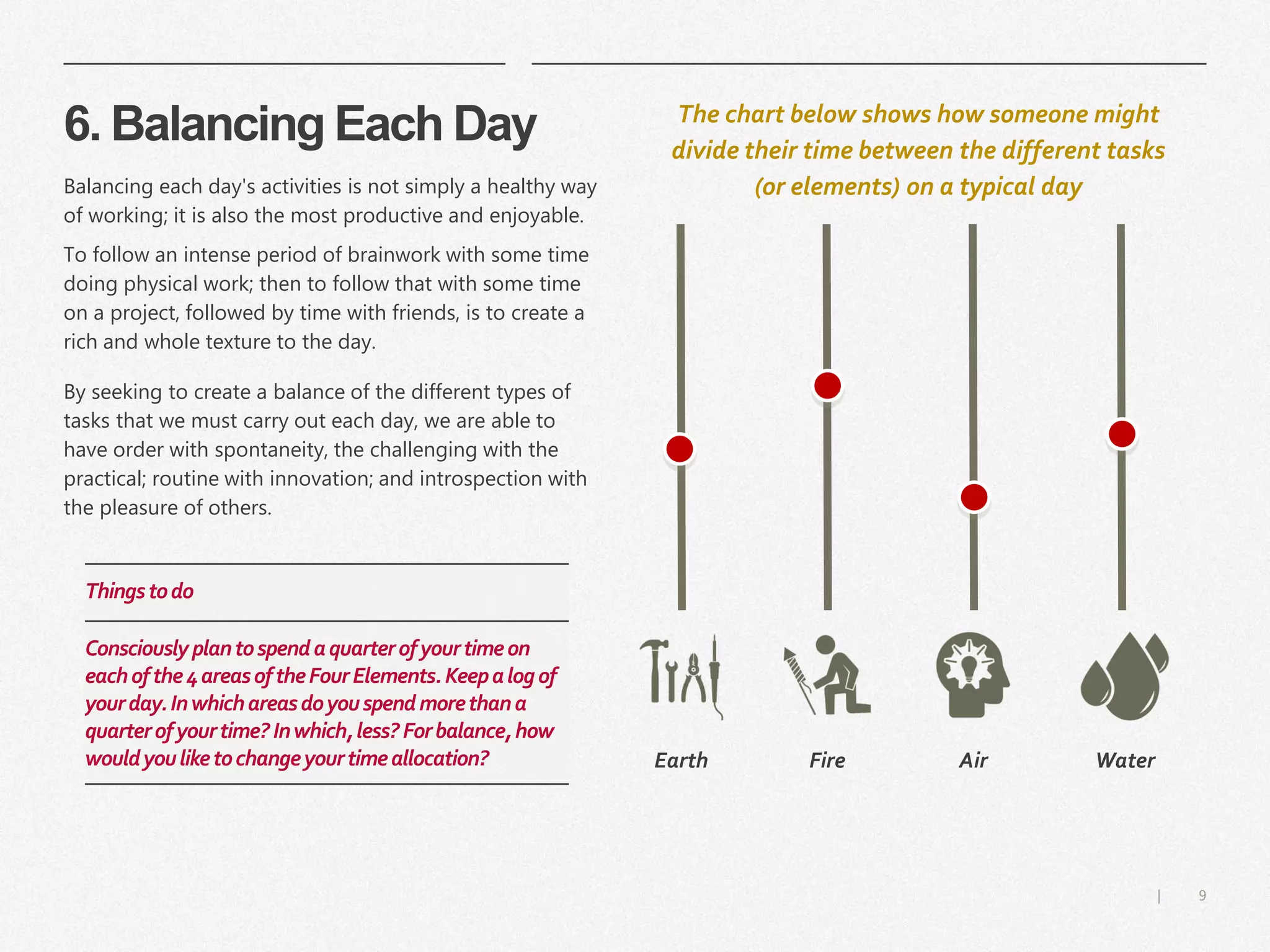
By seeking to create a balance of the different types of
tasks that we must carry out each day, we are able to
have order with spontaneity, the challenging with the
practical; routine with innovation; and introspection with
the pleasure of others.
Thingstodo
Consciouslyplantospendaquarterofyourtimeon
eachofthe4areasoftheFourElements.Keepalogof
yourday.Inwhichareasdoyouspendmorethana
quarterofyourtime?Inwhich,less?Forbalance,how
wouldyouliketochangeyourtimeallocation? ​Earth ​Water​Air​Fire
The chart below shows how someone might
divide their time between the different tasks
(or elements) on a typical day
10|
Example of a Balanced
Day
Laura’s Day
Time Task E F A W
8.00-9.00 Review of plans 1
9.00-9.30 Team catch-up 0.5
9.30-10.30 IT project 1
10.30-11.00 System fault 0.5
11.00-12.00 Customer query 1
12.00-13.00 IT project 1
14.00-15.30 Office clear out 1.5
15.30-16.30 Ideas with Ian 1
16.30-17.00 Joe’s farewell 0.5
2 2 2 2
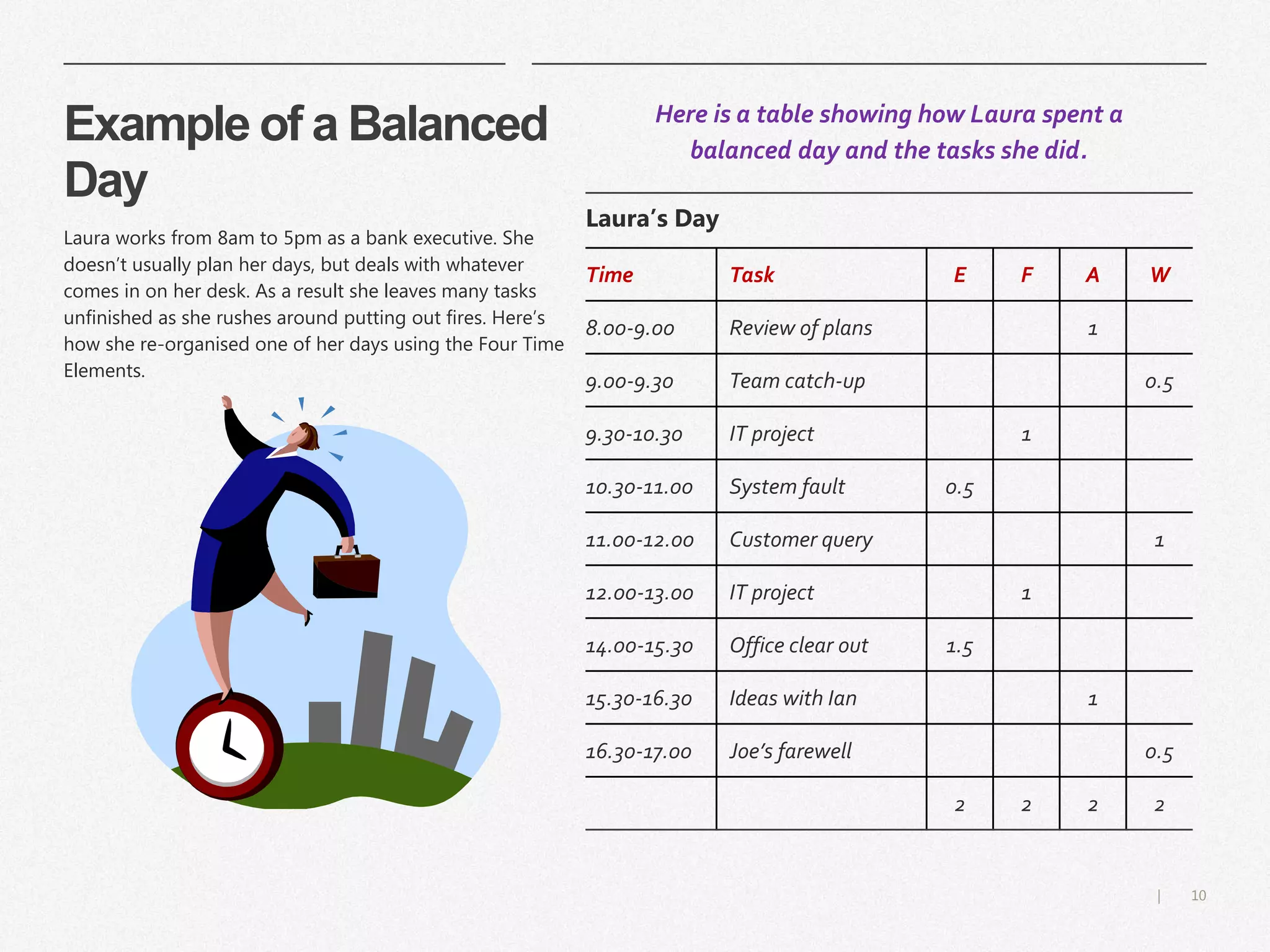
Laura works from 8am to 5pm as a bank executive. She
doesn’t usually plan her days, but deals with whatever
comes in on her desk. As a result she leaves many tasks
unfinished as she rushes around putting out fires. Here’s
how she re-organised one of her days using the Four Time
Elements.
Here is a table showing how Laura spent a
balanced day and the tasks she did.
11|
7. You, the Great Time Manager
​2. Even out the time you spend in each
element each day so that you are able to
maximise your productivity.
​1. Discover which of the four elements you like
to spend most of your time in and which you
are neglecting. Decide if you have balance.
​4. Be aware that each element requires a
different state of being. Air tasks are still
and introverted. Fire tasks are lively and
extroverted. Earth tasks are stodgy and
repetitive.Water tasks are unpredictable
and emotive.
​3. Don't work in one element for more than an
hour at a time. Do some project work for an
hour and then switch off for an hour. Do some
people work for an hour and then go and do
something routine.This is the way to stay
fresh.
​5. Become a great time manager by acquiring the skills of each element.
Learn how to do routine tasks efficiently. Learn how to make others feel
special when you spend time with them. Learn how to set, plan, and achieve
new goals. Learn how to happily be "being" and not always be doing.
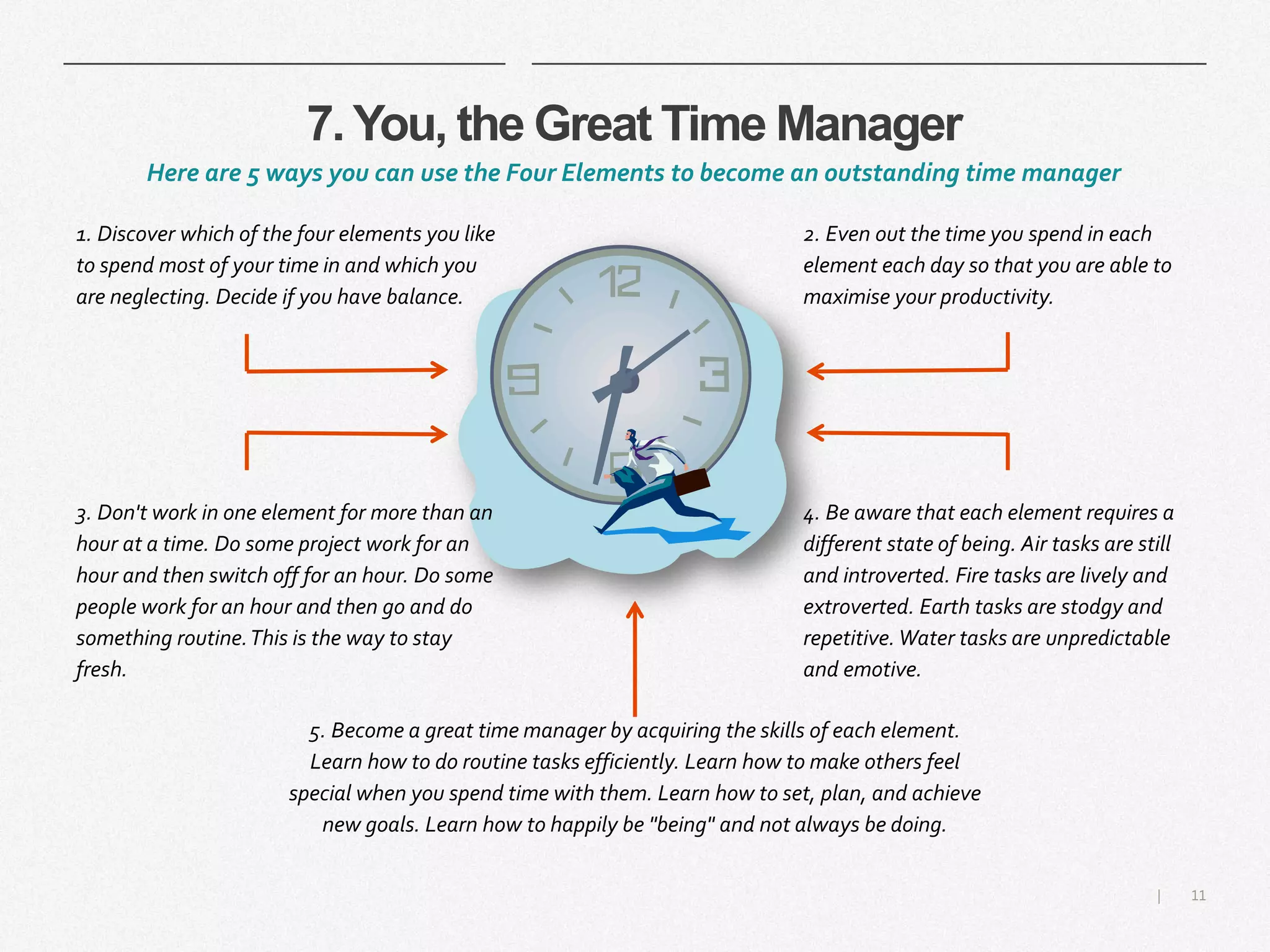
Here are 5 ways you can use the Four Elements to become an outstanding time manager
12|

The 4 Elements of Time

  • 1.
    THE 4 ELEMENTSOF TIME Balance your time with a model from antiquity ​
  • 2.
    2| Table of Contents ThisSlideTopic will show you how to balance your working day using the four elements ​1. The Four Elements ​2. What Are Earth Tasks? ​3. What Are Fire Tasks? ​4. What Are Air Tasks? ​5. What Are Water Tasks? ​7. You, the Great Time Manager ​6. Balancing Your Day
  • 3.
    3| 1. The FourElements ​Our lives as human beings are so complex and mysterious that no one simple solution exists to the question: how should we manage our time and our lives? ​Managing our lives demands however that we should seek a state of balance, harmony and equilibrium in all the different forces that impact on us. Some of these forces are complementary, some competing, some contradictory. ​One model which helps us to make sense of the need to balance different demands on our time is the age-old theory of the Four Elements. This theory suggests that everything in the world derives from just four elements: earth, fire, air and water, and it is natural and healthy for these elements to be in balance. If we consider the elements as symbols of human characteristics and human tasks, we can develop a symbolic model of how to balance our working time. …Earth, our physical surroundings … Fire, the source of heat and life … Air, the invisible consciousness of life … Water, connecting, flowing, and changing ​The Four Elements were believed by the Greeks to be the foundation of all life Here is a model of what the Four Elements stand for:
  • 4.
    4| Applying the Four ElementstoYour Time ​The ancient Greeks believed that there were four elements that everything was made up of: earth, water, air, and fire. This theory was suggested around 450 BC, and it was later supported and added to by Aristotle. (Aristotle also suggested that there was a fifth element, aether, which he applied to the region of the universe above the terrestrial sphere because he couldn't understand how the stars would be made out of earthly elements.) ​The Four Elements became the cornerstone of philosophy, science, and medicine for 2000 years. During this time, they were used both practically and symbolically to explain other features of the manifested world, such as people's personalities, the "humours" that determined our health, and the four seasons of the year. ​The idea that the Four Elements could still have a relevance to our lives today, in particular in understanding the different tasks we manage, was proposed by Margaret Gullan-Whur in her book, "The Four Elements" in 1987. ​How to apply the Four Elements to the 4 areas of your life and work Earth Symbol of routines, systems, and procedures Fire Symbol of creativity, new life, and innovation Air Symbol of non- doing tasks, such as planning and learning Water Symbol of connecting with others The 4 Elements of Time Here is how each of the Four Elements relates to a key aspect of our time:
  • 5.
    5| 2. What areEarth Tasks? ​1. Habits, routines, and rituals ​2. Bodily needs: eating, sleeping, physical health ​3. Essential systems, such as filing tax returns ​4. Fixed needs of the day, such as the time of your train ​5. Maintenance eg of your car, your computer ​7. Keeping things in order, eg filing ​6. Doing repetitive tasks such as clocking in ​Earth tasks keep structures in place ​The Earth element represents the source from which we obtain our nourishment. It is the basis on which everything else is built. It is the rock, the core, the groundwork. Earth tasks are those tasks ​in our life that have to be done if we are to survive. They include sleeping, eating, and bodily needs. In an organizational context, they are the routines, systems, and rituals around which work is ​organized. As such, Earth tasks are essential, if sometimes dull. Here are examples of Earth tasks:
  • 6.
    6| 3. What areFire Tasks? ​1. Creative tasks ​2. Projects ​3. Learning something new ​4. Taking risks ​5. Startups ​7. Problem-solving and fault-finding ​6. Innovations ​Fire tasks launch new projects ​The element of Fire represents the creative spark in us. When this spark is lit, it can produce something uniquely special that adds to our lives and the lives of others. Fire tasks include any ​inspirational, dynamic, spontaneous, and productive work. While we connect with Earth tasks through our lower bodies, we connect with Fire tasks through the heart and belly. Without Fire tasks, your life is ​repetitive and circular. With Fire tasks, you move ahead and fulfil the potential you were born with. Here are examples of Fire tasks:
  • 7.
    7| 4. What areAirTasks? ​1. Planning and strategy ​2. Decision- taking ​3. Thinking ​4. Analyzing ​5. Preparation ​7. Renewal and recuperation ​6. Letting things come to the boil ​Air tasks are intangible and inactive ​The element of Air is associated with any activity that involves thinking. As such, it is often thought of as any non-doing activity. Air is the most elusive of all the elements. Air is everywhere and nowhere, ​yet it is impossible to grasp and contain. For many people who see work as constant activity, the Air element is a reminder of the need to switch off. Without Air tasks in your life, work ​becomes a struggle. With them, it becomes effortless. Here are examples of Air tasks:
  • 8.
    8| 5. What areWater Tasks? ​1. Team meetings ​2. Phone calls ​3. Interviews ​4. E-mails ​5. Socialising ​7. One-to-one conversations ​6. Skyping ​Water tasks are connecting with others ​Water is a metaphor for working with others. Like water, time with others is a connecting process. Just like our relationships, water may be quiet or turbulent, trickling or rushing, bubbly or ​calm, shallow or deep, active or passive, destructive or playful. While essential for getting things done, time with others can also be one of our biggest time robbers. We can achieve nothing without others. ​But if we are not careful, we can achieve nothing because of others. Here are examples of Water tasks:
  • 9.
    9| 6. Balancing EachDay ​Balancing each day's activities is not simply a healthy way of working; it is also the most productive and enjoyable. To follow an intense period of brainwork with some time doing physical work; then to follow that with some time on a project, followed by time with friends, is to create a rich and whole texture to the day. By seeking to create a balance of the different types of tasks that we must carry out each day, we are able to have order with spontaneity, the challenging with the practical; routine with innovation; and introspection with the pleasure of others. Thingstodo Consciouslyplantospendaquarterofyourtimeon eachofthe4areasoftheFourElements.Keepalogof yourday.Inwhichareasdoyouspendmorethana quarterofyourtime?Inwhich,less?Forbalance,how wouldyouliketochangeyourtimeallocation? ​Earth ​Water​Air​Fire The chart below shows how someone might divide their time between the different tasks (or elements) on a typical day
  • 10.
    10| Example of aBalanced Day Laura’s Day Time Task E F A W 8.00-9.00 Review of plans 1 9.00-9.30 Team catch-up 0.5 9.30-10.30 IT project 1 10.30-11.00 System fault 0.5 11.00-12.00 Customer query 1 12.00-13.00 IT project 1 14.00-15.30 Office clear out 1.5 15.30-16.30 Ideas with Ian 1 16.30-17.00 Joe’s farewell 0.5 2 2 2 2 Laura works from 8am to 5pm as a bank executive. She doesn’t usually plan her days, but deals with whatever comes in on her desk. As a result she leaves many tasks unfinished as she rushes around putting out fires. Here’s how she re-organised one of her days using the Four Time Elements. Here is a table showing how Laura spent a balanced day and the tasks she did.
  • 11.
    11| 7. You, theGreat Time Manager ​2. Even out the time you spend in each element each day so that you are able to maximise your productivity. ​1. Discover which of the four elements you like to spend most of your time in and which you are neglecting. Decide if you have balance. ​4. Be aware that each element requires a different state of being. Air tasks are still and introverted. Fire tasks are lively and extroverted. Earth tasks are stodgy and repetitive.Water tasks are unpredictable and emotive. ​3. Don't work in one element for more than an hour at a time. Do some project work for an hour and then switch off for an hour. Do some people work for an hour and then go and do something routine.This is the way to stay fresh. ​5. Become a great time manager by acquiring the skills of each element. Learn how to do routine tasks efficiently. Learn how to make others feel special when you spend time with them. Learn how to set, plan, and achieve new goals. Learn how to happily be "being" and not always be doing. Here are 5 ways you can use the Four Elements to become an outstanding time manager
  • 12.