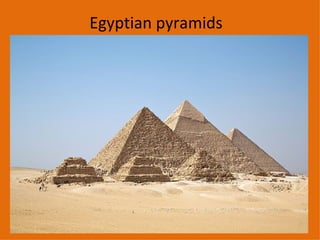
Egyptian pyramids
Historic development The first historically documented Egyptian pyramid is attributed to the architect  Imhotep , who planned what Egyptologists believe to be a tomb for the pharaoh  Djozer . Amenhotep is credited with being the first to conceive the notion of stacking mastabas on top of each other — creating an edifice composed of a number of "steps" that decreased in size towards its apex. The result was the  Step Pyramid of Djoser  — which was designed to serve as a gigantic stairway by which the soul of the deceased pharaoh could ascend to the heavens.
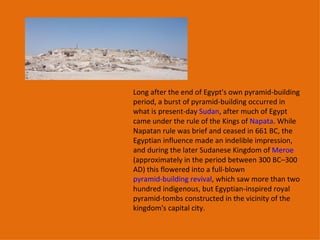
Long after the end of Egypt's own pyramid-building period, a burst of pyramid-building occurred in what is present-day  Sudan , after much of Egypt came under the rule of the Kings of  Napata . While Napatan rule was brief and ceased in 661 BC, the Egyptian influence made an indelible impression, and during the later Sudanese Kingdom of  Meroe  (approximately in the period between 300 BC–300 AD) this flowered into a full-blown  pyramid-building revival , which saw more than two hundred indigenous, but Egyptian-inspired royal pyramid-tombs constructed in the vicinity of the kingdom's capital city.
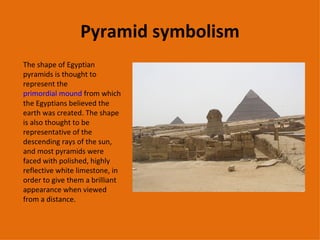
Pyramid symbolism The shape of Egyptian pyramids is thought to represent the  primordial mound  from which the Egyptians believed the earth was created. The shape is also thought to be representative of the descending rays of the sun, and most pyramids were faced with polished, highly reflective white limestone, in order to give them a brilliant appearance when viewed from a distance.
Number and location of pyramids
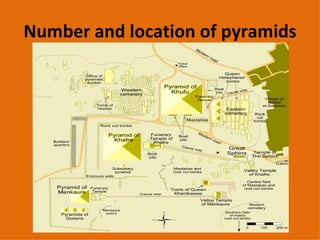
Number and location of pyramids In 1842  Karl Richard Lepsius  produced the first modern  list of pyramids , in which he counted 67. A great many more have since been discovered. As of November 2008, 118 Egyptian pyramids have been identified. [1] The location of Pyramid 29, which Lepsius called the " Headless Pyramid ", was lost for a second time when the structure was buried by desert sands subsequent to Lepsius' survey. It was only rediscovered again during an archaeological dig conducted in 2008. [10] Many pyramids are in a poor state of preservation or buried by desert sands. If visible at all they may appear as little more than mounds of rubble. As a consequence archaeologists are continuing to identify and study previously unknown pyramid structures. The most recent pyramid to be discovered is that of Queen  Sesheshet , mother of 6th Dynasty Pharaoh  Teti , located at Saqqara. The discovery was announced by  Zahi Hawass , Secretary General of the Egyptian  Supreme Council of Antiquities , on 11 November 2008. [11][2]

Egyptian Pyramids

  • 1.
  • 2.
    Historic development Thefirst historically documented Egyptian pyramid is attributed to the architect Imhotep , who planned what Egyptologists believe to be a tomb for the pharaoh Djozer . Amenhotep is credited with being the first to conceive the notion of stacking mastabas on top of each other — creating an edifice composed of a number of "steps" that decreased in size towards its apex. The result was the Step Pyramid of Djoser — which was designed to serve as a gigantic stairway by which the soul of the deceased pharaoh could ascend to the heavens.
  • 3.
    Long after theend of Egypt's own pyramid-building period, a burst of pyramid-building occurred in what is present-day Sudan , after much of Egypt came under the rule of the Kings of Napata . While Napatan rule was brief and ceased in 661 BC, the Egyptian influence made an indelible impression, and during the later Sudanese Kingdom of Meroe (approximately in the period between 300 BC–300 AD) this flowered into a full-blown pyramid-building revival , which saw more than two hundred indigenous, but Egyptian-inspired royal pyramid-tombs constructed in the vicinity of the kingdom's capital city.
  • 4.
    Pyramid symbolism Theshape of Egyptian pyramids is thought to represent the primordial mound from which the Egyptians believed the earth was created. The shape is also thought to be representative of the descending rays of the sun, and most pyramids were faced with polished, highly reflective white limestone, in order to give them a brilliant appearance when viewed from a distance.
  • 5.
  • 6.
    Number and locationof pyramids In 1842 Karl Richard Lepsius produced the first modern list of pyramids , in which he counted 67. A great many more have since been discovered. As of November 2008, 118 Egyptian pyramids have been identified. [1] The location of Pyramid 29, which Lepsius called the " Headless Pyramid ", was lost for a second time when the structure was buried by desert sands subsequent to Lepsius' survey. It was only rediscovered again during an archaeological dig conducted in 2008. [10] Many pyramids are in a poor state of preservation or buried by desert sands. If visible at all they may appear as little more than mounds of rubble. As a consequence archaeologists are continuing to identify and study previously unknown pyramid structures. The most recent pyramid to be discovered is that of Queen Sesheshet , mother of 6th Dynasty Pharaoh Teti , located at Saqqara. The discovery was announced by Zahi Hawass , Secretary General of the Egyptian Supreme Council of Antiquities , on 11 November 2008. [11][2]