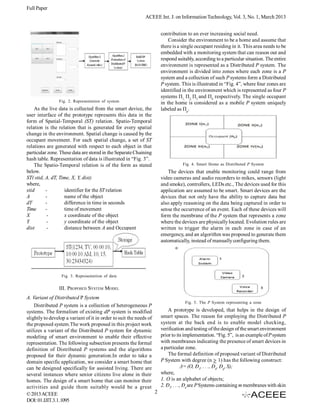
Full Paper
                                                            ACEEE Int. J. on Information Technology, Vol. 3, No. 1, March 2013


  Efficient Representation of Smart Environments using
                 a Parallelized Approach
                                                  Rajalakshmi V, Susan Elias
         Sri Venkateswara College of Engineering/Department of Computer Science and Engineering, Chennai, India
                                           vraji@svce.ac.in, susan@svce.ac.in

Abstract—A parallel approach to model Smart Environments               match, and then an alert is generated. Algorithms that specify
in order to represent them efficiently has been presented in           the steps involved in the automatic creation of P systems as
this paper. The focus of this research work is to achieve fast         well as the Distributed P system to model the smart
response during the dynamic retrieval of information in smart          environment, had been proposed in [6] and presented here
environments. The motivation here is to enable assisted living
                                                                       for clarity in the proposed concept.This research work also
in an effective manner in smart home environments.
Representation of smart environments includes the                      presents experimental results obtained by a parallel
representation of the real-time data as well as representation         implementation of the search routine that enables efficient
of the system. Real-time data from the smart environment is            and fast decision making within the smart environment. In
represented here using the separate chaining hash table data           Section 2 the proposed work that focuses on the
structure while the smart environment is represented here              representation of real-time data is presented and in Section 3
using a variant of an existing membrane computing model                its incorporation in the model of the smart environment is
referred to as the Distributed P System. The model proposed            dealt with. The experimental results are also presented before
in this research work is designed to produce alerts                    the conclusion of the paper in Section 4.
spontaneously in the environment when abnormal activities
are identified by a reasoning system that is assumed to be
part of the smart environment. A prototype of the above model                               II. PROPOSED WORK
has been developed and it is capable of generating SMS alerts               Prototype is designed to collect the occupant activity
that can be sent to the occupant’s care taker for remote               recorded by the smart devices. The live data collected is
monitoring of the occupant.
                                                                       converted to an intermediate form which contains the details
Index Terms—Smart Environment, Membrane Computing,                     of the smart device, the activity and the level of the activity,
Distributed P Systems, Assisted Living, Hashing,                       and also the temporal and spatial data of the activity. These
Parallelization                                                        data are stored on the hash table data structure. Distributed
                                                                       P system that has already been populated with dynamic rules
                         I. OVERVIEW                                   will perform computations on the data stored on the data
                                                                       structure. They perform comparison with the existing rules.
    Representing smart environments [1][2] is as of today              If the rule exists, then the alert/warning is triggered in order
one of the least explored areas, with new options opening up           to alarm the occupant. The alert is sent as SMS to the care
as research challenges. Effective representation will pave the         taker of the occupant. Proposed Work is illustrated in “Fig.
way for effective reasoning, which indicates that the                  1”.
environment is intelligent [3][4] enough to think/learn and
even assist occupants in several ways. No such definite model
has been proposed yet. This research work aims to create
one such state of the art model, which satisfies the
aforementioned criteria. Representation of smart environment
involves representing system and data. The smart
environment is considered to be a system which is
represented here using a variant of the existing membrane
computing model, the Distributed P System [5], which is a
                                                                                           Fig. 1. Proposed System
collection of heterogeneous P systems. The system
considered here is an assisted living scenario for elders, which       A. Representaion of System
monitors the occupants continuously and alerts them in case                System here refers to the smart environment. The set of
of abnormal events by giving them alarms. Evolution rules-
                                                                       all abnormal activities of the occupant in the system are stored
rules that govern the mechanism and functionality of the
                                                                       as rules in the Distributed P system. The user interface of the
system are required for effective modeling. Data from the
                                                                       prototype collects all the abnormal activities of the occupant
smart environment is represented using hash table data
                                                                       from the user. These inputs are converted as rules and stored
structure. Data includes all the occupant activities carried
                                                                       onto the Distributed P system which is illustrated in “Fig. 2”.
out in the environment. The search routine is designed which
compares the live data with the existing rules, if there is a          B. Representaion of Data

© 2013 ACEEE                                                       1
DOI: 01.IJIT.3.1.1095
Full Paper
                                                            ACEEE Int. J. on Information Technology, Vol. 3, No. 1, March 2013


                                                                      contribution to an ever increasing social need.
                                                                          Consider the environment to be a home and assume that
                                                                      there is a single occupant residing in it. This area needs to be
                                                                      embedded with a monitoring system that can reason out and
                                                                      respond suitably, according to a particular situation. The entire
                                                                      environment is represented as a Distributed P system. The
                                                                      environment is divided into zones where each zone is a P
                                                                      system and a collection of such P systems form a Distributed
                                                                      P system. This is illustrated in “Fig. 4”, where four zones are
                                                                      identified in the environment which is represented as four P
                                                                      systems Π1, Π2, Π3 and Π4 respectively. The single occupant
                Fig. 2. Representation of system                      in the home is considered as a mobile P system uniquely
    As the live data is collected from the smart device, the          labeled as Πp.
user interface of the prototype represents this data in the
form of Spatial-Temporal (ST) relation. Spatio-Temporal
relation is the relation that is generated for every spatial
change in the environment. Spatial change is caused by the
occupant movement. For each spatial change, a set of ST
relations are generated with respect to each object in that
particular zone. These data are stored in the Separate Chaining
hash table. Representation of data is illustrated in “Fig. 3”.
    The Spatio-Temporal relation is of the form as stated                        Fig. 4. Smart Home as Distributed P System
below.                                                                   The devices that enable monitoring could range from
ST( stid, A, dT, Time, X, Y, dist)                                    video cameras and audio recorders to mikes, sensors (light
where,                                                                and smoke), controllers, LEDs etc., The devices used for this
stid      -        identifier for the ST relation                     application are assumed to be smart. Smart devices are the
A         -        name of the object                                 devices that not only have the ability to capture data but
dT        -        difference in time in seconds                      also apply reasoning on the data being captured in order to
Time      -        time of movement                                   sense the occurrence of an event. Each of these devices will
X          -       x coordinate of the object                         form the membrane of the P system that represents a zone
Y          -       y coordinate of the object                         where the devices are physically located. Evolution rules are
dist       -       distance between A and Occupant                    written to trigger the alarm in each zone in case of an
                                                                      emergency, and an algorithm was proposed to generate them
                                                                      automatically, instead of manually configuring them.


                 Fig. 3. Representation of data


                III. PROPOSED SYSTEM MODEL
A. Variant of Distributed P System
                                                                                  Fig. 5. The P System representing a zone
    Distributed P system is a collection of heterogeneous P
systems. The formalism of existing dP system is modified                  A prototype is developed, that helps in the design of
slightly to develop a variant of it in order to suit the needs of     smart spaces. The reason for employing the Distributed P
the proposed system.The work proposed in this project work            system at the back end is to enable model checking,
utilizes a variant of the Distributed P system for dynamic            verification and testing of the design of the smart environment
modeling of smart environment to enable their effective               prior to its implementation. “Fig. 5”, is an example of P system
representation. The following subsection presents the formal          with membranes indicating the presence of smart devices in
definition of Distributed P systems and the algorithms                a particular zone.
proposed for their dynamic generation.In order to take a                  The formal definition of proposed variant of Distributed
domain specific application, we consider a smart home that            P System with degree (n 1) has the following construct:
can be designed specifically for assisted living. There are                       Δ= (O, Ð1, . . ., Ðn, Ðp, S);
several instances where senior citizens live alone in their           where,
homes. The design of a smart home that can monitor their              1. O is an alphabet of objects;
activities and guide them suitably would be a great                   2. Ð1, . . ., Ðn are P Systems containing m membranes with skin
© 2013 ACEEE                                                      2
DOI: 01.IJIT.3.1.1095
Full Paper
                                                                ACEEE Int. J. on Information Technology, Vol. 3, No. 1, March 2013


membranes labeled with s1, . . ., sn, respectively where,               The following Algorithm generates the Distributed P
        Ði = (Vi, µi, wi1, ….., wim, Ei, Ri1, ……, Rim)                  System.This algorithm takes as input all individual P Systems
where,                                                                  to form Distributed P System. Assume i, j and k represents
a. Vi is an alphabet of objects, Vi  O;                                the P System.
b. µi is a membrane structure of the ith P System which is of           Input: P Systems = (Π1, . . ., Πn, Πp)
the form [0[1] 1[2] 2[3] 3.....[m] m] 0;                                  Output: DP System Δ = (O, Π1, . . ., Πn, Πp, S)
c. wi1, ….., wim represents the multisets of objects available in        1 Set O ! Φ
each membrane;                                                           2 for each Πi do
d. Ei  Vi represents the objects available in arbitrarily many          3 O       O  {Vi}
copies in the environment;                                               4 Δ       Δ     {Π}   i
e. Ri1, ……, Rim represents the evolution and communication
rules used in each P System.The rules have the form a          v,
                                                                         5    S      S    {(s , u/λ, s )}
                                                                                             i         j
                                                                         6    end
where a, v  Vi.
                                                                         7   For P System Πp,
3. Ðp is a mobile P System that represents the single occupant
in the environment. This is an additional component proposed             8    Δ      Δ  { Πp}
in this paper to suit the domain specific application. Ðp has            9 S         S     {(s , u/λ, s )}
                                                                                                i          p
the following construct:
         Ðp = (Vp, µp, wp, Ep, Rp)                                      C. Separate Chaining Hash Table
where,                                                                      The Separate Chaining hash table contains all the
a. Vp is an alphabet of objects, Vp  O;                                occupant movement. The hash table is indexed with respect
b. µp is a membrane structure of the mobile P System with               to the coordinates of the space. Consider the environment
only the skin membrane [0] 0;                                           space is 400*400. The hash table contains entries from
c. wp are strings representing the multisets over Vp associated         coordinates (1,1) to (400,400). Hash table structure is
with skin region;                                                       illustrated in the “Fig. 6”.
d. Ep Vp represents the objects available in arbitrarily many
copies in the environment;
e. Rp represents evolution rules of the mobile P System.
4. S is a finite set of rules of the form (si, u/v, sj),

B. Algorithms
    Algorithms for formation of P System and Distributed P
System presented in [6] are included here to explain the
extension of the work in representing real-time data.
The following Algorithm will generate rules for triggering
the alarm. This algorithm collects input from the prototype.                      Fig. 6. Separate Chaining Hash table Structure
Output of this algorithm is a rule generated to trigger an                 Each entry in the hash table is a pointer to a linked list.
alarm system.                                                           Each node in the linked list contains the occupant movement
   Input: i, Dev_1, Dev_2, ...., Dev_m                                  hashed to the same coordinates which is shown in “Fig. 7”.
       Output: A rule generated to trigger the alarm system
     1 Set LHS = RHS = NULL
     2 for each membrane ‘k = 1’ in Ði do
     3 Vi         Vi {labik}                                                              Fig. 7. Linked list node Structure
     4 wik         wik {labiklev}                                           After storing the data in the hash table, the search routine
     5 Rik        Rik {labiklev       (labiklev, out) }                 is invoked to compare the activity with the rules in the
                                  lev
     6 LHS         LHS. {labik }                                        Distributed P System. If the activity is an anomaly, then the
     7 end                                                              alert is generated. The alert is also sent as SMS.
    8 For membrane k=1,
                                                                        D. Parallelization of Search Module
    9    Vi       Vi     {labi1}
                                                                           Search module compares the hash table entry with the
   10 wi1         w  {lab
                    i1               i1
                                          lev
                                                }                       existing rules of the Distributed P System. Hash table contains
                           lev
   11 RHS          labi1                                                all occupant movement. In this module, comparison is done
   12 Ri1        Ri1  {LHS                         RHS}                by single processor. By parallelizing the search module, the
                                                                        response time will be improved. While parallelizing, multiple
   13 Ri1        Ri1     {RHS                      si }
                                                                        slave processors are created. Each processor is given one
   14 Ri1         Ri1    {s     i
                                                    labj1lev}           rule for execution. It compares the activity with rule. If there
   15 wi          wik                                                   is a match, then the alert is generated by that processor.
© 2013 ACEEE                                                        3
DOI: 01.IJIT.3.1. 1095
Full Paper
                                                              ACEEE Int. J. on Information Technology, Vol. 3, No. 1, March 2013


Since each processor is executing only one rule, the response                                       CONCLUSIONS
time is improved very much. Once the anomaly in occupant
                                                                             This paper focuses on the effective representation of the
activity is identified, the alert is identified by the search
                                                                         smart environment for efficient real time response. A domain
module. The alert message is also sent as SMS to occupant’s
                                                                         specific application for assisted living in smart home has
care taker.
                                                                         been proposed. Distributed P systems are generally used in
                                                                         representing the functioning of the system and thereby
                   IV. EXPERIMENTAL RESULTS
                                                                         solving problems in a distributed manner. Algorithms are
    The prototype is developed using C#.net and made to                  designed for representing smart spaces using Distributed P
run on Intel Pentium Dual Core machine. For parallelization,             system. Hash table data structure is used for efficient
the search module is implemented using MPI.net and to create             representation of the data. This research work has aimed in
virtual processors on a standalone machine Microsoft                     satisfying the main need of smart environments by providing
Compute Cluster Pack is installed. The Distributed P System              quick response for decision making and improves the
is populated with 50 rules. Hence, 50 processors are created,            response time by producing fast alerts using a parallelized
and each processor is assigned a rule. The activity is                   approach.
compared with the rule assigned to each processor. The results
obtained with single processor and with 50 processors are                                           REFERENCES
listed Table 1. Let Ts and Tm be the response time of the alert
                                                                         [1]    Vivek Menon, Bharat Jayaraman and Venu Govindaraju,
with a single processor and multiple processors respectively.                  “Three R’s of Cyberphysical Spaces,” IEEE Computer Society,
Normally, Speedup (S) is computed as Ts/ Tm. Hence from the                    vol. 44, no. 9, pp. 73-79, 2011.
Table I, it is proved experimentally, that due to parallelization,       [2]   Vivek Menon, Bharat Jayaraman and Venu Govindaraju,
the Speedup is about 200(approx). This proves that decision                    “Multimodal identification and tracking in smart
making can be made faster thereby producing quick response                     environments,” Personal and Ubiquitous Computing Journal-
in the smart spaces.                                                           Springer, vol. 14, no. 8, pp. 685-694, 2010.
                                                                         [3]   Vivek Menon, Bharat Jayaraman and Venu Govindaraju,
                   TABLE I. SPEED UP COMPUTATION                               “Biometrics driven smart environments: abstract framework
                                                                               and evaluation,” Ubiquitous Intelligence and Computing-
                                                                               Springer, vol. 5061, pp. 75-89, 2008.
                                                                         [4]   Vivek Menon, Bharat Jayaraman and Venu Govindaraju,
                                                                               “Integrating recognition and reasoning in smart environments,”
                                                                               In Intelligent Environments, 4th International Conference, pp.
                                                                               1-8, 2008.
                                                                         [5]   Gheorghe Paun, Mario J. Perez-Jimenez, “Solving Problems
                                                                               in a Distributed way in Membrane Computing: dP Systems,”
                                                                               International Journal of Computers, Communication and
                                                                               Control, vol. 2, pp. 238-250, 2010.
                                                                         [6]   Susan Elias, Rajalakshmi V and Sivaranjani S, “Representation
                                                                               of Smart Environments using Distributed P Systems,” In the
                                                                               Proceedings of Third International Conference on Advances
                                                                               in Communication, Network and Computing, pp. 159-164,
                                                                               2012.


© 2013 ACEEE                                                         4
DOI: 01.IJIT.3.1. 1095

Efficient Representation of Smart Environments using a Parallelized Approach

  • 1.
    Full Paper ACEEE Int. J. on Information Technology, Vol. 3, No. 1, March 2013 Efficient Representation of Smart Environments using a Parallelized Approach Rajalakshmi V, Susan Elias Sri Venkateswara College of Engineering/Department of Computer Science and Engineering, Chennai, India vraji@svce.ac.in, susan@svce.ac.in Abstract—A parallel approach to model Smart Environments match, and then an alert is generated. Algorithms that specify in order to represent them efficiently has been presented in the steps involved in the automatic creation of P systems as this paper. The focus of this research work is to achieve fast well as the Distributed P system to model the smart response during the dynamic retrieval of information in smart environment, had been proposed in [6] and presented here environments. The motivation here is to enable assisted living for clarity in the proposed concept.This research work also in an effective manner in smart home environments. Representation of smart environments includes the presents experimental results obtained by a parallel representation of the real-time data as well as representation implementation of the search routine that enables efficient of the system. Real-time data from the smart environment is and fast decision making within the smart environment. In represented here using the separate chaining hash table data Section 2 the proposed work that focuses on the structure while the smart environment is represented here representation of real-time data is presented and in Section 3 using a variant of an existing membrane computing model its incorporation in the model of the smart environment is referred to as the Distributed P System. The model proposed dealt with. The experimental results are also presented before in this research work is designed to produce alerts the conclusion of the paper in Section 4. spontaneously in the environment when abnormal activities are identified by a reasoning system that is assumed to be part of the smart environment. A prototype of the above model II. PROPOSED WORK has been developed and it is capable of generating SMS alerts Prototype is designed to collect the occupant activity that can be sent to the occupant’s care taker for remote recorded by the smart devices. The live data collected is monitoring of the occupant. converted to an intermediate form which contains the details Index Terms—Smart Environment, Membrane Computing, of the smart device, the activity and the level of the activity, Distributed P Systems, Assisted Living, Hashing, and also the temporal and spatial data of the activity. These Parallelization data are stored on the hash table data structure. Distributed P system that has already been populated with dynamic rules I. OVERVIEW will perform computations on the data stored on the data structure. They perform comparison with the existing rules. Representing smart environments [1][2] is as of today If the rule exists, then the alert/warning is triggered in order one of the least explored areas, with new options opening up to alarm the occupant. The alert is sent as SMS to the care as research challenges. Effective representation will pave the taker of the occupant. Proposed Work is illustrated in “Fig. way for effective reasoning, which indicates that the 1”. environment is intelligent [3][4] enough to think/learn and even assist occupants in several ways. No such definite model has been proposed yet. This research work aims to create one such state of the art model, which satisfies the aforementioned criteria. Representation of smart environment involves representing system and data. The smart environment is considered to be a system which is represented here using a variant of the existing membrane computing model, the Distributed P System [5], which is a Fig. 1. Proposed System collection of heterogeneous P systems. The system considered here is an assisted living scenario for elders, which A. Representaion of System monitors the occupants continuously and alerts them in case System here refers to the smart environment. The set of of abnormal events by giving them alarms. Evolution rules- all abnormal activities of the occupant in the system are stored rules that govern the mechanism and functionality of the as rules in the Distributed P system. The user interface of the system are required for effective modeling. Data from the prototype collects all the abnormal activities of the occupant smart environment is represented using hash table data from the user. These inputs are converted as rules and stored structure. Data includes all the occupant activities carried onto the Distributed P system which is illustrated in “Fig. 2”. out in the environment. The search routine is designed which compares the live data with the existing rules, if there is a B. Representaion of Data © 2013 ACEEE 1 DOI: 01.IJIT.3.1.1095
  • 2.
    Full Paper ACEEE Int. J. on Information Technology, Vol. 3, No. 1, March 2013 contribution to an ever increasing social need. Consider the environment to be a home and assume that there is a single occupant residing in it. This area needs to be embedded with a monitoring system that can reason out and respond suitably, according to a particular situation. The entire environment is represented as a Distributed P system. The environment is divided into zones where each zone is a P system and a collection of such P systems form a Distributed P system. This is illustrated in “Fig. 4”, where four zones are identified in the environment which is represented as four P systems Π1, Π2, Π3 and Π4 respectively. The single occupant Fig. 2. Representation of system in the home is considered as a mobile P system uniquely As the live data is collected from the smart device, the labeled as Πp. user interface of the prototype represents this data in the form of Spatial-Temporal (ST) relation. Spatio-Temporal relation is the relation that is generated for every spatial change in the environment. Spatial change is caused by the occupant movement. For each spatial change, a set of ST relations are generated with respect to each object in that particular zone. These data are stored in the Separate Chaining hash table. Representation of data is illustrated in “Fig. 3”. The Spatio-Temporal relation is of the form as stated Fig. 4. Smart Home as Distributed P System below. The devices that enable monitoring could range from ST( stid, A, dT, Time, X, Y, dist) video cameras and audio recorders to mikes, sensors (light where, and smoke), controllers, LEDs etc., The devices used for this stid - identifier for the ST relation application are assumed to be smart. Smart devices are the A - name of the object devices that not only have the ability to capture data but dT - difference in time in seconds also apply reasoning on the data being captured in order to Time - time of movement sense the occurrence of an event. Each of these devices will X - x coordinate of the object form the membrane of the P system that represents a zone Y - y coordinate of the object where the devices are physically located. Evolution rules are dist - distance between A and Occupant written to trigger the alarm in each zone in case of an emergency, and an algorithm was proposed to generate them automatically, instead of manually configuring them. Fig. 3. Representation of data III. PROPOSED SYSTEM MODEL A. Variant of Distributed P System Fig. 5. The P System representing a zone Distributed P system is a collection of heterogeneous P systems. The formalism of existing dP system is modified A prototype is developed, that helps in the design of slightly to develop a variant of it in order to suit the needs of smart spaces. The reason for employing the Distributed P the proposed system.The work proposed in this project work system at the back end is to enable model checking, utilizes a variant of the Distributed P system for dynamic verification and testing of the design of the smart environment modeling of smart environment to enable their effective prior to its implementation. “Fig. 5”, is an example of P system representation. The following subsection presents the formal with membranes indicating the presence of smart devices in definition of Distributed P systems and the algorithms a particular zone. proposed for their dynamic generation.In order to take a The formal definition of proposed variant of Distributed domain specific application, we consider a smart home that P System with degree (n 1) has the following construct: can be designed specifically for assisted living. There are Δ= (O, Ð1, . . ., Ðn, Ðp, S); several instances where senior citizens live alone in their where, homes. The design of a smart home that can monitor their 1. O is an alphabet of objects; activities and guide them suitably would be a great 2. Ð1, . . ., Ðn are P Systems containing m membranes with skin © 2013 ACEEE 2 DOI: 01.IJIT.3.1.1095
  • 3.
    Full Paper ACEEE Int. J. on Information Technology, Vol. 3, No. 1, March 2013 membranes labeled with s1, . . ., sn, respectively where, The following Algorithm generates the Distributed P Ði = (Vi, µi, wi1, ….., wim, Ei, Ri1, ……, Rim) System.This algorithm takes as input all individual P Systems where, to form Distributed P System. Assume i, j and k represents a. Vi is an alphabet of objects, Vi  O; the P System. b. µi is a membrane structure of the ith P System which is of Input: P Systems = (Π1, . . ., Πn, Πp) the form [0[1] 1[2] 2[3] 3.....[m] m] 0; Output: DP System Δ = (O, Π1, . . ., Πn, Πp, S) c. wi1, ….., wim represents the multisets of objects available in 1 Set O ! Φ each membrane; 2 for each Πi do d. Ei  Vi represents the objects available in arbitrarily many 3 O O  {Vi} copies in the environment; 4 Δ Δ {Π} i e. Ri1, ……, Rim represents the evolution and communication rules used in each P System.The rules have the form a v, 5 S S  {(s , u/λ, s )} i j 6 end where a, v  Vi. 7 For P System Πp, 3. Ðp is a mobile P System that represents the single occupant in the environment. This is an additional component proposed 8 Δ Δ  { Πp} in this paper to suit the domain specific application. Ðp has 9 S S  {(s , u/λ, s )} i p the following construct: Ðp = (Vp, µp, wp, Ep, Rp) C. Separate Chaining Hash Table where, The Separate Chaining hash table contains all the a. Vp is an alphabet of objects, Vp  O; occupant movement. The hash table is indexed with respect b. µp is a membrane structure of the mobile P System with to the coordinates of the space. Consider the environment only the skin membrane [0] 0; space is 400*400. The hash table contains entries from c. wp are strings representing the multisets over Vp associated coordinates (1,1) to (400,400). Hash table structure is with skin region; illustrated in the “Fig. 6”. d. Ep Vp represents the objects available in arbitrarily many copies in the environment; e. Rp represents evolution rules of the mobile P System. 4. S is a finite set of rules of the form (si, u/v, sj), B. Algorithms Algorithms for formation of P System and Distributed P System presented in [6] are included here to explain the extension of the work in representing real-time data. The following Algorithm will generate rules for triggering the alarm. This algorithm collects input from the prototype. Fig. 6. Separate Chaining Hash table Structure Output of this algorithm is a rule generated to trigger an Each entry in the hash table is a pointer to a linked list. alarm system. Each node in the linked list contains the occupant movement Input: i, Dev_1, Dev_2, ...., Dev_m hashed to the same coordinates which is shown in “Fig. 7”. Output: A rule generated to trigger the alarm system 1 Set LHS = RHS = NULL 2 for each membrane ‘k = 1’ in Ði do 3 Vi Vi {labik} Fig. 7. Linked list node Structure 4 wik wik {labiklev} After storing the data in the hash table, the search routine 5 Rik Rik {labiklev (labiklev, out) } is invoked to compare the activity with the rules in the lev 6 LHS LHS. {labik } Distributed P System. If the activity is an anomaly, then the 7 end alert is generated. The alert is also sent as SMS. 8 For membrane k=1, D. Parallelization of Search Module 9 Vi Vi {labi1}  Search module compares the hash table entry with the 10 wi1 w  {lab i1 i1 lev } existing rules of the Distributed P System. Hash table contains lev 11 RHS labi1 all occupant movement. In this module, comparison is done 12 Ri1 Ri1  {LHS RHS} by single processor. By parallelizing the search module, the response time will be improved. While parallelizing, multiple 13 Ri1 Ri1  {RHS si } slave processors are created. Each processor is given one 14 Ri1 Ri1  {s i labj1lev} rule for execution. It compares the activity with rule. If there 15 wi wik is a match, then the alert is generated by that processor. © 2013 ACEEE 3 DOI: 01.IJIT.3.1. 1095
  • 4.
    Full Paper ACEEE Int. J. on Information Technology, Vol. 3, No. 1, March 2013 Since each processor is executing only one rule, the response CONCLUSIONS time is improved very much. Once the anomaly in occupant This paper focuses on the effective representation of the activity is identified, the alert is identified by the search smart environment for efficient real time response. A domain module. The alert message is also sent as SMS to occupant’s specific application for assisted living in smart home has care taker. been proposed. Distributed P systems are generally used in representing the functioning of the system and thereby IV. EXPERIMENTAL RESULTS solving problems in a distributed manner. Algorithms are The prototype is developed using C#.net and made to designed for representing smart spaces using Distributed P run on Intel Pentium Dual Core machine. For parallelization, system. Hash table data structure is used for efficient the search module is implemented using MPI.net and to create representation of the data. This research work has aimed in virtual processors on a standalone machine Microsoft satisfying the main need of smart environments by providing Compute Cluster Pack is installed. The Distributed P System quick response for decision making and improves the is populated with 50 rules. Hence, 50 processors are created, response time by producing fast alerts using a parallelized and each processor is assigned a rule. The activity is approach. compared with the rule assigned to each processor. The results obtained with single processor and with 50 processors are REFERENCES listed Table 1. Let Ts and Tm be the response time of the alert [1] Vivek Menon, Bharat Jayaraman and Venu Govindaraju, with a single processor and multiple processors respectively. “Three R’s of Cyberphysical Spaces,” IEEE Computer Society, Normally, Speedup (S) is computed as Ts/ Tm. Hence from the vol. 44, no. 9, pp. 73-79, 2011. Table I, it is proved experimentally, that due to parallelization, [2] Vivek Menon, Bharat Jayaraman and Venu Govindaraju, the Speedup is about 200(approx). This proves that decision “Multimodal identification and tracking in smart making can be made faster thereby producing quick response environments,” Personal and Ubiquitous Computing Journal- in the smart spaces. Springer, vol. 14, no. 8, pp. 685-694, 2010. [3] Vivek Menon, Bharat Jayaraman and Venu Govindaraju, TABLE I. SPEED UP COMPUTATION “Biometrics driven smart environments: abstract framework and evaluation,” Ubiquitous Intelligence and Computing- Springer, vol. 5061, pp. 75-89, 2008. [4] Vivek Menon, Bharat Jayaraman and Venu Govindaraju, “Integrating recognition and reasoning in smart environments,” In Intelligent Environments, 4th International Conference, pp. 1-8, 2008. [5] Gheorghe Paun, Mario J. Perez-Jimenez, “Solving Problems in a Distributed way in Membrane Computing: dP Systems,” International Journal of Computers, Communication and Control, vol. 2, pp. 238-250, 2010. [6] Susan Elias, Rajalakshmi V and Sivaranjani S, “Representation of Smart Environments using Distributed P Systems,” In the Proceedings of Third International Conference on Advances in Communication, Network and Computing, pp. 159-164, 2012. © 2013 ACEEE 4 DOI: 01.IJIT.3.1. 1095