International Journal of Technical Research and Applications e-ISSN: 2320-8163,
www.ijtra.com Volume 3, Issue 1 (Jan-Feb 2015), PP. 109-112
109 | P a g e
Camera
EFFICIENT EMBEDDED SURVEILLANCE
SYSTEM WITH AUTO IMAGE CAPTURING AND
EMAIL SENDING FACILITY
Rohit Ratnakar Vaidya
Department of Electronics & communication Engineering
Deogiri Institute of Engineering and Management Studies,
Aurangabad (MS), India
Vaidyarohit007@gmail.com
Abstract— In this paper we have to design and implement
surveillance system by use of smart sensors like ultrasonic
sensors and pyroelectric infrared sensors (PIR) to detect an
intruder in a home, ATM, Industries, Bank Locker room or a
storehouse. The PIR sensors are placed on the ceiling, and the
ultrasonic sensor module consists of a transmitter and a receiver
which are placed vertically on the wall. We are going to use the
camera to capture images of the people those are coming under
the surveillance area. And we are sending these images to
authorized and related personnel via e-mail to avoid the storage
cost. This system will also help to reduce the power consumption.
Keywords—AVR Microcontroller; Raspberry Pi; Surveillance
System; PIR and ultrasonic Sensors; Webcam; Internet
Connections
I. INTRODUCTION
Recently surveillance systems have become more important
for everyone’s and everywhere for the purpose of security. The
embedded surveillance system, frequently used in a home, an
office or a factory [1-3], uses a sensor triggered to turn on a
camera [4-5]. Some designs use different types of sensors to
achieve reliability by means of the different features of each
sensor [6-7] but they do not provide any facilities like sending
an image through internet. In this paper we have to extend this
previous system not only by using both multiple PIR sensors
and ultrasonic sensors as a sensor group, but also by using the
Maximum Voting Mechanism (MVM) [8-11]. Ultrasonic
receivers and transmitters are located at opposite ends to
reduce the interference from other frequencies in ultrasonic
signals. Some research explores the influence of attenuation in
air and crosstalk of ultrasonic signals. In our system, We have
to use Raspberry Pi credit card-sized computer to send an
Email of captured image to the specified Email ID. So that
there is no issue of storing images as well no issue of losing
the confidential data (captured images).
II. SYSTEM ARCHITECTURE
As shown in Fig. 1 our system which contains several
groups of ultrasonic and PIR sensor. The transmitter circuit
generates a multi-frequency square waveform, and the receiver
circuit amplifies the received signals and filters out any noise.
When a transmitter transmits an ultrasonic coding signal, the
ultrasonic receiver determines whether there is an intruder or
person passing through the sensing area. If there is no
intruder, the MCU (Micro Controller Unit) will keep our
camera off but as soon as intruder is detected and camera can
capture the image. Our design reduces the environmental
interference with the ultrasonic signal. All sensing signals are
input to the embedded surveillance system by the GPIO
(General purpose input and output), and the MVM program
counts the number of sensing states to determine whether to
adopt the MVM or not. The PIR sensor groups obtain the
sensing signals from human temperature. If the voting results
of ultrasonic and PIR sensor groups pass the criteria, the
embedded surveillance system starts the camera to capture
images. When it capture the image this image is send to the
specified Email ID via Internet.
Internet Connectivity
Figure 1. Use of smart sensors to improve the sensing reliability of an
embedded surveillance system
A. Software Required
We choose Embedded Linux as our operating system. The
program of the majority voting mechanism contains a
detection of the GPIO function, a counting and majority voting
function, an image captured function and a Web server.
Fig.3.2 shows the detection software flowchart of the
embedded system. The embedded system scans the GPIO
sockets, which are connected to external PIR sensors and
ultrasonic sensors. To verify the state of each IR and ultrasonic
sensor, the embedded system reads the voltage levels of the
GPIO sockets. When the system reads 5V from a GPIO
socket, we learn that the ultrasonic sensors or the PIR sensors
have been triggered and will execute the majority voting
program by counting the state of each ultrasonic and PIR
sensor. Majority voting is achieved by the sensor groups of the
different GPIO sockets. The embedded system, when
interrupted by the detection procedure, starts the Web camera
to capture images. When this is finished, the embedded system
starts the detection procedure over again. If the intruder is still
in the monitoring area, the count of the GPIO sockets’ voltage
levels continues the majority voting mechanism, and the
embedded system again starts the Web camera to capture
images. The embedded system uploads the captured images by
means of both the Web server and the streaming server
through the Internet.
User
PIR Sensor
groups
Ultrasonic
Sensors
Groups
Signal
Conditi
-oning Raspberry
Pi
Internet
Remote Place
International Journal of Technical Research and Applications e-ISSN: 2320-8163,
www.ijtra.com Volume 3, Issue 1 (Jan-Feb 2015), PP. 109-112
110 | P a g e

Figure 2. Detection software flowchart

B. Hardware modules
We use two groups of the external hardware circuits, the PIR
and the ultrasonic sensor group. As the PIR sensor produces a
weak voltage, we input the sensed signal to a two-stage OP
amplifier to amplify the weak voltage by about 1000 times.
Since the amplified signal changes between positive
Figure 3. PIR module.
and negative voltage, we input this signal to the absolute value
circuit, and then we input it to the adjustable comparator to
and negative voltage, we input this signal to the absolute value
circuit, and then we input it to the adjustable comparator to
compare the sensing voltage and the reference voltage which
are set according to the environment temperature. Fig. 3 shows
the block diagram of the PIR module. Compact and complete,
easy to use Pyroelectric Infrared (PIR) Sensor Module for
human body detection. Incorporating a Fresnel lens and
motion detection circuit. High sensitivity and low noise.
Output is a standard 5V active low output signal.
Fig. 4 shows the ultrasonic circuit which uses a pulse
width modulation (PWM) function in the MCU to send out the
desired frequency of the ultrasonic signal. The ultrasonic
transducer transforms the voltage waveform into an ultrasonic
transmission, and the transducer of the receiver transforms the
ultrasonic transmission into the voltage waveform. The
ultrasonic sensor can easily be interfaced to microcontrollers
where the triggering and measurement can be done using two
I/O pin. The sensor transmits an ultrasonic wave and produces
an output pulse that corresponds to the time required for the
burst echo to return to the sensor. By measuring the echo pulse
width, the distance to target can easily be calculated.
Figure 4. Ultrasonic Sensor with Controller
Table I shows our comparison of the sensing characteristics of
both the ultrasonic sensor and the PIR sensor [6]. We have
found that the ultrasonic sensor and the PIR sensor can both
compensate each other and enhance the overall sensing
probability in our design.
TABLE I. COMPARISON OF CHARACTERISTICS OF PIR
SENSOR AND ULTRASONIC SENSOR
Sensors
Condition
For trigger
Effect of
Environment
temperature
Sensing
Type
Ultrasonic
Moving
block
Independence
Line
direction
PIR
Temperature
change
Dependence
Projection
area
Why Raspberry Pi?
 The Raspberry Pi is a credit-card-sized single-board
computer developed in the UK. The Raspberry Pi has
a Broadcom BCM2835 system on a ip (SoC), which
includes an ARM1176JZF- 700 MHz processor,
Video Core IV GPU, and was originally shipped
with 256 megabytes of RAM, later upgraded to
512 MB. It does not include a built-in hard
disk or solid-state drive, but uses an SD card for
booting and persistent storage.
 The Processor. At the heart of the Raspberry Pi is the
same processor you would have found in the iPhone
3G and the Kindle 2, so you can think of the
capabilities of the Raspberry Pi as comparable to
those powerful little devices. This chip is a 32 bit,
700 MHz System on a Chip, which is built on the
ARM11 architecture. ARM chips come in a variety of
architectures with different cores configured to
provide different capabilities at different price points.
The Model B has 512MB of RAM and the Model A
has 256 MB.
 The Secure Digital (SD) Card slot. You’ll notice
there’s no hard drive on the Pi; everything is stored
on an SD Card. One reason you’ll want some sort of
protective case sooner than later is that the solder
joints on the SD socket may fail if the SD card is
accidentally bent.
 The USB port. On the Model B there are two USB
2.0 ports, but only one on the Model A. Some of the
early Raspberry Pi boards were limited in the amount
of current that they could provide. Some USB devices
can draw up 500mA. The original Pi board supported
100mA or so, but the newer revisions are up to the
full USB 2.0 spec.
Features of coding signal-
In this paper we use a coding signal to increase the reliability
of the ultrasonic sensor group. Equation (1) is the function of
probability of code breaking. Equation (2) is the function of
reliability. when the number of bits increases, the reliability
approaches 1. According to Eqs. (1) and (2) we know that with
one bit if the probability of code breaking is 0.5, the reliability
would be 0.5. To increase the number of bits of the ultrasonic
signal code is to increase the reliability.
(1)
R=1-P
International Journal of Technical Research and Applications e-ISSN: 2320-8163,
www.ijtra.com Volume 3, Issue 1 (Jan-Feb 2015), PP. 109-112
111 | P a g e
III. ARRANGEMENT
Fig.6 shows Arrangement of our experimental environment
that detect intruders in a suitable place. We place the PIR
sensor on the ceiling or above the detection area. Transmitter
and receiver of the ultrasonic sensor module are placed in a
line direction. When an intruder enters the detection area, the
ultrasonic coding signal will be blocked and the PIR sensors
will detect temperature changes.
Figure 6. Arrangement of our experimental environment.
Table II compares our coding signal and noncoding signal.
The coding signal is not interfered with by other frequencies
unless their patterns are similar. It is easier to break a
noncoding signal than a coding signal. When we add to the
bits of the ultrasonic coding signal, the message type rise with
. A noncoding signal transmits just two types of messages,
0 and 1. N means number of bits. With more message types,
more codes can be used in the same design to decrease the
probability of breaking a signal. In our design, when N is
equal to 8, the message conbination of the ultrasonic coding
signal is 128 times better than that of noncoding signal, and
the reliability is enhanced from 0.5 to 0.996 as shown in Eq.
(1).
TABLE II. COMPARISON OF OUR CODING SIGNAL AND
NONCODING SIGNAL
Ultrasonic
signal
patterns
Interference
by other
ultrasonic
signal
Probability
of
breaking
signal
Message
combination
Reliability
Coding Low Low High
Noncoding High High 2 Low
IV. PERFORMANCE ANALYSIS
A. Ultrasonic Sensor-
TABLE III TABLE OF ULTRASONIC SENSOR EQUIVALENT
OUTPUT VOLTAGE
DISATANCE VOLTAGE
15 CM 0.06 mV
20 CM 0.08 mV
25 CM 0.10 mV
30 CM 0.12 mV
Figure 7.Ultrasonic Sensor Voltage Vs Distance Graph
With 2.5V - 5.5V power provides very short to long-range
detection and ranging, in an incredibly small package. The
LV-Max detects objects from 0-inches to 254-inches (6.45-
meters) and provides sonar range information from 6-inches
out to 254-inches with 1-inch resolution. Objects from 0-
inches to 6-inches range as 6-inches. The interface output
formats
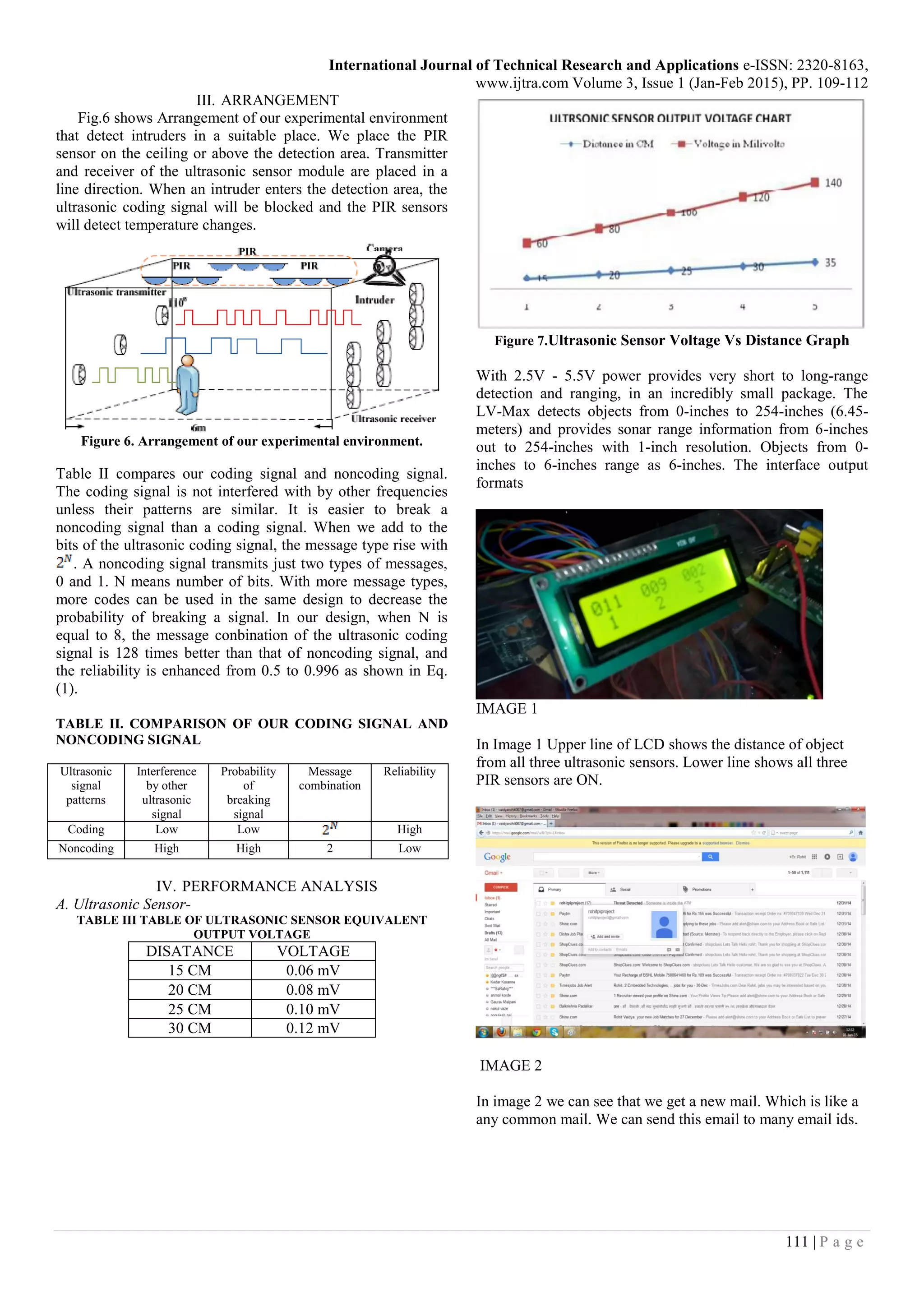
IMAGE 1
In Image 1 Upper line of LCD shows the distance of object
from all three ultrasonic sensors. Lower line shows all three
PIR sensors are ON.
IMAGE 2
In image 2 we can see that we get a new mail. Which is like a
any common mail. We can send this email to many email ids.
International Journal of Technical Research and Applications e-ISSN: 2320-8163,
www.ijtra.com Volume 3, Issue 1 (Jan-Feb 2015), PP. 109-112
112 | P a g e
IMAGE 3
In image 3 we can see that image is attached to mail. This is
just 70kb to 100kb. That is very small. Here we can see that
image “someone is inside the ATM”
Emails Used-
From: rohitpiproject@gmail.com
To: vaidyarohit007@gmail.com
IMAGE 4
In image 4 we can see the image when we click on the
image.
V. CONCLUSION
This system shows two different types of sensors which are
Improving the overall sensing probability by using the MVM
to reduce the shortcomings of both the ultrasonic sensors and
the PIR sensors. As well as we are providing the facility of
sending live images to certain (Authorized) person via
EMAIL. In future may be we are also able to send some
videos (clips).
REFERENCES
[1] Jun Hou, Chengdong Wu, Zhongjia Yuan, Jiyuan Tan,
Qiaoqiao Wang and Yun Zhou, “Research of Intelligent
Home Security Surveillance System Based on ZigBee,”
International Symposium on Intelligent Information
Technology Application Workshops, Shanghai, 21-22 Dec.
2008, pp. 554-57.
[2] Xiangjun Zhu, Shaodong Ying and Le Ling, “Multimedia
sensor networks design for smart home surveillance,”
Control and Decision Conference, 2008, Chinese, 2-4 July
2008, pp. 431-435.
[3] L. Lo Presti, M. La Cascia, “Real-Time Object Detection in
Embedded Video Surveillance Systems,” Ninth
International Workshop on Image Analysis for Multimedia
Interactive Services, 7-9 May 2008, pp. 151-154.
[4] Wen-Tsuen Chen, Po-Yu Chen, Wei-Shun Lee and Chi-Fu
Huang, “Design and Implementation of a Real Time Video
Surveillance System with Wireless Sensor Networks,” VTC
Spring 2008. IEEE Vehicular Technology Conference, 11-
14 May 2008, pp. 218-222.
[5] Mikko Nieminen, Tomi Raty, and Mikko Lindholm,
“Multi-Sensor Logical Decision Making in the Single
Location Surveillance Point System,” Fourth International
Conference on Systems, France, 1-6 March 2009, pp. 86-
90.
[6] Ying-Wen Bai, Li-Sih Shen and Zong-Han Li, “Design and
Implementation of an Embedded Surveillance System by
Use of Multiple Ultrasonic Sensors”, The 28th IEEE
International Conference on Consumer Electronics, Las
Vegas, Nevada, USA, 11-13 Jan. 2010, 11.1-3, pp. 501-
502.
[7] Yang Cao, Huijie Zhao, Na Li and Hong Wei “Land-Cover
Classification by Airborne LIDAR Data Fused with Aerial
Optical Images,” International Workshop on Multi-
Platform/Multi-Sensor Remote Sensing and Mapping
(M2RSM), Jan. 2011, pp. 1-6.
[8] Hai-Wen Zhao, Hong Yue, and He-Gao Cai, “Design of a
Distributed Ultrasonic Detecting System Based on
Multiprocessor for Autonomous Mobile Robot,”
Proceedings of tbe 2007 WSEAS Int. Conference on
Circuits, Systems, Signal and Telecommunications, Gold
Coast, Australia, January 17-19, 2007, pp. 59-64.
[9] Zi-LI Xie and Zong-Han Li, “Design and implementation
of a home embedded surveillance system with ultra-low
alert power,” IEEE Transactions on Consumer Electronics,
Feb. 2011, pp. 153-159.
[10] Francesco Alonge, Marco Brancifortem and Francesco
Motta, “A novel method of distance measurement based on
pulse position modulation and synchronization of chaotic
signals using ultrasonic radar systems,” IEEE Transactions
on Instrumentation and Measurement, Feb.2009, pp. 318-
329.
[11] Shraga Shoval and Johann Borenstein, “Using Coded
Sognals to Benefit from Ultrasonic Sensor Crosstalk in
Mobile Robot Obstacle Avoidance,” IEEE International
Conference on Robotics and Automation, Seoul, Korea, 21-
26 May, 2001, vol.3, pp. 2879-2884.

EFFICIENT EMBEDDED SURVEILLANCE SYSTEM WITH AUTO IMAGE CAPTURING AND EMAIL SENDING FACILITY

  • 1.
    International Journal ofTechnical Research and Applications e-ISSN: 2320-8163, www.ijtra.com Volume 3, Issue 1 (Jan-Feb 2015), PP. 109-112 109 | P a g e Camera EFFICIENT EMBEDDED SURVEILLANCE SYSTEM WITH AUTO IMAGE CAPTURING AND EMAIL SENDING FACILITY Rohit Ratnakar Vaidya Department of Electronics & communication Engineering Deogiri Institute of Engineering and Management Studies, Aurangabad (MS), India Vaidyarohit007@gmail.com Abstract— In this paper we have to design and implement surveillance system by use of smart sensors like ultrasonic sensors and pyroelectric infrared sensors (PIR) to detect an intruder in a home, ATM, Industries, Bank Locker room or a storehouse. The PIR sensors are placed on the ceiling, and the ultrasonic sensor module consists of a transmitter and a receiver which are placed vertically on the wall. We are going to use the camera to capture images of the people those are coming under the surveillance area. And we are sending these images to authorized and related personnel via e-mail to avoid the storage cost. This system will also help to reduce the power consumption. Keywords—AVR Microcontroller; Raspberry Pi; Surveillance System; PIR and ultrasonic Sensors; Webcam; Internet Connections I. INTRODUCTION Recently surveillance systems have become more important for everyone’s and everywhere for the purpose of security. The embedded surveillance system, frequently used in a home, an office or a factory [1-3], uses a sensor triggered to turn on a camera [4-5]. Some designs use different types of sensors to achieve reliability by means of the different features of each sensor [6-7] but they do not provide any facilities like sending an image through internet. In this paper we have to extend this previous system not only by using both multiple PIR sensors and ultrasonic sensors as a sensor group, but also by using the Maximum Voting Mechanism (MVM) [8-11]. Ultrasonic receivers and transmitters are located at opposite ends to reduce the interference from other frequencies in ultrasonic signals. Some research explores the influence of attenuation in air and crosstalk of ultrasonic signals. In our system, We have to use Raspberry Pi credit card-sized computer to send an Email of captured image to the specified Email ID. So that there is no issue of storing images as well no issue of losing the confidential data (captured images). II. SYSTEM ARCHITECTURE As shown in Fig. 1 our system which contains several groups of ultrasonic and PIR sensor. The transmitter circuit generates a multi-frequency square waveform, and the receiver circuit amplifies the received signals and filters out any noise. When a transmitter transmits an ultrasonic coding signal, the ultrasonic receiver determines whether there is an intruder or person passing through the sensing area. If there is no intruder, the MCU (Micro Controller Unit) will keep our camera off but as soon as intruder is detected and camera can capture the image. Our design reduces the environmental interference with the ultrasonic signal. All sensing signals are input to the embedded surveillance system by the GPIO (General purpose input and output), and the MVM program counts the number of sensing states to determine whether to adopt the MVM or not. The PIR sensor groups obtain the sensing signals from human temperature. If the voting results of ultrasonic and PIR sensor groups pass the criteria, the embedded surveillance system starts the camera to capture images. When it capture the image this image is send to the specified Email ID via Internet. Internet Connectivity Figure 1. Use of smart sensors to improve the sensing reliability of an embedded surveillance system A. Software Required We choose Embedded Linux as our operating system. The program of the majority voting mechanism contains a detection of the GPIO function, a counting and majority voting function, an image captured function and a Web server. Fig.3.2 shows the detection software flowchart of the embedded system. The embedded system scans the GPIO sockets, which are connected to external PIR sensors and ultrasonic sensors. To verify the state of each IR and ultrasonic sensor, the embedded system reads the voltage levels of the GPIO sockets. When the system reads 5V from a GPIO socket, we learn that the ultrasonic sensors or the PIR sensors have been triggered and will execute the majority voting program by counting the state of each ultrasonic and PIR sensor. Majority voting is achieved by the sensor groups of the different GPIO sockets. The embedded system, when interrupted by the detection procedure, starts the Web camera to capture images. When this is finished, the embedded system starts the detection procedure over again. If the intruder is still in the monitoring area, the count of the GPIO sockets’ voltage levels continues the majority voting mechanism, and the embedded system again starts the Web camera to capture images. The embedded system uploads the captured images by means of both the Web server and the streaming server through the Internet. User PIR Sensor groups Ultrasonic Sensors Groups Signal Conditi -oning Raspberry Pi Internet Remote Place
  • 2.
    International Journal ofTechnical Research and Applications e-ISSN: 2320-8163, www.ijtra.com Volume 3, Issue 1 (Jan-Feb 2015), PP. 109-112 110 | P a g e  Figure 2. Detection software flowchart  B. Hardware modules We use two groups of the external hardware circuits, the PIR and the ultrasonic sensor group. As the PIR sensor produces a weak voltage, we input the sensed signal to a two-stage OP amplifier to amplify the weak voltage by about 1000 times. Since the amplified signal changes between positive Figure 3. PIR module. and negative voltage, we input this signal to the absolute value circuit, and then we input it to the adjustable comparator to and negative voltage, we input this signal to the absolute value circuit, and then we input it to the adjustable comparator to compare the sensing voltage and the reference voltage which are set according to the environment temperature. Fig. 3 shows the block diagram of the PIR module. Compact and complete, easy to use Pyroelectric Infrared (PIR) Sensor Module for human body detection. Incorporating a Fresnel lens and motion detection circuit. High sensitivity and low noise. Output is a standard 5V active low output signal. Fig. 4 shows the ultrasonic circuit which uses a pulse width modulation (PWM) function in the MCU to send out the desired frequency of the ultrasonic signal. The ultrasonic transducer transforms the voltage waveform into an ultrasonic transmission, and the transducer of the receiver transforms the ultrasonic transmission into the voltage waveform. The ultrasonic sensor can easily be interfaced to microcontrollers where the triggering and measurement can be done using two I/O pin. The sensor transmits an ultrasonic wave and produces an output pulse that corresponds to the time required for the burst echo to return to the sensor. By measuring the echo pulse width, the distance to target can easily be calculated. Figure 4. Ultrasonic Sensor with Controller Table I shows our comparison of the sensing characteristics of both the ultrasonic sensor and the PIR sensor [6]. We have found that the ultrasonic sensor and the PIR sensor can both compensate each other and enhance the overall sensing probability in our design. TABLE I. COMPARISON OF CHARACTERISTICS OF PIR SENSOR AND ULTRASONIC SENSOR Sensors Condition For trigger Effect of Environment temperature Sensing Type Ultrasonic Moving block Independence Line direction PIR Temperature change Dependence Projection area Why Raspberry Pi?  The Raspberry Pi is a credit-card-sized single-board computer developed in the UK. The Raspberry Pi has a Broadcom BCM2835 system on a ip (SoC), which includes an ARM1176JZF- 700 MHz processor, Video Core IV GPU, and was originally shipped with 256 megabytes of RAM, later upgraded to 512 MB. It does not include a built-in hard disk or solid-state drive, but uses an SD card for booting and persistent storage.  The Processor. At the heart of the Raspberry Pi is the same processor you would have found in the iPhone 3G and the Kindle 2, so you can think of the capabilities of the Raspberry Pi as comparable to those powerful little devices. This chip is a 32 bit, 700 MHz System on a Chip, which is built on the ARM11 architecture. ARM chips come in a variety of architectures with different cores configured to provide different capabilities at different price points. The Model B has 512MB of RAM and the Model A has 256 MB.  The Secure Digital (SD) Card slot. You’ll notice there’s no hard drive on the Pi; everything is stored on an SD Card. One reason you’ll want some sort of protective case sooner than later is that the solder joints on the SD socket may fail if the SD card is accidentally bent.  The USB port. On the Model B there are two USB 2.0 ports, but only one on the Model A. Some of the early Raspberry Pi boards were limited in the amount of current that they could provide. Some USB devices can draw up 500mA. The original Pi board supported 100mA or so, but the newer revisions are up to the full USB 2.0 spec. Features of coding signal- In this paper we use a coding signal to increase the reliability of the ultrasonic sensor group. Equation (1) is the function of probability of code breaking. Equation (2) is the function of reliability. when the number of bits increases, the reliability approaches 1. According to Eqs. (1) and (2) we know that with one bit if the probability of code breaking is 0.5, the reliability would be 0.5. To increase the number of bits of the ultrasonic signal code is to increase the reliability. (1) R=1-P
  • 3.
    International Journal ofTechnical Research and Applications e-ISSN: 2320-8163, www.ijtra.com Volume 3, Issue 1 (Jan-Feb 2015), PP. 109-112 111 | P a g e III. ARRANGEMENT Fig.6 shows Arrangement of our experimental environment that detect intruders in a suitable place. We place the PIR sensor on the ceiling or above the detection area. Transmitter and receiver of the ultrasonic sensor module are placed in a line direction. When an intruder enters the detection area, the ultrasonic coding signal will be blocked and the PIR sensors will detect temperature changes. Figure 6. Arrangement of our experimental environment. Table II compares our coding signal and noncoding signal. The coding signal is not interfered with by other frequencies unless their patterns are similar. It is easier to break a noncoding signal than a coding signal. When we add to the bits of the ultrasonic coding signal, the message type rise with . A noncoding signal transmits just two types of messages, 0 and 1. N means number of bits. With more message types, more codes can be used in the same design to decrease the probability of breaking a signal. In our design, when N is equal to 8, the message conbination of the ultrasonic coding signal is 128 times better than that of noncoding signal, and the reliability is enhanced from 0.5 to 0.996 as shown in Eq. (1). TABLE II. COMPARISON OF OUR CODING SIGNAL AND NONCODING SIGNAL Ultrasonic signal patterns Interference by other ultrasonic signal Probability of breaking signal Message combination Reliability Coding Low Low High Noncoding High High 2 Low IV. PERFORMANCE ANALYSIS A. Ultrasonic Sensor- TABLE III TABLE OF ULTRASONIC SENSOR EQUIVALENT OUTPUT VOLTAGE DISATANCE VOLTAGE 15 CM 0.06 mV 20 CM 0.08 mV 25 CM 0.10 mV 30 CM 0.12 mV Figure 7.Ultrasonic Sensor Voltage Vs Distance Graph With 2.5V - 5.5V power provides very short to long-range detection and ranging, in an incredibly small package. The LV-Max detects objects from 0-inches to 254-inches (6.45- meters) and provides sonar range information from 6-inches out to 254-inches with 1-inch resolution. Objects from 0- inches to 6-inches range as 6-inches. The interface output formats IMAGE 1 In Image 1 Upper line of LCD shows the distance of object from all three ultrasonic sensors. Lower line shows all three PIR sensors are ON. IMAGE 2 In image 2 we can see that we get a new mail. Which is like a any common mail. We can send this email to many email ids.
  • 4.
    International Journal ofTechnical Research and Applications e-ISSN: 2320-8163, www.ijtra.com Volume 3, Issue 1 (Jan-Feb 2015), PP. 109-112 112 | P a g e IMAGE 3 In image 3 we can see that image is attached to mail. This is just 70kb to 100kb. That is very small. Here we can see that image “someone is inside the ATM” Emails Used- From: rohitpiproject@gmail.com To: vaidyarohit007@gmail.com IMAGE 4 In image 4 we can see the image when we click on the image. V. CONCLUSION This system shows two different types of sensors which are Improving the overall sensing probability by using the MVM to reduce the shortcomings of both the ultrasonic sensors and the PIR sensors. As well as we are providing the facility of sending live images to certain (Authorized) person via EMAIL. In future may be we are also able to send some videos (clips). REFERENCES [1] Jun Hou, Chengdong Wu, Zhongjia Yuan, Jiyuan Tan, Qiaoqiao Wang and Yun Zhou, “Research of Intelligent Home Security Surveillance System Based on ZigBee,” International Symposium on Intelligent Information Technology Application Workshops, Shanghai, 21-22 Dec. 2008, pp. 554-57. [2] Xiangjun Zhu, Shaodong Ying and Le Ling, “Multimedia sensor networks design for smart home surveillance,” Control and Decision Conference, 2008, Chinese, 2-4 July 2008, pp. 431-435. [3] L. Lo Presti, M. La Cascia, “Real-Time Object Detection in Embedded Video Surveillance Systems,” Ninth International Workshop on Image Analysis for Multimedia Interactive Services, 7-9 May 2008, pp. 151-154. [4] Wen-Tsuen Chen, Po-Yu Chen, Wei-Shun Lee and Chi-Fu Huang, “Design and Implementation of a Real Time Video Surveillance System with Wireless Sensor Networks,” VTC Spring 2008. IEEE Vehicular Technology Conference, 11- 14 May 2008, pp. 218-222. [5] Mikko Nieminen, Tomi Raty, and Mikko Lindholm, “Multi-Sensor Logical Decision Making in the Single Location Surveillance Point System,” Fourth International Conference on Systems, France, 1-6 March 2009, pp. 86- 90. [6] Ying-Wen Bai, Li-Sih Shen and Zong-Han Li, “Design and Implementation of an Embedded Surveillance System by Use of Multiple Ultrasonic Sensors”, The 28th IEEE International Conference on Consumer Electronics, Las Vegas, Nevada, USA, 11-13 Jan. 2010, 11.1-3, pp. 501- 502. [7] Yang Cao, Huijie Zhao, Na Li and Hong Wei “Land-Cover Classification by Airborne LIDAR Data Fused with Aerial Optical Images,” International Workshop on Multi- Platform/Multi-Sensor Remote Sensing and Mapping (M2RSM), Jan. 2011, pp. 1-6. [8] Hai-Wen Zhao, Hong Yue, and He-Gao Cai, “Design of a Distributed Ultrasonic Detecting System Based on Multiprocessor for Autonomous Mobile Robot,” Proceedings of tbe 2007 WSEAS Int. Conference on Circuits, Systems, Signal and Telecommunications, Gold Coast, Australia, January 17-19, 2007, pp. 59-64. [9] Zi-LI Xie and Zong-Han Li, “Design and implementation of a home embedded surveillance system with ultra-low alert power,” IEEE Transactions on Consumer Electronics, Feb. 2011, pp. 153-159. [10] Francesco Alonge, Marco Brancifortem and Francesco Motta, “A novel method of distance measurement based on pulse position modulation and synchronization of chaotic signals using ultrasonic radar systems,” IEEE Transactions on Instrumentation and Measurement, Feb.2009, pp. 318- 329. [11] Shraga Shoval and Johann Borenstein, “Using Coded Sognals to Benefit from Ultrasonic Sensor Crosstalk in Mobile Robot Obstacle Avoidance,” IEEE International Conference on Robotics and Automation, Seoul, Korea, 21- 26 May, 2001, vol.3, pp. 2879-2884.