From Crippling Bureaucracy and Overwhelming
      Complexity to Effective Simplicity

 Van verlammende bureaucratie en overweldigende
        complexiteit naar effectieve eenvoud


                           Eugen Oetringer

    www.comdys.com                eugen@comdys.com
Denktank Project NL
                   Stichting tot versterking van het
                   vertrouwen in grote projecten
                   in Nederland
                   www.denktankproject.nl
                   info@denktankproject.nl


   • E. Oetringer is lid van de werkgroep Complexiteit in projecten
   • de vandaag voorgestelde informatie maakt deel uit van het
     onderzoek van de werkgroep


28-Nov-2011              © Copyright 2011 by ComDyS, all rights reserved   2
Agenda

• What caused today’s situation? How do we know
  what does not work?
• How do we know what works?
• How can we move from today’s situation to effective
  simplicity?
• How do we make it sustainable?


28-Nov-2011       © Copyright 2011 by ComDyS, all rights reserved   3
Complexiteit: Definition


28-Nov-2011        © Copyright 2011 by ComDyS, all rights reserved   4
Patterns


  • Patterns
         –    Are efficient where exact methods struggle
         –    Nothing wrong or right
         –    Not bad or good
         –    Things are as they are


28-Nov-2011                     © Copyright 2011 by ComDyS, all rights reserved   5
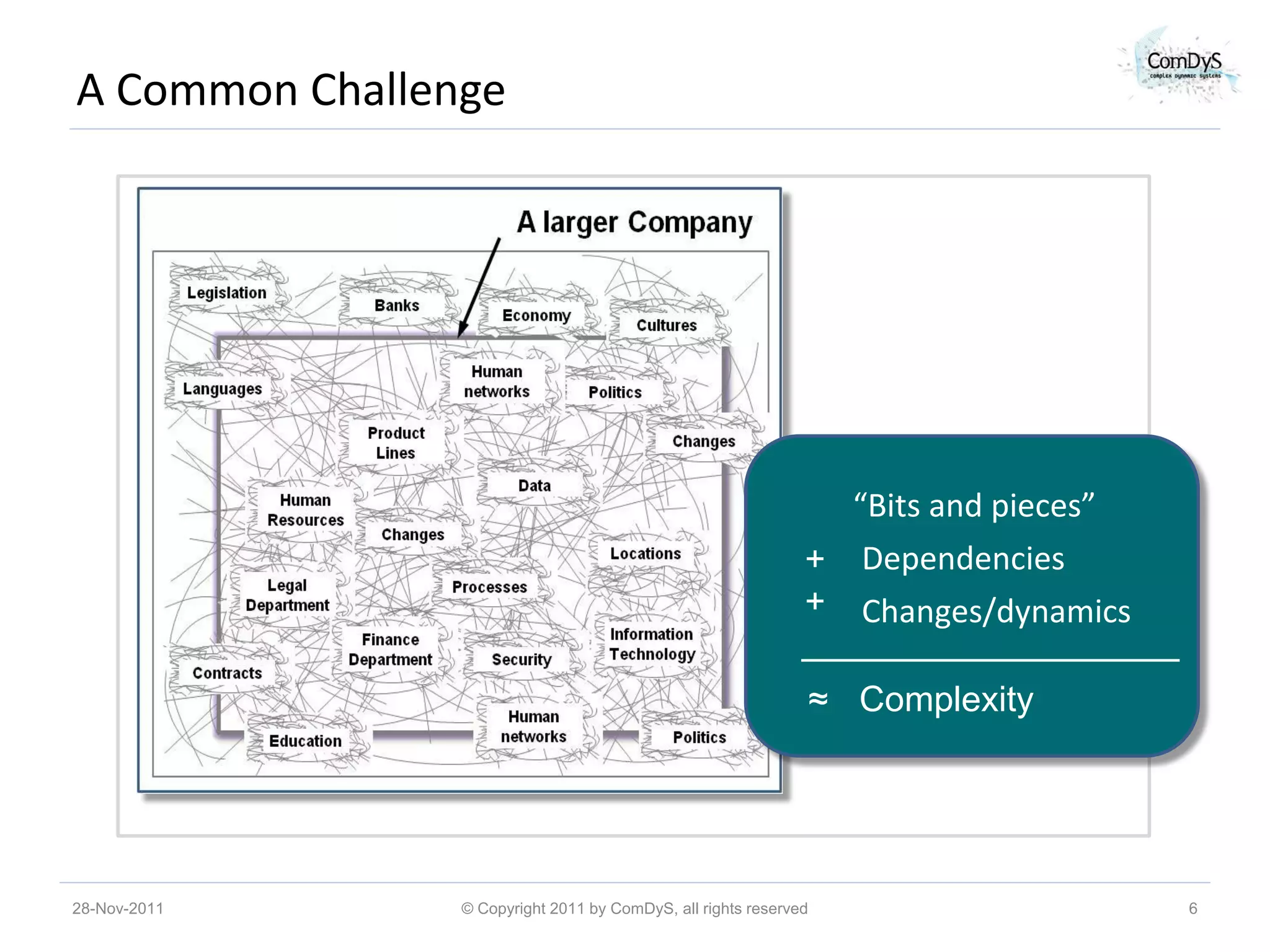
A Common Challenge


                                                                “Bits and pieces”
                                                              + Dependencies
                                                              + Changes/dynamics
                                                        +
                                                        + ≈ Complexity

                                                        ≈ Complexity

28-Nov-2011     © Copyright 2011 by ComDyS, all rights reserved                     6
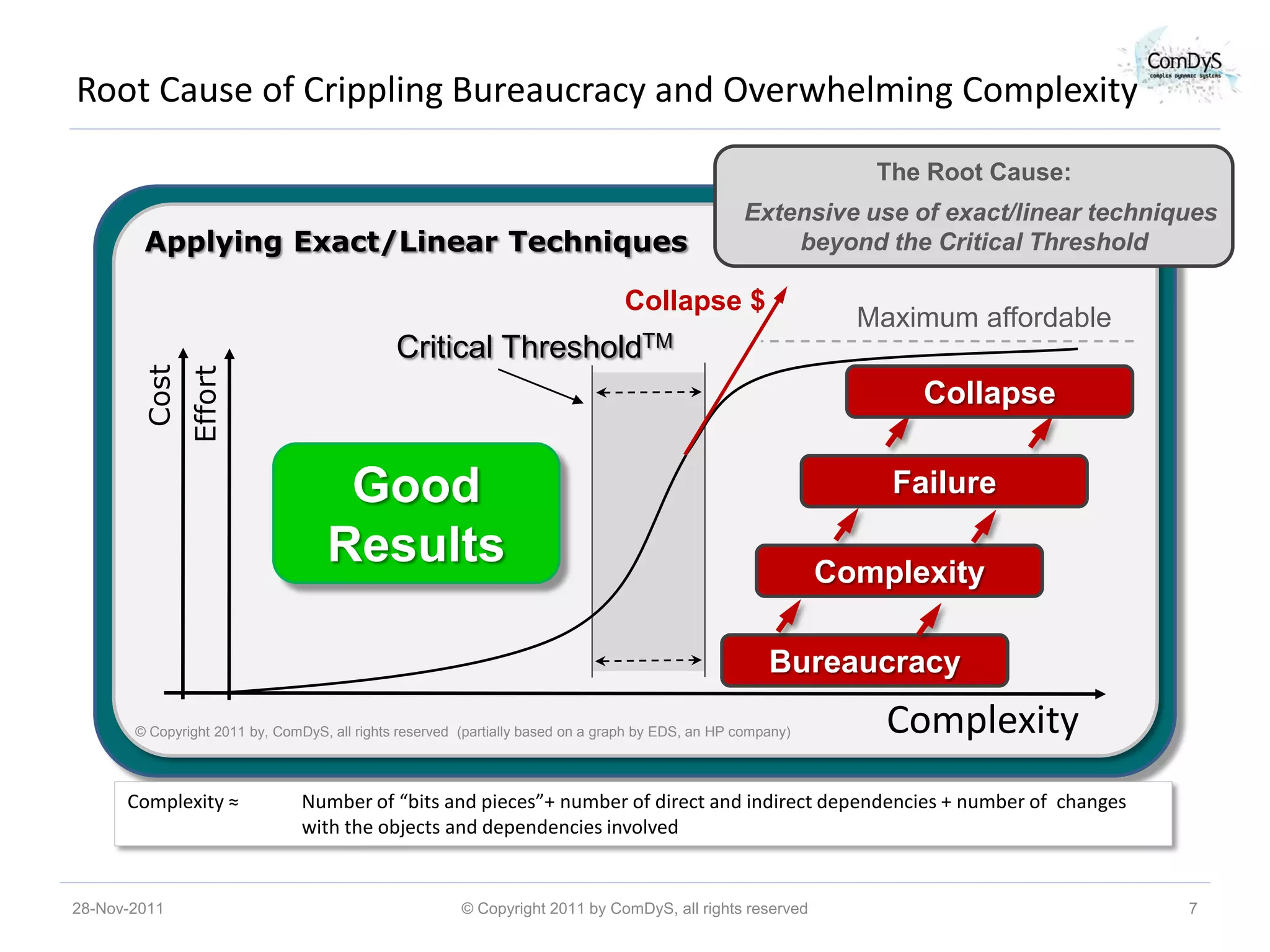
Root Cause of Crippling Bureaucracy and Overwhelming Complexity

                                                                                                                The Root Cause:
                                                                                                  Extensive use of exact/linear techniques
        Applying Exact/Linear Techniques                                                              beyond the Critical Threshold

                                                                                Collapse $
                                                                                                               Maximum affordable
                                              Critical        ThresholdTM
        Cost
               Effort


                                                                                                                   Collapse


                                    Good                                                                         Failure

                                   Results                                                                   Complexity

                                                                                                      Bureaucracy

       © Copyright 2011 by, ComDyS, all rights reserved (partially based on a graph by EDS, an HP company)       Complexity
      Complexity ≈              Number of “bits and pieces”+ number of direct and indirect dependencies + number of changes
                                with the objects and dependencies involved


28-Nov-2011                                             © Copyright 2011 by ComDyS, all rights reserved                                7
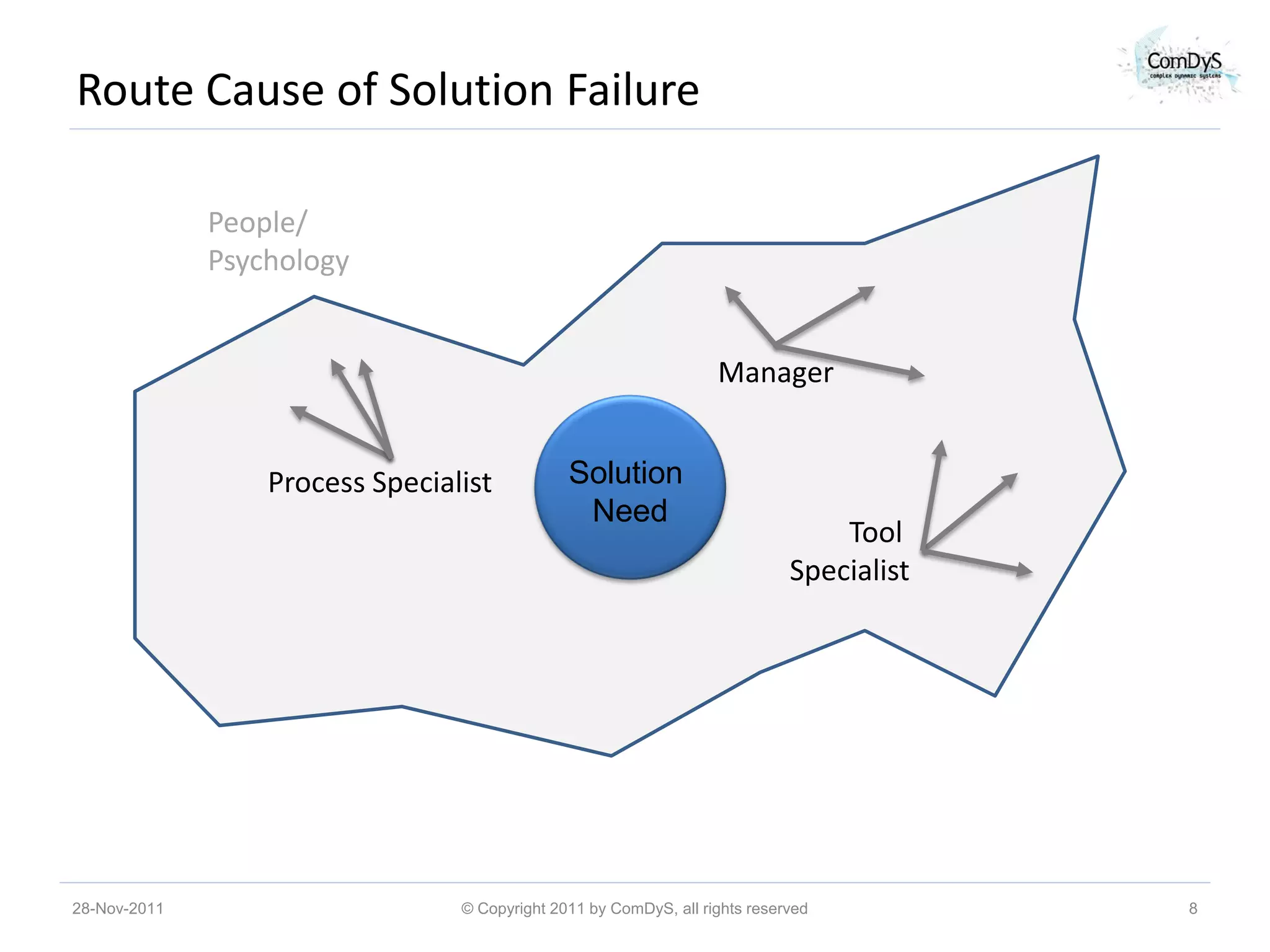
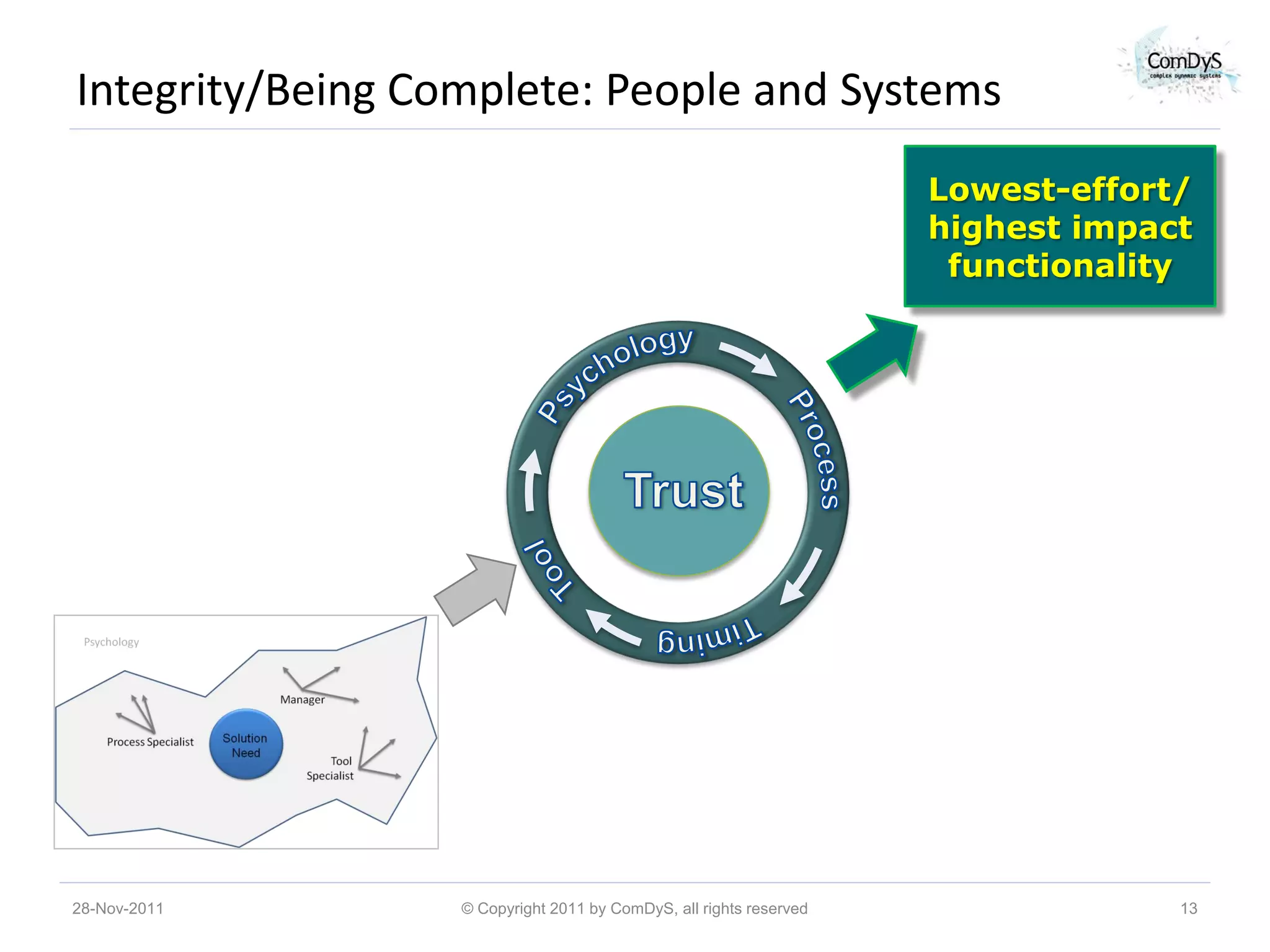
Route Cause of Solution Failure

              People/
              Psychology


                                                                   Manager


                  Process Specialist           Solution
                                                Need
                                                                                 Tool
                                                                             Specialist


28-Nov-2011                      © Copyright 2011 by ComDyS, all rights reserved          8
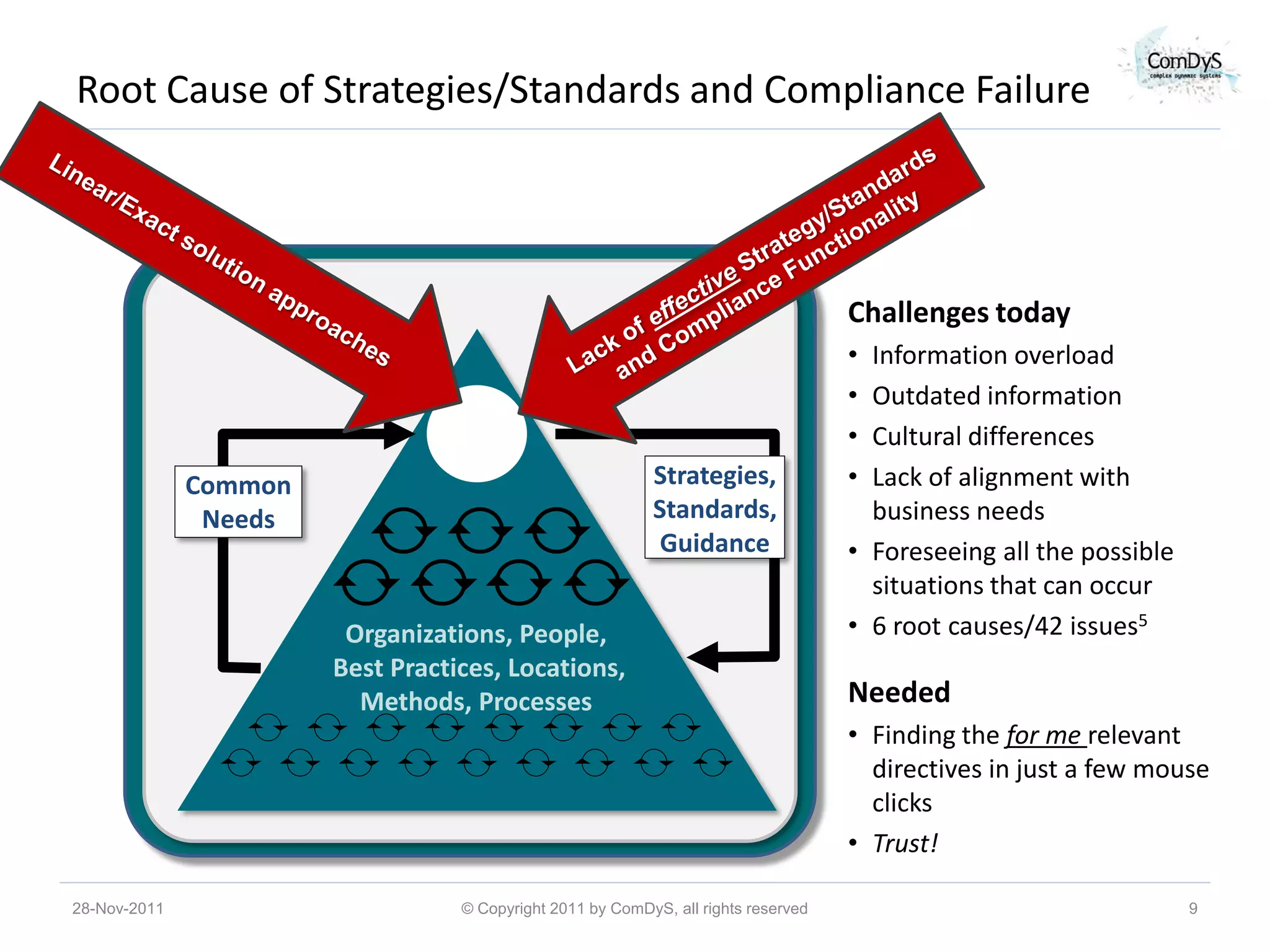
Root Cause of Strategies/Standards and Compliance Failure


                                                                                    Challenges today
                                                                                    • Information overload
                                                                                    • Outdated information
                                                                                    • Cultural differences
              Common                                       Strategies,              • Lack of alignment with
               Needs                                       Standards,                 business needs
                                                            Guidance                • Foreseeing all the possible
                                                                                      situations that can occur
                        Organizations, People,                                      • 6 root causes/42 issues5
                       Best Practices, Locations,
                         Methods, Processes                                         Needed
                                                                                    • Finding the for me relevant
                                                                                      directives in just a few mouse
                                                                                      clicks
                                                                                    • Trust!

28-Nov-2011                       © Copyright 2011 by ComDyS, all rights reserved                                   9
Agenda

• What caused today’s situation? How do we know
  what does not work?
• How do we know what works?
• How can we move from today’s situation to effective
  simplicity?
• How do we make it sustainable?


28-Nov-2011       © Copyright 2011 by ComDyS, all rights reserved   10
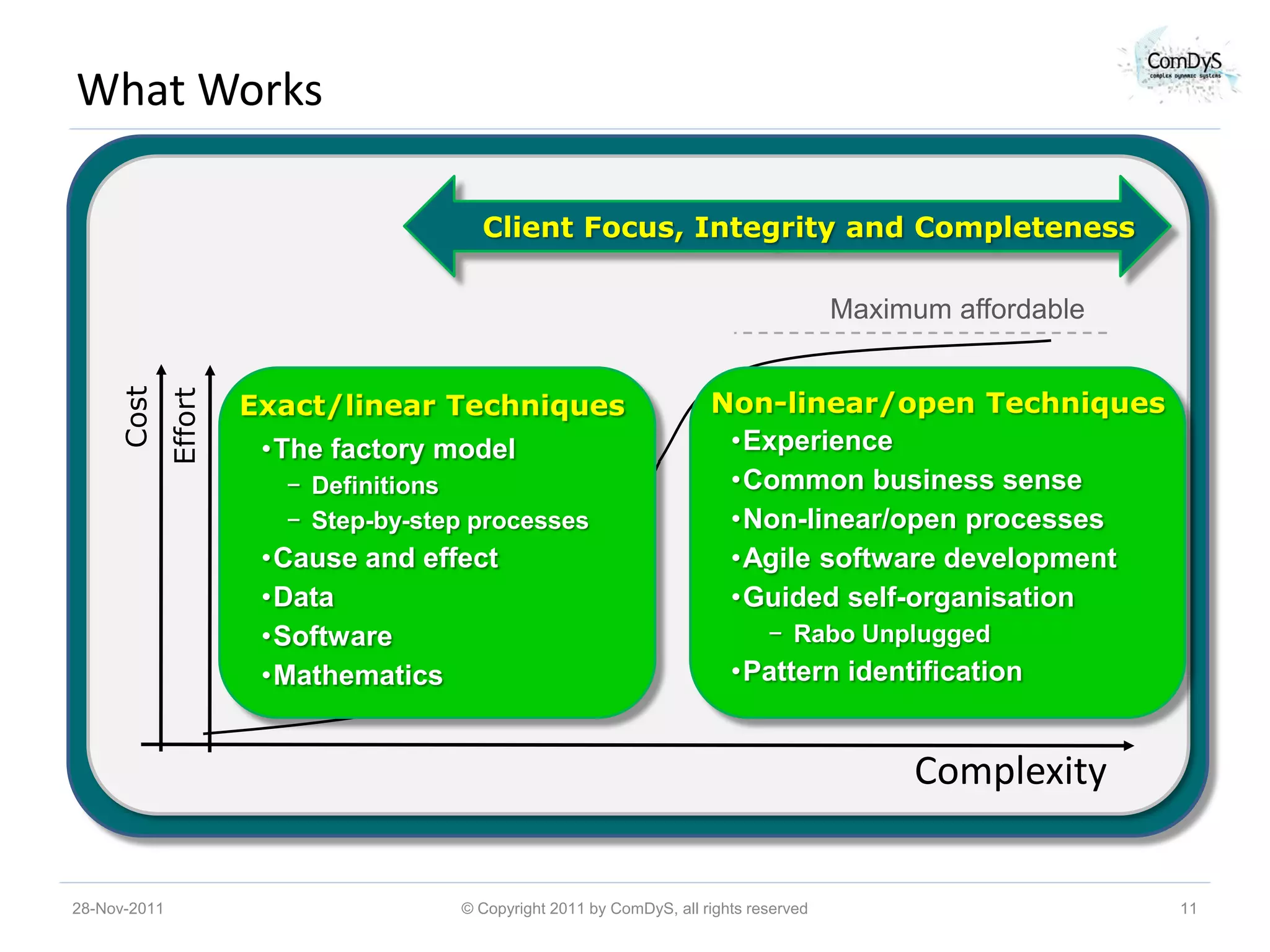
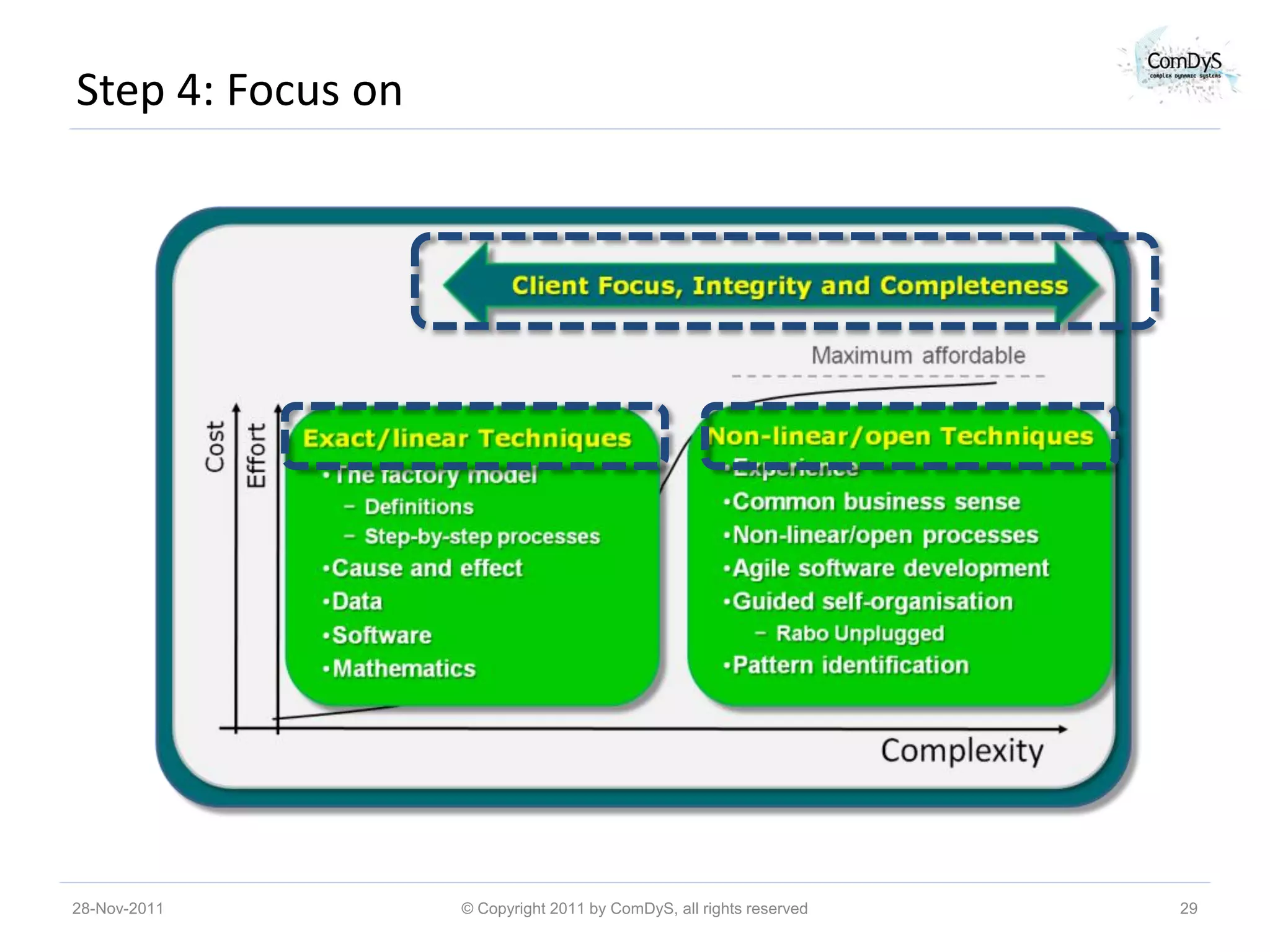
What Works

                                        Client Focus, Integrity and Completeness

                                                                                        Maximum affordable


                                                                       Non-linear/open Techniques
     Cost


                       Exact/linear Techniques
              Effort


                        •The factory model                              •Experience
                         − Definitions                      d           •Common business sense
                         − Step-by-step processes                       •Non-linear/open processes
                        •Cause and effect                               •Agile software development
                        •Data                                           •Guided self-organisation
                        •Software                                              − Rabo Unplugged
                        •Mathematics                                      •Pattern identification


                                                                                             Complexity


28-Nov-2011                           © Copyright 2011 by ComDyS, all rights reserved                        11
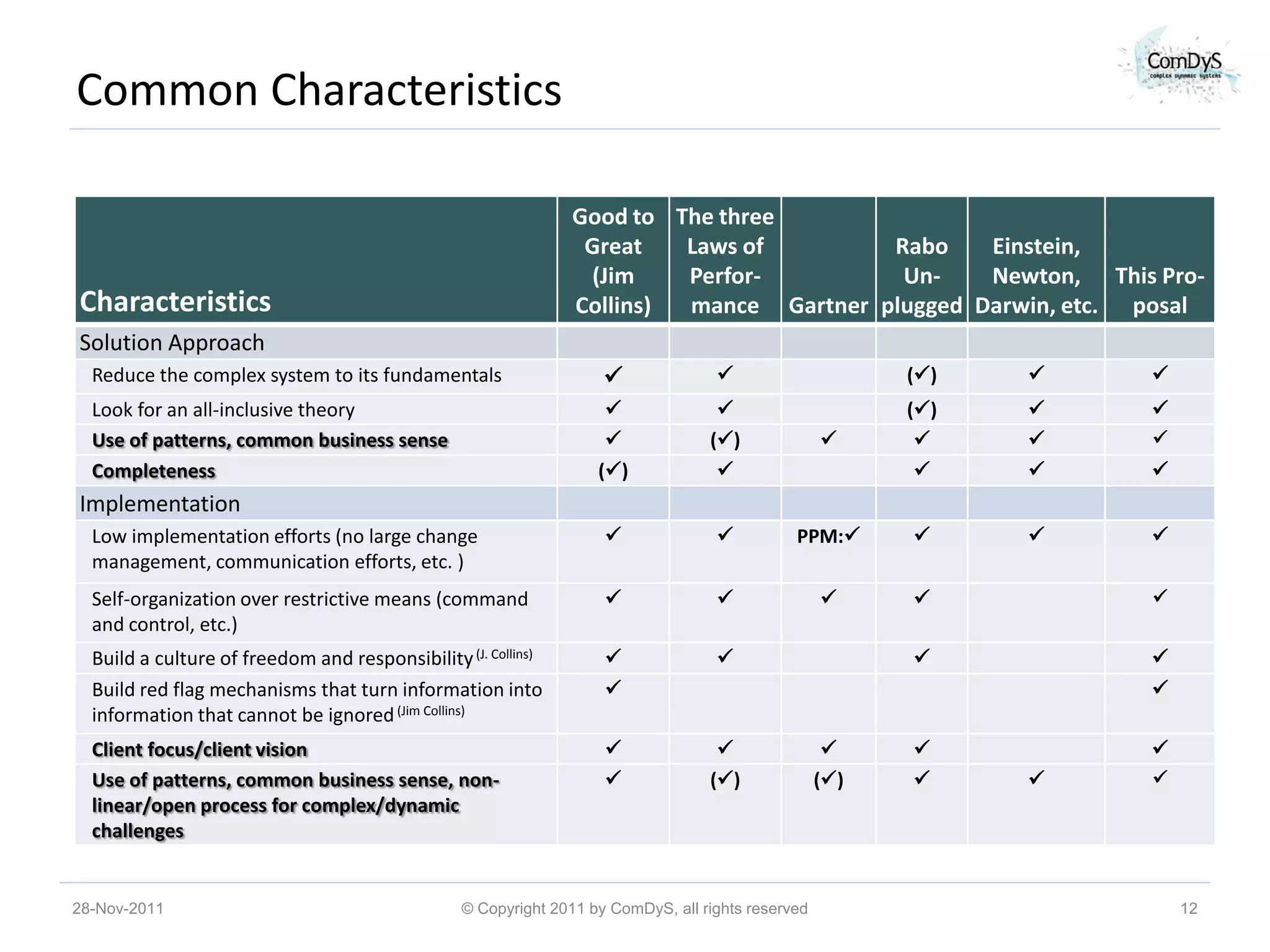
Common Characteristics

                                                                Good to The three
                                                                 Great   Laws of        Rabo    Einstein,
                                                                 (Jim    Perfor-         Un-    Newton, This Pro-
Characteristics                                                 Collins) mance Gartner plugged Darwin, etc. posal
Solution Approach
  Reduce the complex system to its fundamentals                                                        ()      
  Look for an all-inclusive theory                                                                     ()      
  Use of patterns, common business sense                                         ()                           
  Completeness                                                     ()                                          
Implementation
  Low implementation efforts (no large change                                               PPM:              
  management, communication efforts, etc. )
  Self-organization over restrictive means (command                                                            
  and control, etc.)
  Build a culture of freedom and responsibility (J. Collins)                                                    
  Build red flag mechanisms that turn information into                                                            
  information that cannot be ignored (Jim Collins)
  Client focus/client vision                                                                                   
  Use of patterns, common business sense, non-                                   ()              ()           
  linear/open process for complex/dynamic
  challenges


28-Nov-2011                                      © Copyright 2011 by ComDyS, all rights reserved                       12
Integrity/Being Complete: People and Systems
                                                                    Lowest-effort/
                                                                    highest impact
                                                                     functionality


28-Nov-2011       © Copyright 2011 by ComDyS, all rights reserved                13
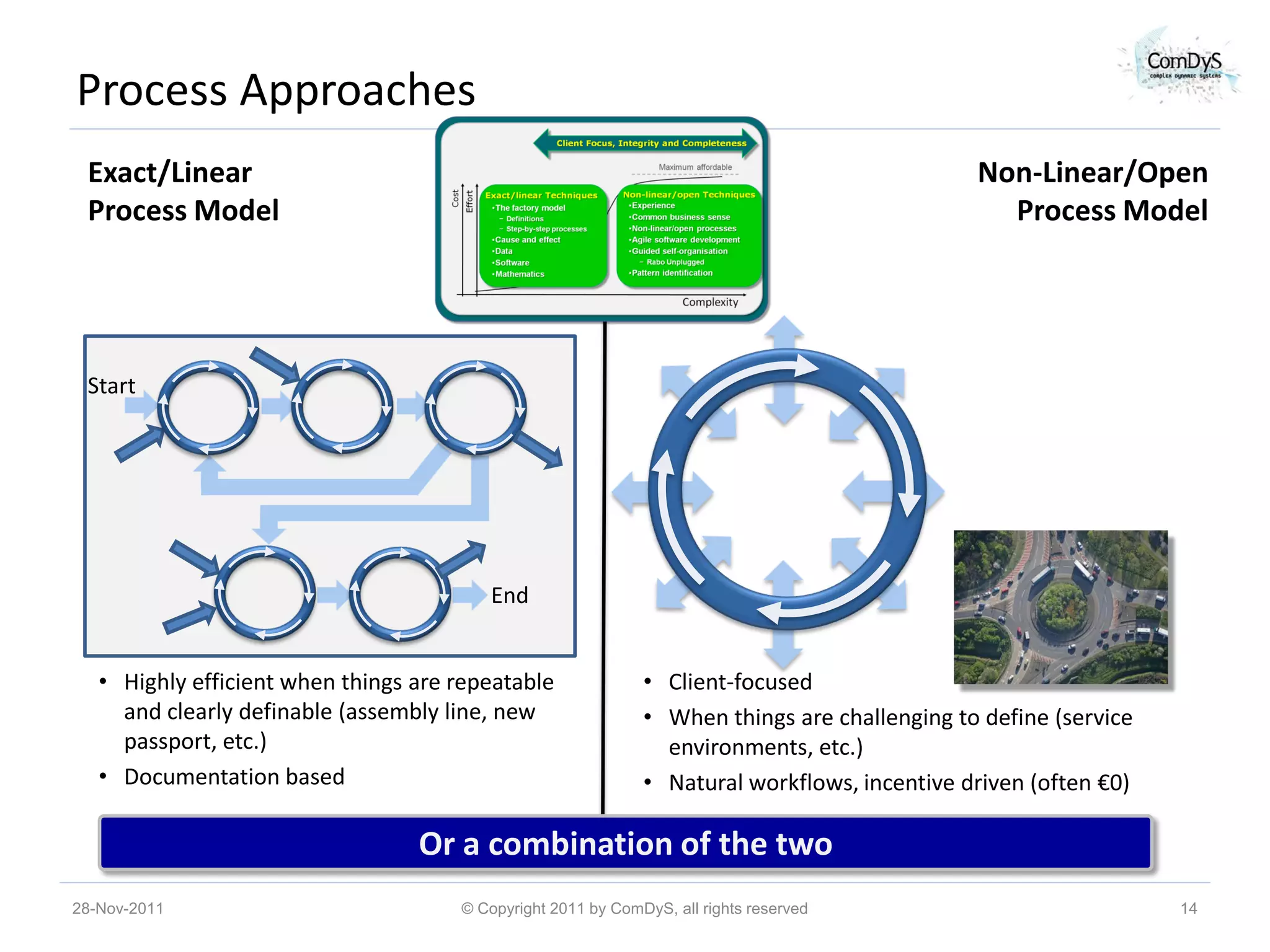
Process Approaches
 Exact/Linear                                                                                 Non-Linear/Open
 Process Model                                                                                  Process Model


 Start


                                         End


   • Highly efficient when things are repeatable              • Client-focused
     and clearly definable (assembly line, new                • When things are challenging to define (service
     passport, etc.)                                            environments, etc.)
   • Documentation based                                      • Natural workflows, incentive driven (often €0)

                                  Or a combination of the two
28-Nov-2011                           © Copyright 2011 by ComDyS, all rights reserved                            14
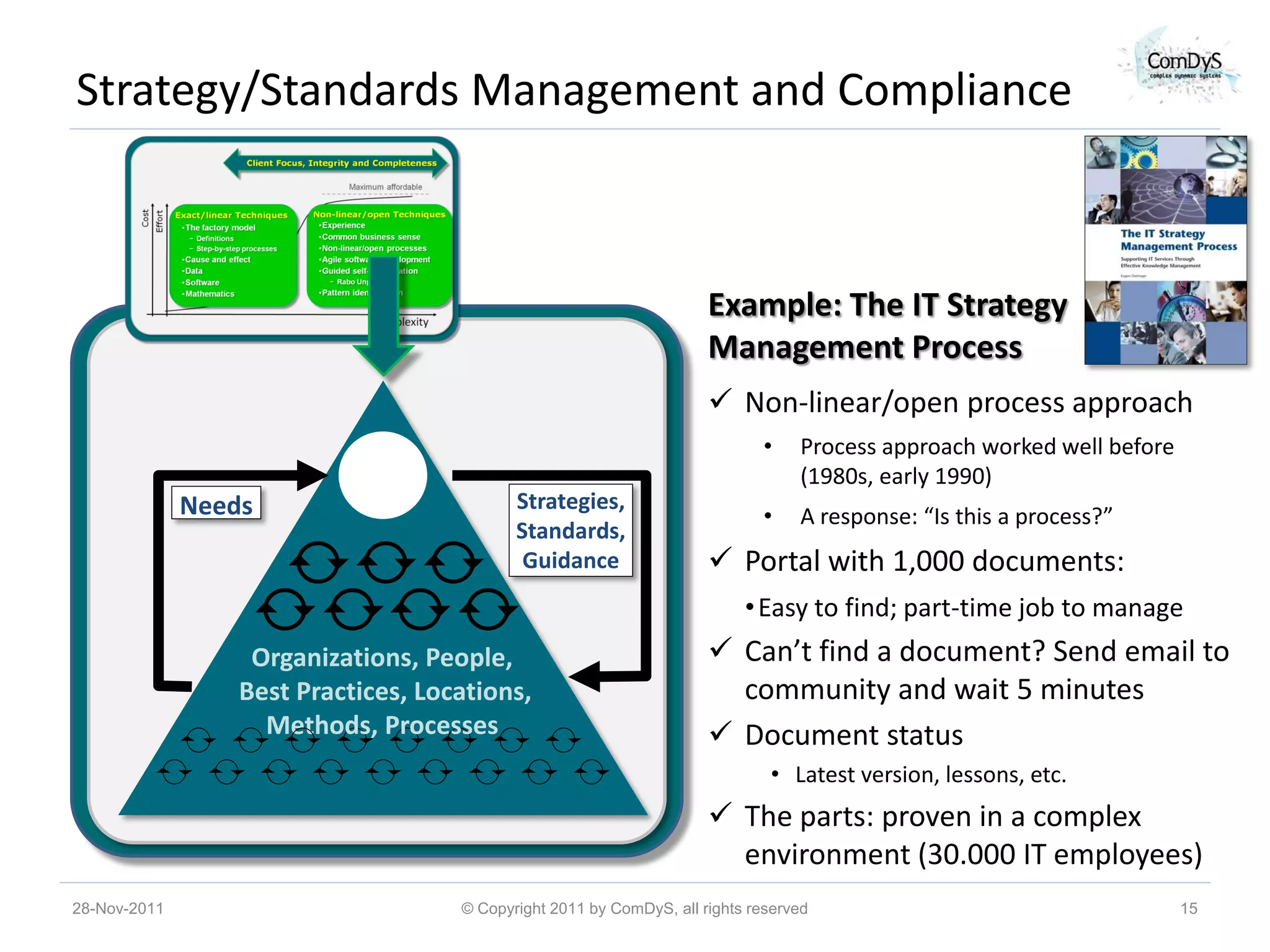
Strategy/Standards Management and Compliance


                                                                      Example: The IT Strategy
                                                                      Management Process
                                                                       Non-linear/open process approach
                                                                             •    Process approach worked well before
                                                                                  (1980s, early 1990)
              Needs                         Strategies,
                                                                             •    A response: “Is this a process?”
                                            Standards,
                                             Guidance                  Portal with 1,000 documents:
                                                                           • Easy to find; part-time job to manage
                   Organizations, People,                              Can’t find a document? Send email to
                  Best Practices, Locations,                            community and wait 5 minutes
                    Methods, Processes                                 Document status
                                                                              • Latest version, lessons, etc.
                                                                       The parts: proven in a complex
                                                                        environment (30.000 IT employees)
28-Nov-2011                          © Copyright 2011 by ComDyS, all rights reserved                                    15
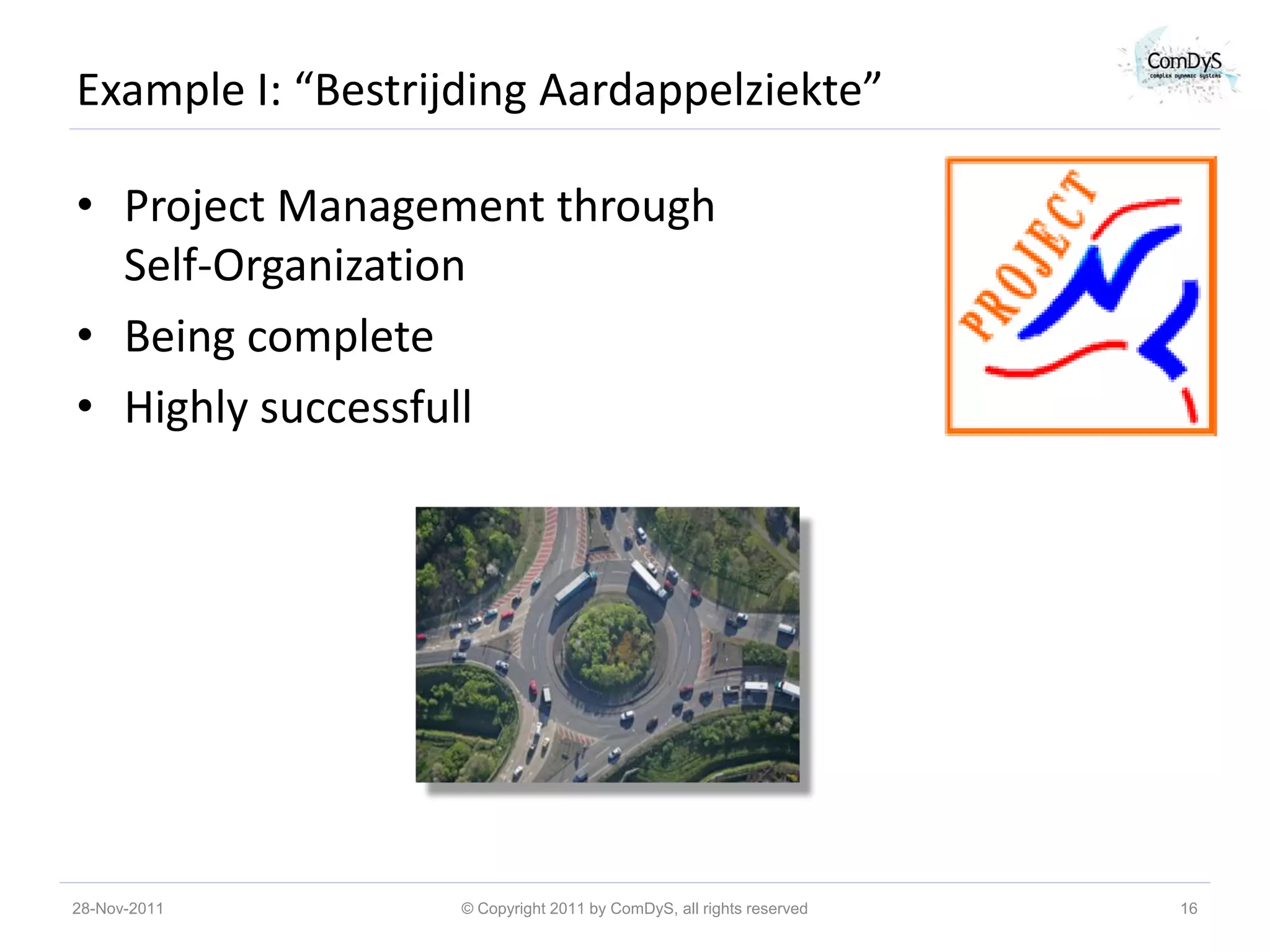
Example I: “Bestrijding Aardappelziekte”

• Project Management through
  Self-Organization
• Being complete
• Highly successfull


28-Nov-2011        © Copyright 2011 by ComDyS, all rights reserved   16
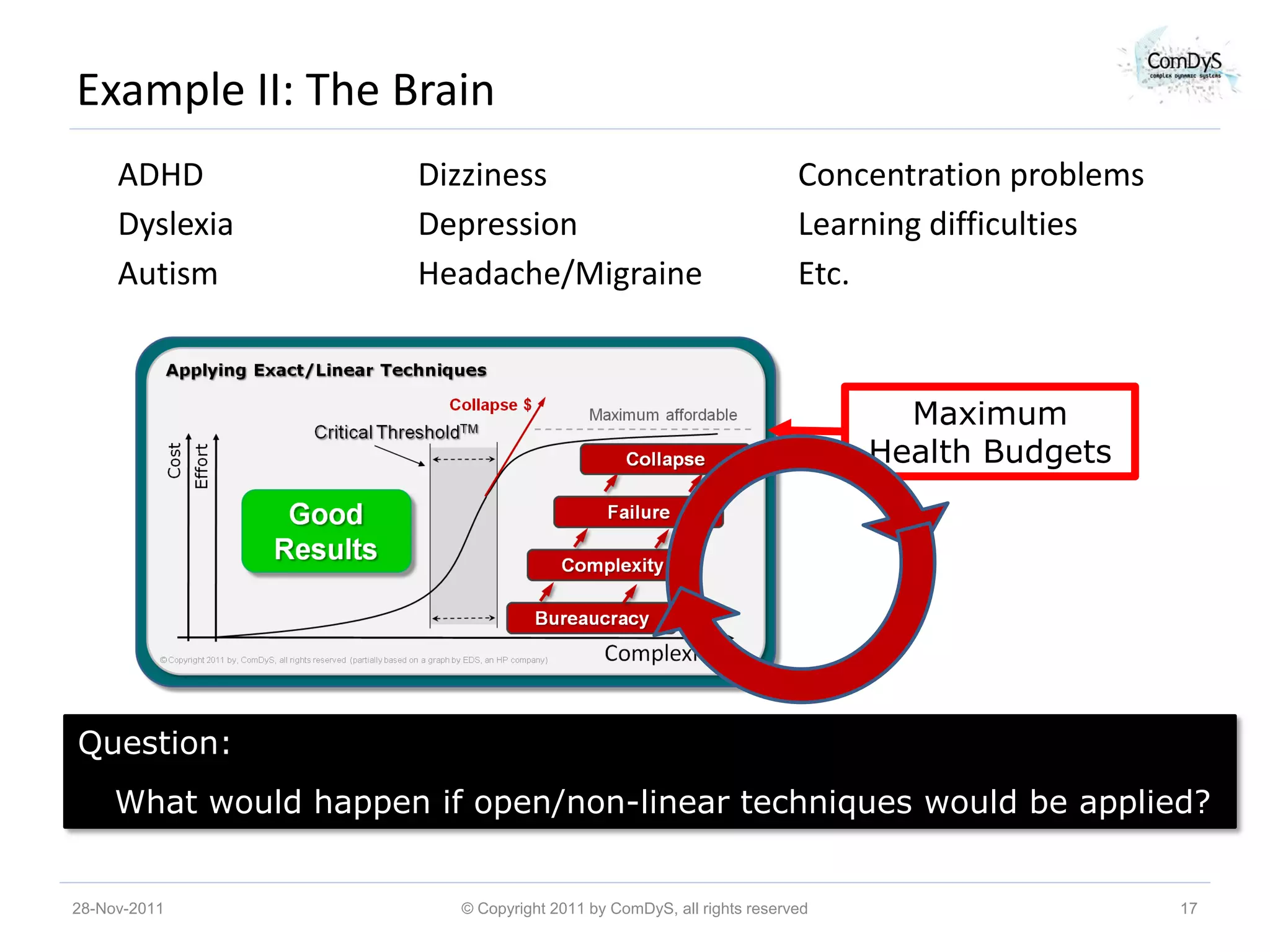
Example II: The Brain
     ADHD             Dizziness                                       Concentration problems
     Dyslexia         Depression                                      Learning difficulties
     Autism           Headache/Migraine                               Etc.


                                                                             Maximum
                                                                           Health Budgets


Question:
     What would happen if open/non-linear techniques would be applied?


28-Nov-2011              © Copyright 2011 by ComDyS, all rights reserved                       17
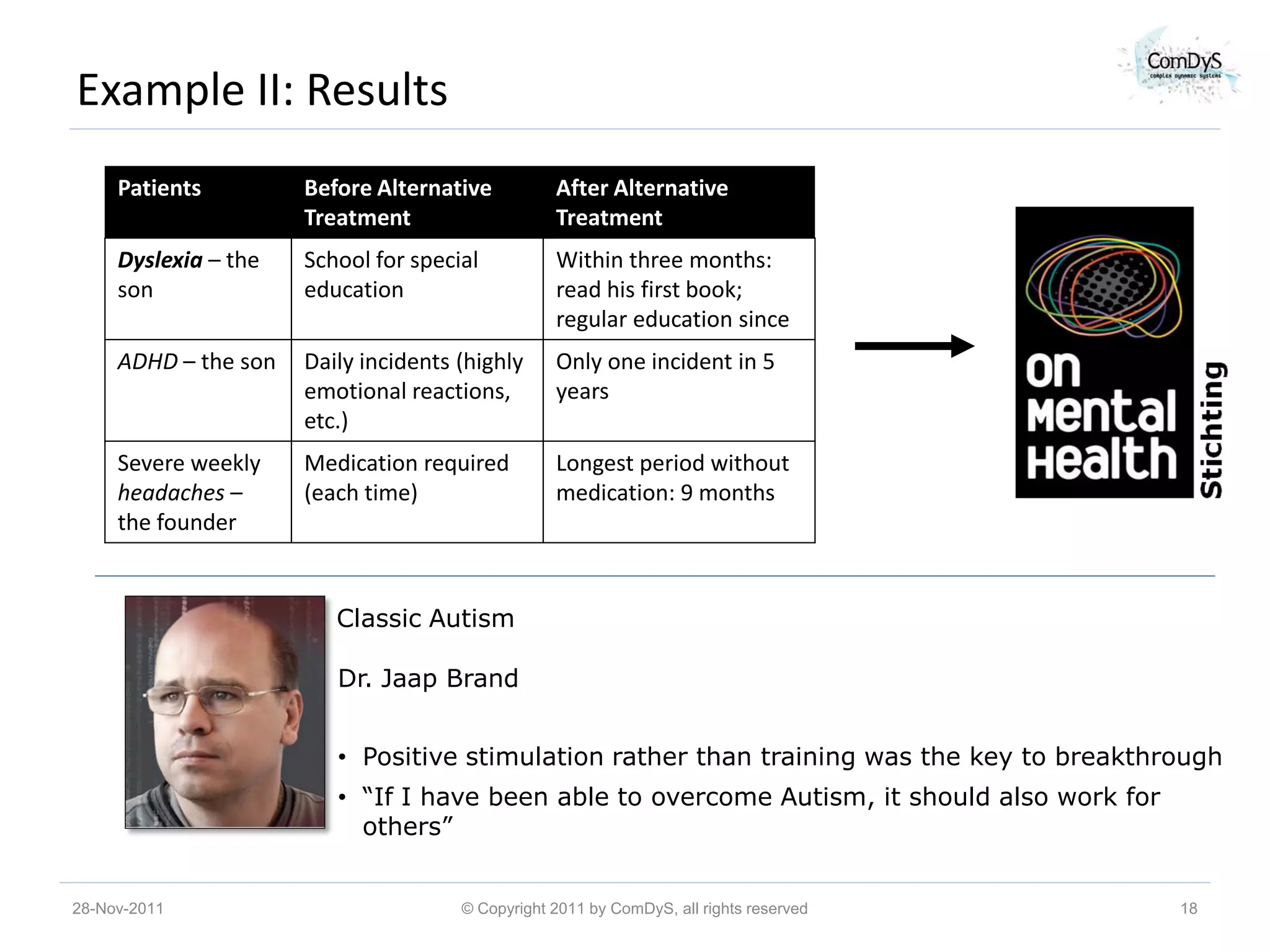
Example II: Results
     Patients         Before Alternative          After Alternative
                      Treatment                   Treatment
     Dyslexia – the   School for special          Within three months:
     son              education                   read his first book;
                                                  regular education since
     ADHD – the son   Daily incidents (highly     Only one incident in 5
                      emotional reactions,        years
                      etc.)
     Severe weekly    Medication required         Longest period without
     headaches –      (each time)                 medication: 9 months
     the founder


                         Classic Autism

                         Dr. Jaap Brand


                         • Positive stimulation rather than training was the key to breakthrough
                         • “If I have been able to overcome Autism, it should also work for
                           others”


28-Nov-2011                           © Copyright 2011 by ComDyS, all rights reserved         18
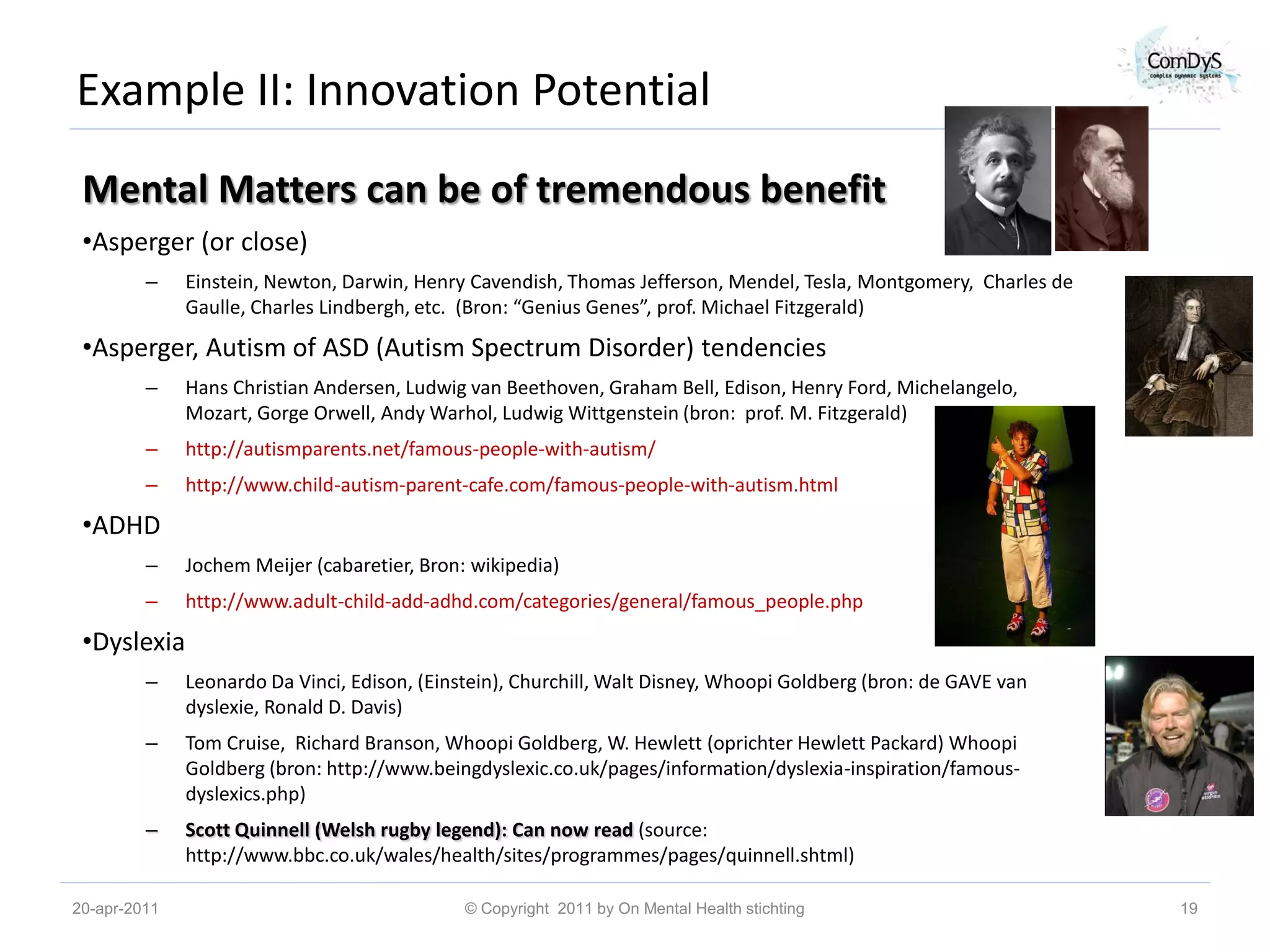
Example II: Innovation Potential
 Mental Matters can be of tremendous benefit
 •Asperger (or close)
         –    Einstein, Newton, Darwin, Henry Cavendish, Thomas Jefferson, Mendel, Tesla, Montgomery, Charles de
              Gaulle, Charles Lindbergh, etc. (Bron: “Genius Genes”, prof. Michael Fitzgerald)

 •Asperger, Autism of ASD (Autism Spectrum Disorder) tendencies
         –    Hans Christian Andersen, Ludwig van Beethoven, Graham Bell, Edison, Henry Ford, Michelangelo,
              Mozart, Gorge Orwell, Andy Warhol, Ludwig Wittgenstein (bron: prof. M. Fitzgerald)
         –    http://autismparents.net/famous-people-with-autism/
         –    http://www.child-autism-parent-cafe.com/famous-people-with-autism.html

 •ADHD
         –    Jochem Meijer (cabaretier, Bron: wikipedia)
         –    http://www.adult-child-add-adhd.com/categories/general/famous_people.php

 •Dyslexia
         –    Leonardo Da Vinci, Edison, (Einstein), Churchill, Walt Disney, Whoopi Goldberg (bron: de GAVE van
              dyslexie, Ronald D. Davis)
         –    Tom Cruise, Richard Branson, Whoopi Goldberg, W. Hewlett (oprichter Hewlett Packard) Whoopi
              Goldberg (bron: http://www.beingdyslexic.co.uk/pages/information/dyslexia-inspiration/famous-
              dyslexics.php)
         –    Scott Quinnell (Welsh rugby legend): Can now read (source:
              http://www.bbc.co.uk/wales/health/sites/programmes/pages/quinnell.shtml)

20-apr-2011                                   © Copyright 2011 by On Mental Health stichting                       19
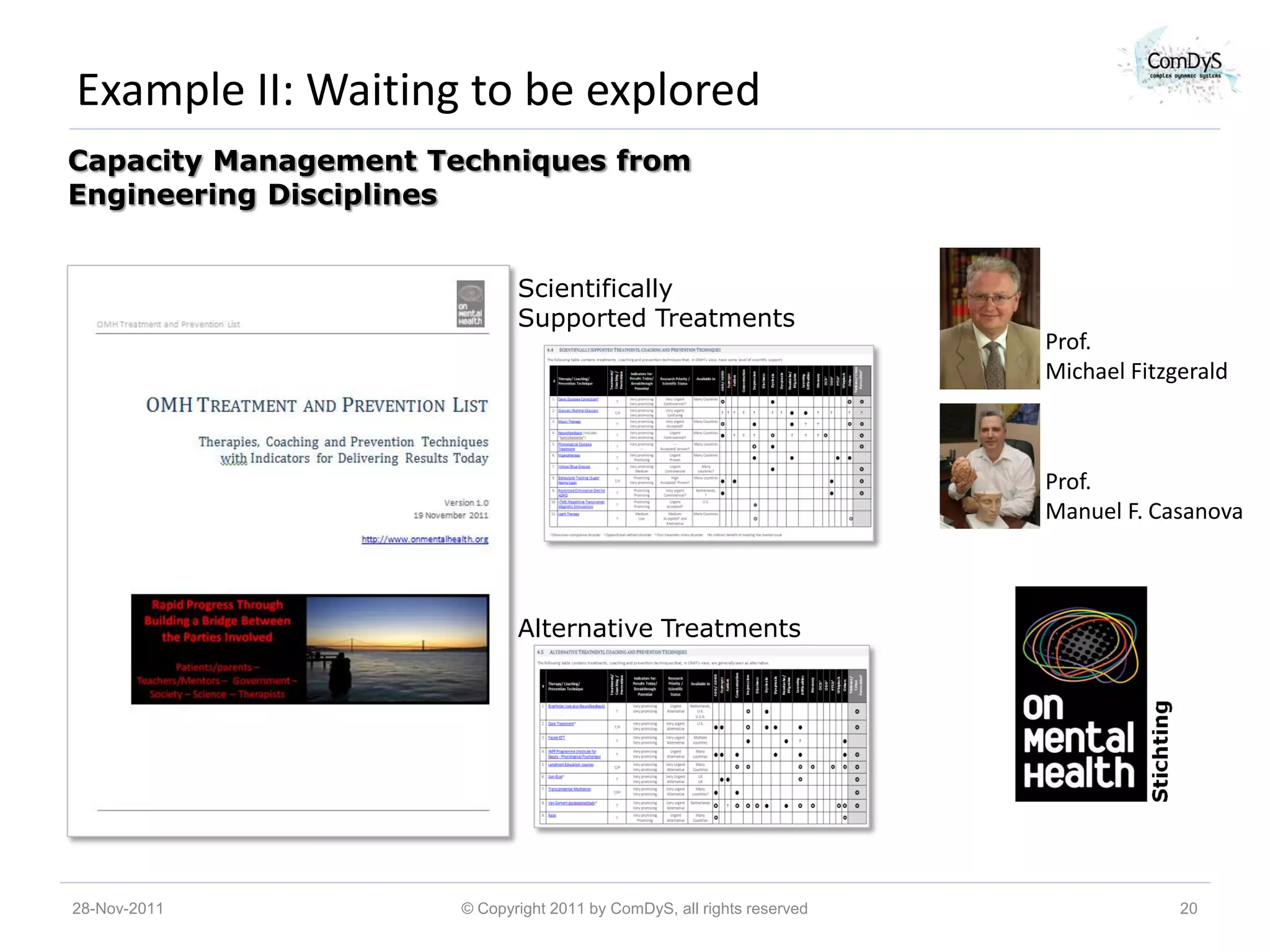
Example II: Waiting to be explored
Capacity Management Techniques from
Engineering Disciplines


                             Scientifically
                             Supported Treatments
                                                                        Prof.
                                                                        Michael Fitzgerald


                                                                        Prof.
                                                                        Manuel F. Casanova


                             Alternative Treatments


28-Nov-2011           © Copyright 2011 by ComDyS, all rights reserved                20
Example II: An exceptional Opportunity


      Benefits
              •   Drastic reduction of the suffering
              •   Drastic reduction of treatment cost
              •   Higher levels of education
              •   Substantial reduction of violence, crime and associated
                  cost


28-Nov-2011                     © Copyright 2011 by ComDyS, all rights reserved   21
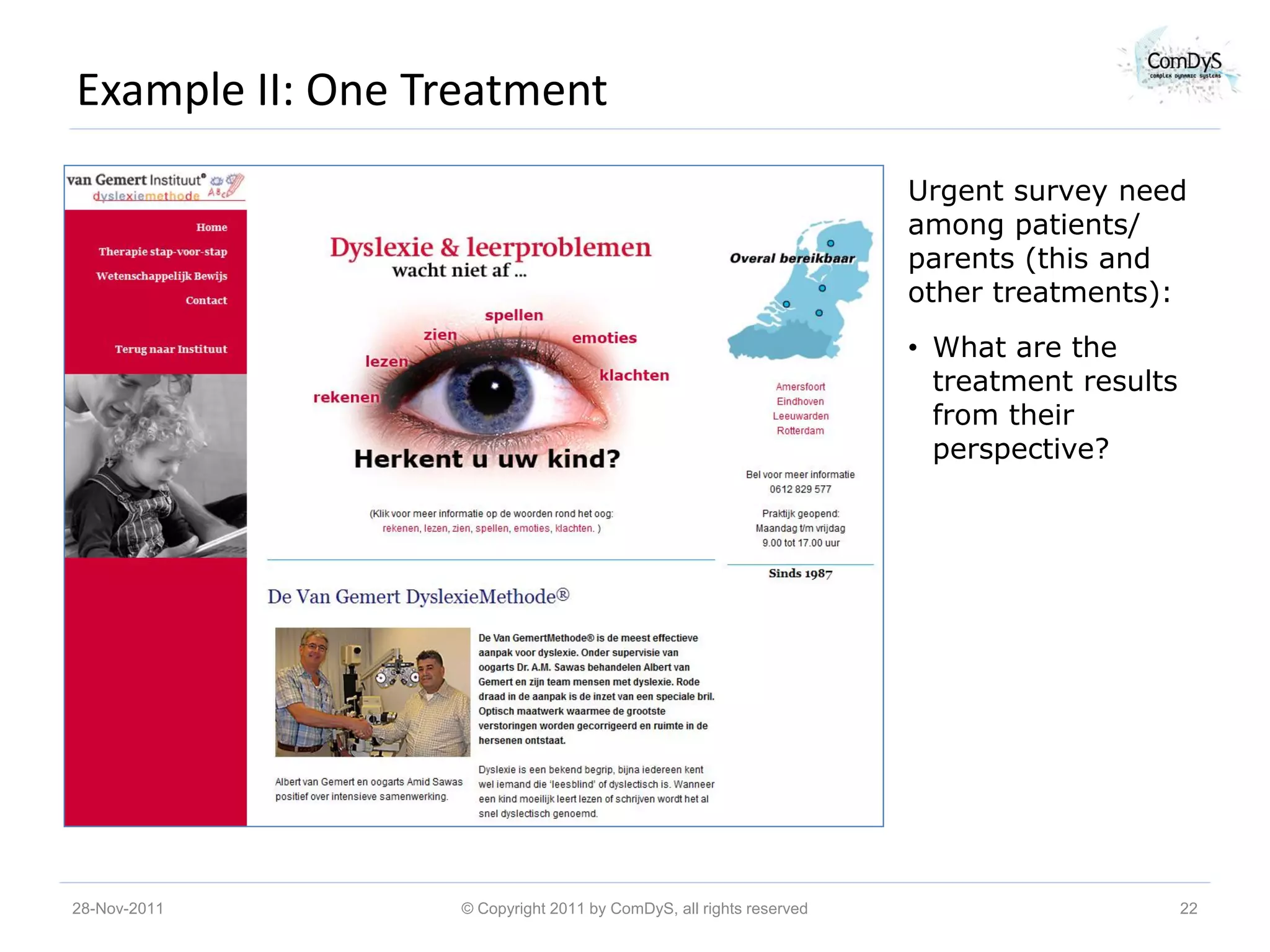
Example II: One Treatment
                                                                    Urgent survey need
                                                                    among patients/
                                                                    parents (this and
                                                                    other treatments):
                                                                    • What are the
                                                                      treatment results
                                                                      from their
                                                                      perspective?


28-Nov-2011       © Copyright 2011 by ComDyS, all rights reserved                         22
Agenda

• What caused today’s situation? How do we know
  what does not work?
• How do we know what works?
• How can we move from today’s situation to
  effective simplicity?
• How do we make it sustainable?


28-Nov-2011      © Copyright 2011 by ComDyS, all rights reserved   23
Step 1: “Get the right People on the Bus” (Jim Collins)4
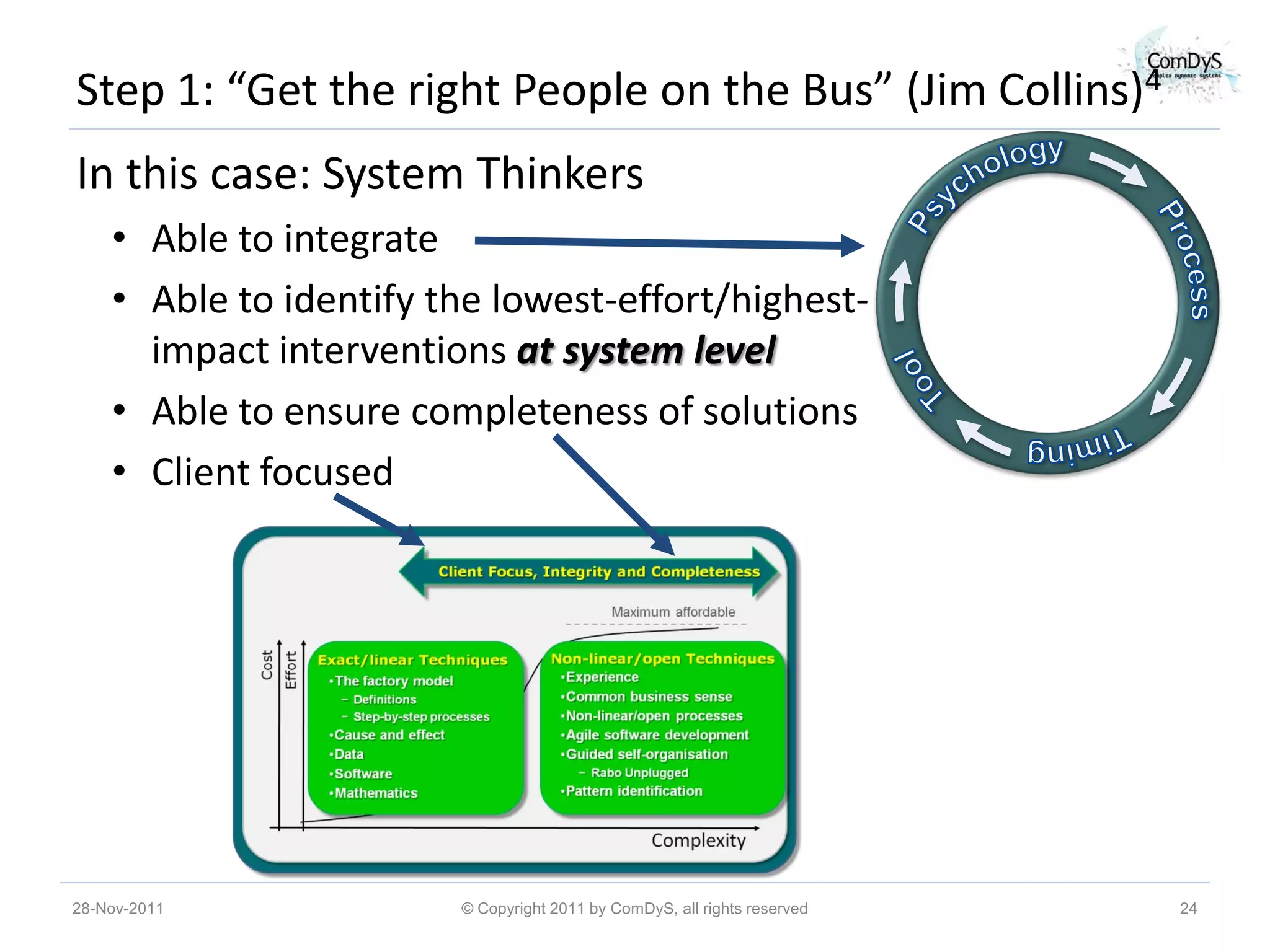
In this case: System Thinkers
    • Able to integrate
    • Able to identify the lowest-effort/highest-
      impact interventions at system level
    • Able to ensure completeness of solutions
    • Client focused


28-Nov-2011             © Copyright 2011 by ComDyS, all rights reserved   24
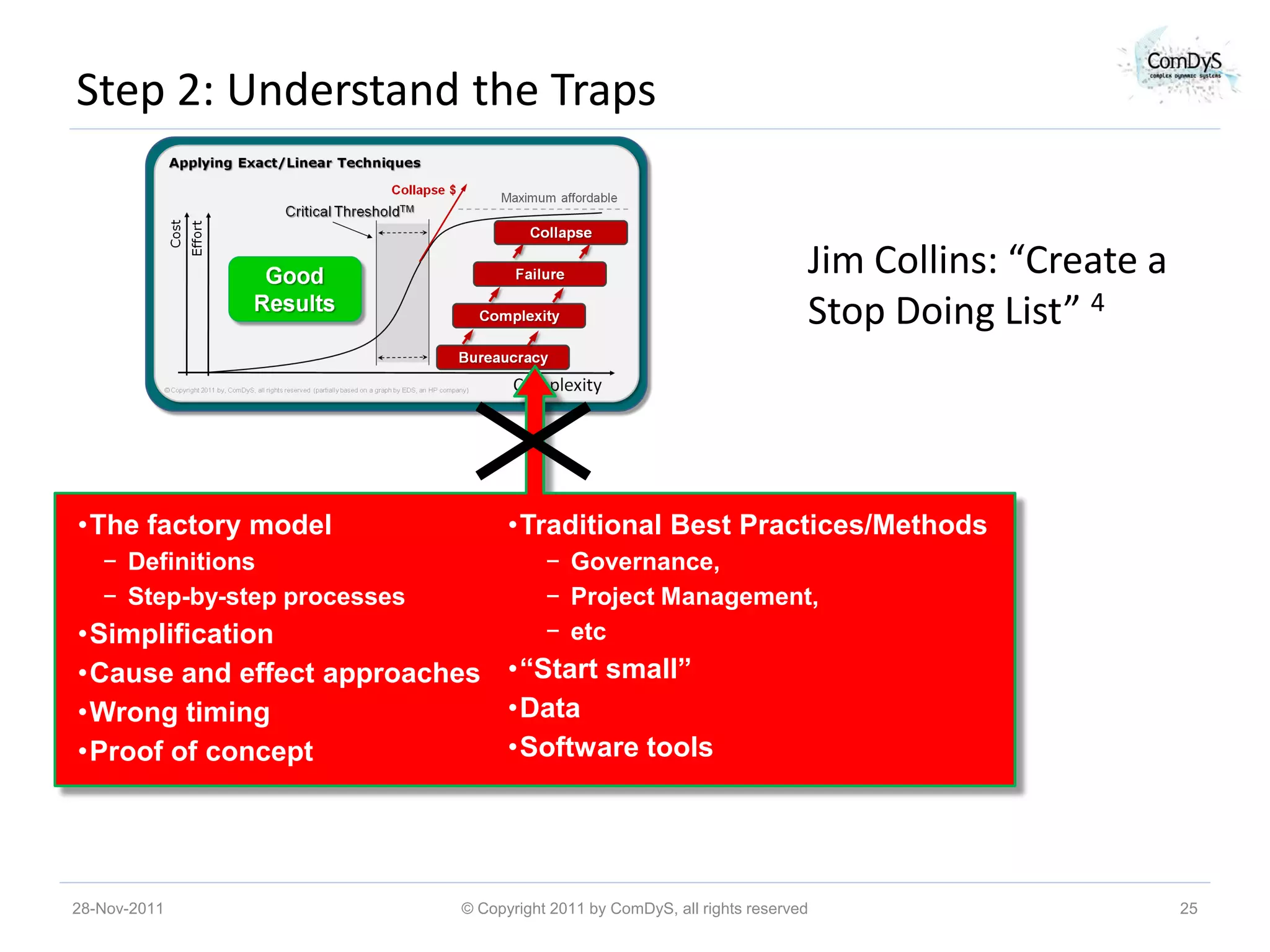
Step 2: Understand the Traps


                                                                            Jim Collins: “Create a
                                                                            Stop Doing List” 4


•The factory model                  •Traditional Best Practices/Methods
   − Definitions                         − Governance,
   − Step-by-step processes              − Project Management,
•Simplification                          − etc
•Cause and effect approaches •“Start small”
•Wrong timing                •Data
•Proof of concept            •Software tools


28-Nov-2011                   © Copyright 2011 by ComDyS, all rights reserved                        25
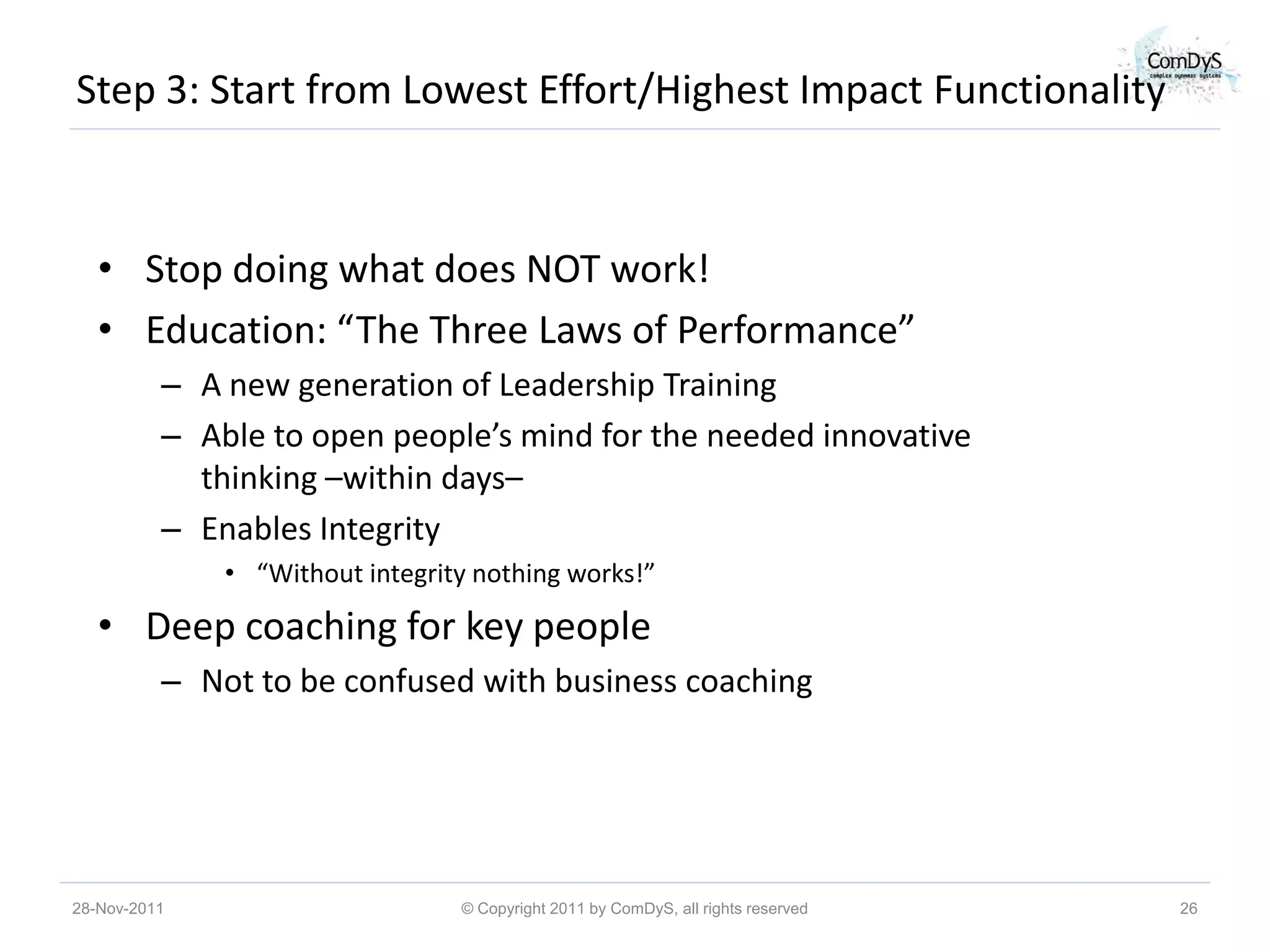
Step 3: Start from Lowest Effort/Highest Impact Functionality


   • Stop doing what does NOT work!
   • Education: “The Three Laws of Performance”
          – A new generation of Leadership Training
          – Able to open people’s mind for the needed innovative
            thinking –within days–
          – Enables Integrity
              • “Without integrity nothing works!”

   • Deep coaching for key people
          – Not to be confused with business coaching


28-Nov-2011                      © Copyright 2011 by ComDyS, all rights reserved   26
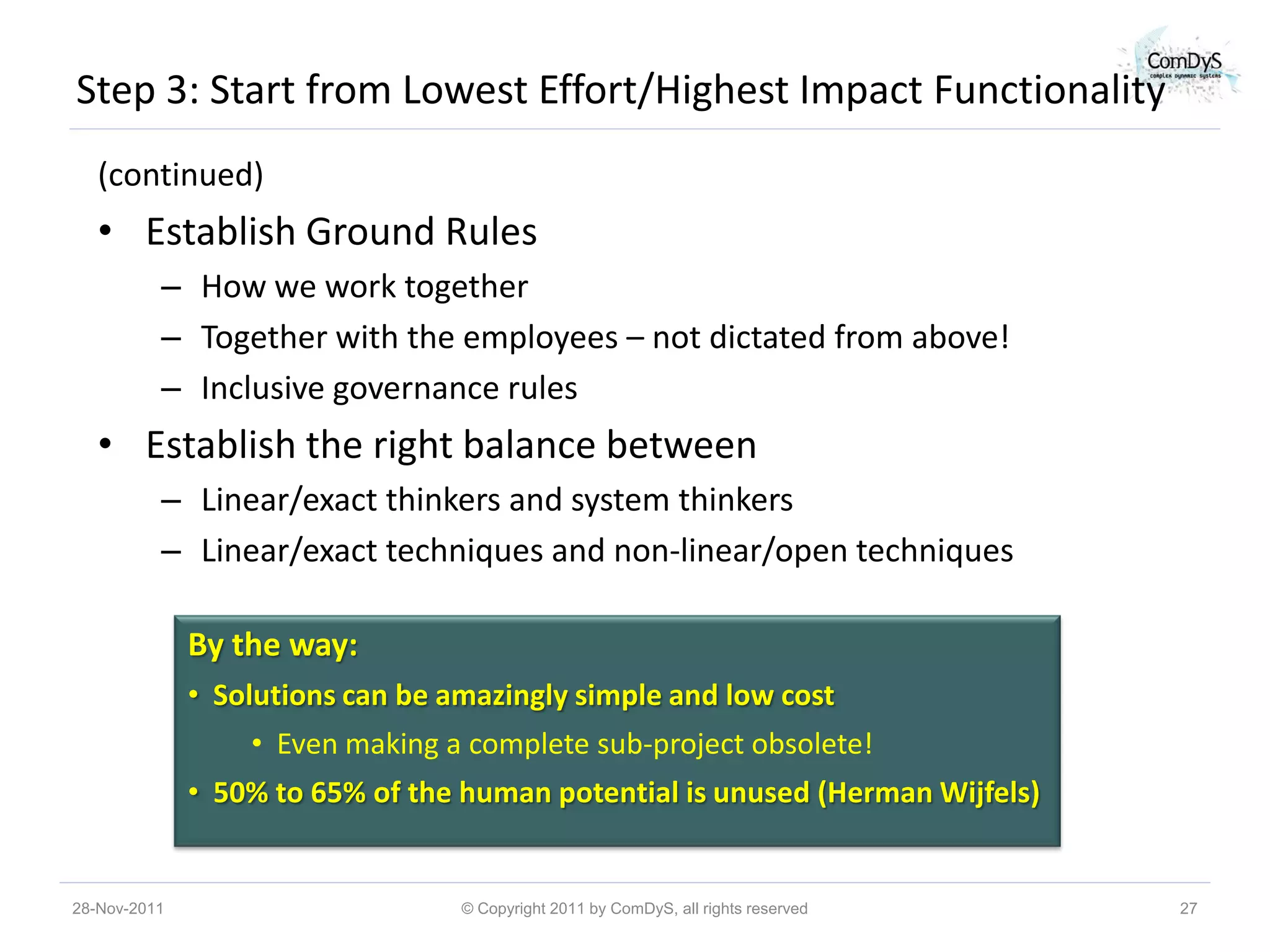
Step 3: Start from Lowest Effort/Highest Impact Functionality
   (continued)
   • Establish Ground Rules
          – How we work together
          – Together with the employees – not dictated from above!
          – Inclusive governance rules
   • Establish the right balance between
          – Linear/exact thinkers and system thinkers
          – Linear/exact techniques and non-linear/open techniques

              By the way:
              • Solutions can be amazingly simple and low cost
                  • Even making a complete sub-project obsolete!
              • 50% to 65% of the human potential is unused (Herman Wijfels)


28-Nov-2011                       © Copyright 2011 by ComDyS, all rights reserved   27
Agenda

• What caused today’s situation? How do we know
  what does not work?
• How do we know what works?
• How can we move from today’s situation to effective
  simplicity?
• How do we make it sustainable?


28-Nov-2011       © Copyright 2011 by ComDyS, all rights reserved   28
Step 4: Focus on


28-Nov-2011        © Copyright 2011 by ComDyS, all rights reserved   29
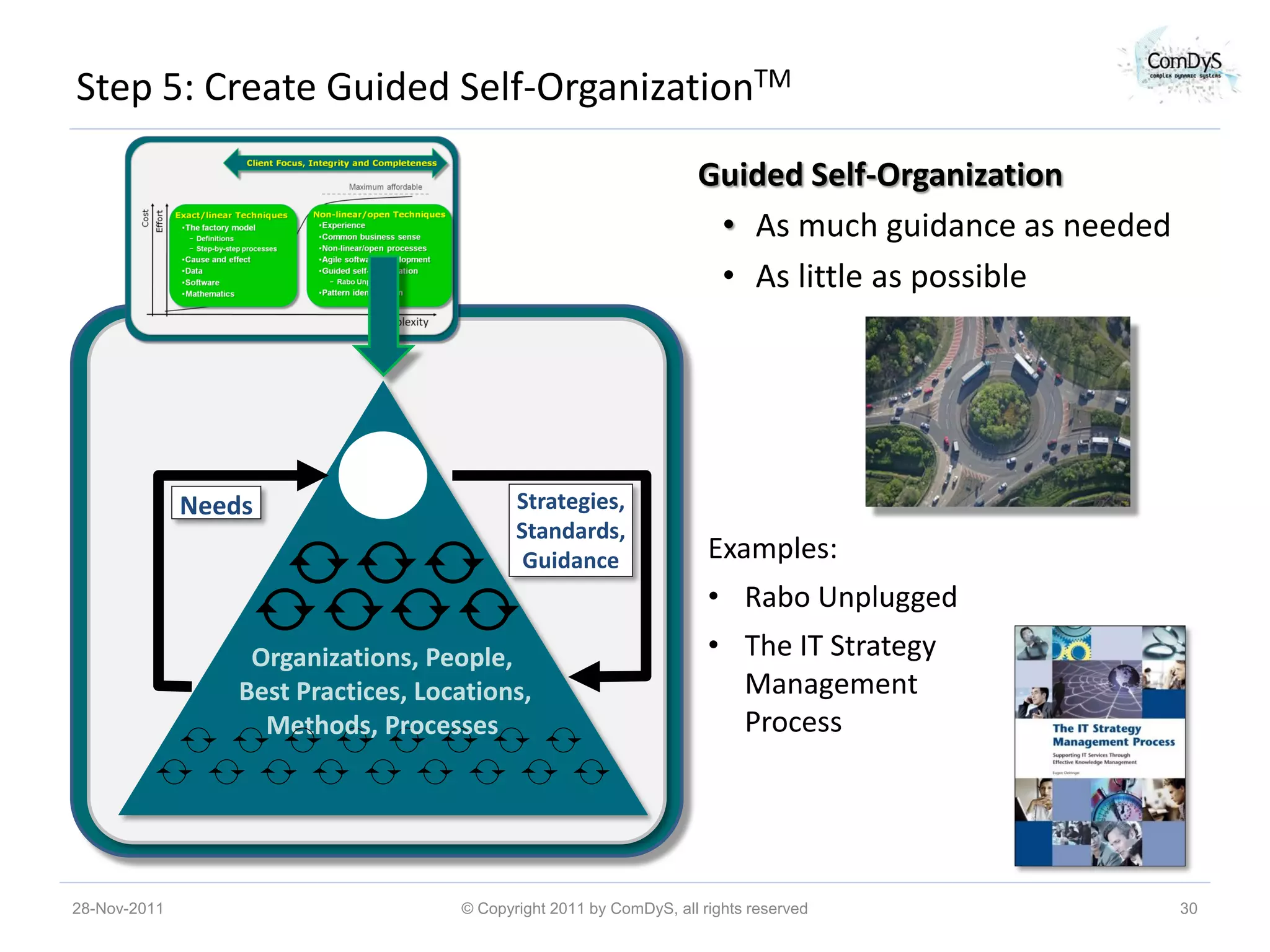
Step 5: Create Guided Self-OrganizationTM

                                                                     Guided Self-Organization
                                                                      • As much guidance as needed
                                                                      • As little as possible


              Needs                         Strategies,
                                            Standards,
                                             Guidance                 Examples:
                                                                      • Rabo Unplugged
                   Organizations, People,                             • The IT Strategy
                  Best Practices, Locations,                            Management
                    Methods, Processes                                  Process


28-Nov-2011                          © Copyright 2011 by ComDyS, all rights reserved                 30
Thank You


                        Eugen Oetringer

www.comdys.com                 eugen@comdys.com
References

    1. Power to the edge, command and control in the information age. Davis S. Alberts, Richard E. Hayes, DoD Command and Control
       Research Program. 2003.
    2. The new quotable Einstein. Alice Calaprice. Princeton University Press. Princeton and Oxford. 2005.
    3. “Complexity and self-organization.” Francis Heylighen. In Bates & Maack, Eds. Prepared for the Encyclopedia of Library and
       Information Services, Taylor & Francis, 2008.
    4. Good to great. Jim Collins. London, United Kingdom: Random House Business Books. 2001.
    5. The IT strategy management process. E. Oetringer, Van Haren Publishing, Zaltbommel, 2004.
    6. Genius genes – how Asperger talents changed the world. Michael Fitzgerald, Brendon O’Brien. Shawnee Mission, Kansas: Autism
       Asperger Publishing Company
    7. Plezier beleven aan taaie vraagstukken. Hans Vermaak. Kluwer. Mei 2009. ISBN-13: 9789013063028
    8. How the mighty fall. Jim Collins. London, United Kingdom: Random House Business Books. 2009.
    9. Playing with complexity. Marcel Hertogh, Eddy Westerveld. Dissertation. 2010
    10. “The future of health service provision”. E. Oetringer, M. Fitzgerald. M.d. Sterke. Irish Medical News. 17-May-2010.
    11. “The three laws of Performance”. S. Saffron, D Logan. Jossey-Bass, Wiley Imprint. San Francisco.

    12. Heeft Het Nieuwe Werken de toekomst? Harold Janssen, Jaap Peters, 16-Nov-2010, www.managementsite.nl

    13 Herman Wijffels, energiedag MKB-krachtcentrale 2010


28-Nov-2011                                      © Copyright 2011 by ComDyS, all rights reserved                                     32

Effective simplicity rotterdam

  • 1.
    From Crippling Bureaucracyand Overwhelming Complexity to Effective Simplicity Van verlammende bureaucratie en overweldigende complexiteit naar effectieve eenvoud Eugen Oetringer www.comdys.com eugen@comdys.com
  • 2.
    Denktank Project NL Stichting tot versterking van het vertrouwen in grote projecten in Nederland www.denktankproject.nl info@denktankproject.nl • E. Oetringer is lid van de werkgroep Complexiteit in projecten • de vandaag voorgestelde informatie maakt deel uit van het onderzoek van de werkgroep 28-Nov-2011 © Copyright 2011 by ComDyS, all rights reserved 2
  • 3.
    Agenda • What causedtoday’s situation? How do we know what does not work? • How do we know what works? • How can we move from today’s situation to effective simplicity? • How do we make it sustainable? 28-Nov-2011 © Copyright 2011 by ComDyS, all rights reserved 3
  • 4.
    Complexiteit: Definition 28-Nov-2011 © Copyright 2011 by ComDyS, all rights reserved 4
  • 5.
    Patterns •Patterns – Are efficient where exact methods struggle – Nothing wrong or right – Not bad or good – Things are as they are 28-Nov-2011 © Copyright 2011 by ComDyS, all rights reserved 5
  • 6.
    A Common Challenge “Bits and pieces” + Dependencies + Changes/dynamics + + ≈ Complexity ≈ Complexity 28-Nov-2011 © Copyright 2011 by ComDyS, all rights reserved 6
  • 7.
    Root Cause ofCrippling Bureaucracy and Overwhelming Complexity The Root Cause: Extensive use of exact/linear techniques Applying Exact/Linear Techniques beyond the Critical Threshold Collapse $ Maximum affordable Critical ThresholdTM Cost Effort Collapse Good Failure Results Complexity Bureaucracy © Copyright 2011 by, ComDyS, all rights reserved (partially based on a graph by EDS, an HP company) Complexity Complexity ≈ Number of “bits and pieces”+ number of direct and indirect dependencies + number of changes with the objects and dependencies involved 28-Nov-2011 © Copyright 2011 by ComDyS, all rights reserved 7
  • 8.
    Route Cause ofSolution Failure People/ Psychology Manager Process Specialist Solution Need Tool Specialist 28-Nov-2011 © Copyright 2011 by ComDyS, all rights reserved 8
  • 9.
    Root Cause ofStrategies/Standards and Compliance Failure Challenges today • Information overload • Outdated information • Cultural differences Common Strategies, • Lack of alignment with Needs Standards, business needs Guidance • Foreseeing all the possible situations that can occur Organizations, People, • 6 root causes/42 issues5 Best Practices, Locations, Methods, Processes Needed • Finding the for me relevant directives in just a few mouse clicks • Trust! 28-Nov-2011 © Copyright 2011 by ComDyS, all rights reserved 9
  • 10.
    Agenda • What causedtoday’s situation? How do we know what does not work? • How do we know what works? • How can we move from today’s situation to effective simplicity? • How do we make it sustainable? 28-Nov-2011 © Copyright 2011 by ComDyS, all rights reserved 10
  • 11.
    What Works Client Focus, Integrity and Completeness Maximum affordable Non-linear/open Techniques Cost Exact/linear Techniques Effort •The factory model •Experience − Definitions d •Common business sense − Step-by-step processes •Non-linear/open processes •Cause and effect •Agile software development •Data •Guided self-organisation •Software − Rabo Unplugged •Mathematics •Pattern identification Complexity 28-Nov-2011 © Copyright 2011 by ComDyS, all rights reserved 11
  • 12.
    Common Characteristics Good to The three Great Laws of Rabo Einstein, (Jim Perfor- Un- Newton, This Pro- Characteristics Collins) mance Gartner plugged Darwin, etc. posal Solution Approach Reduce the complex system to its fundamentals   ()   Look for an all-inclusive theory   ()   Use of patterns, common business sense  ()     Completeness ()     Implementation Low implementation efforts (no large change   PPM:    management, communication efforts, etc. ) Self-organization over restrictive means (command      and control, etc.) Build a culture of freedom and responsibility (J. Collins)     Build red flag mechanisms that turn information into   information that cannot be ignored (Jim Collins) Client focus/client vision      Use of patterns, common business sense, non-  () ()    linear/open process for complex/dynamic challenges 28-Nov-2011 © Copyright 2011 by ComDyS, all rights reserved 12
  • 13.
    Integrity/Being Complete: Peopleand Systems Lowest-effort/ highest impact functionality 28-Nov-2011 © Copyright 2011 by ComDyS, all rights reserved 13
  • 14.
    Process Approaches Exact/Linear Non-Linear/Open Process Model Process Model Start End • Highly efficient when things are repeatable • Client-focused and clearly definable (assembly line, new • When things are challenging to define (service passport, etc.) environments, etc.) • Documentation based • Natural workflows, incentive driven (often €0) Or a combination of the two 28-Nov-2011 © Copyright 2011 by ComDyS, all rights reserved 14
  • 15.
    Strategy/Standards Management andCompliance Example: The IT Strategy Management Process  Non-linear/open process approach • Process approach worked well before (1980s, early 1990) Needs Strategies, • A response: “Is this a process?” Standards, Guidance  Portal with 1,000 documents: • Easy to find; part-time job to manage Organizations, People,  Can’t find a document? Send email to Best Practices, Locations, community and wait 5 minutes Methods, Processes  Document status • Latest version, lessons, etc.  The parts: proven in a complex environment (30.000 IT employees) 28-Nov-2011 © Copyright 2011 by ComDyS, all rights reserved 15
  • 16.
    Example I: “BestrijdingAardappelziekte” • Project Management through Self-Organization • Being complete • Highly successfull 28-Nov-2011 © Copyright 2011 by ComDyS, all rights reserved 16
  • 17.
    Example II: TheBrain ADHD Dizziness Concentration problems Dyslexia Depression Learning difficulties Autism Headache/Migraine Etc. Maximum Health Budgets Question: What would happen if open/non-linear techniques would be applied? 28-Nov-2011 © Copyright 2011 by ComDyS, all rights reserved 17
  • 18.
    Example II: Results Patients Before Alternative After Alternative Treatment Treatment Dyslexia – the School for special Within three months: son education read his first book; regular education since ADHD – the son Daily incidents (highly Only one incident in 5 emotional reactions, years etc.) Severe weekly Medication required Longest period without headaches – (each time) medication: 9 months the founder Classic Autism Dr. Jaap Brand • Positive stimulation rather than training was the key to breakthrough • “If I have been able to overcome Autism, it should also work for others” 28-Nov-2011 © Copyright 2011 by ComDyS, all rights reserved 18
  • 19.
    Example II: InnovationPotential Mental Matters can be of tremendous benefit •Asperger (or close) – Einstein, Newton, Darwin, Henry Cavendish, Thomas Jefferson, Mendel, Tesla, Montgomery, Charles de Gaulle, Charles Lindbergh, etc. (Bron: “Genius Genes”, prof. Michael Fitzgerald) •Asperger, Autism of ASD (Autism Spectrum Disorder) tendencies – Hans Christian Andersen, Ludwig van Beethoven, Graham Bell, Edison, Henry Ford, Michelangelo, Mozart, Gorge Orwell, Andy Warhol, Ludwig Wittgenstein (bron: prof. M. Fitzgerald) – http://autismparents.net/famous-people-with-autism/ – http://www.child-autism-parent-cafe.com/famous-people-with-autism.html •ADHD – Jochem Meijer (cabaretier, Bron: wikipedia) – http://www.adult-child-add-adhd.com/categories/general/famous_people.php •Dyslexia – Leonardo Da Vinci, Edison, (Einstein), Churchill, Walt Disney, Whoopi Goldberg (bron: de GAVE van dyslexie, Ronald D. Davis) – Tom Cruise, Richard Branson, Whoopi Goldberg, W. Hewlett (oprichter Hewlett Packard) Whoopi Goldberg (bron: http://www.beingdyslexic.co.uk/pages/information/dyslexia-inspiration/famous- dyslexics.php) – Scott Quinnell (Welsh rugby legend): Can now read (source: http://www.bbc.co.uk/wales/health/sites/programmes/pages/quinnell.shtml) 20-apr-2011 © Copyright 2011 by On Mental Health stichting 19
  • 20.
    Example II: Waitingto be explored Capacity Management Techniques from Engineering Disciplines Scientifically Supported Treatments Prof. Michael Fitzgerald Prof. Manuel F. Casanova Alternative Treatments 28-Nov-2011 © Copyright 2011 by ComDyS, all rights reserved 20
  • 21.
    Example II: Anexceptional Opportunity Benefits • Drastic reduction of the suffering • Drastic reduction of treatment cost • Higher levels of education • Substantial reduction of violence, crime and associated cost 28-Nov-2011 © Copyright 2011 by ComDyS, all rights reserved 21
  • 22.
    Example II: OneTreatment Urgent survey need among patients/ parents (this and other treatments): • What are the treatment results from their perspective? 28-Nov-2011 © Copyright 2011 by ComDyS, all rights reserved 22
  • 23.
    Agenda • What causedtoday’s situation? How do we know what does not work? • How do we know what works? • How can we move from today’s situation to effective simplicity? • How do we make it sustainable? 28-Nov-2011 © Copyright 2011 by ComDyS, all rights reserved 23
  • 24.
    Step 1: “Getthe right People on the Bus” (Jim Collins)4 In this case: System Thinkers • Able to integrate • Able to identify the lowest-effort/highest- impact interventions at system level • Able to ensure completeness of solutions • Client focused 28-Nov-2011 © Copyright 2011 by ComDyS, all rights reserved 24
  • 25.
    Step 2: Understandthe Traps Jim Collins: “Create a Stop Doing List” 4 •The factory model •Traditional Best Practices/Methods − Definitions − Governance, − Step-by-step processes − Project Management, •Simplification − etc •Cause and effect approaches •“Start small” •Wrong timing •Data •Proof of concept •Software tools 28-Nov-2011 © Copyright 2011 by ComDyS, all rights reserved 25
  • 26.
    Step 3: Startfrom Lowest Effort/Highest Impact Functionality • Stop doing what does NOT work! • Education: “The Three Laws of Performance” – A new generation of Leadership Training – Able to open people’s mind for the needed innovative thinking –within days– – Enables Integrity • “Without integrity nothing works!” • Deep coaching for key people – Not to be confused with business coaching 28-Nov-2011 © Copyright 2011 by ComDyS, all rights reserved 26
  • 27.
    Step 3: Startfrom Lowest Effort/Highest Impact Functionality (continued) • Establish Ground Rules – How we work together – Together with the employees – not dictated from above! – Inclusive governance rules • Establish the right balance between – Linear/exact thinkers and system thinkers – Linear/exact techniques and non-linear/open techniques By the way: • Solutions can be amazingly simple and low cost • Even making a complete sub-project obsolete! • 50% to 65% of the human potential is unused (Herman Wijfels) 28-Nov-2011 © Copyright 2011 by ComDyS, all rights reserved 27
  • 28.
    Agenda • What causedtoday’s situation? How do we know what does not work? • How do we know what works? • How can we move from today’s situation to effective simplicity? • How do we make it sustainable? 28-Nov-2011 © Copyright 2011 by ComDyS, all rights reserved 28
  • 29.
    Step 4: Focuson 28-Nov-2011 © Copyright 2011 by ComDyS, all rights reserved 29
  • 30.
    Step 5: CreateGuided Self-OrganizationTM Guided Self-Organization • As much guidance as needed • As little as possible Needs Strategies, Standards, Guidance Examples: • Rabo Unplugged Organizations, People, • The IT Strategy Best Practices, Locations, Management Methods, Processes Process 28-Nov-2011 © Copyright 2011 by ComDyS, all rights reserved 30
  • 31.
    Thank You Eugen Oetringer www.comdys.com eugen@comdys.com
  • 32.
    References 1. Power to the edge, command and control in the information age. Davis S. Alberts, Richard E. Hayes, DoD Command and Control Research Program. 2003. 2. The new quotable Einstein. Alice Calaprice. Princeton University Press. Princeton and Oxford. 2005. 3. “Complexity and self-organization.” Francis Heylighen. In Bates & Maack, Eds. Prepared for the Encyclopedia of Library and Information Services, Taylor & Francis, 2008. 4. Good to great. Jim Collins. London, United Kingdom: Random House Business Books. 2001. 5. The IT strategy management process. E. Oetringer, Van Haren Publishing, Zaltbommel, 2004. 6. Genius genes – how Asperger talents changed the world. Michael Fitzgerald, Brendon O’Brien. Shawnee Mission, Kansas: Autism Asperger Publishing Company 7. Plezier beleven aan taaie vraagstukken. Hans Vermaak. Kluwer. Mei 2009. ISBN-13: 9789013063028 8. How the mighty fall. Jim Collins. London, United Kingdom: Random House Business Books. 2009. 9. Playing with complexity. Marcel Hertogh, Eddy Westerveld. Dissertation. 2010 10. “The future of health service provision”. E. Oetringer, M. Fitzgerald. M.d. Sterke. Irish Medical News. 17-May-2010. 11. “The three laws of Performance”. S. Saffron, D Logan. Jossey-Bass, Wiley Imprint. San Francisco. 12. Heeft Het Nieuwe Werken de toekomst? Harold Janssen, Jaap Peters, 16-Nov-2010, www.managementsite.nl 13 Herman Wijffels, energiedag MKB-krachtcentrale 2010 28-Nov-2011 © Copyright 2011 by ComDyS, all rights reserved 32