What should we cover?
"We will win and you will lose. You
cannot do anything about it because
your failure is an internal disease.
Your companies are based on Taylor's
principles. ‹
Worse, your heads are Taylorized, too.
You ïŹrmly believe that sound
management means executives on
one side and workers on the other, on
one side men who think and on the
other side men who can only work.
For you, management is the art of
smoothly transferring the executives'
ideas to the workers' hands.”
Konosuke Matsushita‹
[1979 WD management‹
visit to Japan speech]
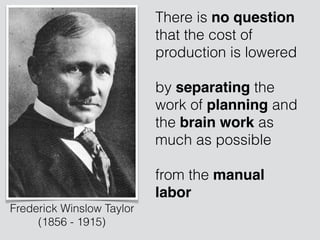
There is no question
that the cost of
production is lowered‹
‹
by separating the
work of planning and
the brain work as
much as possible ‹
‹
from the manual
labor
Frederick Winslow Taylor
(1856 - 1915)

“We have passed the Taylor stage. We
are aware that business has become
terribly complex. Survival is very
uncertain..‹
‹
..We know that the intelligence of a few
technocrats, even very bright ones, has
become totally inadequate to face these
challenges. Only the intellects of all
employees can permit a company to live
with the ups and downs and the
requirements of its new environment.
Yes, we will win and you will lose. For
you are not able to rid your minds of the
obsolete Taylorisms that we never had.”
Process prescription
is not a good idea
Taylorizm is not a good idea.
LeSS is not a good idea.
Except when

Shu - Ha - Ri
Apprentice = Follow the rules and practice
until you reach a good level
Journeyman = Start using the rules and use
a sensei to explore improvement options
Master = Create new rules and become a
sensei (teacher) for new apprentices
Larman's Laws of Organizational Behavior
1. Organizations are implicitly optimized to avoid changing
the status quo of middle- and ïŹrst-level manager and
“specialist” positions & power structures.
2. As a corollary to (1), any change initiative will be reduced
to redeïŹning or overloading the new terminology to mean
basically the same as status quo.
3. As a corollary to (1), any change initiative will be derided
as “purist”, “theoretical”, “revolutionary”, "religion", and
“needing pragmatic customization for local concerns” --
which deïŹ‚ects from addressing weaknesses and manager/
specialist status quo.
4. Culture follows structure.
and

There are no best practices.
Only good practices within a
speciïŹc context
The basic assumptions
(just like scrum
)
For large groups, LeSS hits the sweet
spot between deïŹned concrete
elements and empirical process
control.
Experiments
Guides
Rules
Principles
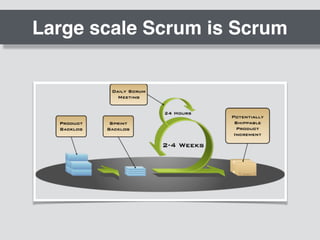
Large scale Scrum is Scrum
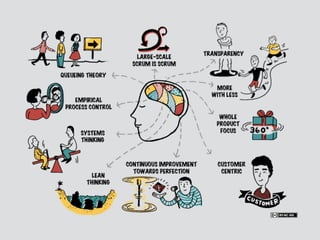
Transparency
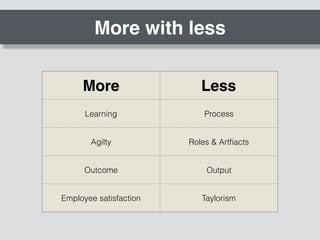
More with less
More Less
Learning Process
Agilty Roles & ArtïŹacts
Outcome Output
Employee satisfaction Taylorism
Whole product focus
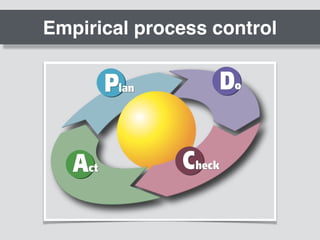
Empirical process control
Customer centric
Queuing theory
Lean thinking
Lean thinking
Waste Value
Opportunity for improvement Traditional improvement
Detect and eliminate waste
1. Overproduction of features
2. Waiting, delay
3. Handoff
4. Extra process
5. Partially done work
6. Task Switching
7. Defects
8. Under-realizing people’s potential
9. Knowledge scatter
10. Wishful thinking
System thinking
Continuous improvement
towards perfection
Product
‱ One product, one backlog
‱ Needs to have a shared codebase.
‱ As broad as possible to minimize constraints.
Product owner
‱ The person that owns the product.
‱ Accountable for results.
‱ DeïŹne the features based on business needs.
‱ Manages the product backlog.
‱ Focus on prioritization, Less on clariïŹcation.
‱ Not “Mr nice-guy”
The Team
‱ The minimal unit of resourcing
‱ Fixed (100% allocated people)
‱ Long-Lived
‱ Cross-functional feature teams
‱ Co-located.
‱ Self managing
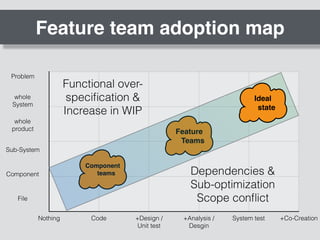
Nothing Code +Design /
Unit test
+Analysis /
Desgin
System test +Co-Creation
Feature team adoption map
Component
Sub-System
whole ‹
product
File
whole ‹
System
Problem
Feature
Teams
Component
teams Dependencies &
Sub-optimization‹
Scope conïŹ‚ict
Functional over-
speciïŹcation &
Increase in WIP
Ideal ‹
state
One sprint
‱ Fixed timebox for
development.
‱ Interruptions and change
of scope are forbidden.
‱ Starts with planning
meeting.
‱ Sustainable pace
‱ Ends with a sprint review.
Cross team coordination
‱ Teams are responsible to decide how and when.
‱ Some options:
‱ Just talk.
‱ Communicate via code.
‱ Continuous integration.
‱ CoP
‱ Travellers
‱ Component Mentors.
‱ SoS.
‹
‹
‹
DeïŹnition of Done
‱ Teams and PO agree on the deïŹnition of Done.
‱ Done reïŹ‚ects the current minimal common
denominator of technical skills in the teams.
‱ Teams can expand the DoD.
‱ Backlog Items that are not done are not reviewed.
‱ The DoD should expend over time.
Undone vs. UnïŹnished
Undone
Dealing with undone work
‱ Strategy 1: Undone department ‹
Awful idea!
‱ Strategy 2: Release sprint ‹
Bad idea!
‱ Strategy 2.5: Release sprint done by the team.‹
average idea!
‱ Strategy 3: Expand team skills - no undone.‹
Good idea!
Product Backlog reïŹnement
‱ Done every sprint with representatives of all teams
and the product owner.
‱ Split and clarify items into ïŹne grained items.
‱ Estimate items.
‱ Identify need for cross-team coordination.
‱ Some techniques include: User Story mapping,
Spec by example.
Avoid the contract game
Sprint review
‱ One sprint review meeting for all teams.
‱ Performed after every sprint.
‱ Inspect and adapt - not judgment.
‱ Avoid “slideware”
‱ Demonstrate only done items.
Sprint retrospective
‱ Not a post-morten! Nobody is dead

‱ Done per team after the sprint review.
‱ Focus on learning and improving.
‱ “The art of the possible”
‱ Generate experiments for the next sprint(s).
‱ Important to keep the meeting safe.
Overall sprint retrospective
‱ Product owner, Representatives of all teams,
Scrum masters.
‱ Usually performed at the beginning of the next
sprint.
‱ Focus on system level and cross team learning.
‱ Use system thinking tools such as causal loop
diagrams.
‱ Generate system experiments for next sprint(s)
Management in LeSS
Supervision
Not Effective
Delegated monitoring
Performance reviews
They ‹
stopped
Managers are teachers
Go See at Gemba
‱ Gemba = Place where
work is done.
‱ Focus on improvement
‱ Teach problem solving
over solving problems.
‱ DO NOT MICRO-
MANAGE!
Scrum master
‱ Dedicated role.
‱ May serve up 1-3 teams
‱ Process owner and team
coach  facilitator.
‱ Not a team leader.
‱ Not a manager.
‱ Not the team
representative.
Scrum master - Questions
‱ How is my product owner
doing?
‱ Is the product backlog in
good shape?
‱ Does he understand Scrum?
‱ How is my team doing?
‱ Are they Collaborating?
‱ Do they improve?
‱ How is my organization
doing?
‱ Is Inter-team coordination
working?
‱ Are there impediments to
handle?
‱ How are our engineering
practices?
‱ Are they improving ?
‱ How is the automation
doing?
‱ Is done being expanded?
LeSS‹
Adoption ‹
Guidelines
Principles
‱ deep and narrow over broad and shallow
‱ top-down and bottom-up
‱ use volunteering
Getting started
‱ educate everyone
‱ deïŹne ‘product’
‱ deïŹne ‘done’
‱ have appropriately-structured teams
‱ only the Product Owner gives work to the teams
‱ keep project managers away from the teams
Next steps
‱Use coaching to develop the
organization by experimenting
‱ Coaching - both internal and external
‱Repeat until you are perfect
‱ continuous improvement.
Less rules - structure
‱ Structure the organization using real teams as the basic
organizational building block.
‱ Each team is (1) self-managing, (2) cross-functional, (3) co-
located, and (4) long-lived.
‱ The majority of the teams are customer-focused feature
teams.
‱ ScrumMasters are responsible for a well-working LeSS
adoption. Their focus is towards the Teams, Product Owner,
organization, and development practices. A ScrumMaster
does not focus on just one team but on the overall
organizational system.
‱ A ScrumMaster is a dedicated full-time role.
‱ One ScrumMaster can serve 1-3 teams.
Less rules - structure
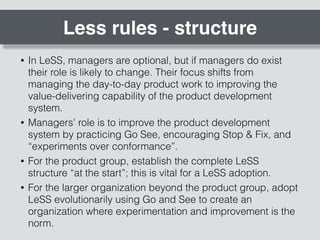
‱ In LeSS, managers are optional, but if managers do exist
their role is likely to change. Their focus shifts from
managing the day-to-day product work to improving the
value-delivering capability of the product development
system.
‱ Managers’ role is to improve the product development
system by practicing Go See, encouraging Stop & Fix, and
“experiments over conformance”.
‱ For the product group, establish the complete LeSS
structure “at the start”; this is vital for a LeSS adoption.
‱ For the larger organization beyond the product group, adopt
LeSS evolutionarily using Go and See to create an
organization where experimentation and improvement is the
norm.
Less rules - product
‱ There is one Product Owner and one Product Backlog for the complete
shippable product.
‱ The Product Owner shouldn’t work alone on Product Backlog
reïŹnement; he is supported by the multiple Teams working directly with
customers/users and other stakeholders.
‱ All prioritization goes through the Product Owner, but clariïŹcation is as
much as possible directly between the Teams and customer/users and
other stakeholders.
‱ The deïŹnition of product should be as broad and end-user/customer
centric as is practical. Over time, the deïŹnition of product might
increase. Broader deïŹnitions are preferred.
‱ One shared DeïŹnition of Done for the whole product.
‱ Each team can have their own expanded DeïŹnition of Done.
‱ The perfection goal is to improve the DeïŹnition of Done so that it results
in a shippable product each Sprint (or even more frequently).
Less rules - sprint
‱ There is one product-level Sprint, not a different Sprint for each Team.
Each Team starts and ends the Sprint at the same time. Each Sprint
results in an integrated whole product.
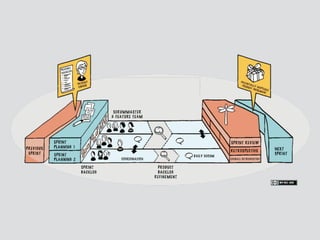
‱ Sprint Planning consists of two parts: Sprint Planning One is common
for all teams while Sprint Planning Two is usually done separately for
each team. Do multi-team Sprint Planning Two in a shared space for
closely related items.
‱ Sprint Planning One is attended by the Product Owner and Teams or
Team representatives. They together tentatively select the items that
each team will work on the that Sprint. The Teams identify opportunities
to work together and ïŹnal questions are clariïŹed.
‱ Each Team has their own Sprint Backlog.
‱ Sprint Planning Two is for Teams to decide how they will do the selected
items. This usually involves design and the creation of their Sprint
Backlogs.
‱ Each Team has their own Daily Scrum.
Less rules - sprint
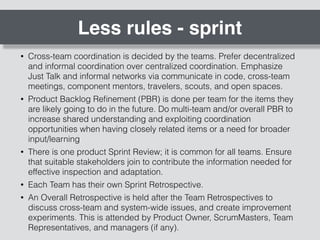
‱ Cross-team coordination is decided by the teams. Prefer decentralized
and informal coordination over centralized coordination. Emphasize
Just Talk and informal networks via communicate in code, cross-team
meetings, component mentors, travelers, scouts, and open spaces.
‱ Product Backlog ReïŹnement (PBR) is done per team for the items they
are likely going to do in the future. Do multi-team and/or overall PBR to
increase shared understanding and exploiting coordination
opportunities when having closely related items or a need for broader
input/learning
‱ There is one product Sprint Review; it is common for all teams. Ensure
that suitable stakeholders join to contribute the information needed for
effective inspection and adaptation.
‱ Each Team has their own Sprint Retrospective.
‱ An Overall Retrospective is held after the Team Retrospectives to
discuss cross-team and system-wide issues, and create improvement
experiments. This is attended by Product Owner, ScrumMasters, Team
Representatives, and managers (if any).
Less org-chart
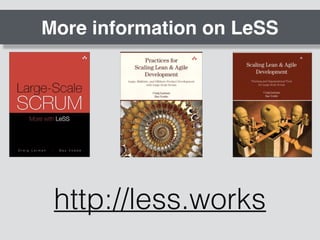
More information on LeSS
http://less.works

Less intro workshop

  • 2.
  • 4.
    "We will winand you will lose. You cannot do anything about it because your failure is an internal disease. Your companies are based on Taylor's principles. ‹ Worse, your heads are Taylorized, too. You ïŹrmly believe that sound management means executives on one side and workers on the other, on one side men who think and on the other side men who can only work. For you, management is the art of smoothly transferring the executives' ideas to the workers' hands.” Konosuke Matsushita‹ [1979 WD management‹ visit to Japan speech]
  • 5.
    There is noquestion that the cost of production is lowered‹ ‹ by separating the work of planning and the brain work as much as possible ‹ ‹ from the manual labor Frederick Winslow Taylor (1856 - 1915)
  • 6.
    “We have passedthe Taylor stage. We are aware that business has become terribly complex. Survival is very uncertain..‹ ‹ ..We know that the intelligence of a few technocrats, even very bright ones, has become totally inadequate to face these challenges. Only the intellects of all employees can permit a company to live with the ups and downs and the requirements of its new environment. Yes, we will win and you will lose. For you are not able to rid your minds of the obsolete Taylorisms that we never had.”
  • 7.
    Process prescription is nota good idea Taylorizm is not a good idea. LeSS is not a good idea.
  • 8.
  • 9.
    Shu - Ha- Ri Apprentice = Follow the rules and practice until you reach a good level Journeyman = Start using the rules and use a sensei to explore improvement options Master = Create new rules and become a sensei (teacher) for new apprentices
  • 14.
    Larman's Laws ofOrganizational Behavior 1. Organizations are implicitly optimized to avoid changing the status quo of middle- and ïŹrst-level manager and “specialist” positions & power structures. 2. As a corollary to (1), any change initiative will be reduced to redeïŹning or overloading the new terminology to mean basically the same as status quo. 3. As a corollary to (1), any change initiative will be derided as “purist”, “theoretical”, “revolutionary”, "religion", and “needing pragmatic customization for local concerns” -- which deïŹ‚ects from addressing weaknesses and manager/ specialist status quo. 4. Culture follows structure.
  • 15.
    and
 There are nobest practices. Only good practices within a speciïŹc context The basic assumptions (just like scrum
) For large groups, LeSS hits the sweet spot between deïŹned concrete elements and empirical process control.
  • 16.
  • 18.
  • 19.
  • 20.
    More with less MoreLess Learning Process Agilty Roles & ArtïŹacts Outcome Output Employee satisfaction Taylorism
  • 21.
  • 22.
  • 23.
  • 24.
  • 25.
  • 26.
    Lean thinking Waste Value Opportunityfor improvement Traditional improvement
  • 27.
    Detect and eliminatewaste 1. Overproduction of features 2. Waiting, delay 3. Handoff 4. Extra process 5. Partially done work 6. Task Switching 7. Defects 8. Under-realizing people’s potential 9. Knowledge scatter 10. Wishful thinking
  • 28.
  • 29.
  • 31.
    Product ‱ One product,one backlog ‱ Needs to have a shared codebase. ‱ As broad as possible to minimize constraints.
  • 32.
    Product owner ‱ Theperson that owns the product. ‱ Accountable for results. ‱ DeïŹne the features based on business needs. ‱ Manages the product backlog. ‱ Focus on prioritization, Less on clariïŹcation. ‱ Not “Mr nice-guy”
  • 33.
    The Team ‱ Theminimal unit of resourcing ‱ Fixed (100% allocated people) ‱ Long-Lived ‱ Cross-functional feature teams ‱ Co-located. ‱ Self managing
  • 34.
    Nothing Code +Design/ Unit test +Analysis / Desgin System test +Co-Creation Feature team adoption map Component Sub-System whole ‹ product File whole ‹ System Problem Feature Teams Component teams Dependencies & Sub-optimization‹ Scope conïŹ‚ict Functional over- speciïŹcation & Increase in WIP Ideal ‹ state
  • 35.
    One sprint ‱ Fixedtimebox for development. ‱ Interruptions and change of scope are forbidden. ‱ Starts with planning meeting. ‱ Sustainable pace ‱ Ends with a sprint review.
  • 36.
    Cross team coordination ‱Teams are responsible to decide how and when. ‱ Some options: ‱ Just talk. ‱ Communicate via code. ‱ Continuous integration. ‱ CoP ‱ Travellers ‱ Component Mentors. ‱ SoS.
  • 37.
  • 38.
    DeïŹnition of Done ‱Teams and PO agree on the deïŹnition of Done. ‱ Done reïŹ‚ects the current minimal common denominator of technical skills in the teams. ‱ Teams can expand the DoD. ‱ Backlog Items that are not done are not reviewed. ‱ The DoD should expend over time.
  • 39.
  • 40.
  • 41.
    Dealing with undonework ‱ Strategy 1: Undone department ‹ Awful idea! ‱ Strategy 2: Release sprint ‹ Bad idea! ‱ Strategy 2.5: Release sprint done by the team.‹ average idea! ‱ Strategy 3: Expand team skills - no undone.‹ Good idea!
  • 42.
    Product Backlog reïŹnement ‱Done every sprint with representatives of all teams and the product owner. ‱ Split and clarify items into ïŹne grained items. ‱ Estimate items. ‱ Identify need for cross-team coordination. ‱ Some techniques include: User Story mapping, Spec by example.
  • 43.
  • 44.
    Sprint review ‱ Onesprint review meeting for all teams. ‱ Performed after every sprint. ‱ Inspect and adapt - not judgment. ‱ Avoid “slideware” ‱ Demonstrate only done items.
  • 45.
    Sprint retrospective ‱ Nota post-morten! Nobody is dead
 ‱ Done per team after the sprint review. ‱ Focus on learning and improving. ‱ “The art of the possible” ‱ Generate experiments for the next sprint(s). ‱ Important to keep the meeting safe.
  • 46.
    Overall sprint retrospective ‱Product owner, Representatives of all teams, Scrum masters. ‱ Usually performed at the beginning of the next sprint. ‱ Focus on system level and cross team learning. ‱ Use system thinking tools such as causal loop diagrams. ‱ Generate system experiments for next sprint(s)
  • 47.
  • 48.
  • 49.
  • 50.
  • 51.
  • 52.
    Go See atGemba ‱ Gemba = Place where work is done. ‱ Focus on improvement ‱ Teach problem solving over solving problems. ‱ DO NOT MICRO- MANAGE!
  • 53.
    Scrum master ‱ Dedicatedrole. ‱ May serve up 1-3 teams ‱ Process owner and team coach facilitator. ‱ Not a team leader. ‱ Not a manager. ‱ Not the team representative.
  • 54.
    Scrum master -Questions ‱ How is my product owner doing? ‱ Is the product backlog in good shape? ‱ Does he understand Scrum? ‱ How is my team doing? ‱ Are they Collaborating? ‱ Do they improve? ‱ How is my organization doing? ‱ Is Inter-team coordination working? ‱ Are there impediments to handle? ‱ How are our engineering practices? ‱ Are they improving ? ‱ How is the automation doing? ‱ Is done being expanded?
  • 55.
  • 56.
    Principles ‱ deep andnarrow over broad and shallow ‱ top-down and bottom-up ‱ use volunteering
  • 57.
    Getting started ‱ educateeveryone ‱ deïŹne ‘product’ ‱ deïŹne ‘done’ ‱ have appropriately-structured teams ‱ only the Product Owner gives work to the teams ‱ keep project managers away from the teams
  • 58.
    Next steps ‱Use coachingto develop the organization by experimenting ‱ Coaching - both internal and external ‱Repeat until you are perfect ‱ continuous improvement.
  • 60.
    Less rules -structure ‱ Structure the organization using real teams as the basic organizational building block. ‱ Each team is (1) self-managing, (2) cross-functional, (3) co- located, and (4) long-lived. ‱ The majority of the teams are customer-focused feature teams. ‱ ScrumMasters are responsible for a well-working LeSS adoption. Their focus is towards the Teams, Product Owner, organization, and development practices. A ScrumMaster does not focus on just one team but on the overall organizational system. ‱ A ScrumMaster is a dedicated full-time role. ‱ One ScrumMaster can serve 1-3 teams.
  • 61.
    Less rules -structure ‱ In LeSS, managers are optional, but if managers do exist their role is likely to change. Their focus shifts from managing the day-to-day product work to improving the value-delivering capability of the product development system. ‱ Managers’ role is to improve the product development system by practicing Go See, encouraging Stop & Fix, and “experiments over conformance”. ‱ For the product group, establish the complete LeSS structure “at the start”; this is vital for a LeSS adoption. ‱ For the larger organization beyond the product group, adopt LeSS evolutionarily using Go and See to create an organization where experimentation and improvement is the norm.
  • 62.
    Less rules -product ‱ There is one Product Owner and one Product Backlog for the complete shippable product. ‱ The Product Owner shouldn’t work alone on Product Backlog reïŹnement; he is supported by the multiple Teams working directly with customers/users and other stakeholders. ‱ All prioritization goes through the Product Owner, but clariïŹcation is as much as possible directly between the Teams and customer/users and other stakeholders. ‱ The deïŹnition of product should be as broad and end-user/customer centric as is practical. Over time, the deïŹnition of product might increase. Broader deïŹnitions are preferred. ‱ One shared DeïŹnition of Done for the whole product. ‱ Each team can have their own expanded DeïŹnition of Done. ‱ The perfection goal is to improve the DeïŹnition of Done so that it results in a shippable product each Sprint (or even more frequently).
  • 63.
    Less rules -sprint ‱ There is one product-level Sprint, not a different Sprint for each Team. Each Team starts and ends the Sprint at the same time. Each Sprint results in an integrated whole product. ‱ Sprint Planning consists of two parts: Sprint Planning One is common for all teams while Sprint Planning Two is usually done separately for each team. Do multi-team Sprint Planning Two in a shared space for closely related items. ‱ Sprint Planning One is attended by the Product Owner and Teams or Team representatives. They together tentatively select the items that each team will work on the that Sprint. The Teams identify opportunities to work together and ïŹnal questions are clariïŹed. ‱ Each Team has their own Sprint Backlog. ‱ Sprint Planning Two is for Teams to decide how they will do the selected items. This usually involves design and the creation of their Sprint Backlogs. ‱ Each Team has their own Daily Scrum.
  • 64.
    Less rules -sprint ‱ Cross-team coordination is decided by the teams. Prefer decentralized and informal coordination over centralized coordination. Emphasize Just Talk and informal networks via communicate in code, cross-team meetings, component mentors, travelers, scouts, and open spaces. ‱ Product Backlog ReïŹnement (PBR) is done per team for the items they are likely going to do in the future. Do multi-team and/or overall PBR to increase shared understanding and exploiting coordination opportunities when having closely related items or a need for broader input/learning ‱ There is one product Sprint Review; it is common for all teams. Ensure that suitable stakeholders join to contribute the information needed for effective inspection and adaptation. ‱ Each Team has their own Sprint Retrospective. ‱ An Overall Retrospective is held after the Team Retrospectives to discuss cross-team and system-wide issues, and create improvement experiments. This is attended by Product Owner, ScrumMasters, Team Representatives, and managers (if any).
  • 65.
  • 66.
    More information onLeSS http://less.works