Electrical and Mechanical Downtilt
and their Effects on
Horizontal Pattern Performance
EXECUTIVE SUMMARY
Inter-sector interference has been a problem for wireless operators ever since RF engineers
deployed the first sector array antennas. Radiation patterns that bleed outside the antenna's
defined sector affect not only the quality of service in adjacent sectors within the same cell, but
can disrupt service in adjacent cells as well.
In an attempt to confine the signal to its specific sector, operators have employed a variety of
techniques, including physically downtilting the antenna. Known as mechanical downtilt, this
technique has been effective to some degree, but has also caused additional problems.
Physically downtilting the antenna occurs along a single horizontal plane. As the front of the
antenna is tilted down, the back is, by default, tilted up. This limitation creates a variety of
radiation pattern irregularities, such as pattern blooming, that are a major source of inter-sector
interference. Even still, mechanical downtilt has become an accepted practice. To help
compensate for the inherent limitations of mechanical downtilt, the industry has developed
certain general guidelines.
MECHANICAL DOWNTILT AND ITS AFFECTS
ON PATTERN PERFORMANCE
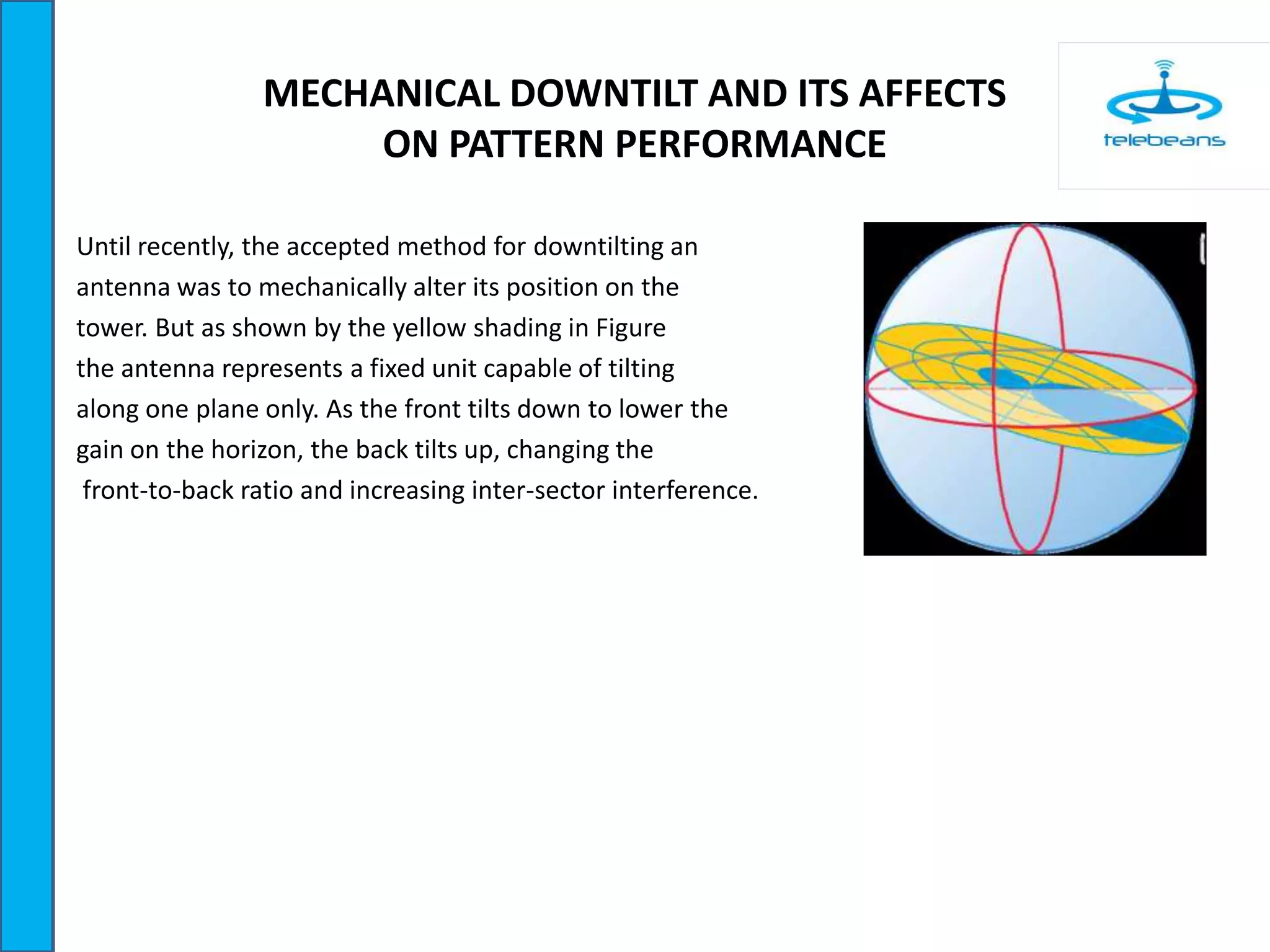
Until recently, the accepted method for downtilting an
antenna was to mechanically alter its position on the
tower. But as shown by the yellow shading in Figure
the antenna represents a fixed unit capable of tilting
along one plane only. As the front tilts down to lower the
gain on the horizon, the back tilts up, changing the
front-to-back ratio and increasing inter-sector interference.
Pattern blooming as a result of mechanical downtilt
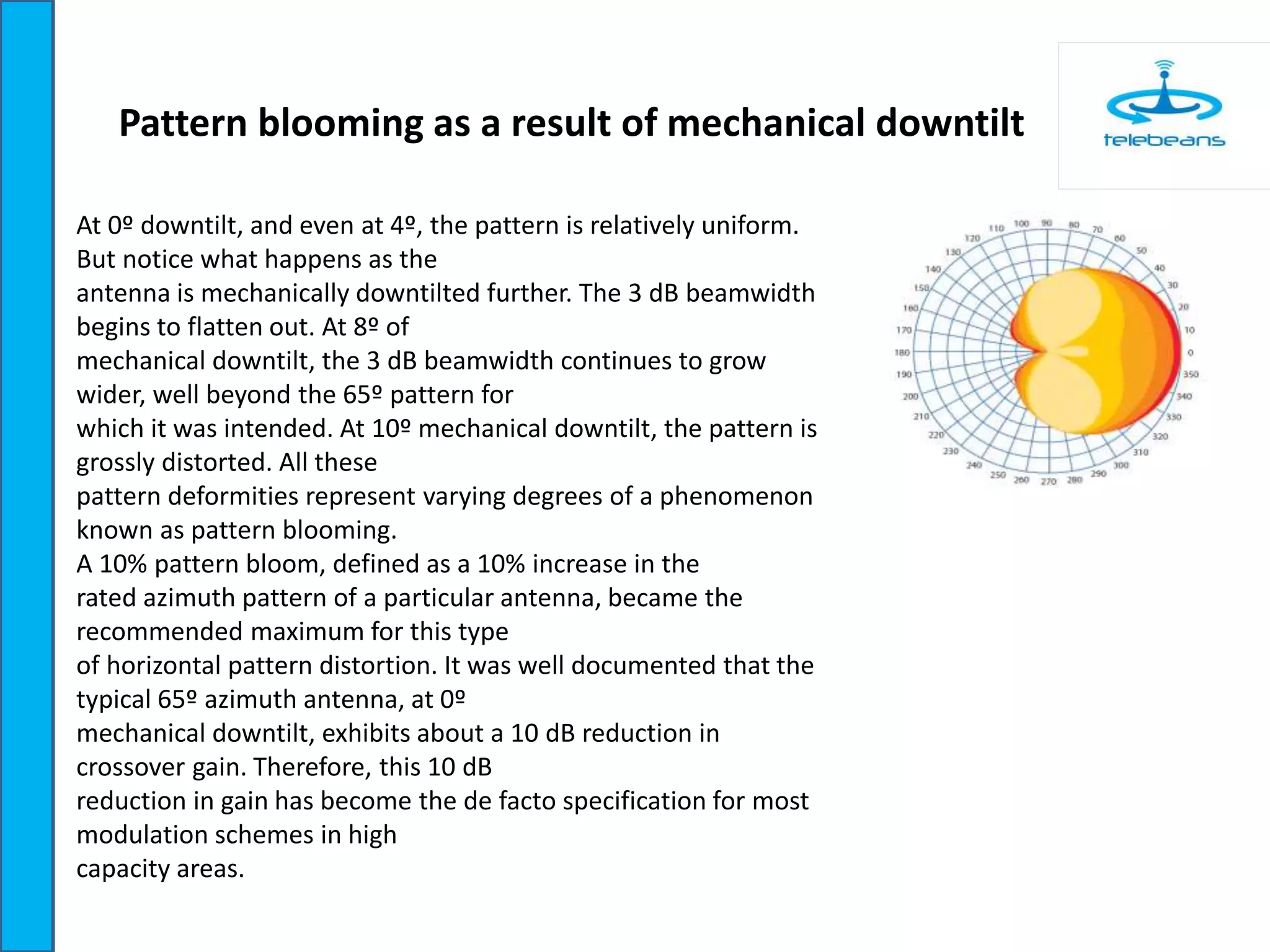
At 0º downtilt, and even at 4º, the pattern is relatively uniform.
But notice what happens as the
antenna is mechanically downtilted further. The 3 dB beamwidth
begins to flatten out. At 8º of
mechanical downtilt, the 3 dB beamwidth continues to grow
wider, well beyond the 65º pattern for
which it was intended. At 10º mechanical downtilt, the pattern is
grossly distorted. All these
pattern deformities represent varying degrees of a phenomenon
known as pattern blooming.
A 10% pattern bloom, defined as a 10% increase in the
rated azimuth pattern of a particular antenna, became the
recommended maximum for this type
of horizontal pattern distortion. It was well documented that the
typical 65º azimuth antenna, at 0º
mechanical downtilt, exhibits about a 10 dB reduction in
crossover gain. Therefore, this 10 dB
reduction in gain has become the de facto specification for most
modulation schemes in high
capacity areas.
ELECTRICAL DOWNTILT PROVIDES GREATER
PATTERN CONTROL
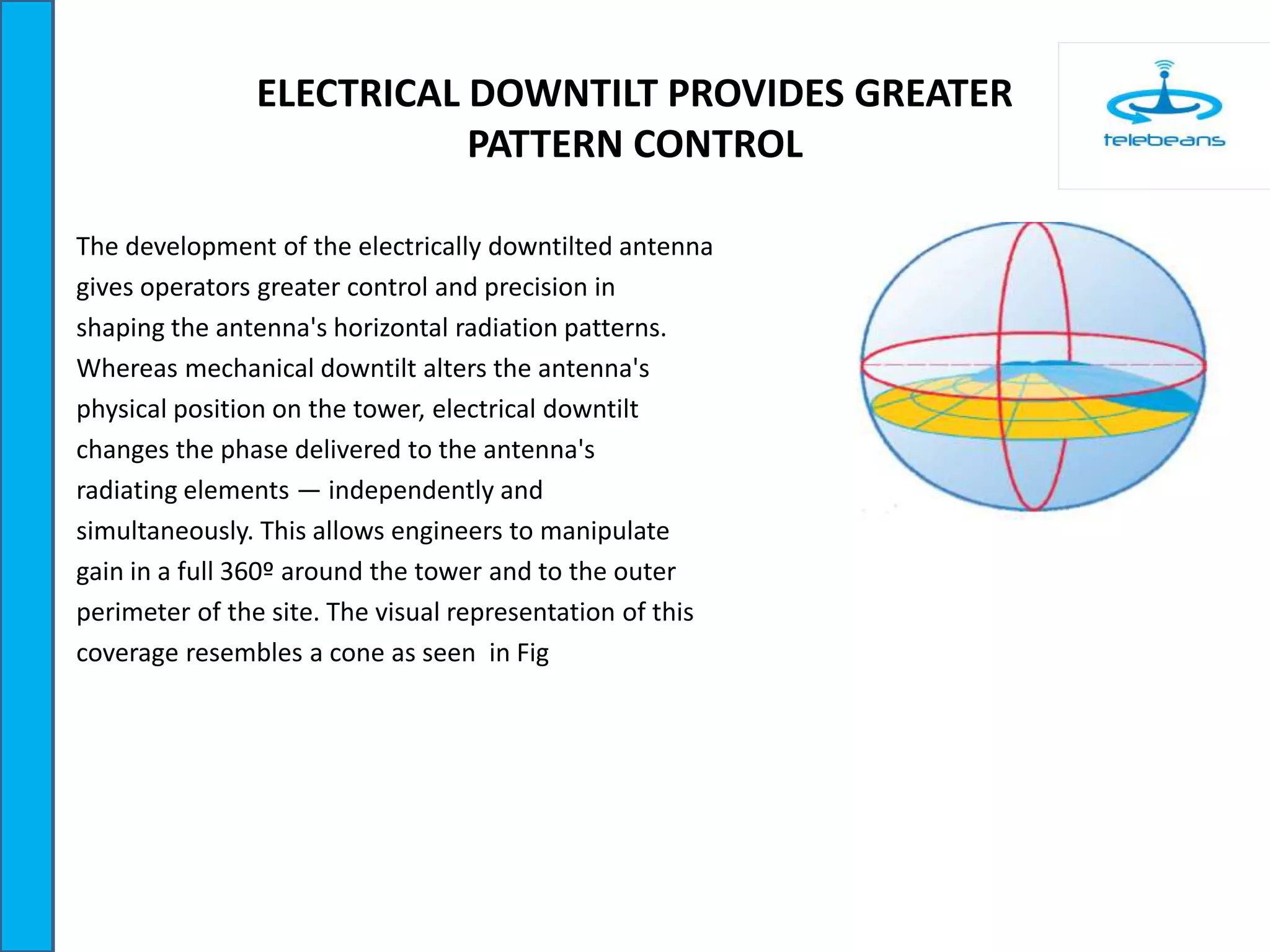
The development of the electrically downtilted antenna
gives operators greater control and precision in
shaping the antenna's horizontal radiation patterns.
Whereas mechanical downtilt alters the antenna's
physical position on the tower, electrical downtilt
changes the phase delivered to the antenna's
radiating elements — independently and
simultaneously. This allows engineers to manipulate
gain in a full 360º around the tower and to the outer
perimeter of the site. The visual representation of this
coverage resembles a cone as seen in Fig
Comparision of Mechanical and Electrical Downtilt
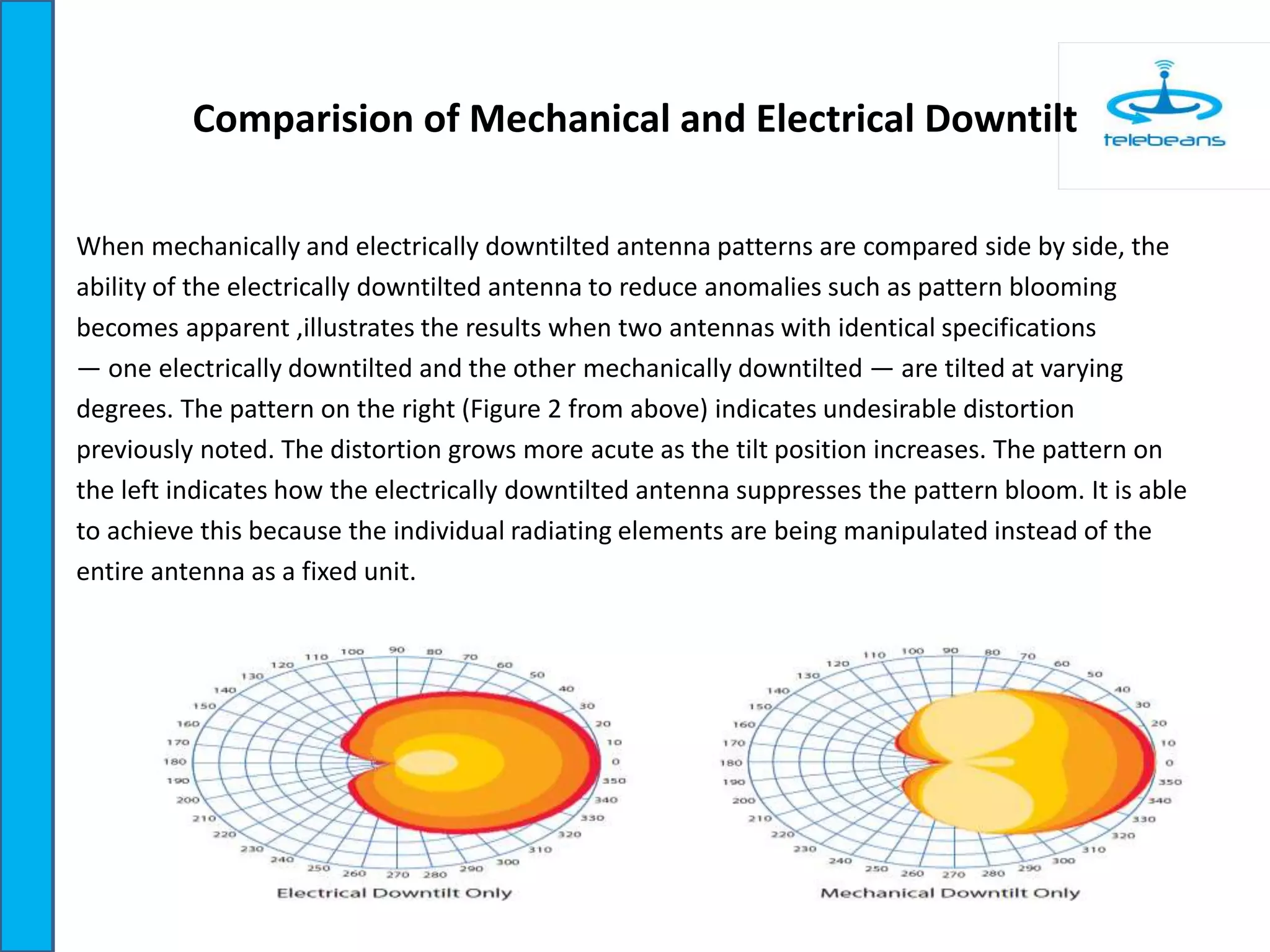
When mechanically and electrically downtilted antenna patterns are compared side by side, the
ability of the electrically downtilted antenna to reduce anomalies such as pattern blooming
becomes apparent ,illustrates the results when two antennas with identical specifications
— one electrically downtilted and the other mechanically downtilted — are tilted at varying
degrees. The pattern on the right (Figure 2 from above) indicates undesirable distortion
previously noted. The distortion grows more acute as the tilt position increases. The pattern on
the left indicates how the electrically downtilted antenna suppresses the pattern bloom. It is able
to achieve this because the individual radiating elements are being manipulated instead of the
entire antenna as a fixed unit.
Effect of electrical and mechanical tilt

Effect of electrical and mechanical tilt

  • 1.
    Electrical and MechanicalDowntilt and their Effects on Horizontal Pattern Performance
  • 2.
    EXECUTIVE SUMMARY Inter-sector interferencehas been a problem for wireless operators ever since RF engineers deployed the first sector array antennas. Radiation patterns that bleed outside the antenna's defined sector affect not only the quality of service in adjacent sectors within the same cell, but can disrupt service in adjacent cells as well. In an attempt to confine the signal to its specific sector, operators have employed a variety of techniques, including physically downtilting the antenna. Known as mechanical downtilt, this technique has been effective to some degree, but has also caused additional problems. Physically downtilting the antenna occurs along a single horizontal plane. As the front of the antenna is tilted down, the back is, by default, tilted up. This limitation creates a variety of radiation pattern irregularities, such as pattern blooming, that are a major source of inter-sector interference. Even still, mechanical downtilt has become an accepted practice. To help compensate for the inherent limitations of mechanical downtilt, the industry has developed certain general guidelines.
  • 3.
    MECHANICAL DOWNTILT ANDITS AFFECTS ON PATTERN PERFORMANCE Until recently, the accepted method for downtilting an antenna was to mechanically alter its position on the tower. But as shown by the yellow shading in Figure the antenna represents a fixed unit capable of tilting along one plane only. As the front tilts down to lower the gain on the horizon, the back tilts up, changing the front-to-back ratio and increasing inter-sector interference.
  • 4.
    Pattern blooming asa result of mechanical downtilt At 0º downtilt, and even at 4º, the pattern is relatively uniform. But notice what happens as the antenna is mechanically downtilted further. The 3 dB beamwidth begins to flatten out. At 8º of mechanical downtilt, the 3 dB beamwidth continues to grow wider, well beyond the 65º pattern for which it was intended. At 10º mechanical downtilt, the pattern is grossly distorted. All these pattern deformities represent varying degrees of a phenomenon known as pattern blooming. A 10% pattern bloom, defined as a 10% increase in the rated azimuth pattern of a particular antenna, became the recommended maximum for this type of horizontal pattern distortion. It was well documented that the typical 65º azimuth antenna, at 0º mechanical downtilt, exhibits about a 10 dB reduction in crossover gain. Therefore, this 10 dB reduction in gain has become the de facto specification for most modulation schemes in high capacity areas.
  • 5.
    ELECTRICAL DOWNTILT PROVIDESGREATER PATTERN CONTROL The development of the electrically downtilted antenna gives operators greater control and precision in shaping the antenna's horizontal radiation patterns. Whereas mechanical downtilt alters the antenna's physical position on the tower, electrical downtilt changes the phase delivered to the antenna's radiating elements — independently and simultaneously. This allows engineers to manipulate gain in a full 360º around the tower and to the outer perimeter of the site. The visual representation of this coverage resembles a cone as seen in Fig
  • 6.
    Comparision of Mechanicaland Electrical Downtilt When mechanically and electrically downtilted antenna patterns are compared side by side, the ability of the electrically downtilted antenna to reduce anomalies such as pattern blooming becomes apparent ,illustrates the results when two antennas with identical specifications — one electrically downtilted and the other mechanically downtilted — are tilted at varying degrees. The pattern on the right (Figure 2 from above) indicates undesirable distortion previously noted. The distortion grows more acute as the tilt position increases. The pattern on the left indicates how the electrically downtilted antenna suppresses the pattern bloom. It is able to achieve this because the individual radiating elements are being manipulated instead of the entire antenna as a fixed unit.