



TEMS PARAMETERS (Speech)
Module ObjectivesModule Objectives
• On completion of the module one should be clear about the parameters
required during drive test what does it mean and how much it is
important.
• Parameters regarding in windows like :
• a) Current Channel
b) Radio parameters
c) Serving + Neighbors
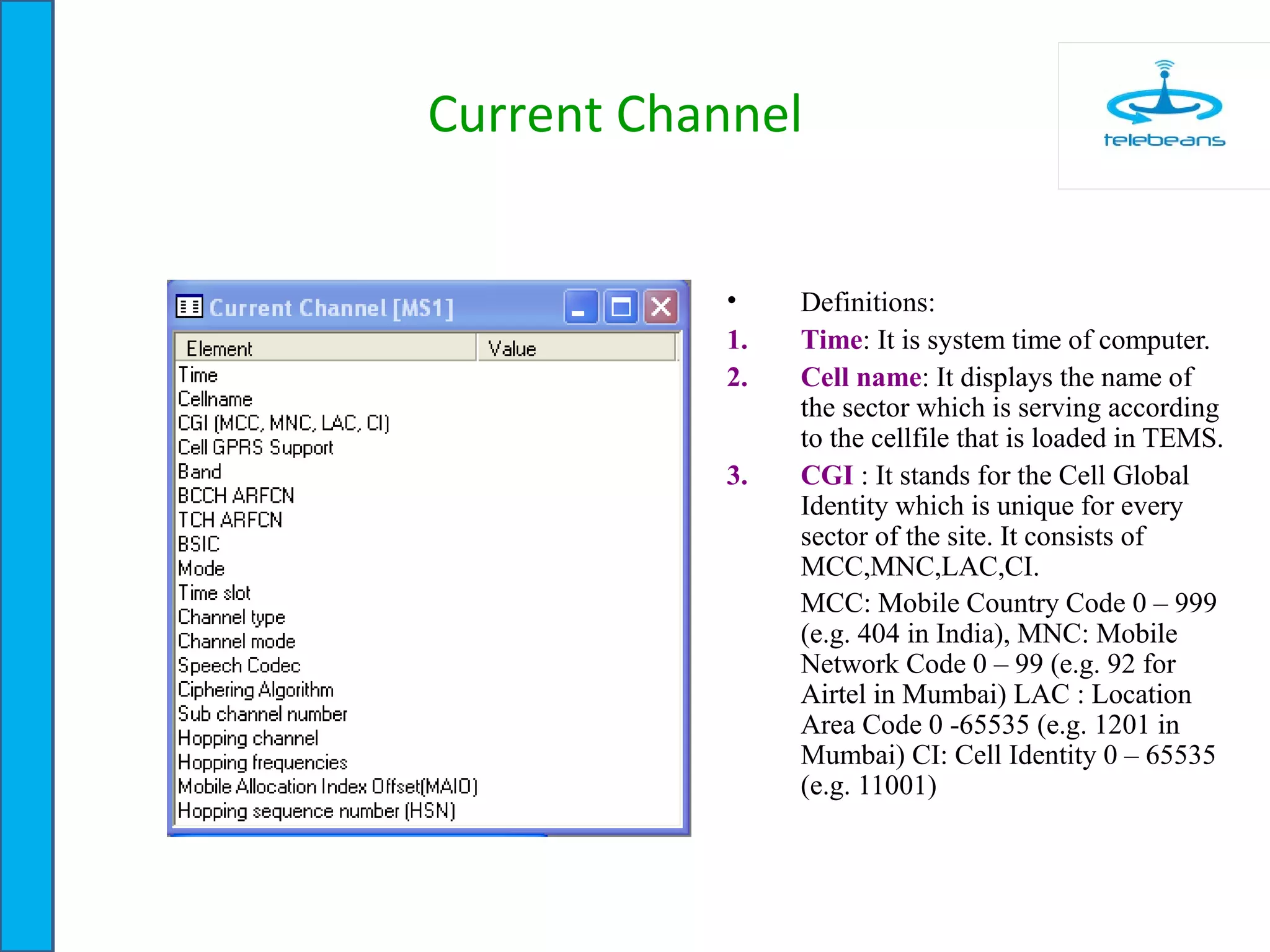
Current Channel
• Definitions:
1. Time: It is system time of computer.
2. Cell name: It displays the name of
the sector which is serving according
to the cellfile that is loaded in TEMS.
3. CGI : It stands for the Cell Global
Identity which is unique for every
sector of the site. It consists of
MCC,MNC,LAC,CI.
MCC: Mobile Country Code 0 – 999
(e.g. 404 in India), MNC: Mobile
Network Code 0 – 99 (e.g. 92 for
Airtel in Mumbai) LAC : Location
Area Code 0 -65535 (e.g. 1201 in
Mumbai) CI: Cell Identity 0 – 65535
(e.g. 11001)
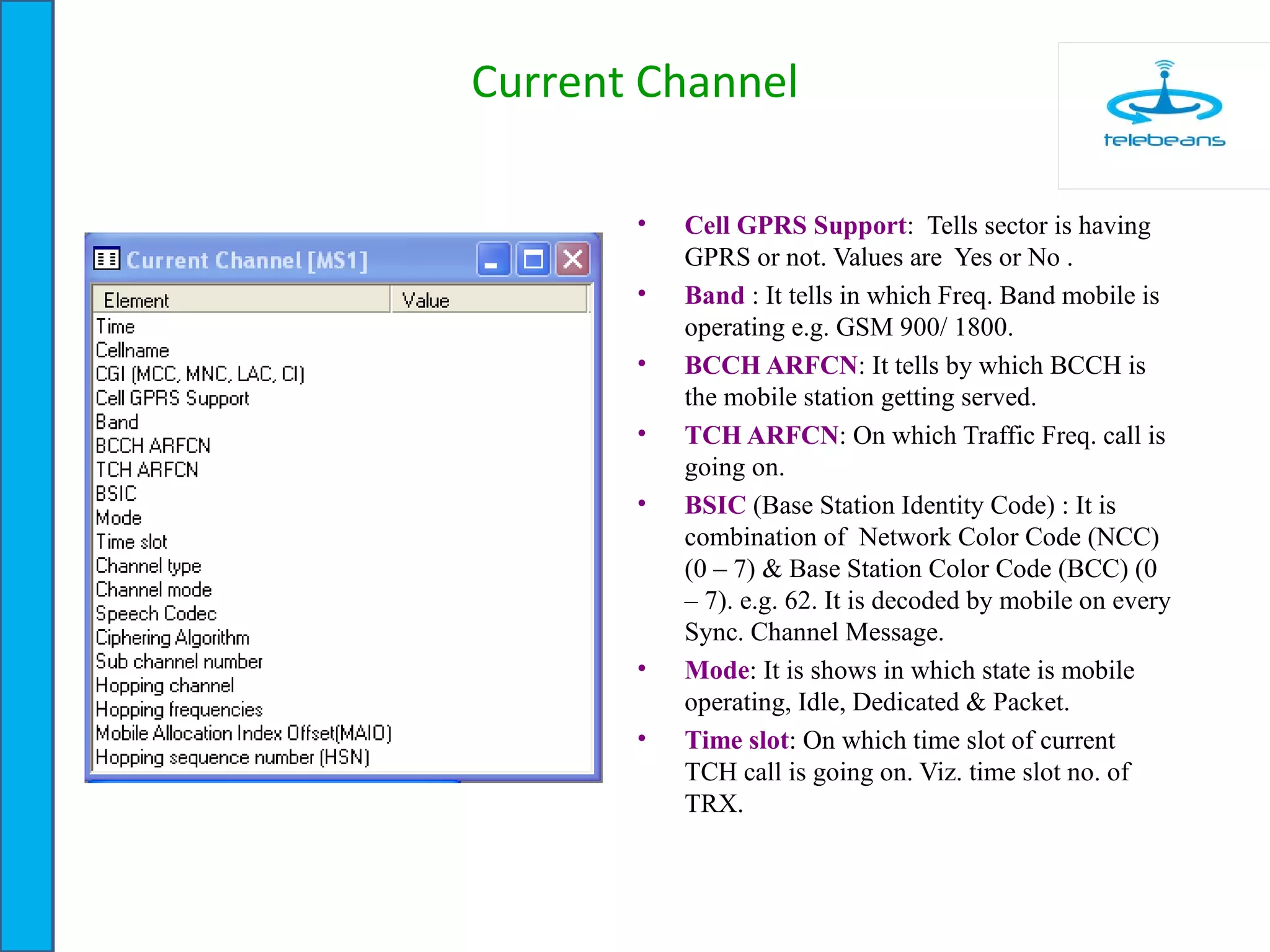
Current Channel
• Cell GPRS Support: Tells sector is having
GPRS or not. Values are Yes or No .
• Band : It tells in which Freq. Band mobile is
operating e.g. GSM 900/ 1800.
• BCCH ARFCN: It tells by which BCCH is
the mobile station getting served.
• TCH ARFCN: On which Traffic Freq. call is
going on.
• BSIC (Base Station Identity Code) : It is
combination of Network Color Code (NCC)
(0 – 7) & Base Station Color Code (BCC) (0
– 7). e.g. 62. It is decoded by mobile on every
Sync. Channel Message.
• Mode: It is shows in which state is mobile
operating, Idle, Dedicated & Packet.
• Time slot: On which time slot of current
TCH call is going on. Viz. time slot no. of
TRX.
Current Channel
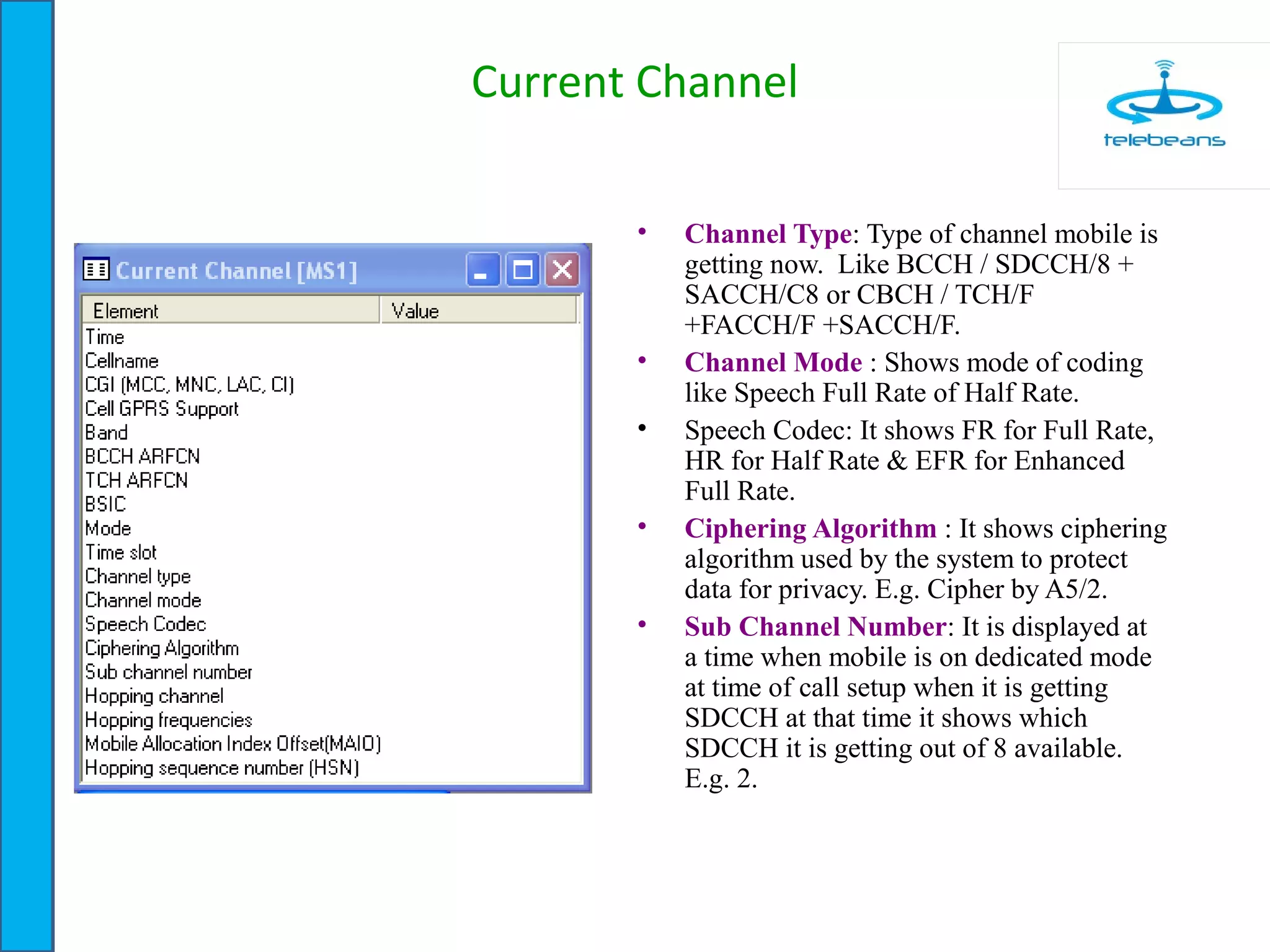
• Channel Type: Type of channel mobile is
getting now. Like BCCH / SDCCH/8 +
SACCH/C8 or CBCH / TCH/F
+FACCH/F +SACCH/F.
• Channel Mode : Shows mode of coding
like Speech Full Rate of Half Rate.
• Speech Codec: It shows FR for Full Rate,
HR for Half Rate & EFR for Enhanced
Full Rate.
• Ciphering Algorithm : It shows ciphering
algorithm used by the system to protect
data for privacy. E.g. Cipher by A5/2.
• Sub Channel Number: It is displayed at
a time when mobile is on dedicated mode
at time of call setup when it is getting
SDCCH at that time it shows which
SDCCH it is getting out of 8 available.
E.g. 2.
Current Channel
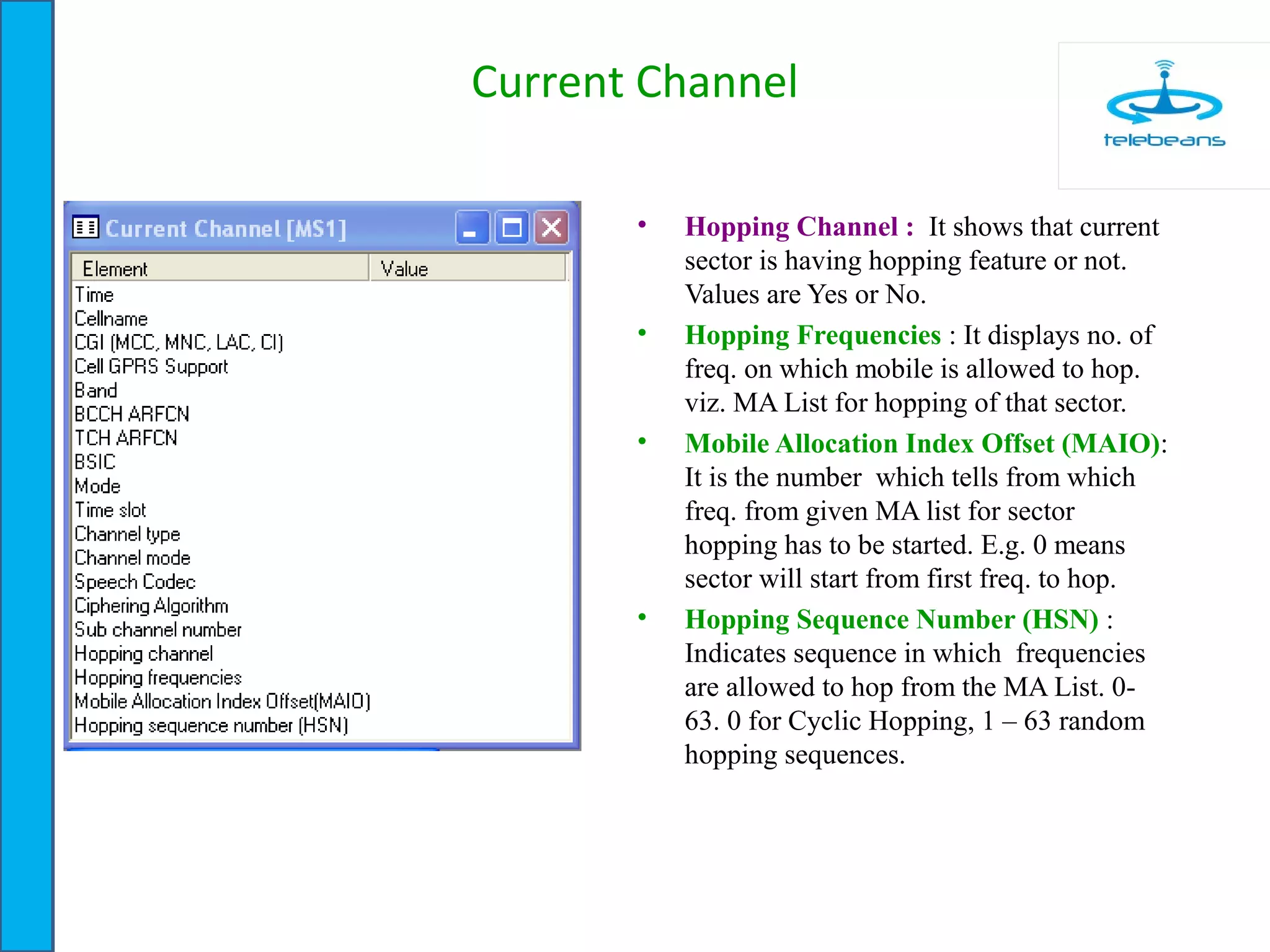
• Hopping Channel : It shows that current
sector is having hopping feature or not.
Values are Yes or No.
• Hopping Frequencies : It displays no. of
freq. on which mobile is allowed to hop.
viz. MA List for hopping of that sector.
• Mobile Allocation Index Offset (MAIO):
It is the number which tells from which
freq. from given MA list for sector
hopping has to be started. E.g. 0 means
sector will start from first freq. to hop.
• Hopping Sequence Number (HSN) :
Indicates sequence in which frequencies
are allowed to hop from the MA List. 0-
63. 0 for Cyclic Hopping, 1 – 63 random
hopping sequences.
Intentionally Blank
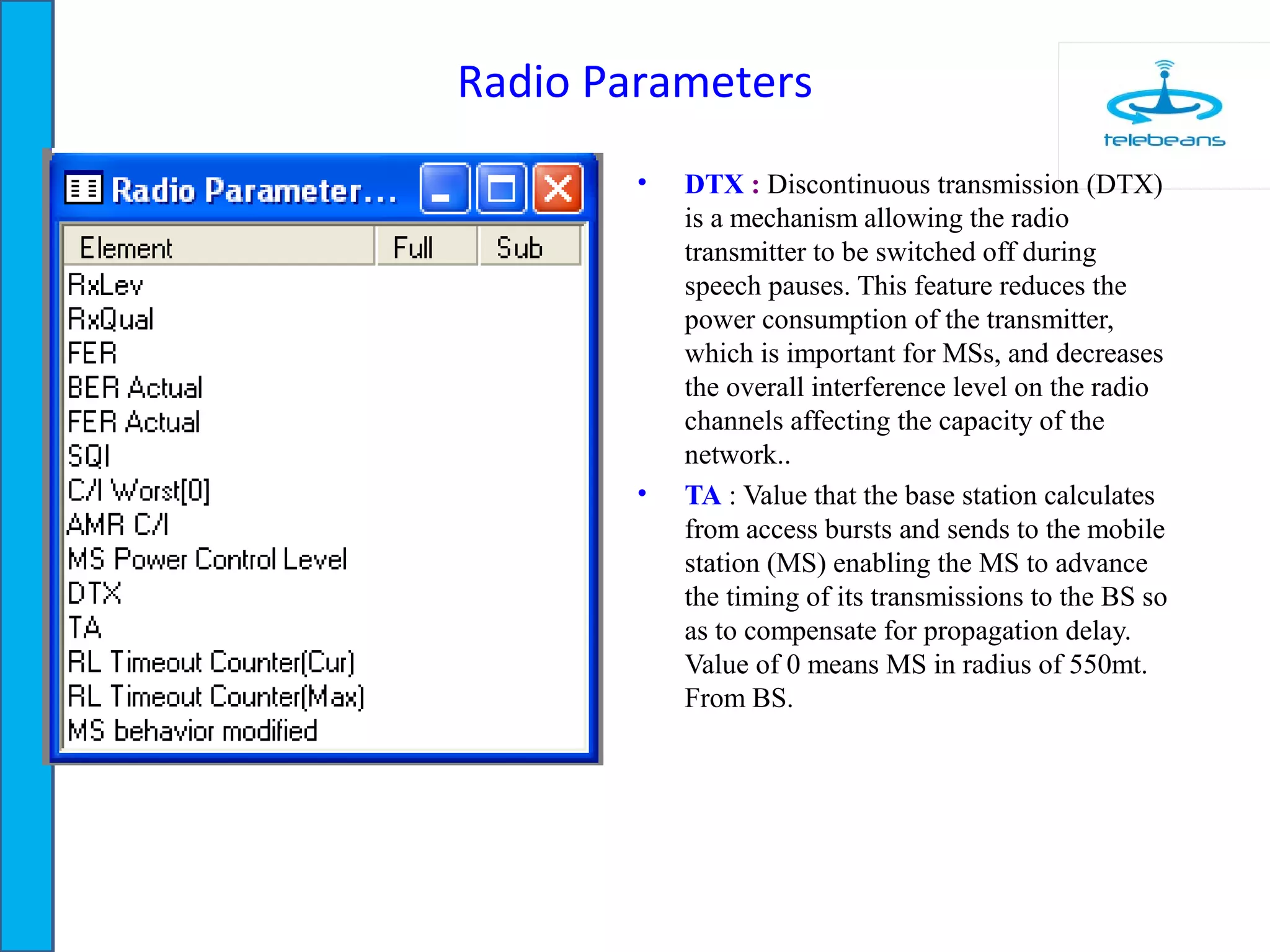
Radio Parameters
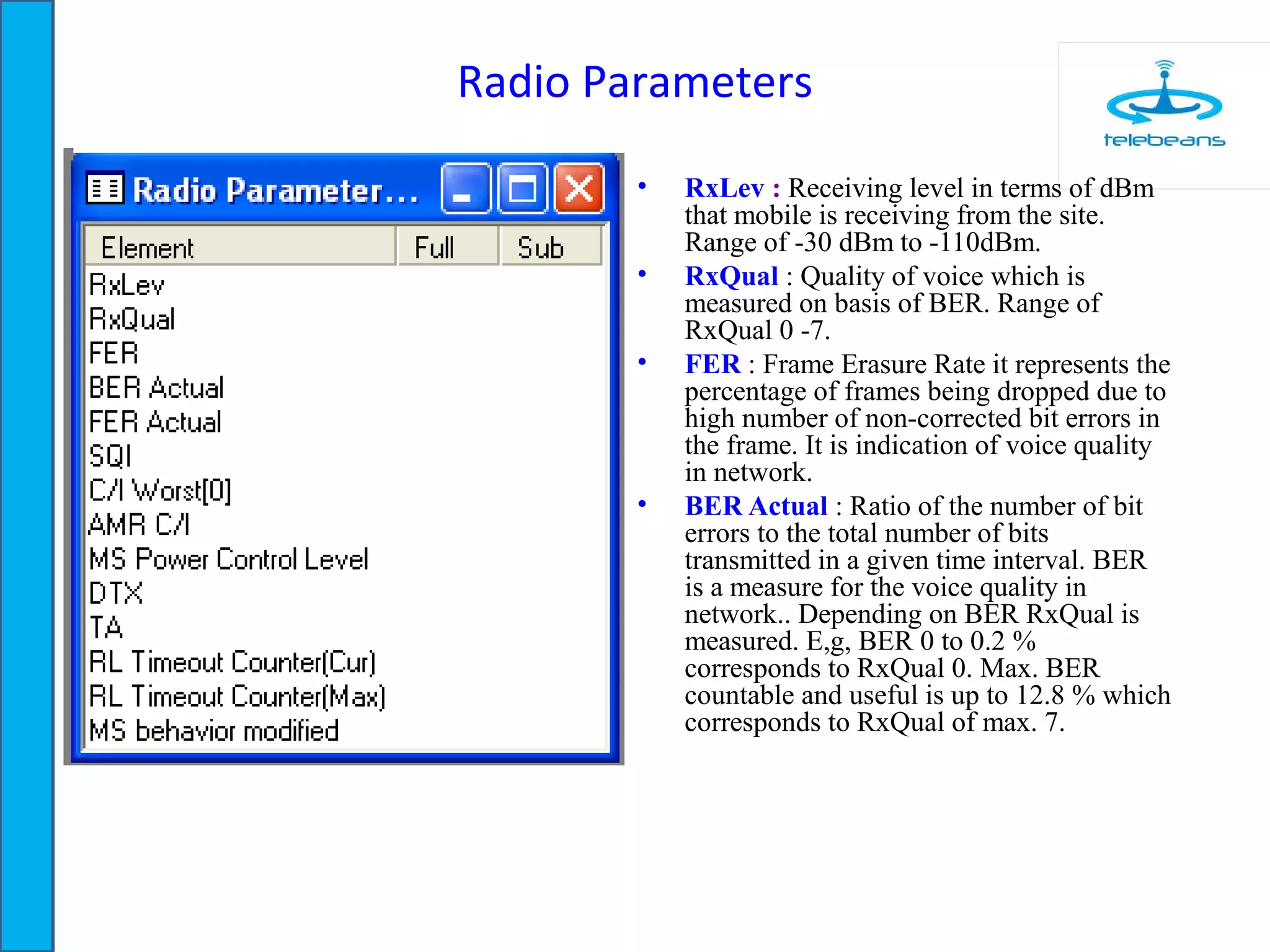
• RxLev : Receiving level in terms of dBm
that mobile is receiving from the site.
Range of -30 dBm to -110dBm.
• RxQual : Quality of voice which is
measured on basis of BER. Range of
RxQual 0 -7.
• FER : Frame Erasure Rate it represents the
percentage of frames being dropped due to
high number of non-corrected bit errors in
the frame. It is indication of voice quality
in network.
• BER Actual : Ratio of the number of bit
errors to the total number of bits
transmitted in a given time interval. BER
is a measure for the voice quality in
network.. Depending on BER RxQual is
measured. E,g, BER 0 to 0.2 %
corresponds to RxQual 0. Max. BER
countable and useful is up to 12.8 % which
corresponds to RxQual of max. 7.
Radio Parameters
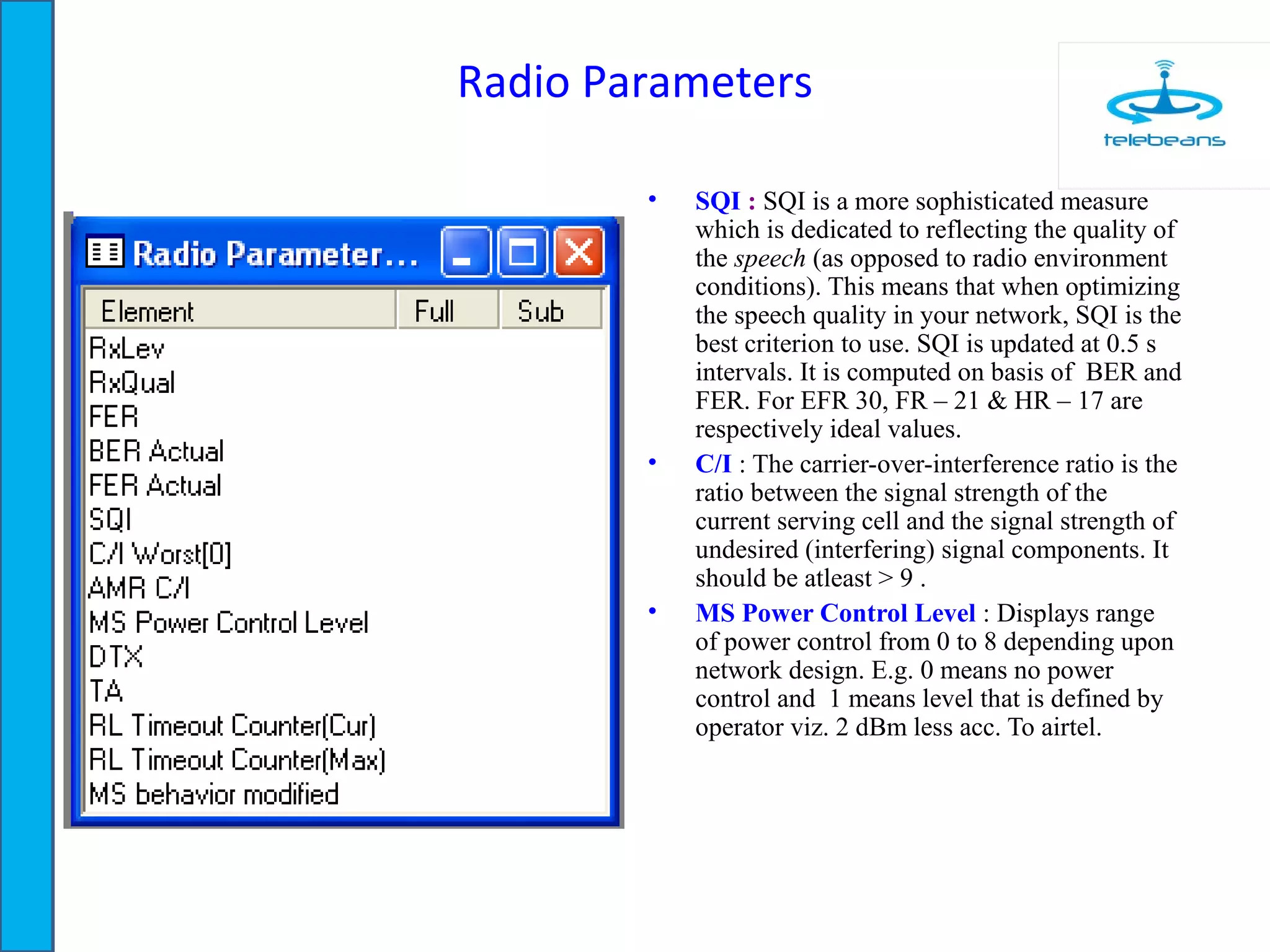
• SQI : SQI is a more sophisticated measure
which is dedicated to reflecting the quality of
the speech (as opposed to radio environment
conditions). This means that when optimizing
the speech quality in your network, SQI is the
best criterion to use. SQI is updated at 0.5 s
intervals. It is computed on basis of BER and
FER. For EFR 30, FR – 21 & HR – 17 are
respectively ideal values.
• C/I : The carrier-over-interference ratio is the
ratio between the signal strength of the
current serving cell and the signal strength of
undesired (interfering) signal components. It
should be atleast > 9 .
• MS Power Control Level : Displays range
of power control from 0 to 8 depending upon
network design. E.g. 0 means no power
control and 1 means level that is defined by
operator viz. 2 dBm less acc. To airtel.
Radio Parameters
• DTX : Discontinuous transmission (DTX)
is a mechanism allowing the radio
transmitter to be switched off during
speech pauses. This feature reduces the
power consumption of the transmitter,
which is important for MSs, and decreases
the overall interference level on the radio
channels affecting the capacity of the
network..
• TA : Value that the base station calculates
from access bursts and sends to the mobile
station (MS) enabling the MS to advance
the timing of its transmissions to the BS so
as to compensate for propagation delay.
Value of 0 means MS in radius of 550mt.
From BS.
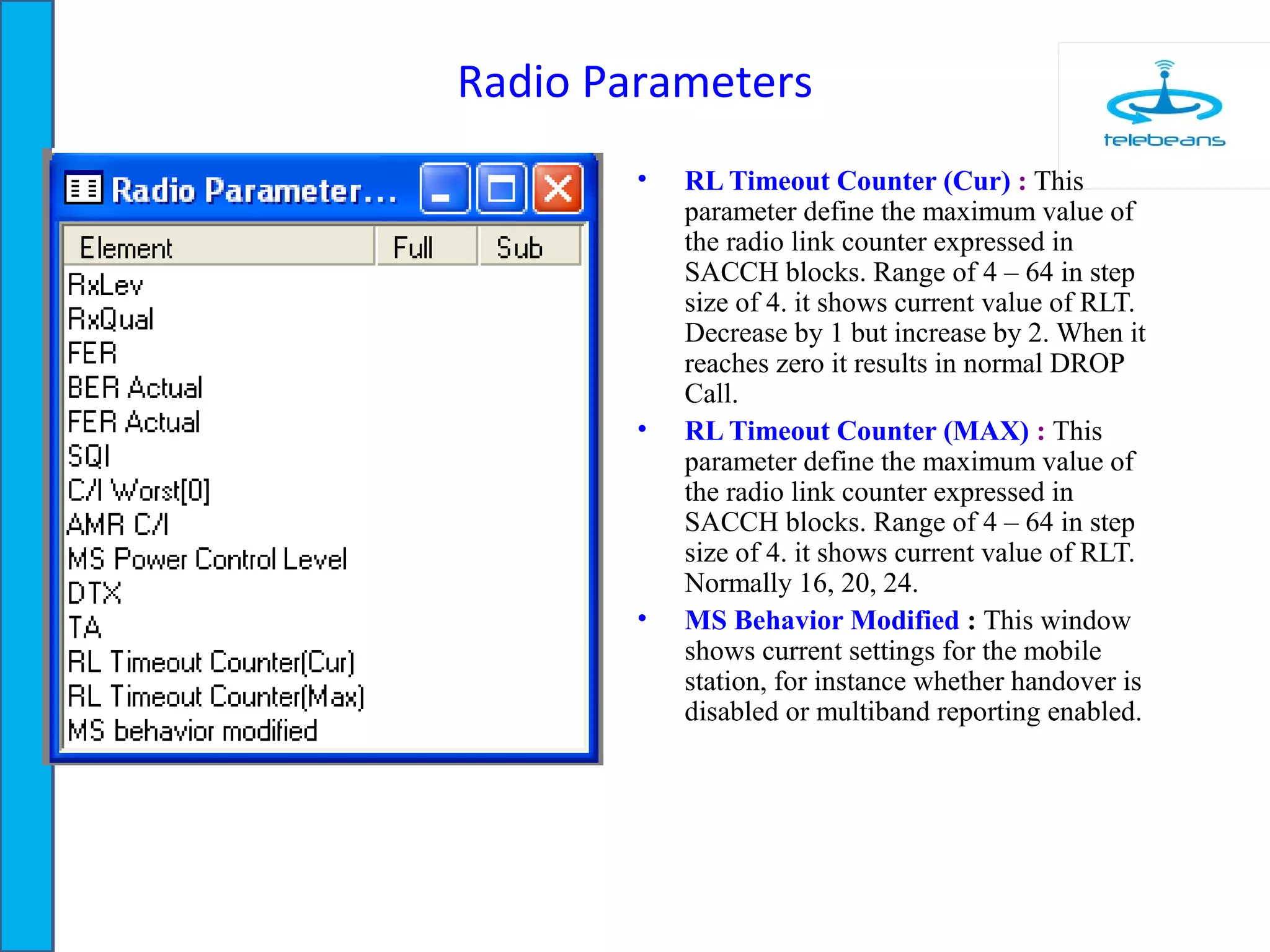
Radio Parameters
• RL Timeout Counter (Cur) : This
parameter define the maximum value of
the radio link counter expressed in
SACCH blocks. Range of 4 – 64 in step
size of 4. it shows current value of RLT.
Decrease by 1 but increase by 2. When it
reaches zero it results in normal DROP
Call.
• RL Timeout Counter (MAX) : This
parameter define the maximum value of
the radio link counter expressed in
SACCH blocks. Range of 4 – 64 in step
size of 4. it shows current value of RLT.
Normally 16, 20, 24.
• MS Behavior Modified : This window
shows current settings for the mobile
station, for instance whether handover is
disabled or multiband reporting enabled.
Intentionally Blank
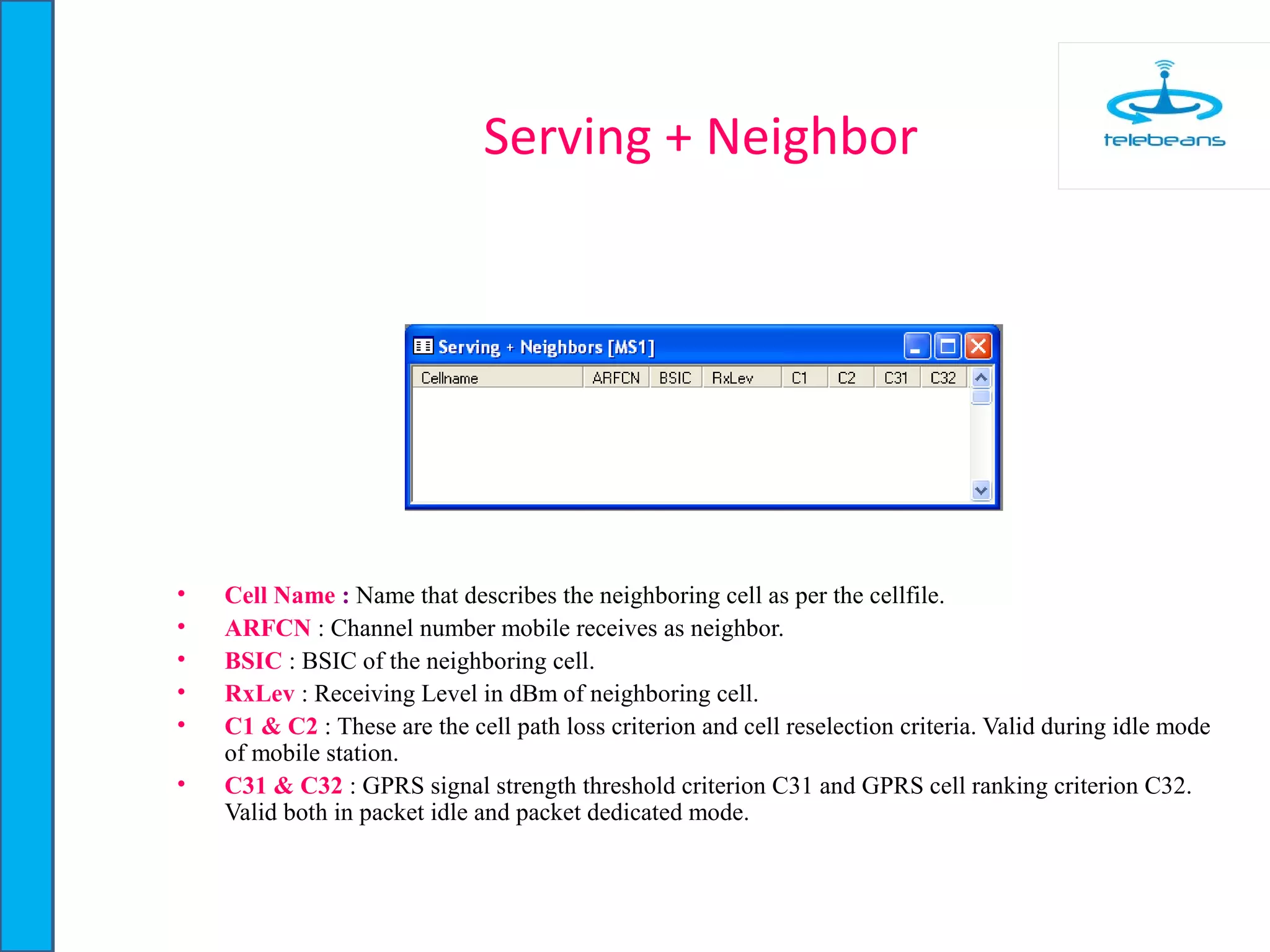
Serving + Neighbor
• Cell Name : Name that describes the neighboring cell as per the cellfile.
• ARFCN : Channel number mobile receives as neighbor.
• BSIC : BSIC of the neighboring cell.
• RxLev : Receiving Level in dBm of neighboring cell.
• C1 & C2 : These are the cell path loss criterion and cell reselection criteria. Valid during idle mode
of mobile station.
• C31 & C32 : GPRS signal strength threshold criterion C31 and GPRS cell ranking criterion C32.
Valid both in packet idle and packet dedicated mode.
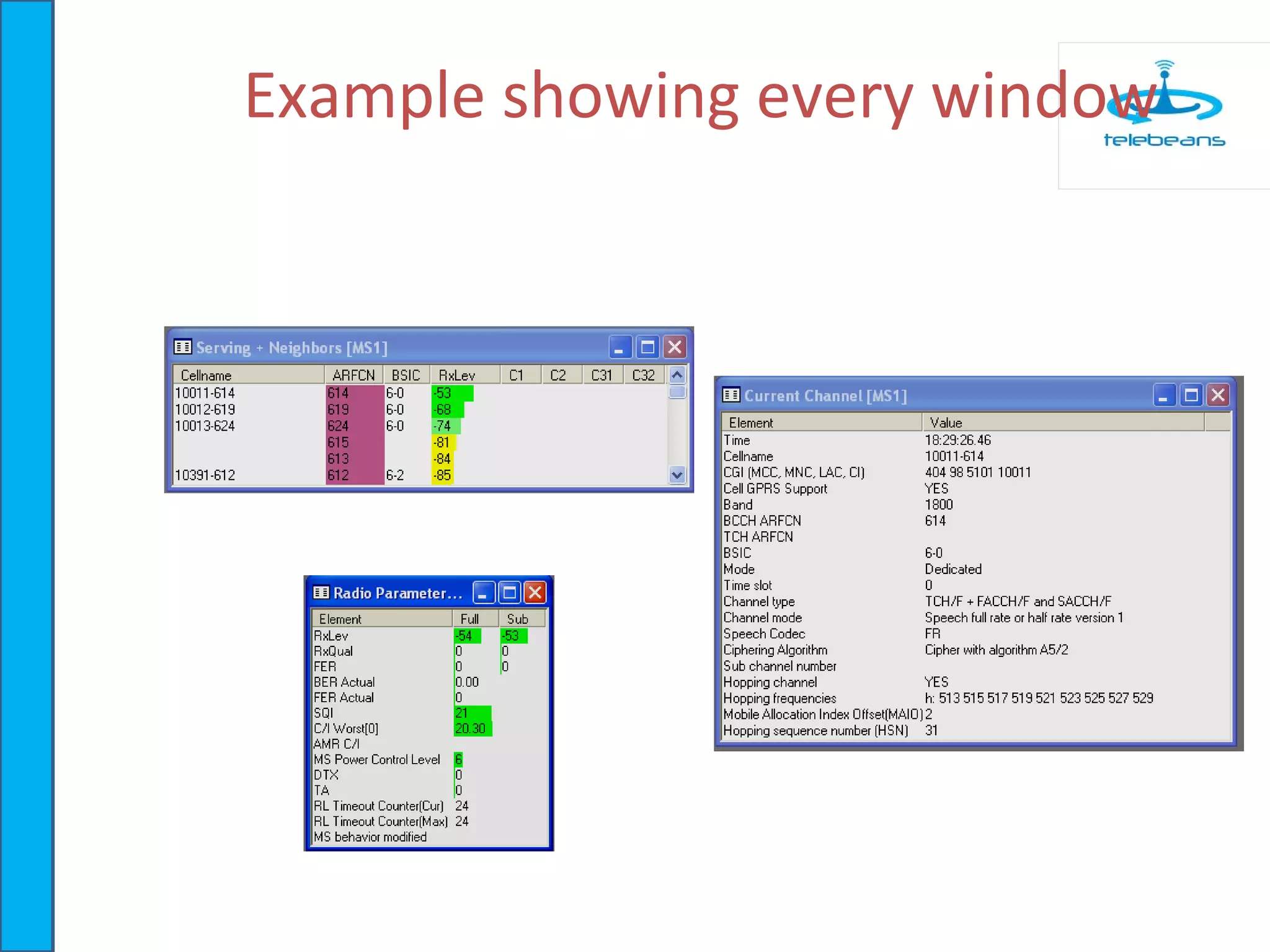
Example
Example showing every window
Tems parameters telebeans

Tems parameters telebeans

  • 1.
  • 2.
    Module ObjectivesModule Objectives •On completion of the module one should be clear about the parameters required during drive test what does it mean and how much it is important. • Parameters regarding in windows like : • a) Current Channel b) Radio parameters c) Serving + Neighbors
  • 3.
    Current Channel • Definitions: 1.Time: It is system time of computer. 2. Cell name: It displays the name of the sector which is serving according to the cellfile that is loaded in TEMS. 3. CGI : It stands for the Cell Global Identity which is unique for every sector of the site. It consists of MCC,MNC,LAC,CI. MCC: Mobile Country Code 0 – 999 (e.g. 404 in India), MNC: Mobile Network Code 0 – 99 (e.g. 92 for Airtel in Mumbai) LAC : Location Area Code 0 -65535 (e.g. 1201 in Mumbai) CI: Cell Identity 0 – 65535 (e.g. 11001)
  • 4.
    Current Channel • CellGPRS Support: Tells sector is having GPRS or not. Values are Yes or No . • Band : It tells in which Freq. Band mobile is operating e.g. GSM 900/ 1800. • BCCH ARFCN: It tells by which BCCH is the mobile station getting served. • TCH ARFCN: On which Traffic Freq. call is going on. • BSIC (Base Station Identity Code) : It is combination of Network Color Code (NCC) (0 – 7) & Base Station Color Code (BCC) (0 – 7). e.g. 62. It is decoded by mobile on every Sync. Channel Message. • Mode: It is shows in which state is mobile operating, Idle, Dedicated & Packet. • Time slot: On which time slot of current TCH call is going on. Viz. time slot no. of TRX.
  • 5.
    Current Channel • ChannelType: Type of channel mobile is getting now. Like BCCH / SDCCH/8 + SACCH/C8 or CBCH / TCH/F +FACCH/F +SACCH/F. • Channel Mode : Shows mode of coding like Speech Full Rate of Half Rate. • Speech Codec: It shows FR for Full Rate, HR for Half Rate & EFR for Enhanced Full Rate. • Ciphering Algorithm : It shows ciphering algorithm used by the system to protect data for privacy. E.g. Cipher by A5/2. • Sub Channel Number: It is displayed at a time when mobile is on dedicated mode at time of call setup when it is getting SDCCH at that time it shows which SDCCH it is getting out of 8 available. E.g. 2.
  • 6.
    Current Channel • HoppingChannel : It shows that current sector is having hopping feature or not. Values are Yes or No. • Hopping Frequencies : It displays no. of freq. on which mobile is allowed to hop. viz. MA List for hopping of that sector. • Mobile Allocation Index Offset (MAIO): It is the number which tells from which freq. from given MA list for sector hopping has to be started. E.g. 0 means sector will start from first freq. to hop. • Hopping Sequence Number (HSN) : Indicates sequence in which frequencies are allowed to hop from the MA List. 0- 63. 0 for Cyclic Hopping, 1 – 63 random hopping sequences.
  • 7.
  • 8.
    Radio Parameters • RxLev: Receiving level in terms of dBm that mobile is receiving from the site. Range of -30 dBm to -110dBm. • RxQual : Quality of voice which is measured on basis of BER. Range of RxQual 0 -7. • FER : Frame Erasure Rate it represents the percentage of frames being dropped due to high number of non-corrected bit errors in the frame. It is indication of voice quality in network. • BER Actual : Ratio of the number of bit errors to the total number of bits transmitted in a given time interval. BER is a measure for the voice quality in network.. Depending on BER RxQual is measured. E,g, BER 0 to 0.2 % corresponds to RxQual 0. Max. BER countable and useful is up to 12.8 % which corresponds to RxQual of max. 7.
  • 9.
    Radio Parameters • SQI: SQI is a more sophisticated measure which is dedicated to reflecting the quality of the speech (as opposed to radio environment conditions). This means that when optimizing the speech quality in your network, SQI is the best criterion to use. SQI is updated at 0.5 s intervals. It is computed on basis of BER and FER. For EFR 30, FR – 21 & HR – 17 are respectively ideal values. • C/I : The carrier-over-interference ratio is the ratio between the signal strength of the current serving cell and the signal strength of undesired (interfering) signal components. It should be atleast > 9 . • MS Power Control Level : Displays range of power control from 0 to 8 depending upon network design. E.g. 0 means no power control and 1 means level that is defined by operator viz. 2 dBm less acc. To airtel.
  • 10.
    Radio Parameters • DTX: Discontinuous transmission (DTX) is a mechanism allowing the radio transmitter to be switched off during speech pauses. This feature reduces the power consumption of the transmitter, which is important for MSs, and decreases the overall interference level on the radio channels affecting the capacity of the network.. • TA : Value that the base station calculates from access bursts and sends to the mobile station (MS) enabling the MS to advance the timing of its transmissions to the BS so as to compensate for propagation delay. Value of 0 means MS in radius of 550mt. From BS.
  • 11.
    Radio Parameters • RLTimeout Counter (Cur) : This parameter define the maximum value of the radio link counter expressed in SACCH blocks. Range of 4 – 64 in step size of 4. it shows current value of RLT. Decrease by 1 but increase by 2. When it reaches zero it results in normal DROP Call. • RL Timeout Counter (MAX) : This parameter define the maximum value of the radio link counter expressed in SACCH blocks. Range of 4 – 64 in step size of 4. it shows current value of RLT. Normally 16, 20, 24. • MS Behavior Modified : This window shows current settings for the mobile station, for instance whether handover is disabled or multiband reporting enabled.
  • 12.
  • 13.
    Serving + Neighbor •Cell Name : Name that describes the neighboring cell as per the cellfile. • ARFCN : Channel number mobile receives as neighbor. • BSIC : BSIC of the neighboring cell. • RxLev : Receiving Level in dBm of neighboring cell. • C1 & C2 : These are the cell path loss criterion and cell reselection criteria. Valid during idle mode of mobile station. • C31 & C32 : GPRS signal strength threshold criterion C31 and GPRS cell ranking criterion C32. Valid both in packet idle and packet dedicated mode.
  • 14.
  • 15.