MEG and EEG analysis with the
FieldTrip toolbox
Robert Oostenveld
Donders Institute, Radboud University, Nijmegen, NL
NatMEG, Karolinska Institute, Stockholm, SE
What is FieldTrip
a MATLAB toolbox for the analysis of MEG, EEG
and animal electrophysiology data
can import data from many different file formats
contains algorithms for spectral analysis, source
reconstruction, statistics, connectivity, …
Talk outline
What kind of signals are generated in the brain
How do we record those signals
Analyzing those signals with FieldTrip
Talk outline
What kind of signals are generated in the brain
How do we record those signals
Analyzing those signals with FieldTrip
What kind of signals are generated in the brain
We measure the scalp potentials or field
associated with post-synaptic potentials in
pyramidal neurons
These PSPs represent the exitatory and inhibitory
input that these neurons receive
Usually we study this neuronal input following the
presentation of a stimulus or following a
cognitive event
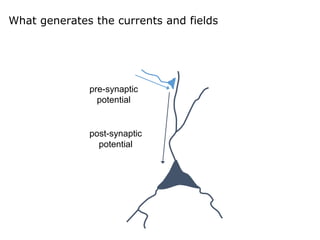
pre-synaptic
potential
post-synaptic
potential
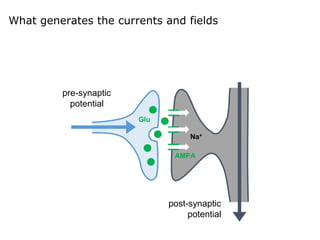
What generates the currents and fields
pre-synaptic
potential
Na+
post-synaptic
potential
Glu
AMPA
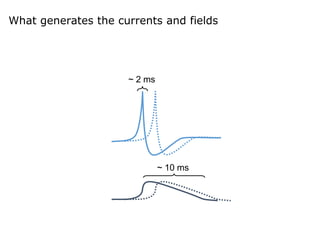
What generates the currents and fields
~ 2 ms
~ 10 ms
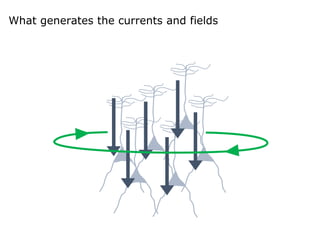
What generates the currents and fields
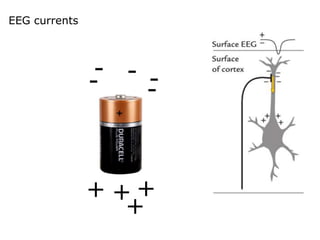
EEG currents
-
- -
-
-
+
+
+ +
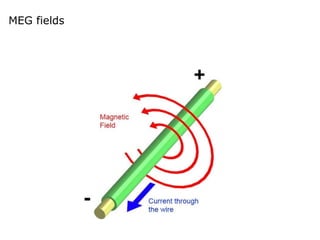
MEG fields
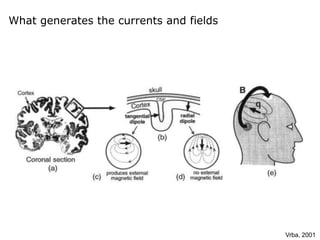
What generates the currents and fields
Vrba, 2001
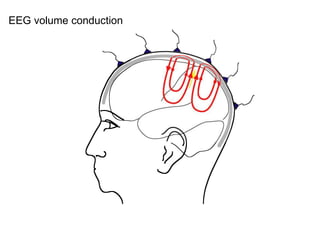
EEG volume conduction
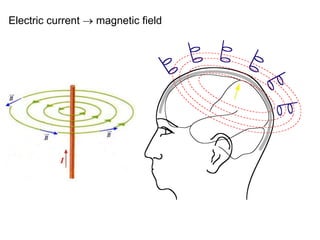
Electric current  magnetic field
Talk outline
What kind of signals are generated in the brain
How do we record those signals
Analyzing those signals with FieldTrip
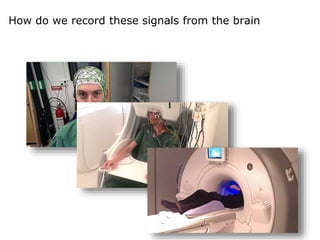
How do we record these signals from the brain
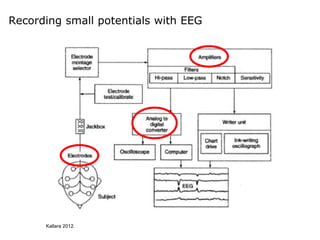
Kallara 2012.
Recording small potentials with EEG
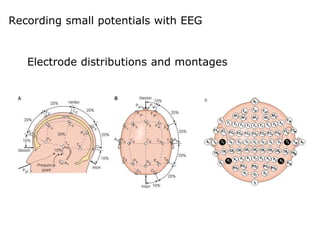
Electrode distributions and montages
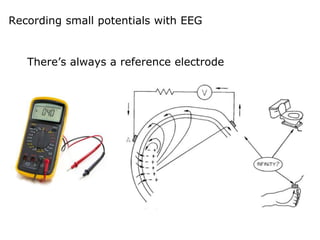
Recording small potentials with EEG
There’s always a reference electrode
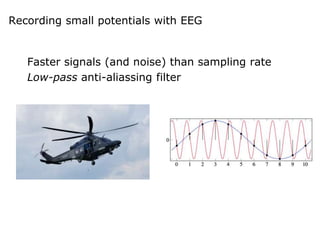
Recording small potentials with EEG
Faster signals (and noise) than sampling rate
Low-pass anti-aliassing filter
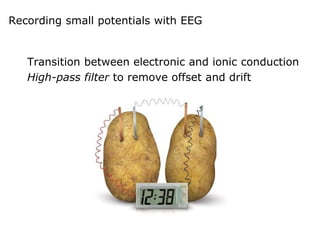
Recording small potentials with EEG
Transition between electronic and ionic conduction
High-pass filter to remove offset and drift
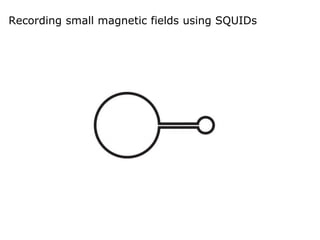
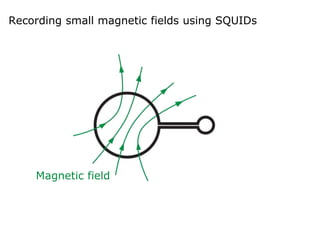
Recording small magnetic fields using SQUIDs
Magnetic field
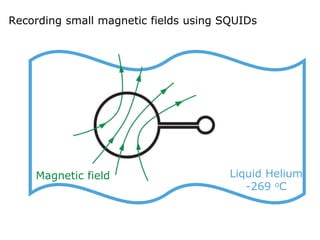
Recording small magnetic fields using SQUIDs
Magnetic field Liquid Helium
-269 oC
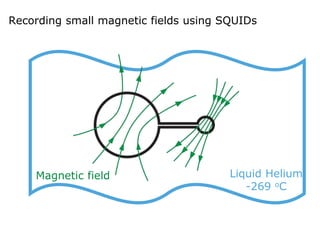
Recording small magnetic fields using SQUIDs
Magnetic field Liquid Helium
-269 oC
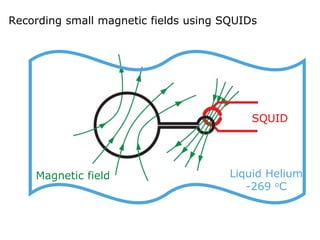
Recording small magnetic fields using SQUIDs
Liquid Helium
-269 oC
SQUID
Magnetic field
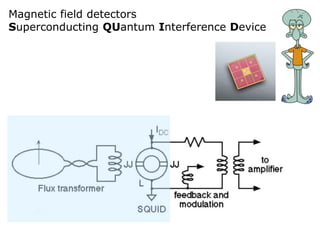
Magnetic field detectors
Superconducting QUantum Interference Device
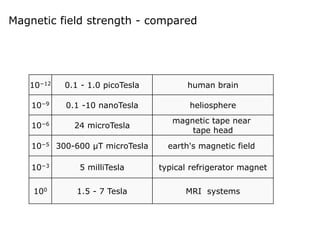
10−12 0.1 - 1.0 picoTesla human brain
10−9 0.1 -10 nanoTesla heliosphere
10−6 24 microTesla
magnetic tape near
tape head
10−5 300-600 µT microTesla earth's magnetic field
10−3 5 milliTesla typical refrigerator magnet
100 1.5 - 7 Tesla MRI systems
Magnetic field strength - compared
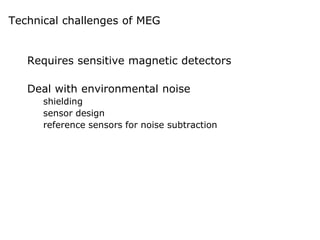
Technical challenges of MEG
Requires sensitive magnetic detectors
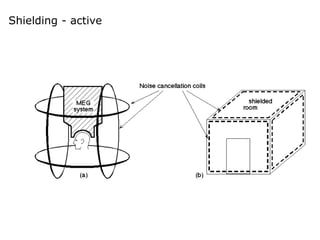
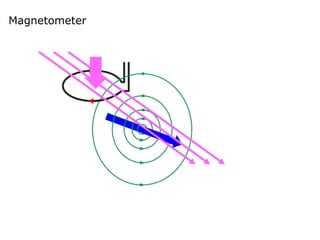
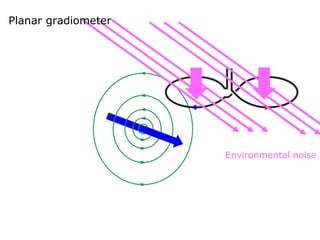
Deal with environmental noise
shielding
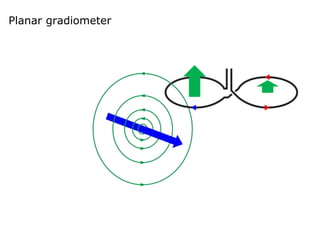
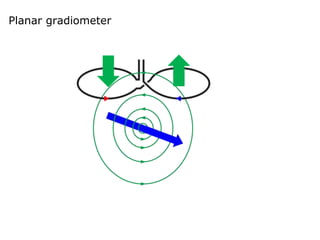
sensor design
reference sensors for noise subtraction
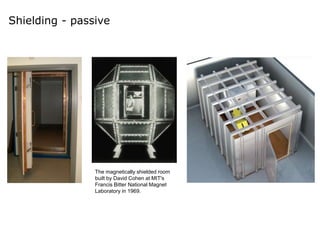
Shielding - passive
The magnetically shielded room
built by David Cohen at MIT's
Francis Bitter National Magnet
Laboratory in 1969.
Shielding - active
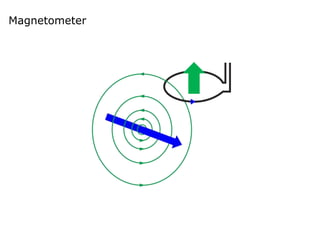
Magnetometer
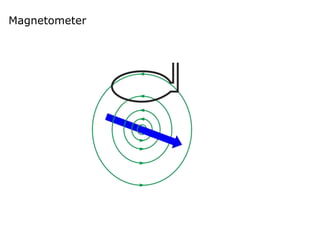
Magnetometer
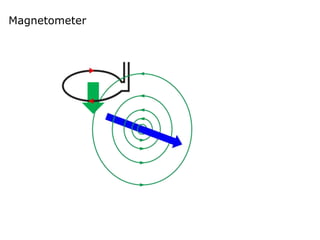
Magnetometer
Magnetometer
Planar gradiometer
Environmental noise
Planar gradiometer
Planar gradiometer
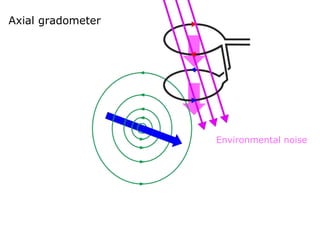
Axial gradometer
Environmental noise
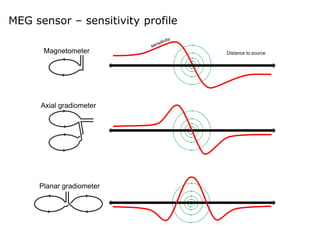
Magnetometer
Axial gradiometer
Planar gradiometer
Distance to source
MEG sensor – sensitivity profile
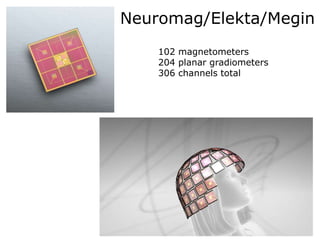
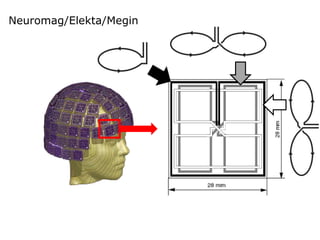
102 magnetometers
204 planar gradiometers
306 channels total
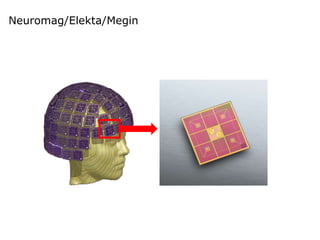
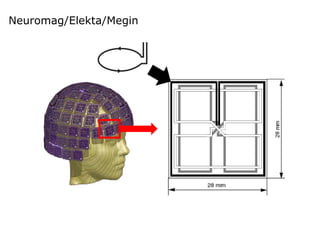
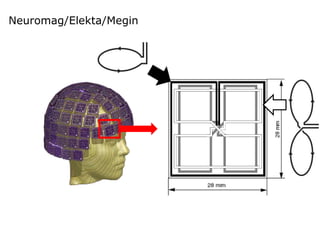
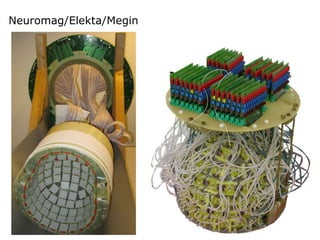
Neuromag/Elekta/Megin
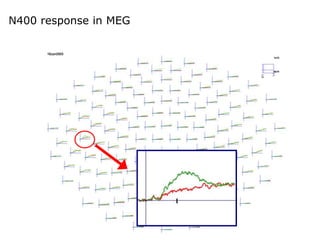
N400 response in MEG
400msec
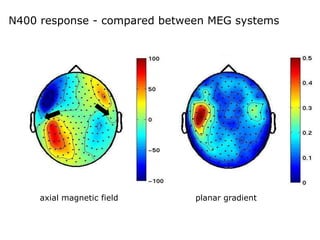
N400 response - compared between MEG systems
axial magnetic field planar gradient
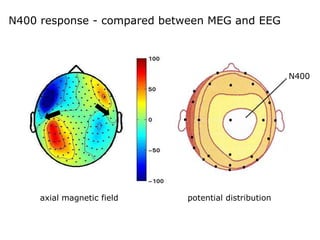
N400 response - compared between MEG and EEG
axial magnetic field potential distribution
N400
https://www.nature.com/articles/nature26147
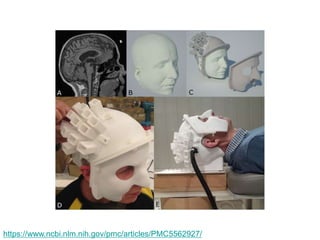
https://www.ncbi.nlm.nih.gov/pmc/articles/PMC5562927/
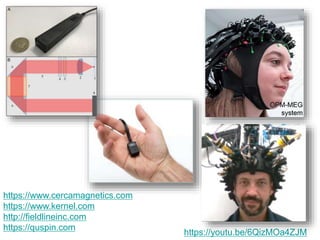
https://www.cercamagnetics.com
https://www.kernel.com
http://fieldlineinc.com
https://quspin.com
https://youtu.be/6QizMOa4ZJM
Talk outline
What kind of signals are generated in the brain
How do we record those signals
Analyzing those signals with FieldTrip
M/EEG signal characteristics considered during analysis
timecourse of activity
-> ERP
spectral characteristics
-> power spectrum
temporal changes in power
-> time-frequency response (TFR)
spatial distribution of activity over the head
-> source reconstruction
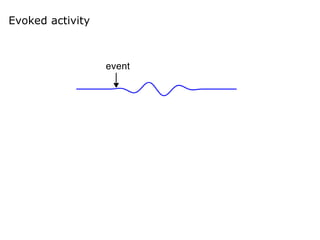
Evoked activity
repeated over
many trials
averaged
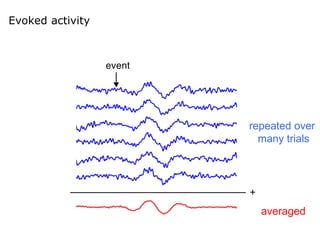
Evoked activity
repeated over
many trials
averaged
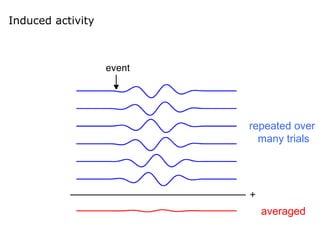
Induced activity
repeated over
many trials
averaged
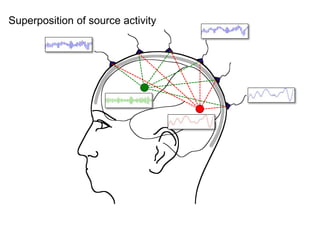
Superposition of source activity
Separating activity of sources
Use the temporal aspects of the data
at the channel level
ERF latencies
ERF difference waves
Filtering the time-series
Spectral decomposition
Use the spatial aspects of the data
Volume conduction model of head
Estimate source model parameters
Talk outline
What kind of signals are generated in the brain
How do we record those signals
Analyzing those signals with FieldTrip
Background on the FieldTrip toolbox
Some FieldTrip basics
dataout = functionname(cfg, datain, …)
functionname(cfg, datain, …)
dataout = functionname(cfg)
the “cfg” argument is a configuration structure, e.g.
cfg.channel = {‘C3’, C4’, ‘F3’, ‘F4’}
cfg.foilim = [1 70]
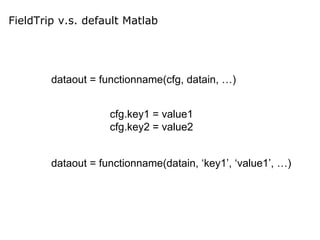
FieldTrip v.s. default Matlab
dataout = functionname(cfg, datain, …)
dataout = functionname(datain, ‘key1’, ‘value1’, …)
cfg.key1 = value1
cfg.key2 = value2
Using functions in an analysis protocol
ft_preprocessing
ft_rejectartifact
ft_freqanalysis
ft_multiplotTFR ft_freqstatistics
ft_multiplotTFR
FT_PREPROCESSING reads MEG and/or EEG data according to user-specified
trials and applies several user-specified preprocessing steps to the
signals.
Use as
[data] = ft_preprocessing(cfg)
or
[data] = ft_preprocessing(cfg, data)
The first input argument "cfg" is the configuration structure, which
contains all details for the dataset filenames, trials and the
preprocessing options. You can only do preprocessing after defining the
segments of data to be read from the file (i.e. the trials), which is for
example done based on the occurence of a trigger in the data.
...
Using functions in an analysis protocol
ft_preprocessing
ft_rejectartifact
ft_freqanalysis
ft_multiplotTFR ft_freqstatistics
ft_multiplotTFR
cfg = [ ]
cfg.dataset = ‘Subject01.ds’
cfg.bpfilter = [0.01 150]
...
rawdata = ft_preprocessing(cfg)
Using functions in an analysis protocol
ft_preprocessing
ft_rejectartifact
ft_freqanalysis
ft_multiplotTFR ft_freqstatistics
ft_multiplotTFR
cfg = [ ]
cfg.method = ‘mtmfft’
cfg.foilim = [1 120]
...
freqdata = ft_freqanalysis(cfg, rawdata)
Raw data structure
rawData =
label: {151x1 cell}
trial: {1x80 cell}
time: {1x80 cell}
fsample: 300
hdr: [1x1 struct]
cfg: [1x1 struct]
Event related response
timelockData =
label: {151x1 cell}
avg: [151x900 double]
var: [151x900 double]
time: [1x900 double]
dimord: 'chan_time’
cfg: [1x1 struct]
Example use in scripts
cfg = []
cfg.dataset = ‘Subject01.ds’
cfg.bpfilter = [0.01 150]
...
rawdata = ft_preprocessing(cfg)
cfg = []
cfg.method = ‘mtmfft’
cfg.foilim = [1 120]
...
freqdata = ft_freqanalysis(cfg, rawdata)
cfg = []
cfg.method = ‘montecarlo’
cfg.statistic = ‘indepsamplesT’
cfg.design = [1 2 1 2 2 1 2 1 1 2 ... ]
...
freqstat = ft_freqstatistics(cfg, freqdata)
ft_preprocessing
ft_freqanalysis
ft_freqstatistics
ft_topoplotTFR
…
Example use in scripts
cfg = []
cfg.dataset = ‘Subject01.ds’
cfg.bpfilter = [0.01 150]
...
rawdata = ft_preprocessing(cfg)
cfg = []
cfg.method = ‘mtmfft’
cfg.foilim = [1 120]
...
freqdata = ft_freqanalysis(cfg, rawdata)
cfg = []
cfg.method = ‘montecarlo’
cfg.statistic = ‘indepsamplesT’
cfg.design = [1 2 1 2 2 1 2 1 1 2 ... ]
...
freqstat = ft_freqstatistics(cfg, freqdata)
ft_preprocessing
ft_freqanalysis
ft_freqstatistics
ft_topoplotTFR
…
Example use in scripts
cfg = []
cfg.dataset = ‘Subject01.ds’
cfg.bpfilter = [0.01 150]
...
rawdata = ft_preprocessing(cfg)
cfg = []
cfg.method = ‘mtmfft’
cfg.foilim = [1 120]
...
freqdata = ft_freqanalysis(cfg, rawdata)
cfg = []
cfg.method = ‘montecarlo’
cfg.statistic = ‘indepsamplesT’
cfg.design = [1 2 1 2 2 1 2 1 1 2 ... ]
...
freqstat = ft_freqstatistics(cfg, freqdata)
ft_preprocessing
ft_freqanalysis
ft_freqstatistics
ft_topoplotTFR
…
Example use in scripts
cfg = []
cfg.dataset = ‘Subject01.ds’
cfg.bpfilter = [0.01 150]
...
rawdata = ft_preprocessing(cfg)
cfg = []
cfg.method = ‘mtmfft’
cfg.foilim = [1 120]
...
freqdata = ft_freqanalysis(cfg, rawdata)
cfg = []
cfg.method = ‘montecarlo’
cfg.statistic = ‘indepsamplesT’
cfg.design = [1 2 1 2 2 1 2 1 1 2 ... ]
...
freqstat = ft_freqstatistics(cfg, freqdata)
ft_preprocessing
ft_freqanalysis
ft_freqstatistics
ft_topoplotTFR
…
Example use in scripts
cfg = []
cfg.dataset = ‘Subject01.ds’
cfg.bpfilter = [0.01 150]
...
rawdata = ft_preprocessing(cfg)
cfg = []
cfg.method = ‘mtmfft’
cfg.foilim = [1 120]
...
freqdata = ft_freqanalysis(cfg, rawdata)
cfg = []
cfg.method = ‘montecarlo’
cfg.statistic = ‘indepsamplesT’
cfg.design = [1 2 1 2 2 1 2 1 1 2 ... ]
...
freqstat = ft_freqstatistics(cfg, freqdata)
ft_preprocessing
ft_freqanalysis
ft_freqstatistics
ft_topoplotTFR
…
Example use in scripts
subj = {‘S01.ds’, ‘S02.ds’, …}
trig = [1 3 7 9]
for s=1:nsubj
for c=1:ncond
cfg = []
cfg.dataset = subj{s}
cfg.trigger = trig(c)
rawdata{s,c} = ft_preprocessing(cfg)
cfg = []
cfg.method = ‘mtmfft’
cfg.foilim = [1 120]
freqdata{s,c} = ft_freqanalysis(cfg, rawdata{s,c})
end
end
Example use in scripts
subj = {‘S01.ds’, ‘S02.ds’, …}
trig = [1 3 7 9]
for s=1:nsubj
for c=1:ncond
cfg = []
cfg.dataset = subj{s}
cfg.trigger = trig(c)
rawdata = ft_preprocessing(cfg)
filename = sprintf(‘raw%s_%d.mat’, subj{s}, trig(c));
save(filename, ‘rawdata’)
end
end
Example use in distributed computing
subj = {‘S01.ds’, ‘S02.ds’, …}
trig = [1 3 7 9]
for s=1:nsubj
for c=1:ncond
cfgA{s,c} = []
cfgA{s,c}.dataset = subj{s}
cfgA{s,c}.trigger = trig(c)
cfgA{s,c}.outputfile = sprintf(‘raw%s_%d.mat’, subj{s}, trig(c))
cfgB{s,c} = []
cfgB{s,c}.dataset = subj{s}
cfgB{s,c}.trigger = trig(c)
cfgB{s,c}.inputfile = sprintf(‘raw%s_%d.mat’, subj{s}, trig(c));
cfgB{s,c}.outputfile = sprintf(‘freq%s_%d.mat’, subj{s}, trig(c));
end
end
qsubcellfun(@ft_preprocessing, cfgA)
qsubcellfun(@ft_freqanalysis, cfgB)
Talk outline
What kind of signals are generated in the brain
How do we record those signals
Analyzing those signals with FieldTrip
EEG, MEG and FieldTrip

EEG, MEG and FieldTrip

  • 1.
    MEG and EEGanalysis with the FieldTrip toolbox Robert Oostenveld Donders Institute, Radboud University, Nijmegen, NL NatMEG, Karolinska Institute, Stockholm, SE
  • 2.
    What is FieldTrip aMATLAB toolbox for the analysis of MEG, EEG and animal electrophysiology data can import data from many different file formats contains algorithms for spectral analysis, source reconstruction, statistics, connectivity, …
  • 3.
    Talk outline What kindof signals are generated in the brain How do we record those signals Analyzing those signals with FieldTrip
  • 4.
    Talk outline What kindof signals are generated in the brain How do we record those signals Analyzing those signals with FieldTrip
  • 5.
    What kind ofsignals are generated in the brain We measure the scalp potentials or field associated with post-synaptic potentials in pyramidal neurons These PSPs represent the exitatory and inhibitory input that these neurons receive Usually we study this neuronal input following the presentation of a stimulus or following a cognitive event
  • 6.
  • 7.
  • 8.
    ~ 2 ms ~10 ms What generates the currents and fields
  • 9.
    What generates thecurrents and fields
  • 10.
  • 11.
  • 12.
    What generates thecurrents and fields Vrba, 2001
  • 13.
  • 14.
    Electric current magnetic field
  • 15.
    Talk outline What kindof signals are generated in the brain How do we record those signals Analyzing those signals with FieldTrip
  • 16.
    How do werecord these signals from the brain
  • 17.
    Kallara 2012. Recording smallpotentials with EEG
  • 18.
    Recording small potentialswith EEG Electrode distributions and montages
  • 19.
    Recording small potentialswith EEG There’s always a reference electrode
  • 20.
    Recording small potentialswith EEG Faster signals (and noise) than sampling rate Low-pass anti-aliassing filter
  • 21.
    Recording small potentialswith EEG Transition between electronic and ionic conduction High-pass filter to remove offset and drift
  • 22.
    Recording small magneticfields using SQUIDs
  • 23.
    Recording small magneticfields using SQUIDs Magnetic field
  • 24.
    Recording small magneticfields using SQUIDs Magnetic field Liquid Helium -269 oC
  • 25.
    Recording small magneticfields using SQUIDs Magnetic field Liquid Helium -269 oC
  • 26.
    Recording small magneticfields using SQUIDs Liquid Helium -269 oC SQUID Magnetic field
  • 27.
    Magnetic field detectors SuperconductingQUantum Interference Device
  • 28.
    10−12 0.1 -1.0 picoTesla human brain 10−9 0.1 -10 nanoTesla heliosphere 10−6 24 microTesla magnetic tape near tape head 10−5 300-600 µT microTesla earth's magnetic field 10−3 5 milliTesla typical refrigerator magnet 100 1.5 - 7 Tesla MRI systems Magnetic field strength - compared
  • 29.
    Technical challenges ofMEG Requires sensitive magnetic detectors Deal with environmental noise shielding sensor design reference sensors for noise subtraction
  • 30.
    Shielding - passive Themagnetically shielded room built by David Cohen at MIT's Francis Bitter National Magnet Laboratory in 1969.
  • 31.
  • 32.
  • 33.
  • 34.
  • 35.
  • 36.
  • 37.
  • 38.
  • 39.
  • 40.
    Magnetometer Axial gradiometer Planar gradiometer Distanceto source MEG sensor – sensitivity profile
  • 41.
    102 magnetometers 204 planargradiometers 306 channels total Neuromag/Elekta/Megin
  • 42.
  • 43.
  • 44.
  • 45.
  • 46.
  • 47.
    N400 response inMEG 400msec
  • 48.
    N400 response -compared between MEG systems axial magnetic field planar gradient
  • 49.
    N400 response -compared between MEG and EEG axial magnetic field potential distribution N400
  • 50.
  • 51.
  • 52.
  • 53.
    Talk outline What kindof signals are generated in the brain How do we record those signals Analyzing those signals with FieldTrip
  • 54.
    M/EEG signal characteristicsconsidered during analysis timecourse of activity -> ERP spectral characteristics -> power spectrum temporal changes in power -> time-frequency response (TFR) spatial distribution of activity over the head -> source reconstruction
  • 55.
  • 56.
  • 57.
  • 58.
  • 59.
    Separating activity ofsources Use the temporal aspects of the data at the channel level ERF latencies ERF difference waves Filtering the time-series Spectral decomposition Use the spatial aspects of the data Volume conduction model of head Estimate source model parameters
  • 60.
    Talk outline What kindof signals are generated in the brain How do we record those signals Analyzing those signals with FieldTrip Background on the FieldTrip toolbox
  • 61.
    Some FieldTrip basics dataout= functionname(cfg, datain, …) functionname(cfg, datain, …) dataout = functionname(cfg) the “cfg” argument is a configuration structure, e.g. cfg.channel = {‘C3’, C4’, ‘F3’, ‘F4’} cfg.foilim = [1 70]
  • 62.
    FieldTrip v.s. defaultMatlab dataout = functionname(cfg, datain, …) dataout = functionname(datain, ‘key1’, ‘value1’, …) cfg.key1 = value1 cfg.key2 = value2
  • 63.
    Using functions inan analysis protocol ft_preprocessing ft_rejectartifact ft_freqanalysis ft_multiplotTFR ft_freqstatistics ft_multiplotTFR FT_PREPROCESSING reads MEG and/or EEG data according to user-specified trials and applies several user-specified preprocessing steps to the signals. Use as [data] = ft_preprocessing(cfg) or [data] = ft_preprocessing(cfg, data) The first input argument "cfg" is the configuration structure, which contains all details for the dataset filenames, trials and the preprocessing options. You can only do preprocessing after defining the segments of data to be read from the file (i.e. the trials), which is for example done based on the occurence of a trigger in the data. ...
  • 64.
    Using functions inan analysis protocol ft_preprocessing ft_rejectartifact ft_freqanalysis ft_multiplotTFR ft_freqstatistics ft_multiplotTFR cfg = [ ] cfg.dataset = ‘Subject01.ds’ cfg.bpfilter = [0.01 150] ... rawdata = ft_preprocessing(cfg)
  • 65.
    Using functions inan analysis protocol ft_preprocessing ft_rejectartifact ft_freqanalysis ft_multiplotTFR ft_freqstatistics ft_multiplotTFR cfg = [ ] cfg.method = ‘mtmfft’ cfg.foilim = [1 120] ... freqdata = ft_freqanalysis(cfg, rawdata)
  • 66.
    Raw data structure rawData= label: {151x1 cell} trial: {1x80 cell} time: {1x80 cell} fsample: 300 hdr: [1x1 struct] cfg: [1x1 struct]
  • 67.
    Event related response timelockData= label: {151x1 cell} avg: [151x900 double] var: [151x900 double] time: [1x900 double] dimord: 'chan_time’ cfg: [1x1 struct]
  • 68.
    Example use inscripts cfg = [] cfg.dataset = ‘Subject01.ds’ cfg.bpfilter = [0.01 150] ... rawdata = ft_preprocessing(cfg) cfg = [] cfg.method = ‘mtmfft’ cfg.foilim = [1 120] ... freqdata = ft_freqanalysis(cfg, rawdata) cfg = [] cfg.method = ‘montecarlo’ cfg.statistic = ‘indepsamplesT’ cfg.design = [1 2 1 2 2 1 2 1 1 2 ... ] ... freqstat = ft_freqstatistics(cfg, freqdata) ft_preprocessing ft_freqanalysis ft_freqstatistics ft_topoplotTFR …
  • 69.
    Example use inscripts cfg = [] cfg.dataset = ‘Subject01.ds’ cfg.bpfilter = [0.01 150] ... rawdata = ft_preprocessing(cfg) cfg = [] cfg.method = ‘mtmfft’ cfg.foilim = [1 120] ... freqdata = ft_freqanalysis(cfg, rawdata) cfg = [] cfg.method = ‘montecarlo’ cfg.statistic = ‘indepsamplesT’ cfg.design = [1 2 1 2 2 1 2 1 1 2 ... ] ... freqstat = ft_freqstatistics(cfg, freqdata) ft_preprocessing ft_freqanalysis ft_freqstatistics ft_topoplotTFR …
  • 70.
    Example use inscripts cfg = [] cfg.dataset = ‘Subject01.ds’ cfg.bpfilter = [0.01 150] ... rawdata = ft_preprocessing(cfg) cfg = [] cfg.method = ‘mtmfft’ cfg.foilim = [1 120] ... freqdata = ft_freqanalysis(cfg, rawdata) cfg = [] cfg.method = ‘montecarlo’ cfg.statistic = ‘indepsamplesT’ cfg.design = [1 2 1 2 2 1 2 1 1 2 ... ] ... freqstat = ft_freqstatistics(cfg, freqdata) ft_preprocessing ft_freqanalysis ft_freqstatistics ft_topoplotTFR …
  • 71.
    Example use inscripts cfg = [] cfg.dataset = ‘Subject01.ds’ cfg.bpfilter = [0.01 150] ... rawdata = ft_preprocessing(cfg) cfg = [] cfg.method = ‘mtmfft’ cfg.foilim = [1 120] ... freqdata = ft_freqanalysis(cfg, rawdata) cfg = [] cfg.method = ‘montecarlo’ cfg.statistic = ‘indepsamplesT’ cfg.design = [1 2 1 2 2 1 2 1 1 2 ... ] ... freqstat = ft_freqstatistics(cfg, freqdata) ft_preprocessing ft_freqanalysis ft_freqstatistics ft_topoplotTFR …
  • 72.
    Example use inscripts cfg = [] cfg.dataset = ‘Subject01.ds’ cfg.bpfilter = [0.01 150] ... rawdata = ft_preprocessing(cfg) cfg = [] cfg.method = ‘mtmfft’ cfg.foilim = [1 120] ... freqdata = ft_freqanalysis(cfg, rawdata) cfg = [] cfg.method = ‘montecarlo’ cfg.statistic = ‘indepsamplesT’ cfg.design = [1 2 1 2 2 1 2 1 1 2 ... ] ... freqstat = ft_freqstatistics(cfg, freqdata) ft_preprocessing ft_freqanalysis ft_freqstatistics ft_topoplotTFR …
  • 73.
    Example use inscripts subj = {‘S01.ds’, ‘S02.ds’, …} trig = [1 3 7 9] for s=1:nsubj for c=1:ncond cfg = [] cfg.dataset = subj{s} cfg.trigger = trig(c) rawdata{s,c} = ft_preprocessing(cfg) cfg = [] cfg.method = ‘mtmfft’ cfg.foilim = [1 120] freqdata{s,c} = ft_freqanalysis(cfg, rawdata{s,c}) end end
  • 74.
    Example use inscripts subj = {‘S01.ds’, ‘S02.ds’, …} trig = [1 3 7 9] for s=1:nsubj for c=1:ncond cfg = [] cfg.dataset = subj{s} cfg.trigger = trig(c) rawdata = ft_preprocessing(cfg) filename = sprintf(‘raw%s_%d.mat’, subj{s}, trig(c)); save(filename, ‘rawdata’) end end
  • 75.
    Example use indistributed computing subj = {‘S01.ds’, ‘S02.ds’, …} trig = [1 3 7 9] for s=1:nsubj for c=1:ncond cfgA{s,c} = [] cfgA{s,c}.dataset = subj{s} cfgA{s,c}.trigger = trig(c) cfgA{s,c}.outputfile = sprintf(‘raw%s_%d.mat’, subj{s}, trig(c)) cfgB{s,c} = [] cfgB{s,c}.dataset = subj{s} cfgB{s,c}.trigger = trig(c) cfgB{s,c}.inputfile = sprintf(‘raw%s_%d.mat’, subj{s}, trig(c)); cfgB{s,c}.outputfile = sprintf(‘freq%s_%d.mat’, subj{s}, trig(c)); end end qsubcellfun(@ft_preprocessing, cfgA) qsubcellfun(@ft_freqanalysis, cfgB)
  • 76.
    Talk outline What kindof signals are generated in the brain How do we record those signals Analyzing those signals with FieldTrip