IT2001PA
Engineering Essentials (2/2)


Chapter 1 – Number System

 Lecturer Name
lecturer_email@ite.edu.sg
                            Nov 20, 2012
Contact Number
Chapter 1 – Number System


Lesson Objectives
Upon completion of this topic, you should be able to:
   Convert numbers e.g. binary, octal, decimal,
    hexadecimal and BCD from one system to another.


    IT2001PA Engineering Essentials (2/2)           2
Chapter 1 – Number System


Specific Objectives
  Students should be able to :
      Explain why the binary number system is ideal for digital
       logic applications.
      Convert decimal whole numbers and fractional numbers into
       binary numbers and vice versa.
      Convert decimal whole numbers into hexadecimal and octal
       numbers and vice versa.
      Explain the term binary coded decimal.
      Convert BCD to decimal number and vice versa.


      IT2001PA Engineering Essentials (2/2)
Chapter 1 – Number System


  Application
  In digital electronics,
   only deal with two voltage levels; i.e.:
       ON ≡ high or 1.
       OFF ≡ low or 0.

  Therefore almost all digital systems use
   binary number system; i.e.: Base 2.
   IT2001PA Engineering Essentials (2/2)       4
Chapter 1 – Number System

   Number Systems
    4 commonly used number systems:
                                           MSB LSB


    • Decimal (Base 10)                     2 5
                                           MSB       LSB


    • Binary        (Base 2)               11001
                                           MSB LSB


    • Octal         (Base 8)                3 1
                                           MSB LSB


    • Hexadecimal (Base 16)                 1 9
   IT2001PA Engineering Essentials (2/2)               5
Chapter 1 – Number System


Binary Number System
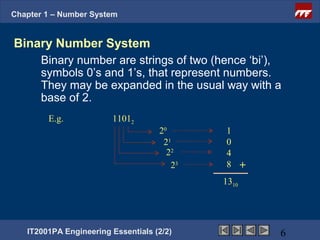
       Binary number are strings of two (hence ‘bi’),
       symbols 0’s and 1’s, that represent numbers.
       They may be expanded in the usual way with a
       base of 2.
        E.g.            11012
                                    20      1
                                     21     0
                                      22    4
                                       23   8 +
                                            1310


   IT2001PA Engineering Essentials (2/2)            6
Chapter 1 – Number System


Binary System
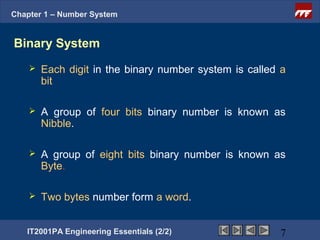
       Each digit in the binary number system is called a
        bit

       A group of four bits binary number is known as
        Nibble.

       A group of eight bits binary number is known as
        Byte.

       Two bytes number form a word.


   IT2001PA Engineering Essentials (2/2)                7
Chapter 1 – Number System


Binary to Decimal Conversion
   Whole number
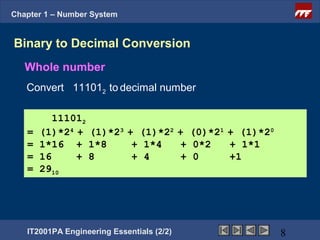
   Convert 111012 to decimal number

         111012
   =   (1)*24 + (1)*23 + (1)*22 + (0)*21 + (1)*20
   =   1*16 + 1*8       + 1*4    + 0*2   + 1*1
   =   16     + 8       + 4      + 0     +1
   =   2910


   IT2001PA Engineering Essentials (2/2)            8
Chapter 1 – Number System


Try the following

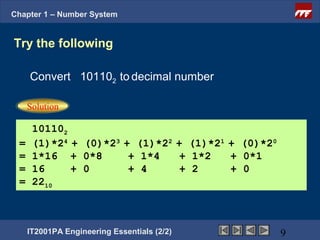
     Convert 101102 to decimal number

     Solution

      101102
 =    (1)*24 + (0)*23 + (1)*22 + (1)*21 + (0)*20
 =    1*16 + 0*8       + 1*4   + 1*2    + 0*1
 =    16     + 0       + 4     + 2      + 0
 =    2210


     IT2001PA Engineering Essentials (2/2)         9
Chapter 1 – Number System


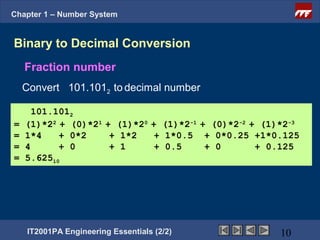
Binary to Decimal Conversion
    Fraction number
    Convert 101.1012 to decimal number

      101.1012
=   (1)*22 + (0)*21 + (1)*20 + (1)*2-1 + (0)*2-2 + (1)*2-3
=   1*4    + 0*2     + 1*2    + 1*0.5 + 0*0.25 +1*0.125
=   4      + 0       + 1      + 0.5     + 0       + 0.125
=   5.62510


    IT2001PA Engineering Essentials (2/2)             10
Chapter 1 – Number System


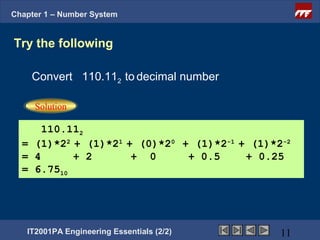
Try the following

    Convert 110.112 to decimal number

     Solution

     110.112
  = (1)*22 + (1)*21 + (0)*20 + (1)*2-1 + (1)*2-2
  = 4      + 2       + 0      + 0.5     + 0.25
  = 6.7510


   IT2001PA Engineering Essentials (2/2)      11
Chapter 1 – Number System


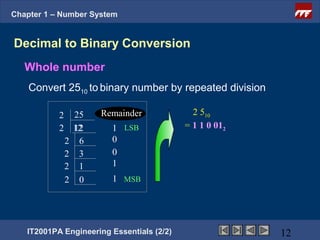
Decimal to Binary Conversion
   Whole number
    Convert 2510 to binary number by repeated division

           2 25      Remainder               2 510
           2 12
              12        1 LSB              = 1 1 0 012
            2 6         0
            2 3         0
            2 1         1
            2 0         1 MSB


   IT2001PA Engineering Essentials (2/2)                 12
Chapter 1 – Number System


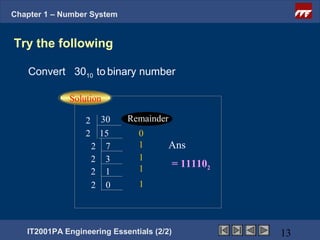
Try the following

   Convert 3010 to binary number

             Solution

                 2 30       Remainder
                 2 15          0
                  2 7          1        Ans
                  2 3          1
                               1           = 111102
                  2 1
                  2 0          1


   IT2001PA Engineering Essentials (2/2)              13
Chapter 1 – Number System


Decimal to Binary Conversion
   Fraction number
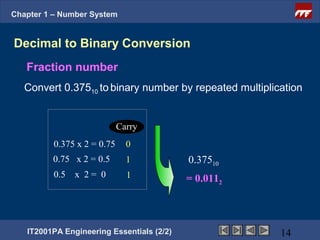
   Convert 0.37510 to binary number by repeated multiplication


                             Carry
          0.375 x 2 = 0.75     0
         0.75 x 2 = 0.5        1           0.37510
          0.5   x 2= 0         1           = 0.0112


   IT2001PA Engineering Essentials (2/2)                 14
Chapter 1 – Number System


Try the following

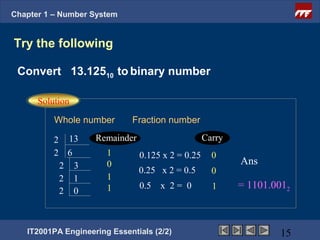
 Convert 13.12510 to binary number

      Solution

          Whole number       Fraction number

          2 13      Remainder                      Carry
          2 6          1        0.125 x 2 = 0.25     0
           2 3         0                                   Ans
                                0.25 x 2 = 0.5       0
           2 1         1
                       1        0.5   x 2= 0         1     = 1101.0012
           2 0


   IT2001PA Engineering Essentials (2/2)                            15
Chapter 1 – Number System


   Decimal to Octal conversion


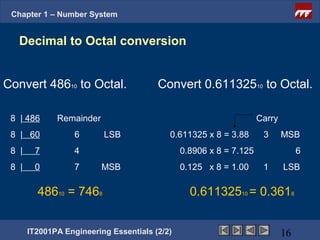
Convert 48610 to Octal.                 Convert 0.61132510 to Octal.

 8 | 486      Remainder                                             Carry
 8 | 60            6      LSB              0.611325 x 8 = 3.88       3      MSB
 8 |    7          4                           0.8906 x 8 = 7.125                6
 8 |    0          7      MSB                  0.125 x 8 = 1.00      1      LSB

         48610 = 7468                            0.61132510 = 0.3618


       IT2001PA Engineering Essentials (2/2)                                16
Chapter 1 – Number System


 Octal to Decimal conversion
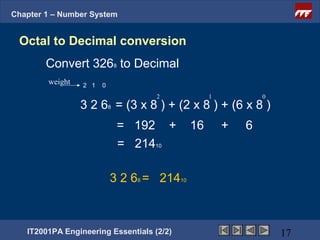
        Convert 3268 to Decimal
        weight   2 1   0
                                    2            1           0
                 3 2 68 = (3 x 8 ) + (2 x 8 ) + (6 x 8 )
                            = 192 +         16       +   6
                            = 21410

                           3 2 68 = 21410


   IT2001PA Engineering Essentials (2/2)                         17
Chapter 1 – Number System


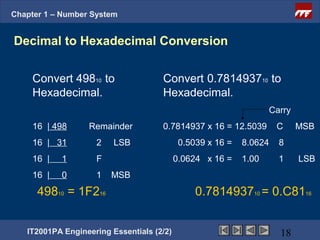
Decimal to Hexadecimal Conversion

     Convert 49810 to                Convert 0.781493710 to
     Hexadecimal.                    Hexadecimal.
                                                                   Carry
     16 | 498     Remainder          0.7814937 x 16 = 12.5039        C     MSB
     16 | 31        2    LSB                0.5039 x 16 =   8.0624   8
     16 |   1       F                      0.0624 x 16 =    1.00     1     LSB
     16 |   0       1   MSB
      49810 = 1F216                             0.781493710 = 0.C8116


   IT2001PA Engineering Essentials (2/2)                             18
Chapter 1 – Number System


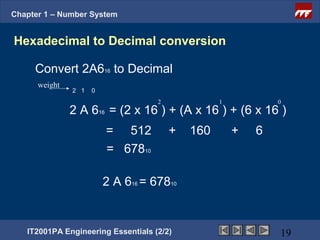
Hexadecimal to Decimal conversion

     Convert 2A616 to Decimal
      weight
               2 1   0
                                    2             1           0
               2 A 616 = (2 x 16 ) + (A x 16 ) + (6 x 16 )
                         = 512          +   160       +   6
                         = 67810

                         2 A 616 = 67810


   IT2001PA Engineering Essentials (2/2)                      19
Chapter 1 – Number System

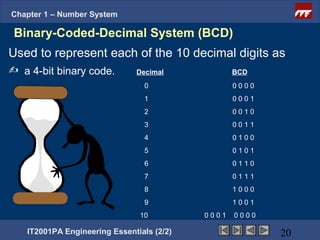
 Binary-Coded-Decimal System (BCD)
Used to represent each of the 10 decimal digits as
 a 4-bit binary code.        Decimal             BCD
                                 0                0000
                                 1                0001
                                 2                0010
                                 3                0011
                                 4                0100
                                 5                0101
                                 6                0110
                                 7                0111
                                 8                1000
                                 9                1001
                               10          0001   0000

   IT2001PA Engineering Essentials (2/2)                 20
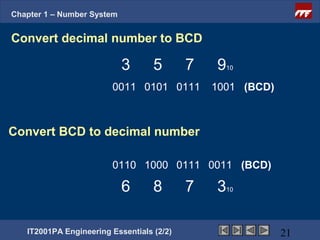
Chapter 1 – Number System


Convert decimal number to BCD

                            3      5       7   9   10


                        0011 0101 0111         1001 (BCD)


Convert BCD to decimal number

                        0110 1000 0111 0011 (BCD)

                            6      8       7   3   10


   IT2001PA Engineering Essentials (2/2)                    21
Chapter 1 – Number System


Next Lesson


   IT2001PA Engineering Essentials (2/2)   22

Ee2 chapter1 number_system

  • 1.
    IT2001PA Engineering Essentials (2/2) Chapter1 – Number System Lecturer Name lecturer_email@ite.edu.sg Nov 20, 2012 Contact Number
  • 2.
    Chapter 1 –Number System Lesson Objectives Upon completion of this topic, you should be able to:  Convert numbers e.g. binary, octal, decimal, hexadecimal and BCD from one system to another. IT2001PA Engineering Essentials (2/2) 2
  • 3.
    Chapter 1 –Number System Specific Objectives Students should be able to :  Explain why the binary number system is ideal for digital logic applications.  Convert decimal whole numbers and fractional numbers into binary numbers and vice versa.  Convert decimal whole numbers into hexadecimal and octal numbers and vice versa.  Explain the term binary coded decimal.  Convert BCD to decimal number and vice versa. IT2001PA Engineering Essentials (2/2)
  • 4.
    Chapter 1 –Number System Application In digital electronics,  only deal with two voltage levels; i.e.:  ON ≡ high or 1.  OFF ≡ low or 0. Therefore almost all digital systems use  binary number system; i.e.: Base 2. IT2001PA Engineering Essentials (2/2) 4
  • 5.
    Chapter 1 –Number System Number Systems 4 commonly used number systems: MSB LSB • Decimal (Base 10) 2 5 MSB LSB • Binary (Base 2) 11001 MSB LSB • Octal (Base 8) 3 1 MSB LSB • Hexadecimal (Base 16) 1 9 IT2001PA Engineering Essentials (2/2) 5
  • 6.
    Chapter 1 –Number System Binary Number System Binary number are strings of two (hence ‘bi’), symbols 0’s and 1’s, that represent numbers. They may be expanded in the usual way with a base of 2. E.g. 11012 20 1 21 0 22 4 23 8 + 1310 IT2001PA Engineering Essentials (2/2) 6
  • 7.
    Chapter 1 –Number System Binary System  Each digit in the binary number system is called a bit  A group of four bits binary number is known as Nibble.  A group of eight bits binary number is known as Byte.  Two bytes number form a word. IT2001PA Engineering Essentials (2/2) 7
  • 8.
    Chapter 1 –Number System Binary to Decimal Conversion Whole number Convert 111012 to decimal number 111012 = (1)*24 + (1)*23 + (1)*22 + (0)*21 + (1)*20 = 1*16 + 1*8 + 1*4 + 0*2 + 1*1 = 16 + 8 + 4 + 0 +1 = 2910 IT2001PA Engineering Essentials (2/2) 8
  • 9.
    Chapter 1 –Number System Try the following Convert 101102 to decimal number Solution 101102 = (1)*24 + (0)*23 + (1)*22 + (1)*21 + (0)*20 = 1*16 + 0*8 + 1*4 + 1*2 + 0*1 = 16 + 0 + 4 + 2 + 0 = 2210 IT2001PA Engineering Essentials (2/2) 9
  • 10.
    Chapter 1 –Number System Binary to Decimal Conversion Fraction number Convert 101.1012 to decimal number 101.1012 = (1)*22 + (0)*21 + (1)*20 + (1)*2-1 + (0)*2-2 + (1)*2-3 = 1*4 + 0*2 + 1*2 + 1*0.5 + 0*0.25 +1*0.125 = 4 + 0 + 1 + 0.5 + 0 + 0.125 = 5.62510 IT2001PA Engineering Essentials (2/2) 10
  • 11.
    Chapter 1 –Number System Try the following Convert 110.112 to decimal number Solution 110.112 = (1)*22 + (1)*21 + (0)*20 + (1)*2-1 + (1)*2-2 = 4 + 2 + 0 + 0.5 + 0.25 = 6.7510 IT2001PA Engineering Essentials (2/2) 11
  • 12.
    Chapter 1 –Number System Decimal to Binary Conversion Whole number Convert 2510 to binary number by repeated division 2 25 Remainder 2 510 2 12 12 1 LSB = 1 1 0 012 2 6 0 2 3 0 2 1 1 2 0 1 MSB IT2001PA Engineering Essentials (2/2) 12
  • 13.
    Chapter 1 –Number System Try the following Convert 3010 to binary number Solution 2 30 Remainder 2 15 0 2 7 1 Ans 2 3 1 1 = 111102 2 1 2 0 1 IT2001PA Engineering Essentials (2/2) 13
  • 14.
    Chapter 1 –Number System Decimal to Binary Conversion Fraction number Convert 0.37510 to binary number by repeated multiplication Carry 0.375 x 2 = 0.75 0 0.75 x 2 = 0.5 1 0.37510 0.5 x 2= 0 1 = 0.0112 IT2001PA Engineering Essentials (2/2) 14
  • 15.
    Chapter 1 –Number System Try the following Convert 13.12510 to binary number Solution Whole number Fraction number 2 13 Remainder Carry 2 6 1 0.125 x 2 = 0.25 0 2 3 0 Ans 0.25 x 2 = 0.5 0 2 1 1 1 0.5 x 2= 0 1 = 1101.0012 2 0 IT2001PA Engineering Essentials (2/2) 15
  • 16.
    Chapter 1 –Number System Decimal to Octal conversion Convert 48610 to Octal. Convert 0.61132510 to Octal. 8 | 486 Remainder Carry 8 | 60 6 LSB 0.611325 x 8 = 3.88 3 MSB 8 | 7 4 0.8906 x 8 = 7.125 6 8 | 0 7 MSB 0.125 x 8 = 1.00 1 LSB 48610 = 7468 0.61132510 = 0.3618 IT2001PA Engineering Essentials (2/2) 16
  • 17.
    Chapter 1 –Number System Octal to Decimal conversion Convert 3268 to Decimal weight 2 1 0 2 1 0 3 2 68 = (3 x 8 ) + (2 x 8 ) + (6 x 8 ) = 192 + 16 + 6 = 21410 3 2 68 = 21410 IT2001PA Engineering Essentials (2/2) 17
  • 18.
    Chapter 1 –Number System Decimal to Hexadecimal Conversion Convert 49810 to Convert 0.781493710 to Hexadecimal. Hexadecimal. Carry 16 | 498 Remainder 0.7814937 x 16 = 12.5039 C MSB 16 | 31 2 LSB 0.5039 x 16 = 8.0624 8 16 | 1 F 0.0624 x 16 = 1.00 1 LSB 16 | 0 1 MSB 49810 = 1F216 0.781493710 = 0.C8116 IT2001PA Engineering Essentials (2/2) 18
  • 19.
    Chapter 1 –Number System Hexadecimal to Decimal conversion Convert 2A616 to Decimal weight 2 1 0 2 1 0 2 A 616 = (2 x 16 ) + (A x 16 ) + (6 x 16 ) = 512 + 160 + 6 = 67810 2 A 616 = 67810 IT2001PA Engineering Essentials (2/2) 19
  • 20.
    Chapter 1 –Number System Binary-Coded-Decimal System (BCD) Used to represent each of the 10 decimal digits as  a 4-bit binary code. Decimal BCD 0 0000 1 0001 2 0010 3 0011 4 0100 5 0101 6 0110 7 0111 8 1000 9 1001 10 0001 0000 IT2001PA Engineering Essentials (2/2) 20
  • 21.
    Chapter 1 –Number System Convert decimal number to BCD 3 5 7 9 10 0011 0101 0111 1001 (BCD) Convert BCD to decimal number 0110 1000 0111 0011 (BCD) 6 8 7 3 10 IT2001PA Engineering Essentials (2/2) 21
  • 22.
    Chapter 1 –Number System Next Lesson IT2001PA Engineering Essentials (2/2) 22