IB Extended Essay
Orientation
Berlin Metropolitan School
July 2015
Today’s Goals
 Learn the requirements of the EE
 Understand importance of EE
 Understand key components of successful EEs
 Know where to go for help!
The Extended Essay is…
“an independent, self-directed piece of research, finishing with
a 4,000-word paper. The extended essay an opportunity for
students to investigate a topic of special interest to them,
which is also related to one of the student's six DP subjects. ”
What is the Extended Essay? International Baccalaureate
Organization. Cardiff: Pearson, 2015. Web.
Tell me More!
 Required for all IB students
 1 year, 40 hours
 Completed outside of class time
 Formal academic essay
 Abstract, Table of Contents, Works Cited
 Assessed Externally
 Scale of 0-36 points
 Letter grade of A-E
Why do I have to do this?
 Because the IB says so…
 Preparation for university-level work
 Focus on an area YOU are interested in
What else should I know?
 BMS teacher will supervise
 Science subjects include experimental work
 Internal deadlines along the way
 Viva Voce at the end
What does the supervisor do?
 Help you formulate a research question
 Advise you on resources and research techniques
 Read and comment on the first draft
 Monitor your progress towards deadlines
 Participate in the Viva Voce
What DOESN’T the supervisor do?
 Chase you down for meetings
 Do your research or write your essay for you
 Proofread for grammar and spelling
What is the Viva Voce?
 10-15 minute concluding interview
 An opportunity for you to reflect on the process and the
result
 An opportunity for you to reflect on successes and
difficulties in the research process
 A check against plagiarism
 Helps your supervisor write their final report
How do I get started?
1. Choose a subject
2. Choose your supervisor
3. Choose your topic
 Interesting?
 Challenging?
 Narrow enough?
 Offer opportunities for research?
4. Find sources and start background reading
5. Formulate a research question (and maybe change it)
This research question is pretty
important, right?
Yes! Choosing a good question might be the most
important part of the EE process…
• Part of the assessment criteria
• Affects ALL other parts of the essay
• Should be narrow and specific
• Should be challenging, but something you can explore
within 40 hours and 4,000 words
• Usually formulated as a question, but may be stated as
a hypothesis
Now what? Research
1. Develop a detailed plan
2. Read, read, read
 Take careful notes and record bibliographic info as you go
3. Organize notes and create an outline
4. Assess your progress. Do you have enough info?
5. If not, read, read, read and take more notes
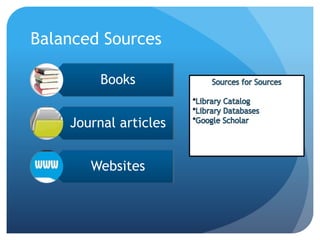
Balanced Sources
Books
Journal articles
Websites
Now what? Drafting and finalizing
1. Write your first draft and hand it in to your supervisor
2. Get feedback and redraft
 Additional research if needed
3. Write final draft and abstract
4. Revise and polish
5. Submit on or before the due date
6. Attend the Viva Voce
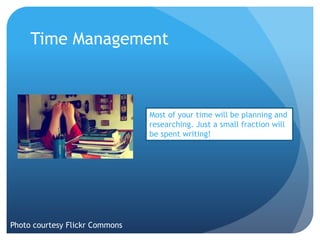
Time Management
Photo courtesy Flickr Commons
Most of your time will be planning and
researching. Just a small fraction will
be spent writing!
Obvious but true advice…
 Start early!
 Stay organized
 Have a plan
What are the deadlines?
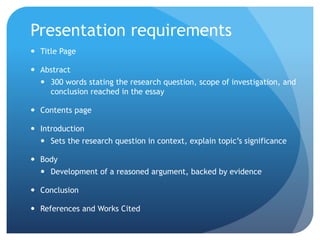
Presentation requirements
 Title Page
 Abstract
 300 words stating the research question, scope of investigation, and
conclusion reached in the essay
 Contents page
 Introduction
 Sets the research question in context, explain topic’s significance
 Body
 Development of a reasoned argument, backed by evidence
 Conclusion
 References and Works Cited
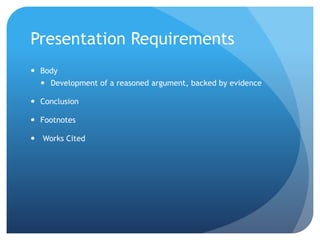
Presentation Requirements
 Body
 Development of a reasoned argument, backed by evidence
 Conclusion
 Footnotes
 Works Cited
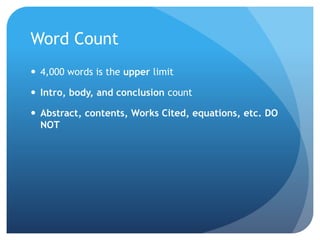
Word Count
 4,000 words is the upper limit
 Intro, body, and conclusion count
 Abstract, contents, Works Cited, equations, etc. DO
NOT
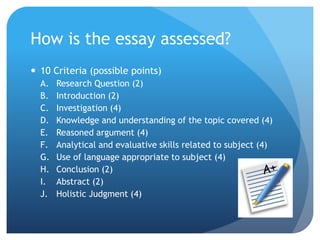
How is the essay assessed?
 10 Criteria (possible points)
A. Research Question (2)
B. Introduction (2)
C. Investigation (4)
D. Knowledge and understanding of the topic covered (4)
E. Reasoned argument (4)
F. Analytical and evaluative skills related to subject (4)
G. Use of language appropriate to subject (4)
H. Conclusion (2)
I. Abstract (2)
J. Holistic Judgment (4)
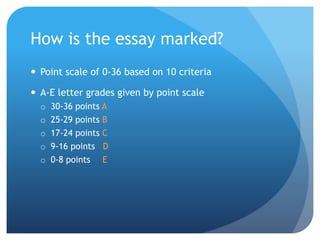
How is the essay marked?
 Point scale of 0-36 based on 10 criteria
 A-E letter grades given by point scale
o 30-36 points A
o 25-29 points B
o 17-24 points C
o 9-16 points D
o 0-8 points E
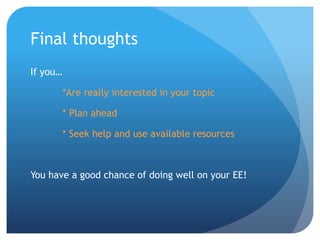
Final thoughts
If you…
*Are really interested in your topic
* Plan ahead
* Seek help and use available resources
You have a good chance of doing well on your EE!

Extended Essay Intro

  • 1.
    IB Extended Essay Orientation BerlinMetropolitan School July 2015
  • 2.
    Today’s Goals  Learnthe requirements of the EE  Understand importance of EE  Understand key components of successful EEs  Know where to go for help!
  • 3.
    The Extended Essayis… “an independent, self-directed piece of research, finishing with a 4,000-word paper. The extended essay an opportunity for students to investigate a topic of special interest to them, which is also related to one of the student's six DP subjects. ” What is the Extended Essay? International Baccalaureate Organization. Cardiff: Pearson, 2015. Web.
  • 4.
    Tell me More! Required for all IB students  1 year, 40 hours  Completed outside of class time  Formal academic essay  Abstract, Table of Contents, Works Cited  Assessed Externally  Scale of 0-36 points  Letter grade of A-E
  • 5.
    Why do Ihave to do this?  Because the IB says so…  Preparation for university-level work  Focus on an area YOU are interested in
  • 6.
    What else shouldI know?  BMS teacher will supervise  Science subjects include experimental work  Internal deadlines along the way  Viva Voce at the end
  • 7.
    What does thesupervisor do?  Help you formulate a research question  Advise you on resources and research techniques  Read and comment on the first draft  Monitor your progress towards deadlines  Participate in the Viva Voce
  • 8.
    What DOESN’T thesupervisor do?  Chase you down for meetings  Do your research or write your essay for you  Proofread for grammar and spelling
  • 9.
    What is theViva Voce?  10-15 minute concluding interview  An opportunity for you to reflect on the process and the result  An opportunity for you to reflect on successes and difficulties in the research process  A check against plagiarism  Helps your supervisor write their final report
  • 10.
    How do Iget started? 1. Choose a subject 2. Choose your supervisor 3. Choose your topic  Interesting?  Challenging?  Narrow enough?  Offer opportunities for research? 4. Find sources and start background reading 5. Formulate a research question (and maybe change it)
  • 11.
    This research questionis pretty important, right? Yes! Choosing a good question might be the most important part of the EE process… • Part of the assessment criteria • Affects ALL other parts of the essay • Should be narrow and specific • Should be challenging, but something you can explore within 40 hours and 4,000 words • Usually formulated as a question, but may be stated as a hypothesis
  • 12.
    Now what? Research 1.Develop a detailed plan 2. Read, read, read  Take careful notes and record bibliographic info as you go 3. Organize notes and create an outline 4. Assess your progress. Do you have enough info? 5. If not, read, read, read and take more notes
  • 13.
  • 14.
    Now what? Draftingand finalizing 1. Write your first draft and hand it in to your supervisor 2. Get feedback and redraft  Additional research if needed 3. Write final draft and abstract 4. Revise and polish 5. Submit on or before the due date 6. Attend the Viva Voce
  • 15.
    Time Management Photo courtesyFlickr Commons Most of your time will be planning and researching. Just a small fraction will be spent writing!
  • 16.
    Obvious but trueadvice…  Start early!  Stay organized  Have a plan
  • 17.
    What are thedeadlines?
  • 18.
    Presentation requirements  TitlePage  Abstract  300 words stating the research question, scope of investigation, and conclusion reached in the essay  Contents page  Introduction  Sets the research question in context, explain topic’s significance  Body  Development of a reasoned argument, backed by evidence  Conclusion  References and Works Cited
  • 19.
    Presentation Requirements  Body Development of a reasoned argument, backed by evidence  Conclusion  Footnotes  Works Cited
  • 20.
    Word Count  4,000words is the upper limit  Intro, body, and conclusion count  Abstract, contents, Works Cited, equations, etc. DO NOT
  • 21.
    How is theessay assessed?  10 Criteria (possible points) A. Research Question (2) B. Introduction (2) C. Investigation (4) D. Knowledge and understanding of the topic covered (4) E. Reasoned argument (4) F. Analytical and evaluative skills related to subject (4) G. Use of language appropriate to subject (4) H. Conclusion (2) I. Abstract (2) J. Holistic Judgment (4)
  • 22.
    How is theessay marked?  Point scale of 0-36 based on 10 criteria  A-E letter grades given by point scale o 30-36 points A o 25-29 points B o 17-24 points C o 9-16 points D o 0-8 points E
  • 23.
    Final thoughts If you… *Arereally interested in your topic * Plan ahead * Seek help and use available resources You have a good chance of doing well on your EE!