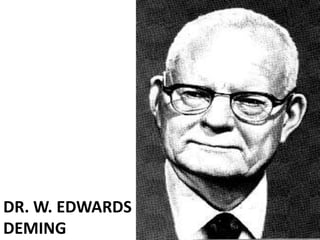
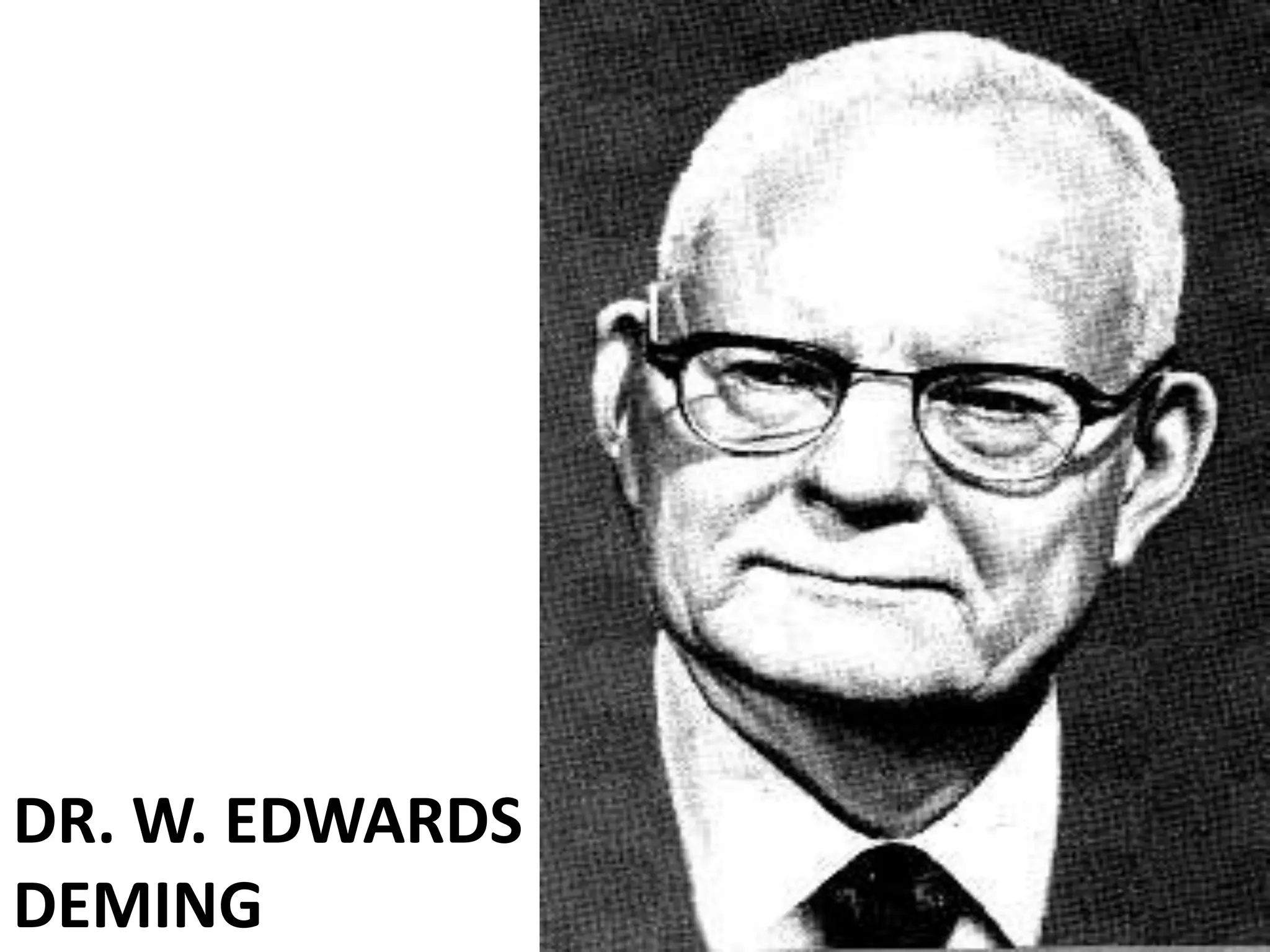
DR. W. EDWARDS
DEMING
Brief Introduction
• Born at October 14, 1900in Sioux City, Iowa
• Deming received his electrical engineering degree from the
  University of Wyoming and his Ph.D. in mathematical physics
  as well.
• Was an American statistician, professor, author, lecturer and
  consultant.
• President Reagan awarded the National Medal of Technology
  to Deming in 1987. And in 1988, he received the Distinguished
  Career in Science award from the National Academy of
  Sciences.
Working
• He worked for the Western Electric Company with
  Walter A. Shewhart, the developer of the control chart.
• Deming then worked with the U.S.
• Department of Agriculture and the U.S. Census Bureau.
• Starting in 1950 he delivered a series of lectures to top
  management in Japan on statistical process control.
  Japanese industry adopted his methods which resulted
  in a significant improvement in quality.
• Deming firmly believed that quality is the responsibility
  of the management.
• The Deming philosophy is summarized in the fourteen
  points.
• Developed better ways for continuous
  improvement.
• Third wave of the industrial revolution.
• One of history’s nine hidden turning points.
• His philosophy has rarely been practiced in its
  fullness.
• Total Quality Management was a revolutionary
  concept developed by the American statistician,
  Dr. W. Edwards Deming, a term now commonly
  referred to as TQM.
• “Zero Defect" production, concept of TQM.
• The basic four cornerstones of Deming's TQM
  include customer focus, continuous
  improvement, defect prevention and the
  importance of sharing quality responsibilities.
• Teamwork and team effort .
Deming’s 14 points
1. Create constancy of purpose for improvement of
   product and service
2. Adopt the new philosophy
3. Cease dependence on inspection
4. Move towards a single supplier for any one item
5. Improve constantly and forever
6. Institute training on the job
7. Institute leadership
8. Drive out fear
9. Break down barriers between departments
10. Eliminate slogans, exhortations, and targets for
   the work force
11. Eliminate numerical quotas for the work force
   and eliminate numerical goals for people in
   management
12. Remove barriers that rob people of pride of
   workmanship
13. Encourage education and self-improvement for
   everyone
14. Take action to accomplish the transformation
These points "represent a philosophy, a
logical, humane and pleasant way to get
things done. Each of these points may sound
reasonably straightforward, even simple in
some cases, but each represents a change in
the ways things are commonly done
(especially) in the United States" (Dobyns et
al, 1994)
While Deming's TQM ideas were hatched over
sixty years ago, in today's global economy they
are as vital and necessary as never before.
Everything moves at a far faster pace than
ever. Technology changes literally from day to
day. So companies unwilling or unable to
provide this coordinated TQM team effort may
fall further and further behind their
competitors.
Some Quotations and Concepts by
               Deming
• “There is no substitute for knowledge”
• “In God we trust; all others must bring data”
• “The most important things cannot be measured”
• “The most important things are unknown or
  unknowable”
• “Experience by itself teaches nothing”
• “The problem is at the top; management is the
  problem”
What Deming's TQM concept really establishes
is organization of tasks and responsibilities.
Everyone has to participate and cooperate for
the system to work properly. Involvement of
each employee is really to point out clearly
and accurately the need and wants of the end
customer. Perhaps one can even reduce
Deming's ideas into three simple yet powerful
words: people, products and profits
• Deming died at December 20, 1993 (aged 93)
  in Washington DC

Edwards deming (quality guru)

  • 1.
  • 2.
    Brief Introduction • Bornat October 14, 1900in Sioux City, Iowa • Deming received his electrical engineering degree from the University of Wyoming and his Ph.D. in mathematical physics as well. • Was an American statistician, professor, author, lecturer and consultant. • President Reagan awarded the National Medal of Technology to Deming in 1987. And in 1988, he received the Distinguished Career in Science award from the National Academy of Sciences.
  • 3.
    Working • He workedfor the Western Electric Company with Walter A. Shewhart, the developer of the control chart. • Deming then worked with the U.S. • Department of Agriculture and the U.S. Census Bureau. • Starting in 1950 he delivered a series of lectures to top management in Japan on statistical process control. Japanese industry adopted his methods which resulted in a significant improvement in quality. • Deming firmly believed that quality is the responsibility of the management. • The Deming philosophy is summarized in the fourteen points.
  • 4.
    • Developed betterways for continuous improvement. • Third wave of the industrial revolution. • One of history’s nine hidden turning points. • His philosophy has rarely been practiced in its fullness.
  • 5.
    • Total QualityManagement was a revolutionary concept developed by the American statistician, Dr. W. Edwards Deming, a term now commonly referred to as TQM. • “Zero Defect" production, concept of TQM. • The basic four cornerstones of Deming's TQM include customer focus, continuous improvement, defect prevention and the importance of sharing quality responsibilities. • Teamwork and team effort .
  • 6.
    Deming’s 14 points 1.Create constancy of purpose for improvement of product and service 2. Adopt the new philosophy 3. Cease dependence on inspection 4. Move towards a single supplier for any one item 5. Improve constantly and forever 6. Institute training on the job 7. Institute leadership
  • 7.
    8. Drive outfear 9. Break down barriers between departments 10. Eliminate slogans, exhortations, and targets for the work force 11. Eliminate numerical quotas for the work force and eliminate numerical goals for people in management 12. Remove barriers that rob people of pride of workmanship 13. Encourage education and self-improvement for everyone 14. Take action to accomplish the transformation
  • 8.
    These points "representa philosophy, a logical, humane and pleasant way to get things done. Each of these points may sound reasonably straightforward, even simple in some cases, but each represents a change in the ways things are commonly done (especially) in the United States" (Dobyns et al, 1994)
  • 9.
    While Deming's TQMideas were hatched over sixty years ago, in today's global economy they are as vital and necessary as never before. Everything moves at a far faster pace than ever. Technology changes literally from day to day. So companies unwilling or unable to provide this coordinated TQM team effort may fall further and further behind their competitors.
  • 10.
    Some Quotations andConcepts by Deming • “There is no substitute for knowledge” • “In God we trust; all others must bring data” • “The most important things cannot be measured” • “The most important things are unknown or unknowable” • “Experience by itself teaches nothing” • “The problem is at the top; management is the problem”
  • 11.
    What Deming's TQMconcept really establishes is organization of tasks and responsibilities. Everyone has to participate and cooperate for the system to work properly. Involvement of each employee is really to point out clearly and accurately the need and wants of the end customer. Perhaps one can even reduce Deming's ideas into three simple yet powerful words: people, products and profits
  • 12.
    • Deming diedat December 20, 1993 (aged 93) in Washington DC