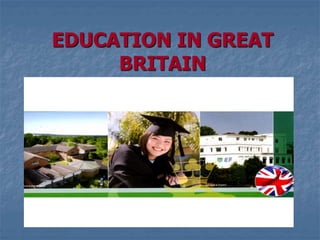
EDUCATION IN GREAT
BRITAIN
New Words
 the system of education
 the state school
 public (private) school
 primary education
 secondary
 further
 infant school
 junior school
 compulsory subjects
 modern school
 comprehensive school
 grammar school
STATE PRIVATE (PUBLIC)
SCHOOLS SCHOOLS
( 90% ) (10 %)
3 stages of education:
 PRIMARY (5-11) - compulsory
 SECONDARY (11-16) - compulsory
 FURTHER (16-18)
INFANT SCHOOLS
(5-7)
JUNIOR SCHOOLS
(7-11)
MODERN SCHOOLS GRAMMAR SCHOOLS
COMPREHENSIVE SCHOOLS
Some notes
 A secondary school may (not) have a Sixth Form or Further
Education college
 The start at Reception (5 y.o) and begin Year 1 (6 y.o.).
Comulsory Education ends at Year 11 (16 y.o) but some
students go on Further Education up to Year 13 (18 y.o.).
 The primary stage covers three age ranges: nursery (under
5), infant (5 to 7 or 8) (Key Stage 1) and junior (up to 11 or
12) (Key Stage 2) but in Scotland and Northern Ireland there
is generally no distinction between infant and junior schools.
 Since September 2010, all three and four year olds are
entitled to 15 hours of free nursery education for 38 weeks of
the year. Early Years education takes place in a variety of
settings including state nursery schools and privately run
nurseries.
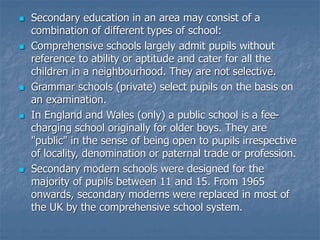
 Secondary education in an area may consist of a
combination of different types of school:
 Comprehensive schools largely admit pupils without
reference to ability or aptitude and cater for all the
children in a neighbourhood. They are not selective.
 Grammar schools (private) select pupils on the basis on
an examination.
 In England and Wales (only) a public school is a fee-
charging school originally for older boys. They are
"public" in the sense of being open to pupils irrespective
of locality, denomination or paternal trade or profession.
 Secondary modern schools were designed for the
majority of pupils between 11 and 15. From 1965
onwards, secondary moderns were replaced in most of
the UK by the comprehensive school system.
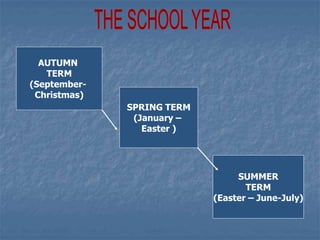
AUTUMN
TERM
(September-
Christmas)
SPRING TERM
(January –
Easter )
SUMMER
TERM
(Easter – June-July)
A lot of people think that school uniforms in
England are for the children from rich families at
the country’s best public schools. But it is not
always true. In fact, uniforms first came to
schools for the poor because they were cheaper.
Today a lot of British schools have uniforms.
SCHOOL TIE
“To be true to your school tie” –
«Быть верным своему школьному галстуку».
Это означает, что и через много лет после
окончания школы выпускники сохраняют
верность своим школьным друзьям. Для
выпускников престижных частных школ такой
галстук является не только символом дружбы
и взаимопомощи, но и пропуском в общество
самых известных и влиятельных людей
страны.
 A* - Excellent
 A – Very good
 B – Good
 C – Satisfactory
 D – Poor
 E – Very poor
 F – Awful
 English schools offer a wide range of extracurricular activities
( school orchestra, music ensembles, sports, and etc. )
 7 % of British schoolchildren go to
the private schools. Parents pay
for these schools. The most
famous schools are called public
schools and they have long
history and traditions. Children of
wealthy or aristocratic families
often go to the same public
schools as their parents and
grandparents. The teachers of the
private schools pay personal
attention to each pupil. Boys and
girls don’t study together at these
schools.
 Eton College –the most famous
English all boys public school.
COLLEGES
Some 16 years pupils go
to colleges of further
education to study for
more practical diplomas.
6th FORM COLLEGES
They prepare pupils for a
national exam called
“A” level (advanced level)
at 18. Children need
“A” level to enter a university.
 UNIVERSITIES COLLEGES
 POLYTECHNICS MAGISTRACY
They accept students with A-levels from 18. The oldest and the
most famous universities are Oxford and Cambridge.
Questions
 What are the stages of education in Great Britain?
 Are there any state schools in Great Britain?
 How many % of children attend state schools?
 Are there any private schools? How are they called?
 When do British children begin to go to school?
 Who attends the public schools?
 What is an important element of a school uniform?
 What do you think, is the British system of education
better than ours?
 What are the oldest and the most famous universities in
GB?

School system in UK.ppt

  • 1.
  • 2.
    New Words  thesystem of education  the state school  public (private) school  primary education  secondary  further  infant school  junior school  compulsory subjects  modern school  comprehensive school  grammar school
  • 3.
    STATE PRIVATE (PUBLIC) SCHOOLSSCHOOLS ( 90% ) (10 %) 3 stages of education:  PRIMARY (5-11) - compulsory  SECONDARY (11-16) - compulsory  FURTHER (16-18)
  • 4.
    INFANT SCHOOLS (5-7) JUNIOR SCHOOLS (7-11) MODERNSCHOOLS GRAMMAR SCHOOLS COMPREHENSIVE SCHOOLS
  • 5.
    Some notes  Asecondary school may (not) have a Sixth Form or Further Education college  The start at Reception (5 y.o) and begin Year 1 (6 y.o.). Comulsory Education ends at Year 11 (16 y.o) but some students go on Further Education up to Year 13 (18 y.o.).  The primary stage covers three age ranges: nursery (under 5), infant (5 to 7 or 8) (Key Stage 1) and junior (up to 11 or 12) (Key Stage 2) but in Scotland and Northern Ireland there is generally no distinction between infant and junior schools.  Since September 2010, all three and four year olds are entitled to 15 hours of free nursery education for 38 weeks of the year. Early Years education takes place in a variety of settings including state nursery schools and privately run nurseries.
  • 6.
     Secondary educationin an area may consist of a combination of different types of school:  Comprehensive schools largely admit pupils without reference to ability or aptitude and cater for all the children in a neighbourhood. They are not selective.  Grammar schools (private) select pupils on the basis on an examination.  In England and Wales (only) a public school is a fee- charging school originally for older boys. They are "public" in the sense of being open to pupils irrespective of locality, denomination or paternal trade or profession.  Secondary modern schools were designed for the majority of pupils between 11 and 15. From 1965 onwards, secondary moderns were replaced in most of the UK by the comprehensive school system.
  • 7.
  • 8.
    A lot ofpeople think that school uniforms in England are for the children from rich families at the country’s best public schools. But it is not always true. In fact, uniforms first came to schools for the poor because they were cheaper. Today a lot of British schools have uniforms. SCHOOL TIE “To be true to your school tie” – «Быть верным своему школьному галстуку». Это означает, что и через много лет после окончания школы выпускники сохраняют верность своим школьным друзьям. Для выпускников престижных частных школ такой галстук является не только символом дружбы и взаимопомощи, но и пропуском в общество самых известных и влиятельных людей страны.
  • 9.
     A* -Excellent  A – Very good  B – Good  C – Satisfactory  D – Poor  E – Very poor  F – Awful
  • 10.
     English schoolsoffer a wide range of extracurricular activities ( school orchestra, music ensembles, sports, and etc. )
  • 11.
     7 %of British schoolchildren go to the private schools. Parents pay for these schools. The most famous schools are called public schools and they have long history and traditions. Children of wealthy or aristocratic families often go to the same public schools as their parents and grandparents. The teachers of the private schools pay personal attention to each pupil. Boys and girls don’t study together at these schools.  Eton College –the most famous English all boys public school.
  • 12.
    COLLEGES Some 16 yearspupils go to colleges of further education to study for more practical diplomas. 6th FORM COLLEGES They prepare pupils for a national exam called “A” level (advanced level) at 18. Children need “A” level to enter a university.
  • 13.
     UNIVERSITIES COLLEGES POLYTECHNICS MAGISTRACY They accept students with A-levels from 18. The oldest and the most famous universities are Oxford and Cambridge.
  • 14.
    Questions  What arethe stages of education in Great Britain?  Are there any state schools in Great Britain?  How many % of children attend state schools?  Are there any private schools? How are they called?  When do British children begin to go to school?  Who attends the public schools?  What is an important element of a school uniform?  What do you think, is the British system of education better than ours?  What are the oldest and the most famous universities in GB?