1 
PSYCHOLOGY OF LEARNING 
Unit Structure : 
1.0 Objective 
1.1 Introduction 
1.2 Meaning and Definition of Educational psychology 
1.3 Nature Of Educational Psychology 
1.4 Scope of Educational Psychology 
1.0 OBJECTIVE 
After going through this unit carefully you should be able to 
• Define Educational Psychology. 
• Explain the nature of Educational Psychology. 
• List out the functions of Educational Psychology. 
1.1 INTRODUCTION 
This is the first unit of the second paper of Psychology of 
Learning. This course deals with the importance and contribution of 
educational psychology on the theory and practice of education. 
every teacher is confronted with the problem of individuals 
difference in the classroom. The purpose of this unit is to define the 
concept of educational Psychology. It describes meaning and 
nature of Educational Psychology. An attempt has also been made 
to describe the characteristics and meaning of learning. 
1.2 MEANING AND DEFINITION OF EDUCATIONAL 
PSYCHOLOGY 
Educational Psychology and consists of two words 
Psychology and Education. While Genral Psychology is a pure 
science. Educational Psychology is its application in the field of 
education with the aim of socializing man and modifying his 
behaviour. According to Crow and Crow Educational Psychology 
describes and explains the learning experiences of an individual 
from birth through old age. Skinner defines Educational Psychology 
as “that branch of Psychology which deals with teaching and 
learning”
2 
Stephen – “Educational Psychology is the systematic study 
of the educational growth and development of a child.” 
Judd – “Educational Psychology is the Science which 
explains the changes that take place in the individuals as they pass 
through the various stages of development.” Peel- “Educational 
Psychology is the science of Education.” 
Educational psychology is one of the branches of applies 
psychology concerned with the application of the principles, 
techniques and other resourse of psychology to the solution of the 
problems confronting the teacher attempting to direct the growth of 
children toward defined objectives. More specifically, we can say 
educational psychology is concerned with an understanding of: 
• The child, his development, his need and his potentialities. 
• The learning situation including group dynamics as the affect 
learning. 
• The learning process its nature and the ways to make it 
effective. Stated differently, the Central theme of Educational 
Psychology is Psychology of learning. 
PSYCHOLOGY OF LEARNING 
This area is concerned with such problems as : How do 
children acquire skills? When is learning more effective? What are 
the factors that help the learning Process? How do we measure the 
amount of learning? Are there any economic methods of 
memorizing? Why do we forget? Can memory be improved? Dose 
the study of Sanskrit helps than study of Hindi? 
Psychology helps the teacher to get answers to these 
questions. It tells us that learning becomes more effective if factors 
like motivation and interest are taken into consideration by every 
teacher. The knowledge of psychology has helped the teacher in 
modifying her approach to the teaching learning process. 
The study of educational Psychology has brought about 
change in the approach and therefore we have child centred 
education. Psychological principles are used in formulation 
curriculum for different stage. Attempts are made to provide 
subjects and activities in the curriculum which are in conformity with 
the needs of the students, their developmental characteristics, 
learning patterns and also needs of the society. 
1.3 NATURE OF EDUCATIONAL PSYCHOLOGY 
Following are the important characteristics of the nature of 
educational psychology:
3 
• It is an applied branch of fundamental Psychology. 
• It combines two fields i.e. education and psychology. 
• It is the scientific study of human behaviour in educational 
situation. 
• It is concerned with these factors, principles and techniques 
which relate to the various aspects of child’s growth and 
development. 
• It is concerned with learning situation and process by which 
learning can be more efficient and effective. 
• Educational Psychology, draws heavily from various 
branches of psychology, biology sociology and anthropology 
• Educational Psychology is not as exact as natural sciences 
since the human behavior cannot be predicated exactly, 
because it is dynamic. 
• Educational Psychology is a science of education dealing 
primarily with how, when and what of education. 
• It is not a normative a science as it is not concerned with the 
value of educational and doesn’t concern itself with and 
‘What ought to be.” It only describes what it is, it is an 
applied positive science. 
• While psychology deals with the behaviour of all individuals 
in all walks of life. Educational Psychology limits its dealing 
with the behaviour of the pupil in relation to Educational 
environment. 
• It does not concern with what and why of education it gives 
the necessary knowledge and skill (Technical Guidance) for 
giving education the pupil in a satisfactory way. 
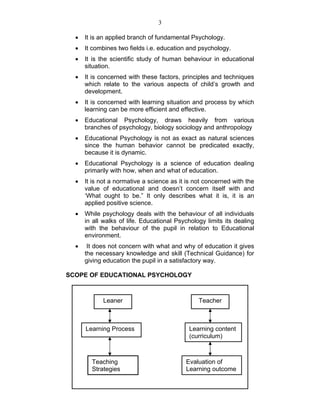
SCOPE OF EDUCATIONAL PSYCHOLOGY 
Leaner Teacher 
Learning Process Learning content 
(curriculum) 
Teaching 
Strategies 
Evaluation of 
Learning outcome
4 
1.4 SCOPE OF EDUCATIONAL PSYCHOLOGY 
Five major areas covered by Educational Psychology are: 
• The Learner 
• The learning Process 
• The learning Situation 
• The Teaching Situation 
• Evaluation of Learning Performance 
• The Teacher 
The Learner 
Educational Psychology aquaints us with need of knowing 
the leaves and deals with the techniques of knowing him well. 
Following are the topics studied included in it: the innate abilities 
and capabilities of the individual differences and their 
measurements, the overt, convert, conscious as well as 
unconscious behaviour of the learner, the characteristics of his 
growth and development at each stage beginning from childhood to 
adulthood. 
The Learning Process 
After knowing the learner and deciding what learning 
experiences are to be provided, the emerging problem is to help 
learner in acquiring these learning experiences with ease and 
confidence. 
Hence, it deals with the nature of learning and how it take 
place and contains the topics such as laws, principles and theories 
of learning; remembering and forgetting, perceiving, concept 
formation, thinking, reasoning process, problem solving, transfer of 
training, ways and means of effective learning etc. 
Learning Situation 
It also deals with the environment factors and learning 
situation which come midway between the learner and the teacher. 
Topics like classroom climate and group dynamics techniques and 
aids which facilitate learning, evaluation techniques, and practices, 
guidance and counseling etc. which help in the smooth functioning 
of the teaching learning process. 
Teaching Situation 
It suggests the techniques of teaching. It also helps in 
deciding what learning situation should be provided by teacher to 
learner according to his mental and physical age, his previous
5 
knowledge and interest level. By describing the learner’s 
characteristics, what teaching aids are appropriate for the particular 
subject 
Evaluation of Learning Performance 
Main objective of education is allround development of the 
learner. It includes cognitive, affective and psychomotor aspects of 
personality. Educational Psychology suggests various tool and 
techniques for assessment and evaluation such as performance 
test, oral test and written test. It does not stop at measurement 
only, after the testing results of the test are anyslysed causes for 
poor performance, backwardness in any aspect of development is 
corrected by maladjustment are helped by guidance and 
counselling study habit, examination techniques and learning styles 
are analysed and helped the learner so that he can overcome the 
difficulties. 
The Teacher 
Educational Psychology emphasizes the need of knowing 
the self for a teacher to play his fole properly in the process of 
education. it throws light on the essential personality traits, 
interests, aptitudes, the characteristics of effective teaching etc., so 
as to inspire, help teacher handle the stress, conflict and anxicty by 
giving insight in their own personality. 
Unit End Exercises : 
1) Knowledge of Educational Psychology helps teacher in …. 
A) Obtaining the B.Ed. degree 
B) It is ethical to have the knowledge of Educational 
Psychology. 
C) Improving the socio-emotional climate of the class. 
D) Teaching the special type of children. 
2) Educational Psychology aims to …… 
A) To decide the future of the learner 
B) To forecast the future behaviour of the learner. 
C) Improve learning situation by desending learning’s needs 
and interest. 
D) To control the Educational Programme. 
™™™™
2 
METHODS OF STUDYING PSYCHOLOGY 
OF LEARNING 
A] INTROSPECTION B] OBSERVATION 
C] EXPREMINENTAL 
Unit Structure : 
2.0 Objectives 
2.1 Introduction 
2.2 Introspection Method 
2.3 Observation Method 
2.4 Experimental Method 
2.0 OBJECTIVES 
After reading this unit, you will be able to: 
• Describe the Introspection method 
• State the merits and demerits on Introspection method 
• Describe the observation method 
• State the merits and demerits of observation method 
• Explain the steps and demerits of observation method 
• Explain the steps of experimental method 
• State the merits and demerits of experimental method 
• Describe the clinical method 
• State the merits and demerits of clinical method 
2.1 INTRODUCTION 
Dear students in the preceding section, you have analysed 
the nature, definition, scope and function of psychology of learning. 
We have also discussed the psychological concept of learing. 
In this unit, we will describe the important methods of 
studying psychology of learning. Students all the method to study 
psychology of learning are basically methods of general 
psychology.
7 
A brief review of the development of methods will be helpful 
for you to understand the important of the subject in greater 
perspective. 
The first effort of conducting systematic experimental studies 
in psychology was stared in 1879 in Germany with the 
establishment of first laboratory of psychology by William Wundt. 
The next important method of collecting data was evolved 
with the development of psychoanalysis an independent system of 
psychology by Sigmund Freud who emphasized importance of 
unconscious in understanding the behaviour. In the second decade 
of 20th century, psychology developed as an objective science of 
behaviour by the efforts of Pavlov Watson and Guthrie. 
Experimental and observation methods were developed to collect 
data to study behaviour. Simultaneously testing movement started 
with the introduction of statistics in psychology. 
Students here we will study only the following methods of 
studying psychology of learning. They are: 
A] Introspection method 
B] Observation method 
C] Experimental method 
2.2 INTROSPECTION METHOD 
Students at many times, when you have experienced an 
emotion like anger or fear you begin to think reasons for the state of 
yours. 
You say, “Why have I been annoyed over this or that? Why 
been afraid of such things” The analysis of your emotional state 
may take place simultaneously with the emotion or it may be done 
after the emotional state is over. In whatever manner it is done, it 
gives you an understanding, though rudimentary of your mind. This 
method of probing into your mental processes is a method of 
introduction utilized by psychologists in a much-refined manner. 
Let us see in detail what do we mean by Introduction and its 
merits and demerits. 
What we mean by introspection 
Introduction is a method of self-observation. The word 
‘Introspection is made up of two Latin words. “Intro” meaning within 
and “Aspection” meaning looking. Hence it is a method where an 
individual is looking within one self.
8 
Angel considered it as “looking inward”. In Introduction the 
individual peeps into his own mental state and observes his own 
mental processes. 
Stout considers that ‘to introspect is to attend to the working 
of one’s own mind in a systematic way’. 
Introspection method is one of the oldest methods to collect 
data about the conscious experiences of the subject. It is a process 
of self – examination where one perceives, analyses and reports 
one’s own feelings. Let us learn this process with the help of an 
example, suppose you are happy and in the state of happiness you 
look within yourself. It is said you are introspecting your own mental 
feelings and examining what is going on in your mental process in 
the state of happiness. Similarly, you may introspect in state of 
anger or fear; etc Introspection is also defined as the notice, which 
the mind takes of itself. 
Let us see the stages distinguished in introspection. 
Students there are three clear stages in introspection. 
1. During the observation of external object, the person beings to 
ponder over his own mental states. For example While listening 
to the music, which is to him pleasant or unpleasant he starts 
thinking about his own mental state. 
2. The person begins to question the working of the his own mind. 
He thinks and analyses: Why has he said such and such thing? 
Why as he talked in a particular manner? And so on. 
3. he tries to frame the laws and conditions of mental processes: 
He thinks in terms of improvement of his reasoning or the 
control of his emotional stages. This stage of that of the 
scientific methods for the advancement of our scientific 
knowledge. 
Characteristics of Introspection: 
Introspection being self- observation has the following 
characteristics: 
1. The subject gets direct, immediate and intuitive knowledge 
about the mind. 
2. The subject has actually to observe his own mental processes. 
He cannot speculate about them. 
Students, Introduction Method was widely used in the past. 
Its use in modern time is being questioned. It is considered 
unscientific and not in keeping with psychology which has recently
9 
emerged out as a positive science however we may say that it is 
still being used by psychologists and though its supremacy is 
undetermined, yet it is not totally discarded. 
Merits of Introspection Method: 
• It is the cheapest and most economical method. We do not 
need any apparatus or laboratory for its use. 
• This method can be used any time and anywhere you can 
introspect while walking, traveling, sitting on a bed & so on. 
• It is the easiest method and is readily available to the 
individual. 
• The introspection data are first hand as the person himself 
examines his own activities. 
• Introspection has generated research which gradually led to 
the development of more objective methods. 
• It is still used in all experimental investigation. 
• It is the only method with the help of which and individual 
can know his emotions and feelings. 
William James has pointed out the importance of this 
method in these words. “Introspective observation is what we have 
to rely on first and foremost and always. The word introspection can 
hardly be defined-it means, of course, looking into our own minds 
and reporting what we there discover. Everyone agrees that we 
there discover states of consciousness. So far as I know, the 
existence of such states has never been doubled by my critic, 
however skeptical in other respects we may have been.” 
Limitations of Introspection Methods: 
• In introspection, one needs to observe or examine one’s mental 
processes carefully in the form of thoughts, feeling and 
sensation. The state of one’s mental processes is continuously 
changing therefore when one concentrates on introspecting a 
particular phase of one’s mental activity that phase passes off. 
For example when you get angry at something and afterwards 
sit down to introspect calmly the state of anger is sure to have 
passed off and so what you try to observe is not what is 
happening at that time with yourself but what had happened 
sometime before. 
• The data collected by introspection cannot be verified. An 
individual may not pass through the same mental state again. 
There is no independent way of checking the data. 
• The data collected by introspection lacks validity and reliability. 
It is impossible to acquire validity and exactness in self-observation 
of one’s own mental processes.
10 
• The data collected by introspection in highly subjective. It has 
danger of being biased and influenced by preconceptions of the 
individual. 
• The observer and the observed are the same. Hence there is 
ample scope fro the individual to lie deliberately and hide the 
facts to mislead. 
• Introspection cannot be applied to children, animal and 
abnormal people. It requires highly trained and skilled workers 
to introspect. 
• Introspection us logically defective because one and the same 
person is the experiencer and observer. It is not possible for the 
same individual to act as an experiencer as well as an observer. 
There introspection is logically defective. 
Conclusion: 
The limitations of introspection can be overcome by practice 
and training, by remaining alter during introspection and by 
comparing results obtained by experts. 
Check Your Progress: 
Note a] Write your answers in the space given below. 
b] Compare your answers with those given at the end of the 
unit. 
1] Fill in the blanks: 
A] Introspection is a method of ------------- 
B] The word introspection is made up of two Latin words --------- 
- and 
2.3 OBSERVATION METHOD 
Student we observe so many things in nature. We also 
observe the action and behaviour of others and form our own 
notions about these person. We look at other persons, listen to their
11 
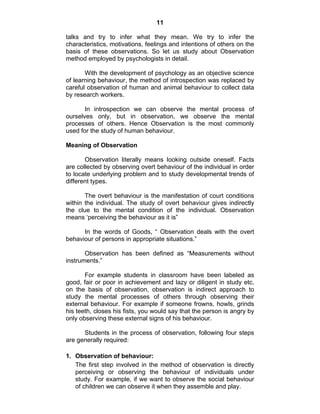
talks and try to infer what they mean. We try to infer the 
characteristics, motivations, feelings and intentions of others on the 
basis of these observations. So let us study about Observation 
method employed by psychologists in detail. 
With the development of psychology as an objective science 
of learning behaviour, the method of introspection was replaced by 
careful observation of human and animal behaviour to collect data 
by research workers. 
In introspection we can observe the mental process of 
ourselves only, but in observation, we observe the mental 
processes of others. Hence Observation is the most commonly 
used for the study of human behaviour. 
Meaning of Observation 
Observation literally means looking outside oneself. Facts 
are collected by observing overt behaviour of the individual in order 
to locate underlying problem and to study developmental trends of 
different types. 
The overt behaviour is the manifestation of court conditions 
within the individual. The study of overt behaviour gives indirectly 
the clue to the mental condition of the individual. Observation 
means ‘perceiving the behaviour as it is” 
In the words of Goods, “ Observation deals with the overt 
behaviour of persons in appropriate situations.” 
Observation has been defined as “Measurements without 
instruments.” 
For example students in classroom have been labeled as 
good, fair or poor in achievement and lazy or diligent in study etc. 
on the basis of observation, observation is indirect approach to 
study the mental processes of others through observing their 
external behaviour. For example if someone frowns, howls, grinds 
his teeth, closes his fists, you would say that the person is angry by 
only observing these external signs of his behaviour. 
Students in the process of observation, following four steps 
are generally required: 
1. Observation of behaviour: 
The first step involved in the method of observation is directly 
perceiving or observing the behaviour of individuals under 
study. For example, if we want to observe the social behaviour 
of children we can observe it when they assemble and play.
12 
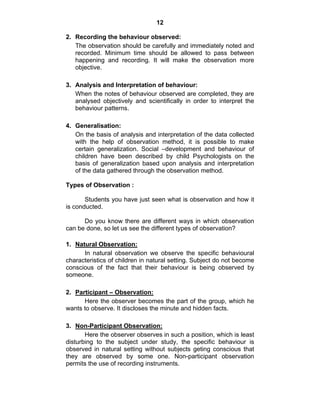
2. Recording the behaviour observed: 
The observation should be carefully and immediately noted and 
recorded. Minimum time should be allowed to pass between 
happening and recording. It will make the observation more 
objective. 
3. Analysis and Interpretation of behaviour: 
When the notes of behaviour observed are completed, they are 
analysed objectively and scientifically in order to interpret the 
behaviour patterns. 
4. Generalisation: 
On the basis of analysis and interpretation of the data collected 
with the help of observation method, it is possible to make 
certain generalization. Social –development and behaviour of 
children have been described by child Psychologists on the 
basis of generalization based upon analysis and interpretation 
of the data gathered through the observation method. 
Types of Observation : 
Students you have just seen what is observation and how it 
is conducted. 
Do you know there are different ways in which observation 
can be done, so let us see the different types of observation? 
1. Natural Observation: 
In natural observation we observe the specific behavioural 
characteristics of children in natural setting. Subject do not become 
conscious of the fact that their behaviour is being observed by 
someone. 
2. Participant – Observation: 
Here the observer becomes the part of the group, which he 
wants to observe. It discloses the minute and hidden facts. 
3. Non-Participant Observation: 
Here the observer observes in such a position, which is least 
disturbing to the subject under study, the specific behaviour is 
observed in natural setting without subjects geting conscious that 
they are observed by some one. Non-participant observation 
permits the use of recording instruments.
13 
4. Structure Observation: 
Here the observer in relevance sets up a form and 
categories in terms of which he wishes to analyse the problem. The 
observer always keeps in view 
a] A frame of reference 
b] Time units. 
c] Limits of an act 
5. Unstructured Observation: 
This is also called as uncontrolled or free observation. It is 
mainly associated with participant observation in which the 
observer assumes the role of a member of the group to be 
observed. Here the individual is observed when he is in his class, 
playground or when he is moving about with his friends and class 
follows without knowing that he is being observed. 
Observation is very useful method to study child and his 
behaviour. Student’s observation method, being commonly used 
method psychology has following merits: 
Merits of Observation Method 
1. Being a record of actual behaviour of the child, it is more reliable 
and objective. 
2. It is an excellent source of information about what actually 
happens in classroom. 
3. It is a study of an individual in a natural situation and is therefore 
more useful than the restricted study in a test situation. 
4. The method can be used with children of all ages. Younger the 
child, the easiest it is to observe him. This method has been 
found very useful with shy children. 
5. it can be used in every situation, physical- activities, workshop 
and classroom situations as well. 
6. It is adaptable both to the individuals and the groups. 
Although observation is regarded as an efficient method for 
psychological studies, students yet it suffers from the following 
drawbacks limitations: 
Limitations: 
1. There is great scope for personal prejudices and bias of the 
observer. The observers interest, values can distort observation.
14 
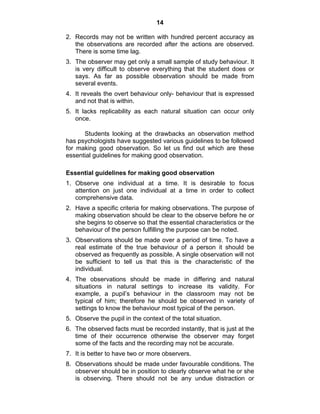
2. Records may not be written with hundred percent accuracy as 
the observations are recorded after the actions are observed. 
There is some time lag. 
3. The observer may get only a small sample of study behaviour. It 
is very difficult to observe everything that the student does or 
says. As far as possible observation should be made from 
several events. 
4. It reveals the overt behaviour only- behaviour that is expressed 
and not that is within. 
5. It lacks replicability as each natural situation can occur only 
once. 
Students looking at the drawbacks an observation method 
has psychologists have suggested various guidelines to be followed 
for making good observation. So let us find out which are these 
essential guidelines for making good observation. 
Essential guidelines for making good observation 
1. Observe one individual at a time. It is desirable to focus 
attention on just one individual at a time in order to collect 
comprehensive data. 
2. Have a specific criteria for making observations. The purpose of 
making observation should be clear to the observe before he or 
she begins to observe so that the essential characteristics or the 
behaviour of the person fulfilling the purpose can be noted. 
3. Observations should be made over a period of time. To have a 
real estimate of the true behaviour of a person it should be 
observed as frequently as possible. A single observation will not 
be sufficient to tell us that this is the characteristic of the 
individual. 
4. The observations should be made in differing and natural 
situations in natural settings to increase its validity. For 
example, a pupil’s behaviour in the classroom may not be 
typical of him; therefore he should be observed in variety of 
settings to know the behaviour most typical of the person. 
5. Observe the pupil in the context of the total situation. 
6. The observed facts must be recorded instantly, that is just at the 
time of their occurrence otherwise the observer may forget 
some of the facts and the recording may not be accurate. 
7. It is better to have two or more observers. 
8. Observations should be made under favourable conditions. The 
observer should be in position to clearly observe what he or she 
is observing. There should not be any undue distraction or
15 
disturbances. One should also have an attitude free from any 
biases or prejudices against the individual being observed. 
9. Data from observations should be integrated with other data. 
While arriving at the final conclusion about the individual, one 
should put together all that we know about the individual from 
the other sources then we can give an integrated and 
comprehensive picture of the individual. 
These precautions must be borne in mind in order to have 
reliable observations. 
Check Your Progress: 
Note: a] Write your answer in the space given below: 
b] Compare your answer with those given at the end: 
2] A] Fill in the blanks: 
1] Observation has been defined as ‘_________ without 
______” 
B] Mention four types of observation : 
1] __________ 2] __________ 
3] __________ 4] __________ 
C] List the steps involved in observation method: 
1] __________ 2] ___________ 
3] __________ 4] ___________ 
2.4 EXPERIMENTAL METHODS 
Students till now, we saw introspection method and 
observation method used in psychology of learning. But these 
methods lack scientific objectivity and validity. Experimental method 
is the most scientific and objective method of studying behaviour. It 
is the method, which is responsible for assigning the status of 
Science to psychology. So let us learn more about this 
Experimental method. 
In 1879, William Wundt established the first psychological 
laboratory at Leipzing in Germany. Since then experimental method 
in psychology has become popular, Experimental method consists 
of actions of actions performed under prearranged or rigidly 
controlled conditions. 
Here the emphasis is on experimentation. Experimentation is 
where the investigator controls the educative factors to which a 
group of children are subjected during the period of inquiry and 
observes the resulting achievement.
16 
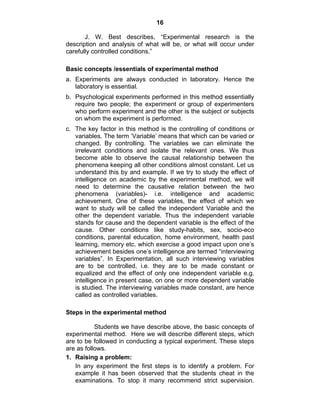
J. W. Best describes, “Experimental research is the 
description and analysis of what will be, or what will occur under 
carefully controlled conditions.” 
Basic concepts /essentials of experimental method 
a. Experiments are always conducted in laboratory. Hence the 
laboratory is essential. 
b. Psychological experiments performed in this method essentially 
require two people; the experiment or group of experimenters 
who perform experiment and the other is the subject or subjects 
on whom the experiment is performed. 
c. The key factor in this method is the controlling of conditions or 
variables. The term ’Variable’ means that which can be varied or 
changed. By controlling. The variables we can eliminate the 
irrelevant conditions and isolate the relevant ones. We thus 
become able to observe the causal relationship between the 
phenomena keeping all other conditions almost constant. Let us 
understand this by and example. If we try to study the effect of 
intelligence on academic by the experimental method, we will 
need to determine the causative relation between the two 
phenomena (variables)- i.e. intelligence and academic 
achievement. One of these variables, the effect of which we 
want to study will be called the independent Variable and the 
other the dependent variable. Thus the independent variable 
stands for cause and the dependent variable is the effect of the 
cause. Other conditions like study-habits, sex, socio-eco 
conditions, parental education, home environment, health past 
learning, memory etc. which exercise a good impact upon one’s 
achievement besides one’s intelligence are termed “interviewing 
variables”. In Experimentation, all such interviewing variables 
are to be controlled, i.e. they are to be made constant or 
equalized and the effect of only one independent variable e.g. 
intelligence in present case, on one or more dependent variable 
is studied. The interviewing variables made constant, are hence 
called as controlled variables. 
Steps in the experimental method 
Students we have describe above, the basic concepts of 
experimental method. Here we will describe different steps, which 
are to be followed in conducting a typical experiment. These steps 
are as follows. 
1. Raising a problem: 
In any experiment the first steps is to identify a problem. For 
example it has been observed that the students cheat in the 
examinations. To stop it many recommend strict supervision.
17 
But it has also been seen that even when there is strict 
supervision there is cheating, hence there crops up the problem 
of cheating under strict supervision or relaxed supervision. This 
problem may lead to experimentation. 
2. Formulation of a hypothesis: 
The next step in experimental method is the formulation of a 
hypothesis that “Strict supervision may lead to less copying in 
the examination as compared to the relaxed supervision. “This 
hypothesis is now to be tested by experiment. 
3. Making a distinction between Independent and dependent 
variables: 
In the example given above the cheating behaviour of the 
students will be dependent variable while the nature of 
supervision will be the independent variable. It is because by 
changing the supervision the cheating behaviour is expected 
change. In the present experiment we manipulate the conditions 
of supervision in order to discover the ways in which they 
determine the dependent variable that is the cheating 
behaviour. We may observe the effect of supervision in the 
experimental situation and also the effect of relaxed supervision 
under similar conditions and with the same group of students. 
4. Controlling the situational variables: 
The experiment will not give valid results unless the situational 
variables are controlled. If the experiment is conducted with 
different set of students who have been trained in a different 
manner of have a different value system then the results will be 
different in comparison to those who have been subjected to 
experiment earlier. Similarly the other conditions like the person 
who is supervising the place of supervision etc. have to be 
controlled. This means that all those conditions, which might 
affect the dependent variable, are to e controlled. Since in any 
experiment there are numerous conditions which are needed to 
be controlled it is many a time difficult to do so. Hence we take 
recourse to various types of experimental designs, which we 
have described earlier. 
5. Analysis of the Results: 
Once the experiment is concluded the results are analysed. In 
our example we may apply simple percentages to find out in 
which type of supervision a higher percentage of students have 
copied. Many a times we apply more sophisticated statistics to 
analyse the results.
18 
6. Verification of Hypothesis: 
The last step in the experimental method is the verification of 
the hypothesis, which we have earlier framed. The result of the 
experiment exhibits whether the hypothesis which we have 
earlier framed. The result of the experiment exhibits whether the 
hypothesis is accepted of refuted. We may find that strict 
supervision leads to less copying. In that case we may conclude 
that our hypothesis is accepted. If the results are otherwise then 
our conclusion will be that the hypothesis is refuted. 
Experimental Designs: 
Students Experimental method is the most precise, planed, 
systematic and controlled method. It uses a systematic procedure 
called as experimental design. The term experimental design has 
tow different meanings one is the experimental design which 
represents the six basic steps we have referred above? Followed in 
an experiment. The second meaning of experimental design and 
selecting an appropriate statistical procedure. Experimental design 
provides important guidelines to the researcher to carry out his 
research study. Experimental design ensures adequate controls by 
avoiding irrelevant causes of variability. The layout of a design 
depends on the type of the problem the investigator wants to 
investigate. Students you should know that, no one design solves 
all the problems of a research study. 
A variety of experimental designs have been developed by 
researchers in recent years. These designs differ as these are 
dependent upon: 
a) the nature of problem 
b) the situation 
c) the subjects and their availability. 
Let us study some of the experimental designs used while 
employing Experiment method. 
Following are the samples of experimental designs. 
(A) One Group Design 
1. One group posttest design: This type of design is the simplest 
ones. It is commonly called pre-experimental design. Students 
in such type of experiment no formal comparison is possible for 
there is no second group with comparison can be made. Let us 
illustrate with an example: suppose a teacher treats 10 students 
who are addicted to smoking in a period of three months. At the 
end of the period six students give up smoking. Such type of 
designs do not control any of the sources of invalidity.
19 
2. One group pretest-posttest design: This is also simple design 
and is considered to be a rather poor design though better than 
one group posttest design. In this design the experimenter first 
tests a group on some aspects of behhaviour and then gives 
special treatment. He statistically analyses the data and 
calculates the difference between the pretest and posttest 
scores of the group. 
The paradigm of the design is as follows: 
Pretest Independent variable Posttest 
T1 X T2 
Example, Suppose in the beginning of the semester, we 
administer test of educational psychology to students of MA 
education and then we teach them the subject through out the 
semester. At the end of the semester we administer posttest (T2), 
and find out the difference between the scores on the initial and 
final tests. 
(B) Two Group Designs 
Researches in education and psychology have often been 
criticized of being loosely controlled. In recent year more rigorous 
designs have been evolved by using statistics to make researches 
more scientific more scientific and objective. 
Generally researchers use two parallel group techniques to 
see the effects of an independent variable on some dependent 
variable. Two group are equated on the basis of significant variable. 
One group called experimental and the other is called control 
group. The experimental group is subjected to a certain experience 
or to a specific treatment whereas the control group is not given 
any type of special treatment. After providing special treatment to 
the experimental group, both the groups are administered the same 
final test. The scores are statistically compared and conclusions are 
drawn as regards the effect of special treatment on the 
experimental group. 
1. Randomized Control Group Pretest Posttest Design: The 
researcher in this design follows the procedure as given below. 
i. He selects subject by random method. 
ii. Assigns subjects to groups and X (Treatment) to groups by 
random method. 
iii. Tests the Ss on the dependent variable. 
iv. Keep all conditions the same for both the groups except for 
exposing the experimental S but not the control group to the 
independent variable for a specific time. 
v. Test the ‘Ss’ on the dependent variable.
20 
vi. Finds the difference between the two. 
vii. Compares the results to see whether the application of ‘X’ 
(treatment) caused a change in the experimental group. 
viii. Applies an appropriate statistical procedure. 
2. Matched two group design. A matched two group design is a 
modification of the totally randomized two group design 
described above. In this design, both groups are matched in 
terms of some variable, the experimenter feels he would 
influence the dependent variable. Suppose we want to test the 
retention of two types of words closely associated and 
disassociated. We believe that I. Q. Will influence how well a 
person can retain words so we match the two groups on I. Q. 
Let us be more concrete to understand this point. Suppose 
there are ten subjects with I. Q. as follows: 
(C) Multi group Design with one Independent Variable 
(ANOVAR) 
Two group paradigms are most common in education and 
psychology but events in nature do not always conveniently order 
into two groups. Some times the investigator has to compare the 
effect of different values of some variable or has to see the effect of 
several alternative variables on more than two groups. The 
procedure for carrying out one way analysis of variance (ANOVAR) 
is the same as for two group design. The distinguishing feature 
between the two types of investigation is the type of statistical 
analysis used. 
(D) Factorial Design 
Factorial design is employed where more than one 
independent variables are involved in the investigation. Factorial 
designs may involves several factors. 
(E) Small N Design 
We have briefly mentioned various experimental designs 
which are termed as large N group designs. In all large N group 
designs, the number of subject in classroom situation. In many 
instances, the psychologist or teacher is faced with situations in 
which large N is not possible, for example delinquency, problem of 
indiscipline etc. with the introduction of statistics in psychology, it is 
possible to conduct scientific research on small N group. 
Merits of experimental method 
Experimental method being most precise and scientific has 
following merits:
21 
1. Experimental method is the most systematic method or getting 
reliable data. 
2. Experimental method enables accurate observations due to 
controlled conditions. 
3. It allows us to establish cause effect relationship between 
different phenomena. 
4. The results obtained are valid and reliable. 
5. The findings of the experimental method are verifiable by other 
experiments under identical conditions. 
6. It helps to protect from the subjective opinions. Hence it 
provides objective information about the problem. 
7. it provides adequate information about the problem. 
8. In experimental method experiments are conducted under 
vigorously controlled conditions. The experimenter can control 
the application and withdrawal of independent variables. 
9. Experimental method increases ones knowledge or 
psychological facts in child psychology, social and abnormal 
psychology. 
It is rightly said the experimental method has made psychology 
a science. 
Demerits of the method 
Experimental method suffers from various following 
demerits: 
1. Experimental method is costly and time consuming method as it 
requires a laboratory and apparatus to conduct it properly. 
2. Experiments are conducted in artificially determined pattern of 
behaviour. In real life situation it is quite different. 
3. It needs specialized knowledge and therefore every teacher 
cannot be expected to conduct the experiment. 
4. The scope is limited. All problems of psychology cannot be 
studied by this method as we cannot perform experiments for all 
the problems that may come up in the diverse subject matter of 
psychology. 
5. Accurate measurements in case of human beings are never 
possible. 
6. It is difficult to always control the independent variable therefore 
it is not possible to create desired conditions in laboratory. 
7. It is not possible to reach certainty in matters of social science s 
including educational psychology.
22 
Check Your Progress – 3 
Note a) Write your answer in the space given below 
b) Compare your answer with those given at the end. 
3 A) Fill in the blanks: 
1) _________ established at the first psychological 
laboratory at Leipzig in Germany. 
2) Psychological experiments require two people. 
They are a) ___________ b) ____________ 
3) The key factor in the experimental method is the 
controlling of _____________ 
4) Experimental method has three following variables 
i) __________ ii) ________ iii) _________ 
B) List the steps involved in experimental method: 
a) __________ b) ________ c) ________ 
d) __________ e) ________ f) _________ 
C) List the different experimental designs employed in 
experimental Method: 
a) _________ b) ________ c) _________ 
d) _________ e) ________ 
Conclusion: 
Students we have learnt in the above unit the four methods 
of studying psychology of learning. But which of the above 
discussed methods is the best among other four is a difficult 
questions to be answered. All the four methods have their strengths 
and weakness and possess some unique characteristics, which 
make them highly specific for use in a particular situation. A wise 
psychologist should have a keen insight into the nature of his 
subjects as well as the conditions affecting his work and 
accordingly select a proper method or methods for the objectives. 
Study of the behaviour of his subjects much depends upon the 
sincerity, honesty, ability and experience of the investigator, who 
should always try to keep himself as scientific and objective as 
possible and leave no stone unturned for the overall analysis for the 
behaviour of the subject or nature of the phenomena of the study. 
Unit End Exercises : 
1. Fill in the blanks: 
a) Introspection is method of self-observation. 
b) The word introspection is made up to two Latin Words 
“Intro” & “Aspection”.
23 
2. A) Fill the blanks 
1) Observation has been defined as “Measurements” 
without “ Instruments”. 
2) Observation deals with the overt bahaviour of persons in 
appropriate situation. 
B) The five types of observation 
1) Natural observation 2) Participant observation 
3) Non-participant observation 4) Structured observation 
5) Unstructured observation. 
C) The steps involved in observation methods are: 
1) Observation of behaviour 
2) Recording the behaviour observed 
3) Analysis and interpretation of behaviour 
4) Generalization 
3. A) Fill in the blanks: 
1) William Wundt established the first psychological at 
Leipzig in Germany. 
2) Psychological experiments required two people. 
They are a) Experimenter b) Observer 
3) The key factor in the experimental method is the 
controlling of variables. 
4) Experimental method has three following variable 
i) Independent variable 
ii) Dependent variable 
iii) Controlled variable 
B) The steps involved in experimental method are: 
a) Raising ;a problem 
b) Formulation of hypothesis 
c) Making a distinction between independent and 
dependent variable 
d) controlling the situational variables 
e) Analysis of result 
f) Verification of hypothesis
24 
C) The different experimental design employed in 
experimental Method. 
a) One group design 
b) Two group design 
c) Multi group with one –Independent variable (ANOVA) 
d) Factorial design 
e) Small N design 
4. A) Fill in the blanks 
i) Clinical method includes clinical-study where in-depth 
study of an individual is done. 
ii) Clinical method employs both method of diagnosis and 
treatment in dealing with an individual case. 
B) The different sources used for collecting information 
about the individual are: 
i) Identifying data 
ii) Environmental background 
iii) developmental history 
iv) History of exceptional behaviour 
C) The different ways in which the problem of an 
individual is diagnosed 
i) Adequate physical checkup 
ii) Making out the case history 
iii) The clinical interview 
iv) Direct observation of behaviour 
v) Using tests and measuring devices. 
D) The two ways in which the changes are brought 
about in their behaviour of the individual for 
treatment of his/her problem. 
a) Modifying the environmental forces 
b) Modifying the individuals attitude 
Textual Questions : 
1. Describe introspection method along with its merits and 
demerits? 
2. How will you use the observation method to study child’s 
behaviour? 
3. Discuss the essential guidelines for making good observations?
25 
4. Discuss the merits and limitations of experimental method? 
5. Why is experimental method considered excellent method of 
collecting data? 
6. Describe fully the clinical method and bring out in detail the 
merits and limitations of this method? 
Reference: 
1. Aggarwal J. C. : Essentials of Educational Psychology, 
Vikas Publishing House Pvt. Ltd., 
1996, New Delhi. 
2. Mangal S. K. : Advanced Educational Psychology 
Prentice –Hall of India Pvt. Ltd., New 
Delhi, 1993. 
3. Dr. Mathur S. S. : Educational Psychology, Vinod Pustar 
Mandir, Agra, 2001. 
4. Dr. Walia J. S. : Foundations of Education Psychology, 
Paul Publishers Jalaudhar, 1996. 
™™™™
3 
GROWTH AND DEVELOPMENT 
Unit Structure 
3.0 Learning Objectives 
3.1 Introduction 
3.2 Human Development 
3.2.1 The Concept of Growth and Development 
3.2.2 Principles of Growth and Development 
3.3 Stages of Development 
3.4 Developmental Characteristics of Children and Adolescents: 
Physical, Cognitive, Emotional and Social aspects 
3.4.1 Developmental Characteristics of Infancy (Birth to 2 
Years) 
3.4.2 Developmental Characteristics of Early Childhood (Age 2- 
6 Years) 
3.4.3 Developmental Characteristics of Late Childhood (Age 6- 
12 Years) 
3.4.4 Developmental Characteristics of Adolescents (Age 12-18 
Years) 
3.5 Role of the Teacher in Facilitating Growth and Development 
3.6 Let Us Sum Up 
3.7 Suggested Readings 
3.0 OBJECTIVES 
This unit will help you learn the concept, the broad principles, 
the stages and developmental characteristics of growth and 
development. After going through this unit, you should be able to: 
• Explain the concept of growth and development. 
• Differentiate between growth and development. 
• Explain the principles of growth and development. 
• Describe the stages of human growth and development. 
• Describe the characteristics of each stage of human growth 
and development.
27 
• Discuss the educational implications of the principles of 
growth and development. 
• Explain the role of the teacher in the facilitation of growth and 
development during adolescence. 
3.1 INTRODUCTION 
Human beings keep changing. During their lives, they 
change in size, appearance and psychological makeup. The way 
they change differs from individual to individual. However, the 
fundamental underlying patterns of growth and development remain 
more or less the same and take place in an orderly way. Each 
individual, with his unique heredity and the way he is nurtured, 
determines the way he traverses the broad highway of his life at his 
rate of progress. He will attain the size, shape, capacities and 
developmental status in a way, which is peculiar to him at each 
stages of life. 
In this unit, we shall discuss the concept, principles and 
various stages of growth & development. Children differ in physical, 
cognitive, social, and emotional growth patterns. They also differ in 
the ways they interact with and respond to their environment as 
well as play, affection. Having an understanding of the sequence of 
growth and development prepares teachers to help and give 
attention to all the children. 
3.2 HUMAN DEVELOPMENT 
Can you recall events from your early childhood say the 
second or third year? You might have a few vague and blurred 
memories about your childhood. The experiences of that period 
form the basis of the type of person you are today. How human 
beings grow, change and adjust themselves to their environment is 
the focus of development and behaviour as also the concepts, 
principles and theories of growth of development. 
The human being is never static. From conception to death, 
he undergoes changes. There are progressive changes in 
response to environmental conditions. His body organs and 
psychological functions show the curves of capacity and 
achievement as well as slow erosion and decay. Cognitive abilities 
develop and then degenerate; basic metabolism reaches a peak, 
then declines, the endocrine function flourishes, and then fades. 
There is a rise and fall of physical energy in terms of both the force 
and speed of action with age. In fact, no organ or function of human 
beings has yet been found which is independent of age 
determinants. At the time of conception, a child has genetic 
potentialities that are partly predictable and partly unpredictable.
28 
These genetic potentialities are determined by the nature of his 
biological inheritance. Still there is room for a tremendous range in 
the ways he uses the genetic potentialities, depending upon the 
environment that may help or hinder the development of those 
potentialities. 
3.2.1 The Concept of Growth and Development 
The terms growth and development are often used 
interchangeably. Actually, they are conceptually different. Neither 
growth nor development takes place all by itself. 
Growth refers to quantitative changes in size, which include 
physical changes in height, weight, size, internal organs, etc. As an 
individual develops, old features like baby fat, hair and teeth, etc., 
disappear and new features like facial hair are acquired. When 
maturity comes, the second set of teeth, primary and secondary 
sex characteristics, etc., appear. Similar changes occur in all 
aspects of the personality. During infancy and childhood, the body 
steadily becomes larger, taller and heavier. To designate this 
change the term growth is used. Growth involves changes in body 
proportions as well as in overall stature and weight. The term 
growth thus indicates an increase in bodily dimensions. However, 
the rate of growth differs from one part of the body to the other. 
Development, by contrast, refers to qualitative changes 
taking place simultaneously with quantitative changes of growth. It 
may be defined as a progressive series of orderly, coherent 
changes. The term progressive signifies that changes are 
directional, that they lead forward rather than backward. Orderly 
and coherent suggest that a definite relationship between the 
changes taking place and those that precede or will follow them. 
Development represents changes in an organism from its origin to 
its death, but more particularly the progressive changes that take 
place from origin to maturity. 
Thus, development may be explained as the series of overall 
changes in an individual due to the emergence of modified 
structures and functions that are the outcome of the interactions 
and exchanges between the organism and its environment. 
3.2.2 The Principles of Growth and Development 
Following are the fundamental principles of growth and 
development. 
(i) Development follows a pattern or a sequence: 
Development tends to proceed from the head downward. 
This is called the cephalocaudal principle. According to this 
principle, the child first gains control of the head, then the arms,
29 
then the legs. Infants gain control of head and face movements 
within the first two months after birth. In the next few months, they 
are able to lift themselves up using their arms. By 6 to 12 months of 
age, infants start to gain leg control and may be able to crawl, 
stand, or walk. 
Development also proceeds from the center of the body 
outward according to the proximodistal principle. Accordingly, the 
spinal cord develops before other parts of the body. The child’s 
arms develop before the hands, and the hands and feet develop 
before the fingers and toes. Fingers and toes are the last to 
develop. 
(ii) Development proceeds from general to specific responses: 
It moves from a generalized to localized behaviour. The 
newborn infant moves its whole body at one time instead of moving 
only one part of it. It makes random kicking with its legs before it 
can coordinate the leg muscles well enough to crawl or to walk. 
(iii) Development is a continuous process: 
Development does not occur in spurts. Growth continues 
from the moments of conception until the individual reaches 
maturity. It takes place at slow regular pace rather than by ‘leaps 
and bounds’. Although development is a continuous process, yet 
the tempo of growth is not even, during infancy and early years 
growth moves swiftly and later it slacken. 
(iv) Different aspects of growth develop at different rates 
Neither all parts of the body grow at the same rate nor do all 
aspects of mental growth proceed equally. They reach maturity at 
different times. Development also depends on maturation. 
Maturation refers to the sequence of biological changes in 
children. These orderly changes give children new abilities. Much of 
the maturation depends on changes in the brain and the nervous 
system. These changes assist children to improve their thinking 
abilities and motor skills. A rich learning environment helps children 
develop to their potential. 
Children must mature to a certain point before they can gain 
some skills. For instance, the brain of a four-month-old has not 
matured enough to allow the child to use words. A four-month-old 
will babble and coo. However, by two years of age, with the help of 
others, the child will be able to say and understand many words. 
This is an example of how cognitive development occurs from 
simple tasks to more tasks that are complex. Likewise, physical 
skills develop from general to specific movements. For example, 
think about the way an infant waves its arms and legs. In a young 
infant, these movements are random. In several months, the infant 
will likely be able to grab a block with his or her whole hand. In a
30 
little more time, the same infant will grasp a block with the thumb 
and forefinger. 
(v) Most traits are correlated in development: 
Generally, it is seen that the child whose intellectual 
development is above average is so in health size, sociability and 
special aptitudes. 
(vi) Growth is complex: 
All of its aspects are closely interrelated. The child’s mental 
development is intimately related to his physical growth and its 
needs. 
(vii) Growth is a product of the interaction of the organism and 
environment: 
Among the environmental factors one can mention nutrition, 
climate the conditions in the home, the type of social organization in 
which individual moves and lives. 
(viii) There are wide individual differences in growth: 
Individual differences in growth are caused by differences in 
heredity and environment. 
(ix) Growth is both quantitative and qualitative: 
These two aspects are inseparable. The child not only grows 
in ‘size’; he grows up or matures in structure and function too. 
(x) Development is predictable: 
It is possible for us to predict at an early age the range within 
which the mature development of the child is likely to fall. However, 
mental development cannot be predicted with the same degree of 
accuracy. 
Check Your Progress 
1) Indicate 'G' for 'growth' and 'D' for 'development' for each of the 
following statements. 
a) A six-month-old baby shows signs of teething. 
b) A three-month-old baby begins to turn over and lie on its 
stomach. 
c) An infant begins to focus its eyes on an object dangling 
before it. 
d) A thirteen-year-old boy begins to have hair on his face.
31 
2) Write 'T' for 'true' and 'F' for 'false' for the following statements. 
a) A child talking full sentences is part of development. 
b) The difference in height between two children is due to the 
different rates of their development 
3) Differentiate between growth and development. 
4) Describe briefly the principles of growth and development 
3.3 STAGES OF DEVELOPMENT 
Any development process proceeds through some stages 
and each development stage differs from the other. Each stage of 
development has its characteristic. Psychologists have separated 
human life span into stages or periods and identified specific 
changes that may be expected during each stage. The transition 
from one stage to the next is gradual rather than sudden. The age 
groups assigned to each stage of the development are general as 
shown in the Table 1.0. 
Table 1.0 
Stages of Development 
Age 
Groups 
(Years) 
Stage of 
Development 
Description of Each Stages 
Birth to 2 Infancy Neonate: This stage is a period from 
birth to two weeks. Babyhood: This 
stage is of rapid growth and 
development. There are changes in 
body proportions as well as 
intellectual growth. 
2 to 6 Early childhood This is the preschool period. It is 
also called the pre-gang age. In this 
stage, the child seeks gain control 
over his environment. He also starts 
to learn to make social adjustment.
32 
6 to 12 Late childhood This is the primary school age. Here 
child is expected to acquire the 
rudiments of knowledge that are 
considered essential for successful 
adjustment to adult life. He/She are 
also expected to learn certain 
essential skills. 
12 to 18 Adolescence This is the period of physiological 
change. It is the period when 
children become sexually mature. It 
is also the period of intensified 
personal interaction with peers of the 
same and opposite sex. 
18 to 40 Young 
adulthood 
The responsibilities of adulthood 
include important decisions like 
choosing a career, a life partner, etc. 
Young adulthood begins with setting 
goals and aspirations. 
40 to 60 Middle 
adulthood 
After settling down in thirties and 
having lived through with rooting 
phase, the individual starts feeling 
sense of uprooting and 
dissatisfaction during the forties. A 
physical decline in the form of 
wrinkles, thickening waistlines, 
greying and thinning hair start 
appearing. The changes are often 
termed middle life transition, middle-age 
revolt, mid-career crisis or 
middle-age slump. These terms 
point U, the loss of youth and the 
coming of old age. In women, 
hormonal changes of menopause 
(ending of menstruation) generate 
anxiety and depression. 
Over 60 Late adulthood Aging is a process, which causes 
loss of vitality. Aged adults are more 
concerned about their health and 
death. Their visit to doctors is more 
frequent. Retirement has the worst 
impact on aged adults. They 
gradually lose their sense of 
meaningfulness in life. Some 
develop interests in social service 
and spend their time in financial 
planning, reading, travelling, visiting 
religious places and enjoying nature.
33 
3.4 DEVELOPMENTAL CHARACTERISTICS OF 
CHILDREN AND ADOLESCENTS: PHYSICAL, 
COGNITIVE, EMOTIONAL AND SOCIAL 
ASPECTS 
Children and adolescents grow and develop at very different 
rates. Each individual is unique, with a distinct personality and life 
experience. For this reason, age is not the only sign of where a 
particular child or adolescent is in terms of development. The 
different aspects of development are as follows. 
• Physical development – genetic make-up, ethnicity, race, 
gender, nutrition and diet, exercise, sleep patterns, use of tobacco, 
alcohol or other drugs, stress and stressful life events, 
environmental toxins and socioeconomic status 
• Cognitive development – academic setting, family environment, 
parent or caregiver involvement, access to early education 
opportunities, teacher support, personal motivation, gender and 
cultural or ethnic context 
• Emotional development – individual temperament, parent and 
family relationships, support network, life experiences and 
transitions; media exposure and influence and a tendency toward 
risk-taking or delinquent behaviours 
• Social development – peer influence, popularity, community and 
societal context 
3.4.1 Developmental Characteristics of Infancy (Birth to 2 
Years) 
Physical Development 
The development of control and mastery over one's own 
body in both gross and fine motor skills is the infant's primary 
physical task, culminating toward the end of the first year in 
walking. 
The infant perfects the gross and fine motor skills that 
emerged during the first year by developing balance, coordination, 
stability, and an improved ability to manipulate objects. 
Cognitive Development 
Cognition begins with alertness, awareness, recognition, and 
interest in visual, auditory, and tactile (touch) stimuli. As motor 
development improves, the infant begins to explore and manipulate
34 
objects and develops a rudimentary understanding of their 
properties. Infants develop object permanence toward the end of 
the first year. 
- The emergence of symbolic thought is central to cognitive 
development. This results in the ability to understand and produce 
language. 
Social Development 
The most important social task is the development of 
attachment to the primary caretaker, most often the child's mother. 
The child develops affectionate and trusting relationships 
with other family members and with adults outside the family. The 
child can also be engaged in simple games and play. 
Emotional Development 
The development of basic trust, a derivative of the positive 
attachment between the infant and the primary caretaker, occurs 
during the first year. This is a cornerstone of emotional 
development. 
The primary developmental task involves the development 
of autonomy, which includes mastery and control over oneself and 
one's environment. Children develop a rudimentary self-concept, 
experiencing pride and pleasure at being "good" and 
embarrassment, shame, and distress at being "bad." 
3.4.2 Developmental Characteristics of Early Childhood (2-6 
Years) 
Physical Development 
The child develops increased strength and uses motor skills 
to master challenges in the environment, such as bicycles, stairs, 
balls, playground equipment, eating utensils, crayons, and other 
objects. The child is developmentally ready to master toilet training. 
Most basic gross motor abilities have emerged. Existing 
skills are practiced and perfected, and the child develops mastery 
in applying motor skills to increasingly challenging and complex 
situations. 
Cognitive Development 
Perfection of language skills and the use of language to 
communicate with others is the principle cognitive task.
35 
Language develops rapidly. Grammar and syntax are 
refined, and vocabulary increases geometrically. The child uses 
language as a communication tool. Thinking is concrete and 
egocentric in nature. Problem solving is illogical and magical 
thinking and fantasies are prevalent. 
Social Development 
The child develops rudimentary relationships with other 
children, which are usually characterized by "parallel play," that is 
playing in the presence of, rather than in interaction with, other 
children. Children also begin to imitate social roles at this time. 
Toilet training represents a significant internalization of social rules 
and expectations. 
The child expands social relationships outside the family and 
develops interactive and cooperative play skills with peers. The 
child begins to understand, explore, imitate, and practice social 
roles. The child learns concepts of "right" and "wrong" and begins 
to understand the nature of rules. He experiences guilt when he 
has done something wrong. 
Emotional Development 
The preschool child has been described as "on the make." 
Erikson refers to the child's primary mode of operation during this 
stage as initiative. The child is intrusive, takes charge, is very 
curious and continually tries new things, actively manipulates the 
environment, and is self-directed in many activities. The child's 
ability to understand "right" and "wrong" leads to self-assessments 
and affects the development of self-esteem. 
3.4.3 Developmental Characteristics of Late Childhood (Age 6- 
12 Years) 
Physical Development 
The child practices, refines, and masters complex gross and 
fine motor and perceptual-motor skills. 
Cognitive Development 
Concrete operational thinking replaces egocentric cognition. 
The child's thinking becomes more logical and rational. The child 
develops the ability to understand others' perspectives. 
Social Development 
Relationships outside the family increase in importance, 
including the development of friendships and participation in a peer 
group. The child imitates, learns, and adopts age appropriate social 
roles, including those that are gender-specific. The child develops
36 
an understanding of rules. Rules are relied upon to dictate proper 
social behaviour and to govern social relationships and activities. 
Emotional Development 
The child is industrious, purposeful, and goal directed in her 
activities. She is confident and self-directed. The child is developing 
a better sense of herself as an individual, with likes and dislikes and 
special areas of skill. She is capable of introspection. The child 
evaluates her worth by her ability to perform. Self-esteem is largely 
derived from one's perceived abilities. 
3.4.4 Developmental Characteristics of Adolescence (Age 12- 
18 Years) 
Physical Development 
Physiological changes at puberty promote rapid growth, the 
maturity of sexual organs, and development of secondary sex 
characteristics. 
Cognitive Development 
During early adolescence, precursors to formal operational 
thinking appear, including a limited ability to think hypothetically and 
to take multiple perspectives. During middle and late adolescence, 
formal operational thinking becomes well developed and integrated 
in a significant percentage of adolescents. 
Social Development 
Social relationships in early adolescence are centered in the 
peer group. Group values guide individual behaviour. Acceptance 
by peers is critical to self-esteem. Most peer relationships are still 
same-sex. 
Young adolescents become interested in sexual 
relationships, but most contact is through groups. Some youth may 
begin to experiment with sexual behaviour, but many early 
adolescents are not sexually active with other youth. Social roles 
are still largely defined by external sources. 
During middle and late adolescence, values become 
individualized and internalized after careful consideration and 
independent thought. 
Friends are more often selected on personal characteristics 
and mutual interests. The peer group declines in importance, 
individual friendships are strengthened, and more youth "date" in 
one-on-one relationships. The youth experiments with social roles 
and explores options for career choice.
37 
Emotional Development 
The early adolescent is strongly identified with the peer 
group. Youth depend upon their peers for emotional stability and 
support and to help mold the youth's emerging identity. Self-esteem 
is greatly affected by acceptance of peers. 
Early adolescents are emotionally labile with exaggerated 
affect and frequent mood swings. They are very vulnerable to 
emotional stress. 
During middle and late adolescence, identity is more 
individualized, and a sense of self develops and stabilizes that is 
separate from either family or peer group. Self-esteem is influenced 
by the youth's ability to live up to internalized standards for 
behaviour. Self-assessment and introspection are common. 
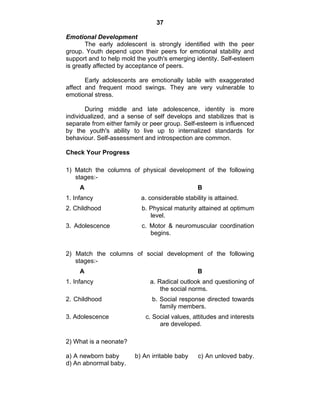
Check Your Progress 
1) Match the columns of physical development of the following 
stages:- 
A B 
1. Infancy a. considerable stability is attained. 
2. Childhood b. Physical maturity attained at optimum 
level. 
3. Adolescence c. Motor & neuromuscular coordination 
begins. 
2) Match the columns of social development of the following 
stages:- 
A B 
1. Infancy a. Radical outlook and questioning of 
the social norms. 
2. Childhood b. Social response directed towards 
family members. 
3. Adolescence c. Social values, attitudes and interests 
are developed. 
2) What is a neonate? 
a) A newborn baby b) An irritable baby c) An unloved baby. 
d) An abnormal baby.
38 
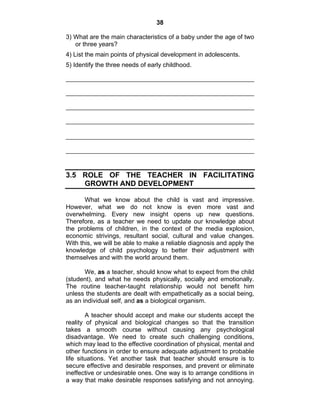
3) What are the main characteristics of a baby under the age of two 
or three years? 
4) List the main points of physical development in adolescents. 
5) Identify the three needs of early childhood. 
3.5 ROLE OF THE TEACHER IN FACILITATING 
GROWTH AND DEVELOPMENT 
What we know about the child is vast and impressive. 
However, what we do not know is even more vast and 
overwhelming. Every new insight opens up new questions. 
Therefore, as a teacher we need to update our knowledge about 
the problems of children, in the context of the media explosion, 
economic strivings, resultant social, cultural and value changes. 
With this, we will be able to make a reliable diagnosis and apply the 
knowledge of child psychology to better their adjustment with 
themselves and with the world around them. 
We, as a teacher, should know what to expect from the child 
(student), and what he needs physically, socially and emotionally. 
The routine teacher-taught relationship would not benefit him 
unless the students are dealt with empathetically as a social being, 
as an individual self, and as a biological organism. 
A teacher should accept and make our students accept the 
reality of physical and biological changes so that the transition 
takes a smooth course without causing any psychological 
disadvantage. We need to create such challenging conditions, 
which may lead to the effective coordination of physical, mental and 
other functions in order to ensure adequate adjustment to probable 
life situations. Yet another task that teacher should ensure is to 
secure effective and desirable responses, and prevent or eliminate 
ineffective or undesirable ones. One way is to arrange conditions in 
a way that make desirable responses satisfying and not annoying.
39 
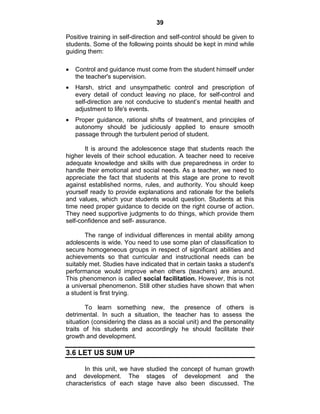
Positive training in self-direction and self-control should be given to 
students. Some of the following points should be kept in mind while 
guiding them: 
• Control and guidance must come from the student himself under 
the teacher's supervision. 
• Harsh, strict and unsympathetic control and prescription of 
every detail of conduct leaving no place, for self-control and 
self-direction are not conducive to student’s mental health and 
adjustment to life's events. 
• Proper guidance, rational shifts of treatment, and principles of 
autonomy should be judiciously applied to ensure smooth 
passage through the turbulent period of student. 
It is around the adolescence stage that students reach the 
higher levels of their school education. A teacher need to receive 
adequate knowledge and skills with due preparedness in order to 
handle their emotional and social needs. As a teacher, we need to 
appreciate the fact that students at this stage are prone to revolt 
against established norms, rules, and authority. You should keep 
yourself ready to provide explanations and rationale for the beliefs 
and values, which your students would question. Students at this 
time need proper guidance to decide on the right course of action. 
They need supportive judgments to do things, which provide them 
self-confidence and self- assurance. 
The range of individual differences in mental ability among 
adolescents is wide. You need to use some plan of classification to 
secure homogeneous groups in respect of significant abilities and 
achievements so that curricular and instructional needs can be 
suitably met. Studies have indicated that in certain tasks a student's 
performance would improve when others (teachers) are around. 
This phenomenon is called social facilitation. However, this is not 
a universal phenomenon. Still other studies have shown that when 
a student is first trying. 
To learn something new, the presence of others is 
detrimental. In such a situation, the teacher has to assess the 
situation (considering the class as a social unit) and the personality 
traits of his students and accordingly he should facilitate their 
growth and development. 
3.6 LET US SUM UP 
In this unit, we have studied the concept of human growth 
and development. The stages of development and the 
characteristics of each stage have also been discussed. The
40 
principles of development, their importance and need to study them 
scientifically have been discussed. As you have seen, adolescence 
is a period of transition between childhood and adulthood. 
Accompanying it is a number of problems. During this period, 
adolescents are considered neither as children nor as adults. Their 
status remains ambiguous. They are prone to rebel against 
authority. What as a teacher, we can do to attend to these 
problems and how we can help the development of a balanced 
personality of our student’s have been dealt with in order to create 
a better understanding of students needs and problems. 
Units End Exercises : 
1. Trace those events from your own childhood and adolescence 
stages that reflect the characteristics of these periods. 
2. "Adolescence is a period of storm and stress". Discuss with 
convincing arguments. 
3. How can a teacher help adolescents develop a balanced 
personality? Discuss your experiences in this regard. 
4. Describe the physical, emotional and social developmental 
characteristics of early and late childhood. 
3.7 SUGGESTED READINGS 
• Craig J Grace (1983): Human Development, Prentice Hall, 
INC, Englewood Cliffs, New 
Jersey. 
• Levinson, D.J., Darrow, C.N., Klein, E.B., Levinson, M.H. & 
McKee, B. (1978): The Seasons of a Man's Link, New York, 
Knopg. 
• Sanden Vander W. James (1989): Human Development, 
Refred A Knopg, INC. New York. 
• Sheehy, G. (1974): Parsages: Predictable Crisis of Adult 
Life, New York, Dutton. 
• Sprinthall, C., Richard and Sprinthall A. Norman (1990): 
Educational Psychology, A Developmental Approach. 
McGraw Hill Publishing Company, New York. 
• Wolrnan, B.B. (Ed), (1982): Handbook of Developmental 
Psychology, Prentice Hall: 
Englewood, Cliffs, N.J. 
™™™™
4 
LEARNING 
Unit Structure 
4.0 Learning Objectives 
4.1 Introduction 
4.2 Concept of learning (Meaning, Definition, Characteristics, 
Types) 
4.3 Nature of learning 
4.4 Process of learning 
4.5 Learning curve 
4.0 OBJECTIVES 
After going through this unit, you will be able to: 
• Explain the concept & nature of learning. 
• Explain the steps involved in the process of learning. 
• Tell the meaning & importance of learning curve. 
• Explain the different types of learning curve. 
• Describe the different stages of learning curve. 
• Describe the different learning theories 
4.1 INTRODUCTION 
Dear students, what does the word “learning” bring to your 
mind? learning to read, to ride a bicycle, to act, to use a computer, 
to play synthesizer etc. Each one of us learns something or the 
other intentionally or accidentally. Learning situations are most 
natural and common in our life. Every moment you learn something 
or the other because of the varied experience you have in life. In 
the educational process, the central idea is learning. 
You are aware of a child learns right from his birth and goes 
on learning throughout his lifetime. An infant is quite helpless at 
birth, but slowly he learns to adopt himself to the environment 
around him.
42 
e.g. A child approaches a burning matchstick; the child burns his 
hand and withdraws. Another time when he comes to a burning 
matchstick, he takes no time to withdraw himself away. He learns to 
avoid not only the burning matchstick but also all burning things. 
When this happens, we say that the child has learned that if you 
touch a flame, you get burnt up. In this way, the change in the 
behaviour of an individual occurs through direct or indirect 
experiences. This change in behaviour brought about by 
experience is called as learning. This is a very simple explanation 
of the term learning. Now let us understand the meaning and 
definitions of learning. 
4.2 CONCEPT OF LEARNING 
Meaning and Definitions of learning 
Learning, in psychology, the process by which a relatively 
lasting change in potential behaviour occurs because of practice or 
experience. Learning is also a process of acquiring modifications in 
existing knowledge, skills, habits, or tendencies through 
experience, practice, or exercise. 
Gates and others “Learning is the modification of behaviour 
through experience” 
Henry, P smith “Learning is the acquisition of new behaviour or 
strengthening or weakening of old behaviour as a result of 
experience”. 
Crow and Crow “Learning is the acquisition of habits, knowledge 
and attitudes. It involves new ways of doing things, and it operates 
in an individual’s attempt to overcome obstacles or to adjust to new 
situations.” 
Skinner “Learning is the process of progressive behaviour 
adaptation.” 
Munn“To learn is to modify behaviour and experience.” 
M. L. Bigge “Learning may be considered as change in insights, 
behaviour, perception, motivation or a combination of these.” 
The above definitions emphasize four attributes of learning... 
• As Process: the first is that learning is permanent change in 
behaviour. 
• It does not include change due to illness, fatigue, maturation 
and use of intoxicant.
43 
• The learning is not directly observable but manifests in the 
activities of the individual. 
• Learning depends on practice and experience. 
Characteristics of Learning 
Yoakum & Simpson have stated the following general 
characteristics of learning: Learning is growth, adjustment, 
organisation of experience, purposeful, both individual and 
social, product of the environment. 
According to W.R Mc law learning has the following 
characteristics. 
1. Learning is a continuous modification of behaviour continues 
throughout life 
2. Learning is pervasive. It reaches into all aspects of human life. 
3. Learning involves the whole person, socially, emotionally & 
intellectually. 
4. Learning is often a change in the organisation of behaviour. 
5. Learning is developmental. Time is one of its dimensions. 
6. Learning is responsive to incentives. In most cases positive 
incentives such as rewards are most effective than negative 
incentives such as punishments. 
7. Learning is always concerned with goals. These goals can be 
expressed in terms of observable behaviour. 
8. Interest & learning are positively related. The individual learns 
bet those things, which he is interested in learning. Most bys 
find learning to play football easier than learning to add 
fractions. 
9. Learning depends on maturation and motivation. 
Types of Learning 
Learning has been classified in many ways. 
I. Informal, formal and non-formal learning: Depending on the way 
of acquiring it learning may be informal, formal or non-formal. 
• Informal learning is incidental. It takes place throughout life. 
It is not planned. 
• Formal learning is intentional and organized. It takes place in 
formal educational institution. 
• Non-formal is also intentional & organized. It is flexible.
44 
II. Individual or Group learning: Learning is called either individual 
or group learning depending upon the number of individuals 
involved in the learning process. 
III. Another classification involves the types of activity involved 
(a) Motor learning: - when learning involves primarily the use of 
muscles it is called as motor learning. e.g.: learning to walk, to 
operate a typewriter 
(b) Discrimination learning: - Learning which involves the act of 
discrimination is called discrimination learning. e.g. infant 
discriminates between mother and aunt, milk and water. 
(c) Verbal learning: - when learning involves the use of words it 
is called as verbal learning. 
(d) Concept learning: - when learning involves the formation of 
concept it is called as concept learning. 
(e) Sensory learning: - when learning is concerned with 
perception and sense it is sensory learning. 
• Check your progress 
1. Define learning 
2. What do you mean my learning? 
3. Explain the concept of learning and state its characteristics. 
4. Write the different types of learning. 
4.3 NATURE OF LEARNING 
a. Learning is adaptation or adjustment: Friends, we all 
continuously interact with our environment. We often make 
adjustment and adapt to our social environment. Through a process 
of continuous learning, the individual prepares himself for
45 
necessary adjustment or adaptation. That is why learning is also 
described as a process of progressive adjustment to ever changing 
conditions, which one encounters. 
b. Learning is improvement: Learning is often considered as a 
process of improvement with practice or training. We learn many 
things, which help us to improve our performance. 
c. Learning is organizing experience: Learning is not mere 
addition of knowledge. It is the reorganization of experience. 
d. Learning brings behavioural changes: Whatever the direction 
of the changes may be, learning brings progressive changes in the 
behaviour of an individual. That is why he is able to adjust to 
changing situations. 
e. Learning is active: Learning does not take place without a 
purpose and self-activity. In any teaching learning process, the 
activity of the learner counts more than the activity of a teacher. 
f. Learning is goal directed: when the aim and purpose of 
learning is clear, an individual learns immediately. It is the purpose 
or goal, which determines what, the learner sees in the learning 
situations and how he acts. If there is no purpose or goal learning 
can hardly be seen. 
g. Learning is universal and continuous: All living creatures 
learn. Every moment the individual engages himself to learn more 
and more. Right from the birth of a child till the death learning 
continues. 
4.4 PROCESS OF LEARNING 
Learning is a process. It is carried out through steps. Learning 
process involves – 
(a) A motive or a drive. 
(b) An attractive goal. 
(c) A block to the attainment of the goal. 
Let us see the steps one by one – 
(a) A motive or a drive: Motive is the dynamic force that energizes 
behaviour and compels an individual to act. We do any activity 
because of our motives or our needs. When our need is strong, 
enough we are compelled to strive for its satisfaction. Learning 
takes place because of response to some stimulation. As long as 
our present behaviour, knowledge, skill and performance are
46 
adequate to satisfy all our needs, use do not feel any necessity to 
change our behaviour or acquire new knowledge and skills. It is this 
requirement, which initiates a learner to learn something. 
(b) Goal: Every individual has to set a definite goal for 
achievement. We should always have a definite goal for achieving 
anything. If a definite goal is set then learning becomes purposeful 
and interesting. 
(c) Obstacle /block /barrier: The obstacle or block or the barrier is 
equally important in the process of learning. The obstacle or the 
barriers keep us away from attaining the goal. 
Now, you will think how the obstacle can be important in the 
process of learning. So let me tell you, if you face no difficulty of 
any kind in attaining the goal, you will not bring any change in your 
present behaviour or stock of knowledge or skills. Thus, the block 
or the barrier is an essential step in the learning process. 
Let us clear the above views by taking an example. Suppose 
you wish to be included in your college hockey team. You want to 
have the esteem of your colleagues, your teachers. You are also 
motivated try the interesting experiences that you many enjoy. But 
you are blocked by your lack of skill in dodging, tackling and 
handling the ball. The obstacles in the path of goal achievement will 
set you make up your deficiency and acquire essential skill through 
sufficient practice and coaching. 
Check Your Progress 
1. Explain the nature of learning. 
2. Explain the process of learning 
4.5 LEARNING CURVE 
Learning curve is a graphic representation of how learning 
takes place in a particular situation. In all type of learning situations, 
the course of learning can be depicted and described graphically by 
drawing learning curves against x and y axis.
47 
The above figure shows a typical learning curve of many 
types of learning. The curve consists of a number of irregularities, 
as the progress is not constant. 
For the convenience, the curve is divided into 5 stages – a, 
b, c, d and e. 
(a) Period of slow progress: Generally, when a person has to 
start a learning of a given activity from a scratch, his early progress 
will be slow. E.g., an infant’s progress in learning to walk is very 
negligible in the beginning. 
(b) Period of rapid progress: In this stage, the learner’s output 
raises rapidly. e.g. In typing once the learner has developed co 
ordination of the movement of fingers he shows rapid progress. 
(c) Period of no apparent progress: Learning curves frequently 
display a period of no apparent progress. It is also known as 
plateau. A period of no visible learning progress, preceded and 
followed by improvement is called as plateaus. E.g. In typing, a 
person may after having made rather consistent progress for some 
time, reach a point where perhaps for weeks no further progress is 
made. 
Causes of plateau 
(i) The learner may be reorganizing the previous learning into 
a new pattern before further progress is possible. 
(ii) The learner may have hit upon bad habits 
(iii) Lack of progress may be due to decrease in motivation. 
(iv) The task may not be of uniform difficulty. 
(v) Loss of interest. 
(vi) The onset of fatigue is also one of the causes of a plateau.
48 
(d) Period of sudden rise: At the end of a plateau, there is 
generally a spurt in achievement. While on the plateau, the learner 
acquires better techniques, which help him later on to show rapid 
progress. 
(e) Levelling: All learning will finally slow down to such an extent 
that it will ultimately reach a period of no improvement. No one can 
continue to improve indefinitely in any given situation. The learning 
curve will eventually reach a limit, where no further improvement is 
possible. This limit is known as physiological limit. 
4.5.1 Characteristics of Learning Curve. 
(i) Slow initial progress. 
(ii) Spurt-like learning after some time. 
(iii) Declination in the rate of learning. 
(iv) Plateaus of learning. 
(v) Sudden increase in learning. 
(vi) Gradual levelling at the end. 
4.5.2 Types of Learning Curve. 
We get different types of learning curves depending upon – 
(a) The nature of the learner 
(b) The nature of the task/learning material 
(c) Time available. 
(d) Conditions under which the learning takes place. 
It is difficult to classify these learning curves. However, three 
common types of curves are there, 
(i) Negatively accelerated or the convex curve. 
(ii) Positively accelerated learning curve or the concave curve. 
(iii) Combination of convex-concave curve. 
Convex curve 
It depicts rapid initial improvement in learning that slows 
down with time. When the task is simple and the learner has 
previous practice on a similar task, we get this type of learning 
curve.
49 
Concave curve 
There is slow initial improvement and learning increases with 
time. When the task is difficult we get such type of learning curve. 
Combination of convex concave curve 
It looks like the capital letter ‘S’. The curve takes concave or 
convex shape in the beginning depending upon the nature of the 
task. 
In actual practical situations, such smooth curves are rarely 
found. Usually there are ups and downs (fluctuation). 
4.5.3 Educational importance of learning curve 
1. In acquiring the basic skills in various subjects, the learner at 
times appears to show no progress. At such moments, the teacher 
can diagnose the reasons for the lack of progress. 
2. A student’s progress may be arrested because the work is too 
complex for him. The teacher can observe the student’s work and 
detect the part that gives him trouble. The teacher should see if the 
student has developed any faulty study habits, which impede his 
progress. 
3. The plateau may be due to the lack of motivation. The teacher 
should provide encouragement in order to maintain motivation at a 
high level.
50 
4. The learning curves give a graphic evidence of one’s progress, 
which is an effective motivational device for the learner. 
5. Occurrence of plateaus can be minimized by using superior 
teaching methods. 
Unit End Exercise : 
1. What is a learning curve? 
2. Describe a typical learning curve. 
3. What are the different types of learning curve? 
4. State any two causes of plateau 
5. Explain the educational importance of a learning curve. 
6. State the important characteristics of a learning curve. 
™™™™
51 
5 
LEARNING THEORIES 
Unit Structure : 
5.0 Objective 
5.1 Learning Theories 
5.2 Transfer of Training 
5.3 Let us sum up 
5.4 Suggested Reading 
5.0 OBJECTIVE 
After going through this unit, you will be able to : 
• Explain the different types of learning curve. 
• Describe the different stages of learning curve. 
• Describe the different learning theories 
5.1 LEARNING THEORIES 
Learning as a process focuses on what happens when the 
learning takes place. Explanations of what happens constitute 
learning theories. A learning theory is an attempt to describe 
how people and animals learn, thereby helping us understands the 
inherently complex process of learning. Learning theories have 
two chief values according to Hill (2002). One is in providing us with 
vocabulary and a conceptual framework for interpreting the 
examples of learning that we observe. The other is in suggesting 
where to look for solutions to practical problems. The theories do 
not give us solutions, but they do direct our attention to those 
variables that are crucial in finding solutions. 
The three main categories or philosophical frameworks 
under which learning theories fall are behavioural, cognitive, and 
constructivism. Behaviourism focuses only on the objectively 
observable aspects of learning. Cognitive theories look beyond 
behaviour to explain brain-based learning. In addition, 
constructivism views learning as a process in which the learner 
actively constructs or builds new ideas or concepts.
52 
We will discuss the behavioural theories under two broad 
categories: S-R theories. 
• S-R (Stimulus-Response) theory with reinforcement 
o E.L Thorndike- Trial and Error theory 
o B.F Skinner- Operant Conditioning 
• S-R (Stimulus-Response) theory without reinforcement 
o Pavlov- Classical Conditioning 
5.1.1 S-R (Stimulus-Response) theory with reinforcement 
A) E.L Thorndike- Trial and Error Theory of Learning: 
Edward Lee Thorndike (1874-1949) was the first American 
psychologist who put forward the Trial and Error Theory of learning. 
According to Thorndike, all learning takes place because of 
formation of bond or connection between stimulus and response. 
He further says that learning takes place through a process of 
approximation and correction. A person makes a number of trials, 
some responses do not give satisfaction to the individual but he 
goes on making further trials until he gets satisfactory responses. 
Thorndike conducted a number of experiments on animals to 
explain the process of learning. His most widely quoted experiment 
is with a cat placed in a puzzle box. 
Thorndike put a hungry cat in a puzzle box. The box had 
one door, which could be opened by manipulating a latch of the 
door. A fish was placed outside the box. The cat being hungry had 
the motivation of eating fish outside the box. However, the obstacle 
was the latch on the door. The cat made random movements inside 
the box indicating trial and error type of behaviour biting at the box, 
scratching the box, walking around, pulling and jumping etc. to 
come out to get the food. Now in the course of her movements, the 
latch was manipulated accidently and the cat came out to get the 
food. Over a series of successive trials, the cat took shorter and 
shorter time, committed less number of errors, and was in a 
position to manipulate the latch as soon as it was put in the box and 
learnt the art of opening the door. 
Thorndike concluded that it was only after many random 
trials that the cat was able to hit upon the solutions. He named it as
53 
Trial and Error Learning. An analysis of the learning behaviour of 
the cat in the box shows that besides trial and error the principles of 
goal, motivation, explanation and reinforcement are involved in the 
process of learning by Trial and Error. 
• Laws of Learning 
Based on Trial and Error Learning Theory, Thorndike gave 
certain laws of Learning. We shall discuss three fundamental Laws 
of Learning in this section. These laws are: 
1. Law of Readiness 
This law refers to the fact that learning takes place only when 
the learner is prepared to learn. No amount of efforts can make the 
child learn if the child is not ready to learn. The dictum that ‘you can 
lead a horse to the pond but you can’t make it drink water unless it 
feels thirsty’ goes very well with this law. In other words, if the child 
is ready to learn, he/she learns more quickly, effectively and with 
greater satisfaction than if he/she is not ready to learn. In the words 
of Thorndike the three stages of this Law of Readiness are : 
• For a conduction unit ready to conduct, to conduct is satisfying. 
• For a conduction unit ready to conduct, not to conduct is 
annoying. 
• For a conduction unit not ready to conduct, to conduct is 
annoying. 
Thus, the Law of Readiness means mental preparation for 
action. It is not to force the child to learn if he is not ready. Learning 
failures are the result of forcing the learner to learn when he is not 
ready to learn something. 
Educational Implications of Law of Readiness: 
The law draws the attention of teacher to the motivation of 
the child. The teacher must consider the psycho-biological 
readiness of the students to ensure successful learning 
experiences. Curriculum / Learning experiences should be 
according to the mental level of maturity of the child. If this is not 
so, there will be poor comprehension and readiness may vanish. 
2. Law of Exercise 
This law explains the role of practice in learning. According 
to this law, learning becomes efficient through practice or exercise. 
The dictum ‘Practice makes a man perfect’ goes very well with this 
law. This law is further split into two parts — Law of use and Law of 
disuse. The law of use means that a connection between a stimulus 
and response is strengthened by its occurrence, its exercise or its 
use. In other words, the use of any response strengthens it, and
54 
makes it more prompt, easy and certain. Regarding the law of 
disuse, it is said that when a modifiable connection is not made 
between a stimulus and a response over a length of time, the 
strength of that connection is decreased. This means that any act 
that is not practised for some time gradually decays. Anything that 
is not used exercised or practised for a certain period tends to be 
forgotten or becomes weak in strength, efficiency and promptness. 
Educational Implications 
Exercise occupies an important place in learning. Teacher 
must repeat, give sufficient drill in some subjects like mathematics, 
drawing, music or vocabulary for fixing material in the minds of the 
students. Thorndike later revised this law of exercise and 
accordingly it is accepted that practice does bring improvement in 
learning but it in itself is not sufficient. 
Always practice must be followed by some reward or 
satisfaction to the learner. The learner must be motivated to learn. 
3. Law of Effect 
This is most important of Thorndike’s laws, which state that 
when a connection between stimulus and response is accompanied 
by satisfying state, its strength is increased. On the other hand, 
when a connection is accompanied by an annoying state of affairs, 
its strength is reduced or weakened. The saying ‘nothing succeeds 
like success’ goes very well with this law. In other words, the 
responses that produce satisfaction or comfort for the learner are 
strengthened and responses that produce annoyance or discomfort 
for the learner are weakened. Thorndike revised this law in 1930 
and according to this revision, he stated that reward strengthened 
the response but punishment did not always weaken the response. 
Then he placed more emphasis on the reward aspect than on the 
punishment aspect of Law of Effect. 
Educational Implications 
This law signifies the use of reinforcement or feedback in 
learning. This implies that learning trials must be associated with 
satisfying consequences. The teacher can use rewards to 
strengthen certain responses and punishment to weaken others. 
However, the use of reward is more desirable than the use of 
punishment in school learning. The teacher for motivating the 
students for learning situations can exploit the use of reward.
55 
Check Your Progress 
1. Define Learning. Describe E.L.Thorndike Trial & Error theory of 
learning. 
2. Explain the Laws of learning given by E.L.Thorndike. 
B) B.F.Skinners- Operant Conditioning 
What Is Operant Conditioning? 
Operant conditioning (sometimes referred to as 
instrumental conditioning) is a method of learning that occurs 
through rewards and punishments for behavior. Through operant 
conditioning, an association is made between a behavior and a 
consequence for that behavior. 
Behaviorist B.F. Skinner coined the term operant 
conditioning, which is why it is also referred as Skinnerian 
conditioning. As a behaviorist, Skinner believed that internal 
thoughts and motivations could not be used to explain behavior. 
Instead, he suggested, we should look only at the external, 
observable causes of human behavior. 
Skinner used the term operant to refer to any "active 
behavior that operates upon the environment to generate 
consequences" (1953). In other words, Skinner's theory explained 
how we acquire the range of learned behaviors we exhibit each and 
every day. 
Skinner is regarded as the father of Operant Conditioning, 
but his work was based on Thorndike’s law of effect. Skinner 
introduced a new term into the Law of Effect - Reinforcement. 
Behaviour that is reinforced tends to be repeated (i.e. 
strengthened); behaviour that is not reinforced tends to die out-or 
be extinguished (i.e. weakened). 
Skinner studied operant conditioning by conducting experiments 
using animals, which he placed in a “Skinner Box” which was 
similar to Thorndike’s puzzle box.
56 
The Skinner box involved placing an animal (such as a rat or 
pigeon) into a sealed box with a lever that would release food when 
pressed. If food was released every time the rat pressed the lever, 
it would press it more and more because it learnt that doing so 
gives it food. Lever pressing is described as an operant behaviour, 
because it is an action that results in a consequence. In other 
words, it operates on the environment and changes it in some way. 
The food that is released as a result of pressing the lever is known 
as a reinforcer, because it causes the operant behaviour (lever 
pressing) to increase. Food could also be described as a 
conditioned stimulus because it causes an effect to occur. 
Note: There is an important difference between a reward and a 
reinforcer in operant conditioning. 
• A reward is something, which has value to the person giving 
the reward, but may not necessarily be of value to the 
person receiving the reward. 
• A reinforcer is something, which benefits the person 
receiving it, and so results in an increase of a certain type of 
behaviour. 
Skinner identified three types of responses or operant that can 
follow behaviour. 
• Neutral operants: Responses from the environment that neither 
increase nor decrease the probability of a behaviour being 
repeated. 
• Reinforcers are any event that strengthens or increases the 
behavior it follows. There are two kinds of reinforcers. 
1. Positive reinforcers are favorable events or outcomes that 
are presented after the behavior. In situations that reflect 
positive reinforcement, a response or behavior is strengthened 
by the addition of something, such as praise or a direct reward.
57 
2. Negative reinforcers involve the removal of an unfavorable 
events or outcomes after the display of a behavior. In these 
situations, a response is strengthened by the removal of 
something considered unpleasant. 
In both of these cases of reinforcement, the behavior increases. 
• Punishment is the presentation of an adverse event or outcome 
that causes a decrease in the behavior it follows. Punishment 
weakens behaviour. There are two kinds of punishment: 
1. Positive punishment, sometimes referred to as punishment 
by application, involves the presentation of an unfavorable 
event or outcome in order to weaken the response it follows. 
2. Negative punishment, also known as punishment by 
removal, occurs when an favorable event or outcome is 
removed after a behavior occurs. 
In both of these cases of punishment, the behavior decreases. 
Schedules of Reinforcement: 
Intermittent reinforcement - reinforcement is given only part of 
the times the animal gives the desired response. 
Continuous reinforcement - reinforcement is given every time the 
animal gives the desired response. 
Ratio reinforcement - a pre-determined proportion of responses 
will be reinforced. 
Fixed ratio reinforcement - reinforcement is given on a regular 
ratio, such as every fifth time the desired behavior is produced.
58 
Variable (random) fixed reinforcement- reinforcement is given for 

a predetermined proportion of responses, but randomly instead of 
on a fixed schedule. 
Interval reinforcement- reinforcement is given after a 
predetermined period of time. 
Fixed interval reinforcement - reinforcement is given on a regular 
schedule, such as every five minutes. 
Variable interval reinforcement - reinforcement is given after 
random amounts of time have passed. 
In animal studies, Skinner found that continuous 
reinforcement in the early stages of training seems to increase the 
rate of learning. Later, intermittent reinforcement keeps the 
response going longer and slows extinction. 
Skinner specifically addressed the applications of 
behaviourism and operant conditioning to educational practice. He 
believed that the goal of education was to train learners in survival 
skills for self and society. The role of the teacher was to reinforce 
behaviours that contributed to survival skills, and extinguish 
behaviours that did not. Behaviourist views have shaped much of 
contemporary education in children and adult learning. 
Implication of the theory of operant conditioning: 
1.Conditioning study behaviour: Teaching is the arrangement of 
contingencies of reinforcement, which expedite learning. For 
effective teaching teacher should arranged effective contingencies 
of reinforcement. Example: For Self learning of a student teacher 
should reinforce student behaviour through variety of incentives 
such as prize, medal, smile, praise, affectionate patting on the back 
or by giving higher marks. 
2. Conditioning and classroom behaviour: During learning 
process child acquire unpleasant experiences also. This 
unpleasantness becomes conditioned to the teacher, subject and 
the classroom and learner dislikes the subject and a teacher. 
Suitable behavioural contingencies, atmosphere of recognition, 
acceptance, affection and esteem helps child in approaching 
teacher and the subject. If student is not serious in study, teacher 
make use of negative reinforcement like showing negligence, 
criticising student etc. but if student is serious in study, teacher 
make use of positive reinforcement like prize, medal, praise and 
smile.
59 
3. Managing Problem Behaviour: Two types of behaviour is seen 
in the classroom viz undesired behaviour and problematic 
behaviour. Operant conditioning is a behaviour therapy technique 
that shape students behaviour. For this teacher should admit 
positive contingencies like praise, encouragement etc. for learning. 
One should not admit negative contingencies. Example punishment 
(student will run away from the dull and dreary classes – escape 
stimulation. 
4.Dealing with anxieties through conditioning: Through 
conditioning fear, anxieties, prejudices, attitudes, perceptual 
meaning develops. Examples of anxiety are signals on the road, 
siren blown during wartime, child receiving painful injection from a 
doctor. Anxiety is a generalized fear response. To break the habits 
of fear, a teacher should use desensitization techniques. Initially 
teacher should provide very weak form of conditioned stimulus. 
Gradually the strength of stimulus should be increased. 
5. Conditioning group behaviour: Conditioning makes entire 
group learn and complete change in behaviour is seen due to 
reinforcement. It breaks undesired and unsocial behaviour too. 
Example: Putting questions or telling lie to teachers will make 
teachers annoyed in such circumstances students learn to keep 
mum in the class. Asking questions, active participation in class 
discussion will make the teacher feel happy – interaction will 
increase and teaching learning process becomes more effective. 
6. Conditioning and Cognitive Processes: Reinforcement is 
given in different form, for the progress of knowledge and in the 
feedback form. When response is correct, positive reinforcement is 
given. Example: A student who stands first in the class in the month 
of January is rewarded in the month of December. To overcome 
this Programme instruction is used. In this subject matter is broken 
down into steps. Organizing in logical sequence helps in learning. 
Each step is build upon the preceding step. Progress is seen in the 
process of learning. Immediate reinforcement is given at each step. 
7.Shaping Complex Behaviour: Complex behaviour exists in form 
of a chain of small behaviour. Control is required for such kind of 
behaviour. This extended form of learning is shaping technique. 
Smallest Behaviour is controlled at initial stage. On behalf of 
different contingencies, next order of chain of behaviours is 
controlled. Example: Vocabulary in English. Teaching spelling is 
mainly a process of shaping complex form of behaviour.
60 
• Check Your Progress 
1. What is Operant Conditioning? Describe theory operant 
conditioning given by B.F.Skinners with appropriate illustration. 
2. Define reinforcement. What are the various schedules of 
reinforcement? Explain with examples. 
3. Discuss the theory of operant conditioning and point out its 
implication to education 
5.1.2 S-R (Stimulus-Response) theory without reinforcement 
• Pavlov- Classical Conditioning (1849-1936) 
Classical conditioning is a term used to describe learning which 
has been acquired through experience. One of the best-known 
examples of classical conditioning can be found with the Russian 
psychologist Ivan Pavlov and his experiments on dogs. 
In these experiments, Pavlov trained his dogs to salivate 
when they heard a bell ring. In order to do this he first showed them 
food, the sight of which caused them to salivate. 
Later Pavlov would ring a bell every time he would bring the 
food out, until eventually, he could get the dogs to salivate just by 
ringing the bell and without giving the dogs any food.
61 
In this simple but ingenious experiment, Pavlov showed how 
a reflex (salivation, a natural bodily response) could become 
conditioned (modified) to an external stimulus (the bell) thereby 
creating a conditioned reflex/response. 
Components Involved In Classical Conditioning 
We can gain a better understanding of classical conditioning 
by looking at the various components involved in his experiment;
62 
• The unconditioned stimulus.(UCS) 
• The conditioned stimulus.(CS) 
• The unconditioned reflex/response.(UCR) 
• The conditioned reflex/response. (CR) 
So let’s look at each of these classical conditioning components in 
more detail now. 
Note: In its strictest definition classical conditioning is described as 
a previously neutral stimulus which causes a reflex (stimulus 
means something which causes a physical response). 
The Unconditioned Stimulus (food): (UCS) An unconditioned 
stimulus is anything, which can evoke a response without prior 
learning or conditioning. 
For example, when a dog eats some food it causes his mouth to 
salivate. Therefore the food is an unconditioned stimulus, because 
it causes a reflex response (salivation) automatically and without 
the dog having to learn how to salivate. 
Unconditioned Stimulus – This causes an automatic reflex 
response. 
Conditioned Stimulus (bell): (CS) The conditioned stimulus is 
created by learning, and therefore does not create a response 
without prior conditioning. 
For example, when Pavlov rang a bell and caused the dogs to 
salivate, this was a conditioned stimulus because the dogs learnt to 
associate the bell with food. If they had not learnt to associate the 
bell with food, they would not have salivated when the bell was 
rung. 
Conditioned Stimulus – You need to learn first before it creates a 
response. It is an acquired power to change something. 
Unconditioned Reflex/Response (salivation): (UCR) An 
unconditioned reflex is anything that happens automatically without 
you having to think about it, such as your mouth salivating when 
you eat. Unconditioned Reflex – Reflex that happens automatically 
and you did not have to learn how to do it. 
Conditioned Reflex (salivation in response to bell): (CR) A 
conditioned reflex is a response which you have learnt to associate 
with something.
63 
For example, the dogs salivated when Pavlov rang a bell, when 
previously (without conditioning) the bell would not cause the dogs 
to salivate. 
Conditioned Reflex – A reflex that can be evoked in response to 
a conditioned stimulus (a previously neutral stimulus). 
• Basic concepts in classical conditioning: 
There are several principles that are associated with classical 
conditioning, some of these are: 
• Extinction: a conditioned response will disappear over time 
when the conditioned stimulus is no longer presented. 
• Spontaneous recovery: sometimes there is the weak 
appearance of a previously extinguished response. 
• Stimulus generalization: this is when individuals respond in 
this same way to experience stimuli. For example, all fuzzy 
animals scaring a young child instead of just a fuzzy cat. 
• Stimulus discrimination: organisms can learn to discriminate 
between various stimuli. 
• Higher order conditioning: this is when a neutral stimulus 
can cause the conditioned response sense if it had been 
associated with the conditioned stimulus. 
Types of classical conditioning 
Forward conditioning: Learning is fastest in forward conditioning. 
During forward conditioning the onset of the conditioned stimulus 
(CS) precedes the onset of the unconditioned stimulus (US). Two 
common forms of forward conditioning are delay and trace 
conditioning. 
Delay conditioning: In delay, conditioning the conditioned stimulus 
(CS) is presented and is overlapped by the presentation of the 
unconditioned stimulus (US). 
Trace conditioning: During trace conditioning, the conditioned 
stimulus (CS) and US do not overlap. Instead, the conditioned 
stimulus (CS) is presented, a period is allowed to elapse during 
which no stimuli are presented, and then the unconditioned 
stimulus (US) is presented. The stimulus-free period is called the 
trace interval. It may also be called the conditioning interval.
64 
Simultaneous conditioning: During simultaneous conditioning, 
the conditioned stimulus (CS) and unconditioned stimulus (US) are 
presented and terminated at the same time. 
Backward conditioning: Backward conditioning occurs when a 
conditional stimulus (CS) immediately follows an unconditional 
stimulus (US). Unlike traditional conditioning models, in which the 
conditional stimulus (CS) precedes the unconditional stimulus (US), 
the conditional response (CR) tends to be inhibitory. This is 
because the conditional stimulus (CS) serves as a signal that the 
unconditional stimulus (US) has ended, rather than a reliable 
method of predicting the future occurrence of the unconditional 
stimulus (US). 
Temporal conditioning: The unconditioned stimulus (US) is 
presented at regularly timed intervals, and CR acquisition is 
dependent upon correct timing of the interval between 
unconditioned stimulus (US) presentations. The background, or 
context, can serve as the conditioned stimulus (CS) in this 
example. 
Unpaired conditioning: The conditioned stimulus (CS) and 
unconditioned stimulus (US) are not presented together. Usually 
they are presented as independent trials that are separated by a 
variable, or pseudo-random, interval. This procedure is used to 
study non-associative behavioral responses, such as sensitization. 
CS-alone extinction: The conditioned stimulus (CS) is presented 
in the absence of the unconditioned stimulus (US). This procedure 
is usually done after the conditional response (CR) has been 
acquired through “forward conditioning” training. Eventually, the 
conditional response (CR) frequency is reduced to pre-training 
levels. Essentially, the stimulus is presented until habituation 
occurs. 
Implications of Pavlov’s Theory to Classroom Situations 
1. The theory believed that one must be able to practice and 
master a task effectively before embarking on another one. This 
means that a student needs to be able to respond to a particular 
stimulus (information) before he/she can be associated with a 
new one.
65 
2. Teachers should know how to motivate their students to learn. 
They should be versatile with various strategies that can 
enhance effective participation of the students in the teaching-learning 
activities. 
3. Most of the emotional responses can be learned through 
classical conditioning. A negative or positive response comes 
through the stimulus being paired with. For example, providing 
the necessary school material for primary school pupils will 
develop good feelings about school and learning in them, while, 
punishment will discourage them from attending the school. 
Check Your Progress 
1) Define Classical Conditioning Theory 
2) What is the meaning of Extinction Stage in Classical 
Conditioning? 
3) Explain the meaning of Salivation in Pavlov’s Theory of 
Classical Conditioning 
4. What is the meaning of Unconditioned Response in Pavlov’s 
Theory? 
Conclusion 
It is believed that the learners and more importantly the 
teachers have greatly benefited from all the theories. The teachers 
should be familiar with this theory and apply it to teaching-learning 
activities where applicable. 
5.2 TRANSFER OF TRAINING 
Introduction 
The ability of the individual to apply the previous experience 
on the new related experience is what we call transfer of learning. 
Except students are able to transfer prior skills and knowledge on 
new ones, the continuity of learning will be difficult. This unit will
66 
explain how old learning can be transferred to a new one. You will 
know what the classroom teacher needs to do in order to facilitate 
transfer of experiences among his/her students. 
The essence of learning is that a previously learnt fact 
should be linked with a present experience. This is because human 
being must be dynamic and that the prior experience will make 
them to develop the new skills and knowledge. The influence the 
past experience has on the succeeding experience is called 
transfer of learning. 
Cormier and Hagman, (1987) define transfer of learning as 
the application of skills and knowledge learned in one context being 
applied in another context. 
Oladele (1998) defines transfer of learning as the effect of 
prior learning on the present. Learning is meaningful when the past 
learning smoothens the progress of something else. For example, if 
a learned experienced refuses to aid the new learning, the goal of 
training has seized to be accomplished. In the school, the teacher 
teaches some subjects in order that the experience gained in those 
subjects could be transferred into another. 
Charham (1987) affirms that human and animal learning is 
normally affected by the past experience, and that the various 
subjects are included in the school curriculum because of their 
utility and wide application to real life situations For instance, the 
teacher who has taught his/her students some skills in Mathematics 
would believe that such skills be transferred to related subjects like 
Physics or Accounting. If the students fail to apply these skills in 
their subsequent learning, it means that the students have not been 
successful in transferring the learning. 
The above example gives us clues into the different types of 
transfer of learning that we have. These are explained below: 
(a) Positive Transfer: This is a situation whereby a previously 
learnt fact or information aids in the understanding of a new task. 
Aside from aiding the learners in their subsequent learning, it also 
helps the learners to learn better and effectively the new task. 
(b) Negative Transfer: This is a type of learning in which prior 
experience imparts negatively on the new one. In this case, the 
understanding of past skills inhibits the mastering of new ones. For 
example, if a student wrongly connects information, it can 
lead to negative transfer.
67 
(c) Zero Transfer: This type of learning reveals no link between the 
previously learnt task and the recent one. The evidence of zero 
transfer is hardly seen, it reveals no clear positive or negative 
effect. 
Theories of Transfer of Learning 
a. Theory of Mental Faculties: This theory was propounded by the 
Greek Philosophers, notable among them was Aristotle. The basic 
tenet of the theory is that human mind is sub-divided into different 
powers of faculties like memory, judgment, reasoning or thinking. It 
is therefore believed that each of these faculties is reinforced and 
developed by cast and continuous memorization of poetry/poem 
and similar works. This theory believes that exercises and regular 
practice will strengthen the mental faculties. The theory therefore 
dismisses the concept of transfer of learning, to it a well trained and 
disciplined mind is the ingredient needed for understanding of new 
information. 
b. Theory of Identical Elements: The theory which was developed 
by the duo of Thorndike and Woodworth (American Psychologists) 
indicates that it is possible for an individual to transfer the prior 
skills and knowledge to recent ones because both experiences are 
identical (share things in common). This theory suggests that a 
successful or effective learning will happen if there are connections 
or interrelatedness between the old and the new experiences. For 
example, it is expected that a student who has learnt about 
anatomical parts of human being in a Biology lesson, should be 
able to do well when he/she is asked to name anatomical parts of a 
goat during Agriculture lesson. 
c. Theory of Generalization: This theory was advocated by a 
Psychologist named Charles Judd. The assumption of the theory is 
that general principles aid transfer of learning better than 
segregated facts. This theory believes in Gestalt, an assertion 
which views learning from a whole or complete form rather than in 
isolated form. For example, the theory of generalization indicates 
that a learnt experience should be useful in other day-to -day 
related activities. 
Classroom Implications of Transfer of Learning 
1. The teacher should know that transfer of learning will not take 
place when both the old and new are unrelated. Hence, the teacher 
should endeavor to teach his/her subject-matter in a more 
meaningful and detailed way rather than by rote. 
2. The teacher should provide the opportunity for his/her students 
to practice a subject-matter being discussed along with him/her.
68 
When the learners are allowed to take active part in teaching 
learning activities, they will be able to repeat the task at another 
time. 
3. For a transfer of learning to take place, the teacher should 
always emphasize the relationship that exists between one subject-matter 
and another. 
4. The teacher should endeavor to develop positive attitudes 
towards a learning task so that the students can be motivated to 
like the task rather avoiding it. 
5. It is believed that what students see, touch, feel or manipulate 
will be better remembered than the one they are not familiar with. 
Hence, for a meaningful transfer of learning to take place, the 
teacher should incorporate exercises that task the various senses 
of learners in the learning process. 
Check Your Progress 
1) List six ways of enhancing transfer of learning 
2) Why do you consider Transfer of Learning a very important 
aspect in teaching? 
3) Write short notes on: 
i. Positive Transfer 
ii. Negative Transfer 
iii. Zero Transfer 
Conclusion 
The relevance of transfer of learning has been stressed in 
this unit. It will help the teachers on the action programmes that can 
facilitate learning transfer.
69 
5.3 LET US SUM UP 
In this unit we learnt about 
• The meaning and concept of learning. The motive behind this is 
to ensure the learners have foundation knowledge of 
educational psychology and learning before actually advancing 
in other concepts. 
• This unit help us to understand characteristics, process of 
learning and Learning curve. 
• The theories of Learning, the meaning of Instrumental/Operant 
Conditioning of B.F. Skinner. It mentioned the two major types 
of responses, the relevance of reinforcement as well as 
punishment to students’ learning. Also, the implications of the 
theory to educational settings were discussed. 
• Thorndike’s theory emphasizes that the fundamental of learning 
is the association between sense impressions and impulses to 
action (stimuli and responses). The theory stresses readiness, 
exercises and effect as the conditions for learning. 
• Classical conditioning theory was formulated by Ivan Pavlov and 
the basic tenet of the theory is that behaviour of an organism 
can be manipulated using some environmental factors. The key 
relevance of theory to the learning is: it emphasizes practice of 
one task before moving on to another and encourages the use 
of motivation for effective learning. 
• In this unit, we learnt about meaning of transfer of learning, 
theories of transfer of learning and classroom implications of 
transfer of learning 
Unit End Exercises : 
1. What is the relevance of Psychology to the learning process? 
2. What is a learning curve? Describe a typical learning curve. 
3. State any two causes of plateau. 
4. Explain the educational importance of a learning curve. State 
the important characteristics of a learning curve. 
5. Itemize and discuss main features of Operant Conditioning 
Theory. 
6. What are the contributions of Skinner’s Theory to educational 
process? 
7. Describe Thorndike’s law of readiness, exercises and 
effect.State the importance of these laws
70 
8. What do you understand by Classical Conditioning Theory? 
9. What are the implications of Classical Conditioning on the 
students’ learning? 
10. Write short notes on the following: 
a. Conditioned Stimulus 
b. Conditioned Response 
c. Unconditioned Response 
11. What is transfer of learning 
12. Discuss the three theories of transfer of learning 
13. What are the implications of transfer of learning on pedagogical 
activities? 
5.4 SUGGESTED READING 
• Chauhan. S. S. (2001) “Advanced Educational Psychology” 
Vikas publicity House Pvt.Ltd. 
• Mangal S. K. (2000) “An Introduction to Psychology. Prakash 
Brothers, Ludhiana 
• Mathur, S. S. (1996) Educational Psychology. Vinod Pustak 
Mandir, Agra. 
• Oladele, J. O. (1998). Fundamentals of Educational Psychology. 
Yaba: Johns-Lad Publishers Ltd. 
• Onyehalu, A.S (1988). Psychological Foundations of Education. 
Awka: Meks-Unique (Nig.) Publishers. 
• Sharma, R.N. (1996) “Educational Psychology” Surjeet 
Publications, Delhi. 
™™™™
6 
FACTORS AFFECTING LEARNING 
Unit Structure 
6.0 Learning Objectives 
6.1 Introduction 
6.2 Maturation as factor in Learning 
6.3 Attention and Perception as factor in Learning 
6.4 Motivation as factor in Learning 
6.5 Fatigue as factor in Learning 
6.6 Let Us Sum Up 
6.7 Suggested Readings 
6.0 OBJECTIVES 
After going through this unit, you will be able to … 
• Explain the factors affecting learning 
• Explain how maturation affect learning 
• Explain the concept and importance of attention and 
perception 
• Explain the concept, principle, theories of motivation and 
technique of motivation students. 
• Discuss Fatigue as factor in Learning 
6.1 INTRODUCTION 
Learning, as we know, can be considered as the process by 
which skills, attitudes, knowledge and concepts are acquired, 
understood, applied and extended. All human beings, engage in the 
process of learning, either consciously, sub-consciously or 
subliminally whether grownups or children. It is through learning 
that their competence and ability to function in their environment 
get enhanced. It is important to understand that while we learn 
some ideas and concepts through instruction or teaching, we also 
learn through our feelings and experiences. Feelings and 
experiences are a tangible part of our lives and these greatly 
influence what we learn, how we learn and why we learn.
72 
Learning has been considered partly a cognitive process and 
partly a social and affective one. It qualifies as a cognitive process 
because it involves the functions of attention, perception, 
reasoning, analysis, drawing of conclusions, making interpretations 
and giving meaning to the observed phenomena. All of these are 
mental processes, which relate to the intellectual functions of the 
individual. Learning is a social and affective process, as the societal 
and cultural context in which we function and the feelings and 
experiences which we have, greatly influence our ideas, concepts, 
images and understanding of the world. These constitute inner 
subjective interpretations and represent our own unique, 
personalized constructions of the specific universe of functioning. 
Our knowledge, ideas, concepts, attitudes, beliefs and the 
skills, which we acquire, are a consequence of these combined 
processes. The process of learning involves cognition, feeling, 
experience and a context. Individuals vary greatly with regard to 
their ability, capacity and interest in learning. You must have 
noticed such variations among your friends and students. In any 
family, children of the same parents differ with respect to what they 
can learn and how well they can learn. 
For example, a particular child may be very good at 
acquiring practical skills such as repairing electrical gadgets, 
shopping for the household etc., while his brother or sister may in 
contrast be very poor on these, and good at academic tasks, 
instead. Even for yourself, you may be perplexed why you can do 
some tasks well, but not others given the same competence level. 
For example, learning the tunes of songs and even their 
lyrics is often found to be easier than learning a formula or a poem. 
Do you ever wonder why this is so? You may have observed that 
for some people, learning driving, swimming, or cooking is achieved 
easily, while for some others it is a nightmare. Why this happens, 
what could be the underlying reasons, why individuals differ with 
respect to how, and what they learn, are the key questions 
addressed in the present unit. To find some answers to these 
questions, we will try to identify and understand the various factors 
affecting learning. 
6.2 MATURATION AS FACTOR IN LEARNING 
Maturation is an important factor that affects our learning is 
defined as “growth that proceeds regularly within a wide range of 
environmental conditions.” Maturation is growth that takes place 
regularly in an individual without special condition of stimulation 
such as training and practice. Learning is possible only when a 
certain stage of maturation is also reached. Exercise and training
73 
becomes fruitful only when a certain stage of maturation is attained. 
Maturation determines the readiness of the child for learning. 
Learning will be ineffective if the child has not attained the required 
level of maturity. There are individual differences in maturation. 
This means the rate of maturation varies with individuals. There are 
individual differences in the capacity to learn at the same age level. 
This is because of the difference of maturation level. Specific skills 
are learnt by children easily who mature earlier than others. 
The 3R’s i e reading, writing and reckoning can be learnt 
only after the maturation of muscular and brain capacities. Rate of 
learning ability is closely related to the maturation of the cerebral 
cortex. Deterioration of cortical tissues in old age brings about 
declination in the learning ability. So it can be said that learning is 
not independent of maturation, but must be based upon a sufficient 
stage of growth. 
Learning is possible only when a certain stage of maturation 
is reached. However much we practice a six month old child with 
walking exercises, the infant cannot walk. The muscles have not 
matured enough for the infant to learn to walk. This particular 
learning is possible only when the nerves & the muscles have 
attained a particular stage of maturity & development. 
Practice is most productive when properly articulated with 
maturational level. It is very essential for the teachers to know the 
maturational level of the pupils. 
• Check Your Progress 
1. Define maturation. 
2. Fill up the blanks. 
(a) Learning is possible only when a certain stage of _________ is 
reached. 
(b) Maturation determines the ________ of the child for learning. 
(c) Practice is most productive when properly articulated with
74 
6.3 ATTENTION AND PERCEPTION AS FACTOR IN 
LEARNING 
Another factor, which affects learning, is attention. Attention 
is always present in conscious life and is common to all types of 
mental activity. It is the characteristics of all conscious life. Every 
activity of yours is based on interest and attention. You can 
succeed in achieving your goals only when your attention is 
directed towards learning. 
Attention is defined as the act of selective consciousness-Ross 
Dumville defined Attention as the concentration of consciousness 
upon one subject rather than another. 
Characteristics of Attention 
• Attention is focusing consciousness on one object. One object is 
the focus of attention. All other objects are in the margin of 
attention. (Right now, what is the focus of your attention? what 
objects are in the margin of your attention?) 
• Attention is selective. We choose to attend to one object in 
preference to others. 
• Attention is constantly shifting from focus to margin 
• Attention is a state of preparedness where the muscles and 
sense organs ready themselves for attending 
• Attention cannot be divided between two mental tasks. 
Types of Attention 
• voluntary attention: 
a person actively searches out information that has personal 
relevance 
• selective attention: 
a person selectively focuses attention on relevant information 
• involuntary attention: 
a person is exposed to something surprising, novel, threatening, or 
unexpected 
- e.g.: surprise, movement ,unusual sounds ,size of stimulus, 
contrast effects and colour 
Several factors affect attention. These are factors inherent in 
the object of attention 
1. Movement: An animated picture elicits more attention than a 
still picture
75 
2. Size of an object: Large letters attract more attention than tiny 
font. 
3. Contrast: Dark letters stand out against a light background. 
4. Colour: Colours, especially bright ones, gain more attention 
than drab colours 
5. Novelty: A new gimmick in advertising is an instant hit 
6. Change in stimuli: If the clock suddenly stops its ticking, it is 
likely to attract attention. If a teacher pauses in the midst of the 
lecture, the students are likely to pay more attention to the next 
few words 
7. Intensity: A glaring light, sharp sound, fluorescent markers 
serve as attention grabbers. 
8. Repetition: Words of a song that are repeated or words in a 
lecture that are repeated attract attention. 
Significance of Attention 
It is basic need for all types of learning. Every moment of 
yours is attracted by many stimuli of the environment. Your mind is 
not able to concentrate on all the stimuli at the same time. It is 
because of attention that you are able to concentrate on important 
aspect of a single object. 
Consider a classroom, where there are lot of things like, 
desk, bench, chalk, black board, duster, fan and charts. When a 
teacher shows you a particular chart, you pay attention to that. It 
shifts the focus of learner to the chart this helps them to learn more 
about it. 
Therefore, it can be said that attention helps you to clear the vivid 
objects. 
• It arouses interest in learners to learn a particular thing. 
• It increases efficiency of the learner 
• It motivates learners to learn more 
• It make the learners ready to learn 
• It brings a state of alternates in learners for doing task 
• It helps the learner to perceive events or ideas. 
Thus, attention is a necessary condition for any task in the 
classroom. It is the hub of entire learning process. It is essential for 
learning as well as understanding well. Attention is an essential 
factor for teachers as well as students. If you are attentive in 
classroom, you are fully prepared to receive any stimulus. It 
enables you to learn properly within a period. It helps you to 
achieve the target within short period and with reasonable amount 
of effort.
76 
• Check Your Progress 
1. What do you mean by attention? State the characteristic of 
attention. 
2. State two significance of attention 
PERCEPTION 
Perception is the process through which a person is exposed 
to information, attends to the information, and comprehends the 
information. 
Exposure: a person receives information through his/her senses 
Attention: a person allocates processing capacity to a stimulus 
Comprehension: a person interprets the information to obtain 
meaning from it 
Meaning: Perception is the mental process by which you get 
knowledge of external world. You receive innumerable impression 
through the sense organs. You select some of these and organise 
them into unit, which convey some meaning. The transformation of 
sensation into organised pattern is called as perception. 
Perception = sensation + Meaning 
For E.g. Eyes react to light and give us the knowledge of 
brightness, nose reacts to smell and give us the knowledge of 
pleasant or unpleasant smell, ear react to the sound of barking and 
gives us the knowledge of presence of a dog. 
Perception is an active state of mind in which it reacts on 
sensation and interprets it. The basis of perception is sensation. 
Importance of Perception in Learning 
Learning depends on an individual’s precepts. If you are able 
to perceive a thing correctly then right learning will take place. 
Learning will proceed in a proper direction due to correct precepts. 
Both sensation and perception play an important role in you 
learning. Sensations are the first impression so it has to be 
absolutely clear. Sensations give rise to perception and on that
77 
basis you get a proper understanding of an object, idea or an 
experience. Learning depends upon accurate and efficient 
perception and perception depends upon the sensation, which 
depends on the normal functioning of the sense organs. Thus 
perception is important for proper learning and understanding. 
Check Your Progress 
1. Explain, what do you mean by perception? 
2. Discuss the importance of perception in classroom teaching and 
learning process. 
6.4. MOTIVATION AS FACTOR IN LEARNING 
The knowledge of how to stimulate the students to 
participate meaningfully in classroom will go a long way in assisting 
the teachers. This unit therefore provides the learners the 
opportunity to understand different theories of motivation and how 
to apply these theories to their day-to-day classroom 
teaching/learning activities. 
Motivation is defined as an inspiration that propels someone 
into an action. It is an internal state or condition that activates and 
gives direction to our thoughts, feelings, and actions (Lahey, 1995). 
In the opinion of Oladele (1998), motivation is a process by which 
the learner’s internal energies are directed toward various goal 
objects in his/her environment. These energies or arousals push an 
individual in achieving his goals. An individual may be highly 
motivated to perform well in a task and completely unmotivated in 
another. This means that when people are motivated, they will work 
tirelessly to achieve their aspirations. 
Maslow (1970) believed that motivation leads to growth and 
development, and that need satisfaction is the most important sole 
factor underlying motivation. Maslow furthered explained that man 
is perpetually in needs and that the resources to satisfy those 
needs are limited. In view of this, man places his/her wants on the 
scale of preference, that he/she selects the most pressing need. 
After this need has been satisfied, it becomes less important, 
paving way for the next on the rank.
78 
The needs of man may either be primary or secondary. 
Primary needs are the physiological wants of man. It may be the 
need for water, rest, sexual intercourse, hunger and thirst. 
Secondary needs are the desire for autonomy, affection, or the 
need for safety and security. For example, the desire of a labourer 
to take a glass of water after thirst is a primary need. At the same 
time, craving of the students to stay in a serene classroom 
environment is a secondary need. 
Types of Motivation 
There are two types of motivation or arousals. They can 
either be internally or externally driven. The desire for food or sex 
arises from within us (intrinsic), while the yearning to obtain 
recognition or approval is influenced by the conditions in our 
environment (extrinsic). In view of the above explanation, 
motivation is divided into intrinsic and extrinsic. 
1. Intrinsic Motivation: Is an internal force or motive within the 
individual which propels him/her into emitting certain behaviour. It is 
an innate or genetically predetermined disposition to behave in a 
particular way when he/she faces a particular situation. This type of 
motivation can make an individual to have the feelings of self-confidence 
and competence (Deci and Ryan, 1985). A student who 
is intrinsically motivated may carry out a task because of the 
enjoyment he/she derives from such a task. In another way, a dog 
that sees a bone and runs for it, did that because of the satisfaction 
it derives from eating bone. This type of behaviour does not require 
any prior learning. Sighting the bone changes the behaviour of the 
dog and propels it to act. 
2. Extrinsic Motivation: Is the external or environmental factor, 
which sets the individual’s behaviour into motion. The 
incentive/reinforcer drives an individual’s behaviour towards a goal. 
A student that is extrinsically motivated will execute an action in 
order to obtain some reward or avoid some sanctions. For example, 
a student who read hard for the examination did so because of the 
desire to obtain better grade. The case also goes for a runner who 
wants to win a prize, he/she will need constant practice than a 
person who wants to run for the fun of it. Extrinsic rewards should 
be used with caution because they have the potential for 
decreasing exiting intrinsic motivation. 
For example extrinsic incentive may spur a student to 
actively participate in the task for which the student has no interest, 
but may undermine intrinsic and continuing motivation in him/her 
(Deci et al, 1985). Therefore, students’ motivation automatically has 
to do with the students’ desire to participate in the learning process. 
It also concerns the reasons or goals that underlie their involvement 
or non-involvement in academic activities.
79 
Theories of Motivation 
Different psychologists have developed several theories on 
motivation. Notable among them are discuss as follows 
Maslow’s Theory of Motivation 
Abraham Maslow was a foremost Psychologist. He 
developed a theory (Human Needs) in which he identified seven 
vital human needs according to level of urgency or exigency. These 
needs according to the Maslow are: 
1. Physiological Needs: These are the biological or survival needs 
of man. They are the most basic needs that control the other 
needs. Until these needs are fulfilled or satisfied, man will not be 
able to go to the next level. Examples of these needs are the desire 
to eat food when hungry, drink water when thirsty or the need for 
rest, sex, air or to excrete unwanted materials from the body 
systems. After these survivals needs have been adequately taken 
care, they become less important and one moves to the next which 
is the desire for security and safety. 
2. Safety and Security Needs: Human beings require safety and 
protection from danger or external aggressors. After one has 
successfully dealt with physiological needs, it is desirable to cater 
for psychological needs. At this point, Man will be thinking of where 
to live and efforts will be made to keep him/herself from impending 
dangers, threats or hazards. The hallmark of these needs is the 
quest by an individual to seek for conducive or peaceful abode. For 
example, the desire of war victims to migrate from their original 
country to become refugees in another country is the need for 
safety and security. Also, a chicken that quickly hibernates under its 
mother on sighting an eagle did so because of its desire for safety. 
3. Love and Belongingness Needs: This involves the aspiration 
of man to establish a cordial relationship with others. It is the need 
of man to love and be loved. At this level of need, people will like to 
extend their hands of fellowship or comradeship to their friends, 
mates, co-workers or neighbours. They equally will expect that 
such gestures be reciprocated by others. Onyehalu (1988) believes 
that this need is manifested in our affiliations and friendships. 
4. Achievement Needs: Achievement needs are divided into two. 
These are the need to achieve success and the need to avoid 
failure or setback. The need to attain success or freedom drives 
man to go extra miles. This need motivates an individual to emit a 
behaviour that will make him/her command respect from others. 
5. Self-Esteem Needs: These are the things we desire in order that 
our ego will be boosted. After the individual has been accorded 
respect or recognition by others, the next thing for him/her is to start
80 
seeking for the things that will make him/her enjoy considerable 
influence from others. The ability of someone to fulfil this condition 
makes him/her feel superior and self-confident. Inability to fulfil this 
need, makes a person feel dejected or inferior. 
6. Aesthetic Needs: These needs include the desire of people to 
pursue or admire beautiful things; their desire for beautiful and 
expensive cars, houses, materials, gorgeous and expensive 
dresses and beautiful surroundings with well trimmed and 
maintained flowers. 
7. Self-Actualization Needs: When a person has successfully 
achieved or gained the most basic needs or wants, then such an 
individual will want to get a rare opportunity. It is the time when a 
person will like to distinguish him/herself, by seeking for power or 
extra-ordinary achievement. At this point person is said to have 
reached the peak of his potentials. 
Henry Murray’s Theory of Motivation 
Murray like Maslow also propounded the theory of motivation. He 
divided his theory into two, viscerogenic and psychogenic needs. 
1. Viscerogenic Needs: These are referred to as biological or 
physiological needs. They are the primary needs and these include 
the desire for water, sex, sleep, food, air and excretion of waste 
products. They are the higher order needs. 
2. Psychogenic Needs: These needs correspond with other needs 
in Maslow’s theory. They are secondary needs. Examples of these 
are the longing for safety and security, love and comradeship, self-esteem, 
beautiful things or serene environment, rare or dominant 
positions etc. 
Classroom Implications of Theory of Motivation 
• It is important for the teacher to know the basic needs of his/her 
students and cater for these according to level of their 
important. For example, the teacher needs to think first of 
students’ food, rest or health before thinking of teaching them. 
• When the teacher praises his/her students for doing well in their 
study or assignment, they will be spurred to sustain that effort. 
• A classroom, which is well decorated or adorned with beautiful 
charts, and learning materials will be students’ friendly. The 
students’ minds will always be attracted to the activities in a 
beautifully adorned classroom. 
• In the classroom, students like being recognized or respected. 
When their views are recognized or respected, they will have 
their confidence boosted and developed.
81 
• From the beginning of the lesson, the teacher should endeavour 
to make his/her students know possible outcome of the lesson. 
It is when the students know what they are likely to achieve from 
the lesson that their attention will be arrested and sustained. 
• Feedback is necessary if the interest of the students must be 
sustained in the classroom. So the teacher should always strive 
to let them know how they are performing in the teaching-learning 
activities. 
• The teacher should also provide/plan for extra-curricular 
activities for his/her students. When the teacher does this, the 
students will have opportunity of establishing a genuine 
interaction among them. Besides, they will be able to display 
their hidden talents. 
• When dealing with the students in the classroom, the teacher 
should take into consideration, the developmental changes and 
differences in the students before deciding on the particular 
motivation pattern to be employed. 
Check Your Progress 
1) What problems are associated with the use of extrinsic reward? 
2) How does learning objectives affect student motivation? 
3) How can you promote intrinsic motivation in student? 
4) Write short notes on the following: 
i. Physiological Needs 
ii. Viscerogenic Needs 
iv. Aesthetic Needs 
6.5 FATIGUE AS FACTOR OF LEARNING 
It is quite essential to do away with fatigue in the process 
of learning as fatigue becomes an obstacle in the task to be 
performed or at least reduces its rate of progress. The truth of the 
matter is that the proportion in which the students becomes 
fatigued, his achievement curve shows a downward trend. 
Achievement decreases with the increase in fatigue. Hence, 
educational psychology makes a detailed study of the cause of 
fatigue and of the methods of alleviating it.
82 
What is Fatigue? 
Fatigue is the state of reduced interest and desire, and this 
constitutes psychological explanation. It is the state or condition in 
which the nerves do not react and mind becomes lax and inert. 
Evidently, fatigue is neither purely physical nor exclusively mental. 
It is a psychological state of exhaustion. Reduce efficiency or 
capacity of body as well as mind is implicit in this phenomenon. 
Kinds of Fatigue 
Fatigue is of many kinds just as capacity. However, it is generally 
believed to be of four kinds. 
1. Mental Fatigue: Mental work, or any kind of strain on the 
mind reduces the capacity of th e mind for work and causes 
mental fatigue. Thus in mental fatigue, the mind tries or the 
capacity to its minute fibres for work is diminished. 
2. Physical Fatigue: This type of fatigue results in the reduction 
in the capacity of the muscles of the body and a feeling of 
fatigue. In this way physical fatigue is brought about by 
physical exertion. Even though the body feels tired due to 
mental exertion which should normally result in mental 
fatigue, yet on account of close relation of the two, it also 
produces physical fatigue. Thus mental fatigue is unavoidable 
and it lead to physical fatigue. 
3. Nervous Fatigue: The subconscious mind of man is 
extremely active and since in the process of its work it 
consumes energy, in due course of time it naturally produces 
a feeling of fatigue and depression. Nervous fatigue can also 
result in the subconscious is extremely tired due to mental 
conflict. 
4. Boredom: Boredom and fatigue are not identical. Fatigue is 
the result of the use of energy but boredom is the feeling of 
tiredness due to an incomplete or improper expulsion of 
energy. If you go to a friend and he is busy in some work you 
become bored. Similarly, you get bored if a person persist in 
talking about the same thing day after. Boredom result in 
restlessness, a state induced by our inability to find proper 
use for our capacity for work. 
Ways of Removing Fatigue 
1. Sleep: Getting proper 8 hrs of sleep is necessary. 
2. Relaxation: sitting or lying in a relaxed position, doing 
activities which are favourites also eliminate fatigue. 
3. Balance of work and rest 
4. Change in the nature of work 
5. Recreation 
6. Change in Emotions
83 
Reducing Fatigue in School and classroom 
The following points can be kept in the view to fight fatigue 
in the classroom situation. 
1. Satisfactory physical condition: the school and the classroom 
should be attractive and clean. The furniture must be quite 
comfortable. 
2. Medical Check Up: Sick children are soon tired. Sometimes 
some children are healthy apparently but they may be suffering 
from some chronic ailments. They cannot carry on sustained 
activity for a long time. Weak eye-sight exhaust the individual 
very soon. 
3. Mid-day Meals: Hungry stomachs invite fatigue during activity. 
Therefore, children should be provide with mid-day meals or 
other light refreshments in the school time. 
4. Supply of fresh air: The rooms must be well ventilated for 
fresh air and light. Oxygen is a necessary thing to fight fatigue. 
There should be enough outdoor activities also. 
5. Motivation: the lesson must be made quite interesting. 
Therefore, various teaching techniques should be implemented 
during teaching-learning process. 
6. Co-curricular activities: Extracurricular activities prove very 
refreshing, interesting and instructive to the children. Therefore, 
there should be ample provisions of such activities in the school. 
Check Your Progress 
1. What do you mean by Fatigue? Explain the kinds of fatigue 
2. Explain the ways of removing the fatigue school and 
classroom situation. 
6.6 LETS SUM UP 
This unit has prepared the teachers to focus on the factors that 
affect the learning process. 
• We discussed how maturation contribute to the learning
84 
• The various strategies teachers can employ to keep the 
attention and give clear perception of the students in the 
teaching-learning activities. 
• We discussed the Definitions, Types and Theories of motivation 
which has given an understanding how to motivate the student 
in classroom. 
• Fatigue is an important factor that influences the learning 
process; we focused on removes the aspects which create 
fatigue in order to have effective learning. 
Unit End Exercises : 
1) Explain how maturation affects the teaching learning process in 
classroom. 
2) Discuss the significance of attention and perception to learning. 
3) Define motivation. Differentiate between intrinsic and extrinsic 
motivation 
4) Distinguish between Maslow and Murray theories of motivation 
5) What is the relevance of motivation to students learning? 
6) Discuss the kind of fatigue, how as a teacher we can remove the 
fatigue of students in classroom situation. 
6.7 SUGGESTED READINGS 
Ayeni, O. (1991). Psychology of Human Learning for Teachers. 
Ilesa: College of Education. 
Crowl, T.K., Kaminsky, S., Podell, D.M. (1997). Educational 
Psychology Windows on Teaching. Chicago: Brown and 
Benchmark Publishers. 
Deci, E.L. and Ryan, R.M. (1985). Intrinsic Motivation and Self- 
Determination in Human Behaviour. New York: Plenum. 
Maslow, A.H. (1970). Motivation and Personality, New York: Harper 
and Row. 
Oladele, J. O. (1998). Fundamentals of Educational Psychology. 
Yaba:Johns-Lad Publishers Ltd. 
Onyehalu, A.S (1988). Psychological Foundations of Education. 
Awka:Meks-Unique (Nig.) Publishers. 
Sharma N.Ram, Sharma R.K (2006) Advance Educational 
Psychology, Atlantic Publisher, India. 
™™™™
7 
MENTAL PROCESSES RELATED TO 
LEARNING 
Unit structure: 
7.0 Objectives 
7.1 Introduction 
7.2 Thinking 
7.2.1 Concept of Thinking 
7.2.2 Tools of Thinking 
7.2.3 Types of Thinking 
7.0 OBJECTIVES 
After going through this unit, you will able to 
• To develop an understanding of the mental processes related to 
learning. 
• To develop an understanding of the nature and concept of 
thinking. 
• To acquaint the learners with the different types of thinking. 
7.1 INTRODUCTION 
Psychology deals with the study of the mental processes 
which includes how people think, perceive, remember and learn. 
Thus, it is concerned with internal processes such as thinking, 
memory, imagination, reasoning etc. Thought or capacity to think 
was at one time held to be not only the most distinctive 
characteristic of human nature but also the one which most clearly 
distinguished the human being from other creatures. 
The great philosopher Descartes had said, “I think, so I 
exist”, implying that thought is the very essence of human 
existence. Thinking, therefore, represents the most complex 
psychological processes. Most of the things in the world produced 
by man are products of his thinking and reasoning abilities. Even to 
understand, appreciate or use the things developed by man, one 
has to employ the powers of thinking and reasoning. Thus, powers 
of thinking and reasoning may be considered to be essential tools 
for the welfare and meaningful existence of the individual as well as 
the society.
86 
Learning not only involves thinking processes but also 
retaining or storing the acquired material and also retrieving and 
remembering the related material. It is a known fact that we neither 
retain nor remember everything that has been learnt or 
experienced. This phenomenon of losing is evidenced by our 
inability to remember what we have learnt and is known as 
forgetting. 
Thus, in this unit we will try to learn something about 
thinking, reasoning, memory and forgetting, which is an integral 
part of human behavior. 
7.2 THINKING 
7.2.1 Concept of Thinking: 
Thinking is a complex process which involves manipulation of 
information as we form concepts. It also engages in problem 
solving, reasoning and making decisions. Thinking is a higher 
cognitive function and the analysis of thinking processes is part of 
cognitive psychology. Thinking is a pattern of behaviour in which 
we make use of internal representations (symbols, signs etc.) of 
things and events for the solution of some specific, purposeful 
problem. 
Definitions: 
Ross: Thinking is a mental activity in its cognitive aspect. 
Kolesnik: Thinking is the reorganization of concepts. 
Woodworth: Thinking is mental exploration for finding out the 
solution of a problem. 
Characteristics: 
• It is one of the most important aspects of ones cognitive 
behavior. 
• It depends on both – perception and memory. 
• Thinking is a mental process which starts with a problem and 
concludes with its solution. 
• It involves trail and error; analysis and synthesis; foresight and 
hindsight. 
• It is a symbolic behavior. 
• It is a cognitive activity. 
• It is always directed to achieve some purpose. 
• It is different from day-dreaming and imagination. 
• It is a problem-solving behavior. 
• There is mental exploration instead of motor exploration..
87 
(e.g.: if a person gets locked in a room and loses his keys and he 
starts searching for them in different places then this becomes 
motor exploration; but if he tries to think of different ways of how 
he can get out of the room then this becomes mental 
exploration- THINKING.) 
• Thinking is a symbolic activity. (e.g.: engineers use mental 
images and symbols to design the plan for buildings) 
Check your Progress 
1. What do you understand by thinking? 
2. Enumerate the characteristics of thinking. 
7.2.2 Tools of Thinking: 
1. Percepts, 2. Images / Object, 3. Concepts, 4. Symbols and 
Signs, 5. Language. 
1. Percepts: A mental impression of something perceived by the 
senses, viewed as the basic component in the formation of 
concepts is called percepts. Percepts are recognition and 
interpretation of sensory stimuli based chiefly on memory. Thus, 
the percept is a perceived form of external stimuli. The percept 
also binds sensations from all of the senses in a whole. 
2. Images / Objects: Often images are used as an instrument of 
thinking. These images may be images of personal experiences 
of objects, persons or scenes actually seen, heard or felt. These 
mental pictures symbolize actual objects, experiences and 
activities. 
3. Concepts: A concept is a ‘general idea’ that stands for a 
general class and represents the common characteristic of all 
objects or events of this general class. The concept formation 
saves our efforts in thinking. E.g. ‘Man is mortal’; you do not
88 
perceive a particular man but mankind in general i.e. including 
women. Thus the generalized ‘man’ is a concept. 
4. Symbols & signs: These represent & stand for a substitute for 
actual subjects, experiences and activities. e.g. Traffic lights, 
railway signals, school bells, songs, slogans etc stand for 
symbolic expression. Thus symbols and signs stimulate & 
economize thinking. They tell us at once what to do or how to 
act. 
5. Language: It serves not only as a link for intercommunication 
but also acts as a tool for thinking. It consists of words therefore 
uses symbols; sometimes we use gestures in our language. 
When one is listening, reading or writing, one is stimulated to 
think. Language is a most effective & developed tool for the 
process of thinking. 
Check your Progress 
1. Enlist the tools of thinking. 
2. Explain the tools of thinking with appropriate examples. 
7.2.3 Types of Thinking 
a) Convergent Thinking 
b) Divergent Thinking 
c) Critical Thinking 
d) Reflective Thinking 
e) Lateral Thinking
89 
a) Convergent Thinking 
Convergent thinking proceeds on the assumption that there 
is one single best solution to any problem, and also that the 
solution can be arrived at on the basis of the existing knowledge. 
Thus, convergent thinking involves the direction of all thought 
process in one single direction. "Convergent" thinking is in which 
the person is good at bringing material from a variety of sources to 
bear on a problem, in such a way as to produce the "correct" 
answer. Because of the need for consistency and reliability, this is 
really the only form of thinking which standardized intelligence tests 
(and even national exams) can test. 
b) Divergent Thinking 
"Divergent" thinking may start from existing knowledge, but it 
proceeds in different directions and are not limited or bound by 
existing knowledge. At times divergent thinker may question and
90 
doubt the adequacy of the existing knowledge. This type of thinking 
may start from a common point and move outward into a variety of 
perspectives. When fostering divergent thinking, teachers use the 
content as a vehicle to prompt diverse or unique thinking among 
students rather than a common view. Divergent thinking is also 
creative thinking. It generates something new or different. It 
involves having a different idea that works as well or better than 
previous ideas. Thus, divergent thinkers have an open mind. He is 
not controlled by the belief that there is “one best solution” to any 
problem or “the correct answer” to any question. 
Basically divergent thinking is a mode in which a person or 
group makes themselves open to new ideas. Generally speaking, 
they are working with, what we might call, an open ended problem, 
a problem for which there is, there may be, many creative possible 
solutions, so the divergent thinking process is one in which we are 
open to all those ideas and we generate lots of new ideas. The 
difference between the two can be seen in the following table: 
Convergent Thinking Divergent Thinking 
Non creative people have 
convergent thinking. 
Creative people have divergent 
thinking. 
Produces single correct answer. Produces variety of responses. 
It is stimulus bound. It is stimulus free. 
The problem is solved by known 
or common method. 
The problem is solved by 
different innovative methods. 
It is rigid, stereotyped & 
mechanically operated. 
It is novel, exploratory & 
venturesome. 
It is measured by intelligence 
test which includes 
remembering, recognition & 
manipulation of some concrete 
material. 
It is measured by creativity tests 
in which novelty, flexibility & 
originality are given more 
weightage. 
It is known as Reasoning or 
Rational Thinking. 
It is known as Creative Thinking, 
Imaginative or Original Thinking. 
c) Critical thinking 
Critical thinking assesses the worth and validity of something 
existent. It involves precise, persistent, objective analysis. When 
teachers try to get several learners to think convergent, they try to 
help them develop common understanding.
91 
Norris, Stephen P: “Critical thinking is deciding rationally what to 
or what not to believe." 
According to Moore and Parker, Critical Thinking is "the 
careful, deliberate determination of whether we should accept, 
reject, or suspend judgment about a claim, and the degree of 
confidence with which we accept or reject it. 
"Broadly speaking, critical thinking is concerned with reason, 
intellectual honesty, and open-mindedness, as opposed to 
emotionalism, intellectual laziness, and closed-mindedness.” 
Attributes of a critical thinker: 
9 asks pertinent questions 
9 assesses statements and arguments 
9 is able to admit a lack of understanding or information 
9 has a sense of curiosity 
9 is interested in finding new solutions 
9 is able to clearly define a set of criteria for analyzing ideas 
9 is willing to examine beliefs, assumptions, and opinions and 
weigh them against facts 
9 listens carefully to others and is able to give feedback 
9 sees that critical thinking is a lifelong process of self-assessment 
9 suspends judgment until all facts have been gathered and 
considered 
9 looks for evidence to support assumption and beliefs 
9 is able to adjust opinions when new facts are found 
9 looks for proof 
9 examines problems closely 
9 Is able to reject information that is incorrect or irrelevant. 
d) Reflective thinking 
Dewey's definition of reflective thinking: 
"Active, persistent, and careful consideration of any belief or 
supposed form of knowledge in the light of the grounds that support 
it and the further conclusion to which it tends" 
Reflective thinking is normally a slow process. It takes 
considerable time to work on inferring and combining by reflecting 
upon what we have learnt:
92 
This is a higher form of thinking. 
• It aims at solving complex problems. 
• It requires reorganization of all the relevant experiences and the 
finding of new ways of reacting to a situation or of removing an 
obstacle instead of a simple association of experiences or 
ideas. 
• There is insightful cognitive approach in reflective thinking. 
• It takes all the relevant facts arranged in a logical order into 
account in order to arrive at a solution of the problem in hand. 
• It links the information we possess into tighter network, thus 
helps to remember the matter better. 
• It criticizes what one has learned and tries to expose 
weaknesses and shortcomings. 
• Enhancing decision making requires that we learn from our 
successes and failures and catalog mentally for future retrieval 
what has occurred and why. 
e) Lateral thinking 
Lateral thinking is a term coined by Edward de Bono, a Maltese 
psychologist, physician and writer. It first appeared in the title of his 
book The Use of Lateral Thinking, published in 1967. De Bono 
defines lateral thinking as methods of thinking concerned with 
changing concepts and perception. Lateral thinking is about 
reasoning that is not immediately obvious and about ideas that may 
not be obtainable by using only traditional step-by-step logic. 
De Bono identifies four critical factors associated with lateral 
thinking: (1) recognize dominant ideas that polarize perception of a 
problem, (2) searching for different ways of looking at things, (3) 
relaxation of rigid control of thinking, and (4) use of chance to 
encourage other ideas. 
Lateral thinking involves discarding the obvious, leaving 
behind traditional modes of thought, and throwing away 
preconceptions. 
¾ Explanation: A person would use lateral thinking when they 
want to move from one known idea to creating new ideas. 
¾ Lateral thinking can be used to help in solving problems but can 
also be used for much more. 
¾ With lateral thinking problems can be solved and questions can 
be answered, as lateral thinkers are able to use their creative
93 
skills to change perceptions and come up with new concepts 
and ideas. 
¾ The lateral thinking technique of ‘challenge’ is designed to 
prevent the mind sliding smoothly down the existing patterns. 
¾ Lateral Thinking is the ability to add a slight "twist" to the pattern 
of logical thinking to produce an unexpected answer! 
¾ Essentially, lateral thinking is a way of attacking problems from 
other angles, as opposed to the more traditional linear and 
logical ways. De bono uses the example of chess, where logic 
normally suffices, if the pieces are a given. Lateral thinking 
acknowledges that in real life we mostly just assume the pieces 
are given, when really we need to change those pieces or look 
beyond them for the most useful solutions. 
Lateral Thinking helps individual to develop skills to: 
Increase productive idea output. 
Design the future. 
Find fresh new solutions to intractable problems. 
Escape the constraints of routine thinking. 
Appreciate the diversity of thinking among team members. 
Plan and lead innovation meetings that deliver powerful results. 
Find new areas of opportunity. 
Unit End Exercises : 
1. Which are the different types of thinking? 
2. Differentiate between convergent and divergent thinking. 
3. What do you understand by critical thinking? 
™™™™
94 
8 
MEMORY 
Unit Structure : 
8.0 Objective 
8.1 Memory 
8.2 Forgetting 
8.3 Imagination 
8.4 Reasoning 
8.5 Let us sum up 
8.6 Glossary 
8.7 Suggested reading 
8.0 OBJECTIVES 
After going through this unit, you will able to: 
• To gain an insight into the mental processes involving memory, 
forgetting, imagination and reasoning. 
8.1 MEMORY 
It is said education is a life long process and we are learning 
all the time. But simply learning without being able to repeat that in 
another situation or occasion is of no use. Thus we must be able to 
make use of past experiences. We must be able to reproduce it. 
This power of reproduction is known as memory, or the ability to 
retain and recall the past events to present consciousness. This 
implies that memory is the reproduction of past experience even 
without the presence of the stimulus. 
Guilford: “Memory is the retention or storage of information in any 
form”. 
Woodworth & Marquis: “Memory consists in learning what was 
previously learned”.
95 
Ryburn: “The power that we have to store our experience and to 
bring them back into the field of consciousness some time after the 
experience have occurred is termed as memory”. 
F’iedsetal: “Memory is the ability to retain & reproduce impressions 
once perceived” 
Memory is the special ability of our mind to store when we 
learn something to recollect &reproduce it after some time. Memory 
is the complex process involving learning, retention, recall & 
recognition. The experiences which we undergo, leaves traces in 
our minds in the form of ‘Schemas’. The length of our retention 
depends on the strength & quality of the traces. 
Types of Memory: 
1. Immediate Memory: This is also known as short term memory. 
This memory is when the individual has to reproduce 
immediately after he has learnt something, thus the time span is 
very less for the matter to be registered in the consciousness. 
Hence the learnt matter is forgotten rapidly. e.g. we may first 
look at the seat number of our ticket & once we sit down we 
forget about it. In this type of memory, the retention time is very 
brief. Immediate memory is needed which helps us to learn a 
thing immediately with speed and accuracy, remember it for a 
short duration and forget it rapidly after use. 
2. Short-term memory: This type of memory is also called as 
temporary memory. It is not short lived as the immediate 
memory. The information temporarily stored in short-term 
memory may last as long as thirty seconds even if the material 
is not being rehearsed. However, some people are able to retain 
much more information in short- term memories by a process 
called chunking, which groups information by coding it, e.g. the 
number 143254376 can be remembered by listing under three 
heads: 143, 254, 376 for better remembering. 
3. Long term memory: This is also known as Permanent Memory. 
Here the individual learns and retains the information for a very 
long period of time. There is an interval of time between learning 
& recall or reproduction. Thus permanent memory is involved 
e.g. knowing our account number of the bank or the phone 
number. 
So we see that memory is a process involving learning & 
reproduction. The amount of material that can be immediately 
reproduced after one repetition is called span of memory. The 
phenomenon of memory may be studied under four different aspects: 
viz.the four R’s.
96 
1. Registration or Learning 
2. Retention 
3. Recall 
4. Recognition 
1. REGISTRATION OR LEARNING: Before remembering it must 
be registered or learnt. Learning requires time. It has 
economical use of time in learning. The most efficient methods 
of learning or memorizing that would yield the best results from 
the point of view of remembering effectively for a long time are 
as follows: 
A. Rote Memorization: This is learning without understanding. Yet 
meaningful material is easily learnt than non sense material. It’s 
easy to learn poetry than prose; prose is easy to learn than 
disconnected words. Disconnected words are easy to learn than 
nonsense words. Thus logical sequence is important, along with 
the systematic arrangement of ideas. However, mechanical 
learning must be avoided as it is less effective. 
B. Spaced V/S Mass Learning: In spaced learning, the learner 
has been allowed some rest in memorization. The subject is not 
required to memorize the assignment in one continuous time 
period. Intervals are provided. The principle of ‘work & rest’ is 
followed. In mass learning, the subject has to memorize the 
assigned material at one sitting without any interval or rest, until 
it is mastered. Shorter study periods are better for young pupils 
& slow learners. Spaced learning benefits pupils of lower 
classes, when motivation level is low or material is complex & 
difficult to understand. It is better to introduce periods of rest 
while studying. This helps in removing the monotony of long 
periods of study. Attention also does not flag and fatigue is 
avoided. Mass learning is effective when the pupils are very 
intelligent or are highly motivated. Although, both the methods 
of learning are found to be useful and effective in one situation 
or the other. In fact, success in the use of a particular method 
depends more on the abilities of the individual and the nature 
and range of the material to be memorized than on the method 
itself. 
C. Whole verses Part method of learning: Let’s take the 
example of a poem, when the poem is read again & again from 
start to finish; this is whole method of learning. This method can 
be adopted when the material is not very lengthy & when the 
material is logically arranged. Less time is used compared to 
part method. Here again the poem for example is broken down 
to parts or stanzas & then learnt, thus slow learners & average 
students are benefitted . The learner is motivated each time he 
masters the parts, thus the whole content is slowly mastered.
97 
Even when the material is large & is not well organized, this 
method can be used. 
D. Recitation: The best method of learning where by the student 
reads the lesson few times & then reviews the lesson without 
the book i.e. he recites the material learnt to him. Studies have 
shown that self recitation is better & time saving than just 
reading & rereading because permanent retention is achieved. 
Learner is able to detect his weakness & rectify them thus he 
knows his progress as well. 
E. Mnemonic Devices: Grouping always helps to memorize 
easily, thus we learn poetry easily compared to prose, but many 
material come without such natural grouping. Thus artificial 
associations are made to associate the ideas or the material. 
Thus memory which is improved by use of artificial associates is 
called Mnemonics. Thus things are learnt verbatim without 
understanding it .e.g. VIBGYOR whose letters represent the 
colours of the rainbow. 
2. RETENTION: The process of learning involves the stage of 
retention thus learning becomes permanent. ‘Retention is the 
inactive state of learnt activity’. The learning activity leaves a 
mark on the brain structure. This mark is called a ‘Memory 
Trace’ which is imprinted on the Cerebral Cortex. This 
preservation of the memory trace in the brain is retaining of the 
learning activity. This can be compared to the traces or marks in 
the sand e.g. our footprints made on the sand. The deeper the 
trace, the longer the retention, the weak traces slowly fades 
away. 
Memory can be improved, but the depth of the trace or retention 
is difficult to improve by practice the reason being the traces 
that are made, depend on the genetic inheritance. 
Retention however can be measured in three ways 
a) Recall b) Recognition & c) Relearning. 
a) Recall Method: A direct method of testing retention, where the 
capacity to recall & reproduce is tested. We can recall matter, 
only if we have retained it. e.g. in a writing a test: the pupil’s 
retention & recall is tested. But sometimes we are not able to 
recall, even when we know the matter. So we cannot measure 
the retention. Therefore this is the poorest retention score of all 
that is learnt. 
b) Recognition Method: This method is widely used now. A 
response given from which the pupil has to pick out the correct 
answer or recognize the correct answer. This ability of
98 
recognizing the correct answer helps measure the power of 
retention. This has a higher score of testing retention than recall 
method & also puts less strain on the child e.g. multiple choice 
questions, or questions based on a picture or map. 
c) Relearning Method: Lets give an example ABC is learning a 
long poem & it takes him 20 minutes & 4 trials to memorize it. 
After a few days ABC again learns the poem & now in 10 
minutes & two trials he learns it fully. Thus we can assume that 
retention has taken place because the time & the number of 
trials have reduced. Thus this method is the best compared to 
recognition & recall methods. 
3. RECALL- The third aspect of memory is recall. We learn 
because we need to recall them at some point of time or other. 
So we can say that recall is the mental revival of past 
experiences. The least index of retention because we are 
unable to remember even though we know it. Recall depends 
on the mental condition & the memory trace formed. 
4. RECOGNITION – Recall & recognition are closely related. 
Recall provides the material in memory, while recognition is the 
process of accepting or rejecting. Recognition is better than 
recall as an index of retention. Recognition starts with the object 
given whereas recalls find the object from the mind. Thus, when 
we meet a person, recognize that person’s face, but may not be 
able to recall his name. Recognition is more a passive behavior 
than an active process like recall. 
Recall Recognition 
1) Recall is the revival of the 
past the experiences. 
1) Recognition is the 
perception & identification of 
an object 
2) The process begins in the 
mind. 
2) The process begins from 
the object 
3) It involves active mental 
process 
3) It involves passive mental 
process 
4) Least index of measuring 
retention. 
4) High index of measuring 
retention. 
e.g. short answer type questions 
involves recall 
e.g. Multiple choice questions, 
sees the picture & recognize 
the answer. 
Check your progress.
99 
1. Explain the components of memory. 
2. What are the different types of memories? 
3. Enumerate with examples, the different ways in the process of 
memorizing. 
4. What are the different ways of measuring recall? 
5. Differentiate between recall and recognition. 
8.2 FORGETTING 
In our daily life we have experienced the time we want to 
recall the name of a friend and we realize that we have forgotten it. 
Forgetting occurs only when some learning has taken place. If 
there is no learning then there is no forgetting. Thus forgetting & 
remembering are two sides of the same coin. 
So when we are unable to remember it’s called forgetting. 
Munn: “Forgetting is the loss permanent or temporary of the ability 
to recall or recognize something learnt earlier” 
Drever: “Forgetting means failure at any time to recall an 
experience, when attempting to do so or perform an action 
previously done. 
Bhatia: “Forgetting is the failure of an individual to review in 
consciousness an idea or a group of ideas without the help of 
original stimulus.” 
Thus forgetting is being unable to find the correct 
information. (from the mind) at the given situation. Forgetting is 
temporary at times when later we can remember the names & 
actions whereas forgetting is said to be permanent when in no 
situation we are able to recall the information. 
Lets see why we are unable to recall information & Why do 
we forget?
100 
Factors influencing Forgetting:- 
1. Decay through disuse or Theory of Decay: 
Forgetting is a process of fading of the learnt matter with 
passage of time. According to this view, the vivid impressions 
created in the cerebral cortex fade away as time passes. Such 
fading or decay could be the result of the normal metabolic 
processes of the brain. As time passes, these processes might 
cause the traces of material once learned to disintegrate 
gradually and eventually to disappear altogether. 
2. Interference of Association or Theory of interference: 
Here we see that forgetting is not caused just by fading away of 
traces, but by influence of the intervening activities. 
a. Retroactive interferences: Here new learning works 
backward & interferes with old learning. 
b. Proactive Inhibition or Interference: Here what we have 
learnt previously interferes with the new learning. 
Forgetting in our daily life is more due to proactive 
interference; our ability to recall what we have learnt is 
reduced by experiences previously learnt. 
3. Theory of Repression or motivated forgetting 
The two earlier theories are physiological process of affecting 
mental trace or interference in learning. But here the person is 
not given importance. For some people, forgetting is a 
psychological process, where by will the unpleasant or 
conflicting experiences are repressed & pushed into the 
unconscious & forgotten. Thus repression is done because it 
may cause anxiety to remember the experiences e.g. 
remembering loved ones whom we will never see again, we 
want to forget those people who hurt us. 
4. Emotions: Rise in emotions like fear or anger or love lead to 
forget the learned experiences e.g. a student afraid of a teacher 
may forget what has been learnt. 
5. Change of stimulus conditions: we may have learnt in a 
specific environment, but we forget in the changed environment 
e.g. we can say the speech well at home but in front of the 
audience, we are unable to speak. 
6. Poor Health: this prevents us from remembering learnt 
material. 
7. Defective mental state, fatigue, lack of interest or willingness 
all lead to forgetting
101 
Factors which helps to minimizing Forgetting or Factors which 
help to improve Memory 
1. Rate of Learning: It’s a fallacy that rapid learning is associated 
with rapid forgetting ‘easy come easy do’. But the reverse is 
actually true, in rapid learning forgetting is slow & when learning 
is slow forgetting is rapid. Thus a slow learner, would eventually 
lose interest in the subject thus forget the material rather quickly 
than a quick learner. 
2. Over learning: forgetting is said to be taking place as soon as 
we stop learning. So we must recall immediately after we have 
learnt & it must continue after intervals. Learning must be 
carried beyond the point where recall is just barely possible. 
Overlearning , beyond the point of complete mastery, 
strengthens the impressions in the brain. 
3. Periodic review: this is very similar to self recitation thus as 
soon as we learn we start the review of the data. Reviews at 
frequent intervals prevent the decay of the learnt data or 
information. 
4. Kind of Material: easy, simple, meaningful and logically related 
materials are easy to retain & forgotten less rapidly. Thus 
general concepts, scientific interpretations are better retained. 
Meaningless materials are forgotten quickly. Thus associations 
make material meaningful & quick to remember. 
5. Intention to Learn: firm determination or strong will to learn is 
required to achieve success. Same material given to sets of 
students wherein one is willing & other is not unwilling, in such 
cases we see that retention was greater in those students who 
had a determination to learn. 
6. Proper Methods of Learning: economical method must be 
chosen depending on the material to be learnt, so we chose 
spaced versus mass or whole versus part learning. 
7. Self recitation: After reading a lesson a few times, the student 
must try to review the whole thing without the help of a book. 
This method may also be termed as attempted recall and it 
makes a more economical use of one’s study time. It also helps 
towards permanent retention. 
How can we improve the way we learn?: 
1. A will to learn: Learning is better achieved when there is a 
drive to learn. Thus without intention learning is not achieved 
much.
102 
2. Use Multiple sensory learning: Things are better remembered 
when presented through more than one sense e.g. heard & 
written on the blackboard help better retention than only hearing 
something 
3. Rehearse and Recite: Rehearsal & recitation are useful in 
memorizing thus self evaluation is possible and learning can be 
modified accordingly. 
4. Space your learning: Spacing what we learn or distributed 
learning helps better retention learning as things learnt in small 
parts is retained longer. 
5. Follow the principle of association: Associating what we are 
learning with what we already know helps in remembering . e.g. 
A for apple, Z for zebra etc. 
6. Use Correlation: Topics must not be taught or learnt in water 
tight compartments thus correlate with experiences & related 
subjects to make learning interesting. 
7. Grouping & rhythm e.g. multiplication tables and poems are 
easy to learn because of grouping & rhythm. Use of Mnemonics 
also aids learning. 
8. Whole to Part to Whole: Before intensive study, go through the 
whole matter, understand it, break it to parts & then study it 
whole following the whole to part to whole method. 
9. Take breaks: Periods of change, rest & sleep helps remove 
fatigue & monotony thus fresh mind stores meaningful 
experiences for longer time. 
10. Over learn: Over learning helps retention. Review and revise 
very often. 
11. Avoid interference of subject similarity: Interference causes 
forgetting so similar situations, subjects, etc .must be spaced 
out. Complete the work, do sufficient drill work & then begin the 
next learning situation. 
12. Good Environment: Better learning environment makes 
learning interesting & vivid by using teaching aids , adopting 
new methods and techniques. 
Check your progress. 
1. What is forgetting? What are the causes of forgetting. 
2. What are the different ways to minimize forgetting? 
3. What are the various ways in which a student can improve the 
ways in which he learns?
103 
8.3 IMAGINATION 
Imagination is a spontaneous process which occurs when an 
individual is doing nothing in particular, is not responding to any 
clearly identifiable stimulus and is relatively passive. It is actually 
the experience of earlier sensory experiences in the absence of the 
relevant stimulus. Therefore, imagination is based on one’s past 
experiences. It is through sensation and perception that the 
knowledge of the world is acquired. 
Imagination can also be defined as mental manipulation. 
These mental manipulations involve recall of past experience in the 
form of mental images and in arranging them in a pattern to form a 
new combination. Here the pattern can be made by adding or 
deleting the images. 
A series of images are called Imagery. Imagery could be 
obtained from any of the five senses. Imagery is the exact replica of 
the object e.g. when we are asked to have an auditory image of the 
school bell, one will not imagine the structure of anything apart 
from the school bell. 
Mc Dougall: “Imagination is the thinking of remote objects.” 
Woodworth: “Imagination is mental manipulation. When the 
individual recalls facts previously observed in reality and proceeds 
to arrange these facts into a new pattern, he is said to show 
imagination.” 
Thus, imagination represents a very simple and passive type 
of thinking process. Normally, imagination occurs when one is 
relatively free and is not particularly directing their attention to any 
specific problem or issue. It is, in a way, a sort of idle activity. 
Types of Imagination 
A) Reproductive B) Productive or Constructive 
Creative Imitative 
Pragmatic Aesthetic Fantastic
104 
Imagination mainly occurs in two ways. The imagination that 
may be the exact copy of the original or may be the original 
rearranged to create something new altogether thus we get- 
A. Reproductive Imagination: The reproductive imagination is a 
mere repetition of the past experiences. This kind of imagination 
is considered to be of the lowest form. e.g. When we memories 
or rote memory it is actual reproduction without any addition or 
cutout. 
B. Productive or Constructive Imagination: When the 
imagination is altered & restructured & new images are formed 
is called productive imagination e.g. writing a poem, painting, 
anything which shows newness or novelty of ideas. 
This is sub divided into Creative Imagination, Imitative Imagination 
1. Creative Imagination is when something new is created. There 
is originality in the creation. It is the very superior kind of 
imagination. E.g. scientist, artists, novelists, poets, playwrights. 
Creative Imagination is again sub divided to 
a) Aesthetic imagination- when it is directed to the production 
and appreciation of beauty. No outside control is accepted. 
The artist has his own code of laws of working. E.g. an artist 
or a dancer or a musician. 
b) Pragmatic imagination- when the imagination fulfills a 
practical aspect. E.g. architects designing a building. 
External control is present. 
c) Fantastic type of imagination- many people build castles 
in the air, in this case, the imagination has no control, there 
are no conditions applying here. 
2. Imitative Imagination is when creative imagination is used or 
the original idea is adapted. E.g. when a play is based on the 
novel or the script becomes film. Thus even readers of science, 
history, travel books, novel and poetry all exercise imitative 
imagination. 
Check your progress: 
1.What is imagination? What are the different types of imagination?
105 
8.4 REASONING 
Meaning 
Reasoning plays a significant role in one’s adjustment to 
one’s environment. It controls not only one’s cognitive activities but 
may also influence the total behavior and personality by the proper 
or improper development of one’s reasoning ability. It is essentially 
a cognitive ability and is like thinking in many aspects. 
Characteristics of reasoning: 
1. It has definite goal or purpose. 
2. It is implicit act and involves problem solving behavior. 
3. It involves the use of one’s previous knowledge and 
experiences. 
4. In reasoning, there is mental exploration rather than motor 
exploration as it involves mental exploration of the reason or 
cause of an event or happening. 
5. It is highly symbolic function. The ability to interpret various 
symbols, development of concepts and language aids 
reasoning. 
Thus, it can be concluded that reasoning is productive and 
advanced stage in complex process of thinking. It is more serious 
and complex mental process. 
Garrett: Reasoning is step – wise thinking with a purpose or goal in 
mind. 
Gates: Reasoning is the term applied to highly purposeful, 
controlled and selective thinking. 
Munn: Reasoning is combining past experiences in order to solve a 
problem which cannot be solved by mere reproduction of earlier 
solutions. 
An analysis of the above definitions reveal that reasoning 
depicts a higher type of thinking which is a very careful, systematic 
and organized function. It may follow some logical systematic steps 
like: 
1. Identification of goal or purpose to which the reasoning is to be 
directed. 
2. Mental exploration or search for the various possibilities, cause 
– and – effect relationships or solutions for realizing the set goal 
or purposes based on the previous learning or experiences and 
present observations or attempts.
106 
3. Selection of the most appropriate possibility or solution by 
careful mental analysis of all the available alternatives. 
4. Testing the validity of the selected possibility or solution, purely 
through mental exercise and thus finally accepting or rejecting it 
for the actual solution of the problem. 
Thus, reasoning may be termed as highly specialized 
thinking which helps an individual to explore mentally the cause – 
and – effect relationship of an event or solution of a problem by 
adopting some well – organized systematic steps based on 
previous experiences combined with present observation. 
Check your Progress: 
1. Define Reasoning. What are its characteristics? 
8.5 LET US SUM UP 
• Thinking is a pattern of behaviour in which we make use of 
internal representations (symbols, signs etc.) of things and 
events for the solution of some specific, purposeful problem. 
• We think with the help of Percepts, Images / Object, Concepts, 
Symbols / Signs, and Language. 
• Thinking can be Convergent (one best answer from many 
sources), Divergent (different ideas from a source), Critical 
(assessing the worth and validity of something), Reflective 
(insightful cognitive thinking), or Lateral (thinking out of the box). 
• Memory is the ability to retain & reproduce impressions once 
perceived 
• Types of Memory are Immediate (few seconds), Short term 
(upto thirty seconds if not chunked or coded) and Permanent 
(for a fairly long time). 
• Retention can be measured through the Recall method, the 
Recognition method and the Relearning method.
107 
• Registration or learning is done through rote memorization, 
spacing out the learning material, using whole or part learning, 
recitation and using mnemonics. 
• Forgetting is the inability to find the correct information (from our 
memory) at the given situation. It can be temporary or 
permanent. 
• Imagination is a passive, idle time activity based on past 
experiences. Imagination can be Reproductive or Productive. 
Productive Imagination can be further be Creative (Pragmatic/ 
Aesthetic/ Fantastic) or Imitative. 
• Reasoning is step – wise thinking with a purpose or goal in 
mind. 
8.6 GLOSSARY 
Thinking: the mental exploration for finding out the solution of a 
problem. 
Memory: the retention or storage of information in any form. 
Forgetting: the inability to find the correct information (from our 
memory) at the given situation. 
Imagination: an idle, passive activity based on previous 
experience in which one thinks of remote objects. 
Reasoning: a highly purposeful, controlled, selective and step by 
step thinking 
8.7 SUGGESTED READING: 
1) S.S.Chauhan (2004) , Advanced Educational Psychology, Vikas 
Publishing House PVT .LTD., New Delhi- 110014 
2) S.K. Mangal (2008), Advanced Educational Psychology, Prentice 
Hall of India Private Limited. New Delhi. 
3) Lahey Benjamin B.(2000),Psychology- An Introduction, sixth 
edition,. Tata McGraw-Hill Publishing Company Limited. New 
Delhi. 
4) Dandekar, W.N.( 1996), Fundamentals of Experimental 
Psychology; Anmol Prakashan, 683, Budhwar Peth, Pune- 
411002. 
™™™™
9 
PERSONALITY 
Unit Structure 
9.0 Objectives 
9.1 Introduction 
9.2 Personality 
9.2.1 Definitions of Personality 
9.2.2 Characteristics of Personality 
9.2.3 Traditional theories of personality type theory 
9.2.4 Trait theory 
9.3 Self Concept 
9.4 Mental Health 
9.4.1 Characteristics of mental health 
9.4.2 Importance of Mental health 
9.5 Maladjustment 
9.5.1 Causes of Maladjustment 
9.5.2 Preventive measures of maladjustment 
9.0 OBJECTIVES 
After going through this unit, you will able to 
• understand the meaning and nature of personality 
• Distinguish between type & theories of personality. 
• Understand the concept of ‘self concept’ 
• Understand the meaning of mental health 
• Describe characteristics of mental health. 
• Understand importance of mental health 
• Understand concept of maladjustment 
• List out causes of maladjustment 
• List out preventive measures of maladjustment 
9.1 INTRODUCTION: 
In child centered education child has been given utmost 
important. Child’s personality plays major role in teaching learning
109 
process. Personality is often misused in describing outer 
appearance of the person. Personality is more than that. It covers 
inner as well as outer look. Attitude aptitude reflects in the type of 
personality. Importance of mental health, role of school and 
teachers in improving personality / adjustment is discussed in this 
block. 
9.2 PERSONALITY 
Personality is the whole individual considered as a whole. It 
may be defined as “the most characteristic integration of an 
individual structure, modes of interest, attitudes, behaviour and 
capacities. 
MUIRHEAD 
Personality is a term that has been used very widely but 
each time to mean some different aspects of a person. Every 
society and in it every school, takes a profound interest in the 
development of the personality of children. Etymologically, the word 
‘personality’ has been derived from the Latin word ‘Persona’. At first 
this word was used for the mask worn by the actors to change their 
appearance but later on, it began to be used for the actors 
themselves. Since then, the term ‘personality’ has been used to 
depict outward appearance or external behavior etc. 
9.2.1: Definitions of the personality: 
* N.L.Munn – ‘Personality may be defined as the most 
characteristic – integration of an individuals structure, modes of 
behavior, interest, attitudes, capacities, abilities and aptitudes’. 
* C.V.Good – ‘The total psychological and social reaction of an 
individual, the synthesis of his subjective, emotional and mental life. 
* Valentine – ‘Personality is the sum total of innate and acquired 
dispositions’. 
9.2.2: Characteristics of personality: 
Personality has got certain important characteristics, they are: 
1. Personality is always dynamic 
2. Personality determines our thinking, reasoning and actions. 
3. personality is both physical and psychological (outer and 
inner). 
4. Personality develops through social interaction. 
5. Every personality has some uniqueness. 
6. Personality has organized and integrated system. 
7. Personality refers to the process of adjustment to our 
environment.
110 
In short: 
P- Perception capacity 
E- Emotional maturity 
R- Responsiveness to situations 
S- Self-expression or sociability 
O- Organized 
N- Not permanent (Flexible) 
A- Appearance 
L- Leadership feeling 
I- Integrated 
T- Tendencies, impulses, dispositions, innate & acquired 
Y- young, vital and unique 
No two individuals are alike and that is what makes life 
interesting and exciting. The emphasis is on growth and 
development that on genetic endowment. 
9.2.3: Traditional Theories of Personality 
Type Theory 
Galen’s Classification 
Humours or Fluids Temperament Personality 
Blood Sanguine Active, Hopeful 
Yellow Bile Choleric Irritable, Easily 
provoked 
Phlegm Phlegmatic 
(Lethargic) 
Dull, sluggish 
Black Bile Malancholic Depressed and 
Ernest Kretshmer, a German Psychiatrist classified human beings 
on the basis of physical constitution. 
Type Bodily Features Personality 
Asthenic Slender, Weak Moody & withdrawn 
Pyknic Shor, Round and Fat Jovial & Outgoing 
Atheletic Strong, Sturdy and 
Well proportioned 
Well adjusted
111 
Dr.William Scheldon’s Classification 
Body Type Temperamental Types 
Endomorphy 
(Round, Fat & Soft) 
Viscerotonia 
(Love of physical comfort, 
Sociable affectionate) 
Mesomorphy 
(Heavy muscular build) 
Somatotonia 
(Energetic, Ambitious & 
Assertive) 
Ectomorphy 
(Long, Slender & Poor muscular 
development) 
Cerebrotonia 
(Restrained, thoughtful and 
withdrawn) 
Spranger’s Classification 
Types Interests 
The Theoretical Intellectual, pursuit, Discovery of 
Truth 
The Economic Pragmatic, Marketing 
transactions 
The Aesthetic Lover of Beauty and Art 
The Social Human relationship and altruism 
The Political Power and Influence 
The religious Ultimate meaning as Unity in life 
in terms of higher power 
9.2.4: Later Theories of Personality 
Trait Theory 
G.W.Allport defines personality trait as “A trait is a 
neuropsychic structure having the capacity to render many stimuli 
functionally equivalent and to initiate and guide equivalent forms of 
adaptive and expressive behaviour” (1961) 
R.B.Cattell attempted a classification beginning with 171 
traits and subsequently narrowing with 171 traits and subsequently 
narrowing them down to 35 and finally to only 12 
These are as follows: 
1.Cyclothymia – Such a person is Frank emotional and given to a 
very frank expression of his views.
112 
2. General mental capacity – An average level of intelligence. 
3. Dominance – self confident, assertive and quarrelsome 
4. Sergency – Humour, intelligence 
5. Positive character – A person of this native gives special 
attention to the view of others. 
6. Emotionally stable – they don’t suffer from instability 
7. Adventurous cyclothymia – Adventurous, inclined to mix easily 
with others. 
8. Mature – Independent, mature and complete in themselves. 
9. Socialised cultured – Give special attention to thoughts about the 
age in which they live. 
10. Trustful – Trustful and grateful to others 
11. Unconventional – Revolt against the times in which they live. 
12. Sophisticated – Rational, reasonable, peaceable and inclined 
towards solitude. 
Check you progress 
1. What are characteristics o personality? 
2. Distinguish between type and trait theories of personality. 
9.3 SELF CONCEPT: 
Definition – Psychologically, the whole set of attitudes opinions 
and cognitions that a person has of himself. 
Self concept is a multidimensional construct that refers to an 
individuals perception of ‘self’ in relation to any number of 
characteristics. 
Such as academics (and non academics), gender roles and 
sexuality, racial identity and many others. The idea of self concept 
is utilized in many disciplines including psychology, philosophy, 
sociology, nursing, biology and anthropology, there is no 
consensus as to how to define “Self concept using terms of 
specificity.
113 
At present the development of self concept among the 
students is worrying. Most students have low self concept and they 
are so passive achievements in school. 
According to Gadeyne, E, Ghesquiere, P, & Onghene P. 
(2004) to develop the students positive self concept, parents need 
to provide a harmonious household climate, full of happiness and 
have adequate necessities. While teachers in schools also need to 
provide a conducive learning environment and be sensitive to the 
psychological needs of the students. 
According to Azizi etal (2005). Any man has a picture or 
perception of himself. This includes looks and appearance, physical 
health, ability, weakness and his behaviour. Thus self concept is 
how one evaluates or judges himself that is either in a positive or 
negative way. Self concept can be classified into two major types 
that are positive self concept and negative self concept. The 
positive self concept is about a circumstance or situation in which 
an individual is confident and sure of him, have good interests, be 
objective and not too sensitive. A negative self concept is when an 
individual has too subjective nature. 
Check your progress 
1. How will you describe self concept? 
9.4 MENTAL HEALTH 
One of the most important aims of education is to help the 
individual in making adjustment with the changing environment. It is 
the mental health which helps the person to adjust in the 
environment. 
Mental health stands for the health of the mind an Carter V. 
Good in the dictionary of Education (1959 P. 263) has termed it as. 
“The wholesomeness of the mind.” 
It is a state or condition on which an individual feels a sense 
of well being. This condition also provides an individual the capacity 
to be resilient to the stresses her / meets and to respond to these 
challenges without having to compromise his well being. This also 
makes him productive and fruitful for himself and his community.
114 
WHO defines mental health as – A state of complete physical, 
mental and social well being and not merely the absence of disease 
or infirmity (2001). 
Definition – A state of emotional and psychological well being in 
which an individual is able to use his or her cognitive and emotional 
capabilities function in society, and meet the ordinary demands of 
every day life. 
9.4.1 : Characteristics of mental health: 
1. Nothing called perfect mental health – No person is with perfect 
mental health rather it is optimum mental health. 
2. Mental health is a dynamic concept: Mental health denotes a 
state of balance or equilibrium of our mind, this balance is not 
static, it is quite dynamic. 
3. Mental health can’t be achieved without physical health-for 
achieving an optimal level of mental health one has to first acquire 
adequate physical health. 
4. Mental health and efficiency are not the same thing – One may 
be quite efficient and successful at his work or profession but he 
could be most unhappy, full of anxiety etc. 
5. Mental health and social ability are not the same thing- A 
mentally healthy person is sociable it is not necessary for a 
sociable or socially adaptable person to be healthy minded. 
6. Mental health differs from ethical standards – Morality does not 
guarantee mental health. 
Check you progress: 
1. what are the characteristics of mental health 
9.4.2 : Importance of Mental Health- 
Mental health has much wider scope than physical health as 
it aims for the development of wholesome balanced and integrated 
personality.
115 
Mental health is very important because of following things: 
1. Helps in the development of desirable personality – Mental 
health helps in the development of a wholesome, well-balanced 
and integrated personality. 
2. Helps in proper emotional development – The individual who 
enjoy good mental health are supposed to demonstrate proper 
emotional maturity in their behaviours. On the other side, those 
who are tense, disintegrated and mentally unhealthy 
demonstrate sudden emotional outburst. 
3. Helps in proper social development- Ones mental health 
helps one in becoming sociable and establishing proper social 
relationships in the society. 
4. Helps in proper moral development – The individuals who 
enjoy sound mental health are usually found to behave as a 
man of integrity and character by following the ethical standards 
of the society. 
5. Helps in proper aesthetic development – Proper mental 
health helps the individual in the development of appropriate 
aesthetic sense, artistic taste and refined temperament. 
6. Helps in seeking proper adjustment – A mentally healthy 
individual is an adjusted person. He is able to adjust his needs 
as per the demands of the situation and well being of the 
society. 
7. Helps in seeking goals of life – Optimum mental health 
always helps the individuals to divert his energies in full capacity 
for the realization of the goals. 
8. Helps in progress of the society – Mental health helps the 
individual to develop as well balanced useful citizens who are 
conscious not only of their rights but also of their 
responsibilities. 
9. Helps in prevention of mental illness – A sound mental health 
and balanced personality has enough resistance to fight against 
the odds of life and bear the accidental stresses and strains of 
life in comparison to those with impaired mental health.
116 
Check you progress 
1. Elvcidate importance of mental health 
9.5 MALADJUSTMENT: 
Adjustment is the process by which a living organism 
maintains a balance between its needs and the circumstances that 
influence the satisfaction of these needs. An individuals adjustment 
is adequate, wholesome or healthy to the extent that he has 
established harmonious relationship between himself and the 
conditions, situations and persons who comprise his physical and 
social environment. 
Maladjustment refers to disharmony between the person and 
his environment. Contrary to adjustment, maladjustment represents 
a condition or state in which one feels that one’s needs are not 
fulfilled and he has been a failure in establishing harmony with his 
self and the environment. 
9.5.1: Causes of maladjustments: 
The causes of one’s maladjustment to his self and the 
environment may be both of personal as well as environmental 
Following are the causes of maladjustment: 
1. Unhealthy home environment – It is because of separated 
family, divorced family, step mother or step father, drunkard or 
addicted parents, single parenting and low moral and social 
standard of family. 
2. Heredity causes – One may feel inferior because of inherit 
defective mental set up, physiological structure, colour of the 
skin (dark) which leads to maladjustment. 
3. Poverty – when poor children meet rich children in the school, 
they sometimes develop jealousy, worry and inferiority complex 
which lead to emotional disturbance. 
4. Environment causes – The forces of environment begin to play 
their role right from the conception of the child in the womb of
117 
the mother in the form of defective nourishment available to him. 
Uncongenial physical environment, adverse physical 
environment. Leads to maladjustment. 
5. Faulty method of teaching – Faulty method of teaching do not 
motivate students. Lesson become dull and drudgery. Student 
begin to hate every process of education. It creates emotional 
tension which lead to mental illness. 
6. Strict Discipline – Some traditional schools impose strict 
discipline, such schools are just like jails and the teachers 
jailors. Those students are always suffering form fear and worry. 
7. Lack of equipments (facility)- In some schools, there is lack of 
furniture and proper equipments. Over crowded classes and 
poor facilities leads to frustration and mental tension. 
8. Lack of guidance and counseling – Mastery over content and 
subject matter only without caring for the interest of students. 
No guidance is provided for various areas at different levels. 
Students became confused, frustrated and become 
maladjusted. 
9. Lack of recreational facilities – children who donot get 
facilities after class room in the forms of play, library, debates, 
discussion, puzzles etc. may hinder adjustment. 
10. Massmedia – children are exposed to mass media, explosion of 
knowledge, adult issues now a days. It the child witness films 
which depict low sexuality and violence. It may lead to 
maladjustment. 
11. Social laws and bindings – The social laws and legal binding 
are the most common source of frustrations in one’s life. 
Similarly restrictions imposed by parents, teachers, ethical and 
other groups are a common sources of maladjustment. 
12. Bad company / neighbourhood – Neighbourhood is an 
important conditioner of child’s behaviour. Many of our 
youngsters develop delinquencies because such patterns of 
behaviour are available in their neighbourhood patterns like 
lying, stealing, obscene talk, promjscuous sex interest. 
9.5.2: Preventice measures of Maladjustment 
Following are the measures which prevent maladjustment; 
1. Proper encouragement – Parents and teachers should speak 
daily with the child about his daily activities. So the child can 
begin to learn the principles of socialization.
118 
2. Proper appreciation – Parents and teachers should directly 
praise the child for good things he has done. 
3. Delegating responsibility – Parents and teachers should 
assign some responsibility to the child. This responsibility 
should evolve tasks which child perceives as real and important. 
4. Provision of entertainment – Provide entertainment facilities 
like parks, sports clubs, amusement places, theaters, museum 
to children. We should encourage the child to engage in play 
with his peers. 
5. Testing – Refer the child for special education testing in some 
instances maladjusted children and eligible for special education 
services. 
6. Pattern of relaxation – The teacher should set a pattern of 
calmness, yoga, meditation, stress management courses plays 
very important roles in preventing maladjustment. 
7. Informing progress – Teacher should inform the child of the 
progress he is making. 
8. Timely help – Teacher should help the child when he needs it 
and not only when he asks for it. If the teacher is wise enough to 
know when the child requires help, he may be able to help him 
avoid many traumatic failure experiences. 
9. Moral Education – School should provide value education 
through various methods. Self confidence, co-operation, caring 
and sharing are the values can be inculcated through co-curricular 
programmes. 
10. Guidance and counseling – If teacher works as guide and 
counselor for parents and children, many of the negative 
situations can be turned into positive one which is benefited to 
students. 
Check your progress: 
1. Describe concept of maladjustment 
2. List out causes of maladjustment 
3. list out preventive measures of maladjustment.
119 
References 
1. Bhatnagar Suresh & Saxena Anamika, “Advanced Educational 
psychology.” R.Lall Book Depot, Meerut (2008) 
2. Dandapani S., A textbook of Advanced Educational 
Psychology.’ Anmol publications Pvt. Ltd. New Delhi (2001) 
3. Walia J.S. Foundation of Educational Psychology. ‘Paul 
publishers, Punjab (2002) 
4. Kundu. C.L. & Tutoo D.N., Educational Psychology, Sterling 
publishers private limited, New Delhi (1991) 
5. Dandekar, W.M. & Makhija Sanyoglata, ‘Psychological 
Foundations of Education’. Macmillan India lts (2006) 
6. Mangal S.K. ‘Essentials of Educational Psychology, Prentice. 
Hall of India, New Delhi (2007) 
7. www. Chow.com/how-6537312 
™™™™
10 
INTELLIGENCE 
Unit Structure 
10.0 Objectives 
10.1 Introduction 
10.2 Concept of Intelligence 
10.3 Nature of Intelligence 
10.4 Functions of Intelligence 
10.5 Measurements of intelligence 
10.6 Uses of Intelligence tests 
10.7 Let us sum-up 
10.0 OBJECTIVE 
After completing this unit you should be able to: 
• Define the concept of intelligence. 
• Describe the functions of intelligence. 
• State the uses of intelligence tests. 
• Test the intelligence by using intelligence tests. 
10.1 INTRODUCTION 
You know that every individual is a unique being. Along with 
the features and characteristics shared with over people, i.e. the 
universal ones, each individual had many particular characteristics. 
The individual is born as a man, but only gradually with the help of 
adults and through his own activity, becomes an individual. As for 
the adult’s influence, the decisive role in this process is played by 
education which is purposeful, planned, professional and 
institutionalized. However, the development of the individual is 
influenced both by internal and external influences. In the process 
of education and development of personality, the pupil is not only 
the object of education but also the subject of his own 
development. These subjective tendencies are intelligence, 
attitude, aptitude, creativity and interest which are particularly the 
concern of psychology. 
This unit deals with the inner ability of the individual like 
intelligence which makes one different from other. As we have
121 
discussed no two organisms are exactly a like. From birth onward, 
differences become increasingly apparent, especially in human 
beings, partly as expressions of here dietary factor and partly 
through the impact of the environment. Such differences have been 
recognized since ancient times and they occur in all human abilities 
including intellectual functions. 
You must have observed that two individuals who study the 
same amount of time for an examination achieve different scores. 
You also know that some succeed in medical school while others 
have difficulty even finishing high school. Then question may arise 
in your mind why this thing happens? Your response to these 
questions might be that high intelligence leads to success. 
Intelligence is one of the most widely used yet mot widely 
debated concepts in scientific and everyday life. Intelligence means 
different things to different people. Rob showed many intelligent 
behaviours when working through computer programmes or 
recalling sports statistics, but he was unable to express his ideas 
and knowledge of English literature clearly on examination. Many 
psychologists believe that intelligence does not refer to one special 
ability but to a group of abilities. All the definitions offered by 
psychologists share certain concepts. Let us discuss about the 
concept of intelligence in detail. 
10.2 CONCEPT ON INTELLIGENCE 
The word intelligence forms part of own ordinary stock of 
words which we use everyday. In the field of psychology too, the 
word intelligence finds a fairly comprehensive use. In fact, there are 
as many definitions of intelligences as there are writers on the 
subject. On account of the different ways in which intelligence is 
interpreted, it has become less acceptable and more exposed to 
criticism by psychologists. Nevertheless, it is traditionally 
acknowledged by the parents and teachers that intelligence is the 
most important single variable which affects success in school and 
in life. In general terms, intelligence means the manner with which 
an individual deals with facts and situations. First, intelligence is 
defined interns of observable objective behaviour. Second, most 
definitions refer both to an individual’s capacity to learn and to 
knowledge that has already been acquired. Many definitions also 
suggest that the ability to adapt to the environment is a sign of 
intelligence. 
A variety of definitions on intelligence have been suggested 
by the psychologists which can be classified into at least four 
distinct groups as follows.
122 
INTELLIGENCE 
Ability to Adjust 
According to this group, intelligence is general mental 
adaptability to new problems and new situations of life. Some 
definitions come under this group are as follows. 
Binet (1905): “Intelligence is the ability of an individual to direct his 
behaviour towards a goal”. 
William James (1907): “It is the ability to adjust oneself successfully 
to a relatively new situation’. 
J. Piagel (1926): “Intelligence is an adaptations to physical and 
social environment”. 
F. N. Freeman (1937); “Intelligence is represented in behaviour by 
the capacity of the individual to adjust himself to new situations to 
solve new problems to learn.” 
Ability to Learn 
This group of definitions of Intelligence stresses the ability to 
learn. The more intelligent the person, the more readily and 
extensively he is able to learn and enlarge his field of activity and 
experience is the key words of these definitions. 
Buckingham (1921) “Intelligence is the learning ability.” 
Superman (1927) “Intelligence may be though of interns of two 
abilities i.e. “g” or general and ‘s’ or specific.” 
Thurstone (1946) “Defines intelligence interns of five primary 
abilities i.e. ‘S’ or space factor, ‘N’ or number factor ‘V’ or Verbal 
Comprehension factor, ‘W’ or word fluency factor and ‘M’ or 
memory factor.” 
Ability to do abstract reasoning 
This group of definitions maintains that intelligence is the 
ability to carry on abstruct thinking. This implies the effective use of 
ideas and efficiency in dealing with symbols, specially numerical 
and verbal symbols. 
L. M. Termon (1921): “An individual is intelligent in proportion as he 
is able to carry on abstract thinking.” 
P. E. Vernon (1927): “Intelligence is an allround thinking capacity or 
mental deficiency.” 
E. L. Thornlike (1931): “we may define intelligence in general as the 
power of good responses from the point of view of truth or fact.”
123 
Henry Garrel (1946): “Intelligence is the abilities demanded in the 
solution of problems which require the comprehension and use of 
symbols i.e. words, numbers diagrams, equations, formula.” 
Operational definition 
These categories of definitions are not and perhaps can not 
be mutually exclusive. 
They intersect and overlap at many points. 
P. E. Vernon (1927) “Intelligence is what intelligence test 
measures.” 
G. D. Stoddard (1943) “Intelligence is the ability to undertake 
activities.” 
Boring (1948) “Intelligence is what intelligence tests”. 
D. W. Wechster (1950) “Intelligence is the aggregate or the 
global capacity of the individual to act purposefully, to think 
rationally and to deal effectively with the environment.” 
Evaluating on the basis of the above definition, we can call a 
person intelligent in proportion to his being able to use his mental 
energy in handing his actual life problems and leading a happy and 
well contented life. 
Check Your Progress: 
Note : Write down answer in the space given below: 
I. Write two definitions to prove that intelligence is an ability to 
learn. 
II. Write the definition of intelligence according to Binet. 
III. In defining intelligence Thurstone and Spearnan both used 
the letter ‘S’. What is the meaning of ‘S’ according to them?
124 
10.3 NATURE OF INTELLIGENCE 
I am sure that you got idea about what intelligence is. Now 
we will discuss the nature of intelligence. You may have the 
experience of discussing about the nature of your friends, parents, 
teachers etc., but today you will get the joy of discussing the nature 
of intelligence which changes the nature of persons. 
The nature of intelligence was first though of by a brilliant 
English Scientist Sir Francis Galton. His general conclusion that 
intelligence is a hereditary trait is reflected by the title of his book 
“Hereditary Genius.” 
As you see that the definition of intelligence is defined 
differently, so the nature of intelligent is also described by different 
persons in different ways. For example the school teacher may 
describe a student as bright, if the learns his lesson easily. The 
manager of a Super Bazar may regard a Salesman as intelligent 
and smart if he can satisfy customers and dispose them of quickly. 
The workshops manager may regard an apprentice as intelligence 
if the he is skillful in using his hands and his tools. In the above 
cases, the word ‘intelligent’ has been used in the sense of “efficient 
behaviour.” 
The nature of intelligence also differs according to the nature 
of work if can do. For example handing ideas and symbols such as 
words, formulas, numbers and diagrams abstract intelligence is 
required. A person with abstract intelligence is able to discover 
relations among symbols and to solve problems. Professionals like 
doctors, lawyers, literary men as well as business men and 
statesmen are supposed to possess a high degree of abstract 
intelligent. 
In the same way the ability to deal with machines, equipment 
and mechanical appliances requires mechanical intelligence. The 
mechanics, the engineer and the trained industrial worker are 
supposed to be mechanically intelligence. 
Efficiency in getting on well in personal and social affairs 
requires social intelligence. Salesmen, Diplomats and Ministers are 
supposed to be socially intelligent. The socially intelligent person 
makes friends easily and is fateful in dealing with human beings. In 
selecting people for different occupations it is useful to know the 
types of intelligence an applicant possesses. 
There are, however, gross variations in the three different 
types of intelligence not only from person to person but also within 
the same person. A boy may not be able to learn mathematics but
125 
may be ingenious in using mechanical tools. A girl may find 
chemistry and physics uninteresting but may have the talent to 
master a foreign language. We do not usually find a student who is 
very good in one subject and poor in all other subjects. It is rare to 
find a person who can do only one task very well. On the other 
hand, it may be found that even average people perform to be 
positively related, we have discussed on the concept & nature of 
intelligence. On that basis we can generalize the important nature & 
characteristics of intelligence as follows. 
Intelligence is inherited 
The amount of intelligence that a person possesses in 
inherited and fixed. The amount though fixed does not reveal itself 
at the start of life with the growth of the child, the amount inherited 
by a child also grows. The general belief is that the growth of 
intelligence stops and it reaches it’s limit at the age of sixteen. But 
you know and it is also true that a man of forty knows more than he 
was a boy of sixteen. But this does not mean that the amount of 
intelligence possessed by him has increased. This may be due to 
his experience. As regards his intelligence, his positions remains 
the same. 
Intelligence is influenced by environment factors 
Love, affection, concern & generosity judiciously bestowed 
on growing children, have very desirable effects. Poor environment 
retard development of intelligence. 
Intelligence helps in adjustment & inventions 
An intelligent person has the ability to adjust himself to the 
changing circumstances with ease, efficiency and speed. He has 
the capacity to assimilate ideas very quickly and clearly. He can 
cope? With new situations very successfully. All the inventions of 
the word can be attributed to persons of very high intelligence. 
Intelligence has no sex differences 
Various studies have been conducted by psychologists & 
researcher a to find out whether women are more intelligent that 
men and vice versa. The result of these researches hangs in one 
way or the other. In some of the cases no significant difference has 
been found. Research studies also so that the average scores of 
the sense are strongly similar. Therefore it is proper to think that 
difference in sex does not contribute towards difference in 
intelligence.
126 
Intelligence has no racial or cultural differences 
Now, students we will see whether a particular race, caste or 
cultural group is superior to other in intelligence. This hypothesis 
are also examined by so many research workers, the results of 
earlier studies proved that intelligence is not the birth right of 
particular race of group. The bright and the ‘dull’ can be found in 
any race, caste or cultural group. In this regard Franze Boas states. 
“If we were to select the most intelligent, imaginative, energetic and 
emotionally stable third of mankind, all races would be represented. 
“you can also take any study & prove if.” 
Intelligence can be recognized in three broad areas 
Students, you know that all the individuals are not same in 
their physical appearance. Here you will also able to know that all 
people are not having same type and same amount of intelligence 
in solving all problems. According to Thurstone intelligent behaviour 
can be recognized in three broad areas. 
Abstract Intelligence Abstract intelligence is the ability 
to understand and manage ideas 
and symbols. Such as words, 
numbers etc. In the case of 
students this is very close to 
scholastic aptitude. 
Mechanical Intelligence Mechanical intelligence is the 
ability to clean, understand and 
manage things and mechanisms, 
such as a knife, a gun, a moving 
machine and automobile etc. 
Social Intelligence social intelligence is the ability to 
understand and mange men and 
women, boys and girls, to act 
wisely in human relations. 
Functions of Intelligence: 
Intelligence directs one’s behaviour towards a goal. 
It helps one to adjust to a new situations. 
It helps an individual to adopt to physical and social 
environment. 
It helps to learn new things and to solve new problems. 
It directs the individual to think rationally and act purposefully.
127 
Check Your Progress II 
Note: Fill in the blanks. 
I. The nature of intelligence was first though by a brilliant 
…………… Scientist Sir ………………. 
II. Intelligent is a hereditary trait is reflected by the title of the 
book …………………… 
III. The German psychologist ……………… introduced the 
concept of I. Q, 
10.5 MEASUREMENT OF INTELLIGENCE 
You know that to measure something we need a unit a 
measure. For example to measure the length we use a scale, 
weighing machine for measuring weight etc. To know how much of 
anything exists, we have to measure it. So in your mind question 
may arise to know how much intelligence you have? Do you know 
how to measure it? Can you measure it through kilogram, 
kilometer, litre, scale or other measure like this? No, to measure the 
amount of intelligence, there is no such one specific measuring 
scale. Because intelligence is not an object, it is not observable, but 
it is a relative mental ability. Though it can not be measured directly 
though any single unit of measure, still if can be measured. Let us 
discuss how intelligence can also be measured. Al of you may be 
very curious to know if. 
It is important to note that intelligence is inferred from a 
variety of elements i.e. behaviour and speed of doing things 
correctly etc. In ancient India intelligence was measured through 
conversation, physical features, gestures, gait, speech, changes in 
the eye and facial expression. But today, many intelligence tests 
are widely which primarily measures abstract intelligence as 
exemplified by competence in dealing with symbols in a meaningful 
way. A number of tests measuring social intelligence as well as 
mechanical intelligence have also been developed. An intelligence 
test is an objective and a standard measure. 
General (or abstract) Intelligence test 
The general intelligence test was first designed by 
psychologists for use in schools. These were intended to serve 
primarily as tools in determining a child’s ability to carry on schools 
work, to use symbols and numbers quickly and accurately and to 
read with comprehension. It is for this reason that tests designed to 
measure abstract abilities came to be known as general intelligence 
tests. Another purpose of designing such tests was to measure the 
abilities that distinguishes the bright child from the dull. Since this
128 
distinction is significant for schools and vocational success and also 
for social adjustment, the intelligence test is an important tool in 
psychology. 
Types of Intelligence Test 
The general intelligence tests have been classified into three 
groups. Individual, group and performance tests. 
Types of Intelligence Test 
Individual Performance 
Individual Test: 
Non - Verbal 
Group 
Verbal 
The individual intelligence test is administered to only one 
individual at a time. A trained psychologist is expected to administer 
the test for a definite period of time and interpret the result. These 
tests cover age group from 2 years to 18 years. These are (i0 The 
Binet simon tests, (ii) Revised tests by Terman, (iii) Mental 
scholastic tests of Burt and (d) Weschler test. 
Group Test: 
The group intelligence tests are meant for assessing the 
intelligence of a large number of individuals in one sitting. There are 
two kinds of group intelligence tests verbal and nonverabal. 
Verbal: 
The verbal group test requires an individuals to read out 
certain problems and write out solutions of these problems. 
Non-Verbal: 
The non-verbal group tests presents similar problems as the 
verbal test but in a different way. The problems are presented in the 
form of pictures, diagrams, puzzles and mazes. If does not require 
the individual to read or write, but only to be able to make a mark 
with a pencil.
129 
Performance Test 
Performance tests are designed to test problem solving 
ability using certain objects such as pictures and blocks, instead of 
words. These tests are specially useful with young children, 
illiterates, persons with speech defects and persons who do not 
have proficiency in language. Some of the famous tests are (i) 
Koh’s Block design test (ii) The cube construction tests and (iii) The 
Pass Along tests. 
Group tests had their birth in America when the intelligence 
of the recruits who joined the army in the first world war was to be 
calculated. These are (i) The Army Alpha and Beta test (ii) 
Terman’s group tests, (iii) Out self administrative tests. 
Intelligence tests consists of different types of questions to 
test the intelligence of individual. These questions are based on the 
following factors. 
Vocabulary 
The extent of an individual’s vocabulary is one of the most 
reliable indices of his intelligence. It can be tested through 
arranging words in difficult order or giving synonym or antonym of a 
word. 
Verbal analogies: 
In this section question are asked like Branch is to a tree as 
brook is to river. 
Sentence completion : 
India has ………….. states is one of the example of this type 
of questions. 
Arithmetic reasoning: 
Simple arithmetical sum increasing in difficulty is included in 
the test. 
Number series: 
A series of number is given and asked what will be the next? 
For example 11, 13, 15, 17, 19, 21 ……..? 
Comprehension: 
It consists of questions designed to measure general 
understanding. It includes questions such as why are coins made of 
metal? 
Digit Span: 
For testing on memory, digits are spoken and the subject is 
asked to respect them in the same or reverse order. For example if 
the examiner says 8, 4, 3 the subject is to say 3, 4, 8.
130 
Similarities: 
The subject is asked to describe the way in which certain 
objects are similar. In way cotton and silk are a like? 
General Information: 
If consists of questions from everyday life. Kinds of 
questions asked. How many inches are there in a foot? 
Picture arrangement: 
Each item consists of a collection of cartoon like drawings 
which make a story when arranged in proper order. 
Picture completion: 
This test consists of a series of pictures which are presented 
to the subject one at a time. An important part is missing from each 
picture and must be identified by the subject. 
Block design: 
The subject must arrange a collection of colored cubes in 
such a way that they reproduce certain printed design. 
Object assembly test. 
Three jigsaw type puzzles are presented to the subject one 
at a time and in order of increasing difficulty. 
Digit symbol test: 
The subject is required to match each one of series of 
printed digits with an appropriate symbol, using a prescribed code. 
These are different verbal and non-verbal factors on which 
questions are framed to test the intelligence of the individual. But 
this process of determining the intelligence is a complicated 
process. It involves a comparison and establishment of a 
relationship between chronological age (C. A.) and mental age (M. 
A.). This relationship is expressed by the term I. Q. (Intelligent 
Quotient) Now we will discuss the concept of age, chronological 
age & intelligent quotient. 
Mental Age: 
In categorizing children of different abilities Binet developed 
a scale of units he called mental age. A Child’s intelligence was 
determined by the mental age level which he could attain on the 
test. A ten years old child who was able to all the tests meant for 
ten years old children was said to be normal or average. If he could 
do the test meant for a higher age level his mental age was said to 
be more than his chronological age and he was described as a
131 
bright child. If he was unable to do the tests meant for his own age 
level, the child’s “mental age” was said to be lower than his 
chronological age and he was described as slow or retarded. 
Mental age is a simple and useful concept. You can easily interpret 
it, when deal with children differing in metal ability. 
Chronological Age: (C. A.) 
Chronological age is noting but the actual calendar age of 
the child. The real age of the child in mental into consideration for 
test is called chronological age. 
Intelligent quotient: 
The intelligent quotient represents the degree of brightness 
possessed by an individual. It expresses intelligent as the ratio of 
the metal age of the chronological age. When the mental age is 
divided by the chronological age and the quotient is multiplied by 
100 the result is I. Q. So the formula of finding out I. Q is. 
I. Q. = M. A. 100 
C. A. 
× 
The fraction is multiplied by 100 in order to remove the 
decimal point and to give the I. Q. a value of 100 when mental age 
is equal with chronological age. This if the M. A. is above the C. A. 
I. Q. will be above 100. If the M. A. is less than the C. A. the 
resulting I. Q. will be less than 100. thus the scale has the same 
meaning from one age to another. I. Q, may also be regarded as an 
index of brightness. The following table shows the relationship 
between I.Q. and the degree of brightness given by Dr. Merrily 
based on the studies by Terman Merely Revision. 
I. Q. Range Classification Percentage of 
populations 
140 and above Very superior 1.5 
129 -139 Superior 11 
110 – 119 High - Average 18 
90 – 109 Average 47 
80 – 89 Low Average 14 
70 – 79 Borderline defective 6 
Below 70 Mentally defective 2.5 
The lowest classification mentally defective sometimes subdivided 
into three classes as: 
Moron I.Q. – 50 – 70 
Imbecility I. Q. – 20 – 50 
Idiot I. Q. – Below 20
132 
Thus you can use the intelligence tests already developed or 
you can also prepare an intelligence tests of measure the 
intelligence of an individual. 
Check Your Progress – 3 
1. What type of Intelligence test can be used to test the intelligent of 
illiterate and language handicap children? Give two examples. 
2. Write the formula of find gone I. Q, 
3. Why 100 is multiplied in the formula of I. Q.? 
You know how to test the intelligence of others, but what you 
will do after knowing the intelligence level others? If there is no use 
of knowing the intelligence of others, there is no need of measuring 
if. Therefore, now we will see in what way intelligence tests help us 
and in which areas we can use this knowledge. 
Intelligence tests have been put to many uses in now a days. 
It has been observed that intelligence has much to do with success 
airfare in making adjustment to life situations and infect, in every 
department of human activity. Some of the important areas in which 
intelligence tests may be used are: 
Educational uses: 
In educational situations intelligence tests helps in: 
Selection of Courses: 
Selection of courses for pupils can be made on the basis of 
intelligence tests. Some subjects required higher order of 
intelligence and other require low order of intelligence. A nationwide 
study conducted in the United states gave the following median I. 
Q. of the high school boys in different courses. 
Courses Median I. Q. 
Technical 114 
Scientific 108 
Academic 106 
Commercial 104 
Trade 102
133 
Selection of pupils to Schools: 
In good school there is always a rush of admission. All the 
applicants though eligible for admission can not be admitted. In this 
case, intelligence tests help a lot to meet out this difficulty. 
Classification of pupils: 
Children can be classification into various categories on the 
basis of intelligence tests. We have children who are of superior 
intelligence, average, intelligence, dull and feeble minded. Children 
having the same I. Q. may be grouped together and constitute a 
class. This helps in avoiding educational wastage and developing 
progress among children according to their ability. 
Detections of various types of pupils: 
In order to classify the pupil into homogeneous group, we 
have to detect them. This can be done with the help of intelligence 
tests. 
Award of Scholarships: 
On the basis of intelligence and achievement tests 
scholarship may be awarded to suitable candidates. 
Promotion of pupils: 
Intelligence tests are also used to promote pupils. In case of 
gifted child, we give double promotion. 
Prediction of success : 
Student’s success can be predicted on the basis of 
intelligence tests. 
Assessment of Teacher’s work: 
The achievement of students when compared to their 
intelligence indicates the teacher’s work. 
Evaluation of Methods and Instructional Material: 
Intelligence tests also help in evaluating the importance of 
different methods & reading materials relating to different subject & 
text books. 
Educational Guidance: 
Educational guidance like selection of courses, streams etc, 
can be given to students on the basis of the results of intelligence 
tests. 
Vocational uses: 
Intelligence tests may be of great use in Vocational 
guidance. Vocational guidance can be given on the basis of the 
result of intelligence tests.
134 
Uses in Army and Civil Services: 
Intelligence tests are extensively used in the Army since the 
first world war. Army Alpha and Army Beta tests have used on 
lakhs of persons. 
Uses in Industry: 
Intelligence tests very useful in Industry in the selection of 
individuals for particular positions in the industry, in locating 
workers who require training and to study working conditions. They 
are also used together with other methods of selection like 
interview and application forms containing data of previous 
experience and qualifications. 
Uses in Research: 
Intelligence tests are very useful for research in selecting the 
area of research etc. 
Uses in the study of National and racial differences: 
Intelligence tests have their utility in making survey of recial 
groups. It helps to know the intelligence level of various races and 
nationalities. Intelligence test scores show that I. Q. scores of 
Germans, Japanese and Americans are more than those of African 
and Mexicans. 
There are some of the important tasks of Intelligence tests. 
But while using the tests. Great care and many precautions are to 
be observed. Tests should be administered by well trained persons. 
Results should be interpreted with care. Test scores should not be 
taken to be absolutely reliable as tests are by no means prefect. 
They should have their limits of usefulness. We require to know 
much more about the individual than revealed by intelligence tests 
to make any decision about him. 
Check Your Progress - 4 
1. Write any three uses of intelligence tests relating to education. 
2. Write other two areas besides education, where intelligence 
tests are also used.
135 
10.7 LET US SUM UP 
You would recall that we have touched upon the following 
learning items in this unit. Intelligence is a mental trait which 
expresses it self in various forms. It is an inborn natural power. It 
helps a man in learning things and to solve complicated and 
comprehend problems and situations. Intelligence can be 
measured by different types of intelligence tests like individual, 
group, verbal, nonverbal and performance tests of intelligence. 
Intelligence is measured through a complicated process 
which involves a compression and establishment of a relationship 
between chronological age and mental age. It is expresses by the 
term I. Q. Intelligence quotients. 
Intelligence tests are used in solving educational problems 
with the help of intelligence tests, occupational, social and personal 
guidance can be easily furnished. These tests are, however, 
required to be use with great care and caution and only by expert in 
the field. 
Unit end Exercises: 
1. 
i. “Intelligence is the learning ability” – Buckingham 
“Intelligence may be thought to interns of two abilities i.e. ‘g’ 
or general and ‘s’ or specific”. 
ii. “Intelligence is the ability of an individual to direct his 
behavior towards a goal”. 
iii. ‘S’ – Special ability – Spearman 
‘S’ – Space factor – Thurs stone 
2. 
i. English, Francis Gallon 
ii. Hereditary Genius 
iii. Stern 
3. Nonverbal intelligence Test, Picture Completion Test and 
i. Picture drawing test 
ii. I.Q. = M.A. ×100 
C.A 
iii. In order to remove the decimal point. 
4. 00 
i. Admission, Promotion & Classification 
ii. Vocation, Research
136 
Exercises: 
1. Explain the meaning and nature of intelligence. 
2. Explain the different types of intelligence tests with examples. 
3. Write Short note on the following questions (In 150 words) 
a) Uses of intelligence tests. 
b) Intelligent quotient. 
c) Functions of intelligence. 
d) Performance test of intelligence. 
Reference books 
Dr. S. S. Mathur (1996) Educational Psychology 
Nerman L. Munn (1967) Introduction to Psychology 
G. D. Boaz (1959) General Psychology 
™™™™
11 
CREATIVITY 
Unit Structure 
11.0 Objectives 
11.1 Introduction 
11.2 Concept of Creativity 
11.2.1 Definition of Creativity 
11.3 Nature and Characteristics of Creativity 
11.4 Characteristics of Creative Personality 
11.5 Process of Creativity 
11.6 Measurement of Creativity 
11.7 Uses of Creativity test 
11.8 Let us Sum up 
11.0 OBJECTIVE 
After reading this unit you will be able to. 
• Define Creativity 
• Explain the Characteristics of Creativity 
• State the Characteristics of a Creative person 
• Tell the uses of Creativity tests 
• Test of Creativity by using creativity tests. 
• Suggests the various ways and means for developing 
creativity among children 
11.1 INTRODUCTION 
Dear Students, you know that thinking, problem; solving and 
creating some things which are novel to the person are some of the 
most complex activities of the human being. In the last chapter, we 
have discussed that intelligence of a person helps him to think 
rationally and to deal effectively with the environment. Individual 
differs from one another in their amount of intelligence. Here in this 
chapter you will know about creativity. You will also able to know 
like intelligence, creativity also differs from individual to individual. 
Creativity is a very important process for the progress and major
138 
advances in every field. All the advances are made as a result of 
new ideas or creative process. It is the basis of the entire social 
development and new inventions and discoveries in the field or 
science and technology. Now, you may be very various to know 
more about creativity which is so important in our life. Let us 
discuss more details about it. 
11.2 CONCEPT OF CREATIVIVY 
Creativity was believed to be a gift of God long to be found in 
highly talented people and geriuses. There fore, the view that the 
very intelligent or very superior people would be also creative was 
held. Creativity was regarded as a rare quality of distinguished 
individuals. A creative person has an inborn talent. The relationship 
between creativity and intelligence is neither linear nor curvilinear. 
For a longtime creativity was considered to be associated with 
artistic individuals who have been distinguished in various fields as 
painters, sculptures or writers. Creativity is distinguished by novelty, 
originality and is unusually inventive. 
The more important feature of recent research is that 
creativity is not an extra ordinary gift, but a basic ability of all human 
beings. All persons to a certain degree potentially are creative. 
Helvetius (1758) was the first to recognize creativity not as a divine 
gift, but as a human quality. Contrary to the long held idea that it is 
a divine gift, it is now accepted that creativity exists in every sphere 
of human activity. People differ greatly on the degree creativity. The 
creative abilities may not have realized and remain potential owing 
to luck of proper stimulating conditions or owing to long neglect. So, 
I think all of you are now feeling very happy by knowing that you 
can also be a creative person by creating something new of your 
own ideas. Let us discuss how you can also create something. 
Creativity is the power of the mind to form new ideas and 
thoughts. It helps you imagine something new and special. For 
example drawing, painting, writing, comes from being able to 
wonder, appreciate and think about things and be inspired by them. 
For example if you draw well and you see a beautiful painting, you 
begin to wonder at it’s beauty. You ask yourself why you should not 
paint something as beautiful as the picture you have seen. Next 
day, you begin to draw or paint something of your own which is 
more beautiful than that you have seen. This is your creativity. So 
creativity brings out something special in you. Now, you must be 
clear about the concept of creativity. We will discuss some more 
examples of creativity for better clarity. 
You know that many great poets have written poems on 
someone or something that made them wonder. Rudyard Kipling
139 
wondered about how a perfect man would be and wrote one of his 
most famous poem ‘If’. William Words Worth, on seeing a bed of 
daffodils was so wonderstruck by it’s beauty that the poem 
“daffodils” just flowed from his pen. Yet, the daffodil is one of the 
commonest blooms in England and millions just took them for 
granted and still do. 
In the same way great painters made their most famous 
paintings. It is believed that Leonardo Davin a was inspired by a 
lady to paint the ‘Monalisa’. You also know that Shahjahan’s 
amazing Love for his wife Mumtaz Mahal, inspired the wonderous 
building the “Tajmahal”. Many very creative people wonder at even 
the tiniest, everyday aspects of life and then make their ideas into 
great works of painting, scripture and literature. You can also take 
up something you enjoy like drawing, music, dance etc. as you 
begin to enjoy if, you will become more and more creative in it. 
Even, ordinary, everyday things can be made into works of art like 
vegetable carving, dall making and matchobox building etc. 
Some of the definitions given by different psychologists will 
also help us to get the meaning more clear. 
11.2.1 Definitions of Creativity 
“Creativity is the capacity of a person to produce compositions, 
products or ideas which are essentially new or novel and previously 
unknown to the producer.” 
- Drevdhal, J. E. 
“Creative is a process extended in time and characterized by 
original adaptiveness and realization.” 
- Mc Kinnon 
“A process is creative when it results in a novel work that is 
accepted as tenable, useful or satisfying by a group at a point in 
time.” 
- Taylor 
“Creativity is a process sensing gaps or disturbing missing 
elements, forming ideas or hypotheses communicating the result, 
possibly modifying and re-testing hypotheses.” 
- Torrance 
“It is distinguished between discovery, invention and creativity by 
saying that fact is discovered, theory is invented by only a 
masterpriece is created.” 
- Bronowsky
140 
If we will analyse the definitions of creativity, it seems to fall under 
four categories. 
- The person who Crates 
- Mental processes asserting within the person who creates. 
- Cultural and environmental factors working on the creator. 
- Products of creativity, i.e. poems, paintings, theories and 
inventions. 
Check Your Progress – I 
Note: i) Write your answer in the space given. 
ii) Check your answer. 
i. Who recognize creative as a human quality? 
ii. Who write the Poem Daffodils? 
iii. Who painted the Monalisa? 
11.3 NATURE AND CHARACTERISTICS OF 
CREATIVITY 
All the definitions reveal the nature & characteristics of creativity. 
- Creativity is the resultant of some interaction. 
- Creativity is the ability to syntherise ideas or objects. 
- It is a ability to create new ideas, theories or objects. 
- It is a ability to develop something original. 
- It is a process as well as a product. 
- It is a complex & dynamic process. 
- It knows no special medium, place, person or time. 
- It is the capacity to accept challenge. 
- It is readiness to change self and environment. 
Though, creativity has some general characteristics, it’s 
nature of work differs from person to person. For example creativity 
to the artist is the ability to evoke an emotional mood. To the 
architect, it is the ability to evolve new approaches, forms and new 
materials. To the Scientist, creativity is the ability to explore new 
way of extending knowledge. To the teacher, it is the ability to
141 
discover and apply dynamic methods of teaching learning whereas 
to the student it is the ability to use words and phrases in new 
situations, to solve sum speedily, to prepare new types of charts, to 
write essays and stories depicting new ideas. 
Students, till now you learn about creativity, it’s concept, 
nature & characteristics. Now you will know the characteristics of a 
creative personality. 
Torrence has complied a list of eighty four characteristics of 
a creative person. 
some of these are:- 
- A creative person is very adventurous. 
- He is flexible in his thinking, feeling & doing. 
- He is very keen to explore and invent. 
- He is intuitive, self disciplined, visionary & willing to take risk. 
On the whole, creative children are constantly probing, 
discovering, imaging, asking questions, guessing and wondering. 
Therefore, they should be encouraged to ask unusual questions, to 
explore new ways of thinking, to try novel approaches to problem 
solving, to play with ideas and material. 
Check Your Progress – II 
Note : Write your answer on the space given below 
i. Write what according to you should be the main three 
characteristics of “Creativity”. 
ii. Write any four characteristics you observe in a creative 
person. 
11.5 PROCESS OF CREATIVITY 
The process of creative thinking involves some specific and 
definite steps these are:- 
- Preparation 
- Incubation 
- Mumination or Inspiration and 
- Verification or revision
142 
Preparation: 
Creative thinking in most fields of endeavourer requires 
some preparation. It includes much trial and error. For example in 
writing a term paper, a student writes something, scratches out 
what he has written and starts over again, only to destroy that also. 
In this way continous and persistent efforts are mode. At some 
point, he finds that he can not solve the problem. So he keeps the 
work aside for the time being. Deliberately or involuntarily turning 
away from the problem is the beginning of the second stage which 
is known as incubation. 
Incubation: 
This stage is characterized by absence of activity or thinking 
about the problem. We can take rest or engage in other activities. 
Sometimes when we engaged in other work, this experience 
provides clue to the solution of the problem. For example 
Archimedes found the solution of the problem when he was taking 
his bath. 
Illumination: 
This experience of sudden appearance of the solution is 
known as inspiration or illumination. If occurs at any time, even in 
dreaming. A solution may appear when it is least expected. This 
process gives the insight or ‘Aha’ experience to the thinker. You 
know that how Archimedes came out of the bath-room by telling 
that “Eureka”, “Eureka”. This “Eureka” is the ‘Aha’ experience which 
is also known as illumination. 
Verification: 
During this stage illumination or inspiration is tried out. We 
determine whether the idea or solution appears suddenly is correct 
or not. In case if does not work well, fresh attempts are made for 
the solution. Sometimes the solution needs slight modification are 
change. Then in the light of the results of verification or testing 
revision is made and the solution or idea is made workable. But at 
no stage, the creative thinkers thinks is made workable or idea is 
made workable. But at no stage, the creative thinkers thinks it 
completely project. It is open for essential modification or revision at 
any time when needed. 
Though these are the difference stages in this process, skill 
you should not consider it as the rigid and fixed for all the times for 
all the thinkers because one may get the solution at the first stage, 
one may get the solution in the last stage, one may repeat the cycle 
again and again till for the a proper solution. However, these stages 
represents a scientific and systematic analysis of a higher creative 
process.
143 
Check Your Process - III 
Fill in the blanks. 
i. The period when a person deliberately turning away from the 
problem is known as the period of …………………………. 
ii. In the process of creative thinking the ‘Aha’ experience 
comes in the …………… stage. 
11.6 MEASUREMENT OF CREATIVITY 
You know that measurement is essential to know the 
existence of anything. So in case of creativity, we also need to 
measure creativity among individuals. According to Torrence, 
measurement of creativity is essential in idealifying creative 
individuals. So, question may arise in your mind that why we should 
identify creative individuals? Identification of creative individual is 
essential because it:- 
- enhances understanding of human mind and personality. 
- Helps in individual teaching. 
- Helps in guiding the mental growth and development. 
- Emphasizes the need for guidance in future. 
- Helps in arranging remedial programme. 
Creativity can be identified in various areas like academic, 
artistic, mechnical and scientific etc,. So, again a question may 
come to your mind that how creativity can be idealified in different 
areas? As every individual is unique, they also have their unique 
way of thinking. So they differ in their areas of interest. These areas 
can be identified by using various testing and non testing 
techniques. These are:- 
Observation: In this technique what your can to do is just to 
observe the behaviour of the individual in different situations. From 
your observation you will be able to ideality the individual’s creative 
areas. 
Cumulative Record: If cumulative recordd is maintained about the 
indivudal, it also help you to know about the post activities of the 
individual. This record if property observed by you also enable you 
to identity the area of creativity of the same individual. 
Informal Tests: You may ask small questions informally between 
the class discussions or general talks and may hope some idea 
about the individuals creative ability. For example you can ask 
questions like what changes will happen in our society after 10 
years? How can you improve your mathematics laboratory? What
144 
will you do if you do not get sufficient food and money? Like this 
you can ask a number of questions from different areas to identity 
the creativity area. 
Standardized Tests: 
Different type of creativity tests developed by psychologists 
are used to measure creativity. Some of them are foreign tests and 
some are Indian tests. 
Foreign tests: 
Some standardized foreign tests used to measure creativity 
are:- 
- Guilford and Merifield test of creativity for college students. 
- Burron and weish Art scale. 
- Harris test of Scientific Creativity. 
Indian Tests: 
Like foreign tests, Indian tests are also developed to test the 
creativity in different areas. Some of these are:- 
- Mazumdar Scientific Creativity Test 
- ISPT Creativity Performance scale 
- Chatteriee Mosaic Test 
- Passi – A Battery of creativity Test 
Besides these, Guilford and Merrifield have developed test 
techniques that measures fluency, flexibility, originality, re-definition 
and sensitivity to problems. Getzels and Jackson have used five 
different measures of Creativity in their research. They are:- 
Word –Association – Tests : In this test students are required to 
give as many definitions and numbers of different categories into 
which they could be placed. 
Uses of things tests: Here the students is asked to give as many 
uses as he can for a common object. 
Hidden shapes Test: A student in this test is required to find more 
complex form of figure on card in a simple form. 
Three difference Endings: A student is required to suggest three 
different endings to an incomplete short tables. 
Make up problems: A student is required to makeup as many 
mathematical problems he can on the basis of information given in 
a complex paragraph.
145 
There are also minessola tests of creative thinking 
comprising non-verbal tests like picture construction, creative 
design, circtes and sahares etc. you can also refers to the 
Torrence’s check list comprising eighty four characteristics for 
identifying the creative children. 
Check Your Progress – IV 
Note: Write the answers in the space given below. 
i. Prepare a creativity test using the five measures given by 
Getzels & Jackson. 
11.7 USES OF CREATIVITY TEST 
If anything you will prepare, you must think how this can be 
used. Here you know that how creativity can be idealified & you 
also have prepared a creativity test. So you should use it. Before 
using it, you should know how you can use it. 
You know that creativity is a natural endowment. If needs 
stimulation and nourishment. Most of creative talent if not given 
proper training, education and appertunity for creativity expression, 
results in wastage. Moreover, creativity is universal. It is not 
monopoly of a few geniuses only. Everyone of us to certain degree 
possesses creative abilities. In a democratic set up like owners, it is 
not only the geniuses who are needed to create, manitest and 
produce, others whether mediocres or below averages are also 
required to think constructly and creatively. 
Creativity tests are useful in finding the nature and amount of 
creativity among the children. This also help us to provide proper 
environment and guidance to develop the originality of the 
individual in a full fledged way. We can organise various activities 
and situations to develop creativity among children according to 
their abilities. These are:- 
Freedom to Respond: 
Adequate freedom should be given to children in responding 
to a situation. They should be encouraged to think about as many 
ideas as they may for the solution of the problem.
146 
Opportunity for involvement: 
The feelings like “It is my creation”, “I have solved” give 
much satisfaction to children. Therefore opportunity should be 
provided to them to derive satisfaction from being a cause. 
Encouraging originality and flexibility: 
Originality on the part of children in any form should be 
encouraged. They should also be asked problem questions to 
answer. In learning a task if they need to change their methods of 
learning, hey should essentially be encouraged to do it. 
Removal of heritation and fear: 
The cause of haritation and fear for doing any work should 
be discovered and removed as far as possible. 
Providing appropriate opportunities and atmosphere: 
A healthy favourable atmosphere for creative thinking and 
expression is an essential condition for the stimulation and 
nourishment of creativity among children. 
Developing healthy habits among children: 
Industriousness, perisistence, reliance and self confidence 
are some of the qualities that are helpful in creative output. 
Therefore children should be helped to imbibe these qualitites. 
Using the Creative resources of the Community: 
Children should be made to visit the centres of creative art or 
scientific and industrial creative work. Occasionally, the creative 
artists, scientists or creative persons from other fields may also 
invited which will be helpful in enhancing the span of knowledge of 
children and kindly the spark of creativity among them. 
Avoidance of Blocks to Creative thinking: 
Factors like conservatism, faculty methods of teaching, rigid 
habits of work, un sympathetic treatment should be avoided. 
Proper organization of the curriculum: 
Curriculum should reflect what if desires from the creative 
children interms of fluency, flexibility, originality, divergent thinking, 
inventiveness and elaboration etc. 
Use of Special Techniques: 
Besides these uses, special techniques also should be used 
to foster creativity, Researchers have suggested some special 
techniques like. 
Brain Storming: 
It is a technique which emphasizes the important of 
divergent thinking. It involves generating ideas in response t some
147 
problem in a group. It allows children to attack and solve a problem 
without any inhibition or restriction. 
Providing the self examples and ideals 
“Self example is better than precept.’ Children are very 
imitative. Therefore the presents, teachers and elders should try to 
develop the habit of creative thinking among themselves. 
Besides these, gaming techniques, showing with and 
humane, encouraging debates, discussions, quick and providing 
activities like drama, dance music etc. should be arranged for the 
children to develop their creativity. 
After identifying creative children adequate and appropriate 
provisions should be made for their education and training, 
because the future of mankind depends upon the development of 
their creative potential. 
Check your Progress- V 
i. Write two ways of Brain storming. 
ii. Write what according to you are the two best ways of using 
creative resources of the community. 
11.8 LET US SUM UP 
In this unit we have discussed that creativity is necessary for 
problem solving. But are all problems demands creative solutions? 
No. For example there is only one correct answer to the question a 
how much is 75 plus 25? But an architect asked design a new 
museum for a particular community might produce a variety of 
design solutions. When asked to solve a problem or form a 
concept, people may respond without much though in a pre 
determined manner, or they form a hypothesis and then test it to 
evaluate potential solutions. For particularly difficult problem, a 
creative solution is often best, although it may not be an obvious 
one. A creative solution is one that makes others say ‘why did not I 
think of that? It is not always easy to define a creative solution. 
Similarly, it is not always easy to identify a creative individual.
148 
This unit gives you an idea creativity is the process of 
developing original, novel and yet appropriate response to a 
problem. A novel response is one that is new or that has no 
precedent. An original response is one that is not usually given. 
However, unless an original and novel solution is also appropriate, 
it can not be termed creative, though not too easy, still by observing 
carefully the characteristics of a creative person and administering 
different creativity tests, a creative person can be identified by you. 
On that basis you can create situations, provide facilities to develop 
creativity among them. Sometimes creative individuals experience 
a sudden brilliant illumination, but more often their new ideas come 
about through a slow intuitive understanding of the field of 
endeavour. Their back-ground allows them to be constructively 
creative. This unit is an attempt to give an outline of how the nature 
and characteristics of creativity & creative individuals help in 
identifying creative individuals. Different types of creativity tests & 
their uses in educational situation are also part of this unit. In short, 
this unit gives an awareness to the parents, teachers and elders 
about their role in promoting creativity among children. 
Unit End Exercises 
1. i) Helvitius 
ii) William words worth 
iii) Leonardo Da Vinci 
2. i) Novelty, originality & appropriateness 
ii) Curiosity, imagining, adventurous & asking questions 
3. i) Incubation 
ii) Illumination/ Imspiration 
4. Word association Test – 
Uses of thing Tests – Ten uses of ‘Scale’ 
Hidden shape Test – Providing card or paper of different size 
& asking to prepare as many pictures can be drawn using it. 
Three different endings – Write an incomplete story asking to 
complete the story in three different way. 
Make-up Problems – Give a paragraph of information & ask 
the students to prepare many problems on the basis of the 
information. 
5. i) ‘Organising a function’ & “Student self government in 
schools” 
ii) Visit to centres of creative work and inviting creative 
persons from other fields for leature.
149 
Exercises 
1. What is creativity? Explain it’s nature & characteristics. 
2. Who is a creative child? What are his chief characteristics? 
3. Define creativity. Explain how can you identify creativity among 
children. 
4. Explain the role of parents and teachers in the promotion of 
creativity in children. 
5. Write short note on the following questions within 150 words. 
a. Steps in creative process 
b. Uses of creativity 
c. Brain storming 
d. Creativity Tests 
Reference Books 
1) Ladislav Duric (1990) “Essentials of Educational Psychology.” 
2) J. C. Aggarwal (1999) “Essentials of Educational Psychology.” 
3) Dr. S. S, Mathur (1996) “Educational Psychology.” 
™™™™
12 
GROUP DYNAMICS 
Unit structure: 
12.0 Objectives 
12.1 Introduction 
12.2 Group Dynamics 
12.2.1 Meaning 
12.2.2 Process of Group Dynamics 
12.2.3 Importance of Group Dynamics 
12.3 Group Mind 
12.3.1 Meaning 
12.3.2 Importance of Group Mind. 
12.4 Techniques of Group Learning 
12.4.1 Co - operative Learning 
12.4.2 Group Discussion 
12.5 Let us sum up 
12.6 Glossary 
12.7 Suggested reading 
12.0 OBJECTIVES 
• To develop an understanding of group dynamics. 
• To develop an understanding of the process of group dynamics. 
• To gain insight into the importance of group dynamics and 
group mind. 
• To acquaint the learners with the different techniques of group 
learning. 
12.1 INTRODUCTION 
Introduction to Group Dynamics 
Human beings exhibit some characteristic behavior patterns 
when interacting in groups. Therefore, understanding group 
behaviour plays a vital role in order to establish a harmonious 
society. The psychology of the group is also called group behavior.
151 
The group helps a person in the satisfaction of his fundamental 
needs and in achieving a sense of accomplishment. In modern 
organizations, groups are employed as major instruments for 
operations, particularly for problem- solving and improving 
performance. 
Meaning of a Group:- 
It has been commonly observed and also established 
through various experimental studies that there are differences in 
the behaviour of an individual when they are alone and when they 
are together in a group. As a member of a group, he exhibits group 
behaviour. When two or more people come together it is known as 
a Group. A group is one in which people come together to attain a 
common goal & the relations among the members are 
interdependent i.e. each members behavior influences the 
behaviour of the others in the group. 
According to Mill, “A unit composed of two or more persons 
who come together to achieve a specific purpose & consider a 
contact meaningful is a GROUP.” 
Bass approached the definition of a group in the angle of 
motivation & satisfaction of needs. 
Bogurdas defines a group as, “A collection of two or more 
persons with common interest, stimulating each other having 
common loyalty & participating in common activities.” 
Characteristics of a Group: A typical group must have the 
following essential characteristics in order to be called a group in 
the psychological sense. 
1. Leadership: - According to Carter, a leader is a person who is 
able to lead the group towards the attainment of the goal. The 
teacher helps the students in the attainment of the goals. In that 
sense, the teacher is the leader of the classroom group. 
2. Interdependency/ Common Interest: - The members of a 
group have common and well defined goals, interest and ideals. 
Every member tries to attain the goals set down by the society 
e.g. members of rotary club have a common aim of social work 
for the benefit of underprivileged. The behavior of one member 
of a group influences that of the other and in this way his own 
behavior is influenced. This type of relationship is also known 
as psychological relationship. 
3. Cohesiveness (Oneness): - There is a sense of oneness in the 
group because of the similarity in interest. A member looks upon
152 
other as related to him. In this way, good feelings, devotion, 
faithfulness, adjustment, suggestion & imitation are developed 
amongst the members. 
4. Conformity (Comply by the rules set within the group): - 
The members of the group have to adhere to the rules set by 
the group. The actions of members are controlled by the group. 
All the members of the group follow the ideals & traditions of the 
group. 
5. Organized structure: - Any group has an organized structure 
which is well defined .e.g. The class is an organized structure 
which is homogeneous with respect to age, subject, etc. 
6. Motivation/ Mutual Obligation: - The degree of motivation or 
the motivational level that exists among the members of the 
group should be the same. It is such a power as keeps not 
only the members of the group united but also provides them 
with energy e.g. the relationship between the children & parents 
in the family or the love of husband & wife. In spite of 
differences, they have certain common aims, ideals & values. 
We-feeling is developed leading to the development of affinity in 
the group. Social values are also developed. 
12.2 GROUP DYNAMIC 
12.2.1 Meaning of Group Dynamics: 
It is a relatively new concept in the socio – psychological 
field. Etymologically, the word, Dynamic, is derived from a Greek 
word, which means ‘force’. Thus, Group Dynamics stands for the 
forces operating in a group. A group is constantly interacting, 
thereby bringing about a perpetual change in the personality and 
behaviour of the members constituting the group. The behaviour is 
not static. Group Dynamics means the change of behaviour through 
interaction in the group. It refers to the forces which operate in 
group situations. It studies the structure of the group and other 
phenomenon which emerge out of group interaction. 
• According to the Goods dictionary – “Group Dynamics implies 
an interactive psychological relationship in which members of a 
group develop a common perception based on feelings and 
emotions. These inter-stimulative relationships may be 
described by the term Group Dynamics.” 
• Kretch & Crutch - Group Dynamics implies changes that take 
place within groups.
153 
Thus group dynamics is the study of forces exerted by the 
group on the individual or the individual on the group. 
12.2.2 Process of Group Dynamics: - 
• Argyle (1969) categorized 4 stages in the “life” of a group 
9 forming 
9 storming 
9 norming 
9 performing 
• Heron (1989) identified a fifth stage 
9 Mourning / Adjourning 
• Forming - This is when a group first gets together. People tend 
to find out about each other, consider purposes, brainstorm 
ideas and possible structures for tasks and consider their own 
roles within the group. This is usually a very sociable time in the 
life of the group. 
• Storming - As the group begins to settle in and individuals get 
to know each other, they may start competing for status and role 
in the group. Disagreements occur and where some members 
may try to assert strong opinions or leadership tactics, others 
may withdraw. If tensions are not mutually dealt with at this 
stage, they tend to disrupt group communication and activity, 
and most importantly, mutual respect for the roles of members. 
To reach stages (c) and (d) conflicts need to be resolved. 
• Norming - After the more tense stage of storming, the group 
usually begins to settle as members have found a common 
approach to the task that all agree upon or accept (this is where 
unsettled conflicts can be problematic as they will probably 
reoccur later). Action plans begin to emerge and people find 
space to begin working on tasks. 
• Performing - This is the stage when the group achieves 
optimum efficiency and work gets done. At this stage it is 
important to know the team work strategies you are working with 
(Sharples, 1999: 71) that will best utilize the expertise of each 
member. It is also useful be aware of time spent on each task 
through a log or diary, so that possible conflicts do not reoccur. 
• Mourning / Adjourning - Having satisfactorily got through the 
group tasks, if the group has been successful in working 
together, despite initial tensions and conflicts, we often see 
members sad to leave each other. This is where mutual respect 
and achievement is felt most significantly. Often sub-groups 
form from the larger groups to continue with personal or 
professional development interests.
154 
12.2.3 Importance of developing Group Dynamics in Learning: 
1) To improve the behavior of students - In a class room group, 
the students come into contact with each other and acquire 
appropriate type of education. 
2) To develop mental processes - Some sort of exchange of 
thoughts goes on in the class group through which intellectual 
activities like reasoning, memory, judgments, decisions, 
thinking and imagination develop. 
3) To develop the feeling of self sacrifice - The students in a 
class room group remain in close contact with each other. 
Therefore so much love, good will and sympathy develops in 
them that in the time of need they do not hesitate to sacrifice 
themselves for the sake of others. 
4) To prepare for future social life - Children in class room group 
live together for pretty long time and try to adjust their thoughts, 
habits and view points to others. Such a type of experience 
prepares them for future social life. 
5) To excite sympathy of numbers - A student starts doing as 
other students do. Their tendency is called sympathy of 
numbers. 
6) To develop qualities of leadership - Students in classroom 
groups plan or organize a number of co curricular activities. 
Thus qualities of leadership are developed in them. 
7) To acquire more knowledge - In a classroom group the 
students learn the habits of competition and imitation and get an 
inspiration to acquire more knowledge. 
8) To develop the feeling of co-operation - The teacher 
encourages all the members of a classroom group to work 
together and thus feeling of cooperation is developed in them. 
Check your progress 
1) What is a group? What are the basic characteristics of a group? 
2) What is group Dynamics? Why is it important for a teacher to 
know about the dynamics of a group?
155 
12.3 GROUP MIND 
12.3.1 Group Mind 
Sociologist, Lebon has used this term for explaining the 
various characteristics of crowd behavior. Lebon asserted that 
individuals behave in a peculiar way when there are members of 
crowd. Explaining the reasons for this, Lebon says that individuals 
as a member of crowd are in the grip of collective or group mind 
and thus behave differently. At this time, as a member of crowd 
their unconscious personality disappears and it is their conscious 
personality moved by the group mind that is responsible for their 
peculiar behavior. 
Various sociologist and psychologist like Mc Dougall use this 
term as a concept to explain the behavior of individuals as 
members of highly stable enduring groups like the army or some 
political and religious organizations. He asserted that members of 
these highly organized well-integrated groups behave differently in 
these groups as they would otherwise behave as an individual 
outside these groups. 
Thus, the concept of group mind has been made into use for 
explaining our peculiar behavior as a member of crowd or a highly 
organized and integrated group. 
12.3.2 Importance of Group Mind: 
School is a social group. All the students and teachers are 
its members. A School has a purpose of imparting education .The 
atmosphere of school persuades new members to join the group 
and continues making efforts to modify the behavior of elder 
members. Several types of conditions are essential for building up 
an organized school community. They are as under: 
1. Continuous existence of the community - The school 
community is not like a crowd. It has stability. Teachers remain 
in the school for long time. A large number of students study in 
the school and in this way it is stable. For its stability, it is 
essential that the teachers do not change often and students do 
not leave it after studying for sometimes. They stay at school for 
considerable time so that they may understand the value of 
school society and acquire its good virtues. 
2. Aims of a school - All schools have aims and ideals to be 
realized. They have their own traditions which help in molding 
the personality of the child as per the requirements of the 
society. There is a close affinity developed towards their 
institution by participating in various activities. The schools 
should organize activities like annual day, sports day, 
exhibitions, morning assembly etc. so that there is a lot of
156 
interaction among students and with teachers which helps in 
developing a we-feeling ,thereby instilling pride towards their 
alma mater. 
3. Social feelings and pride in traditions - The young students 
of a school feel proud of their school. The students of different 
schools compare the activities of their schools and each student 
tries to prove that his school is the better one. Individuals 
compete in debates, sports, games, one act play etc and 
develop in the students for the school. Tradition of the school, 
results, sports, cultural activities etc produces a feeling of rivalry 
among the students. Students are ready to do many a thing to 
bring self respect & glory to their alma mater. All these things 
help in developments of social feelings in them. 
4. Co-operative and creative atmosphere - The school is an 
organized group. It is essential that the students work in co-operation 
with each other. In order to achieve this, the teacher 
will have to lead them. As far as possible, individual competition 
should not be encouraged but group game should be organized 
e.g. inter-class game competitions, etc. 
It is essential for the school environment to be creative and 
progressive. It should change with time so that it remains the mirror 
of the school. Its aim should be decided. It should lead the society. 
Such a thing is possible only in the creative atmosphere of the 
school. 
Check your progress 
1. Explain the process of group formation/ life stages of a group? 
2. What is group mind? How does the knowledge of group mind 
help a teacher? 
12.4 TECHNIQUES OF GROUP LEARNING 
12.4.1 Techniques of Group Learning - Co-operative Learning 
Cooperative learning is the instructional use of small groups so 
that students work together to maximize their own as well as each 
other's learning. Class members are organized into small groups 
after receiving instruction from the teacher. They then work through
157 
the assignment until all group members successfully understand 
and complete it. Cooperative efforts result in participants striving for 
mutual benefit so that all group members gain from each other's 
efforts. 
Some Basic Cooperative Learning Strategies:- 
1. Three-Step Interview: 
Form pairs of students. The teacher may ask students to 
read necessary matter beforehand. 
Step One: One student interviews another within specified time 
limits. e.g. In order to study the topic ‘Learning’, the following 
questions may be asked: What is meant by learning? When does 
learning occur? Give an example of when learning does not occur. 
Step Two: The two then reverse roles and conduct the interview 
again. Same questions or similar type of questions may be used 
Step Three: In a learning team composed of two pairs, the 
students then share the highlights of the information or insights got 
from the paired interview. 
2. Roundtable: 
Roundtable, a cooperative learning structure useful for 
brainstorming, reviewing, or practicing a skill, uses a single sheet of 
paper and pen for each cooperative learning group. Students in the 
group respond in turn to a question or problem by stating their 
ideas aloud as they write them on the paper. Team members are 
encouraged not to skip turns, but if their thoughts are at a standstill, 
they are allowed to say "Pass" rather than to turn the brainstorm 
into a brain drizzle. Thus, there is almost universal participation in 
Roundtable. Students, for example, could identify the 
characteristics of an effective leader or the attributes of terrorism 
before these topics are formally introduced. Comparing a student-generated 
list with those of the "experts," creates interest. In 
Roundtable, the multiple answers encourage creativity and deeper 
thinking. 
3. Think-Pair-Share: 
Think: In this activity the instructor poses a question, preferably 
one demanding analysis, evaluation, or synthesis, and gives 
students thirty seconds or more to think through an appropriate 
response. This time can also be spent writing the response. 
Pair: After this "wait time," students then turn to partners and share 
their responses.
158 
Share: During the third and last stage, student responses can be 
shared within learning teams, with larger groups, or with the entire 
class during a follow-up discussion. 
4. Gallery Walk: 
Assign a topic to be studied by a group. Let the group depict 
their thoughts, understanding of the topic by means of a concept 
map. All groups put up their products for the rest of the groups to 
see. One spokesperson remains near the group’s chart while the 
other members take a gallery walk to see what others have done. 
Queries will be answered by the spokesperson. The spokesperson 
role should be rotated so that no one is left without the stimulation 
of exploring the different student creations. 
5. Jigsaw: 
The students in a history class, for example, are divided into 
small groups of five or six students each. Suppose their task is to 
learn about World War II. In one jigsaw group, Sara is responsible 
for researching Hitler's rise to power in pre-war Germany. Another 
member of the group, Steven, is assigned to cover concentration 
camps; Pradeep is assigned Britain's role in the war; Meeta is to 
research the contribution of the Soviet Union; Tahira will handle 
Japan's entry into the war; Rachna will read about the development 
of the atom bomb. Eventually each student will come back to her or 
his jigsaw group and will try to present a well-organized report to 
the group. The situation is specifically structured so that the only 
access any member has to the other five assignments is by 
listening closely to the report of the person reciting. 
6. Circle the Sage: 
Divide the class into teams of say 4 to 5 members. Select 
some students from the class who will be able to explain a concept 
to the students. Those students (the sages) stand and spread out in 
the room. The teacher then has the rest of the classmates each 
surround a sage, with no two members of the same team going to 
the same sage. The sage explains what they know while the 
classmates listen, ask questions, and take notes. All students then 
return to their teams. Each in turn, explains what they learned. 
Because each one has gone to a different sage, they compare 
notes. If there is disagreement, they stand up as a team. Finally, 
the disagreements are aired and resolved. 
12.4.2 Techniques of Group Learning – Group Discussions 
A Group Discussion is a methodology frequently used by an 
organization to gauge whether the candidate has certain 
personality traits and/or skills that it desires in its members. In this 
methodology, the group of candidates is given a topic or a situation, 
given a few minutes to think about the same, and then asked to 
discuss it among themselves for 15-20 minutes. How a particular
159 
candidate handles, the topic, the interruptions, etc. brings to fore 
his clarity of concepts, his ability to express himself and his 
handling of social behavioural patterns. 
Some of the personality traits that one can gauge through a Group 
Discussion are: 
• Ability to work in a team 
• Communication skills 
• Reasoning ability 
• Leadership skills 
• Initiative 
• Assertiveness 
• Flexibility 
• Creativity 
• Ability to think on ones feet 
The aspects which make up a Group Discussion are verbal 
communication, non-verbal behavior, conformation to norms, 
decision-making ability and cooperation. 
A school, too, is a social organization and the technique of 
Group Discussion can be used by a teacher to clarify concepts and 
also to impart essential social skills. Such discussions can be held 
in the classroom itself and topics from the subject, itself can be 
used. This method of learning helps in enhancing a student’s 
communication skills and other skills for personality development 
such as it checks 
9 how one behaves, participates and contributes in a group, 
9 how much importance does a child give to the group 
objective as well as his own, 
9 how well do one listens to viewpoints of others and how 
open-minded one is in accepting views contrary to one’s 
own. 
12.5 LET US SUM UP: 
• When two or more people come together it is known as a 
Group. A group is one in which people come together to attain a 
common goal & the relations among the members are 
interdependent. Thus, a unit composed of two or more persons 
who come together to achieve a specific purpose & consider a 
contact meaningful is a GROUP. 
• A group is characterized by Leadership, Interdependency, 
Cohesion, Conformity, Organised structure and Motivation.
160 
• Group Dynamics means the change of behaviour through 
interaction in the group. It refers to the forces which operate in 
group situations. It studies the structure of the group and other 
phenomenon which emerge out of group interaction. 
• The five stages in the life of a group are: Forming, Storming, 
Norming Performing and Mourning. 
• Individuals behave in a peculiar way when there are members 
of crowd as they are in the grip of collective or group mind. As a 
member of a crowd, their unconscious personality disappears 
and it is their conscious personality moved by the group mind 
that is responsible for their peculiar behavior. 
• Co-operative learning as well as Group Discussions are some of 
the techniques of Group Learning. 
• Cooperative learning is the instructional use of small groups so 
that students work together to maximize their own as well as 
each other's learning 
• A Group Discussion is a methodology used to gauge whether 
an individual has certain personality traits and/or skills that a 
group desires in its members. 
Check your progress… 
1. How can a teacher use the technique of cooperative learning to 
enhance her student’s learning? Illustrate. 
2. Group Discussions helps in developing learning and social skills 
in an individual. Discuss. 
12.6 GLOSSARY 
Group: A collection of two or more persons with common interest, 
stimulating each other having common loyalty & participating in 
common activities.
161 
Group Dynamics: the study of forces exerted by the group on the 
individual or the individual on the group. 
Group Mind: the peculiar behaviour of an individual as a member of 
crowd or a highly organized and integrated group. 
Co-operative Learning: the instructional use of small groups so 
that students work together to maximize their own as well as each 
other's learning. 
Group Discussion: a methodology used to gauge whether an 
individual has certain personality traits and/or skills that a group 
desires in its members. 
12.7 SUGGESTED READING 
1) S.S.Chauhan (2004) , Advanced Educational Psychology, Vikas 
Publishing House PVT .LTD., New Delhi- 110014 
2) S.K. Mangal (2008), Advanced Educational Psychology, Prentice 
Hall of India Private Limited. New Delhi. 
3) W.N. Dandekar, W.N.( 1996), Fundamentals of Experimental 
Psychology; Anmol Prakashan , 683, Budhwar Peth, Pune- 
411002. 
™™™™
S.Y.B.A. 
EDUCATION PAPER - II (EDUCATIONAL PSYCHOLOGY) 
3 lectures/ week 100 marks (50 +50) 
Objectives: 
i. To acquire knowledge of the characteristics of growth and 
development during childhood and adolescence. 
ii. To develop an understanding of the nature, scope and 
methods of educational psychology. 
iii. To develop an understanding of the nature, concept and 
factors affecting learning. 
iv. To develop and awareness of the influence of intelligence, 
creativity and personality on learning. 
v. To acquaint learners with the concept and process or group 
dynamics. 
Term I 
Unit 1: Meaning, nature, scope and functions of Educational 
Psychology. Methods of Educational Psychology – Introduction, 
Observation, experimental method. 
Unit 2: Growth and Development – Concept, Principles, 
Developmental characteristics of Children & Adolescents especially 
physical, cognitive, emotional and social aspects. 
Units 3: Learning – concept, meaning, definition, characteristics, 
process of learning, learning curve, Learning theories of Thorndike, 
Pavlov and Skinner; transfer of leaning. 
Unit 4: Factors affecting learning – a) maturation b) attention and 
perception c) motivation d) fatigue 
Practical: To perform at least any three of the following 
experiments and record them: 
i) Trial and error ii) transfer of learning iii) motivation iv) fatigue 
v) attention – division, distraction 
Term II 
Unit 5: Mental processes related to learning – thinking – concept, 
tools; types of thinking – divergent, convergent, critical reflective, 
lateral; memory, forgetting imagination, reasoning
II 
Unit 6: Personality – concept- self concept. Mental health-concept, 
importance; causes and prevention of maladjustment. 
Unit 7: Intelligence and creativity: nature of intelligence, testing of 
intelligence; creativity-meaning, identification of creative individuals, 
creative process, development of creativity. 
Unit 8: Group Dynamics – meaning, group dynamic process and 
importance in leaning; group mind its importance, techniques of 
group learning (co operative learning, group discussions0 
Reference Books: 
Aggarwal J. C. (2004) Psychology of learning & development, 
Shipra Publishers, N. Delhi 
Aggarwal J. C. 92001) Basic ideas in Educational Psychology, 
Shipra Publisher, N. Delhi 
Aggrawal J. C. (1995) Essentials of Educational Psychology, Vikas 
Publ House, N. Delhi 
Bhatia KK (1989) Educational Psychology & Techniques of 
teaching, N. Delhi 
Bhatia HR (1986) Elements of Educational Psychology, Bombay 
Bhatia HR (1997) A text book of Educational Psychology, N. Delhi 
Bhatnager Suresh & Saxena Anamika (2007) Advanced 
Educational Psychology, R Lall Book Depot, Meerut 
Bhatnager R, P. Educational Psychology, Meenakshi Publications, 
Kanpur 
Bhattacharya Srinibas (2002): Psychological Foundations of 
Education, Atlantic Publishers, N. Delhi 
Cascio, Wayne F. & Agunis Herman- Applied Psychology in Human 
Resource Management, Prentice Hall of India, N. Delhi 
Chauhan SS (1990) Advanced Educational Psychology, Vikas 
Publication House, N. Delhi 
Chatterjee SK: Advanced Educational Psychology 
Crow LD & Crow A- Educational Psychology 
S. A. Texbook of Advanced Education Psychology 
Dandekar & Makhija (1988) – Psychological foundations of 
Education, Madras 
Dandekar WN (1975): Fundamentals of Experimental Psychology, 
Poona. 
Hergenhahn BR & Olson Matthew H: An introduction to Theories of 
Learning, Prentice Hall of India, N. Delhi
III 
Kakkar SB (1989): Education Psychology & Guidance, Ambala 
Lahey RB. Graham JE & others: An Introduction to Educational 
Psychology, 6th edition, Tata McGraw Hill Publ, 
Lefrancois Guy, R: Theories of Human learning 
Mangal SK: Educational Psychology, Prentice Hall of India, N. Delhi 
Mangal SK: Essentials of Educational Psychology, Prentice Hall of 
India, N. Delhi 
Mathur SS (1983): Educational Psychology, Agra 
Mathur SS; Advanced Educational Psychology 
Rajamanickam M. Experimental Psychology with Advanced 
Experiments, Vol 1& 2, Concept Publishing Co, N. Delhi 
Sharma RA (19960 Essentials of Educational Psychology, R Lall 
Book Depot, Meerut 
Sharma RN & Sharma RK (2002) Educational Psychology, Atlantic 
Publishers & Distributors, N. Delhi. 
Sharma RN & Sharma RK (2003) Advance Educational 
Psychology, Atlantic Publishers & Distributors, N. Delhi 
Tara Chand (1993) Educational Psychology N Delhi 
Walia JS: Foundational of Educational Psychology 
Woolfolk AR (1995) Educational Psychology, 6th edition, Allyn & 
Bacon, Boston 
™™™™

Educational Psychology

  • 1.
    1 PSYCHOLOGY OFLEARNING Unit Structure : 1.0 Objective 1.1 Introduction 1.2 Meaning and Definition of Educational psychology 1.3 Nature Of Educational Psychology 1.4 Scope of Educational Psychology 1.0 OBJECTIVE After going through this unit carefully you should be able to • Define Educational Psychology. • Explain the nature of Educational Psychology. • List out the functions of Educational Psychology. 1.1 INTRODUCTION This is the first unit of the second paper of Psychology of Learning. This course deals with the importance and contribution of educational psychology on the theory and practice of education. every teacher is confronted with the problem of individuals difference in the classroom. The purpose of this unit is to define the concept of educational Psychology. It describes meaning and nature of Educational Psychology. An attempt has also been made to describe the characteristics and meaning of learning. 1.2 MEANING AND DEFINITION OF EDUCATIONAL PSYCHOLOGY Educational Psychology and consists of two words Psychology and Education. While Genral Psychology is a pure science. Educational Psychology is its application in the field of education with the aim of socializing man and modifying his behaviour. According to Crow and Crow Educational Psychology describes and explains the learning experiences of an individual from birth through old age. Skinner defines Educational Psychology as “that branch of Psychology which deals with teaching and learning”
  • 2.
    2 Stephen –“Educational Psychology is the systematic study of the educational growth and development of a child.” Judd – “Educational Psychology is the Science which explains the changes that take place in the individuals as they pass through the various stages of development.” Peel- “Educational Psychology is the science of Education.” Educational psychology is one of the branches of applies psychology concerned with the application of the principles, techniques and other resourse of psychology to the solution of the problems confronting the teacher attempting to direct the growth of children toward defined objectives. More specifically, we can say educational psychology is concerned with an understanding of: • The child, his development, his need and his potentialities. • The learning situation including group dynamics as the affect learning. • The learning process its nature and the ways to make it effective. Stated differently, the Central theme of Educational Psychology is Psychology of learning. PSYCHOLOGY OF LEARNING This area is concerned with such problems as : How do children acquire skills? When is learning more effective? What are the factors that help the learning Process? How do we measure the amount of learning? Are there any economic methods of memorizing? Why do we forget? Can memory be improved? Dose the study of Sanskrit helps than study of Hindi? Psychology helps the teacher to get answers to these questions. It tells us that learning becomes more effective if factors like motivation and interest are taken into consideration by every teacher. The knowledge of psychology has helped the teacher in modifying her approach to the teaching learning process. The study of educational Psychology has brought about change in the approach and therefore we have child centred education. Psychological principles are used in formulation curriculum for different stage. Attempts are made to provide subjects and activities in the curriculum which are in conformity with the needs of the students, their developmental characteristics, learning patterns and also needs of the society. 1.3 NATURE OF EDUCATIONAL PSYCHOLOGY Following are the important characteristics of the nature of educational psychology:
  • 3.
    3 • Itis an applied branch of fundamental Psychology. • It combines two fields i.e. education and psychology. • It is the scientific study of human behaviour in educational situation. • It is concerned with these factors, principles and techniques which relate to the various aspects of child’s growth and development. • It is concerned with learning situation and process by which learning can be more efficient and effective. • Educational Psychology, draws heavily from various branches of psychology, biology sociology and anthropology • Educational Psychology is not as exact as natural sciences since the human behavior cannot be predicated exactly, because it is dynamic. • Educational Psychology is a science of education dealing primarily with how, when and what of education. • It is not a normative a science as it is not concerned with the value of educational and doesn’t concern itself with and ‘What ought to be.” It only describes what it is, it is an applied positive science. • While psychology deals with the behaviour of all individuals in all walks of life. Educational Psychology limits its dealing with the behaviour of the pupil in relation to Educational environment. • It does not concern with what and why of education it gives the necessary knowledge and skill (Technical Guidance) for giving education the pupil in a satisfactory way. SCOPE OF EDUCATIONAL PSYCHOLOGY Leaner Teacher Learning Process Learning content (curriculum) Teaching Strategies Evaluation of Learning outcome
  • 4.
    4 1.4 SCOPEOF EDUCATIONAL PSYCHOLOGY Five major areas covered by Educational Psychology are: • The Learner • The learning Process • The learning Situation • The Teaching Situation • Evaluation of Learning Performance • The Teacher The Learner Educational Psychology aquaints us with need of knowing the leaves and deals with the techniques of knowing him well. Following are the topics studied included in it: the innate abilities and capabilities of the individual differences and their measurements, the overt, convert, conscious as well as unconscious behaviour of the learner, the characteristics of his growth and development at each stage beginning from childhood to adulthood. The Learning Process After knowing the learner and deciding what learning experiences are to be provided, the emerging problem is to help learner in acquiring these learning experiences with ease and confidence. Hence, it deals with the nature of learning and how it take place and contains the topics such as laws, principles and theories of learning; remembering and forgetting, perceiving, concept formation, thinking, reasoning process, problem solving, transfer of training, ways and means of effective learning etc. Learning Situation It also deals with the environment factors and learning situation which come midway between the learner and the teacher. Topics like classroom climate and group dynamics techniques and aids which facilitate learning, evaluation techniques, and practices, guidance and counseling etc. which help in the smooth functioning of the teaching learning process. Teaching Situation It suggests the techniques of teaching. It also helps in deciding what learning situation should be provided by teacher to learner according to his mental and physical age, his previous
  • 5.
    5 knowledge andinterest level. By describing the learner’s characteristics, what teaching aids are appropriate for the particular subject Evaluation of Learning Performance Main objective of education is allround development of the learner. It includes cognitive, affective and psychomotor aspects of personality. Educational Psychology suggests various tool and techniques for assessment and evaluation such as performance test, oral test and written test. It does not stop at measurement only, after the testing results of the test are anyslysed causes for poor performance, backwardness in any aspect of development is corrected by maladjustment are helped by guidance and counselling study habit, examination techniques and learning styles are analysed and helped the learner so that he can overcome the difficulties. The Teacher Educational Psychology emphasizes the need of knowing the self for a teacher to play his fole properly in the process of education. it throws light on the essential personality traits, interests, aptitudes, the characteristics of effective teaching etc., so as to inspire, help teacher handle the stress, conflict and anxicty by giving insight in their own personality. Unit End Exercises : 1) Knowledge of Educational Psychology helps teacher in …. A) Obtaining the B.Ed. degree B) It is ethical to have the knowledge of Educational Psychology. C) Improving the socio-emotional climate of the class. D) Teaching the special type of children. 2) Educational Psychology aims to …… A) To decide the future of the learner B) To forecast the future behaviour of the learner. C) Improve learning situation by desending learning’s needs and interest. D) To control the Educational Programme. ™™™™
  • 6.
    2 METHODS OFSTUDYING PSYCHOLOGY OF LEARNING A] INTROSPECTION B] OBSERVATION C] EXPREMINENTAL Unit Structure : 2.0 Objectives 2.1 Introduction 2.2 Introspection Method 2.3 Observation Method 2.4 Experimental Method 2.0 OBJECTIVES After reading this unit, you will be able to: • Describe the Introspection method • State the merits and demerits on Introspection method • Describe the observation method • State the merits and demerits of observation method • Explain the steps and demerits of observation method • Explain the steps of experimental method • State the merits and demerits of experimental method • Describe the clinical method • State the merits and demerits of clinical method 2.1 INTRODUCTION Dear students in the preceding section, you have analysed the nature, definition, scope and function of psychology of learning. We have also discussed the psychological concept of learing. In this unit, we will describe the important methods of studying psychology of learning. Students all the method to study psychology of learning are basically methods of general psychology.
  • 7.
    7 A briefreview of the development of methods will be helpful for you to understand the important of the subject in greater perspective. The first effort of conducting systematic experimental studies in psychology was stared in 1879 in Germany with the establishment of first laboratory of psychology by William Wundt. The next important method of collecting data was evolved with the development of psychoanalysis an independent system of psychology by Sigmund Freud who emphasized importance of unconscious in understanding the behaviour. In the second decade of 20th century, psychology developed as an objective science of behaviour by the efforts of Pavlov Watson and Guthrie. Experimental and observation methods were developed to collect data to study behaviour. Simultaneously testing movement started with the introduction of statistics in psychology. Students here we will study only the following methods of studying psychology of learning. They are: A] Introspection method B] Observation method C] Experimental method 2.2 INTROSPECTION METHOD Students at many times, when you have experienced an emotion like anger or fear you begin to think reasons for the state of yours. You say, “Why have I been annoyed over this or that? Why been afraid of such things” The analysis of your emotional state may take place simultaneously with the emotion or it may be done after the emotional state is over. In whatever manner it is done, it gives you an understanding, though rudimentary of your mind. This method of probing into your mental processes is a method of introduction utilized by psychologists in a much-refined manner. Let us see in detail what do we mean by Introduction and its merits and demerits. What we mean by introspection Introduction is a method of self-observation. The word ‘Introspection is made up of two Latin words. “Intro” meaning within and “Aspection” meaning looking. Hence it is a method where an individual is looking within one self.
  • 8.
    8 Angel consideredit as “looking inward”. In Introduction the individual peeps into his own mental state and observes his own mental processes. Stout considers that ‘to introspect is to attend to the working of one’s own mind in a systematic way’. Introspection method is one of the oldest methods to collect data about the conscious experiences of the subject. It is a process of self – examination where one perceives, analyses and reports one’s own feelings. Let us learn this process with the help of an example, suppose you are happy and in the state of happiness you look within yourself. It is said you are introspecting your own mental feelings and examining what is going on in your mental process in the state of happiness. Similarly, you may introspect in state of anger or fear; etc Introspection is also defined as the notice, which the mind takes of itself. Let us see the stages distinguished in introspection. Students there are three clear stages in introspection. 1. During the observation of external object, the person beings to ponder over his own mental states. For example While listening to the music, which is to him pleasant or unpleasant he starts thinking about his own mental state. 2. The person begins to question the working of the his own mind. He thinks and analyses: Why has he said such and such thing? Why as he talked in a particular manner? And so on. 3. he tries to frame the laws and conditions of mental processes: He thinks in terms of improvement of his reasoning or the control of his emotional stages. This stage of that of the scientific methods for the advancement of our scientific knowledge. Characteristics of Introspection: Introspection being self- observation has the following characteristics: 1. The subject gets direct, immediate and intuitive knowledge about the mind. 2. The subject has actually to observe his own mental processes. He cannot speculate about them. Students, Introduction Method was widely used in the past. Its use in modern time is being questioned. It is considered unscientific and not in keeping with psychology which has recently
  • 9.
    9 emerged outas a positive science however we may say that it is still being used by psychologists and though its supremacy is undetermined, yet it is not totally discarded. Merits of Introspection Method: • It is the cheapest and most economical method. We do not need any apparatus or laboratory for its use. • This method can be used any time and anywhere you can introspect while walking, traveling, sitting on a bed & so on. • It is the easiest method and is readily available to the individual. • The introspection data are first hand as the person himself examines his own activities. • Introspection has generated research which gradually led to the development of more objective methods. • It is still used in all experimental investigation. • It is the only method with the help of which and individual can know his emotions and feelings. William James has pointed out the importance of this method in these words. “Introspective observation is what we have to rely on first and foremost and always. The word introspection can hardly be defined-it means, of course, looking into our own minds and reporting what we there discover. Everyone agrees that we there discover states of consciousness. So far as I know, the existence of such states has never been doubled by my critic, however skeptical in other respects we may have been.” Limitations of Introspection Methods: • In introspection, one needs to observe or examine one’s mental processes carefully in the form of thoughts, feeling and sensation. The state of one’s mental processes is continuously changing therefore when one concentrates on introspecting a particular phase of one’s mental activity that phase passes off. For example when you get angry at something and afterwards sit down to introspect calmly the state of anger is sure to have passed off and so what you try to observe is not what is happening at that time with yourself but what had happened sometime before. • The data collected by introspection cannot be verified. An individual may not pass through the same mental state again. There is no independent way of checking the data. • The data collected by introspection lacks validity and reliability. It is impossible to acquire validity and exactness in self-observation of one’s own mental processes.
  • 10.
    10 • Thedata collected by introspection in highly subjective. It has danger of being biased and influenced by preconceptions of the individual. • The observer and the observed are the same. Hence there is ample scope fro the individual to lie deliberately and hide the facts to mislead. • Introspection cannot be applied to children, animal and abnormal people. It requires highly trained and skilled workers to introspect. • Introspection us logically defective because one and the same person is the experiencer and observer. It is not possible for the same individual to act as an experiencer as well as an observer. There introspection is logically defective. Conclusion: The limitations of introspection can be overcome by practice and training, by remaining alter during introspection and by comparing results obtained by experts. Check Your Progress: Note a] Write your answers in the space given below. b] Compare your answers with those given at the end of the unit. 1] Fill in the blanks: A] Introspection is a method of ------------- B] The word introspection is made up of two Latin words --------- - and 2.3 OBSERVATION METHOD Student we observe so many things in nature. We also observe the action and behaviour of others and form our own notions about these person. We look at other persons, listen to their
  • 11.
    11 talks andtry to infer what they mean. We try to infer the characteristics, motivations, feelings and intentions of others on the basis of these observations. So let us study about Observation method employed by psychologists in detail. With the development of psychology as an objective science of learning behaviour, the method of introspection was replaced by careful observation of human and animal behaviour to collect data by research workers. In introspection we can observe the mental process of ourselves only, but in observation, we observe the mental processes of others. Hence Observation is the most commonly used for the study of human behaviour. Meaning of Observation Observation literally means looking outside oneself. Facts are collected by observing overt behaviour of the individual in order to locate underlying problem and to study developmental trends of different types. The overt behaviour is the manifestation of court conditions within the individual. The study of overt behaviour gives indirectly the clue to the mental condition of the individual. Observation means ‘perceiving the behaviour as it is” In the words of Goods, “ Observation deals with the overt behaviour of persons in appropriate situations.” Observation has been defined as “Measurements without instruments.” For example students in classroom have been labeled as good, fair or poor in achievement and lazy or diligent in study etc. on the basis of observation, observation is indirect approach to study the mental processes of others through observing their external behaviour. For example if someone frowns, howls, grinds his teeth, closes his fists, you would say that the person is angry by only observing these external signs of his behaviour. Students in the process of observation, following four steps are generally required: 1. Observation of behaviour: The first step involved in the method of observation is directly perceiving or observing the behaviour of individuals under study. For example, if we want to observe the social behaviour of children we can observe it when they assemble and play.
  • 12.
    12 2. Recordingthe behaviour observed: The observation should be carefully and immediately noted and recorded. Minimum time should be allowed to pass between happening and recording. It will make the observation more objective. 3. Analysis and Interpretation of behaviour: When the notes of behaviour observed are completed, they are analysed objectively and scientifically in order to interpret the behaviour patterns. 4. Generalisation: On the basis of analysis and interpretation of the data collected with the help of observation method, it is possible to make certain generalization. Social –development and behaviour of children have been described by child Psychologists on the basis of generalization based upon analysis and interpretation of the data gathered through the observation method. Types of Observation : Students you have just seen what is observation and how it is conducted. Do you know there are different ways in which observation can be done, so let us see the different types of observation? 1. Natural Observation: In natural observation we observe the specific behavioural characteristics of children in natural setting. Subject do not become conscious of the fact that their behaviour is being observed by someone. 2. Participant – Observation: Here the observer becomes the part of the group, which he wants to observe. It discloses the minute and hidden facts. 3. Non-Participant Observation: Here the observer observes in such a position, which is least disturbing to the subject under study, the specific behaviour is observed in natural setting without subjects geting conscious that they are observed by some one. Non-participant observation permits the use of recording instruments.
  • 13.
    13 4. StructureObservation: Here the observer in relevance sets up a form and categories in terms of which he wishes to analyse the problem. The observer always keeps in view a] A frame of reference b] Time units. c] Limits of an act 5. Unstructured Observation: This is also called as uncontrolled or free observation. It is mainly associated with participant observation in which the observer assumes the role of a member of the group to be observed. Here the individual is observed when he is in his class, playground or when he is moving about with his friends and class follows without knowing that he is being observed. Observation is very useful method to study child and his behaviour. Student’s observation method, being commonly used method psychology has following merits: Merits of Observation Method 1. Being a record of actual behaviour of the child, it is more reliable and objective. 2. It is an excellent source of information about what actually happens in classroom. 3. It is a study of an individual in a natural situation and is therefore more useful than the restricted study in a test situation. 4. The method can be used with children of all ages. Younger the child, the easiest it is to observe him. This method has been found very useful with shy children. 5. it can be used in every situation, physical- activities, workshop and classroom situations as well. 6. It is adaptable both to the individuals and the groups. Although observation is regarded as an efficient method for psychological studies, students yet it suffers from the following drawbacks limitations: Limitations: 1. There is great scope for personal prejudices and bias of the observer. The observers interest, values can distort observation.
  • 14.
    14 2. Recordsmay not be written with hundred percent accuracy as the observations are recorded after the actions are observed. There is some time lag. 3. The observer may get only a small sample of study behaviour. It is very difficult to observe everything that the student does or says. As far as possible observation should be made from several events. 4. It reveals the overt behaviour only- behaviour that is expressed and not that is within. 5. It lacks replicability as each natural situation can occur only once. Students looking at the drawbacks an observation method has psychologists have suggested various guidelines to be followed for making good observation. So let us find out which are these essential guidelines for making good observation. Essential guidelines for making good observation 1. Observe one individual at a time. It is desirable to focus attention on just one individual at a time in order to collect comprehensive data. 2. Have a specific criteria for making observations. The purpose of making observation should be clear to the observe before he or she begins to observe so that the essential characteristics or the behaviour of the person fulfilling the purpose can be noted. 3. Observations should be made over a period of time. To have a real estimate of the true behaviour of a person it should be observed as frequently as possible. A single observation will not be sufficient to tell us that this is the characteristic of the individual. 4. The observations should be made in differing and natural situations in natural settings to increase its validity. For example, a pupil’s behaviour in the classroom may not be typical of him; therefore he should be observed in variety of settings to know the behaviour most typical of the person. 5. Observe the pupil in the context of the total situation. 6. The observed facts must be recorded instantly, that is just at the time of their occurrence otherwise the observer may forget some of the facts and the recording may not be accurate. 7. It is better to have two or more observers. 8. Observations should be made under favourable conditions. The observer should be in position to clearly observe what he or she is observing. There should not be any undue distraction or
  • 15.
    15 disturbances. Oneshould also have an attitude free from any biases or prejudices against the individual being observed. 9. Data from observations should be integrated with other data. While arriving at the final conclusion about the individual, one should put together all that we know about the individual from the other sources then we can give an integrated and comprehensive picture of the individual. These precautions must be borne in mind in order to have reliable observations. Check Your Progress: Note: a] Write your answer in the space given below: b] Compare your answer with those given at the end: 2] A] Fill in the blanks: 1] Observation has been defined as ‘_________ without ______” B] Mention four types of observation : 1] __________ 2] __________ 3] __________ 4] __________ C] List the steps involved in observation method: 1] __________ 2] ___________ 3] __________ 4] ___________ 2.4 EXPERIMENTAL METHODS Students till now, we saw introspection method and observation method used in psychology of learning. But these methods lack scientific objectivity and validity. Experimental method is the most scientific and objective method of studying behaviour. It is the method, which is responsible for assigning the status of Science to psychology. So let us learn more about this Experimental method. In 1879, William Wundt established the first psychological laboratory at Leipzing in Germany. Since then experimental method in psychology has become popular, Experimental method consists of actions of actions performed under prearranged or rigidly controlled conditions. Here the emphasis is on experimentation. Experimentation is where the investigator controls the educative factors to which a group of children are subjected during the period of inquiry and observes the resulting achievement.
  • 16.
    16 J. W.Best describes, “Experimental research is the description and analysis of what will be, or what will occur under carefully controlled conditions.” Basic concepts /essentials of experimental method a. Experiments are always conducted in laboratory. Hence the laboratory is essential. b. Psychological experiments performed in this method essentially require two people; the experiment or group of experimenters who perform experiment and the other is the subject or subjects on whom the experiment is performed. c. The key factor in this method is the controlling of conditions or variables. The term ’Variable’ means that which can be varied or changed. By controlling. The variables we can eliminate the irrelevant conditions and isolate the relevant ones. We thus become able to observe the causal relationship between the phenomena keeping all other conditions almost constant. Let us understand this by and example. If we try to study the effect of intelligence on academic by the experimental method, we will need to determine the causative relation between the two phenomena (variables)- i.e. intelligence and academic achievement. One of these variables, the effect of which we want to study will be called the independent Variable and the other the dependent variable. Thus the independent variable stands for cause and the dependent variable is the effect of the cause. Other conditions like study-habits, sex, socio-eco conditions, parental education, home environment, health past learning, memory etc. which exercise a good impact upon one’s achievement besides one’s intelligence are termed “interviewing variables”. In Experimentation, all such interviewing variables are to be controlled, i.e. they are to be made constant or equalized and the effect of only one independent variable e.g. intelligence in present case, on one or more dependent variable is studied. The interviewing variables made constant, are hence called as controlled variables. Steps in the experimental method Students we have describe above, the basic concepts of experimental method. Here we will describe different steps, which are to be followed in conducting a typical experiment. These steps are as follows. 1. Raising a problem: In any experiment the first steps is to identify a problem. For example it has been observed that the students cheat in the examinations. To stop it many recommend strict supervision.
  • 17.
    17 But ithas also been seen that even when there is strict supervision there is cheating, hence there crops up the problem of cheating under strict supervision or relaxed supervision. This problem may lead to experimentation. 2. Formulation of a hypothesis: The next step in experimental method is the formulation of a hypothesis that “Strict supervision may lead to less copying in the examination as compared to the relaxed supervision. “This hypothesis is now to be tested by experiment. 3. Making a distinction between Independent and dependent variables: In the example given above the cheating behaviour of the students will be dependent variable while the nature of supervision will be the independent variable. It is because by changing the supervision the cheating behaviour is expected change. In the present experiment we manipulate the conditions of supervision in order to discover the ways in which they determine the dependent variable that is the cheating behaviour. We may observe the effect of supervision in the experimental situation and also the effect of relaxed supervision under similar conditions and with the same group of students. 4. Controlling the situational variables: The experiment will not give valid results unless the situational variables are controlled. If the experiment is conducted with different set of students who have been trained in a different manner of have a different value system then the results will be different in comparison to those who have been subjected to experiment earlier. Similarly the other conditions like the person who is supervising the place of supervision etc. have to be controlled. This means that all those conditions, which might affect the dependent variable, are to e controlled. Since in any experiment there are numerous conditions which are needed to be controlled it is many a time difficult to do so. Hence we take recourse to various types of experimental designs, which we have described earlier. 5. Analysis of the Results: Once the experiment is concluded the results are analysed. In our example we may apply simple percentages to find out in which type of supervision a higher percentage of students have copied. Many a times we apply more sophisticated statistics to analyse the results.
  • 18.
    18 6. Verificationof Hypothesis: The last step in the experimental method is the verification of the hypothesis, which we have earlier framed. The result of the experiment exhibits whether the hypothesis which we have earlier framed. The result of the experiment exhibits whether the hypothesis is accepted of refuted. We may find that strict supervision leads to less copying. In that case we may conclude that our hypothesis is accepted. If the results are otherwise then our conclusion will be that the hypothesis is refuted. Experimental Designs: Students Experimental method is the most precise, planed, systematic and controlled method. It uses a systematic procedure called as experimental design. The term experimental design has tow different meanings one is the experimental design which represents the six basic steps we have referred above? Followed in an experiment. The second meaning of experimental design and selecting an appropriate statistical procedure. Experimental design provides important guidelines to the researcher to carry out his research study. Experimental design ensures adequate controls by avoiding irrelevant causes of variability. The layout of a design depends on the type of the problem the investigator wants to investigate. Students you should know that, no one design solves all the problems of a research study. A variety of experimental designs have been developed by researchers in recent years. These designs differ as these are dependent upon: a) the nature of problem b) the situation c) the subjects and their availability. Let us study some of the experimental designs used while employing Experiment method. Following are the samples of experimental designs. (A) One Group Design 1. One group posttest design: This type of design is the simplest ones. It is commonly called pre-experimental design. Students in such type of experiment no formal comparison is possible for there is no second group with comparison can be made. Let us illustrate with an example: suppose a teacher treats 10 students who are addicted to smoking in a period of three months. At the end of the period six students give up smoking. Such type of designs do not control any of the sources of invalidity.
  • 19.
    19 2. Onegroup pretest-posttest design: This is also simple design and is considered to be a rather poor design though better than one group posttest design. In this design the experimenter first tests a group on some aspects of behhaviour and then gives special treatment. He statistically analyses the data and calculates the difference between the pretest and posttest scores of the group. The paradigm of the design is as follows: Pretest Independent variable Posttest T1 X T2 Example, Suppose in the beginning of the semester, we administer test of educational psychology to students of MA education and then we teach them the subject through out the semester. At the end of the semester we administer posttest (T2), and find out the difference between the scores on the initial and final tests. (B) Two Group Designs Researches in education and psychology have often been criticized of being loosely controlled. In recent year more rigorous designs have been evolved by using statistics to make researches more scientific more scientific and objective. Generally researchers use two parallel group techniques to see the effects of an independent variable on some dependent variable. Two group are equated on the basis of significant variable. One group called experimental and the other is called control group. The experimental group is subjected to a certain experience or to a specific treatment whereas the control group is not given any type of special treatment. After providing special treatment to the experimental group, both the groups are administered the same final test. The scores are statistically compared and conclusions are drawn as regards the effect of special treatment on the experimental group. 1. Randomized Control Group Pretest Posttest Design: The researcher in this design follows the procedure as given below. i. He selects subject by random method. ii. Assigns subjects to groups and X (Treatment) to groups by random method. iii. Tests the Ss on the dependent variable. iv. Keep all conditions the same for both the groups except for exposing the experimental S but not the control group to the independent variable for a specific time. v. Test the ‘Ss’ on the dependent variable.
  • 20.
    20 vi. Findsthe difference between the two. vii. Compares the results to see whether the application of ‘X’ (treatment) caused a change in the experimental group. viii. Applies an appropriate statistical procedure. 2. Matched two group design. A matched two group design is a modification of the totally randomized two group design described above. In this design, both groups are matched in terms of some variable, the experimenter feels he would influence the dependent variable. Suppose we want to test the retention of two types of words closely associated and disassociated. We believe that I. Q. Will influence how well a person can retain words so we match the two groups on I. Q. Let us be more concrete to understand this point. Suppose there are ten subjects with I. Q. as follows: (C) Multi group Design with one Independent Variable (ANOVAR) Two group paradigms are most common in education and psychology but events in nature do not always conveniently order into two groups. Some times the investigator has to compare the effect of different values of some variable or has to see the effect of several alternative variables on more than two groups. The procedure for carrying out one way analysis of variance (ANOVAR) is the same as for two group design. The distinguishing feature between the two types of investigation is the type of statistical analysis used. (D) Factorial Design Factorial design is employed where more than one independent variables are involved in the investigation. Factorial designs may involves several factors. (E) Small N Design We have briefly mentioned various experimental designs which are termed as large N group designs. In all large N group designs, the number of subject in classroom situation. In many instances, the psychologist or teacher is faced with situations in which large N is not possible, for example delinquency, problem of indiscipline etc. with the introduction of statistics in psychology, it is possible to conduct scientific research on small N group. Merits of experimental method Experimental method being most precise and scientific has following merits:
  • 21.
    21 1. Experimentalmethod is the most systematic method or getting reliable data. 2. Experimental method enables accurate observations due to controlled conditions. 3. It allows us to establish cause effect relationship between different phenomena. 4. The results obtained are valid and reliable. 5. The findings of the experimental method are verifiable by other experiments under identical conditions. 6. It helps to protect from the subjective opinions. Hence it provides objective information about the problem. 7. it provides adequate information about the problem. 8. In experimental method experiments are conducted under vigorously controlled conditions. The experimenter can control the application and withdrawal of independent variables. 9. Experimental method increases ones knowledge or psychological facts in child psychology, social and abnormal psychology. It is rightly said the experimental method has made psychology a science. Demerits of the method Experimental method suffers from various following demerits: 1. Experimental method is costly and time consuming method as it requires a laboratory and apparatus to conduct it properly. 2. Experiments are conducted in artificially determined pattern of behaviour. In real life situation it is quite different. 3. It needs specialized knowledge and therefore every teacher cannot be expected to conduct the experiment. 4. The scope is limited. All problems of psychology cannot be studied by this method as we cannot perform experiments for all the problems that may come up in the diverse subject matter of psychology. 5. Accurate measurements in case of human beings are never possible. 6. It is difficult to always control the independent variable therefore it is not possible to create desired conditions in laboratory. 7. It is not possible to reach certainty in matters of social science s including educational psychology.
  • 22.
    22 Check YourProgress – 3 Note a) Write your answer in the space given below b) Compare your answer with those given at the end. 3 A) Fill in the blanks: 1) _________ established at the first psychological laboratory at Leipzig in Germany. 2) Psychological experiments require two people. They are a) ___________ b) ____________ 3) The key factor in the experimental method is the controlling of _____________ 4) Experimental method has three following variables i) __________ ii) ________ iii) _________ B) List the steps involved in experimental method: a) __________ b) ________ c) ________ d) __________ e) ________ f) _________ C) List the different experimental designs employed in experimental Method: a) _________ b) ________ c) _________ d) _________ e) ________ Conclusion: Students we have learnt in the above unit the four methods of studying psychology of learning. But which of the above discussed methods is the best among other four is a difficult questions to be answered. All the four methods have their strengths and weakness and possess some unique characteristics, which make them highly specific for use in a particular situation. A wise psychologist should have a keen insight into the nature of his subjects as well as the conditions affecting his work and accordingly select a proper method or methods for the objectives. Study of the behaviour of his subjects much depends upon the sincerity, honesty, ability and experience of the investigator, who should always try to keep himself as scientific and objective as possible and leave no stone unturned for the overall analysis for the behaviour of the subject or nature of the phenomena of the study. Unit End Exercises : 1. Fill in the blanks: a) Introspection is method of self-observation. b) The word introspection is made up to two Latin Words “Intro” & “Aspection”.
  • 23.
    23 2. A)Fill the blanks 1) Observation has been defined as “Measurements” without “ Instruments”. 2) Observation deals with the overt bahaviour of persons in appropriate situation. B) The five types of observation 1) Natural observation 2) Participant observation 3) Non-participant observation 4) Structured observation 5) Unstructured observation. C) The steps involved in observation methods are: 1) Observation of behaviour 2) Recording the behaviour observed 3) Analysis and interpretation of behaviour 4) Generalization 3. A) Fill in the blanks: 1) William Wundt established the first psychological at Leipzig in Germany. 2) Psychological experiments required two people. They are a) Experimenter b) Observer 3) The key factor in the experimental method is the controlling of variables. 4) Experimental method has three following variable i) Independent variable ii) Dependent variable iii) Controlled variable B) The steps involved in experimental method are: a) Raising ;a problem b) Formulation of hypothesis c) Making a distinction between independent and dependent variable d) controlling the situational variables e) Analysis of result f) Verification of hypothesis
  • 24.
    24 C) Thedifferent experimental design employed in experimental Method. a) One group design b) Two group design c) Multi group with one –Independent variable (ANOVA) d) Factorial design e) Small N design 4. A) Fill in the blanks i) Clinical method includes clinical-study where in-depth study of an individual is done. ii) Clinical method employs both method of diagnosis and treatment in dealing with an individual case. B) The different sources used for collecting information about the individual are: i) Identifying data ii) Environmental background iii) developmental history iv) History of exceptional behaviour C) The different ways in which the problem of an individual is diagnosed i) Adequate physical checkup ii) Making out the case history iii) The clinical interview iv) Direct observation of behaviour v) Using tests and measuring devices. D) The two ways in which the changes are brought about in their behaviour of the individual for treatment of his/her problem. a) Modifying the environmental forces b) Modifying the individuals attitude Textual Questions : 1. Describe introspection method along with its merits and demerits? 2. How will you use the observation method to study child’s behaviour? 3. Discuss the essential guidelines for making good observations?
  • 25.
    25 4. Discussthe merits and limitations of experimental method? 5. Why is experimental method considered excellent method of collecting data? 6. Describe fully the clinical method and bring out in detail the merits and limitations of this method? Reference: 1. Aggarwal J. C. : Essentials of Educational Psychology, Vikas Publishing House Pvt. Ltd., 1996, New Delhi. 2. Mangal S. K. : Advanced Educational Psychology Prentice –Hall of India Pvt. Ltd., New Delhi, 1993. 3. Dr. Mathur S. S. : Educational Psychology, Vinod Pustar Mandir, Agra, 2001. 4. Dr. Walia J. S. : Foundations of Education Psychology, Paul Publishers Jalaudhar, 1996. ™™™™
  • 26.
    3 GROWTH ANDDEVELOPMENT Unit Structure 3.0 Learning Objectives 3.1 Introduction 3.2 Human Development 3.2.1 The Concept of Growth and Development 3.2.2 Principles of Growth and Development 3.3 Stages of Development 3.4 Developmental Characteristics of Children and Adolescents: Physical, Cognitive, Emotional and Social aspects 3.4.1 Developmental Characteristics of Infancy (Birth to 2 Years) 3.4.2 Developmental Characteristics of Early Childhood (Age 2- 6 Years) 3.4.3 Developmental Characteristics of Late Childhood (Age 6- 12 Years) 3.4.4 Developmental Characteristics of Adolescents (Age 12-18 Years) 3.5 Role of the Teacher in Facilitating Growth and Development 3.6 Let Us Sum Up 3.7 Suggested Readings 3.0 OBJECTIVES This unit will help you learn the concept, the broad principles, the stages and developmental characteristics of growth and development. After going through this unit, you should be able to: • Explain the concept of growth and development. • Differentiate between growth and development. • Explain the principles of growth and development. • Describe the stages of human growth and development. • Describe the characteristics of each stage of human growth and development.
  • 27.
    27 • Discussthe educational implications of the principles of growth and development. • Explain the role of the teacher in the facilitation of growth and development during adolescence. 3.1 INTRODUCTION Human beings keep changing. During their lives, they change in size, appearance and psychological makeup. The way they change differs from individual to individual. However, the fundamental underlying patterns of growth and development remain more or less the same and take place in an orderly way. Each individual, with his unique heredity and the way he is nurtured, determines the way he traverses the broad highway of his life at his rate of progress. He will attain the size, shape, capacities and developmental status in a way, which is peculiar to him at each stages of life. In this unit, we shall discuss the concept, principles and various stages of growth & development. Children differ in physical, cognitive, social, and emotional growth patterns. They also differ in the ways they interact with and respond to their environment as well as play, affection. Having an understanding of the sequence of growth and development prepares teachers to help and give attention to all the children. 3.2 HUMAN DEVELOPMENT Can you recall events from your early childhood say the second or third year? You might have a few vague and blurred memories about your childhood. The experiences of that period form the basis of the type of person you are today. How human beings grow, change and adjust themselves to their environment is the focus of development and behaviour as also the concepts, principles and theories of growth of development. The human being is never static. From conception to death, he undergoes changes. There are progressive changes in response to environmental conditions. His body organs and psychological functions show the curves of capacity and achievement as well as slow erosion and decay. Cognitive abilities develop and then degenerate; basic metabolism reaches a peak, then declines, the endocrine function flourishes, and then fades. There is a rise and fall of physical energy in terms of both the force and speed of action with age. In fact, no organ or function of human beings has yet been found which is independent of age determinants. At the time of conception, a child has genetic potentialities that are partly predictable and partly unpredictable.
  • 28.
    28 These geneticpotentialities are determined by the nature of his biological inheritance. Still there is room for a tremendous range in the ways he uses the genetic potentialities, depending upon the environment that may help or hinder the development of those potentialities. 3.2.1 The Concept of Growth and Development The terms growth and development are often used interchangeably. Actually, they are conceptually different. Neither growth nor development takes place all by itself. Growth refers to quantitative changes in size, which include physical changes in height, weight, size, internal organs, etc. As an individual develops, old features like baby fat, hair and teeth, etc., disappear and new features like facial hair are acquired. When maturity comes, the second set of teeth, primary and secondary sex characteristics, etc., appear. Similar changes occur in all aspects of the personality. During infancy and childhood, the body steadily becomes larger, taller and heavier. To designate this change the term growth is used. Growth involves changes in body proportions as well as in overall stature and weight. The term growth thus indicates an increase in bodily dimensions. However, the rate of growth differs from one part of the body to the other. Development, by contrast, refers to qualitative changes taking place simultaneously with quantitative changes of growth. It may be defined as a progressive series of orderly, coherent changes. The term progressive signifies that changes are directional, that they lead forward rather than backward. Orderly and coherent suggest that a definite relationship between the changes taking place and those that precede or will follow them. Development represents changes in an organism from its origin to its death, but more particularly the progressive changes that take place from origin to maturity. Thus, development may be explained as the series of overall changes in an individual due to the emergence of modified structures and functions that are the outcome of the interactions and exchanges between the organism and its environment. 3.2.2 The Principles of Growth and Development Following are the fundamental principles of growth and development. (i) Development follows a pattern or a sequence: Development tends to proceed from the head downward. This is called the cephalocaudal principle. According to this principle, the child first gains control of the head, then the arms,
  • 29.
    29 then thelegs. Infants gain control of head and face movements within the first two months after birth. In the next few months, they are able to lift themselves up using their arms. By 6 to 12 months of age, infants start to gain leg control and may be able to crawl, stand, or walk. Development also proceeds from the center of the body outward according to the proximodistal principle. Accordingly, the spinal cord develops before other parts of the body. The child’s arms develop before the hands, and the hands and feet develop before the fingers and toes. Fingers and toes are the last to develop. (ii) Development proceeds from general to specific responses: It moves from a generalized to localized behaviour. The newborn infant moves its whole body at one time instead of moving only one part of it. It makes random kicking with its legs before it can coordinate the leg muscles well enough to crawl or to walk. (iii) Development is a continuous process: Development does not occur in spurts. Growth continues from the moments of conception until the individual reaches maturity. It takes place at slow regular pace rather than by ‘leaps and bounds’. Although development is a continuous process, yet the tempo of growth is not even, during infancy and early years growth moves swiftly and later it slacken. (iv) Different aspects of growth develop at different rates Neither all parts of the body grow at the same rate nor do all aspects of mental growth proceed equally. They reach maturity at different times. Development also depends on maturation. Maturation refers to the sequence of biological changes in children. These orderly changes give children new abilities. Much of the maturation depends on changes in the brain and the nervous system. These changes assist children to improve their thinking abilities and motor skills. A rich learning environment helps children develop to their potential. Children must mature to a certain point before they can gain some skills. For instance, the brain of a four-month-old has not matured enough to allow the child to use words. A four-month-old will babble and coo. However, by two years of age, with the help of others, the child will be able to say and understand many words. This is an example of how cognitive development occurs from simple tasks to more tasks that are complex. Likewise, physical skills develop from general to specific movements. For example, think about the way an infant waves its arms and legs. In a young infant, these movements are random. In several months, the infant will likely be able to grab a block with his or her whole hand. In a
  • 30.
    30 little moretime, the same infant will grasp a block with the thumb and forefinger. (v) Most traits are correlated in development: Generally, it is seen that the child whose intellectual development is above average is so in health size, sociability and special aptitudes. (vi) Growth is complex: All of its aspects are closely interrelated. The child’s mental development is intimately related to his physical growth and its needs. (vii) Growth is a product of the interaction of the organism and environment: Among the environmental factors one can mention nutrition, climate the conditions in the home, the type of social organization in which individual moves and lives. (viii) There are wide individual differences in growth: Individual differences in growth are caused by differences in heredity and environment. (ix) Growth is both quantitative and qualitative: These two aspects are inseparable. The child not only grows in ‘size’; he grows up or matures in structure and function too. (x) Development is predictable: It is possible for us to predict at an early age the range within which the mature development of the child is likely to fall. However, mental development cannot be predicted with the same degree of accuracy. Check Your Progress 1) Indicate 'G' for 'growth' and 'D' for 'development' for each of the following statements. a) A six-month-old baby shows signs of teething. b) A three-month-old baby begins to turn over and lie on its stomach. c) An infant begins to focus its eyes on an object dangling before it. d) A thirteen-year-old boy begins to have hair on his face.
  • 31.
    31 2) Write'T' for 'true' and 'F' for 'false' for the following statements. a) A child talking full sentences is part of development. b) The difference in height between two children is due to the different rates of their development 3) Differentiate between growth and development. 4) Describe briefly the principles of growth and development 3.3 STAGES OF DEVELOPMENT Any development process proceeds through some stages and each development stage differs from the other. Each stage of development has its characteristic. Psychologists have separated human life span into stages or periods and identified specific changes that may be expected during each stage. The transition from one stage to the next is gradual rather than sudden. The age groups assigned to each stage of the development are general as shown in the Table 1.0. Table 1.0 Stages of Development Age Groups (Years) Stage of Development Description of Each Stages Birth to 2 Infancy Neonate: This stage is a period from birth to two weeks. Babyhood: This stage is of rapid growth and development. There are changes in body proportions as well as intellectual growth. 2 to 6 Early childhood This is the preschool period. It is also called the pre-gang age. In this stage, the child seeks gain control over his environment. He also starts to learn to make social adjustment.
  • 32.
    32 6 to12 Late childhood This is the primary school age. Here child is expected to acquire the rudiments of knowledge that are considered essential for successful adjustment to adult life. He/She are also expected to learn certain essential skills. 12 to 18 Adolescence This is the period of physiological change. It is the period when children become sexually mature. It is also the period of intensified personal interaction with peers of the same and opposite sex. 18 to 40 Young adulthood The responsibilities of adulthood include important decisions like choosing a career, a life partner, etc. Young adulthood begins with setting goals and aspirations. 40 to 60 Middle adulthood After settling down in thirties and having lived through with rooting phase, the individual starts feeling sense of uprooting and dissatisfaction during the forties. A physical decline in the form of wrinkles, thickening waistlines, greying and thinning hair start appearing. The changes are often termed middle life transition, middle-age revolt, mid-career crisis or middle-age slump. These terms point U, the loss of youth and the coming of old age. In women, hormonal changes of menopause (ending of menstruation) generate anxiety and depression. Over 60 Late adulthood Aging is a process, which causes loss of vitality. Aged adults are more concerned about their health and death. Their visit to doctors is more frequent. Retirement has the worst impact on aged adults. They gradually lose their sense of meaningfulness in life. Some develop interests in social service and spend their time in financial planning, reading, travelling, visiting religious places and enjoying nature.
  • 33.
    33 3.4 DEVELOPMENTALCHARACTERISTICS OF CHILDREN AND ADOLESCENTS: PHYSICAL, COGNITIVE, EMOTIONAL AND SOCIAL ASPECTS Children and adolescents grow and develop at very different rates. Each individual is unique, with a distinct personality and life experience. For this reason, age is not the only sign of where a particular child or adolescent is in terms of development. The different aspects of development are as follows. • Physical development – genetic make-up, ethnicity, race, gender, nutrition and diet, exercise, sleep patterns, use of tobacco, alcohol or other drugs, stress and stressful life events, environmental toxins and socioeconomic status • Cognitive development – academic setting, family environment, parent or caregiver involvement, access to early education opportunities, teacher support, personal motivation, gender and cultural or ethnic context • Emotional development – individual temperament, parent and family relationships, support network, life experiences and transitions; media exposure and influence and a tendency toward risk-taking or delinquent behaviours • Social development – peer influence, popularity, community and societal context 3.4.1 Developmental Characteristics of Infancy (Birth to 2 Years) Physical Development The development of control and mastery over one's own body in both gross and fine motor skills is the infant's primary physical task, culminating toward the end of the first year in walking. The infant perfects the gross and fine motor skills that emerged during the first year by developing balance, coordination, stability, and an improved ability to manipulate objects. Cognitive Development Cognition begins with alertness, awareness, recognition, and interest in visual, auditory, and tactile (touch) stimuli. As motor development improves, the infant begins to explore and manipulate
  • 34.
    34 objects anddevelops a rudimentary understanding of their properties. Infants develop object permanence toward the end of the first year. - The emergence of symbolic thought is central to cognitive development. This results in the ability to understand and produce language. Social Development The most important social task is the development of attachment to the primary caretaker, most often the child's mother. The child develops affectionate and trusting relationships with other family members and with adults outside the family. The child can also be engaged in simple games and play. Emotional Development The development of basic trust, a derivative of the positive attachment between the infant and the primary caretaker, occurs during the first year. This is a cornerstone of emotional development. The primary developmental task involves the development of autonomy, which includes mastery and control over oneself and one's environment. Children develop a rudimentary self-concept, experiencing pride and pleasure at being "good" and embarrassment, shame, and distress at being "bad." 3.4.2 Developmental Characteristics of Early Childhood (2-6 Years) Physical Development The child develops increased strength and uses motor skills to master challenges in the environment, such as bicycles, stairs, balls, playground equipment, eating utensils, crayons, and other objects. The child is developmentally ready to master toilet training. Most basic gross motor abilities have emerged. Existing skills are practiced and perfected, and the child develops mastery in applying motor skills to increasingly challenging and complex situations. Cognitive Development Perfection of language skills and the use of language to communicate with others is the principle cognitive task.
  • 35.
    35 Language developsrapidly. Grammar and syntax are refined, and vocabulary increases geometrically. The child uses language as a communication tool. Thinking is concrete and egocentric in nature. Problem solving is illogical and magical thinking and fantasies are prevalent. Social Development The child develops rudimentary relationships with other children, which are usually characterized by "parallel play," that is playing in the presence of, rather than in interaction with, other children. Children also begin to imitate social roles at this time. Toilet training represents a significant internalization of social rules and expectations. The child expands social relationships outside the family and develops interactive and cooperative play skills with peers. The child begins to understand, explore, imitate, and practice social roles. The child learns concepts of "right" and "wrong" and begins to understand the nature of rules. He experiences guilt when he has done something wrong. Emotional Development The preschool child has been described as "on the make." Erikson refers to the child's primary mode of operation during this stage as initiative. The child is intrusive, takes charge, is very curious and continually tries new things, actively manipulates the environment, and is self-directed in many activities. The child's ability to understand "right" and "wrong" leads to self-assessments and affects the development of self-esteem. 3.4.3 Developmental Characteristics of Late Childhood (Age 6- 12 Years) Physical Development The child practices, refines, and masters complex gross and fine motor and perceptual-motor skills. Cognitive Development Concrete operational thinking replaces egocentric cognition. The child's thinking becomes more logical and rational. The child develops the ability to understand others' perspectives. Social Development Relationships outside the family increase in importance, including the development of friendships and participation in a peer group. The child imitates, learns, and adopts age appropriate social roles, including those that are gender-specific. The child develops
  • 36.
    36 an understandingof rules. Rules are relied upon to dictate proper social behaviour and to govern social relationships and activities. Emotional Development The child is industrious, purposeful, and goal directed in her activities. She is confident and self-directed. The child is developing a better sense of herself as an individual, with likes and dislikes and special areas of skill. She is capable of introspection. The child evaluates her worth by her ability to perform. Self-esteem is largely derived from one's perceived abilities. 3.4.4 Developmental Characteristics of Adolescence (Age 12- 18 Years) Physical Development Physiological changes at puberty promote rapid growth, the maturity of sexual organs, and development of secondary sex characteristics. Cognitive Development During early adolescence, precursors to formal operational thinking appear, including a limited ability to think hypothetically and to take multiple perspectives. During middle and late adolescence, formal operational thinking becomes well developed and integrated in a significant percentage of adolescents. Social Development Social relationships in early adolescence are centered in the peer group. Group values guide individual behaviour. Acceptance by peers is critical to self-esteem. Most peer relationships are still same-sex. Young adolescents become interested in sexual relationships, but most contact is through groups. Some youth may begin to experiment with sexual behaviour, but many early adolescents are not sexually active with other youth. Social roles are still largely defined by external sources. During middle and late adolescence, values become individualized and internalized after careful consideration and independent thought. Friends are more often selected on personal characteristics and mutual interests. The peer group declines in importance, individual friendships are strengthened, and more youth "date" in one-on-one relationships. The youth experiments with social roles and explores options for career choice.
  • 37.
    37 Emotional Development The early adolescent is strongly identified with the peer group. Youth depend upon their peers for emotional stability and support and to help mold the youth's emerging identity. Self-esteem is greatly affected by acceptance of peers. Early adolescents are emotionally labile with exaggerated affect and frequent mood swings. They are very vulnerable to emotional stress. During middle and late adolescence, identity is more individualized, and a sense of self develops and stabilizes that is separate from either family or peer group. Self-esteem is influenced by the youth's ability to live up to internalized standards for behaviour. Self-assessment and introspection are common. Check Your Progress 1) Match the columns of physical development of the following stages:- A B 1. Infancy a. considerable stability is attained. 2. Childhood b. Physical maturity attained at optimum level. 3. Adolescence c. Motor & neuromuscular coordination begins. 2) Match the columns of social development of the following stages:- A B 1. Infancy a. Radical outlook and questioning of the social norms. 2. Childhood b. Social response directed towards family members. 3. Adolescence c. Social values, attitudes and interests are developed. 2) What is a neonate? a) A newborn baby b) An irritable baby c) An unloved baby. d) An abnormal baby.
  • 38.
    38 3) Whatare the main characteristics of a baby under the age of two or three years? 4) List the main points of physical development in adolescents. 5) Identify the three needs of early childhood. 3.5 ROLE OF THE TEACHER IN FACILITATING GROWTH AND DEVELOPMENT What we know about the child is vast and impressive. However, what we do not know is even more vast and overwhelming. Every new insight opens up new questions. Therefore, as a teacher we need to update our knowledge about the problems of children, in the context of the media explosion, economic strivings, resultant social, cultural and value changes. With this, we will be able to make a reliable diagnosis and apply the knowledge of child psychology to better their adjustment with themselves and with the world around them. We, as a teacher, should know what to expect from the child (student), and what he needs physically, socially and emotionally. The routine teacher-taught relationship would not benefit him unless the students are dealt with empathetically as a social being, as an individual self, and as a biological organism. A teacher should accept and make our students accept the reality of physical and biological changes so that the transition takes a smooth course without causing any psychological disadvantage. We need to create such challenging conditions, which may lead to the effective coordination of physical, mental and other functions in order to ensure adequate adjustment to probable life situations. Yet another task that teacher should ensure is to secure effective and desirable responses, and prevent or eliminate ineffective or undesirable ones. One way is to arrange conditions in a way that make desirable responses satisfying and not annoying.
  • 39.
    39 Positive trainingin self-direction and self-control should be given to students. Some of the following points should be kept in mind while guiding them: • Control and guidance must come from the student himself under the teacher's supervision. • Harsh, strict and unsympathetic control and prescription of every detail of conduct leaving no place, for self-control and self-direction are not conducive to student’s mental health and adjustment to life's events. • Proper guidance, rational shifts of treatment, and principles of autonomy should be judiciously applied to ensure smooth passage through the turbulent period of student. It is around the adolescence stage that students reach the higher levels of their school education. A teacher need to receive adequate knowledge and skills with due preparedness in order to handle their emotional and social needs. As a teacher, we need to appreciate the fact that students at this stage are prone to revolt against established norms, rules, and authority. You should keep yourself ready to provide explanations and rationale for the beliefs and values, which your students would question. Students at this time need proper guidance to decide on the right course of action. They need supportive judgments to do things, which provide them self-confidence and self- assurance. The range of individual differences in mental ability among adolescents is wide. You need to use some plan of classification to secure homogeneous groups in respect of significant abilities and achievements so that curricular and instructional needs can be suitably met. Studies have indicated that in certain tasks a student's performance would improve when others (teachers) are around. This phenomenon is called social facilitation. However, this is not a universal phenomenon. Still other studies have shown that when a student is first trying. To learn something new, the presence of others is detrimental. In such a situation, the teacher has to assess the situation (considering the class as a social unit) and the personality traits of his students and accordingly he should facilitate their growth and development. 3.6 LET US SUM UP In this unit, we have studied the concept of human growth and development. The stages of development and the characteristics of each stage have also been discussed. The
  • 40.
    40 principles ofdevelopment, their importance and need to study them scientifically have been discussed. As you have seen, adolescence is a period of transition between childhood and adulthood. Accompanying it is a number of problems. During this period, adolescents are considered neither as children nor as adults. Their status remains ambiguous. They are prone to rebel against authority. What as a teacher, we can do to attend to these problems and how we can help the development of a balanced personality of our student’s have been dealt with in order to create a better understanding of students needs and problems. Units End Exercises : 1. Trace those events from your own childhood and adolescence stages that reflect the characteristics of these periods. 2. "Adolescence is a period of storm and stress". Discuss with convincing arguments. 3. How can a teacher help adolescents develop a balanced personality? Discuss your experiences in this regard. 4. Describe the physical, emotional and social developmental characteristics of early and late childhood. 3.7 SUGGESTED READINGS • Craig J Grace (1983): Human Development, Prentice Hall, INC, Englewood Cliffs, New Jersey. • Levinson, D.J., Darrow, C.N., Klein, E.B., Levinson, M.H. & McKee, B. (1978): The Seasons of a Man's Link, New York, Knopg. • Sanden Vander W. James (1989): Human Development, Refred A Knopg, INC. New York. • Sheehy, G. (1974): Parsages: Predictable Crisis of Adult Life, New York, Dutton. • Sprinthall, C., Richard and Sprinthall A. Norman (1990): Educational Psychology, A Developmental Approach. McGraw Hill Publishing Company, New York. • Wolrnan, B.B. (Ed), (1982): Handbook of Developmental Psychology, Prentice Hall: Englewood, Cliffs, N.J. ™™™™
  • 41.
    4 LEARNING UnitStructure 4.0 Learning Objectives 4.1 Introduction 4.2 Concept of learning (Meaning, Definition, Characteristics, Types) 4.3 Nature of learning 4.4 Process of learning 4.5 Learning curve 4.0 OBJECTIVES After going through this unit, you will be able to: • Explain the concept & nature of learning. • Explain the steps involved in the process of learning. • Tell the meaning & importance of learning curve. • Explain the different types of learning curve. • Describe the different stages of learning curve. • Describe the different learning theories 4.1 INTRODUCTION Dear students, what does the word “learning” bring to your mind? learning to read, to ride a bicycle, to act, to use a computer, to play synthesizer etc. Each one of us learns something or the other intentionally or accidentally. Learning situations are most natural and common in our life. Every moment you learn something or the other because of the varied experience you have in life. In the educational process, the central idea is learning. You are aware of a child learns right from his birth and goes on learning throughout his lifetime. An infant is quite helpless at birth, but slowly he learns to adopt himself to the environment around him.
  • 42.
    42 e.g. Achild approaches a burning matchstick; the child burns his hand and withdraws. Another time when he comes to a burning matchstick, he takes no time to withdraw himself away. He learns to avoid not only the burning matchstick but also all burning things. When this happens, we say that the child has learned that if you touch a flame, you get burnt up. In this way, the change in the behaviour of an individual occurs through direct or indirect experiences. This change in behaviour brought about by experience is called as learning. This is a very simple explanation of the term learning. Now let us understand the meaning and definitions of learning. 4.2 CONCEPT OF LEARNING Meaning and Definitions of learning Learning, in psychology, the process by which a relatively lasting change in potential behaviour occurs because of practice or experience. Learning is also a process of acquiring modifications in existing knowledge, skills, habits, or tendencies through experience, practice, or exercise. Gates and others “Learning is the modification of behaviour through experience” Henry, P smith “Learning is the acquisition of new behaviour or strengthening or weakening of old behaviour as a result of experience”. Crow and Crow “Learning is the acquisition of habits, knowledge and attitudes. It involves new ways of doing things, and it operates in an individual’s attempt to overcome obstacles or to adjust to new situations.” Skinner “Learning is the process of progressive behaviour adaptation.” Munn“To learn is to modify behaviour and experience.” M. L. Bigge “Learning may be considered as change in insights, behaviour, perception, motivation or a combination of these.” The above definitions emphasize four attributes of learning... • As Process: the first is that learning is permanent change in behaviour. • It does not include change due to illness, fatigue, maturation and use of intoxicant.
  • 43.
    43 • Thelearning is not directly observable but manifests in the activities of the individual. • Learning depends on practice and experience. Characteristics of Learning Yoakum & Simpson have stated the following general characteristics of learning: Learning is growth, adjustment, organisation of experience, purposeful, both individual and social, product of the environment. According to W.R Mc law learning has the following characteristics. 1. Learning is a continuous modification of behaviour continues throughout life 2. Learning is pervasive. It reaches into all aspects of human life. 3. Learning involves the whole person, socially, emotionally & intellectually. 4. Learning is often a change in the organisation of behaviour. 5. Learning is developmental. Time is one of its dimensions. 6. Learning is responsive to incentives. In most cases positive incentives such as rewards are most effective than negative incentives such as punishments. 7. Learning is always concerned with goals. These goals can be expressed in terms of observable behaviour. 8. Interest & learning are positively related. The individual learns bet those things, which he is interested in learning. Most bys find learning to play football easier than learning to add fractions. 9. Learning depends on maturation and motivation. Types of Learning Learning has been classified in many ways. I. Informal, formal and non-formal learning: Depending on the way of acquiring it learning may be informal, formal or non-formal. • Informal learning is incidental. It takes place throughout life. It is not planned. • Formal learning is intentional and organized. It takes place in formal educational institution. • Non-formal is also intentional & organized. It is flexible.
  • 44.
    44 II. Individualor Group learning: Learning is called either individual or group learning depending upon the number of individuals involved in the learning process. III. Another classification involves the types of activity involved (a) Motor learning: - when learning involves primarily the use of muscles it is called as motor learning. e.g.: learning to walk, to operate a typewriter (b) Discrimination learning: - Learning which involves the act of discrimination is called discrimination learning. e.g. infant discriminates between mother and aunt, milk and water. (c) Verbal learning: - when learning involves the use of words it is called as verbal learning. (d) Concept learning: - when learning involves the formation of concept it is called as concept learning. (e) Sensory learning: - when learning is concerned with perception and sense it is sensory learning. • Check your progress 1. Define learning 2. What do you mean my learning? 3. Explain the concept of learning and state its characteristics. 4. Write the different types of learning. 4.3 NATURE OF LEARNING a. Learning is adaptation or adjustment: Friends, we all continuously interact with our environment. We often make adjustment and adapt to our social environment. Through a process of continuous learning, the individual prepares himself for
  • 45.
    45 necessary adjustmentor adaptation. That is why learning is also described as a process of progressive adjustment to ever changing conditions, which one encounters. b. Learning is improvement: Learning is often considered as a process of improvement with practice or training. We learn many things, which help us to improve our performance. c. Learning is organizing experience: Learning is not mere addition of knowledge. It is the reorganization of experience. d. Learning brings behavioural changes: Whatever the direction of the changes may be, learning brings progressive changes in the behaviour of an individual. That is why he is able to adjust to changing situations. e. Learning is active: Learning does not take place without a purpose and self-activity. In any teaching learning process, the activity of the learner counts more than the activity of a teacher. f. Learning is goal directed: when the aim and purpose of learning is clear, an individual learns immediately. It is the purpose or goal, which determines what, the learner sees in the learning situations and how he acts. If there is no purpose or goal learning can hardly be seen. g. Learning is universal and continuous: All living creatures learn. Every moment the individual engages himself to learn more and more. Right from the birth of a child till the death learning continues. 4.4 PROCESS OF LEARNING Learning is a process. It is carried out through steps. Learning process involves – (a) A motive or a drive. (b) An attractive goal. (c) A block to the attainment of the goal. Let us see the steps one by one – (a) A motive or a drive: Motive is the dynamic force that energizes behaviour and compels an individual to act. We do any activity because of our motives or our needs. When our need is strong, enough we are compelled to strive for its satisfaction. Learning takes place because of response to some stimulation. As long as our present behaviour, knowledge, skill and performance are
  • 46.
    46 adequate tosatisfy all our needs, use do not feel any necessity to change our behaviour or acquire new knowledge and skills. It is this requirement, which initiates a learner to learn something. (b) Goal: Every individual has to set a definite goal for achievement. We should always have a definite goal for achieving anything. If a definite goal is set then learning becomes purposeful and interesting. (c) Obstacle /block /barrier: The obstacle or block or the barrier is equally important in the process of learning. The obstacle or the barriers keep us away from attaining the goal. Now, you will think how the obstacle can be important in the process of learning. So let me tell you, if you face no difficulty of any kind in attaining the goal, you will not bring any change in your present behaviour or stock of knowledge or skills. Thus, the block or the barrier is an essential step in the learning process. Let us clear the above views by taking an example. Suppose you wish to be included in your college hockey team. You want to have the esteem of your colleagues, your teachers. You are also motivated try the interesting experiences that you many enjoy. But you are blocked by your lack of skill in dodging, tackling and handling the ball. The obstacles in the path of goal achievement will set you make up your deficiency and acquire essential skill through sufficient practice and coaching. Check Your Progress 1. Explain the nature of learning. 2. Explain the process of learning 4.5 LEARNING CURVE Learning curve is a graphic representation of how learning takes place in a particular situation. In all type of learning situations, the course of learning can be depicted and described graphically by drawing learning curves against x and y axis.
  • 47.
    47 The abovefigure shows a typical learning curve of many types of learning. The curve consists of a number of irregularities, as the progress is not constant. For the convenience, the curve is divided into 5 stages – a, b, c, d and e. (a) Period of slow progress: Generally, when a person has to start a learning of a given activity from a scratch, his early progress will be slow. E.g., an infant’s progress in learning to walk is very negligible in the beginning. (b) Period of rapid progress: In this stage, the learner’s output raises rapidly. e.g. In typing once the learner has developed co ordination of the movement of fingers he shows rapid progress. (c) Period of no apparent progress: Learning curves frequently display a period of no apparent progress. It is also known as plateau. A period of no visible learning progress, preceded and followed by improvement is called as plateaus. E.g. In typing, a person may after having made rather consistent progress for some time, reach a point where perhaps for weeks no further progress is made. Causes of plateau (i) The learner may be reorganizing the previous learning into a new pattern before further progress is possible. (ii) The learner may have hit upon bad habits (iii) Lack of progress may be due to decrease in motivation. (iv) The task may not be of uniform difficulty. (v) Loss of interest. (vi) The onset of fatigue is also one of the causes of a plateau.
  • 48.
    48 (d) Periodof sudden rise: At the end of a plateau, there is generally a spurt in achievement. While on the plateau, the learner acquires better techniques, which help him later on to show rapid progress. (e) Levelling: All learning will finally slow down to such an extent that it will ultimately reach a period of no improvement. No one can continue to improve indefinitely in any given situation. The learning curve will eventually reach a limit, where no further improvement is possible. This limit is known as physiological limit. 4.5.1 Characteristics of Learning Curve. (i) Slow initial progress. (ii) Spurt-like learning after some time. (iii) Declination in the rate of learning. (iv) Plateaus of learning. (v) Sudden increase in learning. (vi) Gradual levelling at the end. 4.5.2 Types of Learning Curve. We get different types of learning curves depending upon – (a) The nature of the learner (b) The nature of the task/learning material (c) Time available. (d) Conditions under which the learning takes place. It is difficult to classify these learning curves. However, three common types of curves are there, (i) Negatively accelerated or the convex curve. (ii) Positively accelerated learning curve or the concave curve. (iii) Combination of convex-concave curve. Convex curve It depicts rapid initial improvement in learning that slows down with time. When the task is simple and the learner has previous practice on a similar task, we get this type of learning curve.
  • 49.
    49 Concave curve There is slow initial improvement and learning increases with time. When the task is difficult we get such type of learning curve. Combination of convex concave curve It looks like the capital letter ‘S’. The curve takes concave or convex shape in the beginning depending upon the nature of the task. In actual practical situations, such smooth curves are rarely found. Usually there are ups and downs (fluctuation). 4.5.3 Educational importance of learning curve 1. In acquiring the basic skills in various subjects, the learner at times appears to show no progress. At such moments, the teacher can diagnose the reasons for the lack of progress. 2. A student’s progress may be arrested because the work is too complex for him. The teacher can observe the student’s work and detect the part that gives him trouble. The teacher should see if the student has developed any faulty study habits, which impede his progress. 3. The plateau may be due to the lack of motivation. The teacher should provide encouragement in order to maintain motivation at a high level.
  • 50.
    50 4. Thelearning curves give a graphic evidence of one’s progress, which is an effective motivational device for the learner. 5. Occurrence of plateaus can be minimized by using superior teaching methods. Unit End Exercise : 1. What is a learning curve? 2. Describe a typical learning curve. 3. What are the different types of learning curve? 4. State any two causes of plateau 5. Explain the educational importance of a learning curve. 6. State the important characteristics of a learning curve. ™™™™
  • 51.
    51 5 LEARNINGTHEORIES Unit Structure : 5.0 Objective 5.1 Learning Theories 5.2 Transfer of Training 5.3 Let us sum up 5.4 Suggested Reading 5.0 OBJECTIVE After going through this unit, you will be able to : • Explain the different types of learning curve. • Describe the different stages of learning curve. • Describe the different learning theories 5.1 LEARNING THEORIES Learning as a process focuses on what happens when the learning takes place. Explanations of what happens constitute learning theories. A learning theory is an attempt to describe how people and animals learn, thereby helping us understands the inherently complex process of learning. Learning theories have two chief values according to Hill (2002). One is in providing us with vocabulary and a conceptual framework for interpreting the examples of learning that we observe. The other is in suggesting where to look for solutions to practical problems. The theories do not give us solutions, but they do direct our attention to those variables that are crucial in finding solutions. The three main categories or philosophical frameworks under which learning theories fall are behavioural, cognitive, and constructivism. Behaviourism focuses only on the objectively observable aspects of learning. Cognitive theories look beyond behaviour to explain brain-based learning. In addition, constructivism views learning as a process in which the learner actively constructs or builds new ideas or concepts.
  • 52.
    52 We willdiscuss the behavioural theories under two broad categories: S-R theories. • S-R (Stimulus-Response) theory with reinforcement o E.L Thorndike- Trial and Error theory o B.F Skinner- Operant Conditioning • S-R (Stimulus-Response) theory without reinforcement o Pavlov- Classical Conditioning 5.1.1 S-R (Stimulus-Response) theory with reinforcement A) E.L Thorndike- Trial and Error Theory of Learning: Edward Lee Thorndike (1874-1949) was the first American psychologist who put forward the Trial and Error Theory of learning. According to Thorndike, all learning takes place because of formation of bond or connection between stimulus and response. He further says that learning takes place through a process of approximation and correction. A person makes a number of trials, some responses do not give satisfaction to the individual but he goes on making further trials until he gets satisfactory responses. Thorndike conducted a number of experiments on animals to explain the process of learning. His most widely quoted experiment is with a cat placed in a puzzle box. Thorndike put a hungry cat in a puzzle box. The box had one door, which could be opened by manipulating a latch of the door. A fish was placed outside the box. The cat being hungry had the motivation of eating fish outside the box. However, the obstacle was the latch on the door. The cat made random movements inside the box indicating trial and error type of behaviour biting at the box, scratching the box, walking around, pulling and jumping etc. to come out to get the food. Now in the course of her movements, the latch was manipulated accidently and the cat came out to get the food. Over a series of successive trials, the cat took shorter and shorter time, committed less number of errors, and was in a position to manipulate the latch as soon as it was put in the box and learnt the art of opening the door. Thorndike concluded that it was only after many random trials that the cat was able to hit upon the solutions. He named it as
  • 53.
    53 Trial andError Learning. An analysis of the learning behaviour of the cat in the box shows that besides trial and error the principles of goal, motivation, explanation and reinforcement are involved in the process of learning by Trial and Error. • Laws of Learning Based on Trial and Error Learning Theory, Thorndike gave certain laws of Learning. We shall discuss three fundamental Laws of Learning in this section. These laws are: 1. Law of Readiness This law refers to the fact that learning takes place only when the learner is prepared to learn. No amount of efforts can make the child learn if the child is not ready to learn. The dictum that ‘you can lead a horse to the pond but you can’t make it drink water unless it feels thirsty’ goes very well with this law. In other words, if the child is ready to learn, he/she learns more quickly, effectively and with greater satisfaction than if he/she is not ready to learn. In the words of Thorndike the three stages of this Law of Readiness are : • For a conduction unit ready to conduct, to conduct is satisfying. • For a conduction unit ready to conduct, not to conduct is annoying. • For a conduction unit not ready to conduct, to conduct is annoying. Thus, the Law of Readiness means mental preparation for action. It is not to force the child to learn if he is not ready. Learning failures are the result of forcing the learner to learn when he is not ready to learn something. Educational Implications of Law of Readiness: The law draws the attention of teacher to the motivation of the child. The teacher must consider the psycho-biological readiness of the students to ensure successful learning experiences. Curriculum / Learning experiences should be according to the mental level of maturity of the child. If this is not so, there will be poor comprehension and readiness may vanish. 2. Law of Exercise This law explains the role of practice in learning. According to this law, learning becomes efficient through practice or exercise. The dictum ‘Practice makes a man perfect’ goes very well with this law. This law is further split into two parts — Law of use and Law of disuse. The law of use means that a connection between a stimulus and response is strengthened by its occurrence, its exercise or its use. In other words, the use of any response strengthens it, and
  • 54.
    54 makes itmore prompt, easy and certain. Regarding the law of disuse, it is said that when a modifiable connection is not made between a stimulus and a response over a length of time, the strength of that connection is decreased. This means that any act that is not practised for some time gradually decays. Anything that is not used exercised or practised for a certain period tends to be forgotten or becomes weak in strength, efficiency and promptness. Educational Implications Exercise occupies an important place in learning. Teacher must repeat, give sufficient drill in some subjects like mathematics, drawing, music or vocabulary for fixing material in the minds of the students. Thorndike later revised this law of exercise and accordingly it is accepted that practice does bring improvement in learning but it in itself is not sufficient. Always practice must be followed by some reward or satisfaction to the learner. The learner must be motivated to learn. 3. Law of Effect This is most important of Thorndike’s laws, which state that when a connection between stimulus and response is accompanied by satisfying state, its strength is increased. On the other hand, when a connection is accompanied by an annoying state of affairs, its strength is reduced or weakened. The saying ‘nothing succeeds like success’ goes very well with this law. In other words, the responses that produce satisfaction or comfort for the learner are strengthened and responses that produce annoyance or discomfort for the learner are weakened. Thorndike revised this law in 1930 and according to this revision, he stated that reward strengthened the response but punishment did not always weaken the response. Then he placed more emphasis on the reward aspect than on the punishment aspect of Law of Effect. Educational Implications This law signifies the use of reinforcement or feedback in learning. This implies that learning trials must be associated with satisfying consequences. The teacher can use rewards to strengthen certain responses and punishment to weaken others. However, the use of reward is more desirable than the use of punishment in school learning. The teacher for motivating the students for learning situations can exploit the use of reward.
  • 55.
    55 Check YourProgress 1. Define Learning. Describe E.L.Thorndike Trial & Error theory of learning. 2. Explain the Laws of learning given by E.L.Thorndike. B) B.F.Skinners- Operant Conditioning What Is Operant Conditioning? Operant conditioning (sometimes referred to as instrumental conditioning) is a method of learning that occurs through rewards and punishments for behavior. Through operant conditioning, an association is made between a behavior and a consequence for that behavior. Behaviorist B.F. Skinner coined the term operant conditioning, which is why it is also referred as Skinnerian conditioning. As a behaviorist, Skinner believed that internal thoughts and motivations could not be used to explain behavior. Instead, he suggested, we should look only at the external, observable causes of human behavior. Skinner used the term operant to refer to any "active behavior that operates upon the environment to generate consequences" (1953). In other words, Skinner's theory explained how we acquire the range of learned behaviors we exhibit each and every day. Skinner is regarded as the father of Operant Conditioning, but his work was based on Thorndike’s law of effect. Skinner introduced a new term into the Law of Effect - Reinforcement. Behaviour that is reinforced tends to be repeated (i.e. strengthened); behaviour that is not reinforced tends to die out-or be extinguished (i.e. weakened). Skinner studied operant conditioning by conducting experiments using animals, which he placed in a “Skinner Box” which was similar to Thorndike’s puzzle box.
  • 56.
    56 The Skinnerbox involved placing an animal (such as a rat or pigeon) into a sealed box with a lever that would release food when pressed. If food was released every time the rat pressed the lever, it would press it more and more because it learnt that doing so gives it food. Lever pressing is described as an operant behaviour, because it is an action that results in a consequence. In other words, it operates on the environment and changes it in some way. The food that is released as a result of pressing the lever is known as a reinforcer, because it causes the operant behaviour (lever pressing) to increase. Food could also be described as a conditioned stimulus because it causes an effect to occur. Note: There is an important difference between a reward and a reinforcer in operant conditioning. • A reward is something, which has value to the person giving the reward, but may not necessarily be of value to the person receiving the reward. • A reinforcer is something, which benefits the person receiving it, and so results in an increase of a certain type of behaviour. Skinner identified three types of responses or operant that can follow behaviour. • Neutral operants: Responses from the environment that neither increase nor decrease the probability of a behaviour being repeated. • Reinforcers are any event that strengthens or increases the behavior it follows. There are two kinds of reinforcers. 1. Positive reinforcers are favorable events or outcomes that are presented after the behavior. In situations that reflect positive reinforcement, a response or behavior is strengthened by the addition of something, such as praise or a direct reward.
  • 57.
    57 2. Negativereinforcers involve the removal of an unfavorable events or outcomes after the display of a behavior. In these situations, a response is strengthened by the removal of something considered unpleasant. In both of these cases of reinforcement, the behavior increases. • Punishment is the presentation of an adverse event or outcome that causes a decrease in the behavior it follows. Punishment weakens behaviour. There are two kinds of punishment: 1. Positive punishment, sometimes referred to as punishment by application, involves the presentation of an unfavorable event or outcome in order to weaken the response it follows. 2. Negative punishment, also known as punishment by removal, occurs when an favorable event or outcome is removed after a behavior occurs. In both of these cases of punishment, the behavior decreases. Schedules of Reinforcement: Intermittent reinforcement - reinforcement is given only part of the times the animal gives the desired response. Continuous reinforcement - reinforcement is given every time the animal gives the desired response. Ratio reinforcement - a pre-determined proportion of responses will be reinforced. Fixed ratio reinforcement - reinforcement is given on a regular ratio, such as every fifth time the desired behavior is produced.
  • 58.
    58 Variable (random)fixed reinforcement- reinforcement is given for a predetermined proportion of responses, but randomly instead of on a fixed schedule. Interval reinforcement- reinforcement is given after a predetermined period of time. Fixed interval reinforcement - reinforcement is given on a regular schedule, such as every five minutes. Variable interval reinforcement - reinforcement is given after random amounts of time have passed. In animal studies, Skinner found that continuous reinforcement in the early stages of training seems to increase the rate of learning. Later, intermittent reinforcement keeps the response going longer and slows extinction. Skinner specifically addressed the applications of behaviourism and operant conditioning to educational practice. He believed that the goal of education was to train learners in survival skills for self and society. The role of the teacher was to reinforce behaviours that contributed to survival skills, and extinguish behaviours that did not. Behaviourist views have shaped much of contemporary education in children and adult learning. Implication of the theory of operant conditioning: 1.Conditioning study behaviour: Teaching is the arrangement of contingencies of reinforcement, which expedite learning. For effective teaching teacher should arranged effective contingencies of reinforcement. Example: For Self learning of a student teacher should reinforce student behaviour through variety of incentives such as prize, medal, smile, praise, affectionate patting on the back or by giving higher marks. 2. Conditioning and classroom behaviour: During learning process child acquire unpleasant experiences also. This unpleasantness becomes conditioned to the teacher, subject and the classroom and learner dislikes the subject and a teacher. Suitable behavioural contingencies, atmosphere of recognition, acceptance, affection and esteem helps child in approaching teacher and the subject. If student is not serious in study, teacher make use of negative reinforcement like showing negligence, criticising student etc. but if student is serious in study, teacher make use of positive reinforcement like prize, medal, praise and smile.
  • 59.
    59 3. ManagingProblem Behaviour: Two types of behaviour is seen in the classroom viz undesired behaviour and problematic behaviour. Operant conditioning is a behaviour therapy technique that shape students behaviour. For this teacher should admit positive contingencies like praise, encouragement etc. for learning. One should not admit negative contingencies. Example punishment (student will run away from the dull and dreary classes – escape stimulation. 4.Dealing with anxieties through conditioning: Through conditioning fear, anxieties, prejudices, attitudes, perceptual meaning develops. Examples of anxiety are signals on the road, siren blown during wartime, child receiving painful injection from a doctor. Anxiety is a generalized fear response. To break the habits of fear, a teacher should use desensitization techniques. Initially teacher should provide very weak form of conditioned stimulus. Gradually the strength of stimulus should be increased. 5. Conditioning group behaviour: Conditioning makes entire group learn and complete change in behaviour is seen due to reinforcement. It breaks undesired and unsocial behaviour too. Example: Putting questions or telling lie to teachers will make teachers annoyed in such circumstances students learn to keep mum in the class. Asking questions, active participation in class discussion will make the teacher feel happy – interaction will increase and teaching learning process becomes more effective. 6. Conditioning and Cognitive Processes: Reinforcement is given in different form, for the progress of knowledge and in the feedback form. When response is correct, positive reinforcement is given. Example: A student who stands first in the class in the month of January is rewarded in the month of December. To overcome this Programme instruction is used. In this subject matter is broken down into steps. Organizing in logical sequence helps in learning. Each step is build upon the preceding step. Progress is seen in the process of learning. Immediate reinforcement is given at each step. 7.Shaping Complex Behaviour: Complex behaviour exists in form of a chain of small behaviour. Control is required for such kind of behaviour. This extended form of learning is shaping technique. Smallest Behaviour is controlled at initial stage. On behalf of different contingencies, next order of chain of behaviours is controlled. Example: Vocabulary in English. Teaching spelling is mainly a process of shaping complex form of behaviour.
  • 60.
    60 • CheckYour Progress 1. What is Operant Conditioning? Describe theory operant conditioning given by B.F.Skinners with appropriate illustration. 2. Define reinforcement. What are the various schedules of reinforcement? Explain with examples. 3. Discuss the theory of operant conditioning and point out its implication to education 5.1.2 S-R (Stimulus-Response) theory without reinforcement • Pavlov- Classical Conditioning (1849-1936) Classical conditioning is a term used to describe learning which has been acquired through experience. One of the best-known examples of classical conditioning can be found with the Russian psychologist Ivan Pavlov and his experiments on dogs. In these experiments, Pavlov trained his dogs to salivate when they heard a bell ring. In order to do this he first showed them food, the sight of which caused them to salivate. Later Pavlov would ring a bell every time he would bring the food out, until eventually, he could get the dogs to salivate just by ringing the bell and without giving the dogs any food.
  • 61.
    61 In thissimple but ingenious experiment, Pavlov showed how a reflex (salivation, a natural bodily response) could become conditioned (modified) to an external stimulus (the bell) thereby creating a conditioned reflex/response. Components Involved In Classical Conditioning We can gain a better understanding of classical conditioning by looking at the various components involved in his experiment;
  • 62.
    62 • Theunconditioned stimulus.(UCS) • The conditioned stimulus.(CS) • The unconditioned reflex/response.(UCR) • The conditioned reflex/response. (CR) So let’s look at each of these classical conditioning components in more detail now. Note: In its strictest definition classical conditioning is described as a previously neutral stimulus which causes a reflex (stimulus means something which causes a physical response). The Unconditioned Stimulus (food): (UCS) An unconditioned stimulus is anything, which can evoke a response without prior learning or conditioning. For example, when a dog eats some food it causes his mouth to salivate. Therefore the food is an unconditioned stimulus, because it causes a reflex response (salivation) automatically and without the dog having to learn how to salivate. Unconditioned Stimulus – This causes an automatic reflex response. Conditioned Stimulus (bell): (CS) The conditioned stimulus is created by learning, and therefore does not create a response without prior conditioning. For example, when Pavlov rang a bell and caused the dogs to salivate, this was a conditioned stimulus because the dogs learnt to associate the bell with food. If they had not learnt to associate the bell with food, they would not have salivated when the bell was rung. Conditioned Stimulus – You need to learn first before it creates a response. It is an acquired power to change something. Unconditioned Reflex/Response (salivation): (UCR) An unconditioned reflex is anything that happens automatically without you having to think about it, such as your mouth salivating when you eat. Unconditioned Reflex – Reflex that happens automatically and you did not have to learn how to do it. Conditioned Reflex (salivation in response to bell): (CR) A conditioned reflex is a response which you have learnt to associate with something.
  • 63.
    63 For example,the dogs salivated when Pavlov rang a bell, when previously (without conditioning) the bell would not cause the dogs to salivate. Conditioned Reflex – A reflex that can be evoked in response to a conditioned stimulus (a previously neutral stimulus). • Basic concepts in classical conditioning: There are several principles that are associated with classical conditioning, some of these are: • Extinction: a conditioned response will disappear over time when the conditioned stimulus is no longer presented. • Spontaneous recovery: sometimes there is the weak appearance of a previously extinguished response. • Stimulus generalization: this is when individuals respond in this same way to experience stimuli. For example, all fuzzy animals scaring a young child instead of just a fuzzy cat. • Stimulus discrimination: organisms can learn to discriminate between various stimuli. • Higher order conditioning: this is when a neutral stimulus can cause the conditioned response sense if it had been associated with the conditioned stimulus. Types of classical conditioning Forward conditioning: Learning is fastest in forward conditioning. During forward conditioning the onset of the conditioned stimulus (CS) precedes the onset of the unconditioned stimulus (US). Two common forms of forward conditioning are delay and trace conditioning. Delay conditioning: In delay, conditioning the conditioned stimulus (CS) is presented and is overlapped by the presentation of the unconditioned stimulus (US). Trace conditioning: During trace conditioning, the conditioned stimulus (CS) and US do not overlap. Instead, the conditioned stimulus (CS) is presented, a period is allowed to elapse during which no stimuli are presented, and then the unconditioned stimulus (US) is presented. The stimulus-free period is called the trace interval. It may also be called the conditioning interval.
  • 64.
    64 Simultaneous conditioning:During simultaneous conditioning, the conditioned stimulus (CS) and unconditioned stimulus (US) are presented and terminated at the same time. Backward conditioning: Backward conditioning occurs when a conditional stimulus (CS) immediately follows an unconditional stimulus (US). Unlike traditional conditioning models, in which the conditional stimulus (CS) precedes the unconditional stimulus (US), the conditional response (CR) tends to be inhibitory. This is because the conditional stimulus (CS) serves as a signal that the unconditional stimulus (US) has ended, rather than a reliable method of predicting the future occurrence of the unconditional stimulus (US). Temporal conditioning: The unconditioned stimulus (US) is presented at regularly timed intervals, and CR acquisition is dependent upon correct timing of the interval between unconditioned stimulus (US) presentations. The background, or context, can serve as the conditioned stimulus (CS) in this example. Unpaired conditioning: The conditioned stimulus (CS) and unconditioned stimulus (US) are not presented together. Usually they are presented as independent trials that are separated by a variable, or pseudo-random, interval. This procedure is used to study non-associative behavioral responses, such as sensitization. CS-alone extinction: The conditioned stimulus (CS) is presented in the absence of the unconditioned stimulus (US). This procedure is usually done after the conditional response (CR) has been acquired through “forward conditioning” training. Eventually, the conditional response (CR) frequency is reduced to pre-training levels. Essentially, the stimulus is presented until habituation occurs. Implications of Pavlov’s Theory to Classroom Situations 1. The theory believed that one must be able to practice and master a task effectively before embarking on another one. This means that a student needs to be able to respond to a particular stimulus (information) before he/she can be associated with a new one.
  • 65.
    65 2. Teachersshould know how to motivate their students to learn. They should be versatile with various strategies that can enhance effective participation of the students in the teaching-learning activities. 3. Most of the emotional responses can be learned through classical conditioning. A negative or positive response comes through the stimulus being paired with. For example, providing the necessary school material for primary school pupils will develop good feelings about school and learning in them, while, punishment will discourage them from attending the school. Check Your Progress 1) Define Classical Conditioning Theory 2) What is the meaning of Extinction Stage in Classical Conditioning? 3) Explain the meaning of Salivation in Pavlov’s Theory of Classical Conditioning 4. What is the meaning of Unconditioned Response in Pavlov’s Theory? Conclusion It is believed that the learners and more importantly the teachers have greatly benefited from all the theories. The teachers should be familiar with this theory and apply it to teaching-learning activities where applicable. 5.2 TRANSFER OF TRAINING Introduction The ability of the individual to apply the previous experience on the new related experience is what we call transfer of learning. Except students are able to transfer prior skills and knowledge on new ones, the continuity of learning will be difficult. This unit will
  • 66.
    66 explain howold learning can be transferred to a new one. You will know what the classroom teacher needs to do in order to facilitate transfer of experiences among his/her students. The essence of learning is that a previously learnt fact should be linked with a present experience. This is because human being must be dynamic and that the prior experience will make them to develop the new skills and knowledge. The influence the past experience has on the succeeding experience is called transfer of learning. Cormier and Hagman, (1987) define transfer of learning as the application of skills and knowledge learned in one context being applied in another context. Oladele (1998) defines transfer of learning as the effect of prior learning on the present. Learning is meaningful when the past learning smoothens the progress of something else. For example, if a learned experienced refuses to aid the new learning, the goal of training has seized to be accomplished. In the school, the teacher teaches some subjects in order that the experience gained in those subjects could be transferred into another. Charham (1987) affirms that human and animal learning is normally affected by the past experience, and that the various subjects are included in the school curriculum because of their utility and wide application to real life situations For instance, the teacher who has taught his/her students some skills in Mathematics would believe that such skills be transferred to related subjects like Physics or Accounting. If the students fail to apply these skills in their subsequent learning, it means that the students have not been successful in transferring the learning. The above example gives us clues into the different types of transfer of learning that we have. These are explained below: (a) Positive Transfer: This is a situation whereby a previously learnt fact or information aids in the understanding of a new task. Aside from aiding the learners in their subsequent learning, it also helps the learners to learn better and effectively the new task. (b) Negative Transfer: This is a type of learning in which prior experience imparts negatively on the new one. In this case, the understanding of past skills inhibits the mastering of new ones. For example, if a student wrongly connects information, it can lead to negative transfer.
  • 67.
    67 (c) ZeroTransfer: This type of learning reveals no link between the previously learnt task and the recent one. The evidence of zero transfer is hardly seen, it reveals no clear positive or negative effect. Theories of Transfer of Learning a. Theory of Mental Faculties: This theory was propounded by the Greek Philosophers, notable among them was Aristotle. The basic tenet of the theory is that human mind is sub-divided into different powers of faculties like memory, judgment, reasoning or thinking. It is therefore believed that each of these faculties is reinforced and developed by cast and continuous memorization of poetry/poem and similar works. This theory believes that exercises and regular practice will strengthen the mental faculties. The theory therefore dismisses the concept of transfer of learning, to it a well trained and disciplined mind is the ingredient needed for understanding of new information. b. Theory of Identical Elements: The theory which was developed by the duo of Thorndike and Woodworth (American Psychologists) indicates that it is possible for an individual to transfer the prior skills and knowledge to recent ones because both experiences are identical (share things in common). This theory suggests that a successful or effective learning will happen if there are connections or interrelatedness between the old and the new experiences. For example, it is expected that a student who has learnt about anatomical parts of human being in a Biology lesson, should be able to do well when he/she is asked to name anatomical parts of a goat during Agriculture lesson. c. Theory of Generalization: This theory was advocated by a Psychologist named Charles Judd. The assumption of the theory is that general principles aid transfer of learning better than segregated facts. This theory believes in Gestalt, an assertion which views learning from a whole or complete form rather than in isolated form. For example, the theory of generalization indicates that a learnt experience should be useful in other day-to -day related activities. Classroom Implications of Transfer of Learning 1. The teacher should know that transfer of learning will not take place when both the old and new are unrelated. Hence, the teacher should endeavor to teach his/her subject-matter in a more meaningful and detailed way rather than by rote. 2. The teacher should provide the opportunity for his/her students to practice a subject-matter being discussed along with him/her.
  • 68.
    68 When thelearners are allowed to take active part in teaching learning activities, they will be able to repeat the task at another time. 3. For a transfer of learning to take place, the teacher should always emphasize the relationship that exists between one subject-matter and another. 4. The teacher should endeavor to develop positive attitudes towards a learning task so that the students can be motivated to like the task rather avoiding it. 5. It is believed that what students see, touch, feel or manipulate will be better remembered than the one they are not familiar with. Hence, for a meaningful transfer of learning to take place, the teacher should incorporate exercises that task the various senses of learners in the learning process. Check Your Progress 1) List six ways of enhancing transfer of learning 2) Why do you consider Transfer of Learning a very important aspect in teaching? 3) Write short notes on: i. Positive Transfer ii. Negative Transfer iii. Zero Transfer Conclusion The relevance of transfer of learning has been stressed in this unit. It will help the teachers on the action programmes that can facilitate learning transfer.
  • 69.
    69 5.3 LETUS SUM UP In this unit we learnt about • The meaning and concept of learning. The motive behind this is to ensure the learners have foundation knowledge of educational psychology and learning before actually advancing in other concepts. • This unit help us to understand characteristics, process of learning and Learning curve. • The theories of Learning, the meaning of Instrumental/Operant Conditioning of B.F. Skinner. It mentioned the two major types of responses, the relevance of reinforcement as well as punishment to students’ learning. Also, the implications of the theory to educational settings were discussed. • Thorndike’s theory emphasizes that the fundamental of learning is the association between sense impressions and impulses to action (stimuli and responses). The theory stresses readiness, exercises and effect as the conditions for learning. • Classical conditioning theory was formulated by Ivan Pavlov and the basic tenet of the theory is that behaviour of an organism can be manipulated using some environmental factors. The key relevance of theory to the learning is: it emphasizes practice of one task before moving on to another and encourages the use of motivation for effective learning. • In this unit, we learnt about meaning of transfer of learning, theories of transfer of learning and classroom implications of transfer of learning Unit End Exercises : 1. What is the relevance of Psychology to the learning process? 2. What is a learning curve? Describe a typical learning curve. 3. State any two causes of plateau. 4. Explain the educational importance of a learning curve. State the important characteristics of a learning curve. 5. Itemize and discuss main features of Operant Conditioning Theory. 6. What are the contributions of Skinner’s Theory to educational process? 7. Describe Thorndike’s law of readiness, exercises and effect.State the importance of these laws
  • 70.
    70 8. Whatdo you understand by Classical Conditioning Theory? 9. What are the implications of Classical Conditioning on the students’ learning? 10. Write short notes on the following: a. Conditioned Stimulus b. Conditioned Response c. Unconditioned Response 11. What is transfer of learning 12. Discuss the three theories of transfer of learning 13. What are the implications of transfer of learning on pedagogical activities? 5.4 SUGGESTED READING • Chauhan. S. S. (2001) “Advanced Educational Psychology” Vikas publicity House Pvt.Ltd. • Mangal S. K. (2000) “An Introduction to Psychology. Prakash Brothers, Ludhiana • Mathur, S. S. (1996) Educational Psychology. Vinod Pustak Mandir, Agra. • Oladele, J. O. (1998). Fundamentals of Educational Psychology. Yaba: Johns-Lad Publishers Ltd. • Onyehalu, A.S (1988). Psychological Foundations of Education. Awka: Meks-Unique (Nig.) Publishers. • Sharma, R.N. (1996) “Educational Psychology” Surjeet Publications, Delhi. ™™™™
  • 71.
    6 FACTORS AFFECTINGLEARNING Unit Structure 6.0 Learning Objectives 6.1 Introduction 6.2 Maturation as factor in Learning 6.3 Attention and Perception as factor in Learning 6.4 Motivation as factor in Learning 6.5 Fatigue as factor in Learning 6.6 Let Us Sum Up 6.7 Suggested Readings 6.0 OBJECTIVES After going through this unit, you will be able to … • Explain the factors affecting learning • Explain how maturation affect learning • Explain the concept and importance of attention and perception • Explain the concept, principle, theories of motivation and technique of motivation students. • Discuss Fatigue as factor in Learning 6.1 INTRODUCTION Learning, as we know, can be considered as the process by which skills, attitudes, knowledge and concepts are acquired, understood, applied and extended. All human beings, engage in the process of learning, either consciously, sub-consciously or subliminally whether grownups or children. It is through learning that their competence and ability to function in their environment get enhanced. It is important to understand that while we learn some ideas and concepts through instruction or teaching, we also learn through our feelings and experiences. Feelings and experiences are a tangible part of our lives and these greatly influence what we learn, how we learn and why we learn.
  • 72.
    72 Learning hasbeen considered partly a cognitive process and partly a social and affective one. It qualifies as a cognitive process because it involves the functions of attention, perception, reasoning, analysis, drawing of conclusions, making interpretations and giving meaning to the observed phenomena. All of these are mental processes, which relate to the intellectual functions of the individual. Learning is a social and affective process, as the societal and cultural context in which we function and the feelings and experiences which we have, greatly influence our ideas, concepts, images and understanding of the world. These constitute inner subjective interpretations and represent our own unique, personalized constructions of the specific universe of functioning. Our knowledge, ideas, concepts, attitudes, beliefs and the skills, which we acquire, are a consequence of these combined processes. The process of learning involves cognition, feeling, experience and a context. Individuals vary greatly with regard to their ability, capacity and interest in learning. You must have noticed such variations among your friends and students. In any family, children of the same parents differ with respect to what they can learn and how well they can learn. For example, a particular child may be very good at acquiring practical skills such as repairing electrical gadgets, shopping for the household etc., while his brother or sister may in contrast be very poor on these, and good at academic tasks, instead. Even for yourself, you may be perplexed why you can do some tasks well, but not others given the same competence level. For example, learning the tunes of songs and even their lyrics is often found to be easier than learning a formula or a poem. Do you ever wonder why this is so? You may have observed that for some people, learning driving, swimming, or cooking is achieved easily, while for some others it is a nightmare. Why this happens, what could be the underlying reasons, why individuals differ with respect to how, and what they learn, are the key questions addressed in the present unit. To find some answers to these questions, we will try to identify and understand the various factors affecting learning. 6.2 MATURATION AS FACTOR IN LEARNING Maturation is an important factor that affects our learning is defined as “growth that proceeds regularly within a wide range of environmental conditions.” Maturation is growth that takes place regularly in an individual without special condition of stimulation such as training and practice. Learning is possible only when a certain stage of maturation is also reached. Exercise and training
  • 73.
    73 becomes fruitfulonly when a certain stage of maturation is attained. Maturation determines the readiness of the child for learning. Learning will be ineffective if the child has not attained the required level of maturity. There are individual differences in maturation. This means the rate of maturation varies with individuals. There are individual differences in the capacity to learn at the same age level. This is because of the difference of maturation level. Specific skills are learnt by children easily who mature earlier than others. The 3R’s i e reading, writing and reckoning can be learnt only after the maturation of muscular and brain capacities. Rate of learning ability is closely related to the maturation of the cerebral cortex. Deterioration of cortical tissues in old age brings about declination in the learning ability. So it can be said that learning is not independent of maturation, but must be based upon a sufficient stage of growth. Learning is possible only when a certain stage of maturation is reached. However much we practice a six month old child with walking exercises, the infant cannot walk. The muscles have not matured enough for the infant to learn to walk. This particular learning is possible only when the nerves & the muscles have attained a particular stage of maturity & development. Practice is most productive when properly articulated with maturational level. It is very essential for the teachers to know the maturational level of the pupils. • Check Your Progress 1. Define maturation. 2. Fill up the blanks. (a) Learning is possible only when a certain stage of _________ is reached. (b) Maturation determines the ________ of the child for learning. (c) Practice is most productive when properly articulated with
  • 74.
    74 6.3 ATTENTIONAND PERCEPTION AS FACTOR IN LEARNING Another factor, which affects learning, is attention. Attention is always present in conscious life and is common to all types of mental activity. It is the characteristics of all conscious life. Every activity of yours is based on interest and attention. You can succeed in achieving your goals only when your attention is directed towards learning. Attention is defined as the act of selective consciousness-Ross Dumville defined Attention as the concentration of consciousness upon one subject rather than another. Characteristics of Attention • Attention is focusing consciousness on one object. One object is the focus of attention. All other objects are in the margin of attention. (Right now, what is the focus of your attention? what objects are in the margin of your attention?) • Attention is selective. We choose to attend to one object in preference to others. • Attention is constantly shifting from focus to margin • Attention is a state of preparedness where the muscles and sense organs ready themselves for attending • Attention cannot be divided between two mental tasks. Types of Attention • voluntary attention: a person actively searches out information that has personal relevance • selective attention: a person selectively focuses attention on relevant information • involuntary attention: a person is exposed to something surprising, novel, threatening, or unexpected - e.g.: surprise, movement ,unusual sounds ,size of stimulus, contrast effects and colour Several factors affect attention. These are factors inherent in the object of attention 1. Movement: An animated picture elicits more attention than a still picture
  • 75.
    75 2. Sizeof an object: Large letters attract more attention than tiny font. 3. Contrast: Dark letters stand out against a light background. 4. Colour: Colours, especially bright ones, gain more attention than drab colours 5. Novelty: A new gimmick in advertising is an instant hit 6. Change in stimuli: If the clock suddenly stops its ticking, it is likely to attract attention. If a teacher pauses in the midst of the lecture, the students are likely to pay more attention to the next few words 7. Intensity: A glaring light, sharp sound, fluorescent markers serve as attention grabbers. 8. Repetition: Words of a song that are repeated or words in a lecture that are repeated attract attention. Significance of Attention It is basic need for all types of learning. Every moment of yours is attracted by many stimuli of the environment. Your mind is not able to concentrate on all the stimuli at the same time. It is because of attention that you are able to concentrate on important aspect of a single object. Consider a classroom, where there are lot of things like, desk, bench, chalk, black board, duster, fan and charts. When a teacher shows you a particular chart, you pay attention to that. It shifts the focus of learner to the chart this helps them to learn more about it. Therefore, it can be said that attention helps you to clear the vivid objects. • It arouses interest in learners to learn a particular thing. • It increases efficiency of the learner • It motivates learners to learn more • It make the learners ready to learn • It brings a state of alternates in learners for doing task • It helps the learner to perceive events or ideas. Thus, attention is a necessary condition for any task in the classroom. It is the hub of entire learning process. It is essential for learning as well as understanding well. Attention is an essential factor for teachers as well as students. If you are attentive in classroom, you are fully prepared to receive any stimulus. It enables you to learn properly within a period. It helps you to achieve the target within short period and with reasonable amount of effort.
  • 76.
    76 • CheckYour Progress 1. What do you mean by attention? State the characteristic of attention. 2. State two significance of attention PERCEPTION Perception is the process through which a person is exposed to information, attends to the information, and comprehends the information. Exposure: a person receives information through his/her senses Attention: a person allocates processing capacity to a stimulus Comprehension: a person interprets the information to obtain meaning from it Meaning: Perception is the mental process by which you get knowledge of external world. You receive innumerable impression through the sense organs. You select some of these and organise them into unit, which convey some meaning. The transformation of sensation into organised pattern is called as perception. Perception = sensation + Meaning For E.g. Eyes react to light and give us the knowledge of brightness, nose reacts to smell and give us the knowledge of pleasant or unpleasant smell, ear react to the sound of barking and gives us the knowledge of presence of a dog. Perception is an active state of mind in which it reacts on sensation and interprets it. The basis of perception is sensation. Importance of Perception in Learning Learning depends on an individual’s precepts. If you are able to perceive a thing correctly then right learning will take place. Learning will proceed in a proper direction due to correct precepts. Both sensation and perception play an important role in you learning. Sensations are the first impression so it has to be absolutely clear. Sensations give rise to perception and on that
  • 77.
    77 basis youget a proper understanding of an object, idea or an experience. Learning depends upon accurate and efficient perception and perception depends upon the sensation, which depends on the normal functioning of the sense organs. Thus perception is important for proper learning and understanding. Check Your Progress 1. Explain, what do you mean by perception? 2. Discuss the importance of perception in classroom teaching and learning process. 6.4. MOTIVATION AS FACTOR IN LEARNING The knowledge of how to stimulate the students to participate meaningfully in classroom will go a long way in assisting the teachers. This unit therefore provides the learners the opportunity to understand different theories of motivation and how to apply these theories to their day-to-day classroom teaching/learning activities. Motivation is defined as an inspiration that propels someone into an action. It is an internal state or condition that activates and gives direction to our thoughts, feelings, and actions (Lahey, 1995). In the opinion of Oladele (1998), motivation is a process by which the learner’s internal energies are directed toward various goal objects in his/her environment. These energies or arousals push an individual in achieving his goals. An individual may be highly motivated to perform well in a task and completely unmotivated in another. This means that when people are motivated, they will work tirelessly to achieve their aspirations. Maslow (1970) believed that motivation leads to growth and development, and that need satisfaction is the most important sole factor underlying motivation. Maslow furthered explained that man is perpetually in needs and that the resources to satisfy those needs are limited. In view of this, man places his/her wants on the scale of preference, that he/she selects the most pressing need. After this need has been satisfied, it becomes less important, paving way for the next on the rank.
  • 78.
    78 The needsof man may either be primary or secondary. Primary needs are the physiological wants of man. It may be the need for water, rest, sexual intercourse, hunger and thirst. Secondary needs are the desire for autonomy, affection, or the need for safety and security. For example, the desire of a labourer to take a glass of water after thirst is a primary need. At the same time, craving of the students to stay in a serene classroom environment is a secondary need. Types of Motivation There are two types of motivation or arousals. They can either be internally or externally driven. The desire for food or sex arises from within us (intrinsic), while the yearning to obtain recognition or approval is influenced by the conditions in our environment (extrinsic). In view of the above explanation, motivation is divided into intrinsic and extrinsic. 1. Intrinsic Motivation: Is an internal force or motive within the individual which propels him/her into emitting certain behaviour. It is an innate or genetically predetermined disposition to behave in a particular way when he/she faces a particular situation. This type of motivation can make an individual to have the feelings of self-confidence and competence (Deci and Ryan, 1985). A student who is intrinsically motivated may carry out a task because of the enjoyment he/she derives from such a task. In another way, a dog that sees a bone and runs for it, did that because of the satisfaction it derives from eating bone. This type of behaviour does not require any prior learning. Sighting the bone changes the behaviour of the dog and propels it to act. 2. Extrinsic Motivation: Is the external or environmental factor, which sets the individual’s behaviour into motion. The incentive/reinforcer drives an individual’s behaviour towards a goal. A student that is extrinsically motivated will execute an action in order to obtain some reward or avoid some sanctions. For example, a student who read hard for the examination did so because of the desire to obtain better grade. The case also goes for a runner who wants to win a prize, he/she will need constant practice than a person who wants to run for the fun of it. Extrinsic rewards should be used with caution because they have the potential for decreasing exiting intrinsic motivation. For example extrinsic incentive may spur a student to actively participate in the task for which the student has no interest, but may undermine intrinsic and continuing motivation in him/her (Deci et al, 1985). Therefore, students’ motivation automatically has to do with the students’ desire to participate in the learning process. It also concerns the reasons or goals that underlie their involvement or non-involvement in academic activities.
  • 79.
    79 Theories ofMotivation Different psychologists have developed several theories on motivation. Notable among them are discuss as follows Maslow’s Theory of Motivation Abraham Maslow was a foremost Psychologist. He developed a theory (Human Needs) in which he identified seven vital human needs according to level of urgency or exigency. These needs according to the Maslow are: 1. Physiological Needs: These are the biological or survival needs of man. They are the most basic needs that control the other needs. Until these needs are fulfilled or satisfied, man will not be able to go to the next level. Examples of these needs are the desire to eat food when hungry, drink water when thirsty or the need for rest, sex, air or to excrete unwanted materials from the body systems. After these survivals needs have been adequately taken care, they become less important and one moves to the next which is the desire for security and safety. 2. Safety and Security Needs: Human beings require safety and protection from danger or external aggressors. After one has successfully dealt with physiological needs, it is desirable to cater for psychological needs. At this point, Man will be thinking of where to live and efforts will be made to keep him/herself from impending dangers, threats or hazards. The hallmark of these needs is the quest by an individual to seek for conducive or peaceful abode. For example, the desire of war victims to migrate from their original country to become refugees in another country is the need for safety and security. Also, a chicken that quickly hibernates under its mother on sighting an eagle did so because of its desire for safety. 3. Love and Belongingness Needs: This involves the aspiration of man to establish a cordial relationship with others. It is the need of man to love and be loved. At this level of need, people will like to extend their hands of fellowship or comradeship to their friends, mates, co-workers or neighbours. They equally will expect that such gestures be reciprocated by others. Onyehalu (1988) believes that this need is manifested in our affiliations and friendships. 4. Achievement Needs: Achievement needs are divided into two. These are the need to achieve success and the need to avoid failure or setback. The need to attain success or freedom drives man to go extra miles. This need motivates an individual to emit a behaviour that will make him/her command respect from others. 5. Self-Esteem Needs: These are the things we desire in order that our ego will be boosted. After the individual has been accorded respect or recognition by others, the next thing for him/her is to start
  • 80.
    80 seeking forthe things that will make him/her enjoy considerable influence from others. The ability of someone to fulfil this condition makes him/her feel superior and self-confident. Inability to fulfil this need, makes a person feel dejected or inferior. 6. Aesthetic Needs: These needs include the desire of people to pursue or admire beautiful things; their desire for beautiful and expensive cars, houses, materials, gorgeous and expensive dresses and beautiful surroundings with well trimmed and maintained flowers. 7. Self-Actualization Needs: When a person has successfully achieved or gained the most basic needs or wants, then such an individual will want to get a rare opportunity. It is the time when a person will like to distinguish him/herself, by seeking for power or extra-ordinary achievement. At this point person is said to have reached the peak of his potentials. Henry Murray’s Theory of Motivation Murray like Maslow also propounded the theory of motivation. He divided his theory into two, viscerogenic and psychogenic needs. 1. Viscerogenic Needs: These are referred to as biological or physiological needs. They are the primary needs and these include the desire for water, sex, sleep, food, air and excretion of waste products. They are the higher order needs. 2. Psychogenic Needs: These needs correspond with other needs in Maslow’s theory. They are secondary needs. Examples of these are the longing for safety and security, love and comradeship, self-esteem, beautiful things or serene environment, rare or dominant positions etc. Classroom Implications of Theory of Motivation • It is important for the teacher to know the basic needs of his/her students and cater for these according to level of their important. For example, the teacher needs to think first of students’ food, rest or health before thinking of teaching them. • When the teacher praises his/her students for doing well in their study or assignment, they will be spurred to sustain that effort. • A classroom, which is well decorated or adorned with beautiful charts, and learning materials will be students’ friendly. The students’ minds will always be attracted to the activities in a beautifully adorned classroom. • In the classroom, students like being recognized or respected. When their views are recognized or respected, they will have their confidence boosted and developed.
  • 81.
    81 • Fromthe beginning of the lesson, the teacher should endeavour to make his/her students know possible outcome of the lesson. It is when the students know what they are likely to achieve from the lesson that their attention will be arrested and sustained. • Feedback is necessary if the interest of the students must be sustained in the classroom. So the teacher should always strive to let them know how they are performing in the teaching-learning activities. • The teacher should also provide/plan for extra-curricular activities for his/her students. When the teacher does this, the students will have opportunity of establishing a genuine interaction among them. Besides, they will be able to display their hidden talents. • When dealing with the students in the classroom, the teacher should take into consideration, the developmental changes and differences in the students before deciding on the particular motivation pattern to be employed. Check Your Progress 1) What problems are associated with the use of extrinsic reward? 2) How does learning objectives affect student motivation? 3) How can you promote intrinsic motivation in student? 4) Write short notes on the following: i. Physiological Needs ii. Viscerogenic Needs iv. Aesthetic Needs 6.5 FATIGUE AS FACTOR OF LEARNING It is quite essential to do away with fatigue in the process of learning as fatigue becomes an obstacle in the task to be performed or at least reduces its rate of progress. The truth of the matter is that the proportion in which the students becomes fatigued, his achievement curve shows a downward trend. Achievement decreases with the increase in fatigue. Hence, educational psychology makes a detailed study of the cause of fatigue and of the methods of alleviating it.
  • 82.
    82 What isFatigue? Fatigue is the state of reduced interest and desire, and this constitutes psychological explanation. It is the state or condition in which the nerves do not react and mind becomes lax and inert. Evidently, fatigue is neither purely physical nor exclusively mental. It is a psychological state of exhaustion. Reduce efficiency or capacity of body as well as mind is implicit in this phenomenon. Kinds of Fatigue Fatigue is of many kinds just as capacity. However, it is generally believed to be of four kinds. 1. Mental Fatigue: Mental work, or any kind of strain on the mind reduces the capacity of th e mind for work and causes mental fatigue. Thus in mental fatigue, the mind tries or the capacity to its minute fibres for work is diminished. 2. Physical Fatigue: This type of fatigue results in the reduction in the capacity of the muscles of the body and a feeling of fatigue. In this way physical fatigue is brought about by physical exertion. Even though the body feels tired due to mental exertion which should normally result in mental fatigue, yet on account of close relation of the two, it also produces physical fatigue. Thus mental fatigue is unavoidable and it lead to physical fatigue. 3. Nervous Fatigue: The subconscious mind of man is extremely active and since in the process of its work it consumes energy, in due course of time it naturally produces a feeling of fatigue and depression. Nervous fatigue can also result in the subconscious is extremely tired due to mental conflict. 4. Boredom: Boredom and fatigue are not identical. Fatigue is the result of the use of energy but boredom is the feeling of tiredness due to an incomplete or improper expulsion of energy. If you go to a friend and he is busy in some work you become bored. Similarly, you get bored if a person persist in talking about the same thing day after. Boredom result in restlessness, a state induced by our inability to find proper use for our capacity for work. Ways of Removing Fatigue 1. Sleep: Getting proper 8 hrs of sleep is necessary. 2. Relaxation: sitting or lying in a relaxed position, doing activities which are favourites also eliminate fatigue. 3. Balance of work and rest 4. Change in the nature of work 5. Recreation 6. Change in Emotions
  • 83.
    83 Reducing Fatiguein School and classroom The following points can be kept in the view to fight fatigue in the classroom situation. 1. Satisfactory physical condition: the school and the classroom should be attractive and clean. The furniture must be quite comfortable. 2. Medical Check Up: Sick children are soon tired. Sometimes some children are healthy apparently but they may be suffering from some chronic ailments. They cannot carry on sustained activity for a long time. Weak eye-sight exhaust the individual very soon. 3. Mid-day Meals: Hungry stomachs invite fatigue during activity. Therefore, children should be provide with mid-day meals or other light refreshments in the school time. 4. Supply of fresh air: The rooms must be well ventilated for fresh air and light. Oxygen is a necessary thing to fight fatigue. There should be enough outdoor activities also. 5. Motivation: the lesson must be made quite interesting. Therefore, various teaching techniques should be implemented during teaching-learning process. 6. Co-curricular activities: Extracurricular activities prove very refreshing, interesting and instructive to the children. Therefore, there should be ample provisions of such activities in the school. Check Your Progress 1. What do you mean by Fatigue? Explain the kinds of fatigue 2. Explain the ways of removing the fatigue school and classroom situation. 6.6 LETS SUM UP This unit has prepared the teachers to focus on the factors that affect the learning process. • We discussed how maturation contribute to the learning
  • 84.
    84 • Thevarious strategies teachers can employ to keep the attention and give clear perception of the students in the teaching-learning activities. • We discussed the Definitions, Types and Theories of motivation which has given an understanding how to motivate the student in classroom. • Fatigue is an important factor that influences the learning process; we focused on removes the aspects which create fatigue in order to have effective learning. Unit End Exercises : 1) Explain how maturation affects the teaching learning process in classroom. 2) Discuss the significance of attention and perception to learning. 3) Define motivation. Differentiate between intrinsic and extrinsic motivation 4) Distinguish between Maslow and Murray theories of motivation 5) What is the relevance of motivation to students learning? 6) Discuss the kind of fatigue, how as a teacher we can remove the fatigue of students in classroom situation. 6.7 SUGGESTED READINGS Ayeni, O. (1991). Psychology of Human Learning for Teachers. Ilesa: College of Education. Crowl, T.K., Kaminsky, S., Podell, D.M. (1997). Educational Psychology Windows on Teaching. Chicago: Brown and Benchmark Publishers. Deci, E.L. and Ryan, R.M. (1985). Intrinsic Motivation and Self- Determination in Human Behaviour. New York: Plenum. Maslow, A.H. (1970). Motivation and Personality, New York: Harper and Row. Oladele, J. O. (1998). Fundamentals of Educational Psychology. Yaba:Johns-Lad Publishers Ltd. Onyehalu, A.S (1988). Psychological Foundations of Education. Awka:Meks-Unique (Nig.) Publishers. Sharma N.Ram, Sharma R.K (2006) Advance Educational Psychology, Atlantic Publisher, India. ™™™™
  • 85.
    7 MENTAL PROCESSESRELATED TO LEARNING Unit structure: 7.0 Objectives 7.1 Introduction 7.2 Thinking 7.2.1 Concept of Thinking 7.2.2 Tools of Thinking 7.2.3 Types of Thinking 7.0 OBJECTIVES After going through this unit, you will able to • To develop an understanding of the mental processes related to learning. • To develop an understanding of the nature and concept of thinking. • To acquaint the learners with the different types of thinking. 7.1 INTRODUCTION Psychology deals with the study of the mental processes which includes how people think, perceive, remember and learn. Thus, it is concerned with internal processes such as thinking, memory, imagination, reasoning etc. Thought or capacity to think was at one time held to be not only the most distinctive characteristic of human nature but also the one which most clearly distinguished the human being from other creatures. The great philosopher Descartes had said, “I think, so I exist”, implying that thought is the very essence of human existence. Thinking, therefore, represents the most complex psychological processes. Most of the things in the world produced by man are products of his thinking and reasoning abilities. Even to understand, appreciate or use the things developed by man, one has to employ the powers of thinking and reasoning. Thus, powers of thinking and reasoning may be considered to be essential tools for the welfare and meaningful existence of the individual as well as the society.
  • 86.
    86 Learning notonly involves thinking processes but also retaining or storing the acquired material and also retrieving and remembering the related material. It is a known fact that we neither retain nor remember everything that has been learnt or experienced. This phenomenon of losing is evidenced by our inability to remember what we have learnt and is known as forgetting. Thus, in this unit we will try to learn something about thinking, reasoning, memory and forgetting, which is an integral part of human behavior. 7.2 THINKING 7.2.1 Concept of Thinking: Thinking is a complex process which involves manipulation of information as we form concepts. It also engages in problem solving, reasoning and making decisions. Thinking is a higher cognitive function and the analysis of thinking processes is part of cognitive psychology. Thinking is a pattern of behaviour in which we make use of internal representations (symbols, signs etc.) of things and events for the solution of some specific, purposeful problem. Definitions: Ross: Thinking is a mental activity in its cognitive aspect. Kolesnik: Thinking is the reorganization of concepts. Woodworth: Thinking is mental exploration for finding out the solution of a problem. Characteristics: • It is one of the most important aspects of ones cognitive behavior. • It depends on both – perception and memory. • Thinking is a mental process which starts with a problem and concludes with its solution. • It involves trail and error; analysis and synthesis; foresight and hindsight. • It is a symbolic behavior. • It is a cognitive activity. • It is always directed to achieve some purpose. • It is different from day-dreaming and imagination. • It is a problem-solving behavior. • There is mental exploration instead of motor exploration..
  • 87.
    87 (e.g.: ifa person gets locked in a room and loses his keys and he starts searching for them in different places then this becomes motor exploration; but if he tries to think of different ways of how he can get out of the room then this becomes mental exploration- THINKING.) • Thinking is a symbolic activity. (e.g.: engineers use mental images and symbols to design the plan for buildings) Check your Progress 1. What do you understand by thinking? 2. Enumerate the characteristics of thinking. 7.2.2 Tools of Thinking: 1. Percepts, 2. Images / Object, 3. Concepts, 4. Symbols and Signs, 5. Language. 1. Percepts: A mental impression of something perceived by the senses, viewed as the basic component in the formation of concepts is called percepts. Percepts are recognition and interpretation of sensory stimuli based chiefly on memory. Thus, the percept is a perceived form of external stimuli. The percept also binds sensations from all of the senses in a whole. 2. Images / Objects: Often images are used as an instrument of thinking. These images may be images of personal experiences of objects, persons or scenes actually seen, heard or felt. These mental pictures symbolize actual objects, experiences and activities. 3. Concepts: A concept is a ‘general idea’ that stands for a general class and represents the common characteristic of all objects or events of this general class. The concept formation saves our efforts in thinking. E.g. ‘Man is mortal’; you do not
  • 88.
    88 perceive aparticular man but mankind in general i.e. including women. Thus the generalized ‘man’ is a concept. 4. Symbols & signs: These represent & stand for a substitute for actual subjects, experiences and activities. e.g. Traffic lights, railway signals, school bells, songs, slogans etc stand for symbolic expression. Thus symbols and signs stimulate & economize thinking. They tell us at once what to do or how to act. 5. Language: It serves not only as a link for intercommunication but also acts as a tool for thinking. It consists of words therefore uses symbols; sometimes we use gestures in our language. When one is listening, reading or writing, one is stimulated to think. Language is a most effective & developed tool for the process of thinking. Check your Progress 1. Enlist the tools of thinking. 2. Explain the tools of thinking with appropriate examples. 7.2.3 Types of Thinking a) Convergent Thinking b) Divergent Thinking c) Critical Thinking d) Reflective Thinking e) Lateral Thinking
  • 89.
    89 a) ConvergentThinking Convergent thinking proceeds on the assumption that there is one single best solution to any problem, and also that the solution can be arrived at on the basis of the existing knowledge. Thus, convergent thinking involves the direction of all thought process in one single direction. "Convergent" thinking is in which the person is good at bringing material from a variety of sources to bear on a problem, in such a way as to produce the "correct" answer. Because of the need for consistency and reliability, this is really the only form of thinking which standardized intelligence tests (and even national exams) can test. b) Divergent Thinking "Divergent" thinking may start from existing knowledge, but it proceeds in different directions and are not limited or bound by existing knowledge. At times divergent thinker may question and
  • 90.
    90 doubt theadequacy of the existing knowledge. This type of thinking may start from a common point and move outward into a variety of perspectives. When fostering divergent thinking, teachers use the content as a vehicle to prompt diverse or unique thinking among students rather than a common view. Divergent thinking is also creative thinking. It generates something new or different. It involves having a different idea that works as well or better than previous ideas. Thus, divergent thinkers have an open mind. He is not controlled by the belief that there is “one best solution” to any problem or “the correct answer” to any question. Basically divergent thinking is a mode in which a person or group makes themselves open to new ideas. Generally speaking, they are working with, what we might call, an open ended problem, a problem for which there is, there may be, many creative possible solutions, so the divergent thinking process is one in which we are open to all those ideas and we generate lots of new ideas. The difference between the two can be seen in the following table: Convergent Thinking Divergent Thinking Non creative people have convergent thinking. Creative people have divergent thinking. Produces single correct answer. Produces variety of responses. It is stimulus bound. It is stimulus free. The problem is solved by known or common method. The problem is solved by different innovative methods. It is rigid, stereotyped & mechanically operated. It is novel, exploratory & venturesome. It is measured by intelligence test which includes remembering, recognition & manipulation of some concrete material. It is measured by creativity tests in which novelty, flexibility & originality are given more weightage. It is known as Reasoning or Rational Thinking. It is known as Creative Thinking, Imaginative or Original Thinking. c) Critical thinking Critical thinking assesses the worth and validity of something existent. It involves precise, persistent, objective analysis. When teachers try to get several learners to think convergent, they try to help them develop common understanding.
  • 91.
    91 Norris, StephenP: “Critical thinking is deciding rationally what to or what not to believe." According to Moore and Parker, Critical Thinking is "the careful, deliberate determination of whether we should accept, reject, or suspend judgment about a claim, and the degree of confidence with which we accept or reject it. "Broadly speaking, critical thinking is concerned with reason, intellectual honesty, and open-mindedness, as opposed to emotionalism, intellectual laziness, and closed-mindedness.” Attributes of a critical thinker: 9 asks pertinent questions 9 assesses statements and arguments 9 is able to admit a lack of understanding or information 9 has a sense of curiosity 9 is interested in finding new solutions 9 is able to clearly define a set of criteria for analyzing ideas 9 is willing to examine beliefs, assumptions, and opinions and weigh them against facts 9 listens carefully to others and is able to give feedback 9 sees that critical thinking is a lifelong process of self-assessment 9 suspends judgment until all facts have been gathered and considered 9 looks for evidence to support assumption and beliefs 9 is able to adjust opinions when new facts are found 9 looks for proof 9 examines problems closely 9 Is able to reject information that is incorrect or irrelevant. d) Reflective thinking Dewey's definition of reflective thinking: "Active, persistent, and careful consideration of any belief or supposed form of knowledge in the light of the grounds that support it and the further conclusion to which it tends" Reflective thinking is normally a slow process. It takes considerable time to work on inferring and combining by reflecting upon what we have learnt:
  • 92.
    92 This isa higher form of thinking. • It aims at solving complex problems. • It requires reorganization of all the relevant experiences and the finding of new ways of reacting to a situation or of removing an obstacle instead of a simple association of experiences or ideas. • There is insightful cognitive approach in reflective thinking. • It takes all the relevant facts arranged in a logical order into account in order to arrive at a solution of the problem in hand. • It links the information we possess into tighter network, thus helps to remember the matter better. • It criticizes what one has learned and tries to expose weaknesses and shortcomings. • Enhancing decision making requires that we learn from our successes and failures and catalog mentally for future retrieval what has occurred and why. e) Lateral thinking Lateral thinking is a term coined by Edward de Bono, a Maltese psychologist, physician and writer. It first appeared in the title of his book The Use of Lateral Thinking, published in 1967. De Bono defines lateral thinking as methods of thinking concerned with changing concepts and perception. Lateral thinking is about reasoning that is not immediately obvious and about ideas that may not be obtainable by using only traditional step-by-step logic. De Bono identifies four critical factors associated with lateral thinking: (1) recognize dominant ideas that polarize perception of a problem, (2) searching for different ways of looking at things, (3) relaxation of rigid control of thinking, and (4) use of chance to encourage other ideas. Lateral thinking involves discarding the obvious, leaving behind traditional modes of thought, and throwing away preconceptions. ¾ Explanation: A person would use lateral thinking when they want to move from one known idea to creating new ideas. ¾ Lateral thinking can be used to help in solving problems but can also be used for much more. ¾ With lateral thinking problems can be solved and questions can be answered, as lateral thinkers are able to use their creative
  • 93.
    93 skills tochange perceptions and come up with new concepts and ideas. ¾ The lateral thinking technique of ‘challenge’ is designed to prevent the mind sliding smoothly down the existing patterns. ¾ Lateral Thinking is the ability to add a slight "twist" to the pattern of logical thinking to produce an unexpected answer! ¾ Essentially, lateral thinking is a way of attacking problems from other angles, as opposed to the more traditional linear and logical ways. De bono uses the example of chess, where logic normally suffices, if the pieces are a given. Lateral thinking acknowledges that in real life we mostly just assume the pieces are given, when really we need to change those pieces or look beyond them for the most useful solutions. Lateral Thinking helps individual to develop skills to: Increase productive idea output. Design the future. Find fresh new solutions to intractable problems. Escape the constraints of routine thinking. Appreciate the diversity of thinking among team members. Plan and lead innovation meetings that deliver powerful results. Find new areas of opportunity. Unit End Exercises : 1. Which are the different types of thinking? 2. Differentiate between convergent and divergent thinking. 3. What do you understand by critical thinking? ™™™™
  • 94.
    94 8 MEMORY Unit Structure : 8.0 Objective 8.1 Memory 8.2 Forgetting 8.3 Imagination 8.4 Reasoning 8.5 Let us sum up 8.6 Glossary 8.7 Suggested reading 8.0 OBJECTIVES After going through this unit, you will able to: • To gain an insight into the mental processes involving memory, forgetting, imagination and reasoning. 8.1 MEMORY It is said education is a life long process and we are learning all the time. But simply learning without being able to repeat that in another situation or occasion is of no use. Thus we must be able to make use of past experiences. We must be able to reproduce it. This power of reproduction is known as memory, or the ability to retain and recall the past events to present consciousness. This implies that memory is the reproduction of past experience even without the presence of the stimulus. Guilford: “Memory is the retention or storage of information in any form”. Woodworth & Marquis: “Memory consists in learning what was previously learned”.
  • 95.
    95 Ryburn: “Thepower that we have to store our experience and to bring them back into the field of consciousness some time after the experience have occurred is termed as memory”. F’iedsetal: “Memory is the ability to retain & reproduce impressions once perceived” Memory is the special ability of our mind to store when we learn something to recollect &reproduce it after some time. Memory is the complex process involving learning, retention, recall & recognition. The experiences which we undergo, leaves traces in our minds in the form of ‘Schemas’. The length of our retention depends on the strength & quality of the traces. Types of Memory: 1. Immediate Memory: This is also known as short term memory. This memory is when the individual has to reproduce immediately after he has learnt something, thus the time span is very less for the matter to be registered in the consciousness. Hence the learnt matter is forgotten rapidly. e.g. we may first look at the seat number of our ticket & once we sit down we forget about it. In this type of memory, the retention time is very brief. Immediate memory is needed which helps us to learn a thing immediately with speed and accuracy, remember it for a short duration and forget it rapidly after use. 2. Short-term memory: This type of memory is also called as temporary memory. It is not short lived as the immediate memory. The information temporarily stored in short-term memory may last as long as thirty seconds even if the material is not being rehearsed. However, some people are able to retain much more information in short- term memories by a process called chunking, which groups information by coding it, e.g. the number 143254376 can be remembered by listing under three heads: 143, 254, 376 for better remembering. 3. Long term memory: This is also known as Permanent Memory. Here the individual learns and retains the information for a very long period of time. There is an interval of time between learning & recall or reproduction. Thus permanent memory is involved e.g. knowing our account number of the bank or the phone number. So we see that memory is a process involving learning & reproduction. The amount of material that can be immediately reproduced after one repetition is called span of memory. The phenomenon of memory may be studied under four different aspects: viz.the four R’s.
  • 96.
    96 1. Registrationor Learning 2. Retention 3. Recall 4. Recognition 1. REGISTRATION OR LEARNING: Before remembering it must be registered or learnt. Learning requires time. It has economical use of time in learning. The most efficient methods of learning or memorizing that would yield the best results from the point of view of remembering effectively for a long time are as follows: A. Rote Memorization: This is learning without understanding. Yet meaningful material is easily learnt than non sense material. It’s easy to learn poetry than prose; prose is easy to learn than disconnected words. Disconnected words are easy to learn than nonsense words. Thus logical sequence is important, along with the systematic arrangement of ideas. However, mechanical learning must be avoided as it is less effective. B. Spaced V/S Mass Learning: In spaced learning, the learner has been allowed some rest in memorization. The subject is not required to memorize the assignment in one continuous time period. Intervals are provided. The principle of ‘work & rest’ is followed. In mass learning, the subject has to memorize the assigned material at one sitting without any interval or rest, until it is mastered. Shorter study periods are better for young pupils & slow learners. Spaced learning benefits pupils of lower classes, when motivation level is low or material is complex & difficult to understand. It is better to introduce periods of rest while studying. This helps in removing the monotony of long periods of study. Attention also does not flag and fatigue is avoided. Mass learning is effective when the pupils are very intelligent or are highly motivated. Although, both the methods of learning are found to be useful and effective in one situation or the other. In fact, success in the use of a particular method depends more on the abilities of the individual and the nature and range of the material to be memorized than on the method itself. C. Whole verses Part method of learning: Let’s take the example of a poem, when the poem is read again & again from start to finish; this is whole method of learning. This method can be adopted when the material is not very lengthy & when the material is logically arranged. Less time is used compared to part method. Here again the poem for example is broken down to parts or stanzas & then learnt, thus slow learners & average students are benefitted . The learner is motivated each time he masters the parts, thus the whole content is slowly mastered.
  • 97.
    97 Even whenthe material is large & is not well organized, this method can be used. D. Recitation: The best method of learning where by the student reads the lesson few times & then reviews the lesson without the book i.e. he recites the material learnt to him. Studies have shown that self recitation is better & time saving than just reading & rereading because permanent retention is achieved. Learner is able to detect his weakness & rectify them thus he knows his progress as well. E. Mnemonic Devices: Grouping always helps to memorize easily, thus we learn poetry easily compared to prose, but many material come without such natural grouping. Thus artificial associations are made to associate the ideas or the material. Thus memory which is improved by use of artificial associates is called Mnemonics. Thus things are learnt verbatim without understanding it .e.g. VIBGYOR whose letters represent the colours of the rainbow. 2. RETENTION: The process of learning involves the stage of retention thus learning becomes permanent. ‘Retention is the inactive state of learnt activity’. The learning activity leaves a mark on the brain structure. This mark is called a ‘Memory Trace’ which is imprinted on the Cerebral Cortex. This preservation of the memory trace in the brain is retaining of the learning activity. This can be compared to the traces or marks in the sand e.g. our footprints made on the sand. The deeper the trace, the longer the retention, the weak traces slowly fades away. Memory can be improved, but the depth of the trace or retention is difficult to improve by practice the reason being the traces that are made, depend on the genetic inheritance. Retention however can be measured in three ways a) Recall b) Recognition & c) Relearning. a) Recall Method: A direct method of testing retention, where the capacity to recall & reproduce is tested. We can recall matter, only if we have retained it. e.g. in a writing a test: the pupil’s retention & recall is tested. But sometimes we are not able to recall, even when we know the matter. So we cannot measure the retention. Therefore this is the poorest retention score of all that is learnt. b) Recognition Method: This method is widely used now. A response given from which the pupil has to pick out the correct answer or recognize the correct answer. This ability of
  • 98.
    98 recognizing thecorrect answer helps measure the power of retention. This has a higher score of testing retention than recall method & also puts less strain on the child e.g. multiple choice questions, or questions based on a picture or map. c) Relearning Method: Lets give an example ABC is learning a long poem & it takes him 20 minutes & 4 trials to memorize it. After a few days ABC again learns the poem & now in 10 minutes & two trials he learns it fully. Thus we can assume that retention has taken place because the time & the number of trials have reduced. Thus this method is the best compared to recognition & recall methods. 3. RECALL- The third aspect of memory is recall. We learn because we need to recall them at some point of time or other. So we can say that recall is the mental revival of past experiences. The least index of retention because we are unable to remember even though we know it. Recall depends on the mental condition & the memory trace formed. 4. RECOGNITION – Recall & recognition are closely related. Recall provides the material in memory, while recognition is the process of accepting or rejecting. Recognition is better than recall as an index of retention. Recognition starts with the object given whereas recalls find the object from the mind. Thus, when we meet a person, recognize that person’s face, but may not be able to recall his name. Recognition is more a passive behavior than an active process like recall. Recall Recognition 1) Recall is the revival of the past the experiences. 1) Recognition is the perception & identification of an object 2) The process begins in the mind. 2) The process begins from the object 3) It involves active mental process 3) It involves passive mental process 4) Least index of measuring retention. 4) High index of measuring retention. e.g. short answer type questions involves recall e.g. Multiple choice questions, sees the picture & recognize the answer. Check your progress.
  • 99.
    99 1. Explainthe components of memory. 2. What are the different types of memories? 3. Enumerate with examples, the different ways in the process of memorizing. 4. What are the different ways of measuring recall? 5. Differentiate between recall and recognition. 8.2 FORGETTING In our daily life we have experienced the time we want to recall the name of a friend and we realize that we have forgotten it. Forgetting occurs only when some learning has taken place. If there is no learning then there is no forgetting. Thus forgetting & remembering are two sides of the same coin. So when we are unable to remember it’s called forgetting. Munn: “Forgetting is the loss permanent or temporary of the ability to recall or recognize something learnt earlier” Drever: “Forgetting means failure at any time to recall an experience, when attempting to do so or perform an action previously done. Bhatia: “Forgetting is the failure of an individual to review in consciousness an idea or a group of ideas without the help of original stimulus.” Thus forgetting is being unable to find the correct information. (from the mind) at the given situation. Forgetting is temporary at times when later we can remember the names & actions whereas forgetting is said to be permanent when in no situation we are able to recall the information. Lets see why we are unable to recall information & Why do we forget?
  • 100.
    100 Factors influencingForgetting:- 1. Decay through disuse or Theory of Decay: Forgetting is a process of fading of the learnt matter with passage of time. According to this view, the vivid impressions created in the cerebral cortex fade away as time passes. Such fading or decay could be the result of the normal metabolic processes of the brain. As time passes, these processes might cause the traces of material once learned to disintegrate gradually and eventually to disappear altogether. 2. Interference of Association or Theory of interference: Here we see that forgetting is not caused just by fading away of traces, but by influence of the intervening activities. a. Retroactive interferences: Here new learning works backward & interferes with old learning. b. Proactive Inhibition or Interference: Here what we have learnt previously interferes with the new learning. Forgetting in our daily life is more due to proactive interference; our ability to recall what we have learnt is reduced by experiences previously learnt. 3. Theory of Repression or motivated forgetting The two earlier theories are physiological process of affecting mental trace or interference in learning. But here the person is not given importance. For some people, forgetting is a psychological process, where by will the unpleasant or conflicting experiences are repressed & pushed into the unconscious & forgotten. Thus repression is done because it may cause anxiety to remember the experiences e.g. remembering loved ones whom we will never see again, we want to forget those people who hurt us. 4. Emotions: Rise in emotions like fear or anger or love lead to forget the learned experiences e.g. a student afraid of a teacher may forget what has been learnt. 5. Change of stimulus conditions: we may have learnt in a specific environment, but we forget in the changed environment e.g. we can say the speech well at home but in front of the audience, we are unable to speak. 6. Poor Health: this prevents us from remembering learnt material. 7. Defective mental state, fatigue, lack of interest or willingness all lead to forgetting
  • 101.
    101 Factors whichhelps to minimizing Forgetting or Factors which help to improve Memory 1. Rate of Learning: It’s a fallacy that rapid learning is associated with rapid forgetting ‘easy come easy do’. But the reverse is actually true, in rapid learning forgetting is slow & when learning is slow forgetting is rapid. Thus a slow learner, would eventually lose interest in the subject thus forget the material rather quickly than a quick learner. 2. Over learning: forgetting is said to be taking place as soon as we stop learning. So we must recall immediately after we have learnt & it must continue after intervals. Learning must be carried beyond the point where recall is just barely possible. Overlearning , beyond the point of complete mastery, strengthens the impressions in the brain. 3. Periodic review: this is very similar to self recitation thus as soon as we learn we start the review of the data. Reviews at frequent intervals prevent the decay of the learnt data or information. 4. Kind of Material: easy, simple, meaningful and logically related materials are easy to retain & forgotten less rapidly. Thus general concepts, scientific interpretations are better retained. Meaningless materials are forgotten quickly. Thus associations make material meaningful & quick to remember. 5. Intention to Learn: firm determination or strong will to learn is required to achieve success. Same material given to sets of students wherein one is willing & other is not unwilling, in such cases we see that retention was greater in those students who had a determination to learn. 6. Proper Methods of Learning: economical method must be chosen depending on the material to be learnt, so we chose spaced versus mass or whole versus part learning. 7. Self recitation: After reading a lesson a few times, the student must try to review the whole thing without the help of a book. This method may also be termed as attempted recall and it makes a more economical use of one’s study time. It also helps towards permanent retention. How can we improve the way we learn?: 1. A will to learn: Learning is better achieved when there is a drive to learn. Thus without intention learning is not achieved much.
  • 102.
    102 2. UseMultiple sensory learning: Things are better remembered when presented through more than one sense e.g. heard & written on the blackboard help better retention than only hearing something 3. Rehearse and Recite: Rehearsal & recitation are useful in memorizing thus self evaluation is possible and learning can be modified accordingly. 4. Space your learning: Spacing what we learn or distributed learning helps better retention learning as things learnt in small parts is retained longer. 5. Follow the principle of association: Associating what we are learning with what we already know helps in remembering . e.g. A for apple, Z for zebra etc. 6. Use Correlation: Topics must not be taught or learnt in water tight compartments thus correlate with experiences & related subjects to make learning interesting. 7. Grouping & rhythm e.g. multiplication tables and poems are easy to learn because of grouping & rhythm. Use of Mnemonics also aids learning. 8. Whole to Part to Whole: Before intensive study, go through the whole matter, understand it, break it to parts & then study it whole following the whole to part to whole method. 9. Take breaks: Periods of change, rest & sleep helps remove fatigue & monotony thus fresh mind stores meaningful experiences for longer time. 10. Over learn: Over learning helps retention. Review and revise very often. 11. Avoid interference of subject similarity: Interference causes forgetting so similar situations, subjects, etc .must be spaced out. Complete the work, do sufficient drill work & then begin the next learning situation. 12. Good Environment: Better learning environment makes learning interesting & vivid by using teaching aids , adopting new methods and techniques. Check your progress. 1. What is forgetting? What are the causes of forgetting. 2. What are the different ways to minimize forgetting? 3. What are the various ways in which a student can improve the ways in which he learns?
  • 103.
    103 8.3 IMAGINATION Imagination is a spontaneous process which occurs when an individual is doing nothing in particular, is not responding to any clearly identifiable stimulus and is relatively passive. It is actually the experience of earlier sensory experiences in the absence of the relevant stimulus. Therefore, imagination is based on one’s past experiences. It is through sensation and perception that the knowledge of the world is acquired. Imagination can also be defined as mental manipulation. These mental manipulations involve recall of past experience in the form of mental images and in arranging them in a pattern to form a new combination. Here the pattern can be made by adding or deleting the images. A series of images are called Imagery. Imagery could be obtained from any of the five senses. Imagery is the exact replica of the object e.g. when we are asked to have an auditory image of the school bell, one will not imagine the structure of anything apart from the school bell. Mc Dougall: “Imagination is the thinking of remote objects.” Woodworth: “Imagination is mental manipulation. When the individual recalls facts previously observed in reality and proceeds to arrange these facts into a new pattern, he is said to show imagination.” Thus, imagination represents a very simple and passive type of thinking process. Normally, imagination occurs when one is relatively free and is not particularly directing their attention to any specific problem or issue. It is, in a way, a sort of idle activity. Types of Imagination A) Reproductive B) Productive or Constructive Creative Imitative Pragmatic Aesthetic Fantastic
  • 104.
    104 Imagination mainlyoccurs in two ways. The imagination that may be the exact copy of the original or may be the original rearranged to create something new altogether thus we get- A. Reproductive Imagination: The reproductive imagination is a mere repetition of the past experiences. This kind of imagination is considered to be of the lowest form. e.g. When we memories or rote memory it is actual reproduction without any addition or cutout. B. Productive or Constructive Imagination: When the imagination is altered & restructured & new images are formed is called productive imagination e.g. writing a poem, painting, anything which shows newness or novelty of ideas. This is sub divided into Creative Imagination, Imitative Imagination 1. Creative Imagination is when something new is created. There is originality in the creation. It is the very superior kind of imagination. E.g. scientist, artists, novelists, poets, playwrights. Creative Imagination is again sub divided to a) Aesthetic imagination- when it is directed to the production and appreciation of beauty. No outside control is accepted. The artist has his own code of laws of working. E.g. an artist or a dancer or a musician. b) Pragmatic imagination- when the imagination fulfills a practical aspect. E.g. architects designing a building. External control is present. c) Fantastic type of imagination- many people build castles in the air, in this case, the imagination has no control, there are no conditions applying here. 2. Imitative Imagination is when creative imagination is used or the original idea is adapted. E.g. when a play is based on the novel or the script becomes film. Thus even readers of science, history, travel books, novel and poetry all exercise imitative imagination. Check your progress: 1.What is imagination? What are the different types of imagination?
  • 105.
    105 8.4 REASONING Meaning Reasoning plays a significant role in one’s adjustment to one’s environment. It controls not only one’s cognitive activities but may also influence the total behavior and personality by the proper or improper development of one’s reasoning ability. It is essentially a cognitive ability and is like thinking in many aspects. Characteristics of reasoning: 1. It has definite goal or purpose. 2. It is implicit act and involves problem solving behavior. 3. It involves the use of one’s previous knowledge and experiences. 4. In reasoning, there is mental exploration rather than motor exploration as it involves mental exploration of the reason or cause of an event or happening. 5. It is highly symbolic function. The ability to interpret various symbols, development of concepts and language aids reasoning. Thus, it can be concluded that reasoning is productive and advanced stage in complex process of thinking. It is more serious and complex mental process. Garrett: Reasoning is step – wise thinking with a purpose or goal in mind. Gates: Reasoning is the term applied to highly purposeful, controlled and selective thinking. Munn: Reasoning is combining past experiences in order to solve a problem which cannot be solved by mere reproduction of earlier solutions. An analysis of the above definitions reveal that reasoning depicts a higher type of thinking which is a very careful, systematic and organized function. It may follow some logical systematic steps like: 1. Identification of goal or purpose to which the reasoning is to be directed. 2. Mental exploration or search for the various possibilities, cause – and – effect relationships or solutions for realizing the set goal or purposes based on the previous learning or experiences and present observations or attempts.
  • 106.
    106 3. Selectionof the most appropriate possibility or solution by careful mental analysis of all the available alternatives. 4. Testing the validity of the selected possibility or solution, purely through mental exercise and thus finally accepting or rejecting it for the actual solution of the problem. Thus, reasoning may be termed as highly specialized thinking which helps an individual to explore mentally the cause – and – effect relationship of an event or solution of a problem by adopting some well – organized systematic steps based on previous experiences combined with present observation. Check your Progress: 1. Define Reasoning. What are its characteristics? 8.5 LET US SUM UP • Thinking is a pattern of behaviour in which we make use of internal representations (symbols, signs etc.) of things and events for the solution of some specific, purposeful problem. • We think with the help of Percepts, Images / Object, Concepts, Symbols / Signs, and Language. • Thinking can be Convergent (one best answer from many sources), Divergent (different ideas from a source), Critical (assessing the worth and validity of something), Reflective (insightful cognitive thinking), or Lateral (thinking out of the box). • Memory is the ability to retain & reproduce impressions once perceived • Types of Memory are Immediate (few seconds), Short term (upto thirty seconds if not chunked or coded) and Permanent (for a fairly long time). • Retention can be measured through the Recall method, the Recognition method and the Relearning method.
  • 107.
    107 • Registrationor learning is done through rote memorization, spacing out the learning material, using whole or part learning, recitation and using mnemonics. • Forgetting is the inability to find the correct information (from our memory) at the given situation. It can be temporary or permanent. • Imagination is a passive, idle time activity based on past experiences. Imagination can be Reproductive or Productive. Productive Imagination can be further be Creative (Pragmatic/ Aesthetic/ Fantastic) or Imitative. • Reasoning is step – wise thinking with a purpose or goal in mind. 8.6 GLOSSARY Thinking: the mental exploration for finding out the solution of a problem. Memory: the retention or storage of information in any form. Forgetting: the inability to find the correct information (from our memory) at the given situation. Imagination: an idle, passive activity based on previous experience in which one thinks of remote objects. Reasoning: a highly purposeful, controlled, selective and step by step thinking 8.7 SUGGESTED READING: 1) S.S.Chauhan (2004) , Advanced Educational Psychology, Vikas Publishing House PVT .LTD., New Delhi- 110014 2) S.K. Mangal (2008), Advanced Educational Psychology, Prentice Hall of India Private Limited. New Delhi. 3) Lahey Benjamin B.(2000),Psychology- An Introduction, sixth edition,. Tata McGraw-Hill Publishing Company Limited. New Delhi. 4) Dandekar, W.N.( 1996), Fundamentals of Experimental Psychology; Anmol Prakashan, 683, Budhwar Peth, Pune- 411002. ™™™™
  • 108.
    9 PERSONALITY UnitStructure 9.0 Objectives 9.1 Introduction 9.2 Personality 9.2.1 Definitions of Personality 9.2.2 Characteristics of Personality 9.2.3 Traditional theories of personality type theory 9.2.4 Trait theory 9.3 Self Concept 9.4 Mental Health 9.4.1 Characteristics of mental health 9.4.2 Importance of Mental health 9.5 Maladjustment 9.5.1 Causes of Maladjustment 9.5.2 Preventive measures of maladjustment 9.0 OBJECTIVES After going through this unit, you will able to • understand the meaning and nature of personality • Distinguish between type & theories of personality. • Understand the concept of ‘self concept’ • Understand the meaning of mental health • Describe characteristics of mental health. • Understand importance of mental health • Understand concept of maladjustment • List out causes of maladjustment • List out preventive measures of maladjustment 9.1 INTRODUCTION: In child centered education child has been given utmost important. Child’s personality plays major role in teaching learning
  • 109.
    109 process. Personalityis often misused in describing outer appearance of the person. Personality is more than that. It covers inner as well as outer look. Attitude aptitude reflects in the type of personality. Importance of mental health, role of school and teachers in improving personality / adjustment is discussed in this block. 9.2 PERSONALITY Personality is the whole individual considered as a whole. It may be defined as “the most characteristic integration of an individual structure, modes of interest, attitudes, behaviour and capacities. MUIRHEAD Personality is a term that has been used very widely but each time to mean some different aspects of a person. Every society and in it every school, takes a profound interest in the development of the personality of children. Etymologically, the word ‘personality’ has been derived from the Latin word ‘Persona’. At first this word was used for the mask worn by the actors to change their appearance but later on, it began to be used for the actors themselves. Since then, the term ‘personality’ has been used to depict outward appearance or external behavior etc. 9.2.1: Definitions of the personality: * N.L.Munn – ‘Personality may be defined as the most characteristic – integration of an individuals structure, modes of behavior, interest, attitudes, capacities, abilities and aptitudes’. * C.V.Good – ‘The total psychological and social reaction of an individual, the synthesis of his subjective, emotional and mental life. * Valentine – ‘Personality is the sum total of innate and acquired dispositions’. 9.2.2: Characteristics of personality: Personality has got certain important characteristics, they are: 1. Personality is always dynamic 2. Personality determines our thinking, reasoning and actions. 3. personality is both physical and psychological (outer and inner). 4. Personality develops through social interaction. 5. Every personality has some uniqueness. 6. Personality has organized and integrated system. 7. Personality refers to the process of adjustment to our environment.
  • 110.
    110 In short: P- Perception capacity E- Emotional maturity R- Responsiveness to situations S- Self-expression or sociability O- Organized N- Not permanent (Flexible) A- Appearance L- Leadership feeling I- Integrated T- Tendencies, impulses, dispositions, innate & acquired Y- young, vital and unique No two individuals are alike and that is what makes life interesting and exciting. The emphasis is on growth and development that on genetic endowment. 9.2.3: Traditional Theories of Personality Type Theory Galen’s Classification Humours or Fluids Temperament Personality Blood Sanguine Active, Hopeful Yellow Bile Choleric Irritable, Easily provoked Phlegm Phlegmatic (Lethargic) Dull, sluggish Black Bile Malancholic Depressed and Ernest Kretshmer, a German Psychiatrist classified human beings on the basis of physical constitution. Type Bodily Features Personality Asthenic Slender, Weak Moody & withdrawn Pyknic Shor, Round and Fat Jovial & Outgoing Atheletic Strong, Sturdy and Well proportioned Well adjusted
  • 111.
    111 Dr.William Scheldon’sClassification Body Type Temperamental Types Endomorphy (Round, Fat & Soft) Viscerotonia (Love of physical comfort, Sociable affectionate) Mesomorphy (Heavy muscular build) Somatotonia (Energetic, Ambitious & Assertive) Ectomorphy (Long, Slender & Poor muscular development) Cerebrotonia (Restrained, thoughtful and withdrawn) Spranger’s Classification Types Interests The Theoretical Intellectual, pursuit, Discovery of Truth The Economic Pragmatic, Marketing transactions The Aesthetic Lover of Beauty and Art The Social Human relationship and altruism The Political Power and Influence The religious Ultimate meaning as Unity in life in terms of higher power 9.2.4: Later Theories of Personality Trait Theory G.W.Allport defines personality trait as “A trait is a neuropsychic structure having the capacity to render many stimuli functionally equivalent and to initiate and guide equivalent forms of adaptive and expressive behaviour” (1961) R.B.Cattell attempted a classification beginning with 171 traits and subsequently narrowing with 171 traits and subsequently narrowing them down to 35 and finally to only 12 These are as follows: 1.Cyclothymia – Such a person is Frank emotional and given to a very frank expression of his views.
  • 112.
    112 2. Generalmental capacity – An average level of intelligence. 3. Dominance – self confident, assertive and quarrelsome 4. Sergency – Humour, intelligence 5. Positive character – A person of this native gives special attention to the view of others. 6. Emotionally stable – they don’t suffer from instability 7. Adventurous cyclothymia – Adventurous, inclined to mix easily with others. 8. Mature – Independent, mature and complete in themselves. 9. Socialised cultured – Give special attention to thoughts about the age in which they live. 10. Trustful – Trustful and grateful to others 11. Unconventional – Revolt against the times in which they live. 12. Sophisticated – Rational, reasonable, peaceable and inclined towards solitude. Check you progress 1. What are characteristics o personality? 2. Distinguish between type and trait theories of personality. 9.3 SELF CONCEPT: Definition – Psychologically, the whole set of attitudes opinions and cognitions that a person has of himself. Self concept is a multidimensional construct that refers to an individuals perception of ‘self’ in relation to any number of characteristics. Such as academics (and non academics), gender roles and sexuality, racial identity and many others. The idea of self concept is utilized in many disciplines including psychology, philosophy, sociology, nursing, biology and anthropology, there is no consensus as to how to define “Self concept using terms of specificity.
  • 113.
    113 At presentthe development of self concept among the students is worrying. Most students have low self concept and they are so passive achievements in school. According to Gadeyne, E, Ghesquiere, P, & Onghene P. (2004) to develop the students positive self concept, parents need to provide a harmonious household climate, full of happiness and have adequate necessities. While teachers in schools also need to provide a conducive learning environment and be sensitive to the psychological needs of the students. According to Azizi etal (2005). Any man has a picture or perception of himself. This includes looks and appearance, physical health, ability, weakness and his behaviour. Thus self concept is how one evaluates or judges himself that is either in a positive or negative way. Self concept can be classified into two major types that are positive self concept and negative self concept. The positive self concept is about a circumstance or situation in which an individual is confident and sure of him, have good interests, be objective and not too sensitive. A negative self concept is when an individual has too subjective nature. Check your progress 1. How will you describe self concept? 9.4 MENTAL HEALTH One of the most important aims of education is to help the individual in making adjustment with the changing environment. It is the mental health which helps the person to adjust in the environment. Mental health stands for the health of the mind an Carter V. Good in the dictionary of Education (1959 P. 263) has termed it as. “The wholesomeness of the mind.” It is a state or condition on which an individual feels a sense of well being. This condition also provides an individual the capacity to be resilient to the stresses her / meets and to respond to these challenges without having to compromise his well being. This also makes him productive and fruitful for himself and his community.
  • 114.
    114 WHO definesmental health as – A state of complete physical, mental and social well being and not merely the absence of disease or infirmity (2001). Definition – A state of emotional and psychological well being in which an individual is able to use his or her cognitive and emotional capabilities function in society, and meet the ordinary demands of every day life. 9.4.1 : Characteristics of mental health: 1. Nothing called perfect mental health – No person is with perfect mental health rather it is optimum mental health. 2. Mental health is a dynamic concept: Mental health denotes a state of balance or equilibrium of our mind, this balance is not static, it is quite dynamic. 3. Mental health can’t be achieved without physical health-for achieving an optimal level of mental health one has to first acquire adequate physical health. 4. Mental health and efficiency are not the same thing – One may be quite efficient and successful at his work or profession but he could be most unhappy, full of anxiety etc. 5. Mental health and social ability are not the same thing- A mentally healthy person is sociable it is not necessary for a sociable or socially adaptable person to be healthy minded. 6. Mental health differs from ethical standards – Morality does not guarantee mental health. Check you progress: 1. what are the characteristics of mental health 9.4.2 : Importance of Mental Health- Mental health has much wider scope than physical health as it aims for the development of wholesome balanced and integrated personality.
  • 115.
    115 Mental healthis very important because of following things: 1. Helps in the development of desirable personality – Mental health helps in the development of a wholesome, well-balanced and integrated personality. 2. Helps in proper emotional development – The individual who enjoy good mental health are supposed to demonstrate proper emotional maturity in their behaviours. On the other side, those who are tense, disintegrated and mentally unhealthy demonstrate sudden emotional outburst. 3. Helps in proper social development- Ones mental health helps one in becoming sociable and establishing proper social relationships in the society. 4. Helps in proper moral development – The individuals who enjoy sound mental health are usually found to behave as a man of integrity and character by following the ethical standards of the society. 5. Helps in proper aesthetic development – Proper mental health helps the individual in the development of appropriate aesthetic sense, artistic taste and refined temperament. 6. Helps in seeking proper adjustment – A mentally healthy individual is an adjusted person. He is able to adjust his needs as per the demands of the situation and well being of the society. 7. Helps in seeking goals of life – Optimum mental health always helps the individuals to divert his energies in full capacity for the realization of the goals. 8. Helps in progress of the society – Mental health helps the individual to develop as well balanced useful citizens who are conscious not only of their rights but also of their responsibilities. 9. Helps in prevention of mental illness – A sound mental health and balanced personality has enough resistance to fight against the odds of life and bear the accidental stresses and strains of life in comparison to those with impaired mental health.
  • 116.
    116 Check youprogress 1. Elvcidate importance of mental health 9.5 MALADJUSTMENT: Adjustment is the process by which a living organism maintains a balance between its needs and the circumstances that influence the satisfaction of these needs. An individuals adjustment is adequate, wholesome or healthy to the extent that he has established harmonious relationship between himself and the conditions, situations and persons who comprise his physical and social environment. Maladjustment refers to disharmony between the person and his environment. Contrary to adjustment, maladjustment represents a condition or state in which one feels that one’s needs are not fulfilled and he has been a failure in establishing harmony with his self and the environment. 9.5.1: Causes of maladjustments: The causes of one’s maladjustment to his self and the environment may be both of personal as well as environmental Following are the causes of maladjustment: 1. Unhealthy home environment – It is because of separated family, divorced family, step mother or step father, drunkard or addicted parents, single parenting and low moral and social standard of family. 2. Heredity causes – One may feel inferior because of inherit defective mental set up, physiological structure, colour of the skin (dark) which leads to maladjustment. 3. Poverty – when poor children meet rich children in the school, they sometimes develop jealousy, worry and inferiority complex which lead to emotional disturbance. 4. Environment causes – The forces of environment begin to play their role right from the conception of the child in the womb of
  • 117.
    117 the motherin the form of defective nourishment available to him. Uncongenial physical environment, adverse physical environment. Leads to maladjustment. 5. Faulty method of teaching – Faulty method of teaching do not motivate students. Lesson become dull and drudgery. Student begin to hate every process of education. It creates emotional tension which lead to mental illness. 6. Strict Discipline – Some traditional schools impose strict discipline, such schools are just like jails and the teachers jailors. Those students are always suffering form fear and worry. 7. Lack of equipments (facility)- In some schools, there is lack of furniture and proper equipments. Over crowded classes and poor facilities leads to frustration and mental tension. 8. Lack of guidance and counseling – Mastery over content and subject matter only without caring for the interest of students. No guidance is provided for various areas at different levels. Students became confused, frustrated and become maladjusted. 9. Lack of recreational facilities – children who donot get facilities after class room in the forms of play, library, debates, discussion, puzzles etc. may hinder adjustment. 10. Massmedia – children are exposed to mass media, explosion of knowledge, adult issues now a days. It the child witness films which depict low sexuality and violence. It may lead to maladjustment. 11. Social laws and bindings – The social laws and legal binding are the most common source of frustrations in one’s life. Similarly restrictions imposed by parents, teachers, ethical and other groups are a common sources of maladjustment. 12. Bad company / neighbourhood – Neighbourhood is an important conditioner of child’s behaviour. Many of our youngsters develop delinquencies because such patterns of behaviour are available in their neighbourhood patterns like lying, stealing, obscene talk, promjscuous sex interest. 9.5.2: Preventice measures of Maladjustment Following are the measures which prevent maladjustment; 1. Proper encouragement – Parents and teachers should speak daily with the child about his daily activities. So the child can begin to learn the principles of socialization.
  • 118.
    118 2. Properappreciation – Parents and teachers should directly praise the child for good things he has done. 3. Delegating responsibility – Parents and teachers should assign some responsibility to the child. This responsibility should evolve tasks which child perceives as real and important. 4. Provision of entertainment – Provide entertainment facilities like parks, sports clubs, amusement places, theaters, museum to children. We should encourage the child to engage in play with his peers. 5. Testing – Refer the child for special education testing in some instances maladjusted children and eligible for special education services. 6. Pattern of relaxation – The teacher should set a pattern of calmness, yoga, meditation, stress management courses plays very important roles in preventing maladjustment. 7. Informing progress – Teacher should inform the child of the progress he is making. 8. Timely help – Teacher should help the child when he needs it and not only when he asks for it. If the teacher is wise enough to know when the child requires help, he may be able to help him avoid many traumatic failure experiences. 9. Moral Education – School should provide value education through various methods. Self confidence, co-operation, caring and sharing are the values can be inculcated through co-curricular programmes. 10. Guidance and counseling – If teacher works as guide and counselor for parents and children, many of the negative situations can be turned into positive one which is benefited to students. Check your progress: 1. Describe concept of maladjustment 2. List out causes of maladjustment 3. list out preventive measures of maladjustment.
  • 119.
    119 References 1.Bhatnagar Suresh & Saxena Anamika, “Advanced Educational psychology.” R.Lall Book Depot, Meerut (2008) 2. Dandapani S., A textbook of Advanced Educational Psychology.’ Anmol publications Pvt. Ltd. New Delhi (2001) 3. Walia J.S. Foundation of Educational Psychology. ‘Paul publishers, Punjab (2002) 4. Kundu. C.L. & Tutoo D.N., Educational Psychology, Sterling publishers private limited, New Delhi (1991) 5. Dandekar, W.M. & Makhija Sanyoglata, ‘Psychological Foundations of Education’. Macmillan India lts (2006) 6. Mangal S.K. ‘Essentials of Educational Psychology, Prentice. Hall of India, New Delhi (2007) 7. www. Chow.com/how-6537312 ™™™™
  • 120.
    10 INTELLIGENCE UnitStructure 10.0 Objectives 10.1 Introduction 10.2 Concept of Intelligence 10.3 Nature of Intelligence 10.4 Functions of Intelligence 10.5 Measurements of intelligence 10.6 Uses of Intelligence tests 10.7 Let us sum-up 10.0 OBJECTIVE After completing this unit you should be able to: • Define the concept of intelligence. • Describe the functions of intelligence. • State the uses of intelligence tests. • Test the intelligence by using intelligence tests. 10.1 INTRODUCTION You know that every individual is a unique being. Along with the features and characteristics shared with over people, i.e. the universal ones, each individual had many particular characteristics. The individual is born as a man, but only gradually with the help of adults and through his own activity, becomes an individual. As for the adult’s influence, the decisive role in this process is played by education which is purposeful, planned, professional and institutionalized. However, the development of the individual is influenced both by internal and external influences. In the process of education and development of personality, the pupil is not only the object of education but also the subject of his own development. These subjective tendencies are intelligence, attitude, aptitude, creativity and interest which are particularly the concern of psychology. This unit deals with the inner ability of the individual like intelligence which makes one different from other. As we have
  • 121.
    121 discussed notwo organisms are exactly a like. From birth onward, differences become increasingly apparent, especially in human beings, partly as expressions of here dietary factor and partly through the impact of the environment. Such differences have been recognized since ancient times and they occur in all human abilities including intellectual functions. You must have observed that two individuals who study the same amount of time for an examination achieve different scores. You also know that some succeed in medical school while others have difficulty even finishing high school. Then question may arise in your mind why this thing happens? Your response to these questions might be that high intelligence leads to success. Intelligence is one of the most widely used yet mot widely debated concepts in scientific and everyday life. Intelligence means different things to different people. Rob showed many intelligent behaviours when working through computer programmes or recalling sports statistics, but he was unable to express his ideas and knowledge of English literature clearly on examination. Many psychologists believe that intelligence does not refer to one special ability but to a group of abilities. All the definitions offered by psychologists share certain concepts. Let us discuss about the concept of intelligence in detail. 10.2 CONCEPT ON INTELLIGENCE The word intelligence forms part of own ordinary stock of words which we use everyday. In the field of psychology too, the word intelligence finds a fairly comprehensive use. In fact, there are as many definitions of intelligences as there are writers on the subject. On account of the different ways in which intelligence is interpreted, it has become less acceptable and more exposed to criticism by psychologists. Nevertheless, it is traditionally acknowledged by the parents and teachers that intelligence is the most important single variable which affects success in school and in life. In general terms, intelligence means the manner with which an individual deals with facts and situations. First, intelligence is defined interns of observable objective behaviour. Second, most definitions refer both to an individual’s capacity to learn and to knowledge that has already been acquired. Many definitions also suggest that the ability to adapt to the environment is a sign of intelligence. A variety of definitions on intelligence have been suggested by the psychologists which can be classified into at least four distinct groups as follows.
  • 122.
    122 INTELLIGENCE Abilityto Adjust According to this group, intelligence is general mental adaptability to new problems and new situations of life. Some definitions come under this group are as follows. Binet (1905): “Intelligence is the ability of an individual to direct his behaviour towards a goal”. William James (1907): “It is the ability to adjust oneself successfully to a relatively new situation’. J. Piagel (1926): “Intelligence is an adaptations to physical and social environment”. F. N. Freeman (1937); “Intelligence is represented in behaviour by the capacity of the individual to adjust himself to new situations to solve new problems to learn.” Ability to Learn This group of definitions of Intelligence stresses the ability to learn. The more intelligent the person, the more readily and extensively he is able to learn and enlarge his field of activity and experience is the key words of these definitions. Buckingham (1921) “Intelligence is the learning ability.” Superman (1927) “Intelligence may be though of interns of two abilities i.e. “g” or general and ‘s’ or specific.” Thurstone (1946) “Defines intelligence interns of five primary abilities i.e. ‘S’ or space factor, ‘N’ or number factor ‘V’ or Verbal Comprehension factor, ‘W’ or word fluency factor and ‘M’ or memory factor.” Ability to do abstract reasoning This group of definitions maintains that intelligence is the ability to carry on abstruct thinking. This implies the effective use of ideas and efficiency in dealing with symbols, specially numerical and verbal symbols. L. M. Termon (1921): “An individual is intelligent in proportion as he is able to carry on abstract thinking.” P. E. Vernon (1927): “Intelligence is an allround thinking capacity or mental deficiency.” E. L. Thornlike (1931): “we may define intelligence in general as the power of good responses from the point of view of truth or fact.”
  • 123.
    123 Henry Garrel(1946): “Intelligence is the abilities demanded in the solution of problems which require the comprehension and use of symbols i.e. words, numbers diagrams, equations, formula.” Operational definition These categories of definitions are not and perhaps can not be mutually exclusive. They intersect and overlap at many points. P. E. Vernon (1927) “Intelligence is what intelligence test measures.” G. D. Stoddard (1943) “Intelligence is the ability to undertake activities.” Boring (1948) “Intelligence is what intelligence tests”. D. W. Wechster (1950) “Intelligence is the aggregate or the global capacity of the individual to act purposefully, to think rationally and to deal effectively with the environment.” Evaluating on the basis of the above definition, we can call a person intelligent in proportion to his being able to use his mental energy in handing his actual life problems and leading a happy and well contented life. Check Your Progress: Note : Write down answer in the space given below: I. Write two definitions to prove that intelligence is an ability to learn. II. Write the definition of intelligence according to Binet. III. In defining intelligence Thurstone and Spearnan both used the letter ‘S’. What is the meaning of ‘S’ according to them?
  • 124.
    124 10.3 NATUREOF INTELLIGENCE I am sure that you got idea about what intelligence is. Now we will discuss the nature of intelligence. You may have the experience of discussing about the nature of your friends, parents, teachers etc., but today you will get the joy of discussing the nature of intelligence which changes the nature of persons. The nature of intelligence was first though of by a brilliant English Scientist Sir Francis Galton. His general conclusion that intelligence is a hereditary trait is reflected by the title of his book “Hereditary Genius.” As you see that the definition of intelligence is defined differently, so the nature of intelligent is also described by different persons in different ways. For example the school teacher may describe a student as bright, if the learns his lesson easily. The manager of a Super Bazar may regard a Salesman as intelligent and smart if he can satisfy customers and dispose them of quickly. The workshops manager may regard an apprentice as intelligence if the he is skillful in using his hands and his tools. In the above cases, the word ‘intelligent’ has been used in the sense of “efficient behaviour.” The nature of intelligence also differs according to the nature of work if can do. For example handing ideas and symbols such as words, formulas, numbers and diagrams abstract intelligence is required. A person with abstract intelligence is able to discover relations among symbols and to solve problems. Professionals like doctors, lawyers, literary men as well as business men and statesmen are supposed to possess a high degree of abstract intelligent. In the same way the ability to deal with machines, equipment and mechanical appliances requires mechanical intelligence. The mechanics, the engineer and the trained industrial worker are supposed to be mechanically intelligence. Efficiency in getting on well in personal and social affairs requires social intelligence. Salesmen, Diplomats and Ministers are supposed to be socially intelligent. The socially intelligent person makes friends easily and is fateful in dealing with human beings. In selecting people for different occupations it is useful to know the types of intelligence an applicant possesses. There are, however, gross variations in the three different types of intelligence not only from person to person but also within the same person. A boy may not be able to learn mathematics but
  • 125.
    125 may beingenious in using mechanical tools. A girl may find chemistry and physics uninteresting but may have the talent to master a foreign language. We do not usually find a student who is very good in one subject and poor in all other subjects. It is rare to find a person who can do only one task very well. On the other hand, it may be found that even average people perform to be positively related, we have discussed on the concept & nature of intelligence. On that basis we can generalize the important nature & characteristics of intelligence as follows. Intelligence is inherited The amount of intelligence that a person possesses in inherited and fixed. The amount though fixed does not reveal itself at the start of life with the growth of the child, the amount inherited by a child also grows. The general belief is that the growth of intelligence stops and it reaches it’s limit at the age of sixteen. But you know and it is also true that a man of forty knows more than he was a boy of sixteen. But this does not mean that the amount of intelligence possessed by him has increased. This may be due to his experience. As regards his intelligence, his positions remains the same. Intelligence is influenced by environment factors Love, affection, concern & generosity judiciously bestowed on growing children, have very desirable effects. Poor environment retard development of intelligence. Intelligence helps in adjustment & inventions An intelligent person has the ability to adjust himself to the changing circumstances with ease, efficiency and speed. He has the capacity to assimilate ideas very quickly and clearly. He can cope? With new situations very successfully. All the inventions of the word can be attributed to persons of very high intelligence. Intelligence has no sex differences Various studies have been conducted by psychologists & researcher a to find out whether women are more intelligent that men and vice versa. The result of these researches hangs in one way or the other. In some of the cases no significant difference has been found. Research studies also so that the average scores of the sense are strongly similar. Therefore it is proper to think that difference in sex does not contribute towards difference in intelligence.
  • 126.
    126 Intelligence hasno racial or cultural differences Now, students we will see whether a particular race, caste or cultural group is superior to other in intelligence. This hypothesis are also examined by so many research workers, the results of earlier studies proved that intelligence is not the birth right of particular race of group. The bright and the ‘dull’ can be found in any race, caste or cultural group. In this regard Franze Boas states. “If we were to select the most intelligent, imaginative, energetic and emotionally stable third of mankind, all races would be represented. “you can also take any study & prove if.” Intelligence can be recognized in three broad areas Students, you know that all the individuals are not same in their physical appearance. Here you will also able to know that all people are not having same type and same amount of intelligence in solving all problems. According to Thurstone intelligent behaviour can be recognized in three broad areas. Abstract Intelligence Abstract intelligence is the ability to understand and manage ideas and symbols. Such as words, numbers etc. In the case of students this is very close to scholastic aptitude. Mechanical Intelligence Mechanical intelligence is the ability to clean, understand and manage things and mechanisms, such as a knife, a gun, a moving machine and automobile etc. Social Intelligence social intelligence is the ability to understand and mange men and women, boys and girls, to act wisely in human relations. Functions of Intelligence: Intelligence directs one’s behaviour towards a goal. It helps one to adjust to a new situations. It helps an individual to adopt to physical and social environment. It helps to learn new things and to solve new problems. It directs the individual to think rationally and act purposefully.
  • 127.
    127 Check YourProgress II Note: Fill in the blanks. I. The nature of intelligence was first though by a brilliant …………… Scientist Sir ………………. II. Intelligent is a hereditary trait is reflected by the title of the book …………………… III. The German psychologist ……………… introduced the concept of I. Q, 10.5 MEASUREMENT OF INTELLIGENCE You know that to measure something we need a unit a measure. For example to measure the length we use a scale, weighing machine for measuring weight etc. To know how much of anything exists, we have to measure it. So in your mind question may arise to know how much intelligence you have? Do you know how to measure it? Can you measure it through kilogram, kilometer, litre, scale or other measure like this? No, to measure the amount of intelligence, there is no such one specific measuring scale. Because intelligence is not an object, it is not observable, but it is a relative mental ability. Though it can not be measured directly though any single unit of measure, still if can be measured. Let us discuss how intelligence can also be measured. Al of you may be very curious to know if. It is important to note that intelligence is inferred from a variety of elements i.e. behaviour and speed of doing things correctly etc. In ancient India intelligence was measured through conversation, physical features, gestures, gait, speech, changes in the eye and facial expression. But today, many intelligence tests are widely which primarily measures abstract intelligence as exemplified by competence in dealing with symbols in a meaningful way. A number of tests measuring social intelligence as well as mechanical intelligence have also been developed. An intelligence test is an objective and a standard measure. General (or abstract) Intelligence test The general intelligence test was first designed by psychologists for use in schools. These were intended to serve primarily as tools in determining a child’s ability to carry on schools work, to use symbols and numbers quickly and accurately and to read with comprehension. It is for this reason that tests designed to measure abstract abilities came to be known as general intelligence tests. Another purpose of designing such tests was to measure the abilities that distinguishes the bright child from the dull. Since this
  • 128.
    128 distinction issignificant for schools and vocational success and also for social adjustment, the intelligence test is an important tool in psychology. Types of Intelligence Test The general intelligence tests have been classified into three groups. Individual, group and performance tests. Types of Intelligence Test Individual Performance Individual Test: Non - Verbal Group Verbal The individual intelligence test is administered to only one individual at a time. A trained psychologist is expected to administer the test for a definite period of time and interpret the result. These tests cover age group from 2 years to 18 years. These are (i0 The Binet simon tests, (ii) Revised tests by Terman, (iii) Mental scholastic tests of Burt and (d) Weschler test. Group Test: The group intelligence tests are meant for assessing the intelligence of a large number of individuals in one sitting. There are two kinds of group intelligence tests verbal and nonverabal. Verbal: The verbal group test requires an individuals to read out certain problems and write out solutions of these problems. Non-Verbal: The non-verbal group tests presents similar problems as the verbal test but in a different way. The problems are presented in the form of pictures, diagrams, puzzles and mazes. If does not require the individual to read or write, but only to be able to make a mark with a pencil.
  • 129.
    129 Performance Test Performance tests are designed to test problem solving ability using certain objects such as pictures and blocks, instead of words. These tests are specially useful with young children, illiterates, persons with speech defects and persons who do not have proficiency in language. Some of the famous tests are (i) Koh’s Block design test (ii) The cube construction tests and (iii) The Pass Along tests. Group tests had their birth in America when the intelligence of the recruits who joined the army in the first world war was to be calculated. These are (i) The Army Alpha and Beta test (ii) Terman’s group tests, (iii) Out self administrative tests. Intelligence tests consists of different types of questions to test the intelligence of individual. These questions are based on the following factors. Vocabulary The extent of an individual’s vocabulary is one of the most reliable indices of his intelligence. It can be tested through arranging words in difficult order or giving synonym or antonym of a word. Verbal analogies: In this section question are asked like Branch is to a tree as brook is to river. Sentence completion : India has ………….. states is one of the example of this type of questions. Arithmetic reasoning: Simple arithmetical sum increasing in difficulty is included in the test. Number series: A series of number is given and asked what will be the next? For example 11, 13, 15, 17, 19, 21 ……..? Comprehension: It consists of questions designed to measure general understanding. It includes questions such as why are coins made of metal? Digit Span: For testing on memory, digits are spoken and the subject is asked to respect them in the same or reverse order. For example if the examiner says 8, 4, 3 the subject is to say 3, 4, 8.
  • 130.
    130 Similarities: Thesubject is asked to describe the way in which certain objects are similar. In way cotton and silk are a like? General Information: If consists of questions from everyday life. Kinds of questions asked. How many inches are there in a foot? Picture arrangement: Each item consists of a collection of cartoon like drawings which make a story when arranged in proper order. Picture completion: This test consists of a series of pictures which are presented to the subject one at a time. An important part is missing from each picture and must be identified by the subject. Block design: The subject must arrange a collection of colored cubes in such a way that they reproduce certain printed design. Object assembly test. Three jigsaw type puzzles are presented to the subject one at a time and in order of increasing difficulty. Digit symbol test: The subject is required to match each one of series of printed digits with an appropriate symbol, using a prescribed code. These are different verbal and non-verbal factors on which questions are framed to test the intelligence of the individual. But this process of determining the intelligence is a complicated process. It involves a comparison and establishment of a relationship between chronological age (C. A.) and mental age (M. A.). This relationship is expressed by the term I. Q. (Intelligent Quotient) Now we will discuss the concept of age, chronological age & intelligent quotient. Mental Age: In categorizing children of different abilities Binet developed a scale of units he called mental age. A Child’s intelligence was determined by the mental age level which he could attain on the test. A ten years old child who was able to all the tests meant for ten years old children was said to be normal or average. If he could do the test meant for a higher age level his mental age was said to be more than his chronological age and he was described as a
  • 131.
    131 bright child.If he was unable to do the tests meant for his own age level, the child’s “mental age” was said to be lower than his chronological age and he was described as slow or retarded. Mental age is a simple and useful concept. You can easily interpret it, when deal with children differing in metal ability. Chronological Age: (C. A.) Chronological age is noting but the actual calendar age of the child. The real age of the child in mental into consideration for test is called chronological age. Intelligent quotient: The intelligent quotient represents the degree of brightness possessed by an individual. It expresses intelligent as the ratio of the metal age of the chronological age. When the mental age is divided by the chronological age and the quotient is multiplied by 100 the result is I. Q. So the formula of finding out I. Q is. I. Q. = M. A. 100 C. A. × The fraction is multiplied by 100 in order to remove the decimal point and to give the I. Q. a value of 100 when mental age is equal with chronological age. This if the M. A. is above the C. A. I. Q. will be above 100. If the M. A. is less than the C. A. the resulting I. Q. will be less than 100. thus the scale has the same meaning from one age to another. I. Q, may also be regarded as an index of brightness. The following table shows the relationship between I.Q. and the degree of brightness given by Dr. Merrily based on the studies by Terman Merely Revision. I. Q. Range Classification Percentage of populations 140 and above Very superior 1.5 129 -139 Superior 11 110 – 119 High - Average 18 90 – 109 Average 47 80 – 89 Low Average 14 70 – 79 Borderline defective 6 Below 70 Mentally defective 2.5 The lowest classification mentally defective sometimes subdivided into three classes as: Moron I.Q. – 50 – 70 Imbecility I. Q. – 20 – 50 Idiot I. Q. – Below 20
  • 132.
    132 Thus youcan use the intelligence tests already developed or you can also prepare an intelligence tests of measure the intelligence of an individual. Check Your Progress – 3 1. What type of Intelligence test can be used to test the intelligent of illiterate and language handicap children? Give two examples. 2. Write the formula of find gone I. Q, 3. Why 100 is multiplied in the formula of I. Q.? You know how to test the intelligence of others, but what you will do after knowing the intelligence level others? If there is no use of knowing the intelligence of others, there is no need of measuring if. Therefore, now we will see in what way intelligence tests help us and in which areas we can use this knowledge. Intelligence tests have been put to many uses in now a days. It has been observed that intelligence has much to do with success airfare in making adjustment to life situations and infect, in every department of human activity. Some of the important areas in which intelligence tests may be used are: Educational uses: In educational situations intelligence tests helps in: Selection of Courses: Selection of courses for pupils can be made on the basis of intelligence tests. Some subjects required higher order of intelligence and other require low order of intelligence. A nationwide study conducted in the United states gave the following median I. Q. of the high school boys in different courses. Courses Median I. Q. Technical 114 Scientific 108 Academic 106 Commercial 104 Trade 102
  • 133.
    133 Selection ofpupils to Schools: In good school there is always a rush of admission. All the applicants though eligible for admission can not be admitted. In this case, intelligence tests help a lot to meet out this difficulty. Classification of pupils: Children can be classification into various categories on the basis of intelligence tests. We have children who are of superior intelligence, average, intelligence, dull and feeble minded. Children having the same I. Q. may be grouped together and constitute a class. This helps in avoiding educational wastage and developing progress among children according to their ability. Detections of various types of pupils: In order to classify the pupil into homogeneous group, we have to detect them. This can be done with the help of intelligence tests. Award of Scholarships: On the basis of intelligence and achievement tests scholarship may be awarded to suitable candidates. Promotion of pupils: Intelligence tests are also used to promote pupils. In case of gifted child, we give double promotion. Prediction of success : Student’s success can be predicted on the basis of intelligence tests. Assessment of Teacher’s work: The achievement of students when compared to their intelligence indicates the teacher’s work. Evaluation of Methods and Instructional Material: Intelligence tests also help in evaluating the importance of different methods & reading materials relating to different subject & text books. Educational Guidance: Educational guidance like selection of courses, streams etc, can be given to students on the basis of the results of intelligence tests. Vocational uses: Intelligence tests may be of great use in Vocational guidance. Vocational guidance can be given on the basis of the result of intelligence tests.
  • 134.
    134 Uses inArmy and Civil Services: Intelligence tests are extensively used in the Army since the first world war. Army Alpha and Army Beta tests have used on lakhs of persons. Uses in Industry: Intelligence tests very useful in Industry in the selection of individuals for particular positions in the industry, in locating workers who require training and to study working conditions. They are also used together with other methods of selection like interview and application forms containing data of previous experience and qualifications. Uses in Research: Intelligence tests are very useful for research in selecting the area of research etc. Uses in the study of National and racial differences: Intelligence tests have their utility in making survey of recial groups. It helps to know the intelligence level of various races and nationalities. Intelligence test scores show that I. Q. scores of Germans, Japanese and Americans are more than those of African and Mexicans. There are some of the important tasks of Intelligence tests. But while using the tests. Great care and many precautions are to be observed. Tests should be administered by well trained persons. Results should be interpreted with care. Test scores should not be taken to be absolutely reliable as tests are by no means prefect. They should have their limits of usefulness. We require to know much more about the individual than revealed by intelligence tests to make any decision about him. Check Your Progress - 4 1. Write any three uses of intelligence tests relating to education. 2. Write other two areas besides education, where intelligence tests are also used.
  • 135.
    135 10.7 LETUS SUM UP You would recall that we have touched upon the following learning items in this unit. Intelligence is a mental trait which expresses it self in various forms. It is an inborn natural power. It helps a man in learning things and to solve complicated and comprehend problems and situations. Intelligence can be measured by different types of intelligence tests like individual, group, verbal, nonverbal and performance tests of intelligence. Intelligence is measured through a complicated process which involves a compression and establishment of a relationship between chronological age and mental age. It is expresses by the term I. Q. Intelligence quotients. Intelligence tests are used in solving educational problems with the help of intelligence tests, occupational, social and personal guidance can be easily furnished. These tests are, however, required to be use with great care and caution and only by expert in the field. Unit end Exercises: 1. i. “Intelligence is the learning ability” – Buckingham “Intelligence may be thought to interns of two abilities i.e. ‘g’ or general and ‘s’ or specific”. ii. “Intelligence is the ability of an individual to direct his behavior towards a goal”. iii. ‘S’ – Special ability – Spearman ‘S’ – Space factor – Thurs stone 2. i. English, Francis Gallon ii. Hereditary Genius iii. Stern 3. Nonverbal intelligence Test, Picture Completion Test and i. Picture drawing test ii. I.Q. = M.A. ×100 C.A iii. In order to remove the decimal point. 4. 00 i. Admission, Promotion & Classification ii. Vocation, Research
  • 136.
    136 Exercises: 1.Explain the meaning and nature of intelligence. 2. Explain the different types of intelligence tests with examples. 3. Write Short note on the following questions (In 150 words) a) Uses of intelligence tests. b) Intelligent quotient. c) Functions of intelligence. d) Performance test of intelligence. Reference books Dr. S. S. Mathur (1996) Educational Psychology Nerman L. Munn (1967) Introduction to Psychology G. D. Boaz (1959) General Psychology ™™™™
  • 137.
    11 CREATIVITY UnitStructure 11.0 Objectives 11.1 Introduction 11.2 Concept of Creativity 11.2.1 Definition of Creativity 11.3 Nature and Characteristics of Creativity 11.4 Characteristics of Creative Personality 11.5 Process of Creativity 11.6 Measurement of Creativity 11.7 Uses of Creativity test 11.8 Let us Sum up 11.0 OBJECTIVE After reading this unit you will be able to. • Define Creativity • Explain the Characteristics of Creativity • State the Characteristics of a Creative person • Tell the uses of Creativity tests • Test of Creativity by using creativity tests. • Suggests the various ways and means for developing creativity among children 11.1 INTRODUCTION Dear Students, you know that thinking, problem; solving and creating some things which are novel to the person are some of the most complex activities of the human being. In the last chapter, we have discussed that intelligence of a person helps him to think rationally and to deal effectively with the environment. Individual differs from one another in their amount of intelligence. Here in this chapter you will know about creativity. You will also able to know like intelligence, creativity also differs from individual to individual. Creativity is a very important process for the progress and major
  • 138.
    138 advances inevery field. All the advances are made as a result of new ideas or creative process. It is the basis of the entire social development and new inventions and discoveries in the field or science and technology. Now, you may be very various to know more about creativity which is so important in our life. Let us discuss more details about it. 11.2 CONCEPT OF CREATIVIVY Creativity was believed to be a gift of God long to be found in highly talented people and geriuses. There fore, the view that the very intelligent or very superior people would be also creative was held. Creativity was regarded as a rare quality of distinguished individuals. A creative person has an inborn talent. The relationship between creativity and intelligence is neither linear nor curvilinear. For a longtime creativity was considered to be associated with artistic individuals who have been distinguished in various fields as painters, sculptures or writers. Creativity is distinguished by novelty, originality and is unusually inventive. The more important feature of recent research is that creativity is not an extra ordinary gift, but a basic ability of all human beings. All persons to a certain degree potentially are creative. Helvetius (1758) was the first to recognize creativity not as a divine gift, but as a human quality. Contrary to the long held idea that it is a divine gift, it is now accepted that creativity exists in every sphere of human activity. People differ greatly on the degree creativity. The creative abilities may not have realized and remain potential owing to luck of proper stimulating conditions or owing to long neglect. So, I think all of you are now feeling very happy by knowing that you can also be a creative person by creating something new of your own ideas. Let us discuss how you can also create something. Creativity is the power of the mind to form new ideas and thoughts. It helps you imagine something new and special. For example drawing, painting, writing, comes from being able to wonder, appreciate and think about things and be inspired by them. For example if you draw well and you see a beautiful painting, you begin to wonder at it’s beauty. You ask yourself why you should not paint something as beautiful as the picture you have seen. Next day, you begin to draw or paint something of your own which is more beautiful than that you have seen. This is your creativity. So creativity brings out something special in you. Now, you must be clear about the concept of creativity. We will discuss some more examples of creativity for better clarity. You know that many great poets have written poems on someone or something that made them wonder. Rudyard Kipling
  • 139.
    139 wondered abouthow a perfect man would be and wrote one of his most famous poem ‘If’. William Words Worth, on seeing a bed of daffodils was so wonderstruck by it’s beauty that the poem “daffodils” just flowed from his pen. Yet, the daffodil is one of the commonest blooms in England and millions just took them for granted and still do. In the same way great painters made their most famous paintings. It is believed that Leonardo Davin a was inspired by a lady to paint the ‘Monalisa’. You also know that Shahjahan’s amazing Love for his wife Mumtaz Mahal, inspired the wonderous building the “Tajmahal”. Many very creative people wonder at even the tiniest, everyday aspects of life and then make their ideas into great works of painting, scripture and literature. You can also take up something you enjoy like drawing, music, dance etc. as you begin to enjoy if, you will become more and more creative in it. Even, ordinary, everyday things can be made into works of art like vegetable carving, dall making and matchobox building etc. Some of the definitions given by different psychologists will also help us to get the meaning more clear. 11.2.1 Definitions of Creativity “Creativity is the capacity of a person to produce compositions, products or ideas which are essentially new or novel and previously unknown to the producer.” - Drevdhal, J. E. “Creative is a process extended in time and characterized by original adaptiveness and realization.” - Mc Kinnon “A process is creative when it results in a novel work that is accepted as tenable, useful or satisfying by a group at a point in time.” - Taylor “Creativity is a process sensing gaps or disturbing missing elements, forming ideas or hypotheses communicating the result, possibly modifying and re-testing hypotheses.” - Torrance “It is distinguished between discovery, invention and creativity by saying that fact is discovered, theory is invented by only a masterpriece is created.” - Bronowsky
  • 140.
    140 If wewill analyse the definitions of creativity, it seems to fall under four categories. - The person who Crates - Mental processes asserting within the person who creates. - Cultural and environmental factors working on the creator. - Products of creativity, i.e. poems, paintings, theories and inventions. Check Your Progress – I Note: i) Write your answer in the space given. ii) Check your answer. i. Who recognize creative as a human quality? ii. Who write the Poem Daffodils? iii. Who painted the Monalisa? 11.3 NATURE AND CHARACTERISTICS OF CREATIVITY All the definitions reveal the nature & characteristics of creativity. - Creativity is the resultant of some interaction. - Creativity is the ability to syntherise ideas or objects. - It is a ability to create new ideas, theories or objects. - It is a ability to develop something original. - It is a process as well as a product. - It is a complex & dynamic process. - It knows no special medium, place, person or time. - It is the capacity to accept challenge. - It is readiness to change self and environment. Though, creativity has some general characteristics, it’s nature of work differs from person to person. For example creativity to the artist is the ability to evoke an emotional mood. To the architect, it is the ability to evolve new approaches, forms and new materials. To the Scientist, creativity is the ability to explore new way of extending knowledge. To the teacher, it is the ability to
  • 141.
    141 discover andapply dynamic methods of teaching learning whereas to the student it is the ability to use words and phrases in new situations, to solve sum speedily, to prepare new types of charts, to write essays and stories depicting new ideas. Students, till now you learn about creativity, it’s concept, nature & characteristics. Now you will know the characteristics of a creative personality. Torrence has complied a list of eighty four characteristics of a creative person. some of these are:- - A creative person is very adventurous. - He is flexible in his thinking, feeling & doing. - He is very keen to explore and invent. - He is intuitive, self disciplined, visionary & willing to take risk. On the whole, creative children are constantly probing, discovering, imaging, asking questions, guessing and wondering. Therefore, they should be encouraged to ask unusual questions, to explore new ways of thinking, to try novel approaches to problem solving, to play with ideas and material. Check Your Progress – II Note : Write your answer on the space given below i. Write what according to you should be the main three characteristics of “Creativity”. ii. Write any four characteristics you observe in a creative person. 11.5 PROCESS OF CREATIVITY The process of creative thinking involves some specific and definite steps these are:- - Preparation - Incubation - Mumination or Inspiration and - Verification or revision
  • 142.
    142 Preparation: Creativethinking in most fields of endeavourer requires some preparation. It includes much trial and error. For example in writing a term paper, a student writes something, scratches out what he has written and starts over again, only to destroy that also. In this way continous and persistent efforts are mode. At some point, he finds that he can not solve the problem. So he keeps the work aside for the time being. Deliberately or involuntarily turning away from the problem is the beginning of the second stage which is known as incubation. Incubation: This stage is characterized by absence of activity or thinking about the problem. We can take rest or engage in other activities. Sometimes when we engaged in other work, this experience provides clue to the solution of the problem. For example Archimedes found the solution of the problem when he was taking his bath. Illumination: This experience of sudden appearance of the solution is known as inspiration or illumination. If occurs at any time, even in dreaming. A solution may appear when it is least expected. This process gives the insight or ‘Aha’ experience to the thinker. You know that how Archimedes came out of the bath-room by telling that “Eureka”, “Eureka”. This “Eureka” is the ‘Aha’ experience which is also known as illumination. Verification: During this stage illumination or inspiration is tried out. We determine whether the idea or solution appears suddenly is correct or not. In case if does not work well, fresh attempts are made for the solution. Sometimes the solution needs slight modification are change. Then in the light of the results of verification or testing revision is made and the solution or idea is made workable. But at no stage, the creative thinkers thinks is made workable or idea is made workable. But at no stage, the creative thinkers thinks it completely project. It is open for essential modification or revision at any time when needed. Though these are the difference stages in this process, skill you should not consider it as the rigid and fixed for all the times for all the thinkers because one may get the solution at the first stage, one may get the solution in the last stage, one may repeat the cycle again and again till for the a proper solution. However, these stages represents a scientific and systematic analysis of a higher creative process.
  • 143.
    143 Check YourProcess - III Fill in the blanks. i. The period when a person deliberately turning away from the problem is known as the period of …………………………. ii. In the process of creative thinking the ‘Aha’ experience comes in the …………… stage. 11.6 MEASUREMENT OF CREATIVITY You know that measurement is essential to know the existence of anything. So in case of creativity, we also need to measure creativity among individuals. According to Torrence, measurement of creativity is essential in idealifying creative individuals. So, question may arise in your mind that why we should identify creative individuals? Identification of creative individual is essential because it:- - enhances understanding of human mind and personality. - Helps in individual teaching. - Helps in guiding the mental growth and development. - Emphasizes the need for guidance in future. - Helps in arranging remedial programme. Creativity can be identified in various areas like academic, artistic, mechnical and scientific etc,. So, again a question may come to your mind that how creativity can be idealified in different areas? As every individual is unique, they also have their unique way of thinking. So they differ in their areas of interest. These areas can be identified by using various testing and non testing techniques. These are:- Observation: In this technique what your can to do is just to observe the behaviour of the individual in different situations. From your observation you will be able to ideality the individual’s creative areas. Cumulative Record: If cumulative recordd is maintained about the indivudal, it also help you to know about the post activities of the individual. This record if property observed by you also enable you to identity the area of creativity of the same individual. Informal Tests: You may ask small questions informally between the class discussions or general talks and may hope some idea about the individuals creative ability. For example you can ask questions like what changes will happen in our society after 10 years? How can you improve your mathematics laboratory? What
  • 144.
    144 will youdo if you do not get sufficient food and money? Like this you can ask a number of questions from different areas to identity the creativity area. Standardized Tests: Different type of creativity tests developed by psychologists are used to measure creativity. Some of them are foreign tests and some are Indian tests. Foreign tests: Some standardized foreign tests used to measure creativity are:- - Guilford and Merifield test of creativity for college students. - Burron and weish Art scale. - Harris test of Scientific Creativity. Indian Tests: Like foreign tests, Indian tests are also developed to test the creativity in different areas. Some of these are:- - Mazumdar Scientific Creativity Test - ISPT Creativity Performance scale - Chatteriee Mosaic Test - Passi – A Battery of creativity Test Besides these, Guilford and Merrifield have developed test techniques that measures fluency, flexibility, originality, re-definition and sensitivity to problems. Getzels and Jackson have used five different measures of Creativity in their research. They are:- Word –Association – Tests : In this test students are required to give as many definitions and numbers of different categories into which they could be placed. Uses of things tests: Here the students is asked to give as many uses as he can for a common object. Hidden shapes Test: A student in this test is required to find more complex form of figure on card in a simple form. Three difference Endings: A student is required to suggest three different endings to an incomplete short tables. Make up problems: A student is required to makeup as many mathematical problems he can on the basis of information given in a complex paragraph.
  • 145.
    145 There arealso minessola tests of creative thinking comprising non-verbal tests like picture construction, creative design, circtes and sahares etc. you can also refers to the Torrence’s check list comprising eighty four characteristics for identifying the creative children. Check Your Progress – IV Note: Write the answers in the space given below. i. Prepare a creativity test using the five measures given by Getzels & Jackson. 11.7 USES OF CREATIVITY TEST If anything you will prepare, you must think how this can be used. Here you know that how creativity can be idealified & you also have prepared a creativity test. So you should use it. Before using it, you should know how you can use it. You know that creativity is a natural endowment. If needs stimulation and nourishment. Most of creative talent if not given proper training, education and appertunity for creativity expression, results in wastage. Moreover, creativity is universal. It is not monopoly of a few geniuses only. Everyone of us to certain degree possesses creative abilities. In a democratic set up like owners, it is not only the geniuses who are needed to create, manitest and produce, others whether mediocres or below averages are also required to think constructly and creatively. Creativity tests are useful in finding the nature and amount of creativity among the children. This also help us to provide proper environment and guidance to develop the originality of the individual in a full fledged way. We can organise various activities and situations to develop creativity among children according to their abilities. These are:- Freedom to Respond: Adequate freedom should be given to children in responding to a situation. They should be encouraged to think about as many ideas as they may for the solution of the problem.
  • 146.
    146 Opportunity forinvolvement: The feelings like “It is my creation”, “I have solved” give much satisfaction to children. Therefore opportunity should be provided to them to derive satisfaction from being a cause. Encouraging originality and flexibility: Originality on the part of children in any form should be encouraged. They should also be asked problem questions to answer. In learning a task if they need to change their methods of learning, hey should essentially be encouraged to do it. Removal of heritation and fear: The cause of haritation and fear for doing any work should be discovered and removed as far as possible. Providing appropriate opportunities and atmosphere: A healthy favourable atmosphere for creative thinking and expression is an essential condition for the stimulation and nourishment of creativity among children. Developing healthy habits among children: Industriousness, perisistence, reliance and self confidence are some of the qualities that are helpful in creative output. Therefore children should be helped to imbibe these qualitites. Using the Creative resources of the Community: Children should be made to visit the centres of creative art or scientific and industrial creative work. Occasionally, the creative artists, scientists or creative persons from other fields may also invited which will be helpful in enhancing the span of knowledge of children and kindly the spark of creativity among them. Avoidance of Blocks to Creative thinking: Factors like conservatism, faculty methods of teaching, rigid habits of work, un sympathetic treatment should be avoided. Proper organization of the curriculum: Curriculum should reflect what if desires from the creative children interms of fluency, flexibility, originality, divergent thinking, inventiveness and elaboration etc. Use of Special Techniques: Besides these uses, special techniques also should be used to foster creativity, Researchers have suggested some special techniques like. Brain Storming: It is a technique which emphasizes the important of divergent thinking. It involves generating ideas in response t some
  • 147.
    147 problem ina group. It allows children to attack and solve a problem without any inhibition or restriction. Providing the self examples and ideals “Self example is better than precept.’ Children are very imitative. Therefore the presents, teachers and elders should try to develop the habit of creative thinking among themselves. Besides these, gaming techniques, showing with and humane, encouraging debates, discussions, quick and providing activities like drama, dance music etc. should be arranged for the children to develop their creativity. After identifying creative children adequate and appropriate provisions should be made for their education and training, because the future of mankind depends upon the development of their creative potential. Check your Progress- V i. Write two ways of Brain storming. ii. Write what according to you are the two best ways of using creative resources of the community. 11.8 LET US SUM UP In this unit we have discussed that creativity is necessary for problem solving. But are all problems demands creative solutions? No. For example there is only one correct answer to the question a how much is 75 plus 25? But an architect asked design a new museum for a particular community might produce a variety of design solutions. When asked to solve a problem or form a concept, people may respond without much though in a pre determined manner, or they form a hypothesis and then test it to evaluate potential solutions. For particularly difficult problem, a creative solution is often best, although it may not be an obvious one. A creative solution is one that makes others say ‘why did not I think of that? It is not always easy to define a creative solution. Similarly, it is not always easy to identify a creative individual.
  • 148.
    148 This unitgives you an idea creativity is the process of developing original, novel and yet appropriate response to a problem. A novel response is one that is new or that has no precedent. An original response is one that is not usually given. However, unless an original and novel solution is also appropriate, it can not be termed creative, though not too easy, still by observing carefully the characteristics of a creative person and administering different creativity tests, a creative person can be identified by you. On that basis you can create situations, provide facilities to develop creativity among them. Sometimes creative individuals experience a sudden brilliant illumination, but more often their new ideas come about through a slow intuitive understanding of the field of endeavour. Their back-ground allows them to be constructively creative. This unit is an attempt to give an outline of how the nature and characteristics of creativity & creative individuals help in identifying creative individuals. Different types of creativity tests & their uses in educational situation are also part of this unit. In short, this unit gives an awareness to the parents, teachers and elders about their role in promoting creativity among children. Unit End Exercises 1. i) Helvitius ii) William words worth iii) Leonardo Da Vinci 2. i) Novelty, originality & appropriateness ii) Curiosity, imagining, adventurous & asking questions 3. i) Incubation ii) Illumination/ Imspiration 4. Word association Test – Uses of thing Tests – Ten uses of ‘Scale’ Hidden shape Test – Providing card or paper of different size & asking to prepare as many pictures can be drawn using it. Three different endings – Write an incomplete story asking to complete the story in three different way. Make-up Problems – Give a paragraph of information & ask the students to prepare many problems on the basis of the information. 5. i) ‘Organising a function’ & “Student self government in schools” ii) Visit to centres of creative work and inviting creative persons from other fields for leature.
  • 149.
    149 Exercises 1.What is creativity? Explain it’s nature & characteristics. 2. Who is a creative child? What are his chief characteristics? 3. Define creativity. Explain how can you identify creativity among children. 4. Explain the role of parents and teachers in the promotion of creativity in children. 5. Write short note on the following questions within 150 words. a. Steps in creative process b. Uses of creativity c. Brain storming d. Creativity Tests Reference Books 1) Ladislav Duric (1990) “Essentials of Educational Psychology.” 2) J. C. Aggarwal (1999) “Essentials of Educational Psychology.” 3) Dr. S. S, Mathur (1996) “Educational Psychology.” ™™™™
  • 150.
    12 GROUP DYNAMICS Unit structure: 12.0 Objectives 12.1 Introduction 12.2 Group Dynamics 12.2.1 Meaning 12.2.2 Process of Group Dynamics 12.2.3 Importance of Group Dynamics 12.3 Group Mind 12.3.1 Meaning 12.3.2 Importance of Group Mind. 12.4 Techniques of Group Learning 12.4.1 Co - operative Learning 12.4.2 Group Discussion 12.5 Let us sum up 12.6 Glossary 12.7 Suggested reading 12.0 OBJECTIVES • To develop an understanding of group dynamics. • To develop an understanding of the process of group dynamics. • To gain insight into the importance of group dynamics and group mind. • To acquaint the learners with the different techniques of group learning. 12.1 INTRODUCTION Introduction to Group Dynamics Human beings exhibit some characteristic behavior patterns when interacting in groups. Therefore, understanding group behaviour plays a vital role in order to establish a harmonious society. The psychology of the group is also called group behavior.
  • 151.
    151 The grouphelps a person in the satisfaction of his fundamental needs and in achieving a sense of accomplishment. In modern organizations, groups are employed as major instruments for operations, particularly for problem- solving and improving performance. Meaning of a Group:- It has been commonly observed and also established through various experimental studies that there are differences in the behaviour of an individual when they are alone and when they are together in a group. As a member of a group, he exhibits group behaviour. When two or more people come together it is known as a Group. A group is one in which people come together to attain a common goal & the relations among the members are interdependent i.e. each members behavior influences the behaviour of the others in the group. According to Mill, “A unit composed of two or more persons who come together to achieve a specific purpose & consider a contact meaningful is a GROUP.” Bass approached the definition of a group in the angle of motivation & satisfaction of needs. Bogurdas defines a group as, “A collection of two or more persons with common interest, stimulating each other having common loyalty & participating in common activities.” Characteristics of a Group: A typical group must have the following essential characteristics in order to be called a group in the psychological sense. 1. Leadership: - According to Carter, a leader is a person who is able to lead the group towards the attainment of the goal. The teacher helps the students in the attainment of the goals. In that sense, the teacher is the leader of the classroom group. 2. Interdependency/ Common Interest: - The members of a group have common and well defined goals, interest and ideals. Every member tries to attain the goals set down by the society e.g. members of rotary club have a common aim of social work for the benefit of underprivileged. The behavior of one member of a group influences that of the other and in this way his own behavior is influenced. This type of relationship is also known as psychological relationship. 3. Cohesiveness (Oneness): - There is a sense of oneness in the group because of the similarity in interest. A member looks upon
  • 152.
    152 other asrelated to him. In this way, good feelings, devotion, faithfulness, adjustment, suggestion & imitation are developed amongst the members. 4. Conformity (Comply by the rules set within the group): - The members of the group have to adhere to the rules set by the group. The actions of members are controlled by the group. All the members of the group follow the ideals & traditions of the group. 5. Organized structure: - Any group has an organized structure which is well defined .e.g. The class is an organized structure which is homogeneous with respect to age, subject, etc. 6. Motivation/ Mutual Obligation: - The degree of motivation or the motivational level that exists among the members of the group should be the same. It is such a power as keeps not only the members of the group united but also provides them with energy e.g. the relationship between the children & parents in the family or the love of husband & wife. In spite of differences, they have certain common aims, ideals & values. We-feeling is developed leading to the development of affinity in the group. Social values are also developed. 12.2 GROUP DYNAMIC 12.2.1 Meaning of Group Dynamics: It is a relatively new concept in the socio – psychological field. Etymologically, the word, Dynamic, is derived from a Greek word, which means ‘force’. Thus, Group Dynamics stands for the forces operating in a group. A group is constantly interacting, thereby bringing about a perpetual change in the personality and behaviour of the members constituting the group. The behaviour is not static. Group Dynamics means the change of behaviour through interaction in the group. It refers to the forces which operate in group situations. It studies the structure of the group and other phenomenon which emerge out of group interaction. • According to the Goods dictionary – “Group Dynamics implies an interactive psychological relationship in which members of a group develop a common perception based on feelings and emotions. These inter-stimulative relationships may be described by the term Group Dynamics.” • Kretch & Crutch - Group Dynamics implies changes that take place within groups.
  • 153.
    153 Thus groupdynamics is the study of forces exerted by the group on the individual or the individual on the group. 12.2.2 Process of Group Dynamics: - • Argyle (1969) categorized 4 stages in the “life” of a group 9 forming 9 storming 9 norming 9 performing • Heron (1989) identified a fifth stage 9 Mourning / Adjourning • Forming - This is when a group first gets together. People tend to find out about each other, consider purposes, brainstorm ideas and possible structures for tasks and consider their own roles within the group. This is usually a very sociable time in the life of the group. • Storming - As the group begins to settle in and individuals get to know each other, they may start competing for status and role in the group. Disagreements occur and where some members may try to assert strong opinions or leadership tactics, others may withdraw. If tensions are not mutually dealt with at this stage, they tend to disrupt group communication and activity, and most importantly, mutual respect for the roles of members. To reach stages (c) and (d) conflicts need to be resolved. • Norming - After the more tense stage of storming, the group usually begins to settle as members have found a common approach to the task that all agree upon or accept (this is where unsettled conflicts can be problematic as they will probably reoccur later). Action plans begin to emerge and people find space to begin working on tasks. • Performing - This is the stage when the group achieves optimum efficiency and work gets done. At this stage it is important to know the team work strategies you are working with (Sharples, 1999: 71) that will best utilize the expertise of each member. It is also useful be aware of time spent on each task through a log or diary, so that possible conflicts do not reoccur. • Mourning / Adjourning - Having satisfactorily got through the group tasks, if the group has been successful in working together, despite initial tensions and conflicts, we often see members sad to leave each other. This is where mutual respect and achievement is felt most significantly. Often sub-groups form from the larger groups to continue with personal or professional development interests.
  • 154.
    154 12.2.3 Importanceof developing Group Dynamics in Learning: 1) To improve the behavior of students - In a class room group, the students come into contact with each other and acquire appropriate type of education. 2) To develop mental processes - Some sort of exchange of thoughts goes on in the class group through which intellectual activities like reasoning, memory, judgments, decisions, thinking and imagination develop. 3) To develop the feeling of self sacrifice - The students in a class room group remain in close contact with each other. Therefore so much love, good will and sympathy develops in them that in the time of need they do not hesitate to sacrifice themselves for the sake of others. 4) To prepare for future social life - Children in class room group live together for pretty long time and try to adjust their thoughts, habits and view points to others. Such a type of experience prepares them for future social life. 5) To excite sympathy of numbers - A student starts doing as other students do. Their tendency is called sympathy of numbers. 6) To develop qualities of leadership - Students in classroom groups plan or organize a number of co curricular activities. Thus qualities of leadership are developed in them. 7) To acquire more knowledge - In a classroom group the students learn the habits of competition and imitation and get an inspiration to acquire more knowledge. 8) To develop the feeling of co-operation - The teacher encourages all the members of a classroom group to work together and thus feeling of cooperation is developed in them. Check your progress 1) What is a group? What are the basic characteristics of a group? 2) What is group Dynamics? Why is it important for a teacher to know about the dynamics of a group?
  • 155.
    155 12.3 GROUPMIND 12.3.1 Group Mind Sociologist, Lebon has used this term for explaining the various characteristics of crowd behavior. Lebon asserted that individuals behave in a peculiar way when there are members of crowd. Explaining the reasons for this, Lebon says that individuals as a member of crowd are in the grip of collective or group mind and thus behave differently. At this time, as a member of crowd their unconscious personality disappears and it is their conscious personality moved by the group mind that is responsible for their peculiar behavior. Various sociologist and psychologist like Mc Dougall use this term as a concept to explain the behavior of individuals as members of highly stable enduring groups like the army or some political and religious organizations. He asserted that members of these highly organized well-integrated groups behave differently in these groups as they would otherwise behave as an individual outside these groups. Thus, the concept of group mind has been made into use for explaining our peculiar behavior as a member of crowd or a highly organized and integrated group. 12.3.2 Importance of Group Mind: School is a social group. All the students and teachers are its members. A School has a purpose of imparting education .The atmosphere of school persuades new members to join the group and continues making efforts to modify the behavior of elder members. Several types of conditions are essential for building up an organized school community. They are as under: 1. Continuous existence of the community - The school community is not like a crowd. It has stability. Teachers remain in the school for long time. A large number of students study in the school and in this way it is stable. For its stability, it is essential that the teachers do not change often and students do not leave it after studying for sometimes. They stay at school for considerable time so that they may understand the value of school society and acquire its good virtues. 2. Aims of a school - All schools have aims and ideals to be realized. They have their own traditions which help in molding the personality of the child as per the requirements of the society. There is a close affinity developed towards their institution by participating in various activities. The schools should organize activities like annual day, sports day, exhibitions, morning assembly etc. so that there is a lot of
  • 156.
    156 interaction amongstudents and with teachers which helps in developing a we-feeling ,thereby instilling pride towards their alma mater. 3. Social feelings and pride in traditions - The young students of a school feel proud of their school. The students of different schools compare the activities of their schools and each student tries to prove that his school is the better one. Individuals compete in debates, sports, games, one act play etc and develop in the students for the school. Tradition of the school, results, sports, cultural activities etc produces a feeling of rivalry among the students. Students are ready to do many a thing to bring self respect & glory to their alma mater. All these things help in developments of social feelings in them. 4. Co-operative and creative atmosphere - The school is an organized group. It is essential that the students work in co-operation with each other. In order to achieve this, the teacher will have to lead them. As far as possible, individual competition should not be encouraged but group game should be organized e.g. inter-class game competitions, etc. It is essential for the school environment to be creative and progressive. It should change with time so that it remains the mirror of the school. Its aim should be decided. It should lead the society. Such a thing is possible only in the creative atmosphere of the school. Check your progress 1. Explain the process of group formation/ life stages of a group? 2. What is group mind? How does the knowledge of group mind help a teacher? 12.4 TECHNIQUES OF GROUP LEARNING 12.4.1 Techniques of Group Learning - Co-operative Learning Cooperative learning is the instructional use of small groups so that students work together to maximize their own as well as each other's learning. Class members are organized into small groups after receiving instruction from the teacher. They then work through
  • 157.
    157 the assignmentuntil all group members successfully understand and complete it. Cooperative efforts result in participants striving for mutual benefit so that all group members gain from each other's efforts. Some Basic Cooperative Learning Strategies:- 1. Three-Step Interview: Form pairs of students. The teacher may ask students to read necessary matter beforehand. Step One: One student interviews another within specified time limits. e.g. In order to study the topic ‘Learning’, the following questions may be asked: What is meant by learning? When does learning occur? Give an example of when learning does not occur. Step Two: The two then reverse roles and conduct the interview again. Same questions or similar type of questions may be used Step Three: In a learning team composed of two pairs, the students then share the highlights of the information or insights got from the paired interview. 2. Roundtable: Roundtable, a cooperative learning structure useful for brainstorming, reviewing, or practicing a skill, uses a single sheet of paper and pen for each cooperative learning group. Students in the group respond in turn to a question or problem by stating their ideas aloud as they write them on the paper. Team members are encouraged not to skip turns, but if their thoughts are at a standstill, they are allowed to say "Pass" rather than to turn the brainstorm into a brain drizzle. Thus, there is almost universal participation in Roundtable. Students, for example, could identify the characteristics of an effective leader or the attributes of terrorism before these topics are formally introduced. Comparing a student-generated list with those of the "experts," creates interest. In Roundtable, the multiple answers encourage creativity and deeper thinking. 3. Think-Pair-Share: Think: In this activity the instructor poses a question, preferably one demanding analysis, evaluation, or synthesis, and gives students thirty seconds or more to think through an appropriate response. This time can also be spent writing the response. Pair: After this "wait time," students then turn to partners and share their responses.
  • 158.
    158 Share: Duringthe third and last stage, student responses can be shared within learning teams, with larger groups, or with the entire class during a follow-up discussion. 4. Gallery Walk: Assign a topic to be studied by a group. Let the group depict their thoughts, understanding of the topic by means of a concept map. All groups put up their products for the rest of the groups to see. One spokesperson remains near the group’s chart while the other members take a gallery walk to see what others have done. Queries will be answered by the spokesperson. The spokesperson role should be rotated so that no one is left without the stimulation of exploring the different student creations. 5. Jigsaw: The students in a history class, for example, are divided into small groups of five or six students each. Suppose their task is to learn about World War II. In one jigsaw group, Sara is responsible for researching Hitler's rise to power in pre-war Germany. Another member of the group, Steven, is assigned to cover concentration camps; Pradeep is assigned Britain's role in the war; Meeta is to research the contribution of the Soviet Union; Tahira will handle Japan's entry into the war; Rachna will read about the development of the atom bomb. Eventually each student will come back to her or his jigsaw group and will try to present a well-organized report to the group. The situation is specifically structured so that the only access any member has to the other five assignments is by listening closely to the report of the person reciting. 6. Circle the Sage: Divide the class into teams of say 4 to 5 members. Select some students from the class who will be able to explain a concept to the students. Those students (the sages) stand and spread out in the room. The teacher then has the rest of the classmates each surround a sage, with no two members of the same team going to the same sage. The sage explains what they know while the classmates listen, ask questions, and take notes. All students then return to their teams. Each in turn, explains what they learned. Because each one has gone to a different sage, they compare notes. If there is disagreement, they stand up as a team. Finally, the disagreements are aired and resolved. 12.4.2 Techniques of Group Learning – Group Discussions A Group Discussion is a methodology frequently used by an organization to gauge whether the candidate has certain personality traits and/or skills that it desires in its members. In this methodology, the group of candidates is given a topic or a situation, given a few minutes to think about the same, and then asked to discuss it among themselves for 15-20 minutes. How a particular
  • 159.
    159 candidate handles,the topic, the interruptions, etc. brings to fore his clarity of concepts, his ability to express himself and his handling of social behavioural patterns. Some of the personality traits that one can gauge through a Group Discussion are: • Ability to work in a team • Communication skills • Reasoning ability • Leadership skills • Initiative • Assertiveness • Flexibility • Creativity • Ability to think on ones feet The aspects which make up a Group Discussion are verbal communication, non-verbal behavior, conformation to norms, decision-making ability and cooperation. A school, too, is a social organization and the technique of Group Discussion can be used by a teacher to clarify concepts and also to impart essential social skills. Such discussions can be held in the classroom itself and topics from the subject, itself can be used. This method of learning helps in enhancing a student’s communication skills and other skills for personality development such as it checks 9 how one behaves, participates and contributes in a group, 9 how much importance does a child give to the group objective as well as his own, 9 how well do one listens to viewpoints of others and how open-minded one is in accepting views contrary to one’s own. 12.5 LET US SUM UP: • When two or more people come together it is known as a Group. A group is one in which people come together to attain a common goal & the relations among the members are interdependent. Thus, a unit composed of two or more persons who come together to achieve a specific purpose & consider a contact meaningful is a GROUP. • A group is characterized by Leadership, Interdependency, Cohesion, Conformity, Organised structure and Motivation.
  • 160.
    160 • GroupDynamics means the change of behaviour through interaction in the group. It refers to the forces which operate in group situations. It studies the structure of the group and other phenomenon which emerge out of group interaction. • The five stages in the life of a group are: Forming, Storming, Norming Performing and Mourning. • Individuals behave in a peculiar way when there are members of crowd as they are in the grip of collective or group mind. As a member of a crowd, their unconscious personality disappears and it is their conscious personality moved by the group mind that is responsible for their peculiar behavior. • Co-operative learning as well as Group Discussions are some of the techniques of Group Learning. • Cooperative learning is the instructional use of small groups so that students work together to maximize their own as well as each other's learning • A Group Discussion is a methodology used to gauge whether an individual has certain personality traits and/or skills that a group desires in its members. Check your progress… 1. How can a teacher use the technique of cooperative learning to enhance her student’s learning? Illustrate. 2. Group Discussions helps in developing learning and social skills in an individual. Discuss. 12.6 GLOSSARY Group: A collection of two or more persons with common interest, stimulating each other having common loyalty & participating in common activities.
  • 161.
    161 Group Dynamics:the study of forces exerted by the group on the individual or the individual on the group. Group Mind: the peculiar behaviour of an individual as a member of crowd or a highly organized and integrated group. Co-operative Learning: the instructional use of small groups so that students work together to maximize their own as well as each other's learning. Group Discussion: a methodology used to gauge whether an individual has certain personality traits and/or skills that a group desires in its members. 12.7 SUGGESTED READING 1) S.S.Chauhan (2004) , Advanced Educational Psychology, Vikas Publishing House PVT .LTD., New Delhi- 110014 2) S.K. Mangal (2008), Advanced Educational Psychology, Prentice Hall of India Private Limited. New Delhi. 3) W.N. Dandekar, W.N.( 1996), Fundamentals of Experimental Psychology; Anmol Prakashan , 683, Budhwar Peth, Pune- 411002. ™™™™
  • 162.
    S.Y.B.A. EDUCATION PAPER- II (EDUCATIONAL PSYCHOLOGY) 3 lectures/ week 100 marks (50 +50) Objectives: i. To acquire knowledge of the characteristics of growth and development during childhood and adolescence. ii. To develop an understanding of the nature, scope and methods of educational psychology. iii. To develop an understanding of the nature, concept and factors affecting learning. iv. To develop and awareness of the influence of intelligence, creativity and personality on learning. v. To acquaint learners with the concept and process or group dynamics. Term I Unit 1: Meaning, nature, scope and functions of Educational Psychology. Methods of Educational Psychology – Introduction, Observation, experimental method. Unit 2: Growth and Development – Concept, Principles, Developmental characteristics of Children & Adolescents especially physical, cognitive, emotional and social aspects. Units 3: Learning – concept, meaning, definition, characteristics, process of learning, learning curve, Learning theories of Thorndike, Pavlov and Skinner; transfer of leaning. Unit 4: Factors affecting learning – a) maturation b) attention and perception c) motivation d) fatigue Practical: To perform at least any three of the following experiments and record them: i) Trial and error ii) transfer of learning iii) motivation iv) fatigue v) attention – division, distraction Term II Unit 5: Mental processes related to learning – thinking – concept, tools; types of thinking – divergent, convergent, critical reflective, lateral; memory, forgetting imagination, reasoning
  • 163.
    II Unit 6:Personality – concept- self concept. Mental health-concept, importance; causes and prevention of maladjustment. Unit 7: Intelligence and creativity: nature of intelligence, testing of intelligence; creativity-meaning, identification of creative individuals, creative process, development of creativity. Unit 8: Group Dynamics – meaning, group dynamic process and importance in leaning; group mind its importance, techniques of group learning (co operative learning, group discussions0 Reference Books: Aggarwal J. C. (2004) Psychology of learning & development, Shipra Publishers, N. Delhi Aggarwal J. C. 92001) Basic ideas in Educational Psychology, Shipra Publisher, N. Delhi Aggrawal J. C. (1995) Essentials of Educational Psychology, Vikas Publ House, N. Delhi Bhatia KK (1989) Educational Psychology & Techniques of teaching, N. Delhi Bhatia HR (1986) Elements of Educational Psychology, Bombay Bhatia HR (1997) A text book of Educational Psychology, N. Delhi Bhatnager Suresh & Saxena Anamika (2007) Advanced Educational Psychology, R Lall Book Depot, Meerut Bhatnager R, P. Educational Psychology, Meenakshi Publications, Kanpur Bhattacharya Srinibas (2002): Psychological Foundations of Education, Atlantic Publishers, N. Delhi Cascio, Wayne F. & Agunis Herman- Applied Psychology in Human Resource Management, Prentice Hall of India, N. Delhi Chauhan SS (1990) Advanced Educational Psychology, Vikas Publication House, N. Delhi Chatterjee SK: Advanced Educational Psychology Crow LD & Crow A- Educational Psychology S. A. Texbook of Advanced Education Psychology Dandekar & Makhija (1988) – Psychological foundations of Education, Madras Dandekar WN (1975): Fundamentals of Experimental Psychology, Poona. Hergenhahn BR & Olson Matthew H: An introduction to Theories of Learning, Prentice Hall of India, N. Delhi
  • 164.
    III Kakkar SB(1989): Education Psychology & Guidance, Ambala Lahey RB. Graham JE & others: An Introduction to Educational Psychology, 6th edition, Tata McGraw Hill Publ, Lefrancois Guy, R: Theories of Human learning Mangal SK: Educational Psychology, Prentice Hall of India, N. Delhi Mangal SK: Essentials of Educational Psychology, Prentice Hall of India, N. Delhi Mathur SS (1983): Educational Psychology, Agra Mathur SS; Advanced Educational Psychology Rajamanickam M. Experimental Psychology with Advanced Experiments, Vol 1& 2, Concept Publishing Co, N. Delhi Sharma RA (19960 Essentials of Educational Psychology, R Lall Book Depot, Meerut Sharma RN & Sharma RK (2002) Educational Psychology, Atlantic Publishers & Distributors, N. Delhi. Sharma RN & Sharma RK (2003) Advance Educational Psychology, Atlantic Publishers & Distributors, N. Delhi Tara Chand (1993) Educational Psychology N Delhi Walia JS: Foundational of Educational Psychology Woolfolk AR (1995) Educational Psychology, 6th edition, Allyn & Bacon, Boston ™™™™