Estonian Education Tree
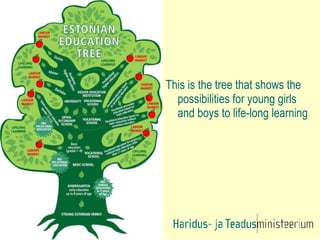
This is the tree that shows the possibilities for young girls and boys to life-long learning
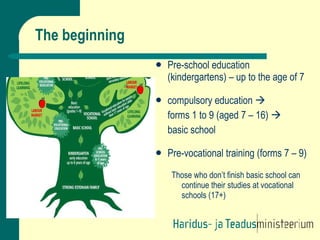
The beginning Pre-school education (kindergartens) – up to the age of 7 compulsory education   forms 1 to 9 (aged 7 – 16)     basic school Pre-vocational training (forms 7 – 9) Those who don’t finish basic school can continue their studies at vocational schools (17+)
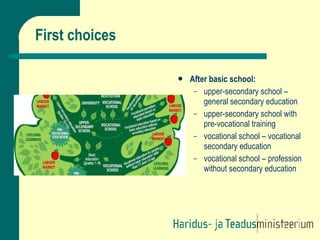
First choices After basic school:  upper-secondary school – general secondary education upper-secondary school with pre-vocational training vocational school – vocational secondary education vocational school – profession without secondary education
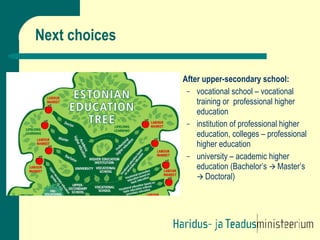
Next choices After upper-secondary school: vocational school – vocational training or  professional higher education institution of professional higher education, colleges – professional higher education university – academic higher education (Bachelor’s     Master’s     Doctoral)
Vocational training When you’ve dropped out of basic school and older than 17 area of specialisation without the next level of education 2 years When you have basic school education areas of specialisation without the next level of education 2 years areas of specialisation with secondary education 3 - 3,5 years, no need to pass state exams  Possibility for extra year in order to study for state exams When you have general secondary education areas of specialisation    professional skills 1 - 2,5 years
Higher education When you have secondary education, you can  Professional higher education (institution of higher education, college, vocational school) 3 - 4,5 years, practical training at least 30% of study period Diploma of professional higher education Bachelor’s level (university) 3 years Bachelor’s Degree Doctor, dentist, pharmacist, vet, architect and engineering training and primary school teacher (university) 5 - 6 years Master’s Degree After Bachelor’s level comes Master’s Level 2 years After Master’s level comes Doctorate level 3 - 4 years
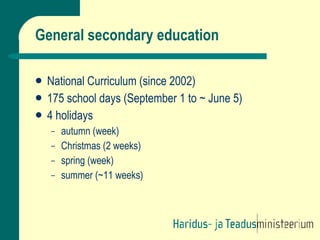
General secondary education National Curriculum (since 2002)  175 school days (September 1 to ~ June 5) 4 holidays autumn (week) Christmas (2 weeks) spring (week) summer (~11 weeks)
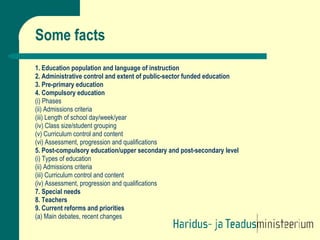
Some facts 1. Education population and language of instruction 2. Administrative control and extent of public-sector funded education 3. Pre-primary education 4. Compulsory education (i) Phases (ii) Admissions criteria (iii) Length of school day/week/year (iv) Class size/student grouping (v) Curriculum control and content (vi) Assessment, progression and qualifications 5. Post-compulsory education/upper secondary and post-secondary level (i) Types of education (ii) Admissions criteria (iii) Curriculum control and content (iv) Assessment, progression and qualifications 7. Special needs 8. Teachers 9. Current reforms and priorities (a) Main debates, recent changes

Education in Estonia

  • 1.
  • 2.
    This is thetree that shows the possibilities for young girls and boys to life-long learning
  • 3.
    The beginning Pre-schooleducation (kindergartens) – up to the age of 7 compulsory education  forms 1 to 9 (aged 7 – 16)  basic school Pre-vocational training (forms 7 – 9) Those who don’t finish basic school can continue their studies at vocational schools (17+)
  • 4.
    First choices Afterbasic school: upper-secondary school – general secondary education upper-secondary school with pre-vocational training vocational school – vocational secondary education vocational school – profession without secondary education
  • 5.
    Next choices Afterupper-secondary school: vocational school – vocational training or professional higher education institution of professional higher education, colleges – professional higher education university – academic higher education (Bachelor’s  Master’s  Doctoral)
  • 6.
    Vocational training Whenyou’ve dropped out of basic school and older than 17 area of specialisation without the next level of education 2 years When you have basic school education areas of specialisation without the next level of education 2 years areas of specialisation with secondary education 3 - 3,5 years, no need to pass state exams Possibility for extra year in order to study for state exams When you have general secondary education areas of specialisation  professional skills 1 - 2,5 years
  • 7.
    Higher education Whenyou have secondary education, you can Professional higher education (institution of higher education, college, vocational school) 3 - 4,5 years, practical training at least 30% of study period Diploma of professional higher education Bachelor’s level (university) 3 years Bachelor’s Degree Doctor, dentist, pharmacist, vet, architect and engineering training and primary school teacher (university) 5 - 6 years Master’s Degree After Bachelor’s level comes Master’s Level 2 years After Master’s level comes Doctorate level 3 - 4 years
  • 8.
    General secondary educationNational Curriculum (since 2002) 175 school days (September 1 to ~ June 5) 4 holidays autumn (week) Christmas (2 weeks) spring (week) summer (~11 weeks)
  • 9.
    Some facts 1.Education population and language of instruction 2. Administrative control and extent of public-sector funded education 3. Pre-primary education 4. Compulsory education (i) Phases (ii) Admissions criteria (iii) Length of school day/week/year (iv) Class size/student grouping (v) Curriculum control and content (vi) Assessment, progression and qualifications 5. Post-compulsory education/upper secondary and post-secondary level (i) Types of education (ii) Admissions criteria (iii) Curriculum control and content (iv) Assessment, progression and qualifications 7. Special needs 8. Teachers 9. Current reforms and priorities (a) Main debates, recent changes