+
Utilizing Rubrics in Audio
/Visual Production
Next Step Plans
Corey Jermaine Anderson
EDGR – 601 | Educational Research
Concordia University – Portland Oregon
+
Research Question
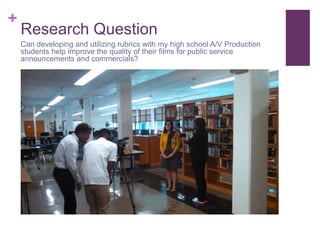
Can developing and utilizing rubrics with my high school A/V Production
students help improve the quality of their films for public service
announcements and commercials?
+
Overview of Research
 The majority of the research suggests positive outcomes for students and instructors when rubrics are included as a
means of authentic assessment (Jonsson, 2014; Diller and Phelps, 2008.) In Rubrics as a Way of Providing
Transparency in Assessment, Jonsson (2014) researched three different assessment situations in professional
education.
 Although, there is significant evidence that rubrics may enhance the academic experience by providing some
transparency to students in regards to grading and expectations, all researchers don’t agree. Common Structural
Design Features of Rubrics May Represent a threat to Validity, focuses on the research of Mark Humphry and
Sandra Heldsinger (2008).
 Typically, students claim that using rubrics helps them to focus their efforts, produce work of higher quality, earn
better grades and feel less anxious about assignments (Jonsson, 2014).
 It takes time for the raters to truly understand the rubrics in a consistent way; therefore normalizing activities are
needed to bring consistency to the process (Diller & Phelps, 2008). Another drawback is the utilization of a
common language between instructors (raters) and students (those being rated). Although one part of the
explanation for student’s lack of understanding could be attributed to illegible writing, which seems to be a common
problem, the real challenge lies in teachers’ use of academic terminology or technical jargon (Jonsson, 2014).
 Research found that structural alignment could create a degree of unintended conceptual overlap and redundancy
in descriptions and gradations for some pairs of criteria (Humphry & Heldsinger, 2014).
 Having students generate the criteria for assessing the performance can serve several purposes (Wolf & Stevens,
2007). In addition to gaining a deeper understanding of what is being taught, Wolf and Stevens (2007) found when
you involve students in the development of the rubrics criteria prior to an assignment or project it can help them
make more informed choices, offer insights into the quality of their performance.
+
Big Idea #1
Pros and Cons of Rubrics
 When considering whether
rubrics can improve the quality of
student work, it is important to
become familiar with the benefits
and drawbacks of this type of
assessment. Researchers Diller
and Phelps (2008) suggest
reliable evaluation of student
work and reflection can be
accomplished through the use of
an assessment rubric.
Furthermore, rubrics are effective
for authentic assessment,
because they make it easy for
educators to close the feedback
loop into the learning
environment (Diller & Phelps,
2008).
 The benefits of utilizing rubrics
do not come without
consequences or drawbacks.
There must be a commitment of
time for proper training and
developing a clear
understanding of the meanings
of each criterion. It takes time
for the raters to truly
understand the rubrics in a
consistent way; therefore
normalizing activities are
needed to bring consistency to
the process (Diller & Phelps,
2008).
+
Big Idea #2
Criteria Selection and Gradations
of Quality for Rubrics
 Humphry and Heldsinger’s (2014)
research found that typically,
there is no underlying
developmental or learning theory
that justifies having precisely the
same number of qualitatively
distinguishable stages across
multiple aspects of a construct.
This makes it unlikely that the
gradations of quality faithfully
capture that which is observed in
student performances for each
criterion separately from other
criteria (Humphry & Heldsinger,
2014).
 Kenneth Wolf and Ellen
Stevens (2007) suggest since
there may be one or two criteria
that are valued more than the
others and they could be given
a higher value when calculating
the overall score for the
performance or product.
+
Big Idea #3
Best Practices for Implementing
Rubrics in the Classroom
 Jonsson (2014) cites research
that implies that, in order to
educate and improve student’s
performance; all tasks, criteria
and standards must be
transparent to both students
and teachers. Learning is a
partnership and using rubrics
and structured collaboration
imposes accountability on the
system (Benjamin, 2011).
 Training students how to use
rubrics will increase
transparency and effectiveness
of usage (Diller & Phelps, 2008;
Jonsson, 2014). It takes time
for the raters to truly
understand the rubrics in a
consistent way; therefore, more
normalizing activities are
needed to bring consistency to
the process (Diller & Phelps,
2008).
+
Next Steps: Plan of Attack
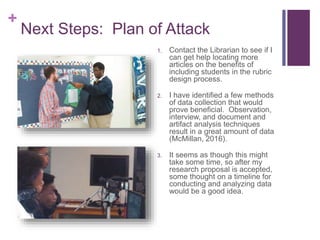
1. Contact the Librarian to see if I
can get help locating more
articles on the benefits of
including students in the rubric
design process.
2. I have identified a few methods
of data collection that would
prove beneficial. Observation,
interview, and document and
artifact analysis techniques
result in a great amount of data
(McMillan, 2016).
3. It seems as though this might
take some time, so after my
research proposal is accepted,
some thought on a timeline for
conducting and analyzing data
would be a good idea.
+
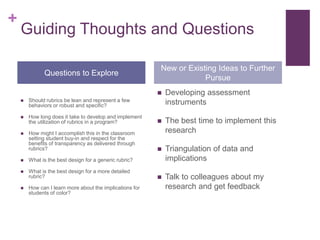
Guiding Thoughts and Questions
 Should rubrics be lean and represent a few
behaviors or robust and specific?
 How long does it take to develop and implement
the utilization of rubrics in a program?
 How might I accomplish this in the classroom
setting student buy-in and respect for the
benefits of transparency as delivered through
rubrics?
 What is the best design for a generic rubric?
 What is the best design for a more detailed
rubric?
 How can I learn more about the implications for
students of color?
 Developing assessment
instruments
 The best time to implement this
research
 Triangulation of data and
implications
 Talk to colleagues about my
research and get feedback
Questions to Explore
New or Existing Ideas to Further
Pursue
+
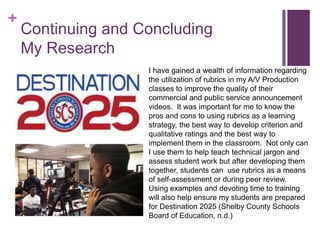
Continuing and Concluding
My Research
I have gained a wealth of information regarding
the utilization of rubrics in my A/V Production
classes to improve the quality of their
commercial and public service announcement
videos. It was important for me to know the
pros and cons to using rubrics as a learning
strategy, the best way to develop criterion and
qualitative ratings and the best way to
implement them in the classroom. Not only can
I use them to help teach technical jargon and
assess student work but after developing them
together, students can use rubrics as a means
of self-assessment or during peer review.
Using examples and devoting time to training
will also help ensure my students are prepared
for Destination 2025 (Shelby County Schools
Board of Education, n.d.)
+
References
 Benjamin, S. (2011). Simple leadership techniques: Rubrics, Checklists, and structured
collaboration. Phi Delta Kappan, 92(8), 25–31. doi:10.1177/003172171109200806
 Diller, K. R., & Phelps, S. F. (2008). Learning outcomes, portfolios, and Rubrics, oh my!
Authentic assessment of an information literacy program. Portal: Libraries and the
Academy, 8(1), 75–89. doi:10.1353/pla.2008.0000
 Humphry, S. M., & Heldsinger, S. A. (2014). Common structural design features of Rubrics
may represent a threat to validity. Educational Researcher, 43(5), 253–263.
doi:10.3102/0013189x14542154
 Jonsson, A. (2014). Rubrics as a way of providing transparency in
assessment. Assessment & Evaluation in Higher Education, 39(7), 840–852.
doi:10.1080/02602938.2013.875117
 McMillan, J. (2016). Fundamentals of educational research (7th ed.). VitalSource
Bookshelf Online: Retrieved from
https://mbsdirect.vitalsource.com/#/books/9780133580747/.
 Shelby County Schools Board of Education. Destination 2025. Retrieved March 26, 2016,
from http://www.scsk12.org/uf/webadmin/foundation/2025/
 Wolf, K., & Stevens, E. (2007). The role of rubrics in advancing and assessing student
learning. The Journal of Effective Teaching, 7(1), 3–14. Retrieved from
http://www.uncw.edu/cte/et/articles/vol7_1/wolf.pdf

Utilizing Rubrics in Audio/Visual Production

  • 1.
    + Utilizing Rubrics inAudio /Visual Production Next Step Plans Corey Jermaine Anderson EDGR – 601 | Educational Research Concordia University – Portland Oregon
  • 2.
    + Research Question Can developingand utilizing rubrics with my high school A/V Production students help improve the quality of their films for public service announcements and commercials?
  • 3.
    + Overview of Research The majority of the research suggests positive outcomes for students and instructors when rubrics are included as a means of authentic assessment (Jonsson, 2014; Diller and Phelps, 2008.) In Rubrics as a Way of Providing Transparency in Assessment, Jonsson (2014) researched three different assessment situations in professional education.  Although, there is significant evidence that rubrics may enhance the academic experience by providing some transparency to students in regards to grading and expectations, all researchers don’t agree. Common Structural Design Features of Rubrics May Represent a threat to Validity, focuses on the research of Mark Humphry and Sandra Heldsinger (2008).  Typically, students claim that using rubrics helps them to focus their efforts, produce work of higher quality, earn better grades and feel less anxious about assignments (Jonsson, 2014).  It takes time for the raters to truly understand the rubrics in a consistent way; therefore normalizing activities are needed to bring consistency to the process (Diller & Phelps, 2008). Another drawback is the utilization of a common language between instructors (raters) and students (those being rated). Although one part of the explanation for student’s lack of understanding could be attributed to illegible writing, which seems to be a common problem, the real challenge lies in teachers’ use of academic terminology or technical jargon (Jonsson, 2014).  Research found that structural alignment could create a degree of unintended conceptual overlap and redundancy in descriptions and gradations for some pairs of criteria (Humphry & Heldsinger, 2014).  Having students generate the criteria for assessing the performance can serve several purposes (Wolf & Stevens, 2007). In addition to gaining a deeper understanding of what is being taught, Wolf and Stevens (2007) found when you involve students in the development of the rubrics criteria prior to an assignment or project it can help them make more informed choices, offer insights into the quality of their performance.
  • 4.
    + Big Idea #1 Prosand Cons of Rubrics  When considering whether rubrics can improve the quality of student work, it is important to become familiar with the benefits and drawbacks of this type of assessment. Researchers Diller and Phelps (2008) suggest reliable evaluation of student work and reflection can be accomplished through the use of an assessment rubric. Furthermore, rubrics are effective for authentic assessment, because they make it easy for educators to close the feedback loop into the learning environment (Diller & Phelps, 2008).  The benefits of utilizing rubrics do not come without consequences or drawbacks. There must be a commitment of time for proper training and developing a clear understanding of the meanings of each criterion. It takes time for the raters to truly understand the rubrics in a consistent way; therefore normalizing activities are needed to bring consistency to the process (Diller & Phelps, 2008).
  • 5.
    + Big Idea #2 CriteriaSelection and Gradations of Quality for Rubrics  Humphry and Heldsinger’s (2014) research found that typically, there is no underlying developmental or learning theory that justifies having precisely the same number of qualitatively distinguishable stages across multiple aspects of a construct. This makes it unlikely that the gradations of quality faithfully capture that which is observed in student performances for each criterion separately from other criteria (Humphry & Heldsinger, 2014).  Kenneth Wolf and Ellen Stevens (2007) suggest since there may be one or two criteria that are valued more than the others and they could be given a higher value when calculating the overall score for the performance or product.
  • 6.
    + Big Idea #3 BestPractices for Implementing Rubrics in the Classroom  Jonsson (2014) cites research that implies that, in order to educate and improve student’s performance; all tasks, criteria and standards must be transparent to both students and teachers. Learning is a partnership and using rubrics and structured collaboration imposes accountability on the system (Benjamin, 2011).  Training students how to use rubrics will increase transparency and effectiveness of usage (Diller & Phelps, 2008; Jonsson, 2014). It takes time for the raters to truly understand the rubrics in a consistent way; therefore, more normalizing activities are needed to bring consistency to the process (Diller & Phelps, 2008).
  • 7.
    + Next Steps: Planof Attack 1. Contact the Librarian to see if I can get help locating more articles on the benefits of including students in the rubric design process. 2. I have identified a few methods of data collection that would prove beneficial. Observation, interview, and document and artifact analysis techniques result in a great amount of data (McMillan, 2016). 3. It seems as though this might take some time, so after my research proposal is accepted, some thought on a timeline for conducting and analyzing data would be a good idea.
  • 8.
    + Guiding Thoughts andQuestions  Should rubrics be lean and represent a few behaviors or robust and specific?  How long does it take to develop and implement the utilization of rubrics in a program?  How might I accomplish this in the classroom setting student buy-in and respect for the benefits of transparency as delivered through rubrics?  What is the best design for a generic rubric?  What is the best design for a more detailed rubric?  How can I learn more about the implications for students of color?  Developing assessment instruments  The best time to implement this research  Triangulation of data and implications  Talk to colleagues about my research and get feedback Questions to Explore New or Existing Ideas to Further Pursue
  • 9.
    + Continuing and Concluding MyResearch I have gained a wealth of information regarding the utilization of rubrics in my A/V Production classes to improve the quality of their commercial and public service announcement videos. It was important for me to know the pros and cons to using rubrics as a learning strategy, the best way to develop criterion and qualitative ratings and the best way to implement them in the classroom. Not only can I use them to help teach technical jargon and assess student work but after developing them together, students can use rubrics as a means of self-assessment or during peer review. Using examples and devoting time to training will also help ensure my students are prepared for Destination 2025 (Shelby County Schools Board of Education, n.d.)
  • 10.
    + References  Benjamin, S.(2011). Simple leadership techniques: Rubrics, Checklists, and structured collaboration. Phi Delta Kappan, 92(8), 25–31. doi:10.1177/003172171109200806  Diller, K. R., & Phelps, S. F. (2008). Learning outcomes, portfolios, and Rubrics, oh my! Authentic assessment of an information literacy program. Portal: Libraries and the Academy, 8(1), 75–89. doi:10.1353/pla.2008.0000  Humphry, S. M., & Heldsinger, S. A. (2014). Common structural design features of Rubrics may represent a threat to validity. Educational Researcher, 43(5), 253–263. doi:10.3102/0013189x14542154  Jonsson, A. (2014). Rubrics as a way of providing transparency in assessment. Assessment & Evaluation in Higher Education, 39(7), 840–852. doi:10.1080/02602938.2013.875117  McMillan, J. (2016). Fundamentals of educational research (7th ed.). VitalSource Bookshelf Online: Retrieved from https://mbsdirect.vitalsource.com/#/books/9780133580747/.  Shelby County Schools Board of Education. Destination 2025. Retrieved March 26, 2016, from http://www.scsk12.org/uf/webadmin/foundation/2025/  Wolf, K., & Stevens, E. (2007). The role of rubrics in advancing and assessing student learning. The Journal of Effective Teaching, 7(1), 3–14. Retrieved from http://www.uncw.edu/cte/et/articles/vol7_1/wolf.pdf