Planning & Designing
  Flexible Learning
       Mazlan Hasan
Mazlan Who?
Learner Support Issues


                     ?
Learner Support Issues
Attrition
 Common causes...

 Satisfaction and dissatisfaction among eLearners

 Strategies to decrease attrition and improve satisfaction
Why Online Learners Drop Out
 Students don't have enough time

 Lack of management oversight

 Lack of motivation

 Problems with technology

 Lack of student support

 Individual learning preferences

 Poorly designed course

 Substandard/inexperienced instructors...
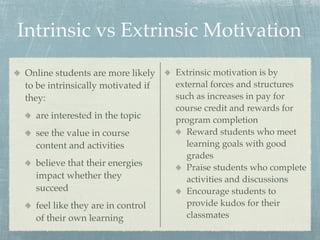
Intrinsic vs Extrinsic Motivation
Online students are more likely    Extrinsic motivation is by
to be intrinsically motivated if   external forces and structures
they:                              such as increases in pay for
                                   course credit and rewards for
  are interested in the topic      program completion
  see the value in course             Reward students who meet
  content and activities              learning goals with good
                                      grades
  believe that their energies         Praise students who complete
  impact whether they                 activities and discussions
  succeed                             Encourage students to
  feel like they are in control       provide kudos for their
  of their own learning               classmates
Motivate through Ongoing
Encouragement
  Establish ongoing communication with your class. How?
  Make course materials relevant to their lives.
  Use humor and light-hearted approaches to increase
  comfort
  Remind students they're saving time by not traveling to a
  face-to-face class
  Ask students to enjoy the freedom of online courses
  Provide reminders about the schedule and praise students
  for staying on schedule
  Encourage students to establish a personal reward system
Motivate through Course
Clarity
  Clearly state course requirements with emphasis on learner
  control over success
  Provide clear assignments and assessments
  Provide specific, quick, feedback, encouragement, and
  grading
  Identify specific due dates. Some students need to structure
  of due dates motivating.
  Be flexible enough to accommodate emergencies and
  specific problems
  Provide learner support through scaffolding assignments
  Encourage student questioning and sharing of concerns
Motivate through Meaningful
Materials
 Place emphasis on activities that will meet course goals and
 aren't perceived as "busy work"

 Provide varied real-world examples

 Use authentic examples, timely resources, and real-world
 data that promote interest and practicality

 Provide multiple channels of communication (i.e., text,
 graphics, audio, video) so learners have choice in learning

 Personalize activities and build in flexibility to meet
 individual needs
Motivate through Learner
Engagement
 Appeal to student life experiences

 Apply course content to real-world situations

 Provide students with choices in terms of topics

 Allow students varied ways to share their understandings
 (i.e., text, visual, audio)

 Require ongoing participation through the course

 Incorporate interactive features that involve learners in
 practice, reflective thinking, and problem-solving.
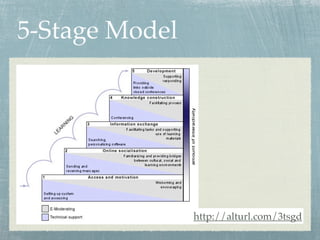
5-Stage Model


                http://alturl.com/3tsgd
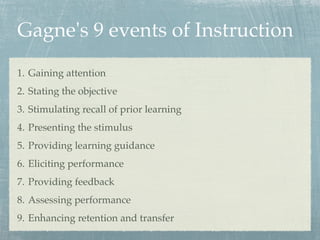
Gagne's 9 events of Instruction
1. Gaining attention
2. Stating the objective
3. Stimulating recall of prior learning
4. Presenting the stimulus
5. Providing learning guidance
6. Eliciting performance
7. Providing feedback
8. Assessing performance
9. Enhancing retention and transfer
Gaining attention

In order for any learning to take place, you must first capture
the attention of the student. A multimedia program that
begins with an animated title screen sequence accompanied
by sound effects or music startles the senses with auditory or
visual stimuli. An even better way to capture students'
attention is to start each lesson with a thought-provoking
question or interesting fact. Curiosity motivates students to
learn.
Inform learners of objectives

 Early in each lesson students should encounter a list of
 learning objectives. This initiates the internal process of
 expectancy and helps motivate the learner to complete the
 lesson. These objectives should form the basis for assessment
 and possible certification as well. Typically, learning
 objectives are presented in the form of "Upon completing this
 lesson you will be able to. . . ." The phrasing of the objectives
 themselves will be covered under Robert Mager's
 contributions later in this chapter.
Stimulate recall of prior learning


 Associating new information with prior knowledge can
 facilitate the learning process. It is easier for learners to
 encode and store information in long-term memory when
 there are links to personal experience and knowledge. A
 simple way to stimulate recall is to ask questions about
 previous experiences, an understanding of previous concepts,
 or a body of content.
Present the content

This event of instruction is where the new content is actually
presented to the learner. Content should be chunked and
organized meaningfully, and typically is explained and then
demonstrated. To appeal to different learning modalities, a
variety of media should be used if possible, including text,
graphics, audio narration, and video.
Provide "learning guidance"


 To help learners encode information for long-term storage,
 additional guidance should be provided along with the
 presentation of new content. Guidance strategies include the
 use of examples, non-examples, case studies, graphical
 representations, mnemonics, and analogies.
Elicit performance


In this event of instruction, the learner is required to practice
the new skill or behavior. Eliciting performance provides an
opportunity for learners to confirm their correct
understanding, and the repetition further increases the
likelihood of retention.
Provide feedback

As learners practice new behavior it is important to provide
specific and immediate feedback of their performance. Unlike
questions in a post-test, exercises within tutorials should be
used for comprehension and encoding purposes, not for
formal scoring. Additional guidance and answers provided at
this stage are called formative feedback.
Assess performance

Upon completing instructional modules, students should be
given the opportunity to take (or be required to take) a post-
test or final assessment. This assessment should be completed
without the ability to receive additional coaching, feedback,
or hints. Mastery of material, or certification, is typically
granted after achieving a certain score or percent correct. A
commonly accepted level of mastery is 80% to 90% correct.
Enhance retention and transfer

 Determining whether or not the skills learned from a training
 program are ever applied back on the job often remains a mystery
 to training managers

 Effective training programs have a "performance" focus,
 incorporating design and media that facilitate retention and
 transfer to the job. The repetition of learned concepts is a tried
 and true means of aiding retention, although often disliked by
 students. (There was a reason for writing spelling words ten times
 as grade school student.)

 Creating electronic or online job-aids, references, templates, and
 wizards are other ways of aiding performance.
Pedagogy & Technology


How can you map Gagne's Nine Events of Instruction with
The 5-Stage Model?
Thank you!
 mazlan.h@nie.edu.sg

Flexible Learning & Technologies

  • 1.
    Planning & Designing Flexible Learning Mazlan Hasan
  • 2.
  • 3.
  • 4.
  • 5.
    Attrition Common causes... Satisfaction and dissatisfaction among eLearners Strategies to decrease attrition and improve satisfaction
  • 6.
    Why Online LearnersDrop Out Students don't have enough time Lack of management oversight Lack of motivation Problems with technology Lack of student support Individual learning preferences Poorly designed course Substandard/inexperienced instructors...
  • 7.
    Intrinsic vs ExtrinsicMotivation Online students are more likely Extrinsic motivation is by to be intrinsically motivated if external forces and structures they: such as increases in pay for course credit and rewards for are interested in the topic program completion see the value in course Reward students who meet content and activities learning goals with good grades believe that their energies Praise students who complete impact whether they activities and discussions succeed Encourage students to feel like they are in control provide kudos for their of their own learning classmates
  • 8.
    Motivate through Ongoing Encouragement Establish ongoing communication with your class. How? Make course materials relevant to their lives. Use humor and light-hearted approaches to increase comfort Remind students they're saving time by not traveling to a face-to-face class Ask students to enjoy the freedom of online courses Provide reminders about the schedule and praise students for staying on schedule Encourage students to establish a personal reward system
  • 9.
    Motivate through Course Clarity Clearly state course requirements with emphasis on learner control over success Provide clear assignments and assessments Provide specific, quick, feedback, encouragement, and grading Identify specific due dates. Some students need to structure of due dates motivating. Be flexible enough to accommodate emergencies and specific problems Provide learner support through scaffolding assignments Encourage student questioning and sharing of concerns
  • 10.
    Motivate through Meaningful Materials Place emphasis on activities that will meet course goals and aren't perceived as "busy work" Provide varied real-world examples Use authentic examples, timely resources, and real-world data that promote interest and practicality Provide multiple channels of communication (i.e., text, graphics, audio, video) so learners have choice in learning Personalize activities and build in flexibility to meet individual needs
  • 11.
    Motivate through Learner Engagement Appeal to student life experiences Apply course content to real-world situations Provide students with choices in terms of topics Allow students varied ways to share their understandings (i.e., text, visual, audio) Require ongoing participation through the course Incorporate interactive features that involve learners in practice, reflective thinking, and problem-solving.
  • 12.
    5-Stage Model http://alturl.com/3tsgd
  • 13.
    Gagne's 9 eventsof Instruction 1. Gaining attention 2. Stating the objective 3. Stimulating recall of prior learning 4. Presenting the stimulus 5. Providing learning guidance 6. Eliciting performance 7. Providing feedback 8. Assessing performance 9. Enhancing retention and transfer
  • 14.
    Gaining attention In orderfor any learning to take place, you must first capture the attention of the student. A multimedia program that begins with an animated title screen sequence accompanied by sound effects or music startles the senses with auditory or visual stimuli. An even better way to capture students' attention is to start each lesson with a thought-provoking question or interesting fact. Curiosity motivates students to learn.
  • 15.
    Inform learners ofobjectives Early in each lesson students should encounter a list of learning objectives. This initiates the internal process of expectancy and helps motivate the learner to complete the lesson. These objectives should form the basis for assessment and possible certification as well. Typically, learning objectives are presented in the form of "Upon completing this lesson you will be able to. . . ." The phrasing of the objectives themselves will be covered under Robert Mager's contributions later in this chapter.
  • 16.
    Stimulate recall ofprior learning Associating new information with prior knowledge can facilitate the learning process. It is easier for learners to encode and store information in long-term memory when there are links to personal experience and knowledge. A simple way to stimulate recall is to ask questions about previous experiences, an understanding of previous concepts, or a body of content.
  • 17.
    Present the content Thisevent of instruction is where the new content is actually presented to the learner. Content should be chunked and organized meaningfully, and typically is explained and then demonstrated. To appeal to different learning modalities, a variety of media should be used if possible, including text, graphics, audio narration, and video.
  • 18.
    Provide "learning guidance" To help learners encode information for long-term storage, additional guidance should be provided along with the presentation of new content. Guidance strategies include the use of examples, non-examples, case studies, graphical representations, mnemonics, and analogies.
  • 19.
    Elicit performance In thisevent of instruction, the learner is required to practice the new skill or behavior. Eliciting performance provides an opportunity for learners to confirm their correct understanding, and the repetition further increases the likelihood of retention.
  • 20.
    Provide feedback As learnerspractice new behavior it is important to provide specific and immediate feedback of their performance. Unlike questions in a post-test, exercises within tutorials should be used for comprehension and encoding purposes, not for formal scoring. Additional guidance and answers provided at this stage are called formative feedback.
  • 21.
    Assess performance Upon completinginstructional modules, students should be given the opportunity to take (or be required to take) a post- test or final assessment. This assessment should be completed without the ability to receive additional coaching, feedback, or hints. Mastery of material, or certification, is typically granted after achieving a certain score or percent correct. A commonly accepted level of mastery is 80% to 90% correct.
  • 22.
    Enhance retention andtransfer Determining whether or not the skills learned from a training program are ever applied back on the job often remains a mystery to training managers Effective training programs have a "performance" focus, incorporating design and media that facilitate retention and transfer to the job. The repetition of learned concepts is a tried and true means of aiding retention, although often disliked by students. (There was a reason for writing spelling words ten times as grade school student.) Creating electronic or online job-aids, references, templates, and wizards are other ways of aiding performance.
  • 23.
    Pedagogy & Technology Howcan you map Gagne's Nine Events of Instruction with The 5-Stage Model?
  • 24.