EDL
European Day of Languages
EU INTERPRETATION
Andrés Sanz Álvarez (English Dpt) IESVELÁZQUEZ (Sevilla) September , 26th. 2019
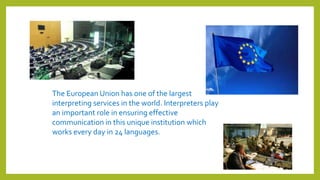
The European Union has one of the largest
interpreting services in the world. Interpreters play
an important role in ensuring effective
communication in this unique institution which
works every day in 24 languages.
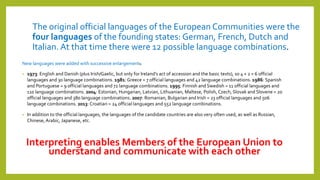
The original official languages of the European Communities were the
four languages of the founding states: German, French, Dutch and
Italian. At that time there were 12 possible language combinations.
New languages were added with successive enlargements:
• 1973: English and Danish (plus Irish/Gaelic, but only for Ireland's act of accession and the basic texts), so 4 + 2 = 6 official
languages and 30 language combinations. 1981: Greece = 7 official languages and 42 language combinations. 1986: Spanish
and Portuguese = 9 official languages and 72 language combinations. 1995: Finnish and Swedish = 11 official languages and
110 language combinations. 2004: Estonian, Hungarian, Latvian, Lithuanian, Maltese, Polish, Czech, Slovak and Slovene = 20
official languages and 380 language combinations. 2007: Romanian, Bulgarian and Irish = 23 official languages and 506
language combinations. 2013: Croatian = 24 official languages and 552 language combinations.
• In addition to the official languages, the languages of the candidate countries are also very often used, as well as Russian,
Chinese, Arabic, Japanese, etc.
Interpreting enables Members of the European Union to
understand and communicate with each other
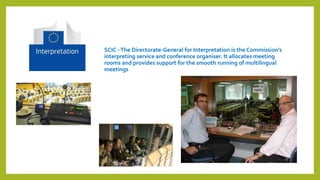
SCIC -The Directorate-General for Interpretation is the Commission’s
interpreting service and conference organiser. It allocates meeting
rooms and provides support for the smooth running of multilingual
meetings
An interpreter's language combination is made up of all their
passive and active languages.
• Active language: target language (the language the Members hear);
• Passive language: source language (the language the Members speak);
• Relay: indirect interpreting into the lesser used languages;
• Retour: also used for the lesser-used languages, where interpreters work
both into and out of their active language.
• An interpreter's language combination is made up of all their passive and
active languages.
Profile of an interpreter
• Understanding of passive languages. Interpreters are professionals who must have
a perfect understanding of the language they are working from (passive language).
• Perfect command of active language.The active language is the interpreter's
working tool, so he or she must have a perfect command of it in order to be able to
express every nuance.
• Broad general knowledge and openness. Interpreters need to constantly update
their knowledge so as to be able to work on a very wide range of subjects.
• Adaptability. Interpreters encounter a variety of different situations and must be
able to interpret all types of discussion.
• They should be able to reproduce in the target language any type of speech,
whatever the subject, context, identity of the participants or location.
International Association of Conference
Interpreters
The InternationalAssociation of Conference
Interpreters is the only global association of
conference interpreters and brings
together over 3,000 professionals from
every continent.
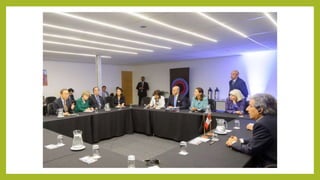
INTERPRETATION PRACTICE WITH ACTUAL PORTABLE EQUIPMENT
WATCH: GretaThunberg's full speech to world leaders at UN Climate Action Summit
https://youtu.be/KAJsdgTPJpU

Edl 1

  • 1.
    EDL European Day ofLanguages EU INTERPRETATION Andrés Sanz Álvarez (English Dpt) IESVELÁZQUEZ (Sevilla) September , 26th. 2019
  • 2.
    The European Unionhas one of the largest interpreting services in the world. Interpreters play an important role in ensuring effective communication in this unique institution which works every day in 24 languages.
  • 3.
    The original officiallanguages of the European Communities were the four languages of the founding states: German, French, Dutch and Italian. At that time there were 12 possible language combinations. New languages were added with successive enlargements: • 1973: English and Danish (plus Irish/Gaelic, but only for Ireland's act of accession and the basic texts), so 4 + 2 = 6 official languages and 30 language combinations. 1981: Greece = 7 official languages and 42 language combinations. 1986: Spanish and Portuguese = 9 official languages and 72 language combinations. 1995: Finnish and Swedish = 11 official languages and 110 language combinations. 2004: Estonian, Hungarian, Latvian, Lithuanian, Maltese, Polish, Czech, Slovak and Slovene = 20 official languages and 380 language combinations. 2007: Romanian, Bulgarian and Irish = 23 official languages and 506 language combinations. 2013: Croatian = 24 official languages and 552 language combinations. • In addition to the official languages, the languages of the candidate countries are also very often used, as well as Russian, Chinese, Arabic, Japanese, etc. Interpreting enables Members of the European Union to understand and communicate with each other
  • 4.
    SCIC -The Directorate-Generalfor Interpretation is the Commission’s interpreting service and conference organiser. It allocates meeting rooms and provides support for the smooth running of multilingual meetings
  • 6.
    An interpreter's languagecombination is made up of all their passive and active languages. • Active language: target language (the language the Members hear); • Passive language: source language (the language the Members speak); • Relay: indirect interpreting into the lesser used languages; • Retour: also used for the lesser-used languages, where interpreters work both into and out of their active language. • An interpreter's language combination is made up of all their passive and active languages.
  • 7.
    Profile of aninterpreter • Understanding of passive languages. Interpreters are professionals who must have a perfect understanding of the language they are working from (passive language). • Perfect command of active language.The active language is the interpreter's working tool, so he or she must have a perfect command of it in order to be able to express every nuance. • Broad general knowledge and openness. Interpreters need to constantly update their knowledge so as to be able to work on a very wide range of subjects. • Adaptability. Interpreters encounter a variety of different situations and must be able to interpret all types of discussion. • They should be able to reproduce in the target language any type of speech, whatever the subject, context, identity of the participants or location.
  • 9.
    International Association ofConference Interpreters The InternationalAssociation of Conference Interpreters is the only global association of conference interpreters and brings together over 3,000 professionals from every continent.
  • 12.
    INTERPRETATION PRACTICE WITHACTUAL PORTABLE EQUIPMENT WATCH: GretaThunberg's full speech to world leaders at UN Climate Action Summit https://youtu.be/KAJsdgTPJpU